PHYSIOLOGY OF PHONATION
Dr. Ashwin Menon
DEFINITION
 Rapid, periodic opening and closing of
the glottis through separation and
apposition of the vocal cords that,
accompanied by breath under lung
pressure, constitutes a source of vocal
sound.
Other functions of Larynx
 Protection of lower airways
 Respiration
 Fixation of Chest wall
Biomechanics of Phonation
 Vocal Folds abduct on inspiration.
 Vocal Folds slightly adduct on
expiration.
 Full abduction in forceful inspiration
 Larynx descends with Inspiration and
Asends with expiration.
 The requirements of normal
phonation are as follows:
 Active respiratory support
 Adequate glottic closure
 Normal mucosal covering of the
vocal cord
 Adequate control of vocal fold
length and tension.
Anatomy:
Physical parts of the vocal system
 Creating sound requires numerous
muscles, bones and organs of the body
 Three main anatomical aspects:
 Actuators: Lungs/diaphragm/intercostal muscles;
these organs deal with breathing/“air
management”
 Vibrator: larynx; this deals with the creation of
pitch in the form of a sound wave
 Resonators: Throat (pharynx), mouth/lips/teeth,
nose; these deal with the modification of sound
into varying accents
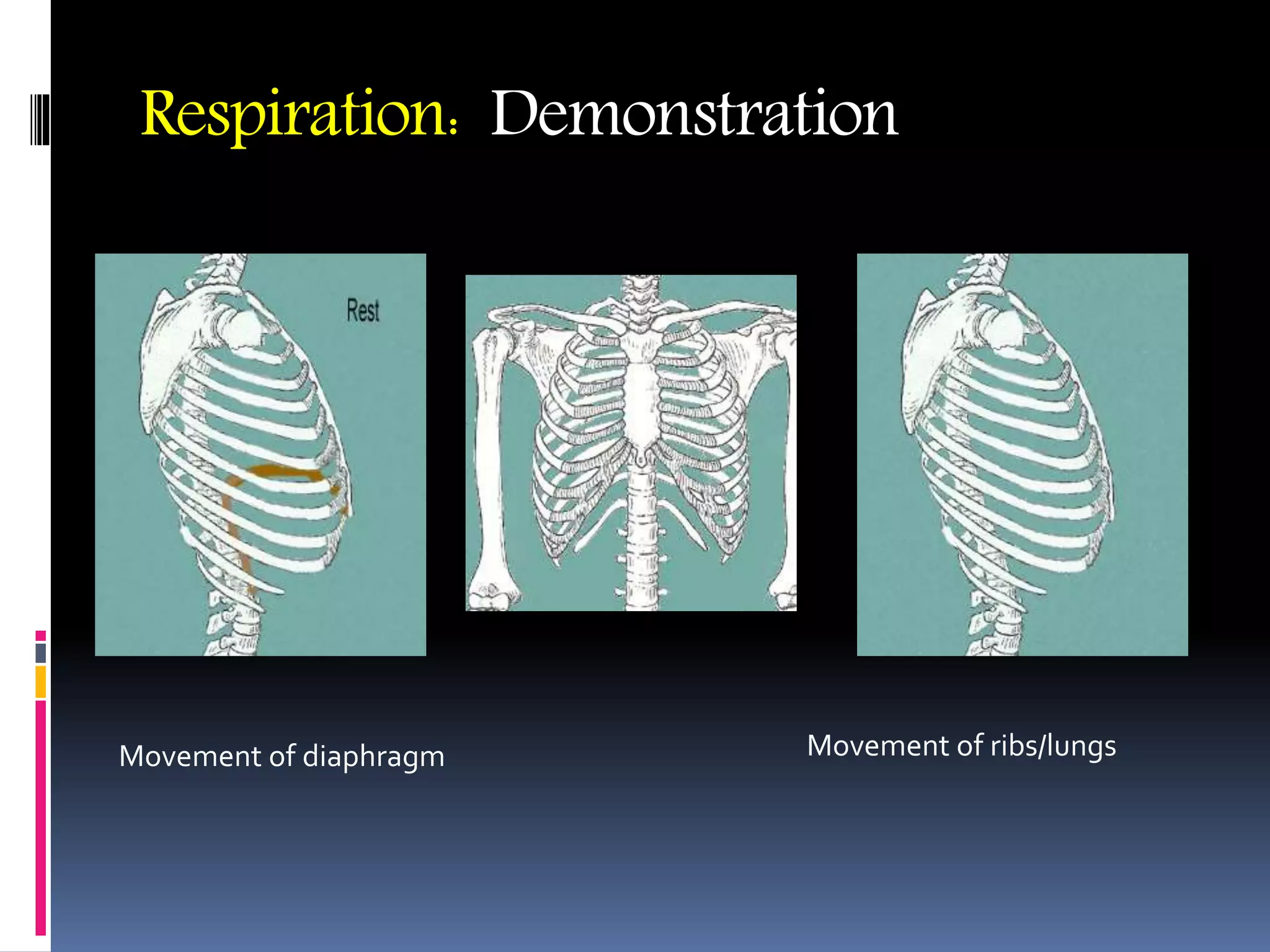
Respiration: Demonstration
Movement of diaphragm Movement of ribs/lungs
Phonation
 The larynx acts as a transducer during
phonation converting the aerodynamic
forces generated by the lungs, diaphragm,
chest and abdominal muscles into acoustic
energy.
 The consonants of speech can be
associated with particular anatomical sites
responsible for their generation i.e. 'p' and
'b' are labials, 't' and 'd' are dentals and 'm'
and 'n' are nasals.
Initiation of Voice
 Before phonation, vocal folds rapidly
abduct to allow intake of air-Pre
Phonatory inspiratory Phase (‘’Wyke’’)
 Vocal folds adducted- Lat cricoarytenoid
M
 Pulmonic air forced between adducted
Vocal Folds – vocal note
 Repeated vibratory movt of the vocal folds
– production of vocal note- Vocal fold
oscillation
 Amount of air pressure required to begin
voicing – Phonation threshold pressure
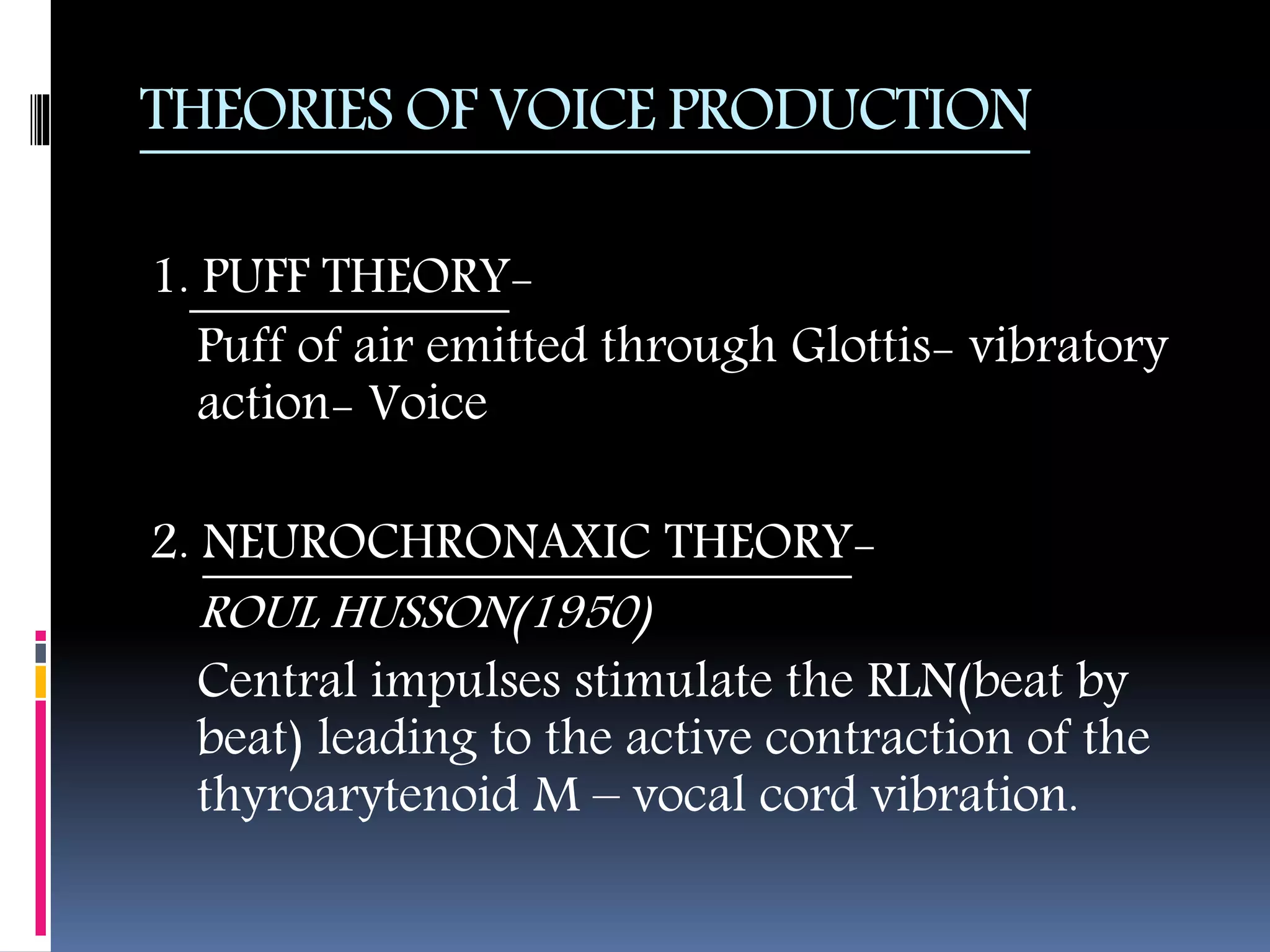
THEORIES OF VOICE PRODUCTION
1. PUFF THEORY-
Puff of air emitted through Glottis- vibratory
action- Voice
2. NEUROCHRONAXIC THEORY-
ROUL HUSSON(1950)
Central impulses stimulate the RLN(beat by
beat) leading to the active contraction of the
thyroarytenoid M – vocal cord vibration.
 This theory was not accepted as-
 Tracheostomy patients cannot phonate.
 Left RLN longer than the right.
3. CAVITY TONE THEORY –
WILLIS
He developed a series of resonating cavities with
different shapes and lengths & coupled them to a
vibrating reed source. He observed that the sound
heard represented a particular vowel & it mainly
depended on the length of the resonating tube
independent of the reed tone and its frequency.
4. HARMONIC THEORY(OVERTONE/STEADY STATE
THEORY)
CHARLES WHEATSTONE
He noticed that the vowels heard were a
combination of the reed tone and its
harmonics. This modulated reed tone can be
further modified at the supra laryngeal level
giving rise to special sounds. But this theory
fails to take into account the dampening
effect.
5. MYO ELASTIC AERODYNAMIC THEORY-
JOHANNES MULLER(1843)
AERO- Air pressure & flow
DYNAMIC- Movt & change
MYO- Muscular movt
ELASTIC- Ability to return to original state
6. COVER BODYTHEORY
7. BODY SOURCE THEORY
8. SOURCE TRANSFER THEORY
VIBRATORY CYCLE
1. ADDUCTION
2. AERODYNAMIC SEPARATION
3. RECOIL
Manifestation of a mucosal wave travelling
from the inferior to the superior surface of
each Vocal Fold.
Mucosal Wave
 Also important component of vocal fold
vibration/ voice production
 Explained by Body-Cover model of vocal fold
vibration
 Diff vibratory properties of vocal fold layers
 Vertical phase difference
Conditions that change density relationships
between cover & body result in decreased mucosal
wave.
The Glottic Cycle
 The vocal folds alternately trap and release
air; each trap/release is one cycle of
vibration. This cycle is often referred to as
the glottic cycle, and it is divided into
phases:
I. opening phase
II. open phase
III. closing phase
IV. closed phase
 During the closed phase, the air pressure
builds up below the vocal folds. When the
glottis opens, the air explodes through the
vocal folds, and that's the beginning of the
sound wave. The strength of that explosion
determines the loudness of the sound
coming directly from the larynx.
 First, the laryngeal muscles position the
vocal cords in various degrees of
adduction and place them under the
appropriate longitudinal tension.
 Next, muscular and passive forces of exhalation
cause the subglottic air pressure to increase.
 When this subglottic pressure reaches a point
where it exceeds muscular opposition, the glottic
chink is forced to open.
 When the vocal cords start opening from
complete closure, they open in a posterior to
anterior direction with the posterior portion of
the glottis opening first, reaching maximum
excursion first, and recontacting each other at
the end of the vibratory cycle prior to the
anterior portion of the cords.
 After release of the puff of air there is a
reduction of sub glottic pressure, and the
vocal cords approximate each other again
(myo elastic forces of the vocal cords have
exceeded the aerodynamic forces).
 The myo elastic forces are enhanced because
air current flowing through a narrow
channel exerts a negative pressure on the
channel walls; This is the basis of Bernoulli's
Principle.
 The vocal cords are thus sucked back together
in an adducted state until the sub glottic air
pressure can overcome the myo elastic forces
of the re approximated cords, and the cycle is
then repeated.
FEATURES OF SOUND:
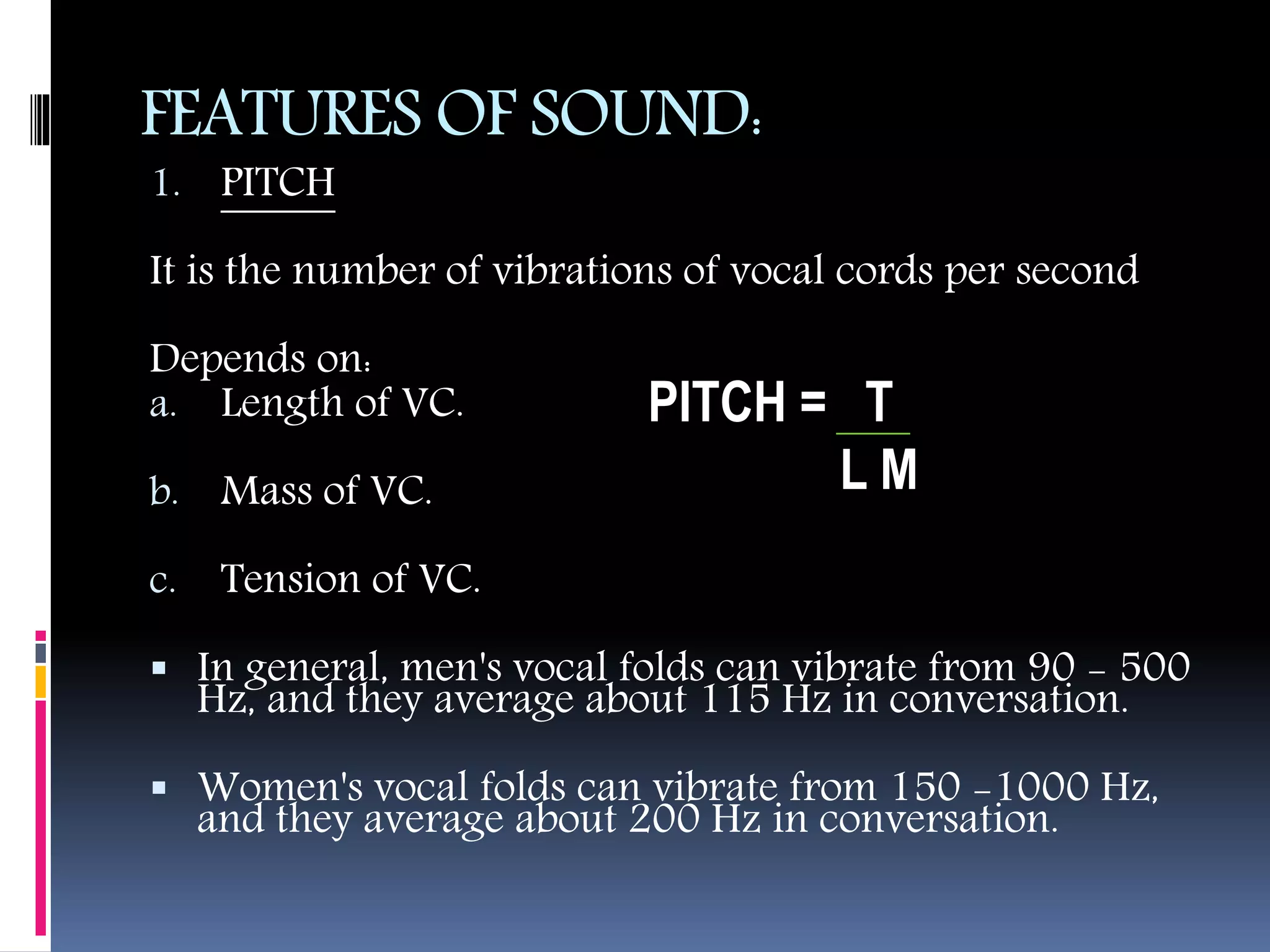
1. PITCH
It is the number of vibrations of vocal cords per second
Depends on:
a. Length of VC.
b. Mass of VC.
c. Tension of VC.
 In general, men's vocal folds can vibrate from 90 - 500
Hz, and they average about 115 Hz in conversation.
 Women's vocal folds can vibrate from 150 -1000 Hz,
and they average about 200 Hz in conversation.
PITCH = T
L M
 Vocal folds vibrate faster as they're pulled
longer, thinner, and more taut and vibrate
more slowly when they're shorter, thicker,
and floppier.
 The cricothyroid muscle and
thyroarytenoid muscle coordinate with
each other to create different pitches.
2. VOLUME(INTENSITY) &
LENGTH(DURATION)
Depends on the air pressure created which is
in turn dependent on the lung capacities.
3. QUALITY(TIMBER)
Depends on the overtones added by the
resonators and articulators.
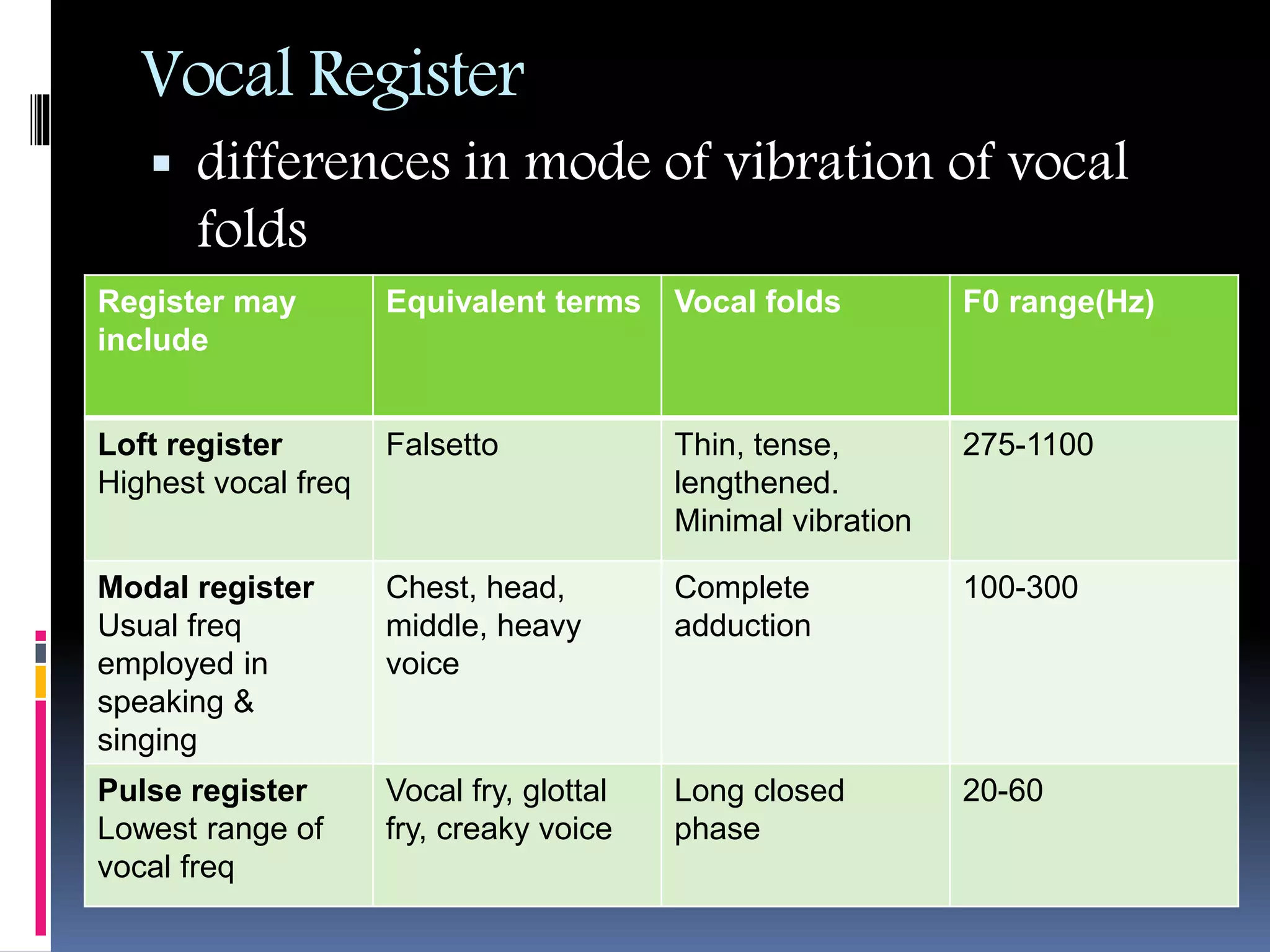
Vocal Register
 differences in mode of vibration of vocal
folds
Register may
include
Equivalent terms Vocal folds F0 range(Hz)
Loft register
Highest vocal freq
Falsetto Thin, tense,
lengthened.
Minimal vibration
275-1100
Modal register
Usual freq
employed in
speaking &
singing
Chest, head,
middle, heavy
voice
Complete
adduction
100-300
Pulse register
Lowest range of
vocal freq
Vocal fry, glottal
fry, creaky voice
Long closed
phase
20-60
Vocal Disorders
 Organic, Functional & Psychogenic.
 Puberphonia- Maintenance of the childhood
pitch despite having passed through puberty
 Spasmodic Dysphonia
 Stuttering
 Phonasthenia
 Bogart-Bacall syndrome
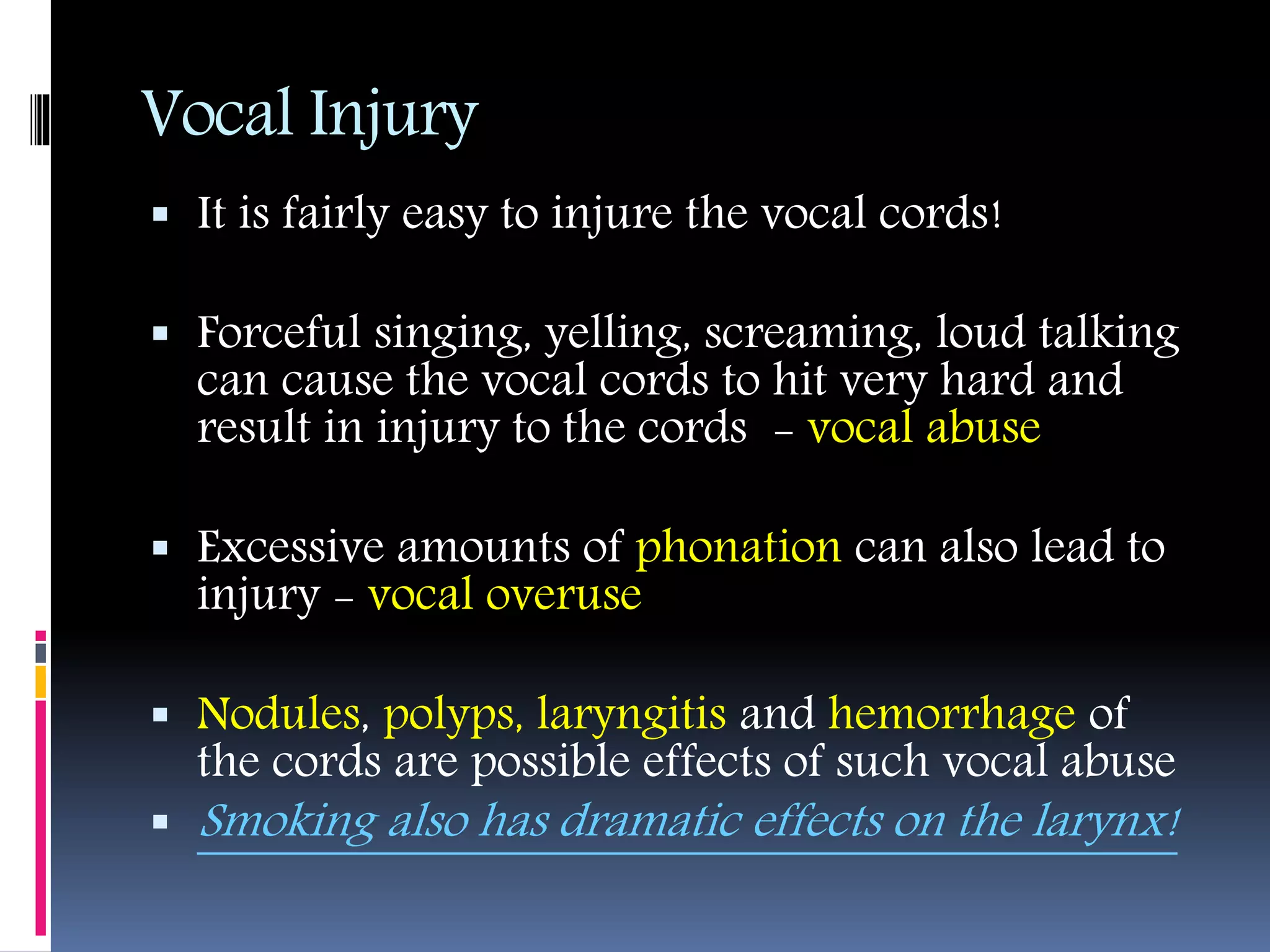
Vocal Injury
 It is fairly easy to injure the vocal cords!
 Forceful singing, yelling, screaming, loud talking
can cause the vocal cords to hit very hard and
result in injury to the cords - vocal abuse
 Excessive amounts of phonation can also lead to
injury - vocal overuse
 Nodules, polyps, laryngitis and hemorrhage of
the cords are possible effects of such vocal abuse
 Smoking also has dramatic effects on the larynx!
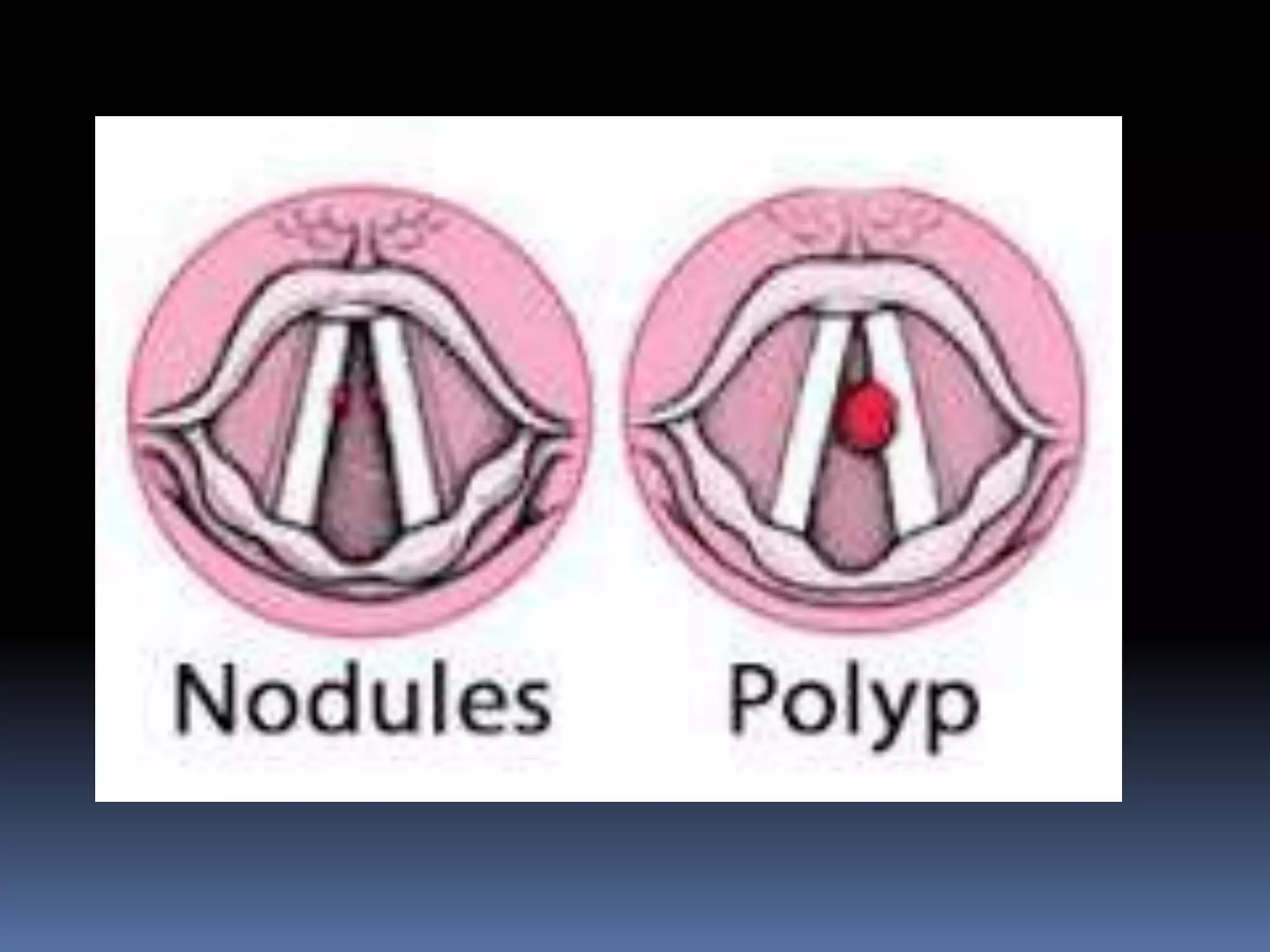
Nodules
 Nodules (also called “nodes”): A common
injury that is essentially a small growth
found on both of the cords (nodules are
much like a callus on the hand or foot);
Nodules keep the cords from fully closing,
resulting in a harsh/breathy voice
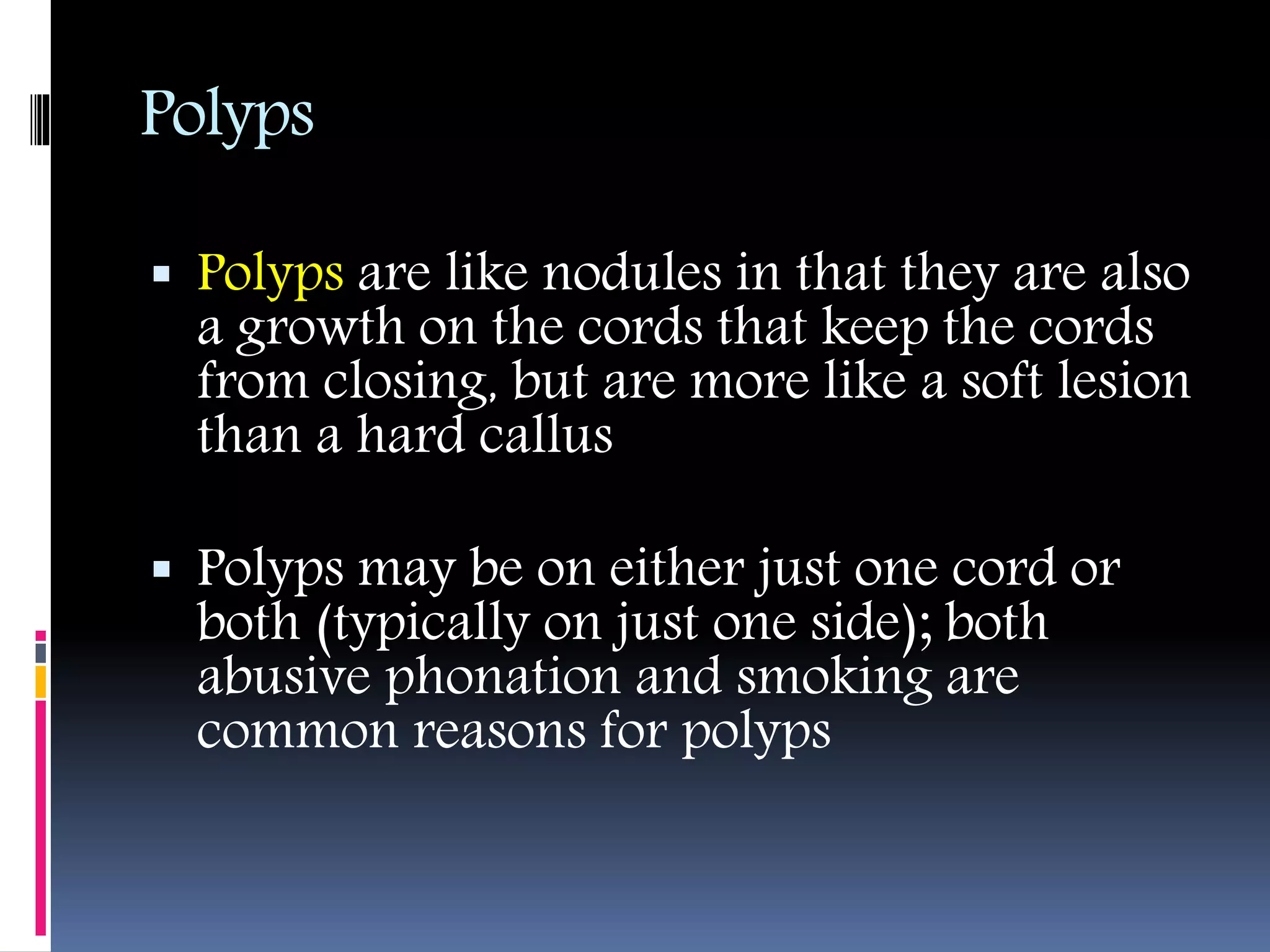
Polyps
 Polyps are like nodules in that they are also
a growth on the cords that keep the cords
from closing, but are more like a soft lesion
than a hard callus
 Polyps may be on either just one cord or
both (typically on just one side); both
abusive phonation and smoking are
common reasons for polyps
Hemorrhage
 A hemorrhage is where a blood vessel
rupture due to excessive pressure
Laryngitis
 Laryngitis is the inflammation of the vocal
cords
 It may be the result of reactions to
allergies, bacterial or fungal infections, or
the result of vocal overuse
 With laryngitis, the vocal cords often swell
too much to correctly close, resulting in
the lack of phonation
Acid Reflux as irritant
 Reflux can cause significant irritation, burning
or swelling on vocal cords/larynx; Two types:
 “GERD”: Gastroesophageal reflux disorder– is when
acid backflows into esophagus
 Symptoms: Heartburn, regurgitation; occurs while
laying down
 “LPR”: Laryngopharyngeal reflux– is when acid
backflows into larynx/pharynx
 Symptoms: Too much mucous in throat, need to
clear throat often, sour taste in mouth, hoarse voice,
feeling of a “lump” in the throat
CANCER
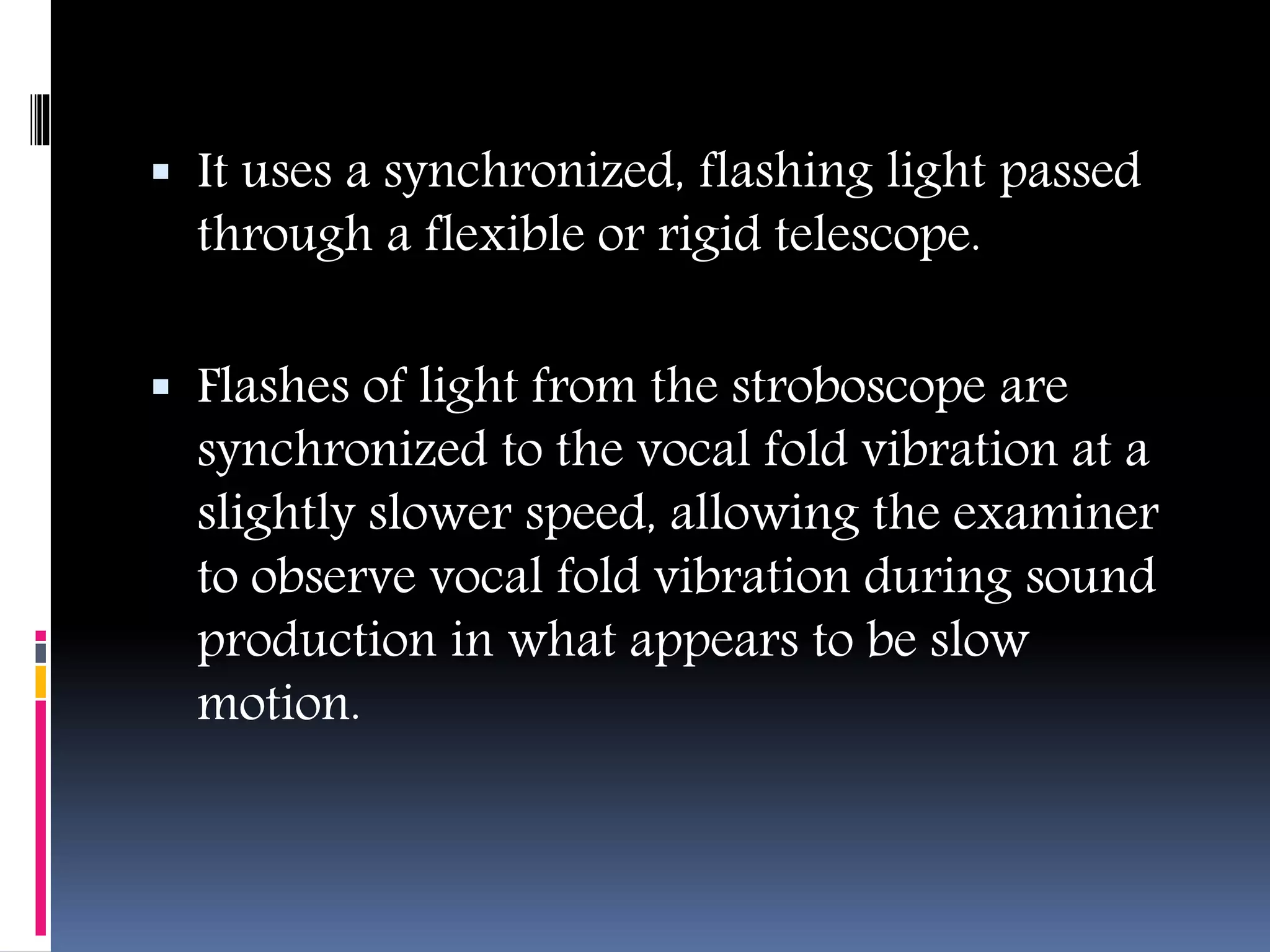
VIDEO STROBOSCOPY
 Invented by JAN G SVEC.
 It has evolved as the most practical and useful
technique for the clinical evaluation of the visco-
elastic properties of the phonatory mucosa.
 Done with topical anaesthesia.
 Essential diagnostic procedure for the evaluation
of laryngeal mucosa, vocal fold motion
biomechanics & mucosal vibration.
 It uses a synchronized, flashing light passed
through a flexible or rigid telescope.
 Flashes of light from the stroboscope are
synchronized to the vocal fold vibration at a
slightly slower speed, allowing the examiner
to observe vocal fold vibration during sound
production in what appears to be slow
motion.
VIDEO STROBOSCOPY OF VOCAL CORDS
Physilogy of phonation by Dr.Ashwin Menon

Physilogy of phonation by Dr.Ashwin Menon

  • 1.
  • 2.
    DEFINITION  Rapid, periodicopening and closing of the glottis through separation and apposition of the vocal cords that, accompanied by breath under lung pressure, constitutes a source of vocal sound.
  • 3.
    Other functions ofLarynx  Protection of lower airways  Respiration  Fixation of Chest wall
  • 4.
    Biomechanics of Phonation Vocal Folds abduct on inspiration.  Vocal Folds slightly adduct on expiration.  Full abduction in forceful inspiration  Larynx descends with Inspiration and Asends with expiration.
  • 6.
     The requirementsof normal phonation are as follows:  Active respiratory support  Adequate glottic closure  Normal mucosal covering of the vocal cord  Adequate control of vocal fold length and tension.
  • 7.
    Anatomy: Physical parts ofthe vocal system  Creating sound requires numerous muscles, bones and organs of the body  Three main anatomical aspects:  Actuators: Lungs/diaphragm/intercostal muscles; these organs deal with breathing/“air management”  Vibrator: larynx; this deals with the creation of pitch in the form of a sound wave  Resonators: Throat (pharynx), mouth/lips/teeth, nose; these deal with the modification of sound into varying accents
  • 8.
    Respiration: Demonstration Movement ofdiaphragm Movement of ribs/lungs
  • 9.
    Phonation  The larynxacts as a transducer during phonation converting the aerodynamic forces generated by the lungs, diaphragm, chest and abdominal muscles into acoustic energy.  The consonants of speech can be associated with particular anatomical sites responsible for their generation i.e. 'p' and 'b' are labials, 't' and 'd' are dentals and 'm' and 'n' are nasals.
  • 10.
    Initiation of Voice Before phonation, vocal folds rapidly abduct to allow intake of air-Pre Phonatory inspiratory Phase (‘’Wyke’’)  Vocal folds adducted- Lat cricoarytenoid M  Pulmonic air forced between adducted Vocal Folds – vocal note
  • 11.
     Repeated vibratorymovt of the vocal folds – production of vocal note- Vocal fold oscillation  Amount of air pressure required to begin voicing – Phonation threshold pressure
  • 12.
    THEORIES OF VOICEPRODUCTION 1. PUFF THEORY- Puff of air emitted through Glottis- vibratory action- Voice 2. NEUROCHRONAXIC THEORY- ROUL HUSSON(1950) Central impulses stimulate the RLN(beat by beat) leading to the active contraction of the thyroarytenoid M – vocal cord vibration.
  • 13.
     This theorywas not accepted as-  Tracheostomy patients cannot phonate.  Left RLN longer than the right. 3. CAVITY TONE THEORY – WILLIS He developed a series of resonating cavities with different shapes and lengths & coupled them to a vibrating reed source. He observed that the sound heard represented a particular vowel & it mainly depended on the length of the resonating tube independent of the reed tone and its frequency.
  • 14.
    4. HARMONIC THEORY(OVERTONE/STEADYSTATE THEORY) CHARLES WHEATSTONE He noticed that the vowels heard were a combination of the reed tone and its harmonics. This modulated reed tone can be further modified at the supra laryngeal level giving rise to special sounds. But this theory fails to take into account the dampening effect.
  • 15.
    5. MYO ELASTICAERODYNAMIC THEORY- JOHANNES MULLER(1843) AERO- Air pressure & flow DYNAMIC- Movt & change MYO- Muscular movt ELASTIC- Ability to return to original state 6. COVER BODYTHEORY 7. BODY SOURCE THEORY 8. SOURCE TRANSFER THEORY
  • 16.
    VIBRATORY CYCLE 1. ADDUCTION 2.AERODYNAMIC SEPARATION 3. RECOIL Manifestation of a mucosal wave travelling from the inferior to the superior surface of each Vocal Fold.
  • 17.
    Mucosal Wave  Alsoimportant component of vocal fold vibration/ voice production  Explained by Body-Cover model of vocal fold vibration  Diff vibratory properties of vocal fold layers  Vertical phase difference Conditions that change density relationships between cover & body result in decreased mucosal wave.
  • 18.
    The Glottic Cycle The vocal folds alternately trap and release air; each trap/release is one cycle of vibration. This cycle is often referred to as the glottic cycle, and it is divided into phases: I. opening phase II. open phase III. closing phase IV. closed phase
  • 20.
     During theclosed phase, the air pressure builds up below the vocal folds. When the glottis opens, the air explodes through the vocal folds, and that's the beginning of the sound wave. The strength of that explosion determines the loudness of the sound coming directly from the larynx.  First, the laryngeal muscles position the vocal cords in various degrees of adduction and place them under the appropriate longitudinal tension.
  • 21.
     Next, muscularand passive forces of exhalation cause the subglottic air pressure to increase.  When this subglottic pressure reaches a point where it exceeds muscular opposition, the glottic chink is forced to open.  When the vocal cords start opening from complete closure, they open in a posterior to anterior direction with the posterior portion of the glottis opening first, reaching maximum excursion first, and recontacting each other at the end of the vibratory cycle prior to the anterior portion of the cords.
  • 22.
     After releaseof the puff of air there is a reduction of sub glottic pressure, and the vocal cords approximate each other again (myo elastic forces of the vocal cords have exceeded the aerodynamic forces).  The myo elastic forces are enhanced because air current flowing through a narrow channel exerts a negative pressure on the channel walls; This is the basis of Bernoulli's Principle.  The vocal cords are thus sucked back together in an adducted state until the sub glottic air pressure can overcome the myo elastic forces of the re approximated cords, and the cycle is then repeated.
  • 23.
    FEATURES OF SOUND: 1.PITCH It is the number of vibrations of vocal cords per second Depends on: a. Length of VC. b. Mass of VC. c. Tension of VC.  In general, men's vocal folds can vibrate from 90 - 500 Hz, and they average about 115 Hz in conversation.  Women's vocal folds can vibrate from 150 -1000 Hz, and they average about 200 Hz in conversation. PITCH = T L M
  • 24.
     Vocal foldsvibrate faster as they're pulled longer, thinner, and more taut and vibrate more slowly when they're shorter, thicker, and floppier.  The cricothyroid muscle and thyroarytenoid muscle coordinate with each other to create different pitches.
  • 27.
    2. VOLUME(INTENSITY) & LENGTH(DURATION) Dependson the air pressure created which is in turn dependent on the lung capacities. 3. QUALITY(TIMBER) Depends on the overtones added by the resonators and articulators.
  • 28.
    Vocal Register  differencesin mode of vibration of vocal folds Register may include Equivalent terms Vocal folds F0 range(Hz) Loft register Highest vocal freq Falsetto Thin, tense, lengthened. Minimal vibration 275-1100 Modal register Usual freq employed in speaking & singing Chest, head, middle, heavy voice Complete adduction 100-300 Pulse register Lowest range of vocal freq Vocal fry, glottal fry, creaky voice Long closed phase 20-60
  • 29.
    Vocal Disorders  Organic,Functional & Psychogenic.  Puberphonia- Maintenance of the childhood pitch despite having passed through puberty  Spasmodic Dysphonia  Stuttering  Phonasthenia  Bogart-Bacall syndrome
  • 30.
    Vocal Injury  Itis fairly easy to injure the vocal cords!  Forceful singing, yelling, screaming, loud talking can cause the vocal cords to hit very hard and result in injury to the cords - vocal abuse  Excessive amounts of phonation can also lead to injury - vocal overuse  Nodules, polyps, laryngitis and hemorrhage of the cords are possible effects of such vocal abuse  Smoking also has dramatic effects on the larynx!
  • 31.
    Nodules  Nodules (alsocalled “nodes”): A common injury that is essentially a small growth found on both of the cords (nodules are much like a callus on the hand or foot); Nodules keep the cords from fully closing, resulting in a harsh/breathy voice
  • 33.
    Polyps  Polyps arelike nodules in that they are also a growth on the cords that keep the cords from closing, but are more like a soft lesion than a hard callus  Polyps may be on either just one cord or both (typically on just one side); both abusive phonation and smoking are common reasons for polyps
  • 34.
    Hemorrhage  A hemorrhageis where a blood vessel rupture due to excessive pressure
  • 35.
    Laryngitis  Laryngitis isthe inflammation of the vocal cords  It may be the result of reactions to allergies, bacterial or fungal infections, or the result of vocal overuse  With laryngitis, the vocal cords often swell too much to correctly close, resulting in the lack of phonation
  • 36.
    Acid Reflux asirritant  Reflux can cause significant irritation, burning or swelling on vocal cords/larynx; Two types:  “GERD”: Gastroesophageal reflux disorder– is when acid backflows into esophagus  Symptoms: Heartburn, regurgitation; occurs while laying down  “LPR”: Laryngopharyngeal reflux– is when acid backflows into larynx/pharynx  Symptoms: Too much mucous in throat, need to clear throat often, sour taste in mouth, hoarse voice, feeling of a “lump” in the throat
  • 37.
  • 38.
    VIDEO STROBOSCOPY  Inventedby JAN G SVEC.  It has evolved as the most practical and useful technique for the clinical evaluation of the visco- elastic properties of the phonatory mucosa.  Done with topical anaesthesia.  Essential diagnostic procedure for the evaluation of laryngeal mucosa, vocal fold motion biomechanics & mucosal vibration.
  • 39.
     It usesa synchronized, flashing light passed through a flexible or rigid telescope.  Flashes of light from the stroboscope are synchronized to the vocal fold vibration at a slightly slower speed, allowing the examiner to observe vocal fold vibration during sound production in what appears to be slow motion.
  • 40.