
AVISHEK DUTTA
What is Hearing Loss
Partially or total inability to hear sounds is known
as hearing loss that is also known as hearing
impairment.
Types of hearing loss
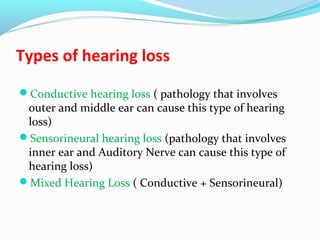
Conductive hearing loss ( pathology that involves
outer and middle ear can cause this type of hearing
loss)
Sensorineural hearing loss (pathology that involves
inner ear and Auditory Nerve can cause this type of
hearing loss)
Mixed Hearing Loss ( Conductive + Sensorineural)
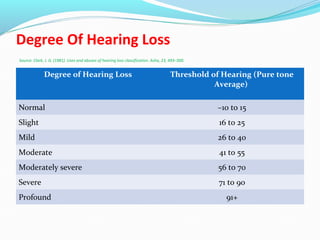
Degree Of Hearing Loss
Source: Clark, J. G. (1981). Uses and abuses of hearing loss classification. Asha, 23, 493–500.
Degree of Hearing Loss Threshold of Hearing (Pure tone
Average)
Normal –10 to 15
Slight 16 to 25
Mild 26 to 40
Moderate 41 to 55
Moderately severe 56 to 70
Severe 71 to 90
Profound 91+
Causes of Conductive Hearing Loss
o Malformation of outer ear, ear canal, or middle ear structures
o Fluid in the middle ear secondary to colds
o Ear Infection (otitis media)
o Allergies
o Poor Eustachian tube function
o Perforated eardrum
o Benign tumors
o Impacted earwax
o Infection in the ear canal
o Foreign body in the ear
o Otosclerosis
Causes of Sensorineural Hearing Loss
o Genetic
o Chromosomal Disorder
o High Noise Exposure
o Head trauma
o Virus or disease
o Autoimmune inner ear disease
o Aging (presbycusis)
o Malformation of the inner ear
o Meniere’s Disease
o Tumors
Rehabilitation
Most of the Conductive hearing loss and few Sensorineural hearing
loss are reversible and those can be treated with medicine or surgical
intervention
Most of the Sensorineural Hearing Loss and Mixed hearing loss required
habilitation / rehabilitation process
Most of the Congenital hearing loss are sensorineural and that affects
development of speech and language
Providing Amplification is the first step of habilitation / rehabilitation
process
Amplification Devices
Hearing Aids
Implantable Devices
Assistive listening Devices
Hearing Aid
Hearing Aid is an electronic device that
amplifies sound for hearing impaired
individual to understand speech.
Types of Hearing Aids
Based On Technology –
 Analog
 Semi digital
 Programmable Digital
Based On Style –
 Body Worn / Pocket model
 Behind The Ear- BTE (mini, standard, power, open, RIC/RITE)
 Custom (ITE, ITC, CIC, IIC)
Selection and Fitting of Hearing Aids
Selection of hearing aid depends upon many factors
like, Type and degree of hearing loss, configuration of
audiogram, speech perception in quite and noise, life
style, other medical, physical and psychological
condition of the patients, family support, affordability
and many more.
Selection procedure involves subjective, objective,
comparative and prescriptive methods
An Audiologist is the key professional who can decide
a proper selection and fitting of hearing aids for any
individual.
If any person is suffering from hearing loss he/she
must visit Audiologist to avoid further complication.
Untreated hearing loss may cause many other
secondary complication that affects emotional,
physical and psychological condition of an individual.
If you are suffering from hearing
loss visit Audiologist without delay
Hearing Loss And Hearing Aids

Hearing Loss And Hearing Aids

  • 1.
  • 2.
    What is HearingLoss Partially or total inability to hear sounds is known as hearing loss that is also known as hearing impairment.
  • 3.
    Types of hearingloss Conductive hearing loss ( pathology that involves outer and middle ear can cause this type of hearing loss) Sensorineural hearing loss (pathology that involves inner ear and Auditory Nerve can cause this type of hearing loss) Mixed Hearing Loss ( Conductive + Sensorineural)
  • 4.
    Degree Of HearingLoss Source: Clark, J. G. (1981). Uses and abuses of hearing loss classification. Asha, 23, 493–500. Degree of Hearing Loss Threshold of Hearing (Pure tone Average) Normal –10 to 15 Slight 16 to 25 Mild 26 to 40 Moderate 41 to 55 Moderately severe 56 to 70 Severe 71 to 90 Profound 91+
  • 5.
    Causes of ConductiveHearing Loss o Malformation of outer ear, ear canal, or middle ear structures o Fluid in the middle ear secondary to colds o Ear Infection (otitis media) o Allergies o Poor Eustachian tube function o Perforated eardrum o Benign tumors o Impacted earwax o Infection in the ear canal o Foreign body in the ear o Otosclerosis
  • 6.
    Causes of SensorineuralHearing Loss o Genetic o Chromosomal Disorder o High Noise Exposure o Head trauma o Virus or disease o Autoimmune inner ear disease o Aging (presbycusis) o Malformation of the inner ear o Meniere’s Disease o Tumors
  • 7.
    Rehabilitation Most of theConductive hearing loss and few Sensorineural hearing loss are reversible and those can be treated with medicine or surgical intervention Most of the Sensorineural Hearing Loss and Mixed hearing loss required habilitation / rehabilitation process Most of the Congenital hearing loss are sensorineural and that affects development of speech and language Providing Amplification is the first step of habilitation / rehabilitation process
  • 8.
    Amplification Devices Hearing Aids ImplantableDevices Assistive listening Devices
  • 9.
    Hearing Aid Hearing Aidis an electronic device that amplifies sound for hearing impaired individual to understand speech.
  • 10.
    Types of HearingAids Based On Technology –  Analog  Semi digital  Programmable Digital Based On Style –  Body Worn / Pocket model  Behind The Ear- BTE (mini, standard, power, open, RIC/RITE)  Custom (ITE, ITC, CIC, IIC)
  • 11.
    Selection and Fittingof Hearing Aids Selection of hearing aid depends upon many factors like, Type and degree of hearing loss, configuration of audiogram, speech perception in quite and noise, life style, other medical, physical and psychological condition of the patients, family support, affordability and many more. Selection procedure involves subjective, objective, comparative and prescriptive methods
  • 12.
    An Audiologist isthe key professional who can decide a proper selection and fitting of hearing aids for any individual. If any person is suffering from hearing loss he/she must visit Audiologist to avoid further complication. Untreated hearing loss may cause many other secondary complication that affects emotional, physical and psychological condition of an individual.
  • 13.
    If you aresuffering from hearing loss visit Audiologist without delay