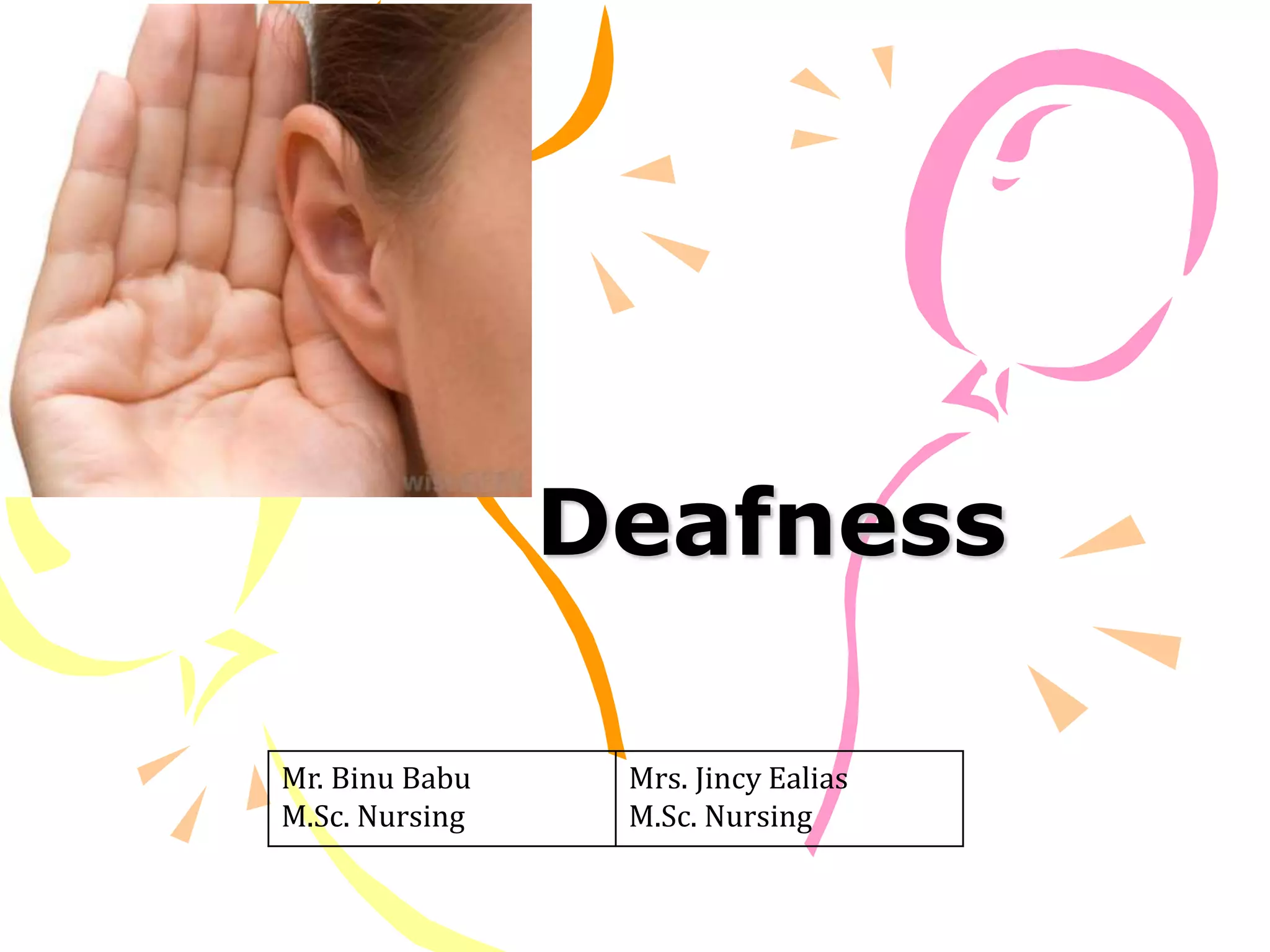
Deafness
Mr. Binu Babu
M.Sc. Nursing
Mrs. Jincy Ealias
M.Sc. Nursing
Definition
โ€ข Deafness, Hearing impairment or
hearing loss refers to the total or
partial inability to hear.
Types
1. Conductive hearing loss (CHL)
2. Sensorineural hearing loss (SHL)
3. Mixed hearing loss (MHL)
4. Others
1. Central hearing loss
2. Functional hearing loss
โ€ข Malingering
Conductive hearing loss
โ€ข Conductive hearing loss is any
interference with the conduction of
sound impulses through the external
auditory canal, the eardrum, or the
middle ear.
โ€ข Conductive hearing loss can be
caused by anything that interferes
with the ability of the sound wave to
reach the inner ear such as cerumen,
foreign bodies, infection.
Sensorineural hearing loss
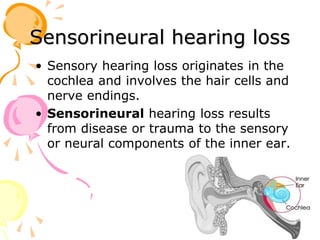
โ€ข Sensory hearing loss originates in the
cochlea and involves the hair cells and
nerve endings.
โ€ข Sensorineural hearing loss results
from disease or trauma to the sensory
or neural components of the inner ear.
โ€ข Presbycusis is hearing loss caused
by the aging process that results
from degeneration of the organ of
Corti.
โ€ข This degenerative process usually
begins at 50 yrs of age.
Mixed hearing loss
โ€ข Mixed hearing loss occurs when an
individual has both conductive and
sensorineural hearing loss.
โ€ข This can be caused by a combination
of any of the disorders
Central hearing loss
โ€ข Central hearing loss occurs when the
central nervous system cannot
interpret normal auditory signals.
โ€ข This condition occurs with such
disorders as cerebrovascular accidents
and tumors.
Functional hearing loss
โ€ข Functional hearing loss is a hearing loss
for which no organic cause or lesion can
be found.
โ€ข Also called psychogenic hearing loss.
โ€ข Precipitated by emotional stress.
โ€ข Malingering is a type of psychogenic
hearing loss.
โ€ข In Malingering, there is no organic or
psychological cause. The patient is
pretending to be deaf for personal
gains.
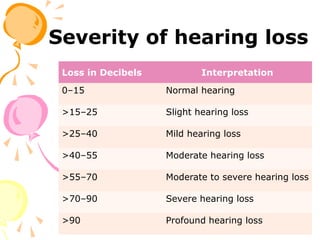
Severity of hearing loss
Loss in Decibels Interpretation
0โ€“15 Normal hearing
>15โ€“25 Slight hearing loss
>25โ€“40 Mild hearing loss
>40โ€“55 Moderate hearing loss
>55โ€“70 Moderate to severe hearing loss
>70โ€“90 Severe hearing loss
>90 Profound hearing loss
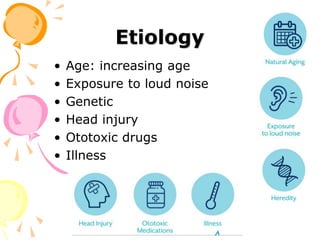
Etiology
โ€ข Age: increasing age
โ€ข Exposure to loud noise
โ€ข Genetic
โ€ข Head injury
โ€ข Ototoxic drugs
โ€ข Illness
โ€ข Illness
โ€“ Ear infections
โ€“ Measles may cause auditory nerve damage
โ€“ Meningitis may damage auditory nerve or
cochlea
โ€“ Auto immune disease
โ€“ Mumps
โ€“ Otosclerosis
โ€“ Medulloblastoma or other brain tumors
โ€“ Syphilis from pregnant woman to fetus
โ€“ Premature birth
โ€“ Fetal alcohol syndrome in infants of alcoholic
mothers
โ€“ Neurological disorders
โ€ข Multiple sclerosis
Risk Factors
โ€ข Family history of sensorineural impairment
โ€ข Congenital malformations of the cranial
structure (ear)
โ€ข Low birth weight (1500 g)
โ€ข Use of ototoxic medications (eg:gentamycin,
loop diuretics)
โ€ข Recurrent ear infections
โ€ข Bacterial meningitis
โ€ข Chronic exposure to loud noises
โ€ข Perforation of the tympanic membrane
Causes of Conductive deafness
EXTERNAL EAR:
โ€ข Impacted Wax
โ€ข Otitis Externa
โ€ข Foreign Bodies
โ€ข Polyps
โ€ข Tumours
โ€ข Fluid in the ear
MIDDLE EAR
โ€ข Congenital defects of the
ear drum and ossicles.
โ€ข Perforation of the tympanic
membrane
โ€ข Traumatic: Barotrauma,
rupture of ear drum, skull
fracture
โ€ข Inflammation: AOM, COM,
โ€ข Neoplasms
โ€ข Otosclerosis
Causes of sensorineural deafness
INNER EAR
โ€ข Congenital
โ€ข Trauma: Head injury,
surgical injury to
labyrinth, loud sounds
producing concussion.
โ€ข Infections: mumps,
syphilis, tuberculous
meningitis, enteric
fever, labyrinthitis.
โ€ข Presbycusis
โ€ข Tumours: Acoustic
neuroma
โ€ข Meniereโ€™s disease
โ€ข Ototoxic drugs:
streptomycin,
Kanamycin,
neomycin, salicylates,
frusemide and
quinine.
Causes of Central hearing loss
โ€ข Cerebrovascular
accidents
โ€ข Brain tumors
โ€ข Multiple sclerosis
Pathophysiology
Disorders of external or middle ear
Interruption in the transmission of
sound by air to the inner ear
Conductive deafness
Disorders of inner ear or
vestibulocochlear nerve or aging
Interruption in neural transmission
of sound to brain
Sensorineural deafness
Clinical manifestations
โ€ข Tinnitus
โ€ข Increasing inability to hear when in a group
โ€ข Need to turn up the volume of the television
โ€ข Failure to respond or In appropriate response
to oral communications
โ€ข Excessively loud speech
โ€ข Strained facial expression
โ€ข Constant need for clarification of conversation
โ€ข Social withdrawal
Diagnostic measures
โ€ข History
โ€ข Physical examination
โ€“ Rinneโ€™s test
โ€“ Weberโ€™s test
โ€ข Audiometry
โ€ข Tympanogram
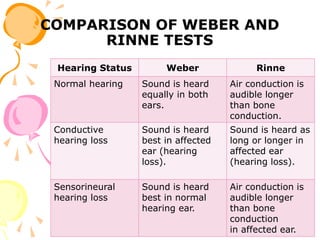
COMPARISON OF WEBER AND
RINNE TESTS
Hearing Status Weber Rinne
Normal hearing Sound is heard
equally in both
ears.
Air conduction is
audible longer
than bone
conduction.
Conductive
hearing loss
Sound is heard
best in affected
ear (hearing
loss).
Sound is heard as
long or longer in
affected ear
(hearing loss).
Sensorineural
hearing loss
Sound is heard
best in normal
hearing ear.
Air conduction is
audible longer
than bone
conduction
in affected ear.
Prevention
โ€ข Minimize the exposure to trauma,
infection, ototoxic drugs.
โ€ข Avoid the risk factors.
โ€ข Wear ear protection to prevent
noise-induced hearing loss when
exposed to loud noise.
Management
Medical management
โ€ข Restore hearing
โ€“ Antibiotics: to treat infections
โ€“ Remove impacted wax or foreign
bodies
โ€“ Ceruminolytics for impacted wax
โ€“ Corticosteroids for inflammation
โ€“ Treat underlying disorders
โ€ข Assist hearing
โ€“ Hearing aids
โ€“ Implantable middle ear hearing
devices
โ€“ Cochlear implants
โ€“ Sign language
โ€“ Auditory rehabilitation
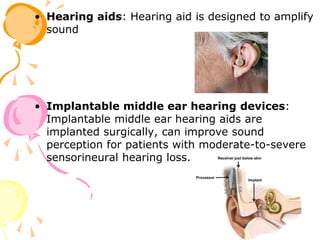
โ€ข Hearing aids: Hearing aid is designed to amplify
sound
โ€ข Implantable middle ear hearing devices:
Implantable middle ear hearing aids are
implanted surgically, can improve sound
perception for patients with moderate-to-severe
sensorineural hearing loss.
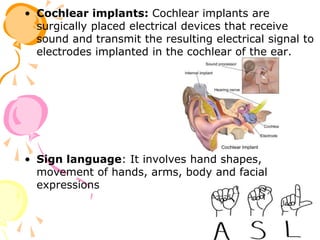
โ€ข Cochlear implants: Cochlear implants are
surgically placed electrical devices that receive
sound and transmit the resulting electrical signal to
electrodes implanted in the cochlear of the ear.
โ€ข Sign language: It involves hand shapes,
movement of hands, arms, body and facial
expressions
AURAL REHABILITATION
โ€ข Aural rehabilitation refers to services
and procedures for facilitating adequate
receptive and expressive
communication in individuals with
hearing impairment.
โ€ข If a hearing loss is permanent or
untreatable, aural rehabilitation may be
beneficial.
Purpose
โ€ข To maximize the communication
skills of the person with hearing
impairment.
Components
โ€ข Auditory training: Auditory training
emphasizes listening skills, so the person
who is hearing-impaired concentrates on
the speaker.
โ€ข Speech reading: Also known as lip
reading. Speech reading can help fill the
gaps left by missed or misheard words.
โ€ข Speech training: The goals of speech
training are to conserve, develop, and
prevent deterioration of current
communication skills.
โ€ข Hearing Aids: A hearing aid is a device
through which speech and environmental
sounds are received by a microphone,
converted to electrical signals, amplified,
and reconverted to acoustic signals.
โ€ข Hearing Guide Dogs: Specially trained dogs
(service dogs) are available to assist the person
with a hearing loss. People who live alone are
eligible to apply for a dog trained by
International Hearing Dog, Inc. The dog reacts
to the sound of a telephone, a doorbell, an
alarm clock, a babyโ€™s cry, a knock at the door,
a smoke alarm, or an intruder. The dog alerts
its master by physical contact; the dog then
runs to the source of the noise. In public, the
dog positions itself between the person with
hearing impairment and any potential hazard
that the person cannot hear, such as an
oncoming vehicle or a loud, hostile person.
Surgical management
โ€ข Surgery is indicated for conductive or
mixed hearing loss.
โ€ข To restore conductive hearing
โ€“ Myringotomy
โ€“ Stapedectomy
โ€ข Assisted hearing in profound deafness
โ€“ Cochlear implants
โ€“ Middle ear implants (Semi-implantable hearing
device)
โ€ข Tumour excision for acoustic neuroma
Nursing Diagnosis
โ€ข Disturbed sensory perception: hearing related to
altered sensory reception and transmission
โ€ข Impaired verbal communication related to
impaired hearing
โ€ข Impaired social interaction related to impaired
hearing and decreased communication skills
โ€ข Disturbed body image related to impaired hearing
and use of assistive hearing devices
โ€ข Ineffective coping related to difficult
communication
โ€ข Deficient knowledge related to care of hearing aid
due to lack of prior experience
Nursing interventions
โ€ข Inspect ear canals for mechanical obstruction.
โ€ข Remove mechanical obstructions like cerumen or
foreign bodies.
โ€ข Assess hearing by use of a tuning fork, or verbal
cues to determine auditory ability at various
distances.
โ€ข Speak slowly with careful pronunciation of words.
โ€ข Add hand gestures, speak face to face and adjust
pitch downward without increasing volume.
โ€ข Introduce assistive devices such as hearing aids,
written communication, and sign language.
โ€ข Allow patient to verbalize feelings and grieving
about hearing loss.

Deafness

  • 1.
    Deafness Mr. Binu Babu M.Sc.Nursing Mrs. Jincy Ealias M.Sc. Nursing
  • 2.
    Definition โ€ข Deafness, Hearingimpairment or hearing loss refers to the total or partial inability to hear.
  • 3.
    Types 1. Conductive hearingloss (CHL) 2. Sensorineural hearing loss (SHL) 3. Mixed hearing loss (MHL) 4. Others 1. Central hearing loss 2. Functional hearing loss โ€ข Malingering
  • 4.
    Conductive hearing loss โ€ขConductive hearing loss is any interference with the conduction of sound impulses through the external auditory canal, the eardrum, or the middle ear.
  • 5.
    โ€ข Conductive hearingloss can be caused by anything that interferes with the ability of the sound wave to reach the inner ear such as cerumen, foreign bodies, infection.
  • 6.
    Sensorineural hearing loss โ€ขSensory hearing loss originates in the cochlea and involves the hair cells and nerve endings. โ€ข Sensorineural hearing loss results from disease or trauma to the sensory or neural components of the inner ear.
  • 7.
    โ€ข Presbycusis ishearing loss caused by the aging process that results from degeneration of the organ of Corti. โ€ข This degenerative process usually begins at 50 yrs of age.
  • 8.
    Mixed hearing loss โ€ขMixed hearing loss occurs when an individual has both conductive and sensorineural hearing loss. โ€ข This can be caused by a combination of any of the disorders
  • 9.
    Central hearing loss โ€ขCentral hearing loss occurs when the central nervous system cannot interpret normal auditory signals. โ€ข This condition occurs with such disorders as cerebrovascular accidents and tumors.
  • 10.
    Functional hearing loss โ€ขFunctional hearing loss is a hearing loss for which no organic cause or lesion can be found. โ€ข Also called psychogenic hearing loss. โ€ข Precipitated by emotional stress. โ€ข Malingering is a type of psychogenic hearing loss. โ€ข In Malingering, there is no organic or psychological cause. The patient is pretending to be deaf for personal gains.
  • 11.
    Severity of hearingloss Loss in Decibels Interpretation 0โ€“15 Normal hearing >15โ€“25 Slight hearing loss >25โ€“40 Mild hearing loss >40โ€“55 Moderate hearing loss >55โ€“70 Moderate to severe hearing loss >70โ€“90 Severe hearing loss >90 Profound hearing loss
  • 12.
    Etiology โ€ข Age: increasingage โ€ข Exposure to loud noise โ€ข Genetic โ€ข Head injury โ€ข Ototoxic drugs โ€ข Illness
  • 13.
    โ€ข Illness โ€“ Earinfections โ€“ Measles may cause auditory nerve damage โ€“ Meningitis may damage auditory nerve or cochlea โ€“ Auto immune disease โ€“ Mumps โ€“ Otosclerosis โ€“ Medulloblastoma or other brain tumors โ€“ Syphilis from pregnant woman to fetus โ€“ Premature birth โ€“ Fetal alcohol syndrome in infants of alcoholic mothers โ€“ Neurological disorders โ€ข Multiple sclerosis
  • 14.
    Risk Factors โ€ข Familyhistory of sensorineural impairment โ€ข Congenital malformations of the cranial structure (ear) โ€ข Low birth weight (1500 g) โ€ข Use of ototoxic medications (eg:gentamycin, loop diuretics) โ€ข Recurrent ear infections โ€ข Bacterial meningitis โ€ข Chronic exposure to loud noises โ€ข Perforation of the tympanic membrane
  • 15.
    Causes of Conductivedeafness EXTERNAL EAR: โ€ข Impacted Wax โ€ข Otitis Externa โ€ข Foreign Bodies โ€ข Polyps โ€ข Tumours โ€ข Fluid in the ear MIDDLE EAR โ€ข Congenital defects of the ear drum and ossicles. โ€ข Perforation of the tympanic membrane โ€ข Traumatic: Barotrauma, rupture of ear drum, skull fracture โ€ข Inflammation: AOM, COM, โ€ข Neoplasms โ€ข Otosclerosis
  • 16.
    Causes of sensorineuraldeafness INNER EAR โ€ข Congenital โ€ข Trauma: Head injury, surgical injury to labyrinth, loud sounds producing concussion. โ€ข Infections: mumps, syphilis, tuberculous meningitis, enteric fever, labyrinthitis. โ€ข Presbycusis โ€ข Tumours: Acoustic neuroma โ€ข Meniereโ€™s disease โ€ข Ototoxic drugs: streptomycin, Kanamycin, neomycin, salicylates, frusemide and quinine.
  • 17.
    Causes of Centralhearing loss โ€ข Cerebrovascular accidents โ€ข Brain tumors โ€ข Multiple sclerosis
  • 18.
    Pathophysiology Disorders of externalor middle ear Interruption in the transmission of sound by air to the inner ear Conductive deafness
  • 19.
    Disorders of innerear or vestibulocochlear nerve or aging Interruption in neural transmission of sound to brain Sensorineural deafness
  • 20.
    Clinical manifestations โ€ข Tinnitus โ€ขIncreasing inability to hear when in a group โ€ข Need to turn up the volume of the television โ€ข Failure to respond or In appropriate response to oral communications โ€ข Excessively loud speech โ€ข Strained facial expression โ€ข Constant need for clarification of conversation โ€ข Social withdrawal
  • 21.
    Diagnostic measures โ€ข History โ€ขPhysical examination โ€“ Rinneโ€™s test โ€“ Weberโ€™s test โ€ข Audiometry โ€ข Tympanogram
  • 22.
    COMPARISON OF WEBERAND RINNE TESTS Hearing Status Weber Rinne Normal hearing Sound is heard equally in both ears. Air conduction is audible longer than bone conduction. Conductive hearing loss Sound is heard best in affected ear (hearing loss). Sound is heard as long or longer in affected ear (hearing loss). Sensorineural hearing loss Sound is heard best in normal hearing ear. Air conduction is audible longer than bone conduction in affected ear.
  • 23.
    Prevention โ€ข Minimize theexposure to trauma, infection, ototoxic drugs. โ€ข Avoid the risk factors. โ€ข Wear ear protection to prevent noise-induced hearing loss when exposed to loud noise.
  • 24.
    Management Medical management โ€ข Restorehearing โ€“ Antibiotics: to treat infections โ€“ Remove impacted wax or foreign bodies โ€“ Ceruminolytics for impacted wax โ€“ Corticosteroids for inflammation โ€“ Treat underlying disorders
  • 25.
    โ€ข Assist hearing โ€“Hearing aids โ€“ Implantable middle ear hearing devices โ€“ Cochlear implants โ€“ Sign language โ€“ Auditory rehabilitation
  • 26.
    โ€ข Hearing aids:Hearing aid is designed to amplify sound โ€ข Implantable middle ear hearing devices: Implantable middle ear hearing aids are implanted surgically, can improve sound perception for patients with moderate-to-severe sensorineural hearing loss.
  • 27.
    โ€ข Cochlear implants:Cochlear implants are surgically placed electrical devices that receive sound and transmit the resulting electrical signal to electrodes implanted in the cochlear of the ear. โ€ข Sign language: It involves hand shapes, movement of hands, arms, body and facial expressions
  • 28.
  • 29.
    โ€ข Aural rehabilitationrefers to services and procedures for facilitating adequate receptive and expressive communication in individuals with hearing impairment. โ€ข If a hearing loss is permanent or untreatable, aural rehabilitation may be beneficial.
  • 30.
    Purpose โ€ข To maximizethe communication skills of the person with hearing impairment.
  • 31.
    Components โ€ข Auditory training:Auditory training emphasizes listening skills, so the person who is hearing-impaired concentrates on the speaker. โ€ข Speech reading: Also known as lip reading. Speech reading can help fill the gaps left by missed or misheard words. โ€ข Speech training: The goals of speech training are to conserve, develop, and prevent deterioration of current communication skills.
  • 32.
    โ€ข Hearing Aids:A hearing aid is a device through which speech and environmental sounds are received by a microphone, converted to electrical signals, amplified, and reconverted to acoustic signals.
  • 33.
    โ€ข Hearing GuideDogs: Specially trained dogs (service dogs) are available to assist the person with a hearing loss. People who live alone are eligible to apply for a dog trained by International Hearing Dog, Inc. The dog reacts to the sound of a telephone, a doorbell, an alarm clock, a babyโ€™s cry, a knock at the door, a smoke alarm, or an intruder. The dog alerts its master by physical contact; the dog then runs to the source of the noise. In public, the dog positions itself between the person with hearing impairment and any potential hazard that the person cannot hear, such as an oncoming vehicle or a loud, hostile person.
  • 34.
    Surgical management โ€ข Surgeryis indicated for conductive or mixed hearing loss. โ€ข To restore conductive hearing โ€“ Myringotomy โ€“ Stapedectomy โ€ข Assisted hearing in profound deafness โ€“ Cochlear implants โ€“ Middle ear implants (Semi-implantable hearing device) โ€ข Tumour excision for acoustic neuroma
  • 35.
    Nursing Diagnosis โ€ข Disturbedsensory perception: hearing related to altered sensory reception and transmission โ€ข Impaired verbal communication related to impaired hearing โ€ข Impaired social interaction related to impaired hearing and decreased communication skills โ€ข Disturbed body image related to impaired hearing and use of assistive hearing devices โ€ข Ineffective coping related to difficult communication โ€ข Deficient knowledge related to care of hearing aid due to lack of prior experience
  • 36.
    Nursing interventions โ€ข Inspectear canals for mechanical obstruction. โ€ข Remove mechanical obstructions like cerumen or foreign bodies. โ€ข Assess hearing by use of a tuning fork, or verbal cues to determine auditory ability at various distances. โ€ข Speak slowly with careful pronunciation of words. โ€ข Add hand gestures, speak face to face and adjust pitch downward without increasing volume. โ€ข Introduce assistive devices such as hearing aids, written communication, and sign language. โ€ข Allow patient to verbalize feelings and grieving about hearing loss.