Sana Hassan Janjua
Sarah Majeed
Zahra Jabeen
Waheeda Bano
HEARING :
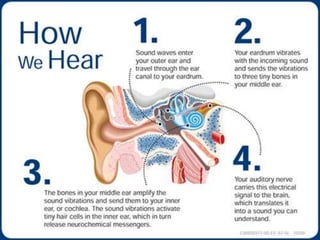
Hearing refers to the reception of sound by
the ear, its analysis, and its transmission to
the brain.
IMPAIRMENT:
An impairment is any loss or abnormality of
psychological, physiological or anatomical
structure or function.
TYPES OF
HEARING
IMPAIRMENT
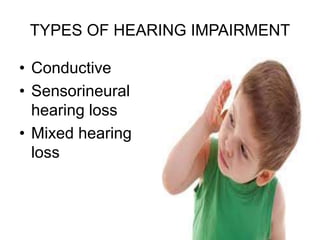
TYPES OF HEARING IMPAIRMENT
• Conductive
• Sensorineural
hearing loss
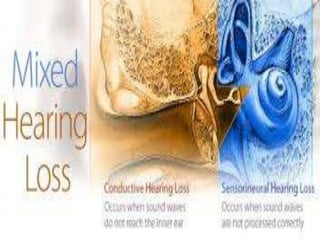
• Mixed hearing
loss
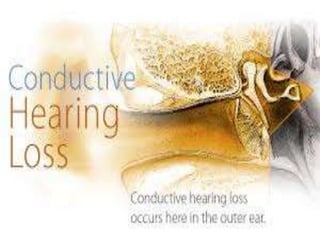
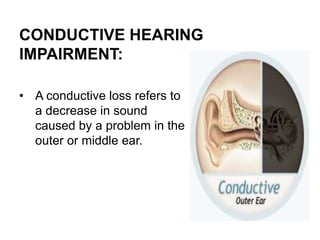
CONDUCTIVE HEARING
IMPAIRMENT:
• A conductive loss refers to
a decrease in sound
caused by a problem in the
outer or middle ear.
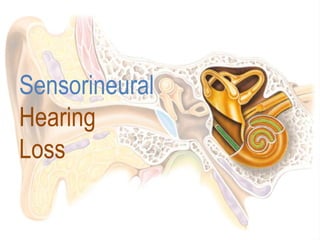
Sensorineural
Hearing
Loss
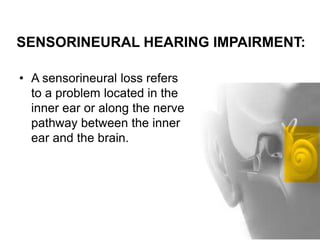
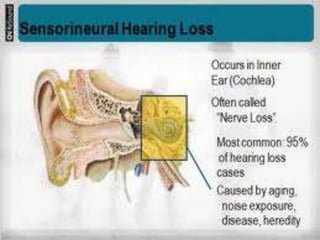
SENSORINEURAL HEARING IMPAIRMENT:
• A sensorineural loss refers
to a problem located in the
inner ear or along the nerve
pathway between the inner
ear and the brain.
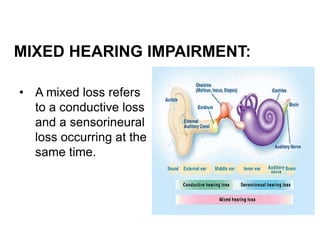
MIXED HEARING IMPAIRMENT:
• A mixed loss refers
to a conductive loss
and a sensorineural
loss occurring at the
same time.
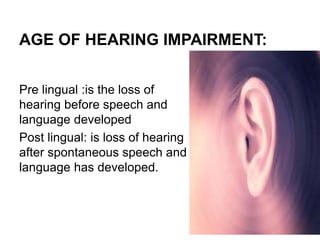
AGE OF HEARING IMPAIRMENT:
Pre lingual :is the loss of
hearing before speech and
language developed
Post lingual: is loss of hearing
after spontaneous speech and
language has developed.
DEGREE
AND TYPES
OF HEARING
IMPAIRMENT
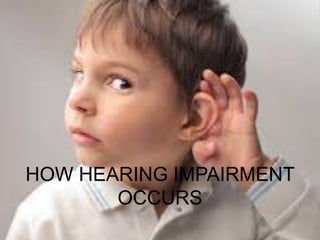
HOW HEARING IMPAIRMENT
OCCURS
Causes:
Hearing impairment includes:
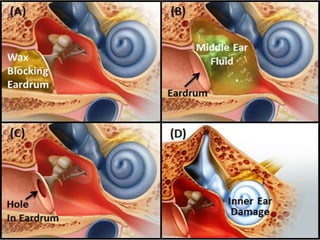
a) A gradual buildup of earwax.
b)Ear infection and abnormal bone growths or
tumors.
c)Ruptured eardrum.
d)Damage to the inner ear.
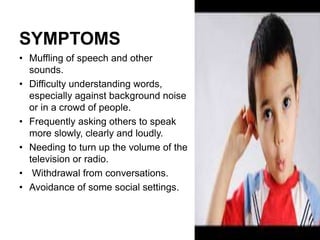
SYMPTOMS
• Muffling of speech and other
sounds.
• Difficulty understanding words,
especially against background noise
or in a crowd of people.
• Frequently asking others to speak
more slowly, clearly and loudly.
• Needing to turn up the volume of the
television or radio.
• Withdrawal from conversations.
• Avoidance of some social settings.
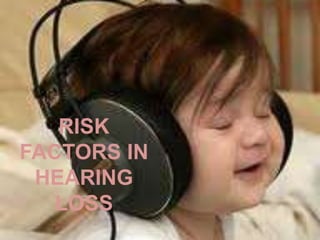
RISK
FACTORS IN
HEARING
LOSS
RISK FACTORS:
• Aging.
• Heredity.
• Occupational noises.
• Some medications.
• Some illness,
PSYCHOLOGICAL
EFFECTS
• Depression
• Anxiety
• An often false sense that others are
angry with you.
• Shame, guilt and anger.
• Lack of concentration.
• Worry and frustration.
• Insecurity.
• Embarrassment
• Self-criticism and low self confidence
• Adjustment problems.
PSYCHOLOGICAL EFFECTS:
COPING AND SUPPORT:
These tips can help you to communicate
more easily despite your hearing loss.
• Position yourself to hear:
Face the person with whom you're having
a conversation.
• Turn off background noise:
For example, noise from a television may
interfere with conversation.
• Ask others to speak clearly:
Most people will be helpful if they know
you're having trouble hearing them.
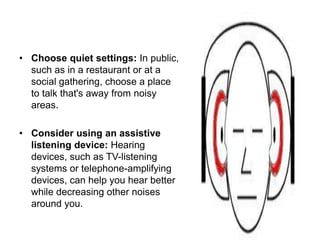
• Choose quiet settings: In public,
such as in a restaurant or at a
social gathering, choose a place
to talk that's away from noisy
areas.
• Consider using an assistive
listening device: Hearing
devices, such as TV-listening
systems or telephone-amplifying
devices, can help you hear better
while decreasing other noises
around you.
BENEFITS OF TREATMENT
• Greater self-confidence
• Closer relationships with loved ones
• Improved outlook on life
PREVENTION FOR HEARING
IMPAIRMENT
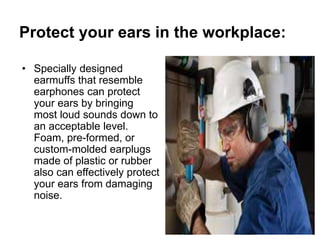
Protect your ears in the workplace:
• Specially designed
earmuffs that resemble
earphones can protect
your ears by bringing
most loud sounds down to
an acceptable level.
Foam, pre-formed, or
custom-molded earplugs
made of plastic or rubber
also can effectively protect
your ears from damaging
noise.
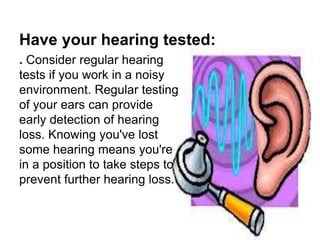
Have your hearing tested:
. Consider regular hearing
tests if you work in a noisy
environment. Regular testing
of your ears can provide
early detection of hearing
loss. Knowing you've lost
some hearing means you're
in a position to take steps to
prevent further hearing loss.
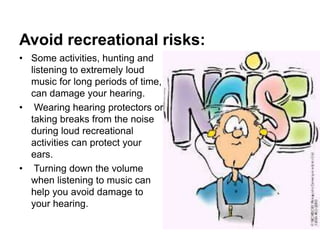
Avoid recreational risks:
• Some activities, hunting and
listening to extremely loud
music for long periods of time,
can damage your hearing.
• Wearing hearing protectors or
taking breaks from the noise
during loud recreational
activities can protect your
ears.
• Turning down the volume
when listening to music can
help you avoid damage to
your hearing.
TEST AND
DIAGNOSIS
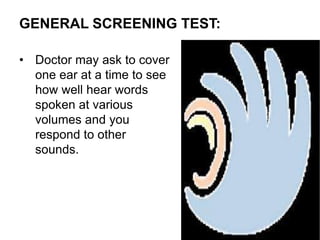
GENERAL SCREENING TEST:
• Doctor may ask to cover
one ear at a time to see
how well hear words
spoken at various
volumes and you
respond to other
sounds.
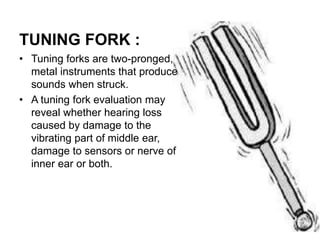
TUNING FORK :
• Tuning forks are two-pronged,
metal instruments that produce
sounds when struck.
• A tuning fork evaluation may
reveal whether hearing loss
caused by damage to the
vibrating part of middle ear,
damage to sensors or nerve of
inner ear or both.
AUDIOMETRY TEST
• Test conducted by an
audiologist, you wear earphones
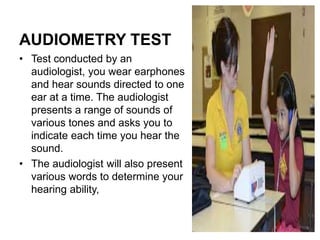
and hear sounds directed to one
ear at a time. The audiologist
presents a range of sounds of
various tones and asks you to
indicate each time you hear the
sound.
• The audiologist will also present
various words to determine your
hearing ability,
TREATMENTS:
Treatment depends on the cause and severity of your
hearing loss.
Options include:
• Removing wax blockage.
• Hearing aids.
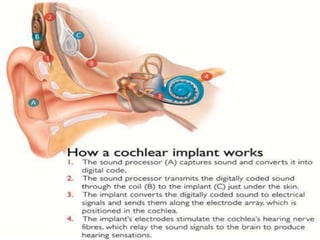
• Cochlear implants.
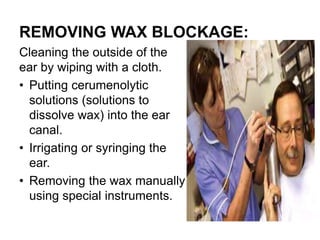
REMOVING WAX BLOCKAGE:
Cleaning the outside of the
ear by wiping with a cloth.
• Putting cerumenolytic
solutions (solutions to
dissolve wax) into the ear
canal.
• Irrigating or syringing the
ear.
• Removing the wax manually
using special instruments.
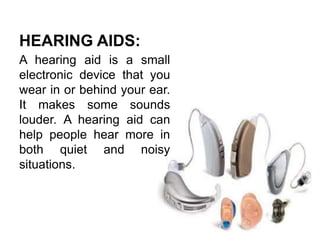
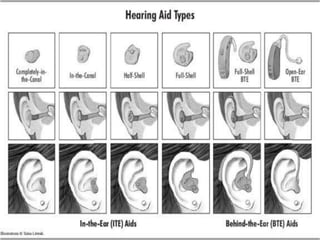
HEARING AIDS:
A hearing aid is a small
electronic device that you
wear in or behind your ear.
It makes some sounds
louder. A hearing aid can
help people hear more in
both quiet and noisy
situations.
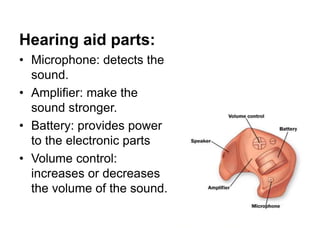
Hearing aid parts:
• Microphone: detects the
sound.
• Amplifier: make the
sound stronger.
• Battery: provides power
to the electronic parts
• Volume control:
increases or decreases
the volume of the sound.
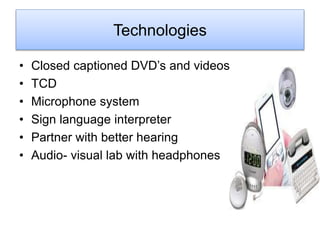
Technologies
• Closed captioned DVD’s and videos
• TCD
• Microphone system
• Sign language interpreter
• Partner with better hearing
• Audio- visual lab with headphones
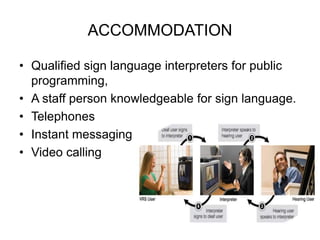
ACCOMMODATION
• Qualified sign language interpreters for public
programming,
• A staff person knowledgeable for sign language.
• Telephones
• Instant messaging
• Video calling
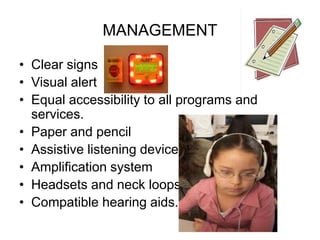
MANAGEMENT
• Clear signs
• Visual alert
• Equal accessibility to all programs and
services.
• Paper and pencil
• Assistive listening devices
• Amplification system
• Headsets and neck loops
• Compatible hearing aids.
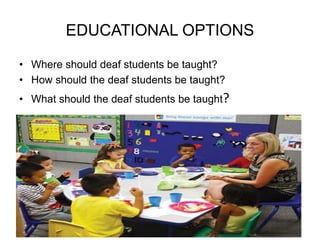
EDUCATIONAL OPTIONS
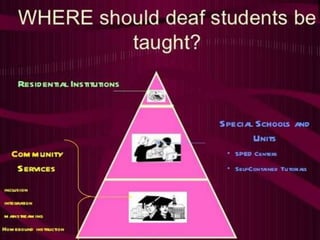
• Where should deaf students be taught?
• How should the deaf students be taught?
• What should the deaf students be taught?
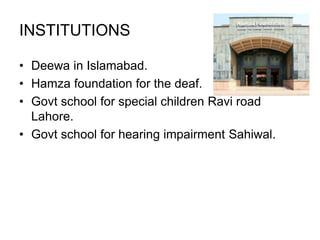
INSTITUTIONS
• Deewa in Islamabad.
• Hamza foundation for the deaf.
• Govt school for special children Ravi road
Lahore.
• Govt school for hearing impairment Sahiwal.
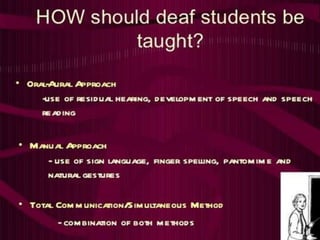
How should the deaf students be
taught?
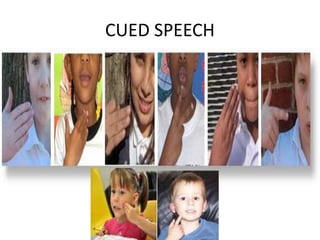
CUED SPEECH
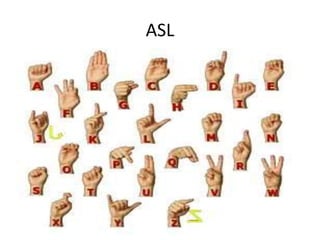
ASL
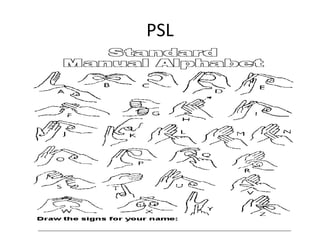
PSL
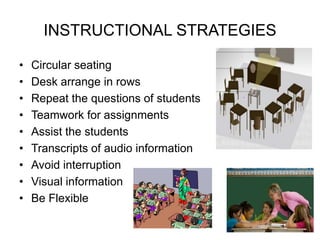
INSTRUCTIONAL STRATEGIES
• Circular seating
• Desk arrange in rows
• Repeat the questions of students
• Teamwork for assignments
• Assist the students
• Transcripts of audio information
• Avoid interruption
• Visual information
• Be Flexible
What should deaf students be taught?
• General education subject content.
(English , Math, Science, general knowledge etc)
• Special curriculum features for the deaf.
(Rhythm, auditory training, speech & language)
Teaching strategies:
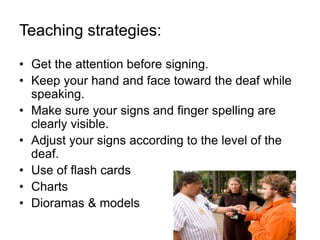
• Get the attention before signing.
• Keep your hand and face toward the deaf while
speaking.
• Make sure your signs and finger spelling are
clearly visible.
• Adjust your signs according to the level of the
deaf.
• Use of flash cards
• Charts
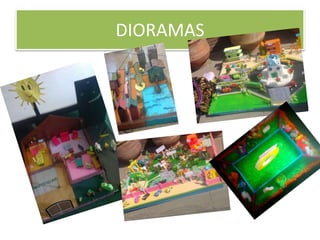
• Dioramas & models
FLASH CARDS
MODELS
DIORAMAS
Hearing impairment

Hearing impairment

  • 3.
    Sana Hassan Janjua SarahMajeed Zahra Jabeen Waheeda Bano
  • 4.
    HEARING : Hearing refersto the reception of sound by the ear, its analysis, and its transmission to the brain.
  • 5.
    IMPAIRMENT: An impairment isany loss or abnormality of psychological, physiological or anatomical structure or function.
  • 7.
  • 8.
    TYPES OF HEARINGIMPAIRMENT • Conductive • Sensorineural hearing loss • Mixed hearing loss
  • 10.
    CONDUCTIVE HEARING IMPAIRMENT: • Aconductive loss refers to a decrease in sound caused by a problem in the outer or middle ear.
  • 11.
  • 12.
    SENSORINEURAL HEARING IMPAIRMENT: •A sensorineural loss refers to a problem located in the inner ear or along the nerve pathway between the inner ear and the brain.
  • 15.
    MIXED HEARING IMPAIRMENT: •A mixed loss refers to a conductive loss and a sensorineural loss occurring at the same time.
  • 16.
    AGE OF HEARINGIMPAIRMENT: Pre lingual :is the loss of hearing before speech and language developed Post lingual: is loss of hearing after spontaneous speech and language has developed.
  • 17.
  • 20.
  • 21.
    Causes: Hearing impairment includes: a)A gradual buildup of earwax. b)Ear infection and abnormal bone growths or tumors. c)Ruptured eardrum. d)Damage to the inner ear.
  • 23.
    SYMPTOMS • Muffling ofspeech and other sounds. • Difficulty understanding words, especially against background noise or in a crowd of people. • Frequently asking others to speak more slowly, clearly and loudly. • Needing to turn up the volume of the television or radio. • Withdrawal from conversations. • Avoidance of some social settings.
  • 24.
  • 25.
    RISK FACTORS: • Aging. •Heredity. • Occupational noises. • Some medications. • Some illness,
  • 26.
  • 27.
    • Depression • Anxiety •An often false sense that others are angry with you. • Shame, guilt and anger. • Lack of concentration. • Worry and frustration. • Insecurity. • Embarrassment • Self-criticism and low self confidence • Adjustment problems. PSYCHOLOGICAL EFFECTS:
  • 28.
    COPING AND SUPPORT: Thesetips can help you to communicate more easily despite your hearing loss. • Position yourself to hear: Face the person with whom you're having a conversation. • Turn off background noise: For example, noise from a television may interfere with conversation. • Ask others to speak clearly: Most people will be helpful if they know you're having trouble hearing them.
  • 29.
    • Choose quietsettings: In public, such as in a restaurant or at a social gathering, choose a place to talk that's away from noisy areas. • Consider using an assistive listening device: Hearing devices, such as TV-listening systems or telephone-amplifying devices, can help you hear better while decreasing other noises around you.
  • 30.
    BENEFITS OF TREATMENT •Greater self-confidence • Closer relationships with loved ones • Improved outlook on life
  • 31.
  • 32.
    Protect your earsin the workplace: • Specially designed earmuffs that resemble earphones can protect your ears by bringing most loud sounds down to an acceptable level. Foam, pre-formed, or custom-molded earplugs made of plastic or rubber also can effectively protect your ears from damaging noise.
  • 33.
    Have your hearingtested: . Consider regular hearing tests if you work in a noisy environment. Regular testing of your ears can provide early detection of hearing loss. Knowing you've lost some hearing means you're in a position to take steps to prevent further hearing loss.
  • 34.
    Avoid recreational risks: •Some activities, hunting and listening to extremely loud music for long periods of time, can damage your hearing. • Wearing hearing protectors or taking breaks from the noise during loud recreational activities can protect your ears. • Turning down the volume when listening to music can help you avoid damage to your hearing.
  • 35.
  • 36.
    GENERAL SCREENING TEST: •Doctor may ask to cover one ear at a time to see how well hear words spoken at various volumes and you respond to other sounds.
  • 37.
    TUNING FORK : •Tuning forks are two-pronged, metal instruments that produce sounds when struck. • A tuning fork evaluation may reveal whether hearing loss caused by damage to the vibrating part of middle ear, damage to sensors or nerve of inner ear or both.
  • 38.
    AUDIOMETRY TEST • Testconducted by an audiologist, you wear earphones and hear sounds directed to one ear at a time. The audiologist presents a range of sounds of various tones and asks you to indicate each time you hear the sound. • The audiologist will also present various words to determine your hearing ability,
  • 39.
    TREATMENTS: Treatment depends onthe cause and severity of your hearing loss. Options include: • Removing wax blockage. • Hearing aids. • Cochlear implants.
  • 40.
    REMOVING WAX BLOCKAGE: Cleaningthe outside of the ear by wiping with a cloth. • Putting cerumenolytic solutions (solutions to dissolve wax) into the ear canal. • Irrigating or syringing the ear. • Removing the wax manually using special instruments.
  • 41.
    HEARING AIDS: A hearingaid is a small electronic device that you wear in or behind your ear. It makes some sounds louder. A hearing aid can help people hear more in both quiet and noisy situations.
  • 42.
    Hearing aid parts: •Microphone: detects the sound. • Amplifier: make the sound stronger. • Battery: provides power to the electronic parts • Volume control: increases or decreases the volume of the sound.
  • 45.
    Technologies • Closed captionedDVD’s and videos • TCD • Microphone system • Sign language interpreter • Partner with better hearing • Audio- visual lab with headphones
  • 46.
    ACCOMMODATION • Qualified signlanguage interpreters for public programming, • A staff person knowledgeable for sign language. • Telephones • Instant messaging • Video calling
  • 47.
    MANAGEMENT • Clear signs •Visual alert • Equal accessibility to all programs and services. • Paper and pencil • Assistive listening devices • Amplification system • Headsets and neck loops • Compatible hearing aids.
  • 48.
    EDUCATIONAL OPTIONS • Whereshould deaf students be taught? • How should the deaf students be taught? • What should the deaf students be taught?
  • 50.
    INSTITUTIONS • Deewa inIslamabad. • Hamza foundation for the deaf. • Govt school for special children Ravi road Lahore. • Govt school for hearing impairment Sahiwal.
  • 51.
    How should thedeaf students be taught?
  • 52.
  • 53.
  • 54.
  • 55.
    INSTRUCTIONAL STRATEGIES • Circularseating • Desk arrange in rows • Repeat the questions of students • Teamwork for assignments • Assist the students • Transcripts of audio information • Avoid interruption • Visual information • Be Flexible
  • 56.
    What should deafstudents be taught? • General education subject content. (English , Math, Science, general knowledge etc) • Special curriculum features for the deaf. (Rhythm, auditory training, speech & language)
  • 57.
    Teaching strategies: • Getthe attention before signing. • Keep your hand and face toward the deaf while speaking. • Make sure your signs and finger spelling are clearly visible. • Adjust your signs according to the level of the deaf. • Use of flash cards • Charts • Dioramas & models
  • 58.
  • 59.
  • 60.