Meniere’s Disease
DEFINITION
Disease of inner ear
Distention of endolymphatic system
   Vertigo
   Sensorineural hearing loss
   Tinnitus
History
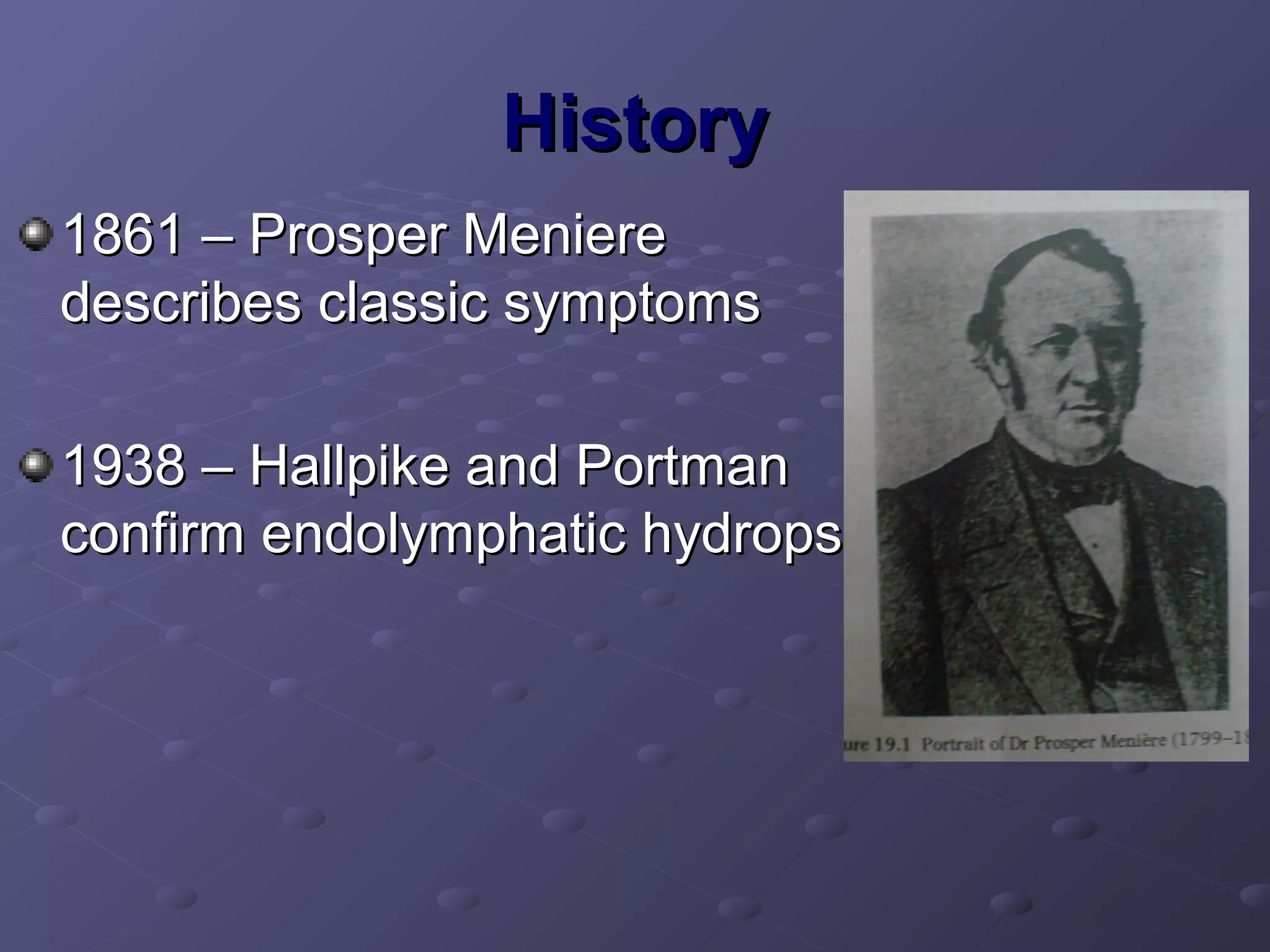
1861 – Prosper Meniere
describes classic symptoms

1938 – Hallpike and Portman
confirm endolymphatic hydrops
AGE DISTRIBUTION AND
          INCIDENCE
35-60 yrs
Females : Male 3:2
Familial
Unilateral / bilateral
PATHOPHYSIOLOGY
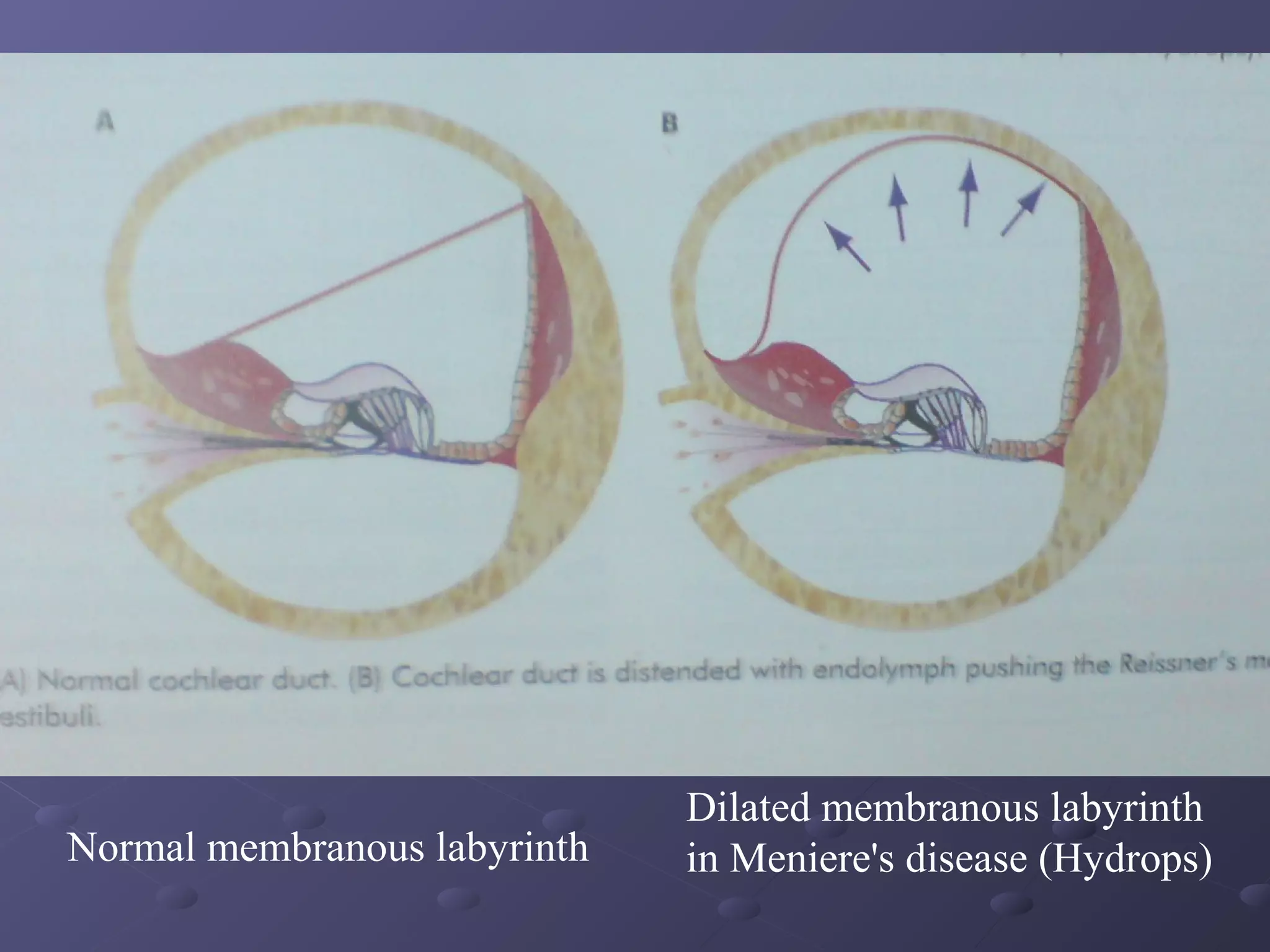
Dilated membranous labyrinth
Normal membranous labyrinth   in Meniere's disease (Hydrops)
Pathophysiology
Theories behind endolymphatic hydrops
   Obstruction of endolymphatic duct/sac
   Hypoplasia of endolymphatic duct/sac

    Alteration of absorption of endolymph
   Alteration in production of endolymph
   Autoimmune insult

    Vascular origin
   Viral etiology
AETIOLOGY (primary causes)
Genetic
Anatomical (small vestibular aqueduct)
Traumatic (physical, acoustic)
Viral infection (HSV type 1)
Allergy
Autoimmunity
AETIOLOGY (secondary causes)
  Developmental insult
  Metabolic states
     (DM, hypothyroidism, hyperlipidaemia)
  Syphilis
  CSOM
  Otosclerosis
  Abnormal fluid balance
CLINICAL FEATURES
Vertigo
   Episodic
   Nystagmus
Hearing loss
   Sensorineural
   Progressive
Tinnitus
   Continuous / intermittent
Aural fullness
DIFFERENTIAL DIAGNOSIS
Vestibular neuronitis
Benign paroxysmal positional vertigo
Vestibular schwannoma
Vertibrobasilar insufficiency
EXAMINATION
Otoscopy: Normal
Nystagmus: During acute attacks
Tuning fork tests:
   Rinnie    Positive

    Weber     Lateralized to better ear
   ABC       Reduced in affected ear
Complete neurological examination
INVESTIGATIONS
Assessment of cochlear function

    PTA


                                  Rising

                                  Flat

                                  Falling
INVESTIGATIONS
Speial audiometric tests
Evoked response audiometry
Transtympanic electrocochleography
INVESTIGATIONS
Assessment of vestibular function
Metabolic screening
   CBC-ESR
   UREA / ELETROLYTES
   VDRL / TPHA
   BSR
   GTT
   CHOLESTEROL / TG
   TFT
TREATMENT
MEDICAL TREATMENT
   Acute Therapy
Medical Treatment
Symptomatic relief

    Salt restriction

    Avoid caffeine, nicotine, alcohol, high-
    carbohydrate substances, high-
    cholesterol/triglyceride foods
   Vestibular suppressants

    Diuretics

    Vasodilators (Betahistine)
   Steroids
Hearing aids
Chemical ablation of
      vestibular function
Intratympanic gentamicin / streptomycin
Surgical Therapy
Endolymphatic Sac Surgery
   Decompression:
    Removal of bone overlying the sac
   Shunting:
    Placement of synthetic shunt to drain
    endolymph into mastoid
   Drainage:
    Incision of the sac to allow drainage

    Removal of sac:
    Excision of the sac
Endolymphatic Sac Surgery
Vestibular Nerve Section
Approaches:
   Middle Fossa
   Retrolabyrinthine/Retrosigmoid

    Transcanal
Complications
   Damage to facial nerve

    Damage to cochlear nerve
   CSF leak (about 13%)
Ultrasonic destruction of
   vestibular labyrinth
Labyrinthectomy
Approaches:
   Transcanal
   Transmastoid
THANK YOU

Meniere’s disease