ANTIHYPERTENSIVE DRUGS IN
SPECIAL SITUATIONS
CURRENT RECOMMENDATIONS FOR BP GOALS
JNC 7 (Joint National Committee on Prevention, Detection,
Evaluation, and Treatment of High Blood) Pressure
 Goal BP <140/90
 Goal with Diabetes or CKD <130/80
http://www.nhlbi.nih.gov/guidelines/hypertension/
ANTIHYPERTENSIVES IN
SPECIAL POPULATION
SPECIAL POPULATIONS INCLUDE
o Diabetes
o Cardiovascular Disease
oCCF
oIschaemic heart disease
oBradycardia
oPeripheral Vascular disease
o Elderly
o Chronic Kidney Disease
o Hypertensive crisis
Other Situations
oChildren and Adolescents
oPregnancy
oHormone replacement therapy
oDyslipidemia
oAsthma and COPD
oCerebrovascular disease
oLiver disease
oGout
oPsoriasis
oScleroderma with Reynaud's phenomenon
HYPERTENSION IN DIABETES
 JNC 7 Guidelines say: Treat to <130/80
 Evidence says: No renal or cardiovascular benefit with
lower BP
 ACE/ARB therapy do improve renal outcomes in
patients with proteinuria including microalbuminuria
 New ICSI guideline: <140/85 (consider <130/80 in
patients with proteinuria)
www.icsi.org
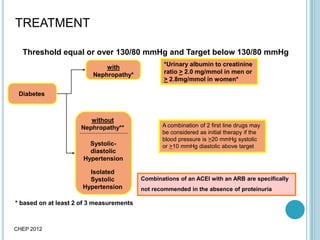
TREATMENT
CHEP 2012
Threshold equal or over 130/80 mmHg and Target below 130/80 mmHg
with
Nephropathy*
*Urinary albumin to creatinine
ratio > 2.0 mg/mmol in men or
> 2.8mg/mmol in women*
Diabetes
without
Nephropathy**
Isolated
Systolic
Hypertension
Systolic-
diastolic
Hypertension
* based on at least 2 of 3 measurements
A combination of 2 first line drugs may
be considered as initial therapy if the
blood pressure is >20 mmHg systolic
or >10 mmHg diastolic above target
Combinations of an ACEI with an ARB are specifically
not recommended in the absence of proteinuria
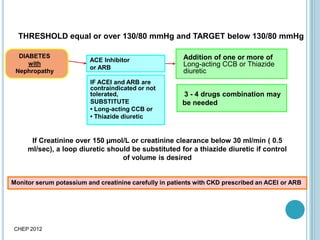
If Creatinine over 150 µmol/L or creatinine clearance below 30 ml/min ( 0.5
ml/sec), a loop diuretic should be substituted for a thiazide diuretic if control
of volume is desired
THRESHOLD equal or over 130/80 mmHg and TARGET below 130/80 mmHg
DIABETES
with
Nephropathy
ACE Inhibitor
or ARB
IF ACEI and ARB are
contraindicated or not
tolerated,
SUBSTITUTE
• Long-acting CCB or
• Thiazide diuretic
Addition of one or more of
Long-acting CCB or Thiazide
diuretic
3 - 4 drugs combination may
be needed
Monitor serum potassium and creatinine carefully in patients with CKD prescribed an ACEI or ARB
CHEP 2012
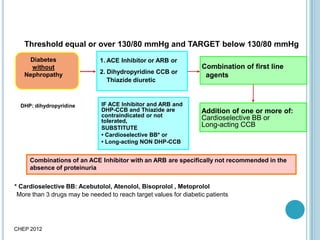
1. ACE Inhibitor or ARB or
2. Dihydropyridine CCB or
Thiazide diuretic
IF ACE Inhibitor and ARB and
DHP-CCB and Thiazide are
contraindicated or not
tolerated,
SUBSTITUTE
• Cardioselective BB* or
• Long-acting NON DHP-CCB
More than 3 drugs may be needed to reach target values for diabetic patients
* Cardioselective BB: Acebutolol, Atenolol, Bisoprolol , Metoprolol
Threshold equal or over 130/80 mmHg and TARGET below 130/80 mmHg
Combination of first line
agents
Addition of one or more of:
Cardioselective BB or
Long-acting CCB
Diabetes
without
Nephropathy
DHP: dihydropyridine
Combinations of an ACE Inhibitor with an ARB are specifically not recommended in the
absence of proteinuria
CHEP 2012
HYPERTENSION WITH
CARDIOVASCULAR DISEASE
HYPERTENSION WITH CO-EXISTING
CARDIOVASCULAR DISEASES
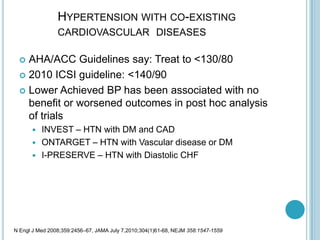
 AHA/ACC Guidelines say: Treat to <130/80
 2010 ICSI guideline: <140/90
 Lower Achieved BP has been associated with no
benefit or worsened outcomes in post hoc analysis
of trials
 INVEST – HTN with DM and CAD
 ONTARGET – HTN with Vascular disease or DM
 I-PRESERVE – HTN with Diastolic CHF
N Engl J Med 2008;359:2456–67, JAMA July 7,2010;304(1)61-68, NEJM 358:1547-1559
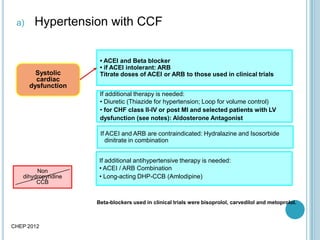
a) Hypertension with CCF
CHEP 2012
Beta-blockers used in clinical trials were bisoprolol, carvedilol and metoprolol.
If additional therapy is needed:
• Diuretic (Thiazide for hypertension; Loop for volume control)
• for CHF class II-IV or post MI and selected patients with LV
dysfunction (see notes): Aldosterone Antagonist
Systolic
cardiac
dysfunction
• ACEI and Beta blocker
• if ACEI intolerant: ARB
Titrate doses of ACEI or ARB to those used in clinical trials
If ACEI and ARB are contraindicated: Hydralazine and Isosorbide
dinitrate in combination
If additional antihypertensive therapy is needed:
• ACEI / ARB Combination
• Long-acting DHP-CCB (Amlodipine)
Non
dihydropyridine
CCB
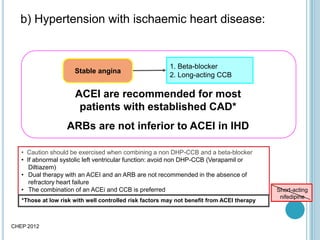
b) Hypertension with ischaemic heart disease:
• Caution should be exercised when combining a non DHP-CCB and a beta-blocker
• If abnormal systolic left ventricular function: avoid non DHP-CCB (Verapamil or
Diltiazem)
• Dual therapy with an ACEI and an ARB are not recommended in the absence of
refractory heart failure
• The combination of an ACEi and CCB is preferred
1. Beta-blocker
2. Long-acting CCB
Stable angina
ACEI are recommended for most
patients with established CAD*
ARBs are not inferior to ACEI in IHD
Short-acting
nifedipine
*Those at low risk with well controlled risk factors may not benefit from ACEI therapy
CHEP 2012
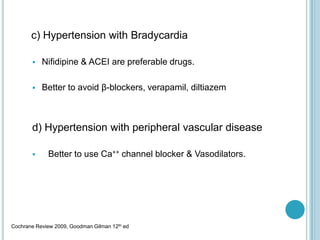
c) Hypertension with Bradycardia
 Nifidipine & ACEI are preferable drugs.
 Better to avoid β-blockers, verapamil, diltiazem
d) Hypertension with peripheral vascular disease
 Better to use Ca++ channel blocker & Vasodilators.
Cochrane Review 2009, Goodman Gilman 12th ed
HYPERTENSION IN ELDERLY
HYPERTENSION IN THE ELDERLY
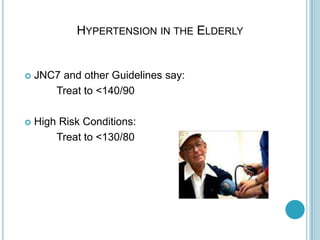
 JNC7 and other Guidelines say:
Treat to <140/90
 High Risk Conditions:
Treat to <130/80
HYVET- HYPERTENSION IN THE VERY ELDERLY
TRIAL
 Only HTN RCT in Patients ≥80 years
 N=3850 mean age 83 years, mean SBP 173 mm
Hg
 Goal SBP<150 mm Hg, mean achieved SBP =143
mm Hg
 Placebo vs perendipril/indapamide
 18 month BP separation = -15/6 mmHg
N Engl J Med 2008; 358(18):1887-98.
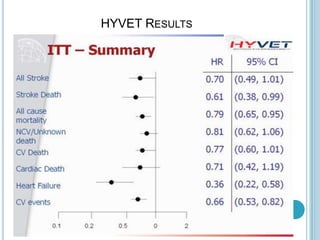
HYVET RESULTS
TREATMENT
 Check and follow BP while standing
 Remember diet/lifestyle changes
 Treat patients with SBP >160 with medications (start with
thiazide or ACE or Ca channel blockers)
 Target BP in those over 80 years: 150
 Recognize that patients with DBP <60 or PP >50 have a
higher risk of CV events, but not clear if this can be
modified
HYPERTENSION IN CHRONIC KIDNEY
DISEASE
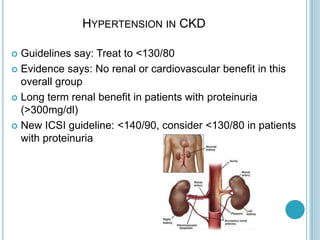
HYPERTENSION IN CKD
 Guidelines say: Treat to <130/80
 Evidence says: No renal or cardiovascular benefit in this
overall group
 Long term renal benefit in patients with proteinuria
(>300mg/dl)
 New ICSI guideline: <140/90, consider <130/80 in patients
with proteinuria
Treatment
CHEP 2012
Chronic kidney
disease and
proteinuria *
ACEI/ARB:
Bilateral renal
artery stenosis
ACEI or ARB (if ACEI intolerant)
Combination with other agents
Additive therapy: Thiazide diuretic.
Alternate: If volume overload: loop diuretic
Target BP: < 140/90 mmHg
* albumin:creatinine ratio [ACR] > 30 mg/mmol
or urinary protein > 500 mg/24hr
Monitor serum potassium and creatinine carefully in patients with CKD prescribed an ACEI or ARB
Combinations of a ACEI and a ARB are specifically not recommended in the absence of proteinuria
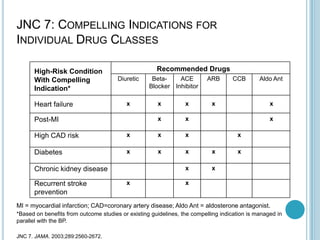
xxRecurrent stroke
prevention
MI = myocardial infarction; CAD=coronary artery disease; Aldo Ant = aldosterone antagonist.
*Based on benefits from outcome studies or existing guidelines, the compelling indication is managed in
parallel with the BP.
JNC 7. JAMA. 2003;289:2560-2672.
xxChronic kidney disease
xxxxxDiabetes
xxxxHigh CAD risk
xxxPost-MI
xxxxxHeart failure
Aldo AntCCBARBACE
Inhibitor
Beta-
Blocker
Diuretic
Recommended DrugsHigh-Risk Condition
With Compelling
Indication*
JNC 7: COMPELLING INDICATIONS FOR
INDIVIDUAL DRUG CLASSES
HYPERTENSIVE CRISIS
HYPERTENSIVE CRISIS
 Systolic blood pressure >220 and diastolic >120mmHg.
 HYPERTENSIVE EMERGENCY: is severe hypertension
with acute impairment of an organ system. In these
conditions, the blood pressure (BP) should be lowered
aggressively over minutes to hours.
 HYPERTENSIVE URGENCY: the BP is a potential risk
but has not yet caused acute end-organ damage. These
patients require BP control over several days to weeks.
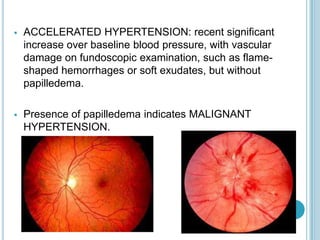
 ACCELERATED HYPERTENSION: recent significant
increase over baseline blood pressure, with vascular
damage on fundoscopic examination, such as flame-
shaped hemorrhages or soft exudates, but without
papilledema.
 Presence of papilledema indicates MALIGNANT
HYPERTENSION.
TREATMENT
Weigh benefits of decreasing BP against risks of
decreasing end-organ perfusion. Important steps
include:
- Appropriately evaluating patients with an elevated BP
- Correctly classifying the hypertension
- Determining aggressiveness of therapy
An important point to remember in the management of
the patient with any degree of BP elevation is to "treat
the patient and not the number."
TREATMENT
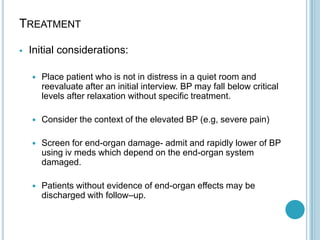
 Initial considerations:
 Place patient who is not in distress in a quiet room and
reevaluate after an initial interview. BP may fall below critical
levels after relaxation without specific treatment.
 Consider the context of the elevated BP (e.g, severe pain)
 Screen for end-organ damage- admit and rapidly lower of BP
using iv meds which depend on the end-organ system
damaged.
 Patients without evidence of end-organ effects may be
discharged with follow–up.
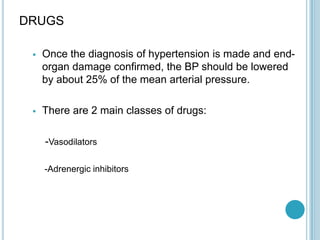
DRUGS
 Once the diagnosis of hypertension is made and end-
organ damage confirmed, the BP should be lowered
by about 25% of the mean arterial pressure.
 There are 2 main classes of drugs:
-Vasodilators
-Adrenergic inhibitors
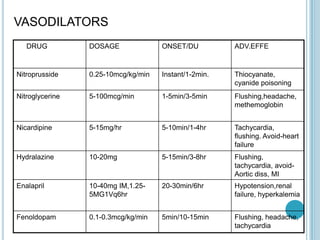
VASODILATORS
DRUG DOSAGE ONSET/DU ADV.EFFE
Nitroprusside 0.25-10mcg/kg/min Instant/1-2min. Thiocyanate,
cyanide poisoning
Nitroglycerine 5-100mcg/min 1-5min/3-5min Flushing,headache,
methemoglobin
Nicardipine 5-15mg/hr 5-10min/1-4hr Tachycardia,
flushing. Avoid-heart
failure
Hydralazine 10-20mg 5-15min/3-8hr Flushing,
tachycardia, avoid-
Aortic diss, MI
Enalapril 10-40mg IM,1.25-
5MG1Vq6hr
20-30min/6hr Hypotension,renal
failure, hyperkalemia
Fenoldopam 0.1-0.3mcg/kg/min 5min/10-15min Flushing, headache,
tachycardia
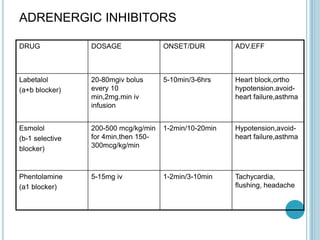
DRUG DOSAGE ONSET/DUR ADV.EFF
Labetalol
(a+b blocker)
20-80mgiv bolus
every 10
min,2mg.min iv
infusion
5-10min/3-6hrs Heart block,ortho
hypotension.avoid-
heart failure,asthma
Esmolol
(b-1 selective
blocker)
200-500 mcg/kg/min
for 4min,then 150-
300mcg/kg/min
1-2min/10-20min Hypotension,avoid-
heart failure,asthma
Phentolamine
(a1 blocker)
5-15mg iv 1-2min/3-10min Tachycardia,
flushing, headache
ADRENERGIC INHIBITORS
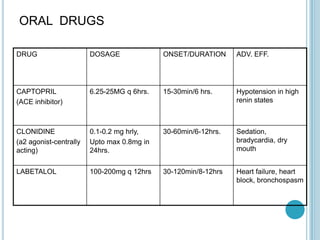
ORAL DRUGS
DRUG DOSAGE ONSET/DURATION ADV. EFF.
CAPTOPRIL
(ACE inhibitor)
6.25-25MG q 6hrs. 15-30min/6 hrs. Hypotension in high
renin states
CLONIDINE
(a2 agonist-centrally
acting)
0.1-0.2 mg hrly,
Upto max 0.8mg in
24hrs.
30-60min/6-12hrs. Sedation,
bradycardia, dry
mouth
LABETALOL 100-200mg q 12hrs 30-120min/8-12hrs Heart failure, heart
block, bronchospasm
OTHER SITUATIONS
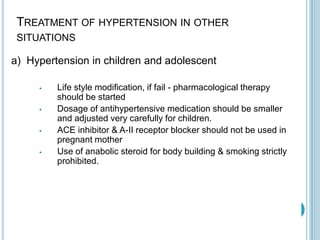
TREATMENT OF HYPERTENSION IN OTHER
SITUATIONS
a) Hypertension in children and adolescent
 Life style modification, if fail - pharmacological therapy
should be started
 Dosage of antihypertensive medication should be smaller
and adjusted very carefully for children.
 ACE inhibitor & A-II receptor blocker should not be used in
pregnant mother
 Use of anabolic steroid for body building & smoking strictly
prohibited.
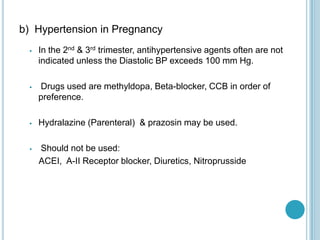
b) Hypertension in Pregnancy
 In the 2nd & 3rd trimester, antihypertensive agents often are not
indicated unless the Diastolic BP exceeds 100 mm Hg.
 Drugs used are methyldopa, Beta-blocker, CCB in order of
preference.
 Hydralazine (Parenteral) & prazosin may be used.
 Should not be used:
ACEI, A-II Receptor blocker, Diuretics, Nitroprusside
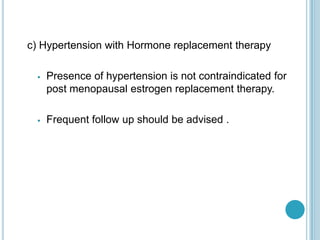
c) Hypertension with Hormone replacement therapy
 Presence of hypertension is not contraindicated for
post menopausal estrogen replacement therapy.
 Frequent follow up should be advised .
D) HYPERTENSION IN DYSLIPIDAEMIA:
 Common co-existence & demand aggressive
management of both conditions.
 High dose thiazides, loop diuretics & beta blockers may
transiently increase total cholesterol, still has significant
reduction CV morbidity & sudden death. So should be
used without hesitation.
E) HYPERTENSION WITH ASTHMA & COPD:
 Ca++ channel blocker is the preferable drug.
 ACEI are safe in most patients with asthma.
 A-II receptor blocker may be used if cough is trouble
some problem after using ACEI.
 Contraindications:
β-blocker should not be used in patient with asthma
except in special circumstances.
Goodman Gilman 12th ed
F) HYPERTENSION WITH CVD:
Treat extreme BP elevation (systolic
> 220 mmHg, diastolic > 120 mmHg)
by 15-25% over the first 24 hour
with gradual reduction after.
•If eligible for thrombolytic therapy
treat very high BP (>185/110 mmHg)
Acute
ischemic
Stroke
Avoid excessive lowering of BP which can exacerbate ischemia
CHEP 2012
G) HYPERTENSION WITH LIVER DISEASE:
All Antihypertensive drugs can be used except methyldopa
H) HYPERTENSION WITH GOUT
All hypertensive drugs can be used
But all Diuretics can increase serum uric acid level. So
diuretics should be avoided if possible.
Contraindications: diuretics
I) HYPERTENSION WITH PSORIASIS:
β-Blocker and ACEI aggravate psoriasis. So better to avoid
them.
J) HYPERTENSION WITH SCLERODERMA WITH
REYNAUD'S PHENOMENON
Nifedipine and prostacycline infusion may occasionally
helpful in patient with severe Reynaud's phenomenon.

Hypertension

  • 1.
  • 2.
    CURRENT RECOMMENDATIONS FORBP GOALS JNC 7 (Joint National Committee on Prevention, Detection, Evaluation, and Treatment of High Blood) Pressure  Goal BP <140/90  Goal with Diabetes or CKD <130/80 http://www.nhlbi.nih.gov/guidelines/hypertension/
  • 3.
  • 4.
    SPECIAL POPULATIONS INCLUDE oDiabetes o Cardiovascular Disease oCCF oIschaemic heart disease oBradycardia oPeripheral Vascular disease o Elderly o Chronic Kidney Disease o Hypertensive crisis
  • 5.
    Other Situations oChildren andAdolescents oPregnancy oHormone replacement therapy oDyslipidemia oAsthma and COPD oCerebrovascular disease oLiver disease oGout oPsoriasis oScleroderma with Reynaud's phenomenon
  • 6.
  • 7.
    HYPERTENSION IN DIABETES JNC 7 Guidelines say: Treat to <130/80  Evidence says: No renal or cardiovascular benefit with lower BP  ACE/ARB therapy do improve renal outcomes in patients with proteinuria including microalbuminuria  New ICSI guideline: <140/85 (consider <130/80 in patients with proteinuria) www.icsi.org
  • 8.
    TREATMENT CHEP 2012 Threshold equalor over 130/80 mmHg and Target below 130/80 mmHg with Nephropathy* *Urinary albumin to creatinine ratio > 2.0 mg/mmol in men or > 2.8mg/mmol in women* Diabetes without Nephropathy** Isolated Systolic Hypertension Systolic- diastolic Hypertension * based on at least 2 of 3 measurements A combination of 2 first line drugs may be considered as initial therapy if the blood pressure is >20 mmHg systolic or >10 mmHg diastolic above target Combinations of an ACEI with an ARB are specifically not recommended in the absence of proteinuria
  • 9.
    If Creatinine over150 µmol/L or creatinine clearance below 30 ml/min ( 0.5 ml/sec), a loop diuretic should be substituted for a thiazide diuretic if control of volume is desired THRESHOLD equal or over 130/80 mmHg and TARGET below 130/80 mmHg DIABETES with Nephropathy ACE Inhibitor or ARB IF ACEI and ARB are contraindicated or not tolerated, SUBSTITUTE • Long-acting CCB or • Thiazide diuretic Addition of one or more of Long-acting CCB or Thiazide diuretic 3 - 4 drugs combination may be needed Monitor serum potassium and creatinine carefully in patients with CKD prescribed an ACEI or ARB CHEP 2012
  • 10.
    1. ACE Inhibitoror ARB or 2. Dihydropyridine CCB or Thiazide diuretic IF ACE Inhibitor and ARB and DHP-CCB and Thiazide are contraindicated or not tolerated, SUBSTITUTE • Cardioselective BB* or • Long-acting NON DHP-CCB More than 3 drugs may be needed to reach target values for diabetic patients * Cardioselective BB: Acebutolol, Atenolol, Bisoprolol , Metoprolol Threshold equal or over 130/80 mmHg and TARGET below 130/80 mmHg Combination of first line agents Addition of one or more of: Cardioselective BB or Long-acting CCB Diabetes without Nephropathy DHP: dihydropyridine Combinations of an ACE Inhibitor with an ARB are specifically not recommended in the absence of proteinuria CHEP 2012
  • 11.
  • 12.
    HYPERTENSION WITH CO-EXISTING CARDIOVASCULARDISEASES  AHA/ACC Guidelines say: Treat to <130/80  2010 ICSI guideline: <140/90  Lower Achieved BP has been associated with no benefit or worsened outcomes in post hoc analysis of trials  INVEST – HTN with DM and CAD  ONTARGET – HTN with Vascular disease or DM  I-PRESERVE – HTN with Diastolic CHF N Engl J Med 2008;359:2456–67, JAMA July 7,2010;304(1)61-68, NEJM 358:1547-1559
  • 13.
    a) Hypertension withCCF CHEP 2012 Beta-blockers used in clinical trials were bisoprolol, carvedilol and metoprolol. If additional therapy is needed: • Diuretic (Thiazide for hypertension; Loop for volume control) • for CHF class II-IV or post MI and selected patients with LV dysfunction (see notes): Aldosterone Antagonist Systolic cardiac dysfunction • ACEI and Beta blocker • if ACEI intolerant: ARB Titrate doses of ACEI or ARB to those used in clinical trials If ACEI and ARB are contraindicated: Hydralazine and Isosorbide dinitrate in combination If additional antihypertensive therapy is needed: • ACEI / ARB Combination • Long-acting DHP-CCB (Amlodipine) Non dihydropyridine CCB
  • 14.
    b) Hypertension withischaemic heart disease: • Caution should be exercised when combining a non DHP-CCB and a beta-blocker • If abnormal systolic left ventricular function: avoid non DHP-CCB (Verapamil or Diltiazem) • Dual therapy with an ACEI and an ARB are not recommended in the absence of refractory heart failure • The combination of an ACEi and CCB is preferred 1. Beta-blocker 2. Long-acting CCB Stable angina ACEI are recommended for most patients with established CAD* ARBs are not inferior to ACEI in IHD Short-acting nifedipine *Those at low risk with well controlled risk factors may not benefit from ACEI therapy CHEP 2012
  • 15.
    c) Hypertension withBradycardia  Nifidipine & ACEI are preferable drugs.  Better to avoid β-blockers, verapamil, diltiazem d) Hypertension with peripheral vascular disease  Better to use Ca++ channel blocker & Vasodilators. Cochrane Review 2009, Goodman Gilman 12th ed
  • 16.
  • 17.
    HYPERTENSION IN THEELDERLY  JNC7 and other Guidelines say: Treat to <140/90  High Risk Conditions: Treat to <130/80
  • 18.
    HYVET- HYPERTENSION INTHE VERY ELDERLY TRIAL  Only HTN RCT in Patients ≥80 years  N=3850 mean age 83 years, mean SBP 173 mm Hg  Goal SBP<150 mm Hg, mean achieved SBP =143 mm Hg  Placebo vs perendipril/indapamide  18 month BP separation = -15/6 mmHg N Engl J Med 2008; 358(18):1887-98.
  • 19.
  • 20.
    TREATMENT  Check andfollow BP while standing  Remember diet/lifestyle changes  Treat patients with SBP >160 with medications (start with thiazide or ACE or Ca channel blockers)  Target BP in those over 80 years: 150  Recognize that patients with DBP <60 or PP >50 have a higher risk of CV events, but not clear if this can be modified
  • 21.
  • 22.
    HYPERTENSION IN CKD Guidelines say: Treat to <130/80  Evidence says: No renal or cardiovascular benefit in this overall group  Long term renal benefit in patients with proteinuria (>300mg/dl)  New ICSI guideline: <140/90, consider <130/80 in patients with proteinuria
  • 23.
    Treatment CHEP 2012 Chronic kidney diseaseand proteinuria * ACEI/ARB: Bilateral renal artery stenosis ACEI or ARB (if ACEI intolerant) Combination with other agents Additive therapy: Thiazide diuretic. Alternate: If volume overload: loop diuretic Target BP: < 140/90 mmHg * albumin:creatinine ratio [ACR] > 30 mg/mmol or urinary protein > 500 mg/24hr Monitor serum potassium and creatinine carefully in patients with CKD prescribed an ACEI or ARB Combinations of a ACEI and a ARB are specifically not recommended in the absence of proteinuria
  • 24.
    xxRecurrent stroke prevention MI =myocardial infarction; CAD=coronary artery disease; Aldo Ant = aldosterone antagonist. *Based on benefits from outcome studies or existing guidelines, the compelling indication is managed in parallel with the BP. JNC 7. JAMA. 2003;289:2560-2672. xxChronic kidney disease xxxxxDiabetes xxxxHigh CAD risk xxxPost-MI xxxxxHeart failure Aldo AntCCBARBACE Inhibitor Beta- Blocker Diuretic Recommended DrugsHigh-Risk Condition With Compelling Indication* JNC 7: COMPELLING INDICATIONS FOR INDIVIDUAL DRUG CLASSES
  • 25.
  • 26.
    HYPERTENSIVE CRISIS  Systolicblood pressure >220 and diastolic >120mmHg.  HYPERTENSIVE EMERGENCY: is severe hypertension with acute impairment of an organ system. In these conditions, the blood pressure (BP) should be lowered aggressively over minutes to hours.  HYPERTENSIVE URGENCY: the BP is a potential risk but has not yet caused acute end-organ damage. These patients require BP control over several days to weeks.
  • 27.
     ACCELERATED HYPERTENSION:recent significant increase over baseline blood pressure, with vascular damage on fundoscopic examination, such as flame- shaped hemorrhages or soft exudates, but without papilledema.  Presence of papilledema indicates MALIGNANT HYPERTENSION.
  • 28.
    TREATMENT Weigh benefits ofdecreasing BP against risks of decreasing end-organ perfusion. Important steps include: - Appropriately evaluating patients with an elevated BP - Correctly classifying the hypertension - Determining aggressiveness of therapy An important point to remember in the management of the patient with any degree of BP elevation is to "treat the patient and not the number."
  • 29.
    TREATMENT  Initial considerations: Place patient who is not in distress in a quiet room and reevaluate after an initial interview. BP may fall below critical levels after relaxation without specific treatment.  Consider the context of the elevated BP (e.g, severe pain)  Screen for end-organ damage- admit and rapidly lower of BP using iv meds which depend on the end-organ system damaged.  Patients without evidence of end-organ effects may be discharged with follow–up.
  • 30.
    DRUGS  Once thediagnosis of hypertension is made and end- organ damage confirmed, the BP should be lowered by about 25% of the mean arterial pressure.  There are 2 main classes of drugs: -Vasodilators -Adrenergic inhibitors
  • 31.
    VASODILATORS DRUG DOSAGE ONSET/DUADV.EFFE Nitroprusside 0.25-10mcg/kg/min Instant/1-2min. Thiocyanate, cyanide poisoning Nitroglycerine 5-100mcg/min 1-5min/3-5min Flushing,headache, methemoglobin Nicardipine 5-15mg/hr 5-10min/1-4hr Tachycardia, flushing. Avoid-heart failure Hydralazine 10-20mg 5-15min/3-8hr Flushing, tachycardia, avoid- Aortic diss, MI Enalapril 10-40mg IM,1.25- 5MG1Vq6hr 20-30min/6hr Hypotension,renal failure, hyperkalemia Fenoldopam 0.1-0.3mcg/kg/min 5min/10-15min Flushing, headache, tachycardia
  • 32.
    DRUG DOSAGE ONSET/DURADV.EFF Labetalol (a+b blocker) 20-80mgiv bolus every 10 min,2mg.min iv infusion 5-10min/3-6hrs Heart block,ortho hypotension.avoid- heart failure,asthma Esmolol (b-1 selective blocker) 200-500 mcg/kg/min for 4min,then 150- 300mcg/kg/min 1-2min/10-20min Hypotension,avoid- heart failure,asthma Phentolamine (a1 blocker) 5-15mg iv 1-2min/3-10min Tachycardia, flushing, headache ADRENERGIC INHIBITORS
  • 33.
    ORAL DRUGS DRUG DOSAGEONSET/DURATION ADV. EFF. CAPTOPRIL (ACE inhibitor) 6.25-25MG q 6hrs. 15-30min/6 hrs. Hypotension in high renin states CLONIDINE (a2 agonist-centrally acting) 0.1-0.2 mg hrly, Upto max 0.8mg in 24hrs. 30-60min/6-12hrs. Sedation, bradycardia, dry mouth LABETALOL 100-200mg q 12hrs 30-120min/8-12hrs Heart failure, heart block, bronchospasm
  • 34.
  • 35.
    TREATMENT OF HYPERTENSIONIN OTHER SITUATIONS a) Hypertension in children and adolescent  Life style modification, if fail - pharmacological therapy should be started  Dosage of antihypertensive medication should be smaller and adjusted very carefully for children.  ACE inhibitor & A-II receptor blocker should not be used in pregnant mother  Use of anabolic steroid for body building & smoking strictly prohibited.
  • 36.
    b) Hypertension inPregnancy  In the 2nd & 3rd trimester, antihypertensive agents often are not indicated unless the Diastolic BP exceeds 100 mm Hg.  Drugs used are methyldopa, Beta-blocker, CCB in order of preference.  Hydralazine (Parenteral) & prazosin may be used.  Should not be used: ACEI, A-II Receptor blocker, Diuretics, Nitroprusside
  • 37.
    c) Hypertension withHormone replacement therapy  Presence of hypertension is not contraindicated for post menopausal estrogen replacement therapy.  Frequent follow up should be advised .
  • 38.
    D) HYPERTENSION INDYSLIPIDAEMIA:  Common co-existence & demand aggressive management of both conditions.  High dose thiazides, loop diuretics & beta blockers may transiently increase total cholesterol, still has significant reduction CV morbidity & sudden death. So should be used without hesitation.
  • 39.
    E) HYPERTENSION WITHASTHMA & COPD:  Ca++ channel blocker is the preferable drug.  ACEI are safe in most patients with asthma.  A-II receptor blocker may be used if cough is trouble some problem after using ACEI.  Contraindications: β-blocker should not be used in patient with asthma except in special circumstances. Goodman Gilman 12th ed
  • 40.
    F) HYPERTENSION WITHCVD: Treat extreme BP elevation (systolic > 220 mmHg, diastolic > 120 mmHg) by 15-25% over the first 24 hour with gradual reduction after. •If eligible for thrombolytic therapy treat very high BP (>185/110 mmHg) Acute ischemic Stroke Avoid excessive lowering of BP which can exacerbate ischemia CHEP 2012
  • 41.
    G) HYPERTENSION WITHLIVER DISEASE: All Antihypertensive drugs can be used except methyldopa H) HYPERTENSION WITH GOUT All hypertensive drugs can be used But all Diuretics can increase serum uric acid level. So diuretics should be avoided if possible. Contraindications: diuretics
  • 42.
    I) HYPERTENSION WITHPSORIASIS: β-Blocker and ACEI aggravate psoriasis. So better to avoid them. J) HYPERTENSION WITH SCLERODERMA WITH REYNAUD'S PHENOMENON Nifedipine and prostacycline infusion may occasionally helpful in patient with severe Reynaud's phenomenon.

Editor's Notes

  • #8 ICSI – institute of clinical systems improvement
  • #9 Chep - Canadian Hypertension Education Program
  • #10 1. Persons with diabetes mellitus should be treated to attain systolic blood pressure of lower than130 mmHg (Grade C) and diastolic blood pressure of less than 80 mmHg (Grade A). (These target blood pressure levels are the same as the blood pressure treatment thresholds.)Combination therapy using two first-line agents may also be considered as initial treatment of hypertension (Grade B) if the SBP is 20 mmHg above the target or if DBP is 10 mmHg above the target. However caution should be exercised in patients in whom a substantial fall in blood pressure is more likely or poorly tolerated (e.g. elderly patients, patients with autonomic neuropathy). 2. For persons with cardiovascular or kidney disease, including microalbuminuria or with cardiovascular risk factors in addition to diabetes and hypertension, an ACE inhibitor or an ARB is recommended as initial therapy (Grade A). 3. For persons with diabetes and hypertension not included in the above recommendation, appropriate choices include (in alphabetical order): ACE inhibitors (Grade A), angiotensin receptor blockers (Grade B), dihydropyridine CCBs (Grade A) and thiazide/thiazide-like diuretics (Grade A).4. If target blood pressures are not achieved with standard-dose monotherapy, additional antihypertensive therapy should be used. For persons in whom combination therapy with an ACE inhibitor is being considered, a dihydropyridine CCB is preferable to hydrochlorothiazide (Grade A).
  • #11 1. Persons with diabetes mellitus should be treated to attain systolic blood pressure of lower than130 mmHg (Grade C) and diastolic blood pressure of less than 80 mmHg (Grade A). (These target blood pressure levels are the same as the blood pressure treatment thresholds.)Combination therapy using two first-line agents may also be considered as initial treatment of hypertension (Grade B) if the SBP is 20 mmHg above the target or if DBP is 10 mmHg above the target. However caution should be exercised in patients in whom a substantial fall in blood pressure is more likely or poorly tolerated (e.g. elderly patients, patients with autonomic neuropathy). 2. For persons with cardiovascular or kidney disease, including microalbuminuria or with cardiovascular risk factors in addition to diabetes and hypertension, an ACE inhibitor or an ARB is recommended as initial therapy (Grade A). 3. For persons with diabetes and hypertension not included in the above recommendation, appropriate choices include (in alphabetical order): ACE inhibitors (Grade A), angiotensin receptor blockers (Grade B), dihydropyridine CCBs (Grade A) and thiazide/thiazide-like diuretics (Grade A).4. If target blood pressures are not achieved with standard-dose monotherapy, additional antihypertensive therapy should be used. For persons in whom combination therapy with an ACE inhibitor is being considered, a dihydropyridine CCB is preferable to hydrochlorothiazide (Grade A).
  • #13 AHA – american heart associationACC – american college of cardiology
  • #19 In 2008, the HYVET trial specifically looked at patients over 80 with almost 4000 patients from europe, china, and other countries. Patients had bps between 160-199 (after 2 months off of all antihypertensive medications) and were randomized to either indapamide, a thiazide type diuretic, or placebo; patients were given additional therapy with an ace inhibitor or placebo if bps remained above target. As in prior studies, the primary endpoint was stroke.