Hearing loss(Types, causes,
disability and handicap certification)
Dr. Sharath Chandra
Junior resident
ENT dept,
AIIMS Rishikesh
Hearing loss
• Hearing loss, also known as hearing impairment, is a
partial or total inability to hear.
Disabling hearing loss refers to hearing loss greater than 40
dB in the better hearing ear in adults (15 years or older) and
greater than 30 dB in the better hearing ear in children (0 to
14 years).
Reference : WHO 2012 guidelines
Prevalence of hearing loss: WHO global estimates
360 million/ 5.8% world’s population
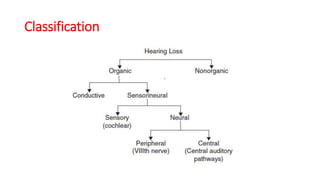
Classification
Conductive hearing loss
Any disease process which interferes with the conduction of
sound to reach cochlea causes conductive hearing loss.
Lesion may be in
• External ear/EAC
• Tympanic membrane
• Ossicles
Essential criteria
BC> AC
AB gap 15dB
Normal bone
conduction
Hearing threshold =< 70dB
Speech discrimination
should be good
Causes
Audiograms of conductive hearing loss
AHL in various lesions of conductive
apparatus
Complete obstruction of ear canal 30 dB
Perforation of tympanic membrane 10–40 dB
Ossicular interruption with intact drum 54 dB
Ossicular interruption with perforation 38 dB
Malleus fixation 10–25 dB
Closure of oval window 60 dB
Sensorineural hearing loss
• Sensorineural hearing loss (SNHL) results from lesions of
• Cochlea
• VIII nerve
• Central auditory pathway lesion
• It can be congenital or acquired.
characteristics of sensorineural hearing loss
• A positive Rinne test, i.e. AC > BC.
• Weber lateralized to better ear.
• Reduced absolute bone conduction test.
• More often involving high frequencies.
• No gap between air and bone conduction curve on audiometry
• Loss may exceed 60 db.
• Speech discrimination is poor.
• There is difficulty in hearing in the presence of noise.
Congenital
Present at birth
Result of anomalies
• Inner ear or
• Damage to the hearing apparatus by prenatal or perinatal factors
Syndromes associated with hearing loss
Acquired
Appears later in life
• Age related hearing loss
• Noise-induced hearing loss
• Ototoxic drugs
• Meniere's disease
• Acoustic neuroma
• Infections of labyrinth—viral, bacterial or spirochaetal
• Sudden hearing loss
Age-related hearing loss
• Definition :
Mid- to late adult onset, bilateral, progressive sensorineural
hearing loss
• Atherosclerosis,
• Diabetes ,
• Hypertension,
• Paget’s disease of bone,
• Otosclerosis,
• Chronic otitis media and Meniers
• Head injury
• Ototoxic drug therapies.
Inner ear
• Histopathological studies performed by Schuknecht and colleagues
• sensory type-loss of hair cells
• neural type- degeneration of the neurons of the cochlear nerve
• vascular-atrophy of the cochlear stria vascularis
• mechanical-stiffness of the cochlear basilar membrane
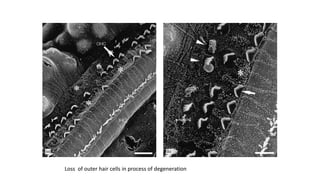
Loss of outer hair cells in process of degeneration
Environmental causes
smokin
g
Noise
exposure
Hypervis
cous
blood
HTN
Ototoxicity
• Ototoxicity is chemical injury to the labyrinth occurring as a side
effect of pharmacotherapy.
• Affect the hearing, vestibular function or both.
• The most widely used drugs causing irreversible ototoxicity are
the aminoglycosides and the chemotherapeutic agent, cisplatin.
Noise induced hearing loss
• Def: The term noise-induced
hearing loss refers to reduction in
auditory acuity associated with
noise exposure
• May be hours to days
• TTS PTS
Pathology of noise induced hearing loss
Metabolic mechanism
• Over stimulation by noise
• Vasoconstriction of cochlea
vasculature
Structural mechanism
• Depolymerization of actin
filaments in stereocilia
• swelling of the stria vascularis,
afferent nerve endings
(a) Audiometry (one month before death)
(b) light microscopy findings from a 47-year-old boilermaker. At
light microscopy a loss of OHC in the 5–13mm region (basal
turn). The other structures of the cochlea are of normal
appearance.
Infections and inflammations
• Viral
• Bacterial
• syphilitic
Sudden hearing loss
Sudden SNHL is defined as 30 dB or more of SNHL over at least three
contiguous frequencies occurring within a period of 3 days or less.
• viral,
• vascular or
• Rupture of cochlear membranes.
Sudden SNHL
Infections
Mumps
Herpes zoster
Syphilis
Meningitis
encephalitis
vascular
Hemorrhage
Thrombosis
Leukemia
Vasospasm
Diabetes
HTN
Sickle cell
Trauma
Head inj
Noise trauma
surgery
Ear
Meniere
Large
aqueduct
Toxic
Ototoxic
Insecticides
Neoplastic
Acosutic
neuroma
CP tumors
psychogenic
SOCIAL AND LEGAL ASPECTS OF
HEARING LOSS
• Hearing loss is impairment of hearing and its severity may
vary from mild to severe or profound,
• Deafness is used, when there is little or no hearing at all.
• WHO in 1980 recommended to use term ‘Deaf’ only when hearing
impairment not benefited from any amplification of sound.
“The deaf are those in whom the sense of hearing is nonfunctional
for ordinary purposes of life”
Definition of deafness
The cases included in the category will be those having hearing
loss more than 90 dB in the better ear
Ministry of Social Welfare, Government of India—Scheme
of Assistance to Hearing Handicap
Impairment, Disability and Handicap
Impairment
Impairment either
in structure or
function
Disability
Affects the ability to
perform certain
functions
Handicap
The disability
further restricts the
duties and roles
expected from an
individual by society
Degree of handicap( calculation)
Average of PTA(X)
Deduct 25dB from PTA avg(X)
Multiply by 1.5
% of hearing loss (X-25 x
1.5)
Percentage of handicap
Example
American Academy of Ophthalmology and Otolaryngology Recommends four
frequencies
Recommended categorization and percentage of hearing
impairment (Dept. of Personnel, Govt. of India).
Recommendations about the categories of disability (Hearing
impairment-Physical aspect only-Test recommended).
• Pure tone audiometry (ISO R 389–1970 at present, is being used as Audiometric Standard
• Three frequency average at 500, 1000 and 2000 Hz by Air Conduction
• PTA should be supplemented by the speech discrimination score
• In child free field testing should be employed.
Suggestions of the facilities to be offered to the
disabled for rehabilitation.
Category I • No special benefits
Category II • Considered for Hearing Aids at free or
concessional costs only.
Category III • Hearing aids, free of cost or at
concessional rates.
• Job reservation—benefit of special
Employment Exchange.
• Scholarships at School.
• Single language formula.
Category IV • Hearing Aids—facilities of reservation-
Special employment exchange.
• Special facilities in schools like
Scholarships. Hearing aids
• Exemption from 3 language formula
Special quota in central institutes like IIT. etc
Hearing loss

Hearing loss

  • 1.
    Hearing loss(Types, causes, disabilityand handicap certification) Dr. Sharath Chandra Junior resident ENT dept, AIIMS Rishikesh
  • 2.
    Hearing loss • Hearingloss, also known as hearing impairment, is a partial or total inability to hear. Disabling hearing loss refers to hearing loss greater than 40 dB in the better hearing ear in adults (15 years or older) and greater than 30 dB in the better hearing ear in children (0 to 14 years). Reference : WHO 2012 guidelines
  • 3.
    Prevalence of hearingloss: WHO global estimates 360 million/ 5.8% world’s population
  • 4.
  • 5.
    Conductive hearing loss Anydisease process which interferes with the conduction of sound to reach cochlea causes conductive hearing loss. Lesion may be in • External ear/EAC • Tympanic membrane • Ossicles
  • 6.
    Essential criteria BC> AC ABgap 15dB Normal bone conduction Hearing threshold =< 70dB Speech discrimination should be good
  • 7.
  • 8.
  • 10.
    AHL in variouslesions of conductive apparatus Complete obstruction of ear canal 30 dB Perforation of tympanic membrane 10–40 dB Ossicular interruption with intact drum 54 dB Ossicular interruption with perforation 38 dB Malleus fixation 10–25 dB Closure of oval window 60 dB
  • 11.
    Sensorineural hearing loss •Sensorineural hearing loss (SNHL) results from lesions of • Cochlea • VIII nerve • Central auditory pathway lesion • It can be congenital or acquired.
  • 12.
    characteristics of sensorineuralhearing loss • A positive Rinne test, i.e. AC > BC. • Weber lateralized to better ear. • Reduced absolute bone conduction test. • More often involving high frequencies. • No gap between air and bone conduction curve on audiometry • Loss may exceed 60 db. • Speech discrimination is poor. • There is difficulty in hearing in the presence of noise.
  • 14.
    Congenital Present at birth Resultof anomalies • Inner ear or • Damage to the hearing apparatus by prenatal or perinatal factors
  • 15.
  • 16.
    Acquired Appears later inlife • Age related hearing loss • Noise-induced hearing loss • Ototoxic drugs • Meniere's disease • Acoustic neuroma • Infections of labyrinth—viral, bacterial or spirochaetal • Sudden hearing loss
  • 17.
    Age-related hearing loss •Definition : Mid- to late adult onset, bilateral, progressive sensorineural hearing loss • Atherosclerosis, • Diabetes , • Hypertension, • Paget’s disease of bone, • Otosclerosis, • Chronic otitis media and Meniers • Head injury • Ototoxic drug therapies.
  • 20.
    Inner ear • Histopathologicalstudies performed by Schuknecht and colleagues • sensory type-loss of hair cells • neural type- degeneration of the neurons of the cochlear nerve • vascular-atrophy of the cochlear stria vascularis • mechanical-stiffness of the cochlear basilar membrane
  • 21.
    Loss of outerhair cells in process of degeneration
  • 22.
  • 23.
    Ototoxicity • Ototoxicity ischemical injury to the labyrinth occurring as a side effect of pharmacotherapy. • Affect the hearing, vestibular function or both. • The most widely used drugs causing irreversible ototoxicity are the aminoglycosides and the chemotherapeutic agent, cisplatin.
  • 25.
    Noise induced hearingloss • Def: The term noise-induced hearing loss refers to reduction in auditory acuity associated with noise exposure • May be hours to days • TTS PTS
  • 26.
    Pathology of noiseinduced hearing loss Metabolic mechanism • Over stimulation by noise • Vasoconstriction of cochlea vasculature Structural mechanism • Depolymerization of actin filaments in stereocilia • swelling of the stria vascularis, afferent nerve endings
  • 27.
    (a) Audiometry (onemonth before death) (b) light microscopy findings from a 47-year-old boilermaker. At light microscopy a loss of OHC in the 5–13mm region (basal turn). The other structures of the cochlea are of normal appearance.
  • 30.
    Infections and inflammations •Viral • Bacterial • syphilitic
  • 31.
    Sudden hearing loss SuddenSNHL is defined as 30 dB or more of SNHL over at least three contiguous frequencies occurring within a period of 3 days or less. • viral, • vascular or • Rupture of cochlear membranes.
  • 32.
    Sudden SNHL Infections Mumps Herpes zoster Syphilis Meningitis encephalitis vascular Hemorrhage Thrombosis Leukemia Vasospasm Diabetes HTN Sicklecell Trauma Head inj Noise trauma surgery Ear Meniere Large aqueduct Toxic Ototoxic Insecticides Neoplastic Acosutic neuroma CP tumors psychogenic
  • 34.
    SOCIAL AND LEGALASPECTS OF HEARING LOSS • Hearing loss is impairment of hearing and its severity may vary from mild to severe or profound, • Deafness is used, when there is little or no hearing at all. • WHO in 1980 recommended to use term ‘Deaf’ only when hearing impairment not benefited from any amplification of sound.
  • 35.
    “The deaf arethose in whom the sense of hearing is nonfunctional for ordinary purposes of life” Definition of deafness The cases included in the category will be those having hearing loss more than 90 dB in the better ear Ministry of Social Welfare, Government of India—Scheme of Assistance to Hearing Handicap
  • 38.
    Impairment, Disability andHandicap Impairment Impairment either in structure or function Disability Affects the ability to perform certain functions Handicap The disability further restricts the duties and roles expected from an individual by society
  • 39.
    Degree of handicap(calculation) Average of PTA(X) Deduct 25dB from PTA avg(X) Multiply by 1.5 % of hearing loss (X-25 x 1.5)
  • 40.
  • 41.
    Example American Academy ofOphthalmology and Otolaryngology Recommends four frequencies
  • 42.
    Recommended categorization andpercentage of hearing impairment (Dept. of Personnel, Govt. of India).
  • 43.
    Recommendations about thecategories of disability (Hearing impairment-Physical aspect only-Test recommended). • Pure tone audiometry (ISO R 389–1970 at present, is being used as Audiometric Standard • Three frequency average at 500, 1000 and 2000 Hz by Air Conduction • PTA should be supplemented by the speech discrimination score • In child free field testing should be employed.
  • 44.
    Suggestions of thefacilities to be offered to the disabled for rehabilitation. Category I • No special benefits Category II • Considered for Hearing Aids at free or concessional costs only. Category III • Hearing aids, free of cost or at concessional rates. • Job reservation—benefit of special Employment Exchange. • Scholarships at School. • Single language formula. Category IV • Hearing Aids—facilities of reservation- Special employment exchange. • Special facilities in schools like Scholarships. Hearing aids • Exemption from 3 language formula Special quota in central institutes like IIT. etc