Understanding
Deafness and
Hearing Loss
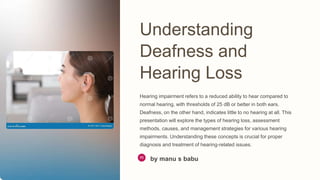
Hearing impairment refers to a reduced ability to hear compared to
normal hearing, with thresholds of 25 dB or better in both ears.
Deafness, on the other hand, indicates little to no hearing at all. This
presentation will explore the types of hearing loss, assessment
methods, causes, and management strategies for various hearing
impairments. Understanding these concepts is crucial for proper
diagnosis and treatment of hearing-related issues.
by manu s babu
Types of Hearing Loss
Conductive Hearing Loss
Caused by interference with
sound conduction from the
external ear to the
stapediovestibular joint. Issues
may arise in the external ear,
tympanic membrane, middle ear,
ossicles, or eustachian tube.
Sensorineural Hearing
Loss
Results from lesions of the
cochlea (sensory type) or VIIIth
nerve and its central connections
(neural type). Retrocochlear
refers to VIIIth nerve lesions,
while central deafness involves
central auditory connection
lesions.
Mixed Hearing Loss
Combines elements of both
conductive and sensorineural
deafness in the same ear. Seen
in some cases of otosclerosis and
chronic suppurative otitis media.
Assessment of Hearing: Tuning Fork Tests
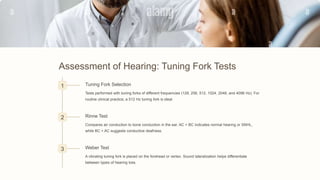
1 Tuning Fork Selection
Tests performed with tuning forks of different frequencies (128, 256, 512, 1024, 2048, and 4096 Hz). For
routine clinical practice, a 512 Hz tuning fork is ideal.
2 Rinne Test
Compares air conduction to bone conduction in the ear. AC > BC indicates normal hearing or SNHL,
while BC > AC suggests conductive deafness.
3 Weber Test
A vibrating tuning fork is placed on the forehead or vertex. Sound lateralization helps differentiate
between types of hearing loss.
Pure Tone Audiometry
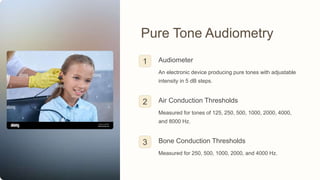
1 Audiometer
An electronic device producing pure tones with adjustable
intensity in 5 dB steps.
2 Air Conduction Thresholds
Measured for tones of 125, 250, 500, 1000, 2000, 4000,
and 8000 Hz.
3 Bone Conduction Thresholds
Measured for 250, 500, 1000, 2000, and 4000 Hz.
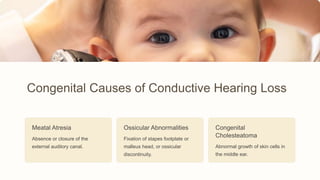
Congenital Causes of Conductive Hearing Loss
Meatal Atresia
Absence or closure of the
external auditory canal.
Ossicular Abnormalities
Fixation of stapes footplate or
malleus head, or ossicular
discontinuity.
Congenital
Cholesteatoma
Abnormal growth of skin cells in
the middle ear.
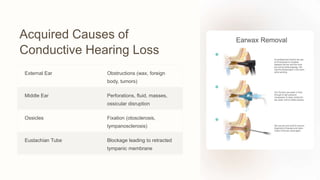
Acquired Causes of
Conductive Hearing Loss
External Ear Obstructions (wax, foreign
body, tumors)
Middle Ear Perforations, fluid, masses,
ossicular disruption
Ossicles Fixation (otosclerosis,
tympanosclerosis)
Eustachian Tube Blockage leading to retracted
tympanic membrane
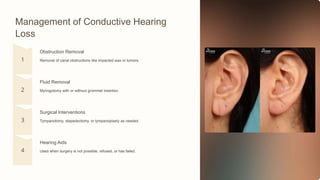
Management of Conductive Hearing
Loss
Obstruction Removal
Removal of canal obstructions like impacted wax or tumors.
Fluid Removal
Myringotomy with or without grommet insertion.
Surgical Interventions
Tympanotomy, stapedectomy, or tympanoplasty as needed.
Hearing Aids
Used when surgery is not possible, refused, or has failed.
Causes of Sensorineural Hearing Loss
(SNHL)
Congenital Causes
Present at birth due to inner ear anomalies or
prenatal/perinatal damage.
Acquired Causes
Infections, trauma, noise exposure, ototoxic drugs,
presbycusis, Ménière's disease, acoustic neuroma,
sudden hearing loss, familial progressive SNHL, and
systemic disorders.
Ototoxicity and Noise-Induced Hearing
Loss
Ototoxic Drugs
Various medications can cause hearing loss, including aminoglycosides, diuretics, antimalarials, and
cytotoxic drugs.
Noise Trauma
Acoustic trauma from brief, intense noise exposure and noise-induced hearing loss from prolonged
exposure can cause permanent damage.
Protection
Hearing protection devices like ear plugs and muffs can provide significant attenuation, especially at
higher frequencies.
Sudden Hearing Loss and
Presbycusis
Sudden Hearing Loss
Defined as 30 dB or more SNHL over at least three contiguous frequencies
occurring within 3 days or less. Various causes include infections, trauma, vascular
issues, and neoplasms.
Treatment for Sudden Hearing Loss
Includes bed rest, steroid therapy, carbogen inhalation, vasodilator drugs, and
hyperbaric oxygen therapy.
Presbycusis
Age-related SNHL, usually manifesting around 65 years. May occur earlier due to
hereditary predisposition, chronic noise exposure, or vascular disease.
The Deaf Child
1 Critical Period
Birth to 5 years is crucial for speech and language development,
necessitating early identification and rehabilitation.
2 Prenatal Causes
Genetic factors, maternal infections, drug exposure, and radiation during
pregnancy.
3 Perinatal Causes
Anoxia, prematurity, birth injuries, jaundice, meningitis, and ototoxic drugs.
4 Postnatal Causes
Genetic factors manifesting later in childhood or various acquired causes
similar to adults.
Comprehensive Approach to Hearing Loss
1 Early Detection
Crucial for effective management, especially in
children.
2 Accurate Diagnosis
Utilizing various tests to determine the type and
extent of hearing loss.
3 Tailored Treatment
Ranging from medical interventions to assistive
devices based on individual needs.
4 Ongoing Support
Rehabilitation and support services to improve
quality of life for those with hearing impairments.
Thank You
We hope this presentation has provided a comprehensive
overview of hearing loss and the various approaches to
assessment, diagnosis, and management. Thank you for your
time and attention.

Understanding-Deafness-and-Hearing-Loss.pptx

  • 1.
    Understanding Deafness and Hearing Loss Hearingimpairment refers to a reduced ability to hear compared to normal hearing, with thresholds of 25 dB or better in both ears. Deafness, on the other hand, indicates little to no hearing at all. This presentation will explore the types of hearing loss, assessment methods, causes, and management strategies for various hearing impairments. Understanding these concepts is crucial for proper diagnosis and treatment of hearing-related issues. by manu s babu
  • 2.
    Types of HearingLoss Conductive Hearing Loss Caused by interference with sound conduction from the external ear to the stapediovestibular joint. Issues may arise in the external ear, tympanic membrane, middle ear, ossicles, or eustachian tube. Sensorineural Hearing Loss Results from lesions of the cochlea (sensory type) or VIIIth nerve and its central connections (neural type). Retrocochlear refers to VIIIth nerve lesions, while central deafness involves central auditory connection lesions. Mixed Hearing Loss Combines elements of both conductive and sensorineural deafness in the same ear. Seen in some cases of otosclerosis and chronic suppurative otitis media.
  • 3.
    Assessment of Hearing:Tuning Fork Tests 1 Tuning Fork Selection Tests performed with tuning forks of different frequencies (128, 256, 512, 1024, 2048, and 4096 Hz). For routine clinical practice, a 512 Hz tuning fork is ideal. 2 Rinne Test Compares air conduction to bone conduction in the ear. AC > BC indicates normal hearing or SNHL, while BC > AC suggests conductive deafness. 3 Weber Test A vibrating tuning fork is placed on the forehead or vertex. Sound lateralization helps differentiate between types of hearing loss.
  • 4.
    Pure Tone Audiometry 1Audiometer An electronic device producing pure tones with adjustable intensity in 5 dB steps. 2 Air Conduction Thresholds Measured for tones of 125, 250, 500, 1000, 2000, 4000, and 8000 Hz. 3 Bone Conduction Thresholds Measured for 250, 500, 1000, 2000, and 4000 Hz.
  • 5.
    Congenital Causes ofConductive Hearing Loss Meatal Atresia Absence or closure of the external auditory canal. Ossicular Abnormalities Fixation of stapes footplate or malleus head, or ossicular discontinuity. Congenital Cholesteatoma Abnormal growth of skin cells in the middle ear.
  • 6.
    Acquired Causes of ConductiveHearing Loss External Ear Obstructions (wax, foreign body, tumors) Middle Ear Perforations, fluid, masses, ossicular disruption Ossicles Fixation (otosclerosis, tympanosclerosis) Eustachian Tube Blockage leading to retracted tympanic membrane
  • 7.
    Management of ConductiveHearing Loss Obstruction Removal Removal of canal obstructions like impacted wax or tumors. Fluid Removal Myringotomy with or without grommet insertion. Surgical Interventions Tympanotomy, stapedectomy, or tympanoplasty as needed. Hearing Aids Used when surgery is not possible, refused, or has failed.
  • 8.
    Causes of SensorineuralHearing Loss (SNHL) Congenital Causes Present at birth due to inner ear anomalies or prenatal/perinatal damage. Acquired Causes Infections, trauma, noise exposure, ototoxic drugs, presbycusis, Ménière's disease, acoustic neuroma, sudden hearing loss, familial progressive SNHL, and systemic disorders.
  • 9.
    Ototoxicity and Noise-InducedHearing Loss Ototoxic Drugs Various medications can cause hearing loss, including aminoglycosides, diuretics, antimalarials, and cytotoxic drugs. Noise Trauma Acoustic trauma from brief, intense noise exposure and noise-induced hearing loss from prolonged exposure can cause permanent damage. Protection Hearing protection devices like ear plugs and muffs can provide significant attenuation, especially at higher frequencies.
  • 10.
    Sudden Hearing Lossand Presbycusis Sudden Hearing Loss Defined as 30 dB or more SNHL over at least three contiguous frequencies occurring within 3 days or less. Various causes include infections, trauma, vascular issues, and neoplasms. Treatment for Sudden Hearing Loss Includes bed rest, steroid therapy, carbogen inhalation, vasodilator drugs, and hyperbaric oxygen therapy. Presbycusis Age-related SNHL, usually manifesting around 65 years. May occur earlier due to hereditary predisposition, chronic noise exposure, or vascular disease.
  • 11.
    The Deaf Child 1Critical Period Birth to 5 years is crucial for speech and language development, necessitating early identification and rehabilitation. 2 Prenatal Causes Genetic factors, maternal infections, drug exposure, and radiation during pregnancy. 3 Perinatal Causes Anoxia, prematurity, birth injuries, jaundice, meningitis, and ototoxic drugs. 4 Postnatal Causes Genetic factors manifesting later in childhood or various acquired causes similar to adults.
  • 12.
    Comprehensive Approach toHearing Loss 1 Early Detection Crucial for effective management, especially in children. 2 Accurate Diagnosis Utilizing various tests to determine the type and extent of hearing loss. 3 Tailored Treatment Ranging from medical interventions to assistive devices based on individual needs. 4 Ongoing Support Rehabilitation and support services to improve quality of life for those with hearing impairments.
  • 13.
    Thank You We hopethis presentation has provided a comprehensive overview of hearing loss and the various approaches to assessment, diagnosis, and management. Thank you for your time and attention.