D.C Machine
Winding Fundamentals
Dr. Siba Prasada Panigrahi
Winding in Armature
• Armature of D.C machines carries a closed
winding.
• Closed winding means that the coils forms a
closed circuit.
• The junction points of the coils are on copper
bars called commutator segments.
• These commutator segments are insulated
from each other by insulation.
Terminologies
• Coil
• Coil span
• Double layer winding
• Numbering a coil
• Commutator segment
• Commutator pitch
Coil
• A conductor is placed in a designated slot
• Two conductors from two different slots
when connected at one end forms a coil
• Hence each coil has two coil sides.
• Spacing between two coil sides are close to
180° electrical to occupy a place under
opposite poles.
Coil span
• Spacing between the two coil sides is termed as
coil span and counted by number of slots
between the sides.
• Coil Span= No. of slots (S)/ No. of Poles (P)
• For 30 slots, 6 poles winding, coil span is 5.
• Let the slots be numbered serially as 1, 2,…, 30.
• If one coil side is placed in slot number 7, the
other coil side of the coil must occupy slot
number 12(= 7+ 5).
Double layer winding
• To maximize number of coils for a given number of
slots, each slot now divided into two layers separated
by insulation.
• One slot carries two coil sides they belong to two
different coils.
• For slot No. 7, the upper coil side is numbered as 7
and the lower coil side is 7'.
• For a given coil one coil side is placed in the upper
deck of one slot, the other side will be in the lower
deck of another slot.
• Since there are two layers, the winding is two layer
winding.
Numbering a coil
• Suppose S = 20 and P = 4, then coil span is 5.
• Let the upper coil side of this coil be placed in
slot number 6, the other coil side must be in
the lower deck of slot number 11.
• The coil should now be identified as (5 - 11').
• In other words coil sides of a coil are
numbered depending on the slot numbers in
which these are placed.
Commutator segment
• Two coil sides (belonging to two different
coils) terminate On a Commutator segment.
• 2S being the total number of coil sides,
number of commutator segments must be
equal to S, number of slots.
• Commutator segments can also be numbered
as 1,2,…,30 in order to identify them clearly.
Commutator pitch
• The separation of coil sides of a coil in terms
of number of commutator segments is called
the commutator pitch, yc.
• The value of yc decides the types of winding
(lap or wave).
• For example, in case of lap winding yc = 1.
Terminology
• Pole Pitch
• Coil span or coil pitch
• Back Pitch
• Front Pitch
• Pitch of a winding
• Resultant Pitch
• Commutator Pitch
Pole Pitch
• Distance between adjacent poles
• (Periphery of armature)/(Number of poles)
Coil span or coil pitch
• Periphery of armature spanned by two sides of a
coil
• Measured in terms of armature slots or
conductors
• Full pitch wdg.=coil span is 1800 electrical (Pole
pitch=coil pitch)
• Short pitched wdg (Coil pitch<pole pitch)
• 36 slots, 4 poles, coil span=36/4=9,
• If slos=3, Ys=35/4=4
Pitch..
• Back Pitch=YB=Distance by which a coil
advances on back of the armature
• Front Pitch=YF= Number of armature
conductors are spanned on the front of the
commutator
• Pitch of a winding=Y=Distance round the
armature between two successive conductors
directly connected, Y=YB-YF (Lap), Y=YB+YF
(Wave),
Pitch..
• Resultant Pitch=YR=Distance between
beginning of one coil and beginning of the
next coil to which it is connected
• Commutator Pitch=YC=Distance between
segments to which two ends of one coil are
connected
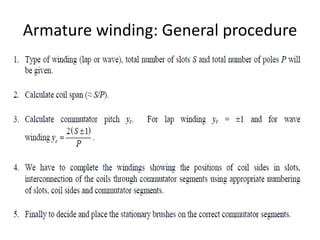
Armature winding: General procedure
16 slot, 4 pole, 2 layer lap
• YB&YF odd, YB & YF of opposite sign, differ by 2
or multiple, nearly equal to pole pitch
• Avg. Pitch=(YB+YF )/2=Z/P
• YC=±1; YR= YB-YF =even
• No. of conductors=Z=16X2=32
• Pole pitch=32/4=8,
• Progressive wdg: YC=-1; YB=9; YF=-7
• YB=(Z/P)+1=9; YF =(Z/P)-1=7
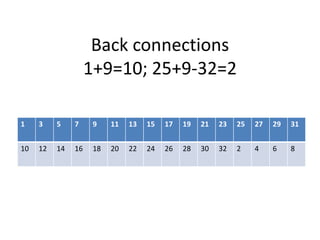
Back connections
1+9=10; 25+9-32=2
1 3 5 7 9 11 13 15 17 19 21 23 25 27 29 31
10 12 14 16 18 20 22 24 26 28 30 32 2 4 6 8
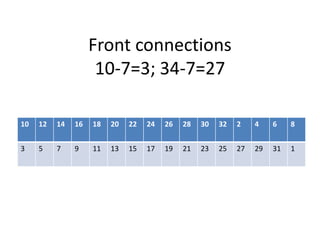
Front connections
10-7=3; 34-7=27
10 12 14 16 18 20 22 24 26 28 30 32 2 4 6 8
3 5 7 9 11 13 15 17 19 21 23 25 27 29 31 1
30 conductors, 4 pole, 2 layer wave
• YB&YF odd, YB & YF of samesign, may be equal
or differ by 2, nearly equal to pole pitch
• Avg. Pitch=(YB+YF )/2=Z/P
• YC=YA=Integer=(Z±2)/P
• YR= YB+YF
• YA= YB=YF=7
Back connections
1+7=8; 29+7-30=6
1 15 29 13 27 11 25 9 23 7 21
8 22 6 20 4 18 2 16 30 14 28
Front connections
8+7=15; 30+7-30=7
8 22 6 20 4 18 2 16 30 14 28
15 29 13 27 11 25 9 23 7 21 5
Lap winding
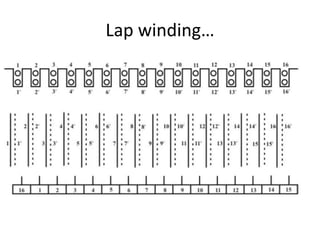
• Suppose we want to make a lap winding for a
P = 4 pole D.C machine having a total number
slots S = 16.
• So coil span is 16/4 = 4. Commutator pitch of a
progressive lap winding is yc = +1.
• To view the coil sides / coils, we must look
below from above the slots as depicted in
figure
Lap winding…
Lap winding…
• Once we number the slots, the numbering of
the coil sides gets fixed and written.
• The upper coil side present in slot number 1 is
shown by firm line and named 1 while lower
coil side is shown by a dashed line (just beside
the upper coil side) and named as 1'.
• Let us now see how coils can be drawn with
proper termination on the commutator
segments.
Lap winding…
• Since the coil span is 4, the first coil has sides 1 and 5' and
the identification of the coil can be expressed as (1 - 5').
• Let us terminate coil side 1 on commutator segment 1. The
question now is where to terminate coil side 5'?
• Since the commutator pitch yc is +1, 5' to be terminated on
commutator segment 2 (= yc +1).
• In D.C armature winding all coils are to be connected in
series.
• So naturally next coil (2 - 6') should start from commutator
segment 2 and the coil side 6' terminated on segment 3 as
shown in figure (next).
• It may be noted that in a lap winding there exist a single
coil between any two consecutive commutator segments.
Lap winding..
• It can be seen that the second coil 2 - 6' is in the
lap of the first coil 1 - 5', hence the winding is
called lap winding.
• The winding proceeds from left to right due to
our assumption that yc = +1.
• Such a winding is called progressive simplex lap
winding.
• It can be easily shown that if yc is chosen to be -1,
the winding would have proceeded from right to
left giving rise to a retrogressive lap winding.
Lap winding..
• One can make first a winding table and then
go for actual winding.
• By now it is clear that to go ahead with
winding, two information are essential;
namely the number of coil sides of a coil and
the number of commutator segments where
the free ends of the coil sides will be
terminated.
Progressive lap winding
Wave winding
• In this winding these coil sides of a coil is not
terminated in adjacent commutator segments,
i.e., yc ≠ 1.
• Instead yc is selected to be closely equal to two
pole pitch in terms of commutator segments.
• Mathematically yc ≈ 2S/P.
• Let us attempt to make a wave winding with
the specifications S = 16 and P = 4. Obviously,
coil span is 4 and yc = 8.
Wave Winding
• The first coil is (1 - 5') and is terminated on
commutator segments 1 and 9.
• The second coil (9 - 13') to be connected in series with
the first and to be terminated on commutator
segments 9 and 1 (i.e., 17').
• Thus we find the winding gets closed just after
traversing only two coils and it is not possible to carry
on with the winding.
• Our inability to complete the wave winding will persist
if 2S remains a multiple of P.
• It is because of this reason expression for commutator
pitch yc, is modified to yc = 2(S ± 1)/P.
Wave Winding
• In other words, number of slots, should be
such that 2(S ± 1) should be multiple of P.
• It can be shown that if +ve sign is taken the
result will be a progressive wave winding and
if –ve sign is taken the result will be
retrogressive wave winding.
Queries?

D.c machine winding funda

  • 1.
  • 2.
    Winding in Armature •Armature of D.C machines carries a closed winding. • Closed winding means that the coils forms a closed circuit. • The junction points of the coils are on copper bars called commutator segments. • These commutator segments are insulated from each other by insulation.
  • 3.
    Terminologies • Coil • Coilspan • Double layer winding • Numbering a coil • Commutator segment • Commutator pitch
  • 4.
    Coil • A conductoris placed in a designated slot • Two conductors from two different slots when connected at one end forms a coil • Hence each coil has two coil sides. • Spacing between two coil sides are close to 180° electrical to occupy a place under opposite poles.
  • 5.
    Coil span • Spacingbetween the two coil sides is termed as coil span and counted by number of slots between the sides. • Coil Span= No. of slots (S)/ No. of Poles (P) • For 30 slots, 6 poles winding, coil span is 5. • Let the slots be numbered serially as 1, 2,…, 30. • If one coil side is placed in slot number 7, the other coil side of the coil must occupy slot number 12(= 7+ 5).
  • 6.
    Double layer winding •To maximize number of coils for a given number of slots, each slot now divided into two layers separated by insulation. • One slot carries two coil sides they belong to two different coils. • For slot No. 7, the upper coil side is numbered as 7 and the lower coil side is 7'. • For a given coil one coil side is placed in the upper deck of one slot, the other side will be in the lower deck of another slot. • Since there are two layers, the winding is two layer winding.
  • 7.
    Numbering a coil •Suppose S = 20 and P = 4, then coil span is 5. • Let the upper coil side of this coil be placed in slot number 6, the other coil side must be in the lower deck of slot number 11. • The coil should now be identified as (5 - 11'). • In other words coil sides of a coil are numbered depending on the slot numbers in which these are placed.
  • 8.
    Commutator segment • Twocoil sides (belonging to two different coils) terminate On a Commutator segment. • 2S being the total number of coil sides, number of commutator segments must be equal to S, number of slots. • Commutator segments can also be numbered as 1,2,…,30 in order to identify them clearly.
  • 9.
    Commutator pitch • Theseparation of coil sides of a coil in terms of number of commutator segments is called the commutator pitch, yc. • The value of yc decides the types of winding (lap or wave). • For example, in case of lap winding yc = 1.
  • 10.
    Terminology • Pole Pitch •Coil span or coil pitch • Back Pitch • Front Pitch • Pitch of a winding • Resultant Pitch • Commutator Pitch
  • 11.
    Pole Pitch • Distancebetween adjacent poles • (Periphery of armature)/(Number of poles)
  • 12.
    Coil span orcoil pitch • Periphery of armature spanned by two sides of a coil • Measured in terms of armature slots or conductors • Full pitch wdg.=coil span is 1800 electrical (Pole pitch=coil pitch) • Short pitched wdg (Coil pitch<pole pitch) • 36 slots, 4 poles, coil span=36/4=9, • If slos=3, Ys=35/4=4
  • 13.
    Pitch.. • Back Pitch=YB=Distanceby which a coil advances on back of the armature • Front Pitch=YF= Number of armature conductors are spanned on the front of the commutator • Pitch of a winding=Y=Distance round the armature between two successive conductors directly connected, Y=YB-YF (Lap), Y=YB+YF (Wave),
  • 14.
    Pitch.. • Resultant Pitch=YR=Distancebetween beginning of one coil and beginning of the next coil to which it is connected • Commutator Pitch=YC=Distance between segments to which two ends of one coil are connected
  • 15.
  • 16.
    16 slot, 4pole, 2 layer lap • YB&YF odd, YB & YF of opposite sign, differ by 2 or multiple, nearly equal to pole pitch • Avg. Pitch=(YB+YF )/2=Z/P • YC=±1; YR= YB-YF =even • No. of conductors=Z=16X2=32 • Pole pitch=32/4=8, • Progressive wdg: YC=-1; YB=9; YF=-7 • YB=(Z/P)+1=9; YF =(Z/P)-1=7
  • 17.
    Back connections 1+9=10; 25+9-32=2 13 5 7 9 11 13 15 17 19 21 23 25 27 29 31 10 12 14 16 18 20 22 24 26 28 30 32 2 4 6 8
  • 18.
    Front connections 10-7=3; 34-7=27 1012 14 16 18 20 22 24 26 28 30 32 2 4 6 8 3 5 7 9 11 13 15 17 19 21 23 25 27 29 31 1
  • 19.
    30 conductors, 4pole, 2 layer wave • YB&YF odd, YB & YF of samesign, may be equal or differ by 2, nearly equal to pole pitch • Avg. Pitch=(YB+YF )/2=Z/P • YC=YA=Integer=(Z±2)/P • YR= YB+YF • YA= YB=YF=7
  • 20.
    Back connections 1+7=8; 29+7-30=6 115 29 13 27 11 25 9 23 7 21 8 22 6 20 4 18 2 16 30 14 28
  • 21.
    Front connections 8+7=15; 30+7-30=7 822 6 20 4 18 2 16 30 14 28 15 29 13 27 11 25 9 23 7 21 5
  • 22.
    Lap winding • Supposewe want to make a lap winding for a P = 4 pole D.C machine having a total number slots S = 16. • So coil span is 16/4 = 4. Commutator pitch of a progressive lap winding is yc = +1. • To view the coil sides / coils, we must look below from above the slots as depicted in figure
  • 23.
  • 24.
    Lap winding… • Oncewe number the slots, the numbering of the coil sides gets fixed and written. • The upper coil side present in slot number 1 is shown by firm line and named 1 while lower coil side is shown by a dashed line (just beside the upper coil side) and named as 1'. • Let us now see how coils can be drawn with proper termination on the commutator segments.
  • 25.
    Lap winding… • Sincethe coil span is 4, the first coil has sides 1 and 5' and the identification of the coil can be expressed as (1 - 5'). • Let us terminate coil side 1 on commutator segment 1. The question now is where to terminate coil side 5'? • Since the commutator pitch yc is +1, 5' to be terminated on commutator segment 2 (= yc +1). • In D.C armature winding all coils are to be connected in series. • So naturally next coil (2 - 6') should start from commutator segment 2 and the coil side 6' terminated on segment 3 as shown in figure (next). • It may be noted that in a lap winding there exist a single coil between any two consecutive commutator segments.
  • 27.
    Lap winding.. • Itcan be seen that the second coil 2 - 6' is in the lap of the first coil 1 - 5', hence the winding is called lap winding. • The winding proceeds from left to right due to our assumption that yc = +1. • Such a winding is called progressive simplex lap winding. • It can be easily shown that if yc is chosen to be -1, the winding would have proceeded from right to left giving rise to a retrogressive lap winding.
  • 28.
    Lap winding.. • Onecan make first a winding table and then go for actual winding. • By now it is clear that to go ahead with winding, two information are essential; namely the number of coil sides of a coil and the number of commutator segments where the free ends of the coil sides will be terminated.
  • 29.
  • 30.
    Wave winding • Inthis winding these coil sides of a coil is not terminated in adjacent commutator segments, i.e., yc ≠ 1. • Instead yc is selected to be closely equal to two pole pitch in terms of commutator segments. • Mathematically yc ≈ 2S/P. • Let us attempt to make a wave winding with the specifications S = 16 and P = 4. Obviously, coil span is 4 and yc = 8.
  • 31.
    Wave Winding • Thefirst coil is (1 - 5') and is terminated on commutator segments 1 and 9. • The second coil (9 - 13') to be connected in series with the first and to be terminated on commutator segments 9 and 1 (i.e., 17'). • Thus we find the winding gets closed just after traversing only two coils and it is not possible to carry on with the winding. • Our inability to complete the wave winding will persist if 2S remains a multiple of P. • It is because of this reason expression for commutator pitch yc, is modified to yc = 2(S ± 1)/P.
  • 32.
    Wave Winding • Inother words, number of slots, should be such that 2(S ± 1) should be multiple of P. • It can be shown that if +ve sign is taken the result will be a progressive wave winding and if –ve sign is taken the result will be retrogressive wave winding.
  • 34.