GUJARAT POWER ENGINEERING 
& RESEARCH INSTITUTE 
By- 
-Thawani Karan(58)
Nikola Tesla 
-Inventor of A.C 
Generator 
GENERATION OF 
ALTERNATING CURRENT
•Alternating Current: An alternating current is the 
current which changes periodically both in 
magnitude and direction. 
•The machines which are used to generate 
electrical voltages are called “GENERATORS”. 
•The generators which generate purely sinusoidal 
A.C. voltage are called “ALTERNATORS” 
•Sinusoidal Voltage:A sinusoidal voltage is an 
oscillating voltage that can be described 
mathematically through the use of a sine function. 
•A.C voltage may be generated by rotating a coil in a 
magnetic field or by rotating a magnetic field 
within a stationary coil.
•The basic principle of an alternate is the 
principle of Electromagnetic Induction.It says 
that whenever there is a relative motion 
between the conductor and the magnetic field 
in which it is kept,an e.m.f gets indduced in the 
conductor. 
-Construction of single wave alternator: 
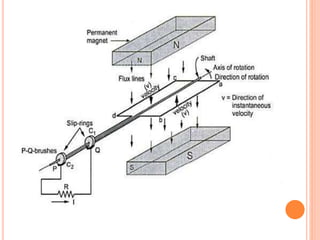
•It consists of a permanent magnet of two 
poles.A single turn rectangular coil is kept on 
the vicinity of the permanent magnet.This coil 
is made up of same conducting material like 
copper or aluminium.The coil is made up of two 
conductors namely a-b and c-d.Such two 
conductors are connected at one end to a coil.
•The coil is so placed that it can be rotated about 
its own axis in clockwise or anticlockwise 
direction.the remaining two ends C1 and C2 of the 
coil are connected to the rings mounted on the 
shaft called slip rings.slip rings are also rotating 
members of the alternator.the two brushes P and Q 
are resting on the slip rings.The brushes are 
stationary and are just making contacts with slip 
rings.The slip rings and brush assembly is necessary 
to collect the current induced in the rotating coil 
and make it available to the stationary external 
resistance.The overall construction is shown in the 
next slide.
Working: The coil is rotated in anticlockwise 
direction. While rotating, the conductors ab and 
cd cut the lines of flux of the permanent magnet. 
Due to faraday’s law of electromagnetic 
induction, an e.m.f gets induced in the 
conductors. The e.m.f. drives a current through 
resistance R connected across the brush P and Q. 
The magnitude of the induced e.m.f depends on 
the position of the coil in magnetic field. Let us 
see the relation between magnitude of the 
induced e.m.f and the position of the coil. 
Consider different instants and the different 
position of the coil.
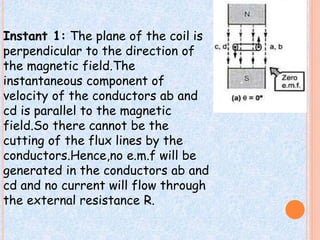
Instant 1: The plane of the coil is 
perpendicular to the direction of 
the magnetic field.The 
instantaneous component of 
velocity of the conductors ab and 
cd is parallel to the magnetic 
field.So there cannot be the 
cutting of the flux lines by the 
conductors.Hence,no e.m.f will be 
generated in the conductors ab and 
cd and no current will flow through 
the external resistance R.
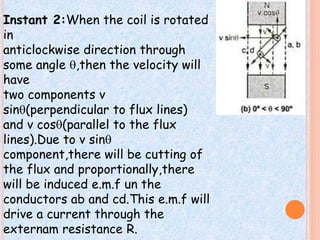
Instant 2:When the coil is rotated 
in 
anticlockwise direction through 
some angle ,then the velocity will 
have 
two components v 
sin(perpendicular to flux lines) 
and v cos(parallel to the flux 
lines).Due to v sin 
component,there will be cutting of 
the flux and proportionally,there 
will be induced e.m.f un the 
conductors ab and cd.This e.m.f will 
drive a current through the 
externam resistance R.
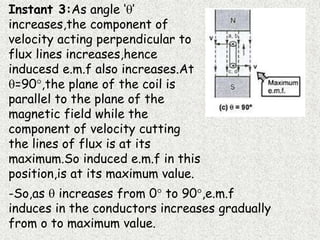
Instant 3:As angle ‘’ 
increases,the component of 
velocity acting perpendicular to 
flux lines increases,hence 
inducesd e.m.f also increases.At 
=90,the plane of the coil is 
parallel to the plane of the 
magnetic field while the 
component of velocity cutting 
the lines of flux is at its 
maximum.So induced e.m.f in this 
position,is at its maximum value. 
-So,as  increases from 0 to 90,e.m.f 
induces in the conductors increases gradually 
from o to maximum value.
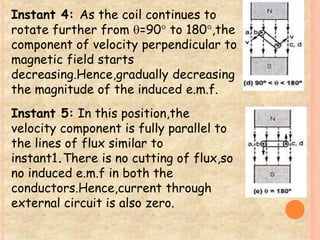
Instant 4: As the coil continues to 
rotate further from =90 to 180,the 
component of velocity perpendicular to 
magnetic field starts 
decreasing.Hence,gradually decreasing 
the magnitude of the induced e.m.f. 
Instant 5: In this position,the 
velocity component is fully parallel to 
the lines of flux similar to 
instant1.There is no cutting of flux,so 
no induced e.m.f in both the 
conductors.Hence,current through 
external circuit is also zero.
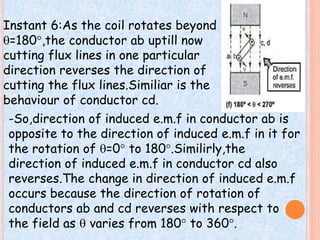
Instant 6:As the coil rotates beyond 
=180,the conductor ab uptill now 
cutting flux lines in one particular 
direction reverses the direction of 
cutting the flux lines.Similiar is the 
behaviour of conductor cd. 
-So,direction of induced e.m.f in conductor ab is 
opposite to the direction of induced e.m.f in it for 
the rotation of =0 to 180.Similirly,the 
direction of induced e.m.f in conductor cd also 
reverses.The change in direction of induced e.m.f 
occurs because the direction of rotation of 
conductors ab and cd reverses with respect to 
the field as  varies from 180 to 360.
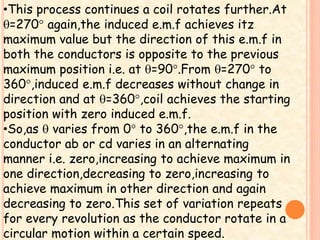
•This process continues a coil rotates further.At 
=270 again,the induced e.m.f achieves itz 
maximum value but the direction of this e.m.f in 
both the conductors is opposite to the previous 
maximum position i.e. at =90.From =270 to 
360,induced e.m.f decreases without change in 
direction and at =360,coil achieves the starting 
position with zero induced e.m.f. 
•So,as  varies from 0 to 360,the e.m.f in the 
conductor ab or cd varies in an alternating 
manner i.e. zero,increasing to achieve maximum in 
one direction,decreasing to zero,increasing to 
achieve maximum in other direction and again 
decreasing to zero.This set of variation repeats 
for every revolution as the conductor rotate in a 
circular motion within a certain speed.
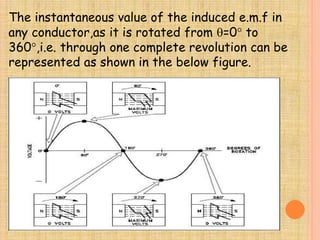
The instantaneous value of the induced e.m.f in 
any conductor,as it is rotated from =0 to 
360,i.e. through one complete revolution can be 
represented as shown in the below figure.
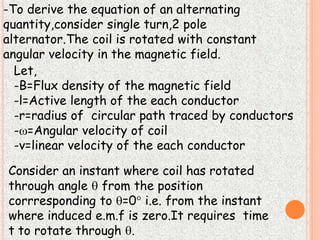
-To derive the equation of an alternating 
quantity,consider single turn,2 pole 
alternator.The coil is rotated with constant 
angular velocity in the magnetic field. 
Let, 
-B=Flux density of the magnetic field 
-l=Active length of the each conductor 
-r=radius of circular path traced by conductors 
-=Angular velocity of coil 
-v=linear velocity of the each conductor 
Consider an instant where coil has rotated 
through angle  from the position 
corrresponding to =0 i.e. from the instant 
where induced e.m.f is zero.It requires time 
t to rotate through .
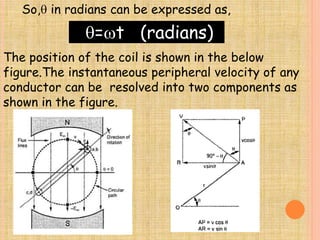
So, in radians can be expressed as, 
=t (radians) 
The position of the coil is shown in the below 
figure.The instantaneous peripheral velocity of any 
conductor can be resolved into two components as 
shown in the figure.
-The components of velocity(v) are, 
(1) Parallel to the magnetic flux lines(v cos) 
(2)Perpendicular to the magnetic flux lines(v sin) 
•Out of the two,due to the component parallel to 
the flux lines,there cannot be the generation of 
e.m.f as there cannot be the cutting of the flux 
lines.Hence,the component which is acting 
perpendicular to the magnetic flux lines i.e. v sin 
is responsible for the generation of the em.f. 
•According to the faraday’s law of 
electromagnetic induction,the expression for the 
generated e.m.f in each conductor is, 
E=B l v sin (volts)
-The active length ‘l’ means the length of the 
conductor which is under the influence of the 
magnetic field 
Now, 
Em=B l v (volts) 
= Maximum value of the induced em.f in the 
conductor 
•This is achieved at =90 and is the peak value or 
amplitude of the sinusoidal induced e.m.f. 
•Hence,equation giving instantaneous value of the 
generated e.m.f can be expressed as, 
e=Em sin (volts)
•This alternating e.m.f drives a current through 
the electrical load which also varies in similar 
manner. 
•Its frequency as the same as the frequency of 
the generated e.m.f.Hence,it can be expressed as, 
i=Im sin (Ampere) 
•Where Im is the maximum or peak value of the 
current.This maximum value depends on the 
resistance of the electric circuit to which an e.m.f 
is applied.The instantaneous value of the 
sinusoidal current set by the e.m.f can be 
expressed as, 
i=Im sin(wt) (Ampere)
Generation of A.C. voltage

Generation of A.C. voltage

  • 1.
    GUJARAT POWER ENGINEERING & RESEARCH INSTITUTE By- -Thawani Karan(58)
  • 2.
    Nikola Tesla -Inventorof A.C Generator GENERATION OF ALTERNATING CURRENT
  • 3.
    •Alternating Current: Analternating current is the current which changes periodically both in magnitude and direction. •The machines which are used to generate electrical voltages are called “GENERATORS”. •The generators which generate purely sinusoidal A.C. voltage are called “ALTERNATORS” •Sinusoidal Voltage:A sinusoidal voltage is an oscillating voltage that can be described mathematically through the use of a sine function. •A.C voltage may be generated by rotating a coil in a magnetic field or by rotating a magnetic field within a stationary coil.
  • 4.
    •The basic principleof an alternate is the principle of Electromagnetic Induction.It says that whenever there is a relative motion between the conductor and the magnetic field in which it is kept,an e.m.f gets indduced in the conductor. -Construction of single wave alternator: •It consists of a permanent magnet of two poles.A single turn rectangular coil is kept on the vicinity of the permanent magnet.This coil is made up of same conducting material like copper or aluminium.The coil is made up of two conductors namely a-b and c-d.Such two conductors are connected at one end to a coil.
  • 5.
    •The coil isso placed that it can be rotated about its own axis in clockwise or anticlockwise direction.the remaining two ends C1 and C2 of the coil are connected to the rings mounted on the shaft called slip rings.slip rings are also rotating members of the alternator.the two brushes P and Q are resting on the slip rings.The brushes are stationary and are just making contacts with slip rings.The slip rings and brush assembly is necessary to collect the current induced in the rotating coil and make it available to the stationary external resistance.The overall construction is shown in the next slide.
  • 7.
    Working: The coilis rotated in anticlockwise direction. While rotating, the conductors ab and cd cut the lines of flux of the permanent magnet. Due to faraday’s law of electromagnetic induction, an e.m.f gets induced in the conductors. The e.m.f. drives a current through resistance R connected across the brush P and Q. The magnitude of the induced e.m.f depends on the position of the coil in magnetic field. Let us see the relation between magnitude of the induced e.m.f and the position of the coil. Consider different instants and the different position of the coil.
  • 8.
    Instant 1: Theplane of the coil is perpendicular to the direction of the magnetic field.The instantaneous component of velocity of the conductors ab and cd is parallel to the magnetic field.So there cannot be the cutting of the flux lines by the conductors.Hence,no e.m.f will be generated in the conductors ab and cd and no current will flow through the external resistance R.
  • 9.
    Instant 2:When thecoil is rotated in anticlockwise direction through some angle ,then the velocity will have two components v sin(perpendicular to flux lines) and v cos(parallel to the flux lines).Due to v sin component,there will be cutting of the flux and proportionally,there will be induced e.m.f un the conductors ab and cd.This e.m.f will drive a current through the externam resistance R.
  • 10.
    Instant 3:As angle‘’ increases,the component of velocity acting perpendicular to flux lines increases,hence inducesd e.m.f also increases.At =90,the plane of the coil is parallel to the plane of the magnetic field while the component of velocity cutting the lines of flux is at its maximum.So induced e.m.f in this position,is at its maximum value. -So,as  increases from 0 to 90,e.m.f induces in the conductors increases gradually from o to maximum value.
  • 11.
    Instant 4: Asthe coil continues to rotate further from =90 to 180,the component of velocity perpendicular to magnetic field starts decreasing.Hence,gradually decreasing the magnitude of the induced e.m.f. Instant 5: In this position,the velocity component is fully parallel to the lines of flux similar to instant1.There is no cutting of flux,so no induced e.m.f in both the conductors.Hence,current through external circuit is also zero.
  • 12.
    Instant 6:As thecoil rotates beyond =180,the conductor ab uptill now cutting flux lines in one particular direction reverses the direction of cutting the flux lines.Similiar is the behaviour of conductor cd. -So,direction of induced e.m.f in conductor ab is opposite to the direction of induced e.m.f in it for the rotation of =0 to 180.Similirly,the direction of induced e.m.f in conductor cd also reverses.The change in direction of induced e.m.f occurs because the direction of rotation of conductors ab and cd reverses with respect to the field as  varies from 180 to 360.
  • 13.
    •This process continuesa coil rotates further.At =270 again,the induced e.m.f achieves itz maximum value but the direction of this e.m.f in both the conductors is opposite to the previous maximum position i.e. at =90.From =270 to 360,induced e.m.f decreases without change in direction and at =360,coil achieves the starting position with zero induced e.m.f. •So,as  varies from 0 to 360,the e.m.f in the conductor ab or cd varies in an alternating manner i.e. zero,increasing to achieve maximum in one direction,decreasing to zero,increasing to achieve maximum in other direction and again decreasing to zero.This set of variation repeats for every revolution as the conductor rotate in a circular motion within a certain speed.
  • 14.
    The instantaneous valueof the induced e.m.f in any conductor,as it is rotated from =0 to 360,i.e. through one complete revolution can be represented as shown in the below figure.
  • 15.
    -To derive theequation of an alternating quantity,consider single turn,2 pole alternator.The coil is rotated with constant angular velocity in the magnetic field. Let, -B=Flux density of the magnetic field -l=Active length of the each conductor -r=radius of circular path traced by conductors -=Angular velocity of coil -v=linear velocity of the each conductor Consider an instant where coil has rotated through angle  from the position corrresponding to =0 i.e. from the instant where induced e.m.f is zero.It requires time t to rotate through .
  • 16.
    So, in radianscan be expressed as, =t (radians) The position of the coil is shown in the below figure.The instantaneous peripheral velocity of any conductor can be resolved into two components as shown in the figure.
  • 17.
    -The components ofvelocity(v) are, (1) Parallel to the magnetic flux lines(v cos) (2)Perpendicular to the magnetic flux lines(v sin) •Out of the two,due to the component parallel to the flux lines,there cannot be the generation of e.m.f as there cannot be the cutting of the flux lines.Hence,the component which is acting perpendicular to the magnetic flux lines i.e. v sin is responsible for the generation of the em.f. •According to the faraday’s law of electromagnetic induction,the expression for the generated e.m.f in each conductor is, E=B l v sin (volts)
  • 18.
    -The active length‘l’ means the length of the conductor which is under the influence of the magnetic field Now, Em=B l v (volts) = Maximum value of the induced em.f in the conductor •This is achieved at =90 and is the peak value or amplitude of the sinusoidal induced e.m.f. •Hence,equation giving instantaneous value of the generated e.m.f can be expressed as, e=Em sin (volts)
  • 19.
    •This alternating e.m.fdrives a current through the electrical load which also varies in similar manner. •Its frequency as the same as the frequency of the generated e.m.f.Hence,it can be expressed as, i=Im sin (Ampere) •Where Im is the maximum or peak value of the current.This maximum value depends on the resistance of the electric circuit to which an e.m.f is applied.The instantaneous value of the sinusoidal current set by the e.m.f can be expressed as, i=Im sin(wt) (Ampere)