Managing Marketing
Information
4
Principles of Marketing
Learning Objectives
After studying this chapter, you should be able to:
1. Explain the importance of information to the
company
2. Define the marketing information system and
discuss its parts
3. Outline the steps in the marketing research process
4. Explain how companies analyze and distribute
marketing information
4-2
Chapter Outline
1. Assessing Marketing Information Needs
2. Developing Marketing Information
3. Marketing Research
4. Analyzing Marketing Information
5. Distributing and Using Marketing Information
6. Other Marketing Information Considerations
4-3
Assessing Marketing
Information Needs
Marketing information system (MIS) consists of
people, equipment, and procedures to gather, sort,
analyze, evaluate, and distribute needed, timely,
and accurate information to marketing decision
makers:
• Assess the information needs
• Develop needed information
• Analyze information
• Distribute information
4-4
Developing Marketing Information
Marketers can obtain information from:
• Internal data
• Marketing intelligence
• Marketing research
4-7
Developing Marketing Information
Internal Data
Internal databases are electronic collections
of consumer and market information
obtained from data sources within the
company network, including accounting,
marketing, customer service, and sales
departments
4-8
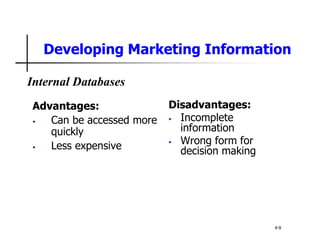
Developing Marketing Information
Advantages:
• Can be accessed more
quickly
• Less expensive
Disadvantages:
• Incomplete
information
• Wrong form for
decision making
4-9
Internal Databases
Developing Marketing Information
Marketing Intelligence
Marketing intelligence is the systematic collection
and analysis of publicly available information about
competitors and developments in the marketplace
The goal of marketing intelligence is to improve
strategic decision making, assess and track
competitors’ actions, and provide early warning of
opportunities and threats
4-10
Marketing Research
Marketing research is the systematic
design, collection, analysis, and
reporting of data relevant to a specific
marketing situation facing an
organization
4-11
Marketing Research
Steps in the marketing research process
1. Defining the problem and research
objectives
2. Developing the research plan
3. Implementing the plan
4. Interpreting and reporting the findings
4-12
Marketing Research
Defining the Problem and Research Objectives
Types of objectives
• Exploratory research
• Descriptive research
• Causal research
4-13
Marketing Research
Defining the Problem and Research Objectives
Exploratory research is the gathering of preliminary
information that will help to define the problem and
suggest hypotheses
Descriptive research is to describe things such as
market potential for a product or the demographics
and attitudes of consumers who buy the product
Causal research is to test hypotheses about cause-
and-effect relationships
4-14
Marketing Research
Developing the Research Plan
Research plan outlines sources of existing
data and spells out the specific research
approaches, contact methods, sampling
plans, and instruments that researchers will
use to gather data
4-15
Marketing Research
Developing the Research Plan
Research plan is a written proposal that includes:
• Management problem
• Research objectives
• Information needed
• How the results will help management decisions
• Budget
4-16
Marketing Research
Developing the Research Plan
Secondary data consists of information that
already exists somewhere, having been
collected for another purpose
Primary data consists of information gathered
for the special research plan
4-17
Marketing Research
Advantages:
• Speed
• Cost
• Provides data
that a company
cannot collect on
its own
Disadvantages:
• Availability
• Relevance
• Accuracy
• Impartial
4-18
Marketing Research
Marketing Research
Primary Data Collection
• Research approaches
• Contact methods
• Sampling plan
• Research instruments
4-19
Marketing Research
Research Approaches
Observational research involves gathering
primary data by observing relevant people,
actions, and situations
Ethnographic research involves sending
trained observers to watch and interact with
consumers in their natural environment
4-20
Marketing Research
Research Approaches
Survey research is the most widely used
method and is best for descriptive
information—knowledge, attitudes,
preferences, and buying behavior
• Flexible
• People can be unable or unwilling to answer
• Gives misleading or pleasing answers
• Privacy concerns
4-21
Marketing Research
Research Approaches
Experimental research is best for gathering
causal information—cause-and-effect
relationships
4-22
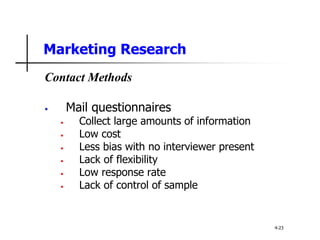
Marketing Research
Contact Methods
• Mail questionnaires
• Collect large amounts of information
• Low cost
• Less bias with no interviewer present
• Lack of flexibility
• Low response rate
• Lack of control of sample
4-23
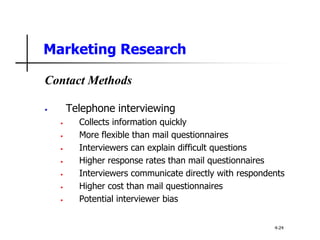
Marketing Research
Contact Methods
• Telephone interviewing
• Collects information quickly
• More flexible than mail questionnaires
• Interviewers can explain difficult questions
• Higher response rates than mail questionnaires
• Interviewers communicate directly with respondents
• Higher cost than mail questionnaires
• Potential interviewer bias
4-24
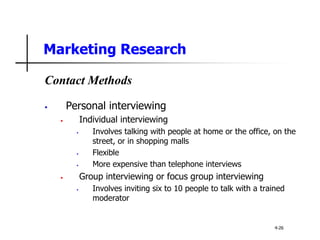
Marketing Research
Contact Methods
• Personal interviewing
• Individual interviewing
• Involves talking with people at home or the office, on the
street, or in shopping malls
• Flexible
• More expensive than telephone interviews
• Group interviewing or focus group interviewing
• Involves inviting six to 10 people to talk with a trained
moderator
4-26
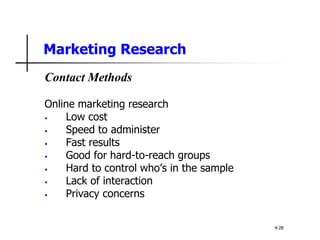
Marketing Research
Contact Methods
Online marketing research
• Low cost
• Speed to administer
• Fast results
• Good for hard-to-reach groups
• Hard to control who’s in the sample
• Lack of interaction
• Privacy concerns
4-28
Marketing Research
Sampling Plan
Sample is a segment of the population
selected for marketing research to
represent the population as a whole
• Who is to be surveyed?
• How many people should be surveyed?
• How should the people be chosen?
4-29
Marketing Research
Research Instruments
Questionnaires
• Most common
• Administered in person, by phone, or online
• Flexible
4-32
Marketing Research
Research Instruments
Closed-end questions include all possible answers,
and subjects make choices among them
• Provide answers that are easier to interpret and
tabulate
Open-end questions allow respondents to answer in
their own words
• Useful in exploratory research
4-33
Marketing Research
Implementing the Research Plan
• Collecting the information
• Processing the information
• Analyzing the information
4-34
Distributing and Using
Marketing Information
Information distribution involves entering
information into databases and making it available
in a time- useable manner
• Intranet provides information to employees and
other stakeholders
• Extranet provides information to key customers and
suppliers
4-38

managing marketing information

  • 1.
  • 2.
    Learning Objectives After studyingthis chapter, you should be able to: 1. Explain the importance of information to the company 2. Define the marketing information system and discuss its parts 3. Outline the steps in the marketing research process 4. Explain how companies analyze and distribute marketing information 4-2
  • 3.
    Chapter Outline 1. AssessingMarketing Information Needs 2. Developing Marketing Information 3. Marketing Research 4. Analyzing Marketing Information 5. Distributing and Using Marketing Information 6. Other Marketing Information Considerations 4-3
  • 4.
    Assessing Marketing Information Needs Marketinginformation system (MIS) consists of people, equipment, and procedures to gather, sort, analyze, evaluate, and distribute needed, timely, and accurate information to marketing decision makers: • Assess the information needs • Develop needed information • Analyze information • Distribute information 4-4
  • 5.
    Developing Marketing Information Marketerscan obtain information from: • Internal data • Marketing intelligence • Marketing research 4-7
  • 6.
    Developing Marketing Information InternalData Internal databases are electronic collections of consumer and market information obtained from data sources within the company network, including accounting, marketing, customer service, and sales departments 4-8
  • 7.
    Developing Marketing Information Advantages: •Can be accessed more quickly • Less expensive Disadvantages: • Incomplete information • Wrong form for decision making 4-9 Internal Databases
  • 8.
    Developing Marketing Information MarketingIntelligence Marketing intelligence is the systematic collection and analysis of publicly available information about competitors and developments in the marketplace The goal of marketing intelligence is to improve strategic decision making, assess and track competitors’ actions, and provide early warning of opportunities and threats 4-10
  • 9.
    Marketing Research Marketing researchis the systematic design, collection, analysis, and reporting of data relevant to a specific marketing situation facing an organization 4-11
  • 10.
    Marketing Research Steps inthe marketing research process 1. Defining the problem and research objectives 2. Developing the research plan 3. Implementing the plan 4. Interpreting and reporting the findings 4-12
  • 11.
    Marketing Research Defining theProblem and Research Objectives Types of objectives • Exploratory research • Descriptive research • Causal research 4-13
  • 12.
    Marketing Research Defining theProblem and Research Objectives Exploratory research is the gathering of preliminary information that will help to define the problem and suggest hypotheses Descriptive research is to describe things such as market potential for a product or the demographics and attitudes of consumers who buy the product Causal research is to test hypotheses about cause- and-effect relationships 4-14
  • 13.
    Marketing Research Developing theResearch Plan Research plan outlines sources of existing data and spells out the specific research approaches, contact methods, sampling plans, and instruments that researchers will use to gather data 4-15
  • 14.
    Marketing Research Developing theResearch Plan Research plan is a written proposal that includes: • Management problem • Research objectives • Information needed • How the results will help management decisions • Budget 4-16
  • 15.
    Marketing Research Developing theResearch Plan Secondary data consists of information that already exists somewhere, having been collected for another purpose Primary data consists of information gathered for the special research plan 4-17
  • 16.
    Marketing Research Advantages: • Speed •Cost • Provides data that a company cannot collect on its own Disadvantages: • Availability • Relevance • Accuracy • Impartial 4-18 Marketing Research
  • 17.
    Marketing Research Primary DataCollection • Research approaches • Contact methods • Sampling plan • Research instruments 4-19
  • 18.
    Marketing Research Research Approaches Observationalresearch involves gathering primary data by observing relevant people, actions, and situations Ethnographic research involves sending trained observers to watch and interact with consumers in their natural environment 4-20
  • 19.
    Marketing Research Research Approaches Surveyresearch is the most widely used method and is best for descriptive information—knowledge, attitudes, preferences, and buying behavior • Flexible • People can be unable or unwilling to answer • Gives misleading or pleasing answers • Privacy concerns 4-21
  • 20.
    Marketing Research Research Approaches Experimentalresearch is best for gathering causal information—cause-and-effect relationships 4-22
  • 21.
    Marketing Research Contact Methods •Mail questionnaires • Collect large amounts of information • Low cost • Less bias with no interviewer present • Lack of flexibility • Low response rate • Lack of control of sample 4-23
  • 22.
    Marketing Research Contact Methods •Telephone interviewing • Collects information quickly • More flexible than mail questionnaires • Interviewers can explain difficult questions • Higher response rates than mail questionnaires • Interviewers communicate directly with respondents • Higher cost than mail questionnaires • Potential interviewer bias 4-24
  • 23.
    Marketing Research Contact Methods •Personal interviewing • Individual interviewing • Involves talking with people at home or the office, on the street, or in shopping malls • Flexible • More expensive than telephone interviews • Group interviewing or focus group interviewing • Involves inviting six to 10 people to talk with a trained moderator 4-26
  • 24.
    Marketing Research Contact Methods Onlinemarketing research • Low cost • Speed to administer • Fast results • Good for hard-to-reach groups • Hard to control who’s in the sample • Lack of interaction • Privacy concerns 4-28
  • 25.
    Marketing Research Sampling Plan Sampleis a segment of the population selected for marketing research to represent the population as a whole • Who is to be surveyed? • How many people should be surveyed? • How should the people be chosen? 4-29
  • 26.
    Marketing Research Research Instruments Questionnaires •Most common • Administered in person, by phone, or online • Flexible 4-32
  • 27.
    Marketing Research Research Instruments Closed-endquestions include all possible answers, and subjects make choices among them • Provide answers that are easier to interpret and tabulate Open-end questions allow respondents to answer in their own words • Useful in exploratory research 4-33
  • 28.
    Marketing Research Implementing theResearch Plan • Collecting the information • Processing the information • Analyzing the information 4-34
  • 29.
    Distributing and Using MarketingInformation Information distribution involves entering information into databases and making it available in a time- useable manner • Intranet provides information to employees and other stakeholders • Extranet provides information to key customers and suppliers 4-38