Store Layout, Design and Visual
Merchandising
18-2
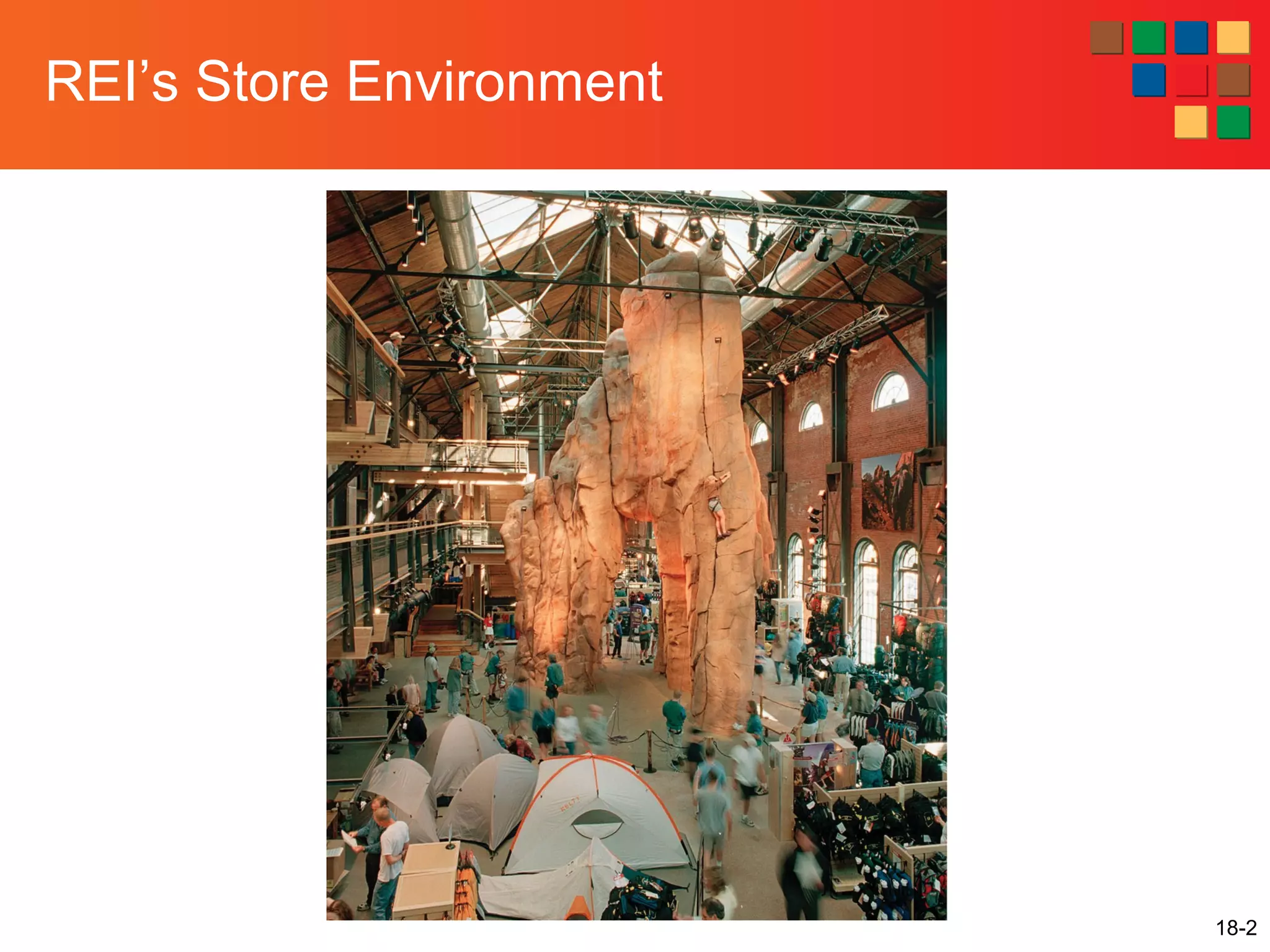
REI’s Store Environment
18-3
H & M
18-4
Store Design Objectives
■ Implement retailer’s strategy
■ Influence customer buying behavior
■ Provide flexibility
■ Control design and maintenance costs
■ Meet legal requirements
18-5
Store Design and Retail Strategy
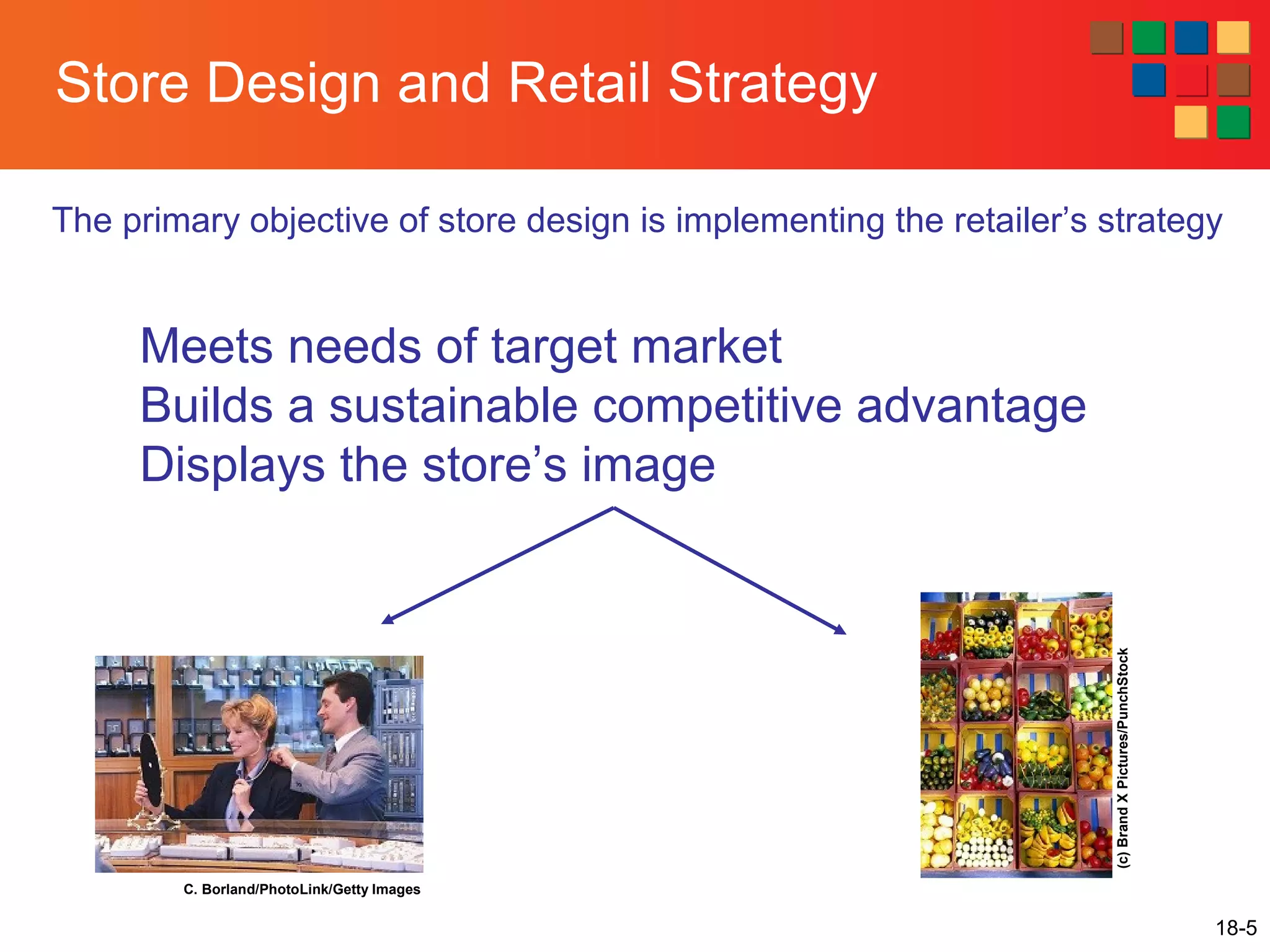
The primary objective of store design is implementing the retailer’s strategy
(c)BrandXPictures/PunchStock
C. Borland/PhotoLink/Getty Images
Meets needs of target market
Builds a sustainable competitive advantage
Displays the store’s image
18-6
McDonald’s remodeled its stores to better appeal to European customers
18-7
In India, a retailer finds key to success is clutter
18-8
Chaos Sells in India
Americans and Europeans might like to shop in pristine, quiet stores.
But one entrepreneur (founder of India’s Big Bazaar) his fortune by
redesigning stores in India to be messier, nosier, and more
cramped.
http://online.wsj.com/article/SB118598686231984863.html
18-9
Influence Customer Buying Behavior
■ Attract customers to store
■ Enable them to easily locate merchandise
■ Keep them in the store for a long time
■ Motivate them to make unplanned purchases
■ Provide them with a satisfying shopping experience
H. Wiesenhofer/PhotoLink/Getty Images
18-10
Today’s Demographics
Time limited families are spending less
time planning shopping trips and
making more decisions in the stores.
So retailers are making adjustments to
their stores to get people in and out
quicker.
Royalty-Free/CORBIS
18-11
Whole Foods stores’ checkout system was redesigned to reduce wait time
18-12
Cost
■ Control the cost of implementing the store
design and maintain the store’s appearance
■ Store design influences

shopping experience and thus sales

Labor costs

Inventory shrinkage
18-13
Legal Considerations
Protects people with disabilities
18-14
Reasonable Access
What does that mean?
■ 32 inch wide pathways on the main
aisle and to the bathroom, fitting
rooms elevators and around most
fixtures
■ Lower most cash wraps and fixtures
so they can be reached by a person
in a wheelchair
■ Make bathroom and fitting room
fully accessible
Keith Brofsky/Getty Images
18-15
Tradeoff in Store Design
Ease of locating
merchandise for
planned purchases
Exploration of store,
impulse purchases
Royalty-Free/CORBIS
(c)image100/PunchStock
Giving customers
adequate space to
shop
Productivity of using
this scarce resource
for merchandise
18-16
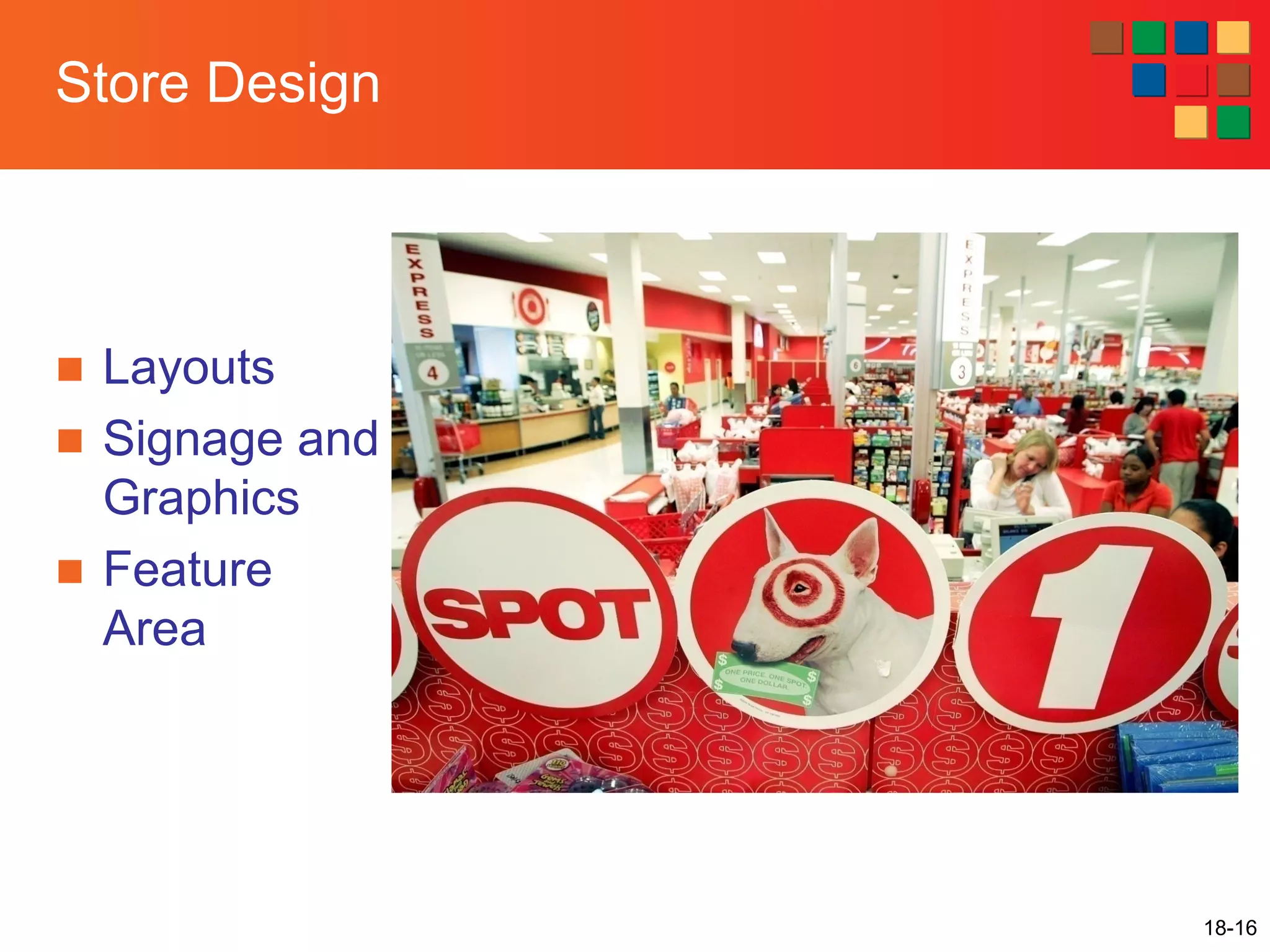
Store Design
■ Layouts
■ Signage and
Graphics
■ Feature
Area
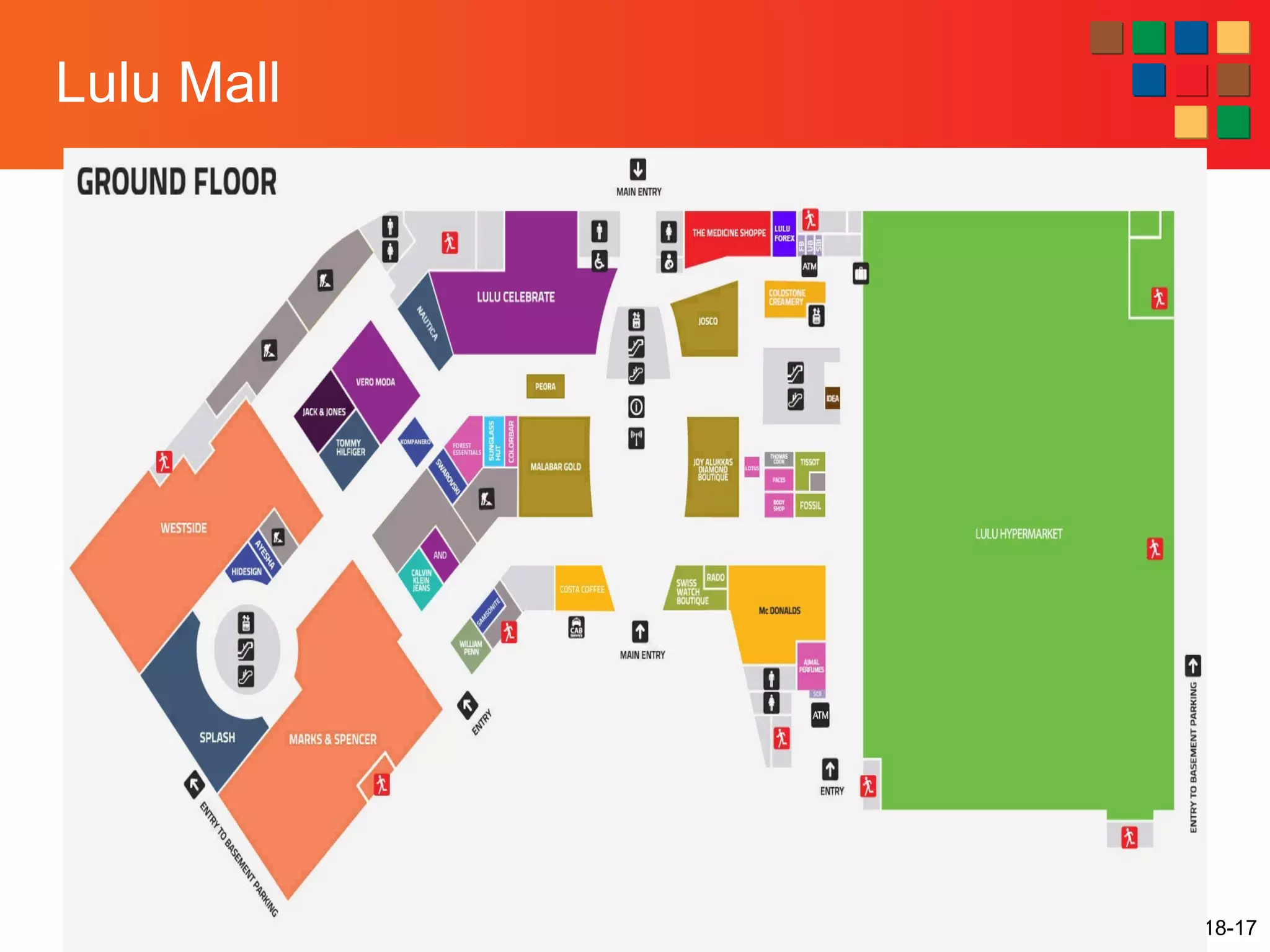
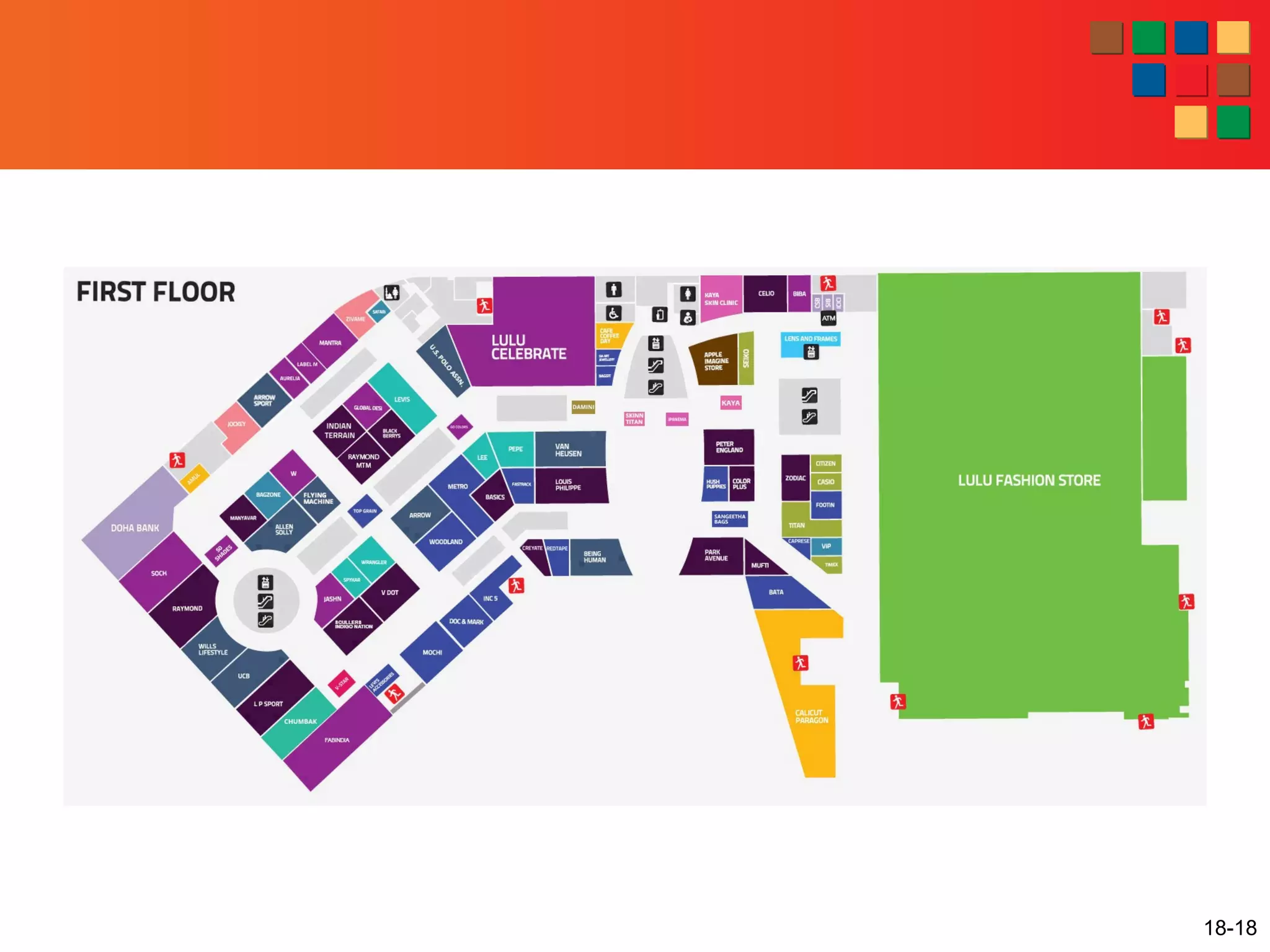
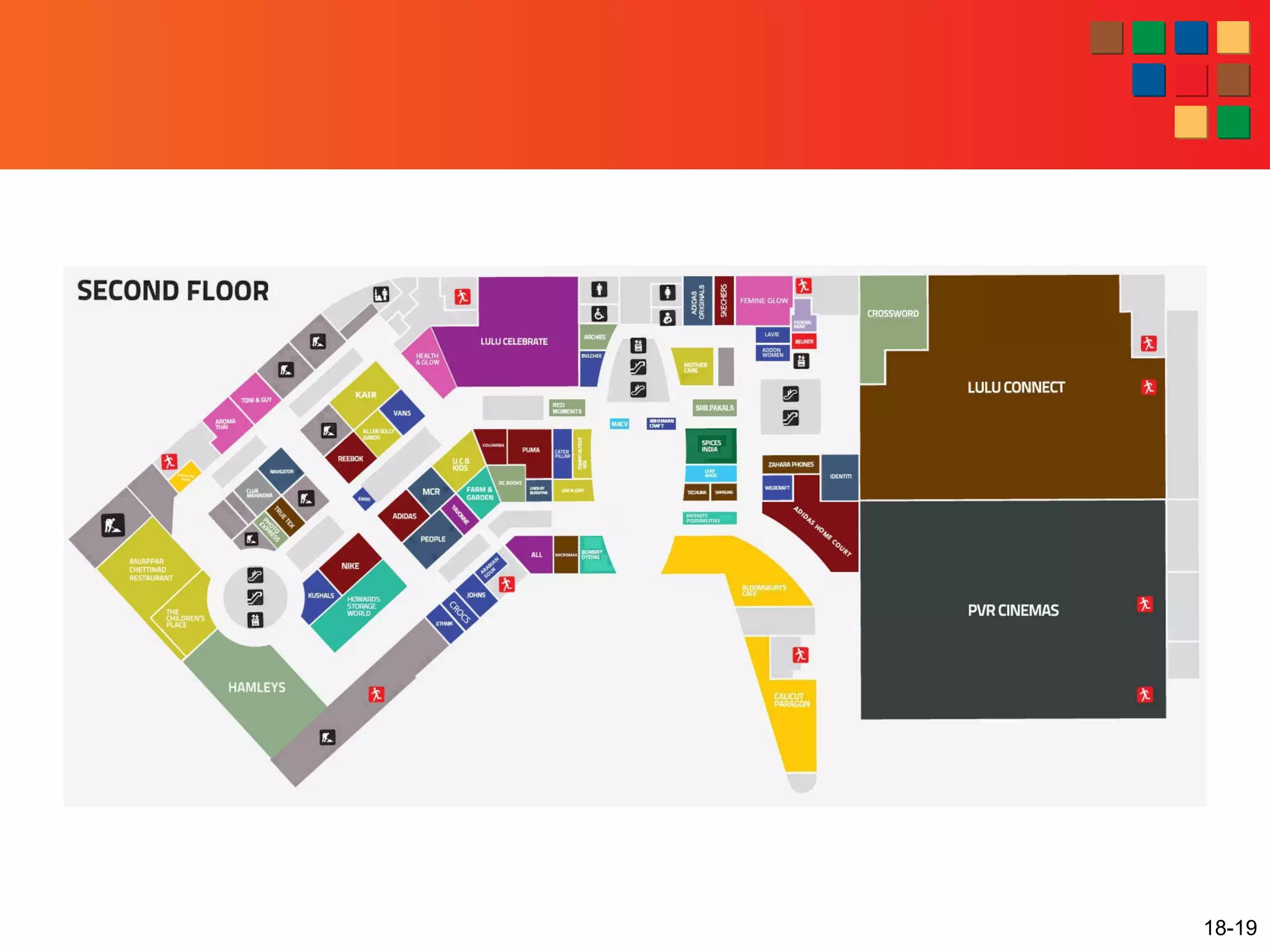
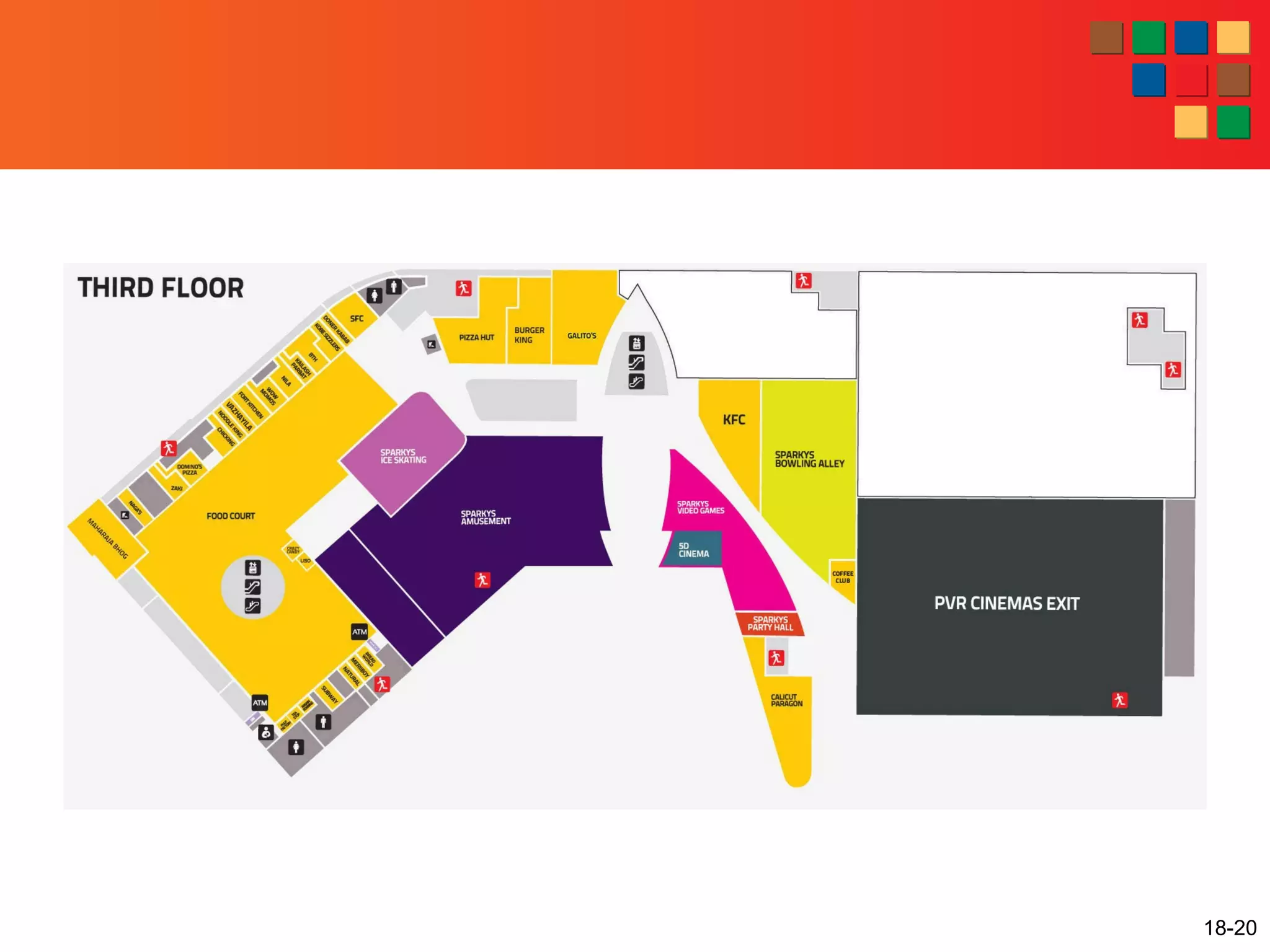
Lulu Mall
18-17
18-18
18-19
18-20
18-21
Store Layouts
■ To encourage customer exploration and help
customers move through the stores

Use a layout that facilitates a specific traffic
pattern

Provide interesting design elements
■ Types of Store Layouts

Grid

Racetrack

Free Form
18-22
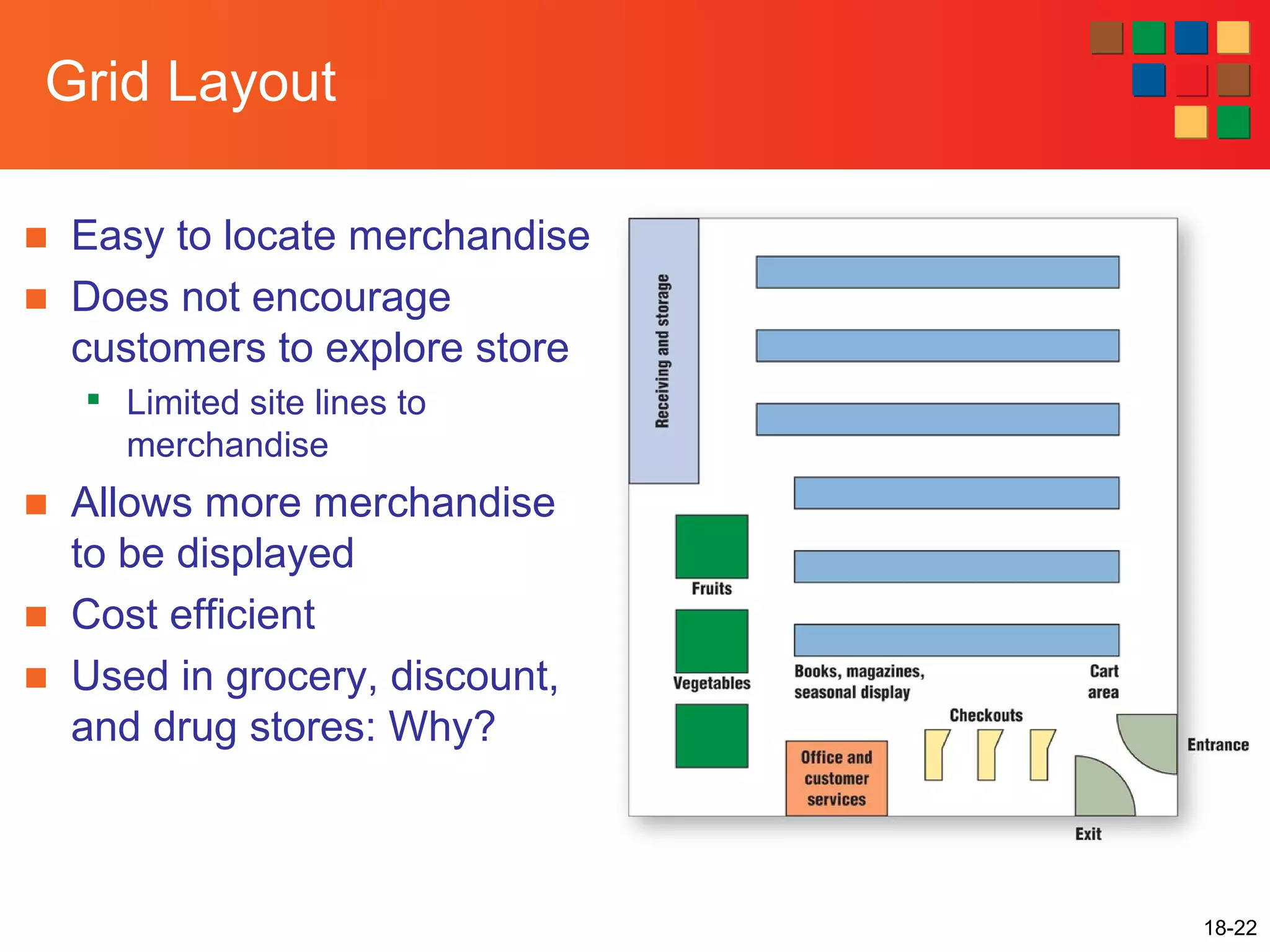
Grid Layout
■ Easy to locate merchandise
■ Does not encourage
customers to explore store

Limited site lines to
merchandise
■ Allows more merchandise
to be displayed
■ Cost efficient
■ Used in grocery, discount,
and drug stores: Why?
18-23
Racetrack Layout (Loop)
■ Loop with a major aisle that has access to
departments
■ Draws customers around the store
■ Provide different viewing angles and encourage
exploration, impulse buying
■ Used in department stores
18-24
JCPenney Racetrack Layout
18-25
Example of Race Track Layout
PhotoLink/Getty Images
18-26
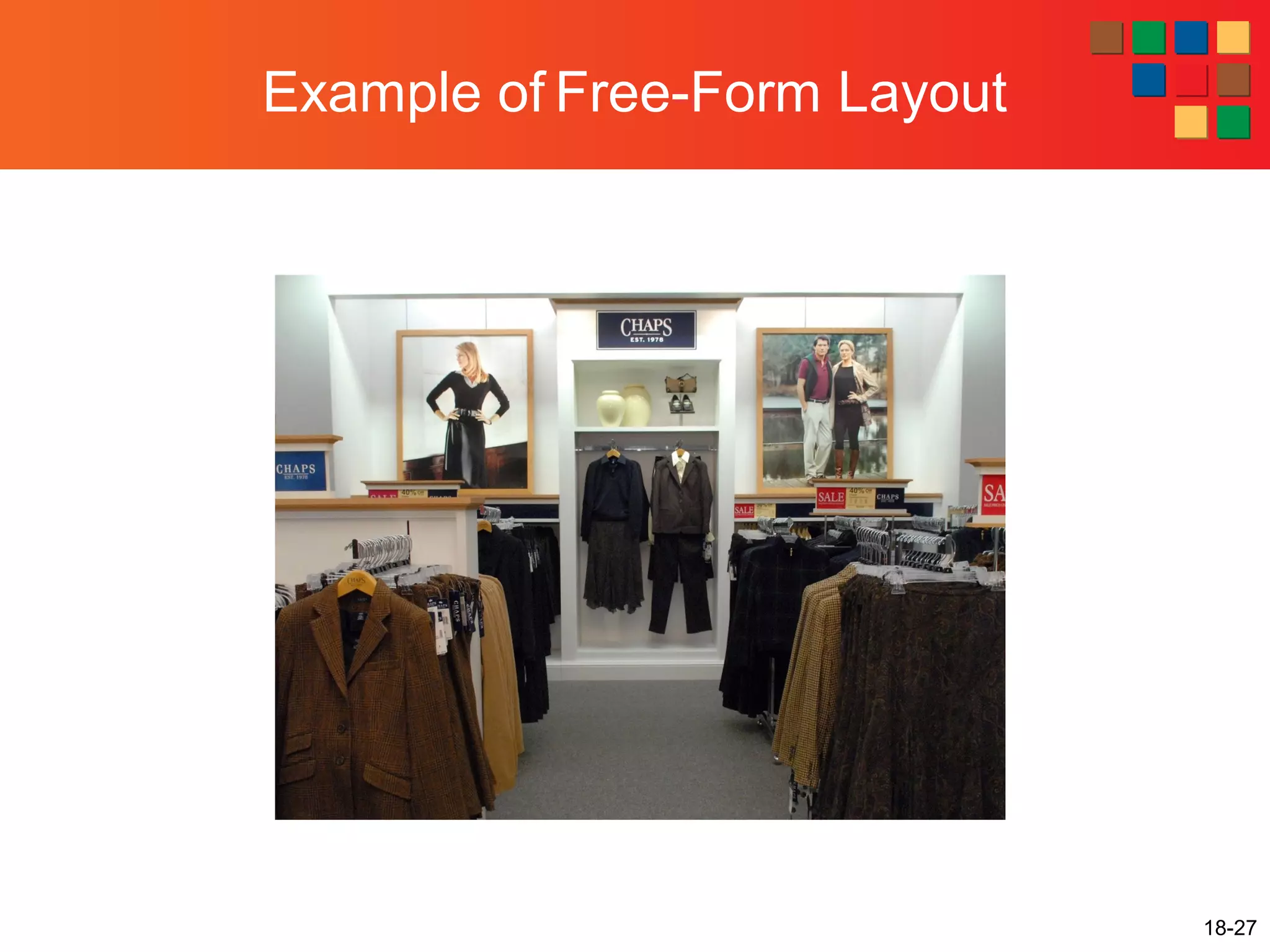
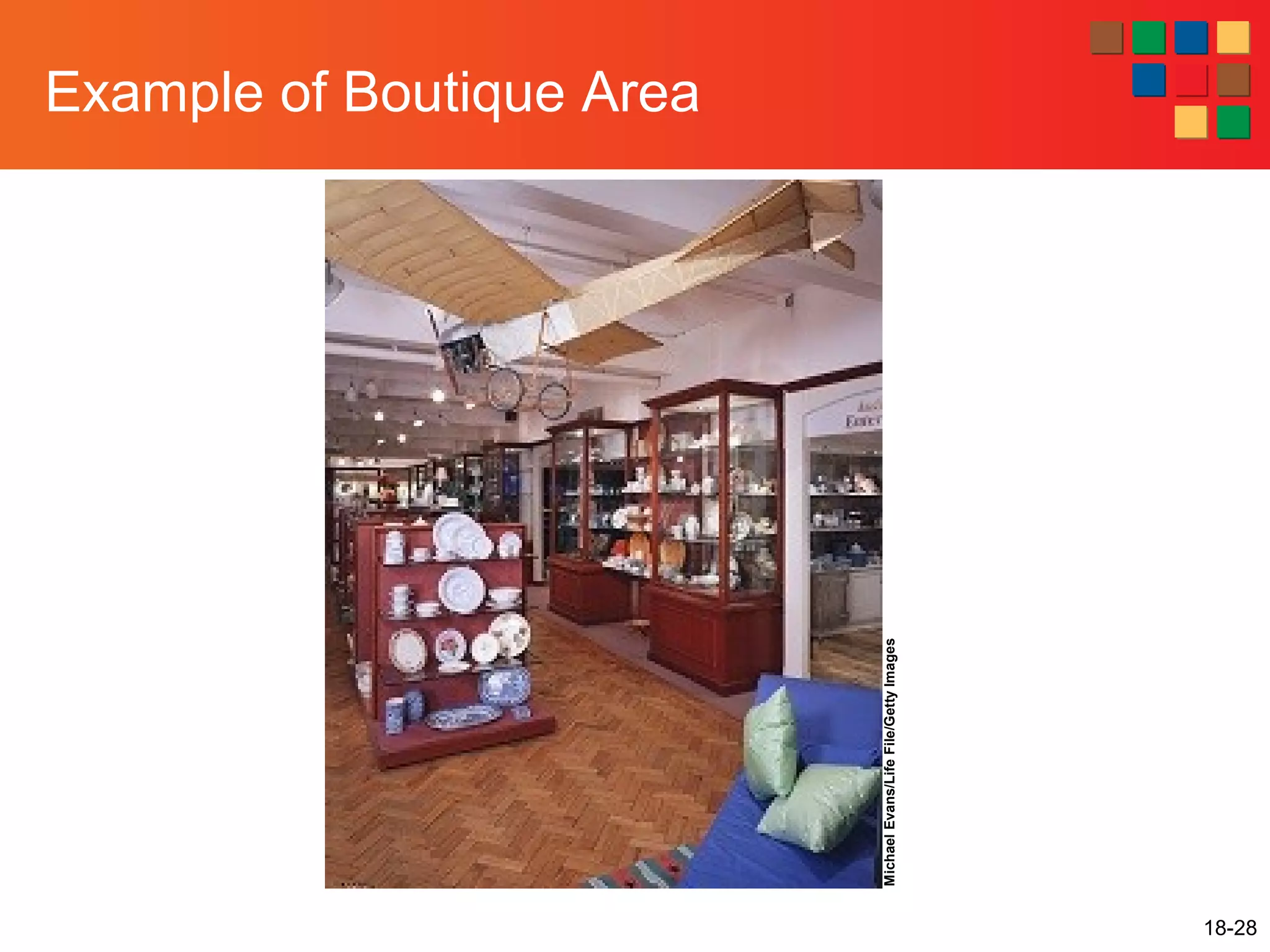
Free-Form (Boutique) Layout
■ Fixtures and aisles arranged
asymmetrically
■ Provides an intimate,
relaxing environment that
facilitates shopping and
browsing
■ Pleasant relaxing ambiance
doesn’t come cheap – small
store experience
■ Inefficient use of space
■ More susceptible to
shoplifting – salespeople can
not view adjacent spaces.
■ Used in specialty stores and
upscale department stores
18-27
Example of Free-Form Layout
18-28
MichaelEvans/LifeFile/GettyImages
Example of Boutique Area
18-29
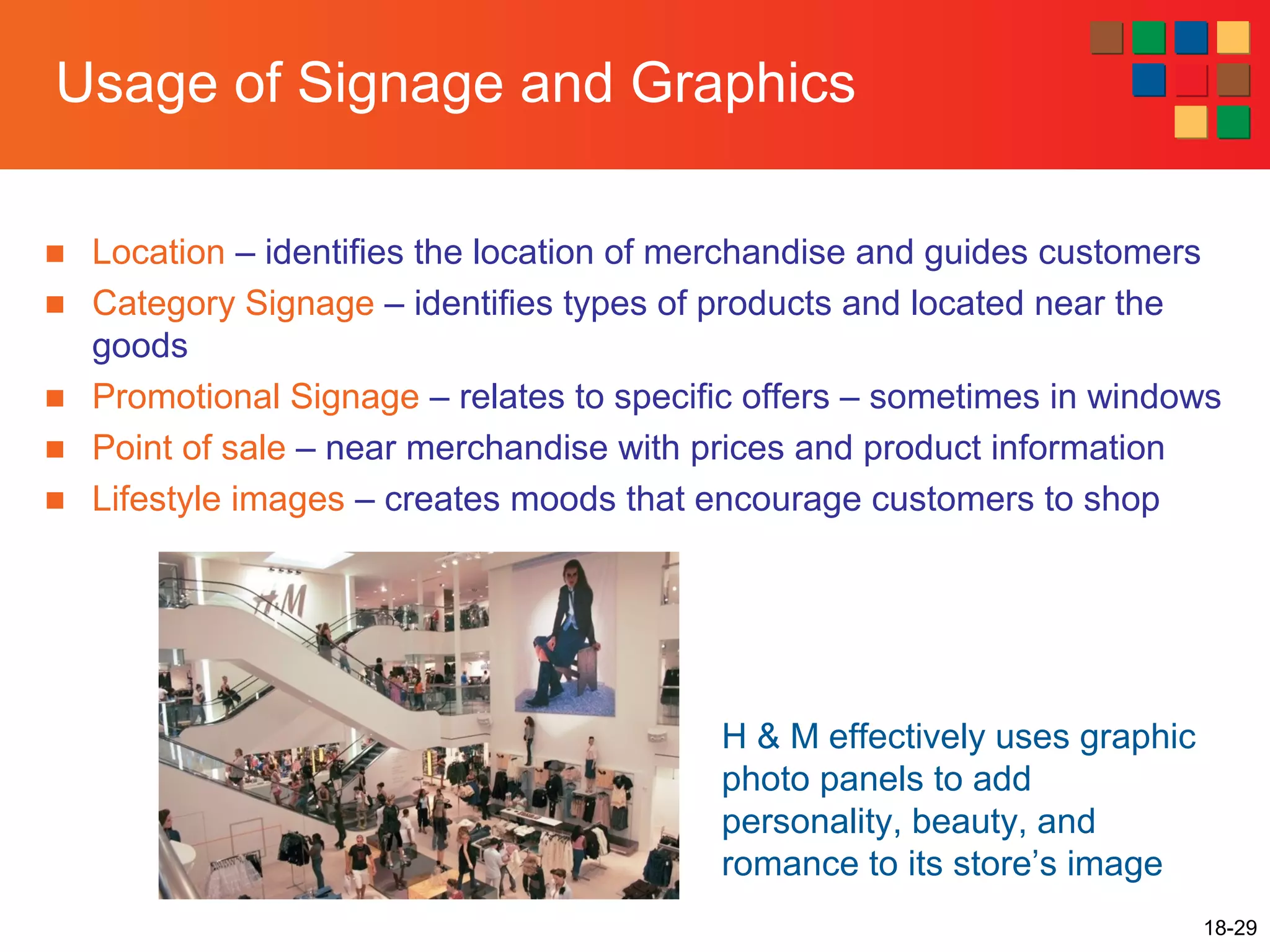
Usage of Signage and Graphics
■ Location – identifies the location of merchandise and guides customers
■ Category Signage – identifies types of products and located near the
goods
■ Promotional Signage – relates to specific offers – sometimes in windows
■ Point of sale – near merchandise with prices and product information
■ Lifestyle images – creates moods that encourage customers to shop
H & M effectively uses graphic
photo panels to add
personality, beauty, and
romance to its store’s image
18-30
18-31
Suggestions for Effectively Using Signage
■ Coordinate signage to store’s image
■ Use appropriate type faces on signs
■ Inform customers
■ Use them as props
■ Keep them fresh
■ Limit the text on signs
■ Use appropriate typefaces on signs
18-32
Digital Signage
Visual Content delivered digitally through a centrally managed and
controlled network and displayed on a TV monitor or flat panel
screen
■ Superior in attracting attention
■ Enhances store environment
■ Provides appealing atmosphere
■ Overcomes time-to-message hurdle
■ Messages can target demographics
■ Eliminates costs with printing, distribution and installing traditional
signage
18-33
18-34
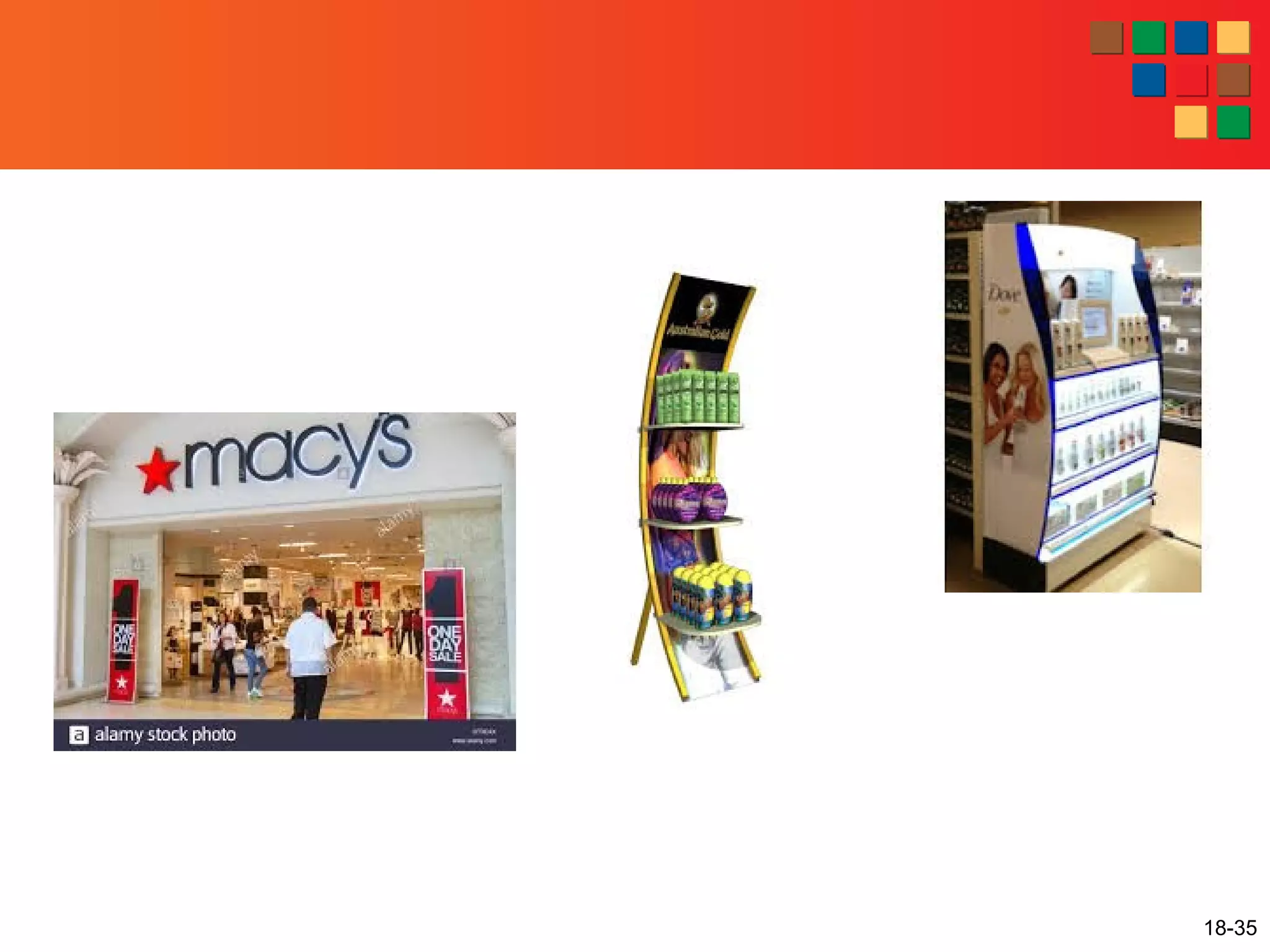
Feature Areas
Areas within a store designed to get the
customers’ attention
Feature areas

Entrances

Freestanding displays

Cash wraps (POP counters,
checkout areas)

Promotional aisles

Walls

Windows

Fitting rooms
PhotoLink/Getty Images
18-35
18-36
18-37
18-38
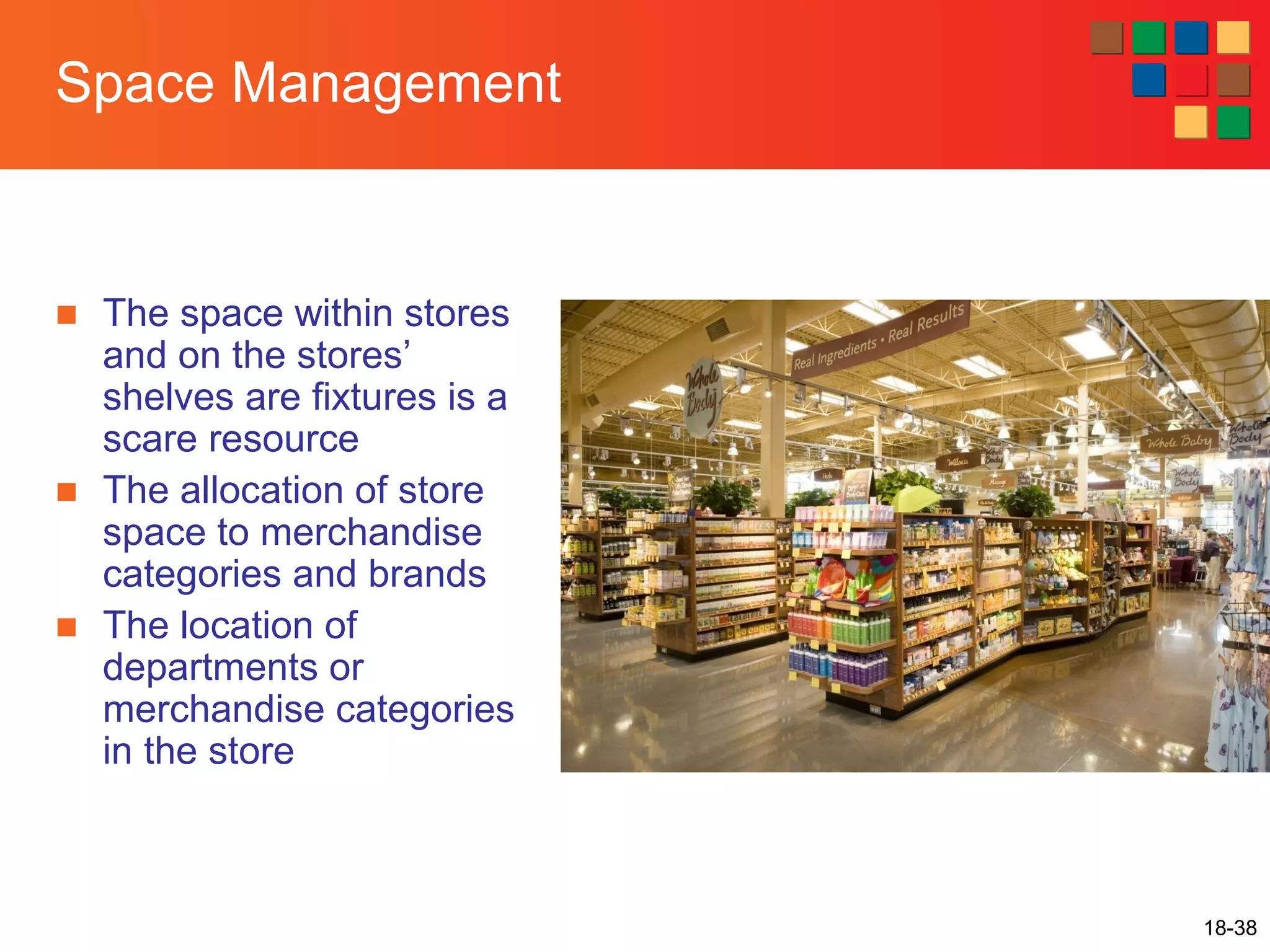
Space Management
■ The space within stores
and on the stores’
shelves are fixtures is a
scare resource
■ The allocation of store
space to merchandise
categories and brands
■ The location of
departments or
merchandise categories
in the store
18-39
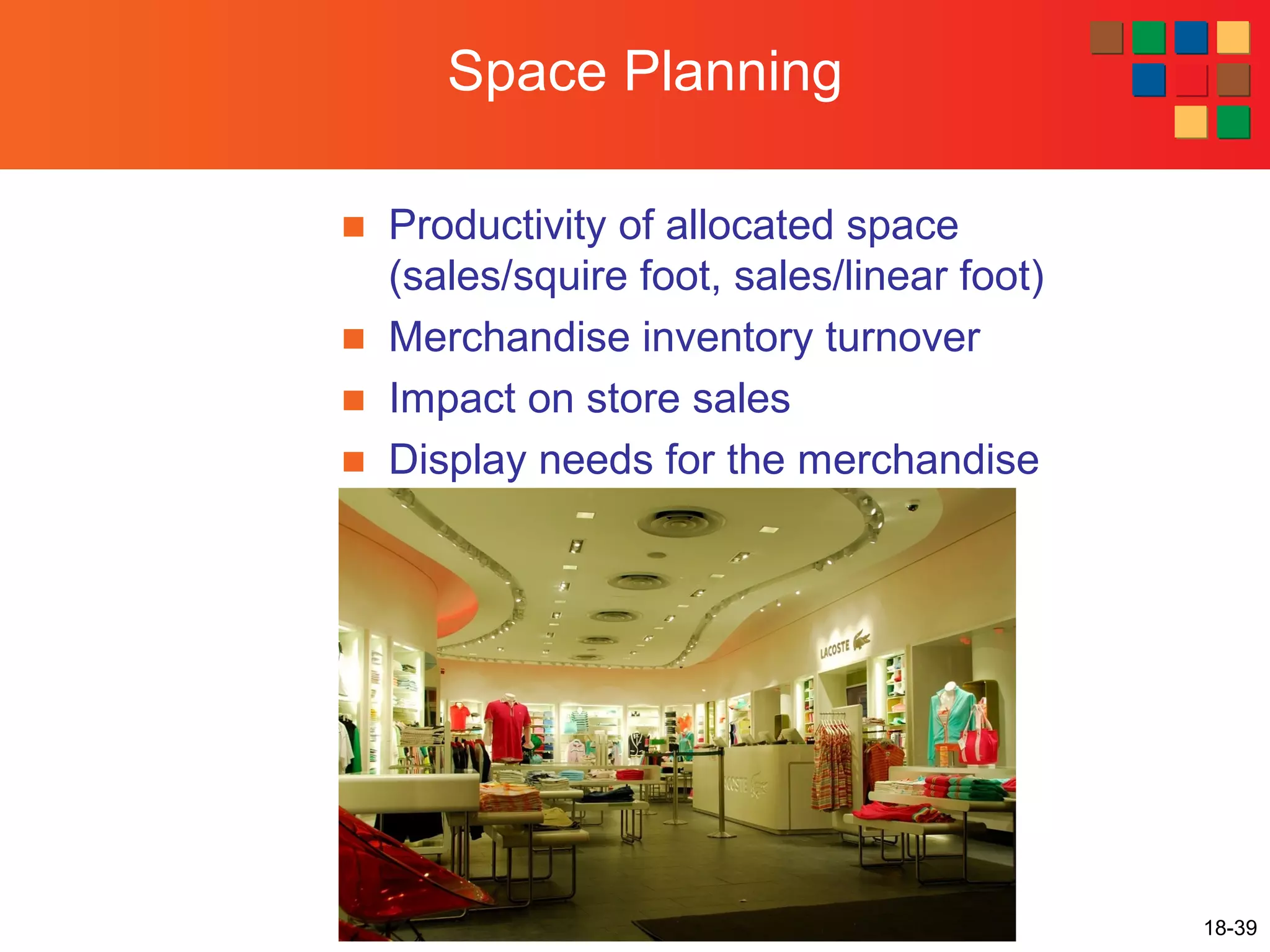
Space Planning
■ Productivity of allocated space
(sales/squire foot, sales/linear foot)
■ Merchandise inventory turnover
■ Impact on store sales
■ Display needs for the merchandise
18-40
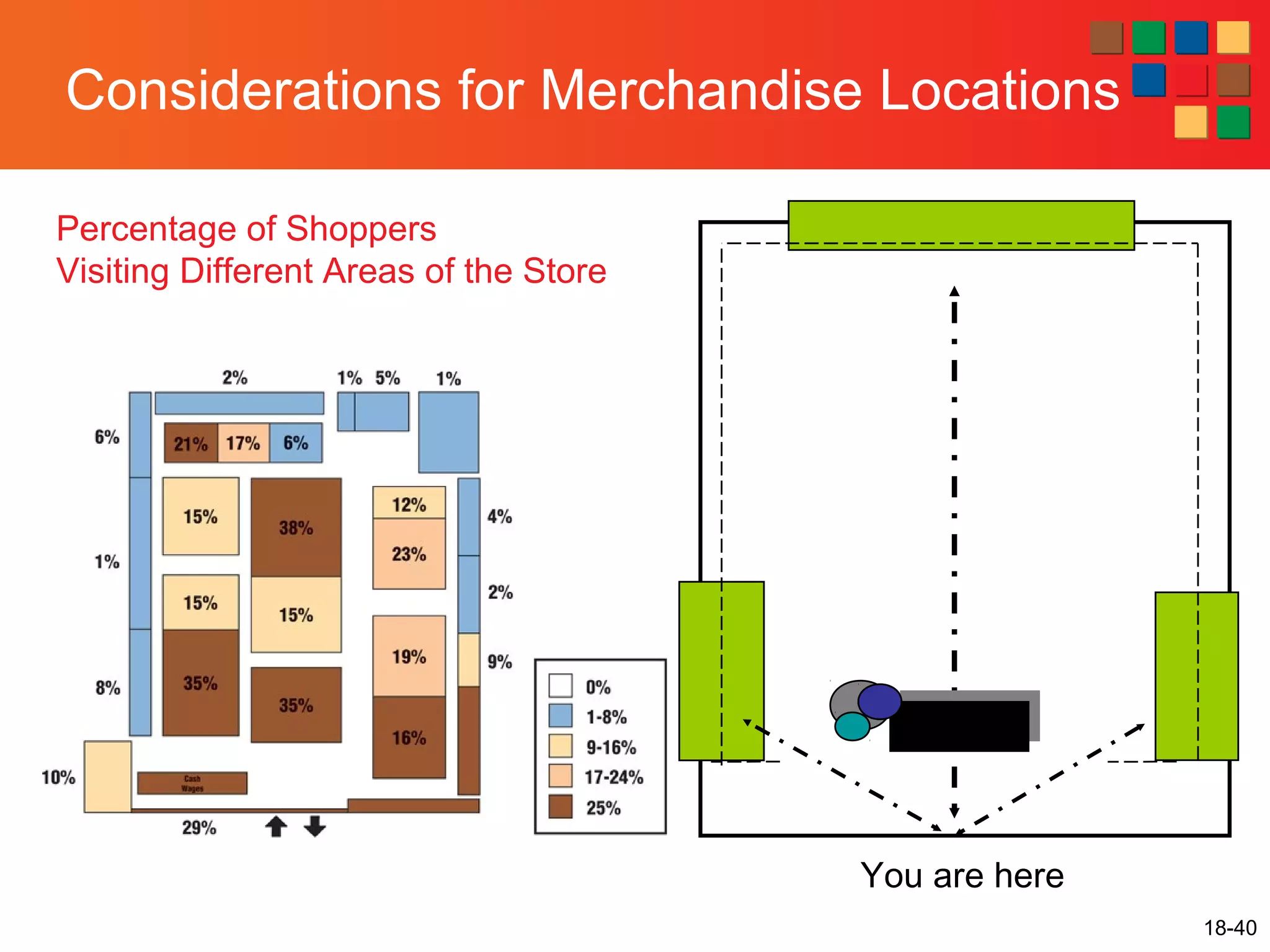
You are here
Percentage of Shoppers
Visiting Different Areas of the Store
Considerations for Merchandise Locations
18-41
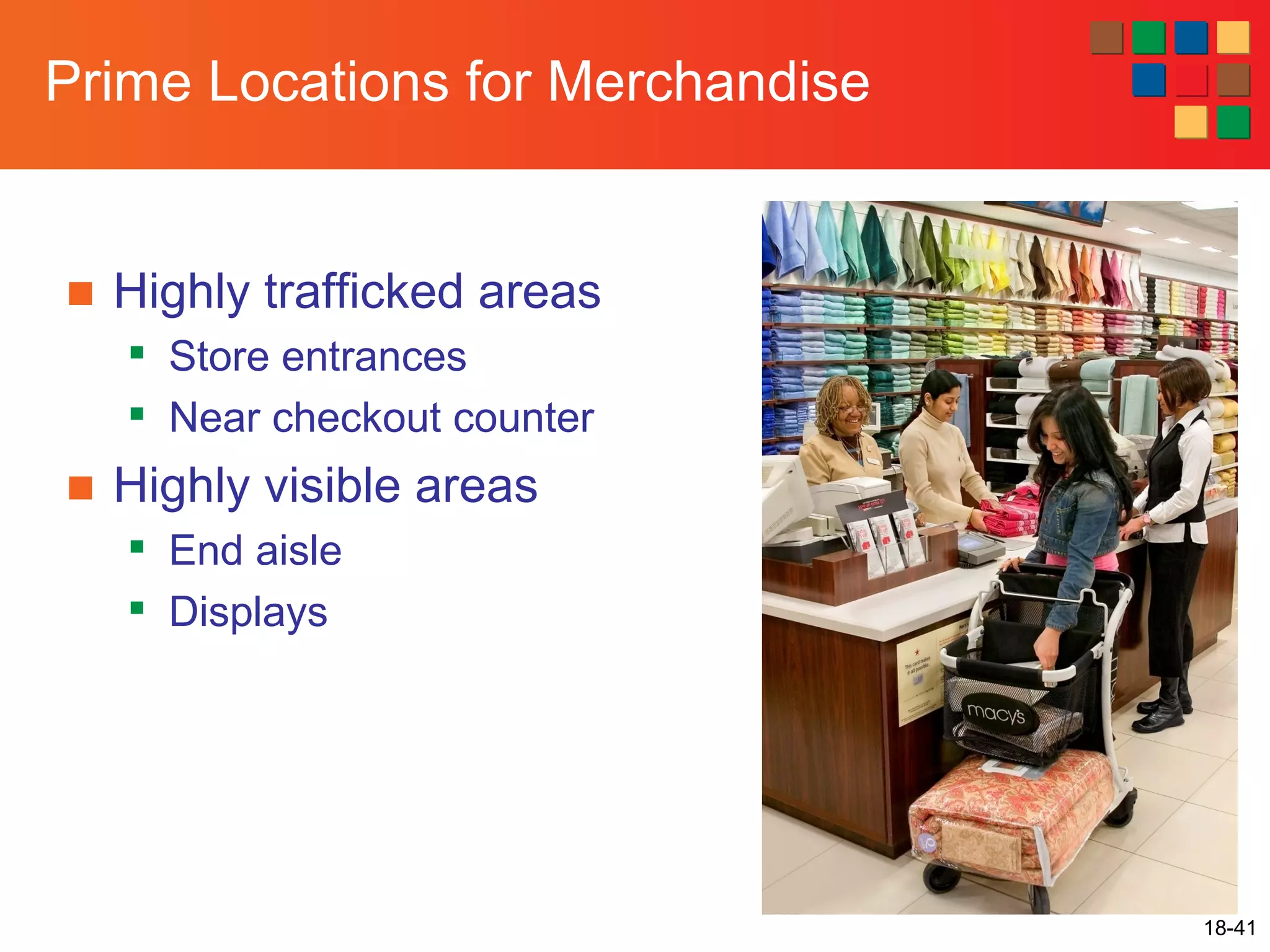
Prime Locations for Merchandise
■ Highly trafficked areas

Store entrances

Near checkout counter
■ Highly visible areas

End aisle

Displays
18-42
Location of Merchandise Categories
■ Impulse merchandise – near heavily trafficked areas
■ Demand/Destination merchandise – back left-hand
corner of the store
■ Special merchandise – lightly trafficked areas (glass
pieces, women’s lingerie)
■ Adjacencies – cluster complimentary merchandise next
to each other
18-43
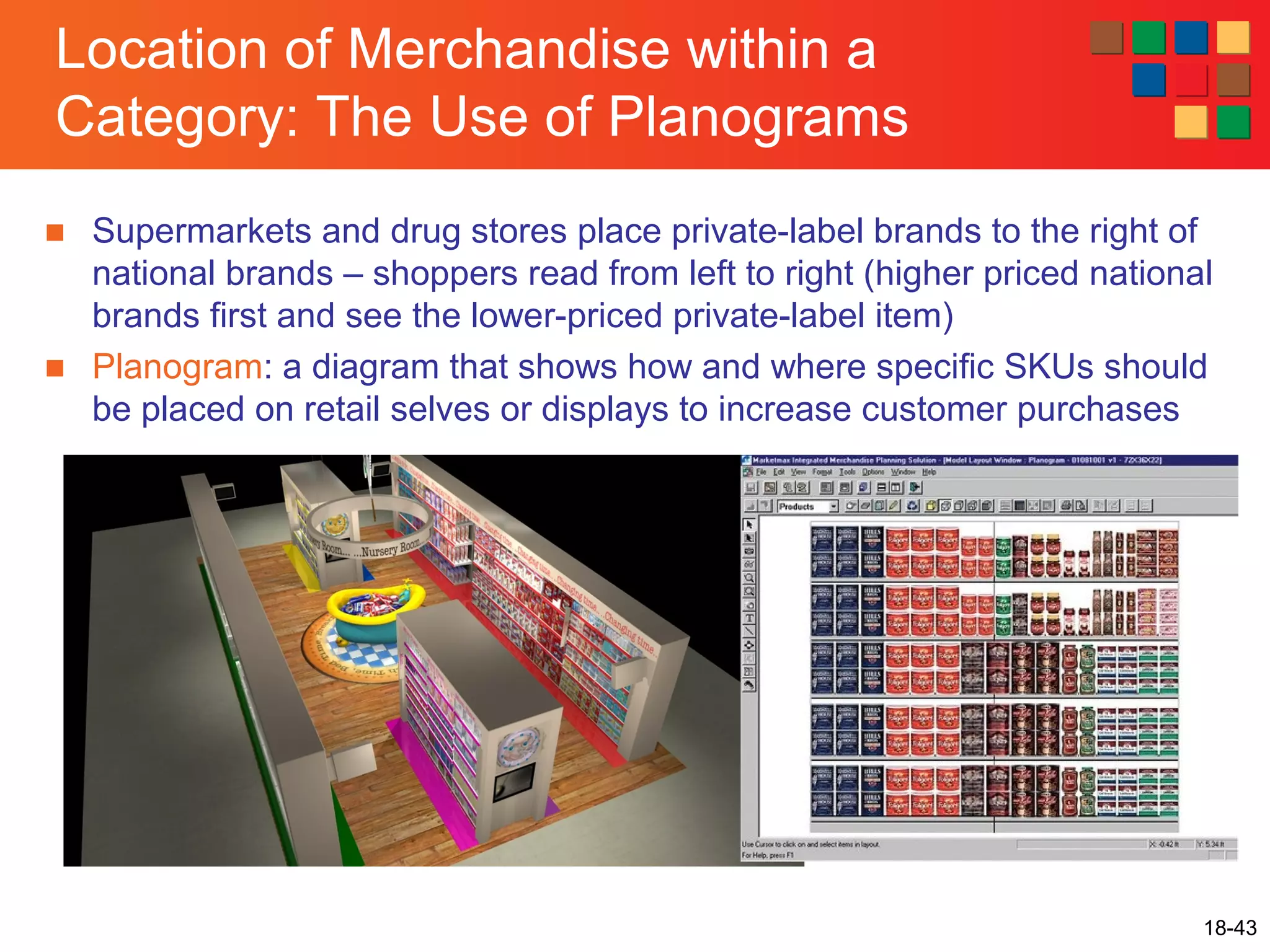
Location of Merchandise within a
Category: The Use of Planograms
■ Supermarkets and drug stores place private-label brands to the right of
national brands – shoppers read from left to right (higher priced national
brands first and see the lower-priced private-label item)
■ Planogram: a diagram that shows how and where specific SKUs should
be placed on retail selves or displays to increase customer purchases
18-44
18-45
Learning customers’ movements and
decision-making
■ Videotaping Consumers

Learn customers’
movements, where they
pause or move quickly, or
where there is congestion

Evaluate the layout,
merchandise placement,
promotion
■ Virtual Store Software

Learn the best place to
merchandise and test
how customers react to
new products
18-46
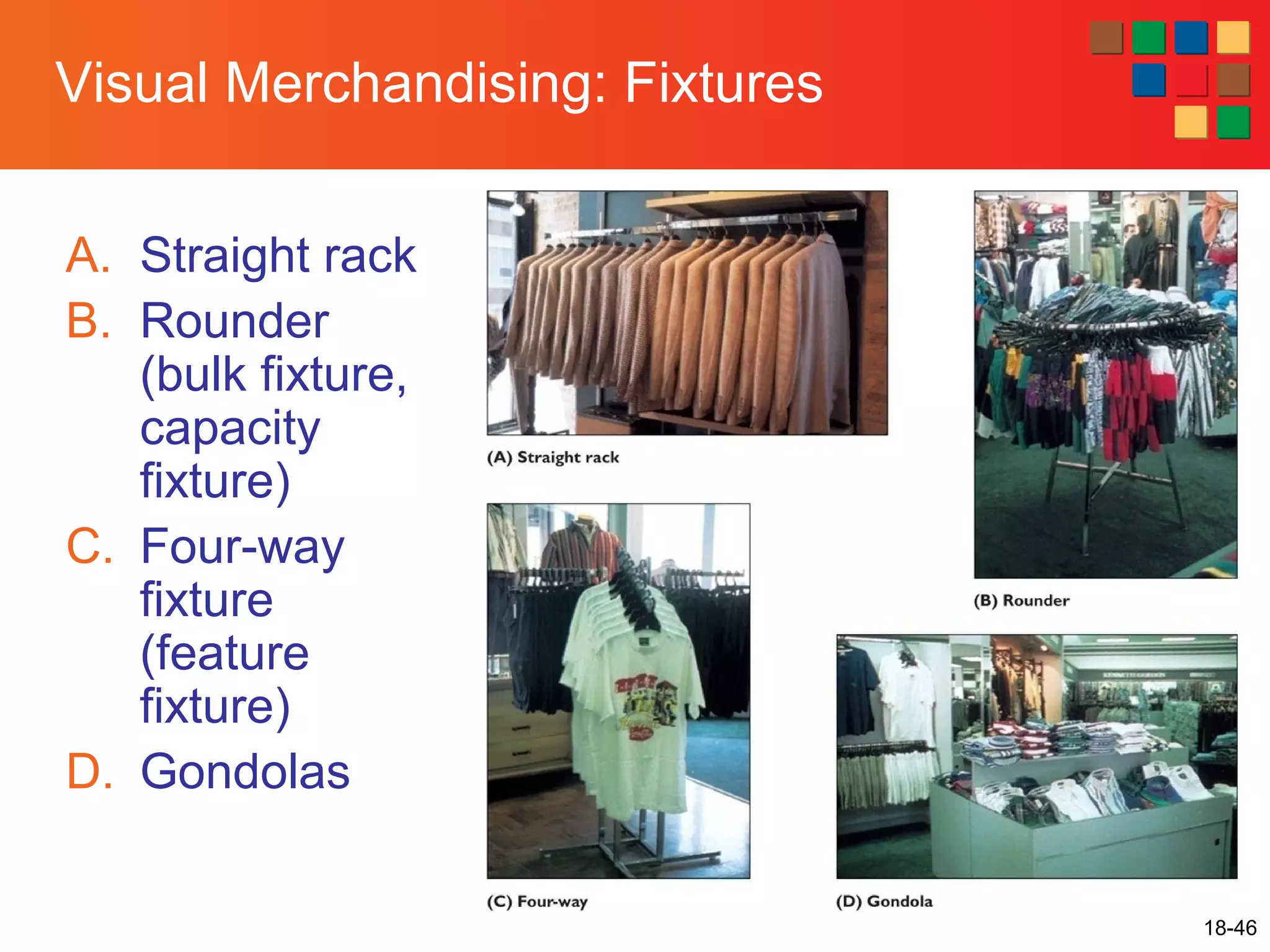
Visual Merchandising: Fixtures
A. Straight rack
B. Rounder
(bulk fixture,
capacity
fixture)
C. Four-way
fixture
(feature
fixture)
D. Gondolas
18-47
Straight Rack
■ Holds a lot of apparel
■ Hard to feature specific styles and
colors
■ Found often in discount and off-price
stores
Royalty-Free/CORBIS
18-48
Rounder
■ Smaller than straight rack
■ Holds a maximum
amount of merchandise
■ Easy to move around
■ Customers can’t get
frontal view of
merchandise
18-49
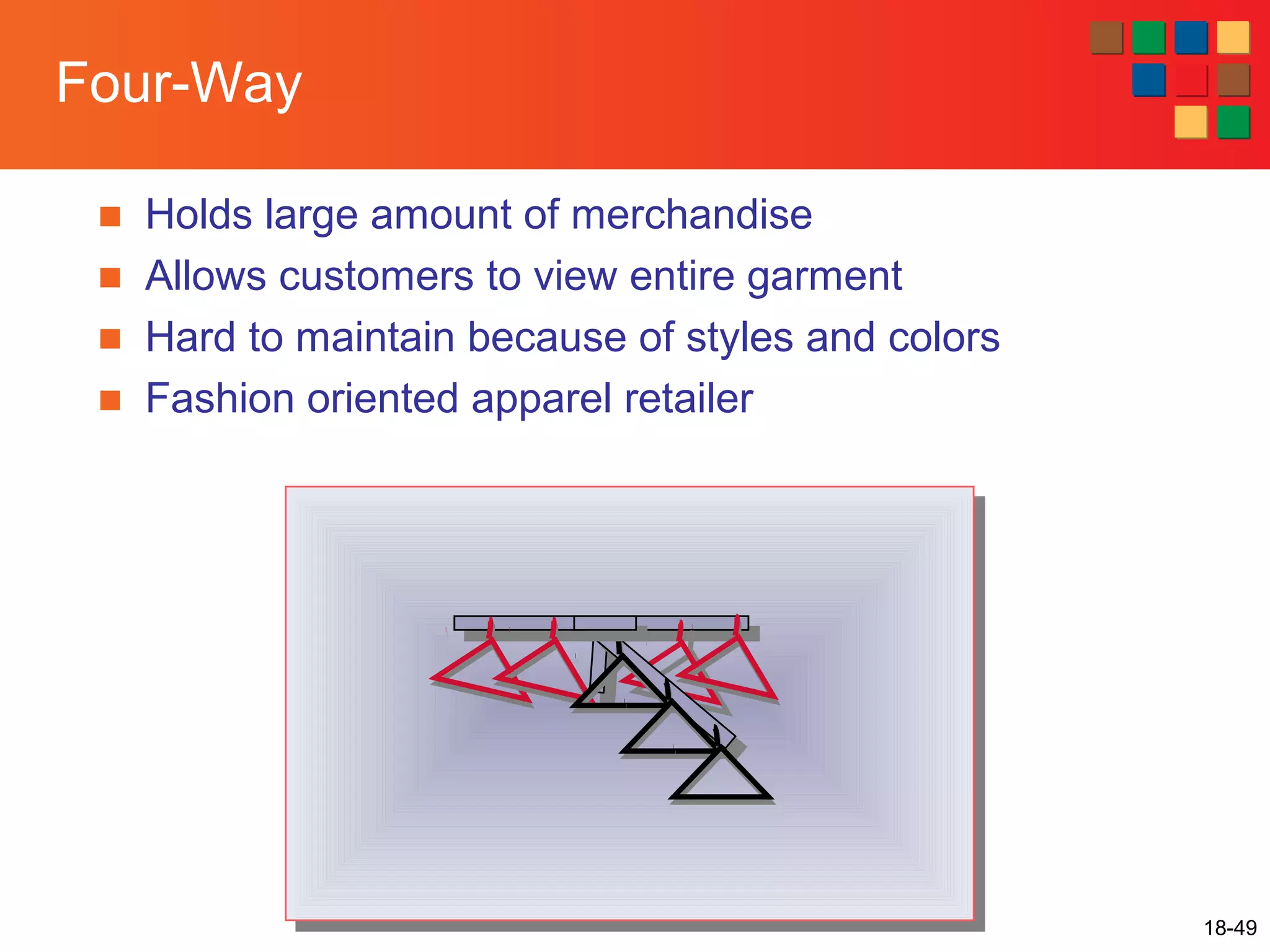
Four-Way
■ Holds large amount of merchandise
■ Allows customers to view entire garment
■ Hard to maintain because of styles and colors
■ Fashion oriented apparel retailer
18-50
Gondolas
■ Versatile
■ Grocery and discount stores
■ Some department stores
■ Hard to view apparel as
they are folded
Royalty-Free/CORBIS
18-51
Merchandise
Presentation Techniques
■ Idea-Oriented Presentation
■ Style/Item Presentation
■ Color Organization
■ Price Lining
■ Vertical Merchandising
■ Tonnage Merchandising
large quantities of merchandise
displayed together
■ Frontal Presentation
display as much of the product as
possible to catch the customer’s
eye
18-52
Idea-Orientation Presentation
■ Present merchandise based on a
specific idea or the image of the
store
■ Encourage multiple
complementary purchases

Women’s fashion

Furniture combined in room settings

Sony Style mini-living rooms
Fifty percent of women get their ideas for clothes from store displays or
window shopping
18-53
18-54
Store Atmospherics
Color
Scent Music
Lighting
Store Atmosphere
The design of an environment through visual
communications, lighting, colors, music, and scent to
stimulate customers’ perceptual and emotional responses
and ultimately to affect their purchase behavior
18-55
Lighting
Highlight merchandise
Structure space and
capture a mood
Energy efficient lighting
Downplay features
The McGraw-Hill Companies, Inc./Lars A. Niki, photographer
18-56
Color
■ Warm colors (red, gold, yellow)
produce emotional, vibrant, hot,
and active responses
■ Cool colors (white, blue, green)
have a peaceful, gentle, calming
effect
■ Culturally bounded

French-Canadians – respond more
to warm colors

Anglo-Canadians – respond more
to cool colors
The McGraw-Hill Companies, Inc./Lars Niki, photographer
18-57
Music
■ Control the pace of store traffic, create an image, and
attract or direct consumers’ attention
■ A mix of classical or soothing music encourage shoppers

to slow down, relax, and take a good look at the merchandise

thus to stay longer and purchase more
■ J.C. Penney – different music at different times of the day

Jazzy music in the morning for older shoppers

Adult contemporary music in the afternoon for 35-40 year old
shoppers
■ U.S. firm Muzak supplies 400,000 shops, restaurants, and
hotels with songs tailed to reflect their identity
18-58
Scent
Has a positive impact on
impulse buying behavior
and customer satisfaction
■ Scents that are neutral produce
better perceptions of the store
than no scent
■ Customers in scented stores
think they spent less time in the
store than subjects in unscented
stores
The McGraw-Hill Companies, Inc./Gary He, photographer
18-59
How Exciting Should a Store Be?
Depends on the Customer’s Shopping Goals
■ Task-completion:
a simple atmosphere with slow music, dimmer
lighting, and blue/green colors
■ Fun:
an exciting atmosphere with fast music, bright
lighting, and red/yellow colors
18-60
Web Site Design
■ Simplicity Matters
■ Getting Around – Easy Navigation
■ Let Them See It

Example: Lands’ End My Virtual Model
■ Blend the Web Site with the Store
■ Prioritize
■ Type of Layout

When shopping on the Web, customer are interested in speed,
convenience, ease of navigation, not necessarily fancy graphics
■ Checkout

Make the process clear and appear simple

Enclose the checkout process

Make the process navigable without loss of information

Reinforce trust in the checkout process

Retail Store layout

  • 1.
    Store Layout, Designand Visual Merchandising
  • 2.
  • 3.
  • 4.
    18-4 Store Design Objectives ■Implement retailer’s strategy ■ Influence customer buying behavior ■ Provide flexibility ■ Control design and maintenance costs ■ Meet legal requirements
  • 5.
    18-5 Store Design andRetail Strategy The primary objective of store design is implementing the retailer’s strategy (c)BrandXPictures/PunchStock C. Borland/PhotoLink/Getty Images Meets needs of target market Builds a sustainable competitive advantage Displays the store’s image
  • 6.
    18-6 McDonald’s remodeled itsstores to better appeal to European customers
  • 7.
    18-7 In India, aretailer finds key to success is clutter
  • 8.
    18-8 Chaos Sells inIndia Americans and Europeans might like to shop in pristine, quiet stores. But one entrepreneur (founder of India’s Big Bazaar) his fortune by redesigning stores in India to be messier, nosier, and more cramped. http://online.wsj.com/article/SB118598686231984863.html
  • 9.
    18-9 Influence Customer BuyingBehavior ■ Attract customers to store ■ Enable them to easily locate merchandise ■ Keep them in the store for a long time ■ Motivate them to make unplanned purchases ■ Provide them with a satisfying shopping experience H. Wiesenhofer/PhotoLink/Getty Images
  • 10.
    18-10 Today’s Demographics Time limitedfamilies are spending less time planning shopping trips and making more decisions in the stores. So retailers are making adjustments to their stores to get people in and out quicker. Royalty-Free/CORBIS
  • 11.
    18-11 Whole Foods stores’checkout system was redesigned to reduce wait time
  • 12.
    18-12 Cost ■ Control thecost of implementing the store design and maintain the store’s appearance ■ Store design influences  shopping experience and thus sales  Labor costs  Inventory shrinkage
  • 13.
  • 14.
    18-14 Reasonable Access What doesthat mean? ■ 32 inch wide pathways on the main aisle and to the bathroom, fitting rooms elevators and around most fixtures ■ Lower most cash wraps and fixtures so they can be reached by a person in a wheelchair ■ Make bathroom and fitting room fully accessible Keith Brofsky/Getty Images
  • 15.
    18-15 Tradeoff in StoreDesign Ease of locating merchandise for planned purchases Exploration of store, impulse purchases Royalty-Free/CORBIS (c)image100/PunchStock Giving customers adequate space to shop Productivity of using this scarce resource for merchandise
  • 16.
    18-16 Store Design ■ Layouts ■Signage and Graphics ■ Feature Area
  • 17.
  • 18.
  • 19.
  • 20.
  • 21.
    18-21 Store Layouts ■ Toencourage customer exploration and help customers move through the stores  Use a layout that facilitates a specific traffic pattern  Provide interesting design elements ■ Types of Store Layouts  Grid  Racetrack  Free Form
  • 22.
    18-22 Grid Layout ■ Easyto locate merchandise ■ Does not encourage customers to explore store  Limited site lines to merchandise ■ Allows more merchandise to be displayed ■ Cost efficient ■ Used in grocery, discount, and drug stores: Why?
  • 23.
    18-23 Racetrack Layout (Loop) ■Loop with a major aisle that has access to departments ■ Draws customers around the store ■ Provide different viewing angles and encourage exploration, impulse buying ■ Used in department stores
  • 24.
  • 25.
    18-25 Example of RaceTrack Layout PhotoLink/Getty Images
  • 26.
    18-26 Free-Form (Boutique) Layout ■Fixtures and aisles arranged asymmetrically ■ Provides an intimate, relaxing environment that facilitates shopping and browsing ■ Pleasant relaxing ambiance doesn’t come cheap – small store experience ■ Inefficient use of space ■ More susceptible to shoplifting – salespeople can not view adjacent spaces. ■ Used in specialty stores and upscale department stores
  • 27.
  • 28.
  • 29.
    18-29 Usage of Signageand Graphics ■ Location – identifies the location of merchandise and guides customers ■ Category Signage – identifies types of products and located near the goods ■ Promotional Signage – relates to specific offers – sometimes in windows ■ Point of sale – near merchandise with prices and product information ■ Lifestyle images – creates moods that encourage customers to shop H & M effectively uses graphic photo panels to add personality, beauty, and romance to its store’s image
  • 30.
  • 31.
    18-31 Suggestions for EffectivelyUsing Signage ■ Coordinate signage to store’s image ■ Use appropriate type faces on signs ■ Inform customers ■ Use them as props ■ Keep them fresh ■ Limit the text on signs ■ Use appropriate typefaces on signs
  • 32.
    18-32 Digital Signage Visual Contentdelivered digitally through a centrally managed and controlled network and displayed on a TV monitor or flat panel screen ■ Superior in attracting attention ■ Enhances store environment ■ Provides appealing atmosphere ■ Overcomes time-to-message hurdle ■ Messages can target demographics ■ Eliminates costs with printing, distribution and installing traditional signage
  • 33.
  • 34.
    18-34 Feature Areas Areas withina store designed to get the customers’ attention Feature areas  Entrances  Freestanding displays  Cash wraps (POP counters, checkout areas)  Promotional aisles  Walls  Windows  Fitting rooms PhotoLink/Getty Images
  • 35.
  • 36.
  • 37.
  • 38.
    18-38 Space Management ■ Thespace within stores and on the stores’ shelves are fixtures is a scare resource ■ The allocation of store space to merchandise categories and brands ■ The location of departments or merchandise categories in the store
  • 39.
    18-39 Space Planning ■ Productivityof allocated space (sales/squire foot, sales/linear foot) ■ Merchandise inventory turnover ■ Impact on store sales ■ Display needs for the merchandise
  • 40.
    18-40 You are here Percentageof Shoppers Visiting Different Areas of the Store Considerations for Merchandise Locations
  • 41.
    18-41 Prime Locations forMerchandise ■ Highly trafficked areas  Store entrances  Near checkout counter ■ Highly visible areas  End aisle  Displays
  • 42.
    18-42 Location of MerchandiseCategories ■ Impulse merchandise – near heavily trafficked areas ■ Demand/Destination merchandise – back left-hand corner of the store ■ Special merchandise – lightly trafficked areas (glass pieces, women’s lingerie) ■ Adjacencies – cluster complimentary merchandise next to each other
  • 43.
    18-43 Location of Merchandisewithin a Category: The Use of Planograms ■ Supermarkets and drug stores place private-label brands to the right of national brands – shoppers read from left to right (higher priced national brands first and see the lower-priced private-label item) ■ Planogram: a diagram that shows how and where specific SKUs should be placed on retail selves or displays to increase customer purchases
  • 44.
  • 45.
    18-45 Learning customers’ movementsand decision-making ■ Videotaping Consumers  Learn customers’ movements, where they pause or move quickly, or where there is congestion  Evaluate the layout, merchandise placement, promotion ■ Virtual Store Software  Learn the best place to merchandise and test how customers react to new products
  • 46.
    18-46 Visual Merchandising: Fixtures A.Straight rack B. Rounder (bulk fixture, capacity fixture) C. Four-way fixture (feature fixture) D. Gondolas
  • 47.
    18-47 Straight Rack ■ Holdsa lot of apparel ■ Hard to feature specific styles and colors ■ Found often in discount and off-price stores Royalty-Free/CORBIS
  • 48.
    18-48 Rounder ■ Smaller thanstraight rack ■ Holds a maximum amount of merchandise ■ Easy to move around ■ Customers can’t get frontal view of merchandise
  • 49.
    18-49 Four-Way ■ Holds largeamount of merchandise ■ Allows customers to view entire garment ■ Hard to maintain because of styles and colors ■ Fashion oriented apparel retailer
  • 50.
    18-50 Gondolas ■ Versatile ■ Groceryand discount stores ■ Some department stores ■ Hard to view apparel as they are folded Royalty-Free/CORBIS
  • 51.
    18-51 Merchandise Presentation Techniques ■ Idea-OrientedPresentation ■ Style/Item Presentation ■ Color Organization ■ Price Lining ■ Vertical Merchandising ■ Tonnage Merchandising large quantities of merchandise displayed together ■ Frontal Presentation display as much of the product as possible to catch the customer’s eye
  • 52.
    18-52 Idea-Orientation Presentation ■ Presentmerchandise based on a specific idea or the image of the store ■ Encourage multiple complementary purchases  Women’s fashion  Furniture combined in room settings  Sony Style mini-living rooms Fifty percent of women get their ideas for clothes from store displays or window shopping
  • 53.
  • 54.
    18-54 Store Atmospherics Color Scent Music Lighting StoreAtmosphere The design of an environment through visual communications, lighting, colors, music, and scent to stimulate customers’ perceptual and emotional responses and ultimately to affect their purchase behavior
  • 55.
    18-55 Lighting Highlight merchandise Structure spaceand capture a mood Energy efficient lighting Downplay features The McGraw-Hill Companies, Inc./Lars A. Niki, photographer
  • 56.
    18-56 Color ■ Warm colors(red, gold, yellow) produce emotional, vibrant, hot, and active responses ■ Cool colors (white, blue, green) have a peaceful, gentle, calming effect ■ Culturally bounded  French-Canadians – respond more to warm colors  Anglo-Canadians – respond more to cool colors The McGraw-Hill Companies, Inc./Lars Niki, photographer
  • 57.
    18-57 Music ■ Control thepace of store traffic, create an image, and attract or direct consumers’ attention ■ A mix of classical or soothing music encourage shoppers  to slow down, relax, and take a good look at the merchandise  thus to stay longer and purchase more ■ J.C. Penney – different music at different times of the day  Jazzy music in the morning for older shoppers  Adult contemporary music in the afternoon for 35-40 year old shoppers ■ U.S. firm Muzak supplies 400,000 shops, restaurants, and hotels with songs tailed to reflect their identity
  • 58.
    18-58 Scent Has a positiveimpact on impulse buying behavior and customer satisfaction ■ Scents that are neutral produce better perceptions of the store than no scent ■ Customers in scented stores think they spent less time in the store than subjects in unscented stores The McGraw-Hill Companies, Inc./Gary He, photographer
  • 59.
    18-59 How Exciting Shoulda Store Be? Depends on the Customer’s Shopping Goals ■ Task-completion: a simple atmosphere with slow music, dimmer lighting, and blue/green colors ■ Fun: an exciting atmosphere with fast music, bright lighting, and red/yellow colors
  • 60.
    18-60 Web Site Design ■Simplicity Matters ■ Getting Around – Easy Navigation ■ Let Them See It  Example: Lands’ End My Virtual Model ■ Blend the Web Site with the Store ■ Prioritize ■ Type of Layout  When shopping on the Web, customer are interested in speed, convenience, ease of navigation, not necessarily fancy graphics ■ Checkout  Make the process clear and appear simple  Enclose the checkout process  Make the process navigable without loss of information  Reinforce trust in the checkout process