Managing Merchandise
Assortments
12-2
Merchandise Management
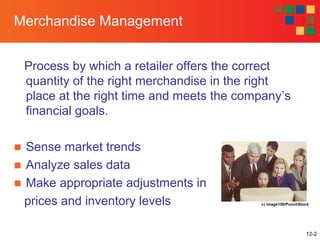
Process by which a retailer offers the correct
quantity of the right merchandise in the right
place at the right time and meets the company’s
financial goals.
■ Sense market trends
■ Analyze sales data
■ Make appropriate adjustments in
prices and inventory levels c) image100/PunchStock
12-3
Merchandise Management
■ Dollars to invest in inventory
■ Invest in “hot” merchandise
■ Save a little for opportunities
(open to buy)
■ Monitor portfolio of
merchandise (stocks)
■ Sell losers (markdowns)
12-4
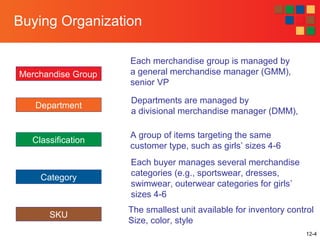
Buying Organization
Merchandise Group
Department
Classification
Category
SKU
Each merchandise group is managed by
a general merchandise manager (GMM),
senior VP
Departments are managed by
a divisional merchandise manager (DMM),
A group of items targeting the same
customer type, such as girls’ sizes 4-6
Each buyer manages several merchandise
categories (e.g., sportswear, dresses,
swimwear, outerwear categories for girls’
sizes 4-6
The smallest unit available for inventory control
Size, color, style
12-5
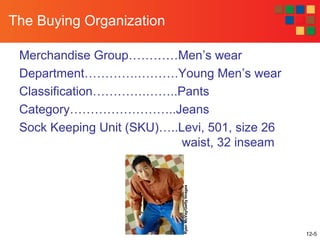
The Buying Organization
Merchandise Group…………Men’s wear
Department………….……….Young Men’s wear
Classification………….……..Pants
Category……………………..Jeans
Sock Keeping Unit (SKU)…..Levi, 501, size 26
waist, 32 inseam
RyanMcVay/GettyImages
12-6
Merchandise Category –
The Planning Unit
A merchandise category is an assortment of items that
customers see as substitutes for each other.
Vendors might assign products to different categories
based on differences in product attributes
Retailers might assign two products to the same
category based upon common consumers and buying
behavior
12-7
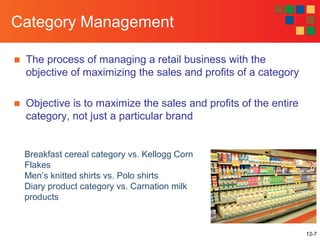
Category Management
Breakfast cereal category vs. Kellogg Corn
Flakes
Men’s knitted shirts vs. Polo shirts
Diary product category vs. Carnation milk
products
■ The process of managing a retail business with the
objective of maximizing the sales and profits of a category
■ Objective is to maximize the sales and profits of the entire
category, not just a particular brand
12-8
Category Captain
Selected vendor responsible for managing a category
Vendors frequently have more information and analytical skills
about the category in which they compete than retailers
■ Helps retailer understand consumer behavior
■ Creates assortments that satisfy the customer
■ Improves profitability of category
Problems
■ Vendor category captain may have different goals than
retailer
12-9
Evaluating Merchandise Management
Performance - GMROI
Merchandise managers have control over
■ The merchandise they buy
■ The price at which the merchandise is sold
■ The cost of the merchandise
Merchandise managers do not have control over
■ Operating expenses
■ Human resources
■ Real estate
■ Supply chain management
■ Information systems
SO HOW ARE MERCHANTS EVALUATED?
12-10
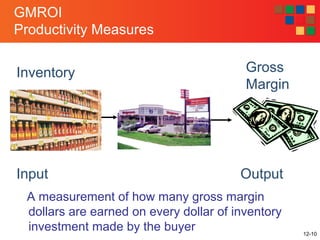
GMROI
Productivity Measures
Inventory Gross
Margin
Input Output
A measurement of how many gross margin
dollars are earned on every dollar of inventory
investment made by the buyer
12-11
Advantages of Rapid Turnover
■ Increased sales volume
■ Less risk of obsolescence and markdowns
■ Improved salesperson morale
■ More resources to take advantage of new
buying opportunities
12-12
Approaches for Improving Inventory Turnover
■ Reduce number of categories
■ Reduce number of SKUs within a category
■ Reduce number of items in a SKU
BUT if a customer can’t find their size or color or
brand, patronage and sales decrease!
another approach…
12-13
…another approach
To improve inventory turnover
■ Buy merchandise more often
■ Buy in smaller quantities which should reduce average
inventory without reducing sales
BUT by buying smaller quantities
■ Buyers can’t take advantage of quantity discounts so
■ Gross margin decreases
■ Operating expenses increase
■ Buyers need to spend more time placing orders and
monitoring deliveries
12-14
Types of Merchandise Management
Planning Processes
Two distinct types of merchandise management systems
for managing
■ Staple (Basic) Merchandise Categories

Continuous demand over an extended time period

Limited number of new product introductions

Hosiery, basic casual apparel

Easy to forecast demand

Continuous replenishment
■ Fashion Merchandise Categories

In demand for a relatively short period of time

Continuous introductions of new products, making existing
products obsolete

Athletic shoes, laptop computers, women’s apparel
12-15
Merchandise Management Process
1. Forecasting sales
2. Developing an assortment plan
3. Determining the appropriate inventory level
12-16
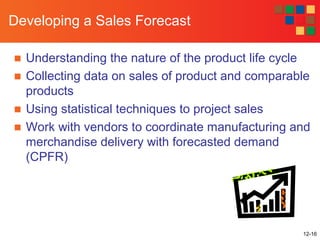
Developing a Sales Forecast
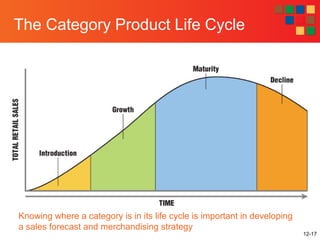
■ Understanding the nature of the product life cycle
■ Collecting data on sales of product and comparable
products
■ Using statistical techniques to project sales
■ Work with vendors to coordinate manufacturing and
merchandise delivery with forecasted demand
(CPFR)
12-17
The Category Product Life Cycle
Knowing where a category is in its life cycle is important in developing
a sales forecast and merchandising strategy
12-18
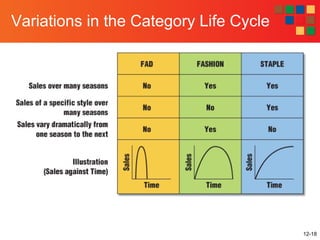
Variations in the Category Life Cycle
12-19
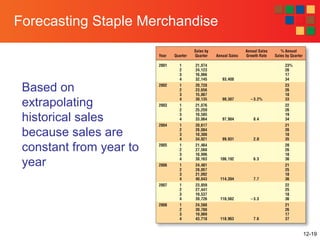
Forecasting Staple Merchandise
Based on
extrapolating
historical sales
because sales are
constant from year to
year
12-20
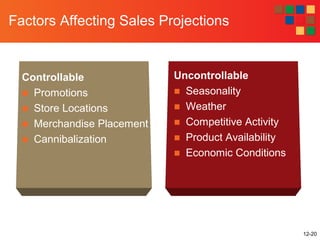
Factors Affecting Sales Projections
Controllable
■ Promotions
■ Store Locations
■ Merchandise Placement
■ Cannibalization
Uncontrollable
■ Seasonality
■ Weather
■ Competitive Activity
■ Product Availability
■ Economic Conditions
12-21
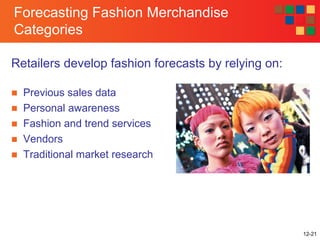
Forecasting Fashion Merchandise
Categories
Retailers develop fashion forecasts by relying on:
■ Previous sales data
■ Personal awareness
■ Fashion and trend services
■ Vendors
■ Traditional market research
12-22
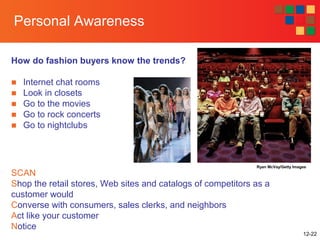
Personal Awareness
How do fashion buyers know the trends?
■ Internet chat rooms
■ Look in closets
■ Go to the movies
■ Go to rock concerts
■ Go to nightclubs
Ryan McVay/Getty Images
SCAN
Shop the retail stores, Web sites and catalogs of competitors as a
customer would
Converse with consumers, sales clerks, and neighbors
Act like your customer
Notice
12-23
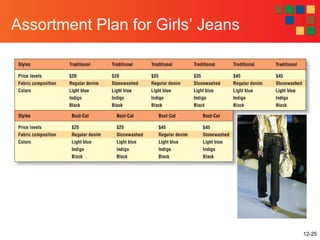
Developing Assortment Planning
Assortment plan is a list of the SKUs that a retailer will offer
in a merchandise category and reflects the variety and
assortment that the retailer plans to offer in a merchandise
category
Variety (breadth) is the number of different merchandising
categories within a store or department
Assortment (depth) is the number of SKUs within a
category.
Product availability defines the percentage of demand for a
particular SKU that is satisfied.
12-24
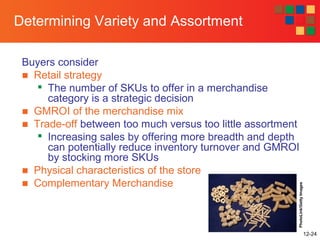
Determining Variety and Assortment
Buyers consider
■ Retail strategy

The number of SKUs to offer in a merchandise
category is a strategic decision
■ GMROI of the merchandise mix
■ Trade-off between too much versus too little assortment

Increasing sales by offering more breadth and depth
can potentially reduce inventory turnover and GMROI
by stocking more SKUs
■ Physical characteristics of the store
■ Complementary Merchandise
PhotoLink/GettyImages
12-25
Assortment Plan for Girls’ Jeans
12-26
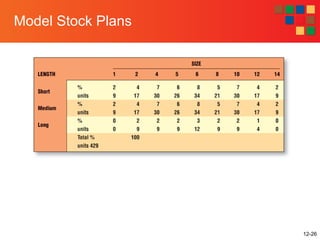
Model Stock Plans
13-27
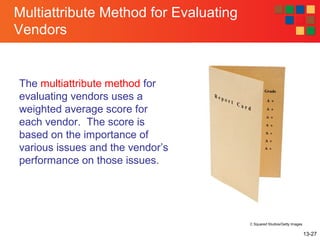
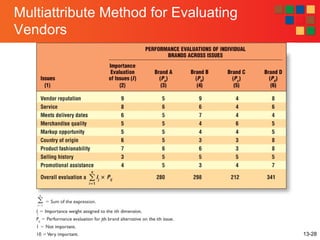
Multiattribute Method for Evaluating
Vendors
The multiattribute method for
evaluating vendors uses a
weighted average score for
each vendor. The score is
based on the importance of
various issues and the vendor’s
performance on those issues.
C Squared Studios/Getty Images
13-28
Multiattribute Method for Evaluating
Vendors
13-29
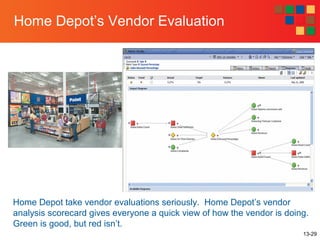
Home Depot’s Vendor Evaluation
Home Depot take vendor evaluations seriously. Home Depot’s vendor
analysis scorecard gives everyone a quick view of how the vendor is doing.
Green is good, but red isn’t.

Managing merchandise

  • 1.
  • 2.
    12-2 Merchandise Management Process bywhich a retailer offers the correct quantity of the right merchandise in the right place at the right time and meets the company’s financial goals. ■ Sense market trends ■ Analyze sales data ■ Make appropriate adjustments in prices and inventory levels c) image100/PunchStock
  • 3.
    12-3 Merchandise Management ■ Dollarsto invest in inventory ■ Invest in “hot” merchandise ■ Save a little for opportunities (open to buy) ■ Monitor portfolio of merchandise (stocks) ■ Sell losers (markdowns)
  • 4.
    12-4 Buying Organization Merchandise Group Department Classification Category SKU Eachmerchandise group is managed by a general merchandise manager (GMM), senior VP Departments are managed by a divisional merchandise manager (DMM), A group of items targeting the same customer type, such as girls’ sizes 4-6 Each buyer manages several merchandise categories (e.g., sportswear, dresses, swimwear, outerwear categories for girls’ sizes 4-6 The smallest unit available for inventory control Size, color, style
  • 5.
    12-5 The Buying Organization MerchandiseGroup…………Men’s wear Department………….……….Young Men’s wear Classification………….……..Pants Category……………………..Jeans Sock Keeping Unit (SKU)…..Levi, 501, size 26 waist, 32 inseam RyanMcVay/GettyImages
  • 6.
    12-6 Merchandise Category – ThePlanning Unit A merchandise category is an assortment of items that customers see as substitutes for each other. Vendors might assign products to different categories based on differences in product attributes Retailers might assign two products to the same category based upon common consumers and buying behavior
  • 7.
    12-7 Category Management Breakfast cerealcategory vs. Kellogg Corn Flakes Men’s knitted shirts vs. Polo shirts Diary product category vs. Carnation milk products ■ The process of managing a retail business with the objective of maximizing the sales and profits of a category ■ Objective is to maximize the sales and profits of the entire category, not just a particular brand
  • 8.
    12-8 Category Captain Selected vendorresponsible for managing a category Vendors frequently have more information and analytical skills about the category in which they compete than retailers ■ Helps retailer understand consumer behavior ■ Creates assortments that satisfy the customer ■ Improves profitability of category Problems ■ Vendor category captain may have different goals than retailer
  • 9.
    12-9 Evaluating Merchandise Management Performance- GMROI Merchandise managers have control over ■ The merchandise they buy ■ The price at which the merchandise is sold ■ The cost of the merchandise Merchandise managers do not have control over ■ Operating expenses ■ Human resources ■ Real estate ■ Supply chain management ■ Information systems SO HOW ARE MERCHANTS EVALUATED?
  • 10.
    12-10 GMROI Productivity Measures Inventory Gross Margin InputOutput A measurement of how many gross margin dollars are earned on every dollar of inventory investment made by the buyer
  • 11.
    12-11 Advantages of RapidTurnover ■ Increased sales volume ■ Less risk of obsolescence and markdowns ■ Improved salesperson morale ■ More resources to take advantage of new buying opportunities
  • 12.
    12-12 Approaches for ImprovingInventory Turnover ■ Reduce number of categories ■ Reduce number of SKUs within a category ■ Reduce number of items in a SKU BUT if a customer can’t find their size or color or brand, patronage and sales decrease! another approach…
  • 13.
    12-13 …another approach To improveinventory turnover ■ Buy merchandise more often ■ Buy in smaller quantities which should reduce average inventory without reducing sales BUT by buying smaller quantities ■ Buyers can’t take advantage of quantity discounts so ■ Gross margin decreases ■ Operating expenses increase ■ Buyers need to spend more time placing orders and monitoring deliveries
  • 14.
    12-14 Types of MerchandiseManagement Planning Processes Two distinct types of merchandise management systems for managing ■ Staple (Basic) Merchandise Categories  Continuous demand over an extended time period  Limited number of new product introductions  Hosiery, basic casual apparel  Easy to forecast demand  Continuous replenishment ■ Fashion Merchandise Categories  In demand for a relatively short period of time  Continuous introductions of new products, making existing products obsolete  Athletic shoes, laptop computers, women’s apparel
  • 15.
    12-15 Merchandise Management Process 1.Forecasting sales 2. Developing an assortment plan 3. Determining the appropriate inventory level
  • 16.
    12-16 Developing a SalesForecast ■ Understanding the nature of the product life cycle ■ Collecting data on sales of product and comparable products ■ Using statistical techniques to project sales ■ Work with vendors to coordinate manufacturing and merchandise delivery with forecasted demand (CPFR)
  • 17.
    12-17 The Category ProductLife Cycle Knowing where a category is in its life cycle is important in developing a sales forecast and merchandising strategy
  • 18.
    12-18 Variations in theCategory Life Cycle
  • 19.
    12-19 Forecasting Staple Merchandise Basedon extrapolating historical sales because sales are constant from year to year
  • 20.
    12-20 Factors Affecting SalesProjections Controllable ■ Promotions ■ Store Locations ■ Merchandise Placement ■ Cannibalization Uncontrollable ■ Seasonality ■ Weather ■ Competitive Activity ■ Product Availability ■ Economic Conditions
  • 21.
    12-21 Forecasting Fashion Merchandise Categories Retailersdevelop fashion forecasts by relying on: ■ Previous sales data ■ Personal awareness ■ Fashion and trend services ■ Vendors ■ Traditional market research
  • 22.
    12-22 Personal Awareness How dofashion buyers know the trends? ■ Internet chat rooms ■ Look in closets ■ Go to the movies ■ Go to rock concerts ■ Go to nightclubs Ryan McVay/Getty Images SCAN Shop the retail stores, Web sites and catalogs of competitors as a customer would Converse with consumers, sales clerks, and neighbors Act like your customer Notice
  • 23.
    12-23 Developing Assortment Planning Assortmentplan is a list of the SKUs that a retailer will offer in a merchandise category and reflects the variety and assortment that the retailer plans to offer in a merchandise category Variety (breadth) is the number of different merchandising categories within a store or department Assortment (depth) is the number of SKUs within a category. Product availability defines the percentage of demand for a particular SKU that is satisfied.
  • 24.
    12-24 Determining Variety andAssortment Buyers consider ■ Retail strategy  The number of SKUs to offer in a merchandise category is a strategic decision ■ GMROI of the merchandise mix ■ Trade-off between too much versus too little assortment  Increasing sales by offering more breadth and depth can potentially reduce inventory turnover and GMROI by stocking more SKUs ■ Physical characteristics of the store ■ Complementary Merchandise PhotoLink/GettyImages
  • 25.
  • 26.
  • 27.
    13-27 Multiattribute Method forEvaluating Vendors The multiattribute method for evaluating vendors uses a weighted average score for each vendor. The score is based on the importance of various issues and the vendor’s performance on those issues. C Squared Studios/Getty Images
  • 28.
  • 29.
    13-29 Home Depot’s VendorEvaluation Home Depot take vendor evaluations seriously. Home Depot’s vendor analysis scorecard gives everyone a quick view of how the vendor is doing. Green is good, but red isn’t.