“Shopper found deadin local
store; cause of death – boredom”
Stanley Marcus, Chairman-Emeritus, Neiman Marcus
No other variable in the retailing mix influences the consumer’s initial
perceptions of a bricks & mortar retailer as much as the store itself.
The store is “where the action is” and includes such minor details as
the placement of the merchandise.
3.
Objectives of theStore Environment
Get customers into the store (store image)
Serves a critical role in the store selection process
Important criteria include cleanliness, labeled prices, accurate and pleasant
checkout clerks, and well-stocked shelves
The store itself makes the most significant and last impression
Once they are inside the store, convert them into customers
buying merchandise (space productivity)
The more merchandise customers are exposed to that is presented in an
orderly manner, the more they tend to buy
Retailers focusing more attention on in-store marketing – marketing dollars
spent in the store, in the form of store design, merchandise presentation,
visual displays, and in-store promotions, should lead to greater sales and
profits (bottom line: it is easier to get a consumer in your store to buy more
merchandise than planned than to get a new consumer to come into your
store)
4.
Objectives of GoodStore Design
Design should:
be consistent with image and strategy
positively influence consumer behavior
consider costs versus value
be flexible
recognize the needs of the disabled – The
Americans with Disabilities Act
5.
Types of FloorSpace in Store
Back Room – receiving area, stockroom
Department stores (50%)
Small specialty and convenience stores (10%)
General merchandise stores (15-20%)
Offices and Other Functional Space – employee break room,
store offices, cash office, restrooms
Aisles, Service Areas and Other Non-Selling Areas
Moving shoppers through the store, dressing rooms, layaway
areas, service desks, customer service facilities
Merchandise Space
Floor
Wall
6.
Store Layout (andTraffic Flow)
Conflicting objectives:
Ease of finding merchandise versus varied and
interesting layout
Giving customers adequate space to shop versus
use expensive space productively
7.
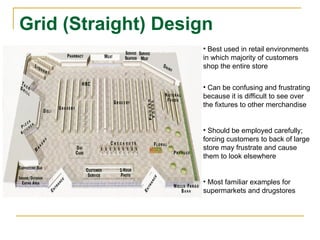
Grid (Straight) Design
•Best used in retail environments
in which majority of customers
shop the entire store
• Can be confusing and frustrating
because it is difficult to see over
the fixtures to other merchandise
• Should be employed carefully;
forcing customers to back of large
store may frustrate and cause
them to look elsewhere
• Most familiar examples for
supermarkets and drugstores
8.
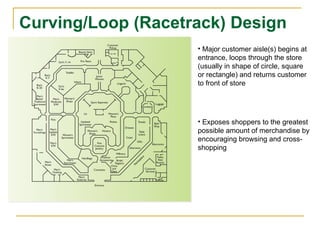
Curving/Loop (Racetrack) Design
•Major customer aisle(s) begins at
entrance, loops through the store
(usually in shape of circle, square
or rectangle) and returns customer
to front of store
• Exposes shoppers to the greatest
possible amount of merchandise by
encouraging browsing and cross-
shopping
9.
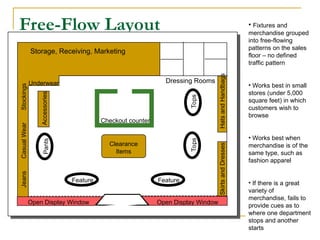
Free-Flow Layout •Fixtures and
merchandise grouped
into free-flowing
patterns on the sales
floor – no defined
traffic pattern
• Works best in small
stores (under 5,000
square feet) in which
customers wish to
browse
• Works best when
merchandise is of the
same type, such as
fashion apparel
• If there is a great
variety of
merchandise, fails to
provide cues as to
where one department
stops and another
starts
Storage, Receiving, Marketing
Underwear Dressing Rooms
Checkout counter
Clearance
Items
Feature Feature
Jeans
Casual
Wear
Stockings
Accessories
Pants
Tops
Tops
Skirts
and
Dresses
Hats
and
Handbags
Open Display Window Open Display Window
10.
Spine Layout •Variation of grid, loop and free-form
layouts
• Based on single main aisle running from
the front to the back of the store
(transporting customers in both directions)
• On either side of spine, merchandise
departments branch off toward the back or
side walls
• Heavily used by medium-sized specialty
stores ranging from 2,000 – 10,000 square
feet
• In fashion stores the spine is often subtly
offset by a change in floor coloring or
surface and is not perceived as an aisle
11.
Location of Departments
Relative location advantages
Impulse products
Demand/destination areas
Seasonal needs
Physical characteristics of merchandise
Adjacent departments
12.
Feature Areas
Theareas within a store designed to get the
customer’s attention which include:
End caps – displays located at the end of the
aisles
Promotional aisle/area
Freestanding fixtures
Windows
Walls
Point-of-sale (POS) displays/areas
13.
Fixture Types
StraightRack – long pipe suspended
with supports to the floor or attached to
a wall
Gondola – large base with a vertical
spine or wall fitted with sockets or
notches into which a variety of shelves,
peghooks, bins, baskets and other
hardware can be inserted.
Four-way Fixture – two crossbars that sit
perpendicular to each other on a
pedestal
Round Rack – round fixture that sits on
pedestal
Other common fixtures: tables, large
bins, flat-based decks
14.
Fixture Types
WallFixtures
To make store’s wall
merchandisable, wall usually
covered with a skin that is fitted
with vertical columns of
notches similar to those on a
gondola, into which a variety of
hardware can be inserted
Can be merchandised much
higher than floor fixtures (max
of 42” on floor for round racks
on wall can be as high as 72”
15.
Merchandise Display Planning
Shelving – flexible, easy to maintain
Hanging
Pegging – small rods inserted into gondolas or wall systems – can be labor
intensive to display/maintain but gives neat/orderly appearance
Folding – for softlines can be folded and stacked on shelves or tables - creates
high fashion image
Stacking – for large hardlines can be stacked on shelves, base decks of
gondolas or flats – easy to maintain and gives image of high volume and low
price
Dumping – large quantities of small merchandise can be dumped into baskets or
bins – highly effective for softlines (socks, wash cloths) or hardlines (batteries,
candy, grocery products) – creates high volume, low cost image
16.
Three Psychological Factorsto
Consider in Merchandising Stores
Value/fashion image
Trendy, exclusive, pricy vs value-oriented
Angles and Sightlines
Customers view store at 45 degree angles from the path they
travel as they move through the store
Most stores set up at right angles because it’s easier and
consumes less space
Vertical color blocking
Merchandise should be displayed in vertical bands of color
wherever possible – will be viewed as rainbow of colors if each
item displayed vertically by color
Creates strong visual effect that shoppers are exposed to more
merchandise (which increases sales)
17.
POS Displays
Assortmentdisplay – open and
closed assortment
Theme-setting display
Ensemble display
Rack display
Case display
Cut case
Dump bin
18.
Visual Merchandising
Theartistic display of merchandise and theatrical props used as
scene-setting decoration in the store
Several key characteristics
Not associated with shop-able fixture but located as a focal point
or other area remote from the on-shelf merchandising (and
perhaps out of the reach of customers)
Use of props and elements in addition to merchandise – visuals
don’t always include merchandise; may just be interesting display
of items related to merchandise or to mood retailer wishes to
create
Visuals should incorporate relevant merchandise to be most
effective
Retailers should make sure displays don’t create walls that make
it difficult for shoppers to reach other areas of the store
19.
StoreFront Design
Storefrontsmust:
Clearly identify the name and general nature of
the store
Give some hint as to the merchandise inside
Includes all exterior signage
In many cases includes store windows – an
advertising medium for the store – window
displays should be changed often, be fun/exciting,
and reflect merchandise offered inside
20.
Atmospherics
The designof an environment via:
visual communications
lighting
color
sound
scent
to stimulate customers’ perceptual and emotional responses and
ultimately influence their purchase behavior
Visual Communications
Coordinatesigns and graphics with store’s
image
Inform the customer
Use signs and graphics as props
Keep signs and graphics fresh
Limit sign copy
Use appropriate typefaces on signs
Create theatrical effects
23.
Lighting
Important butoften overlooked element in
successful store design
Highlight merchandise
Capture a mood
Level of light can make a difference
Blockbuster
Fashion Departments
24.
Color
Can influencebehavior
Warm colors increase blood pressure, respiratory rate
and other physiological responses – attract customers
and gain attention but can also be distracting
Cool colors are relaxing, peaceful, calm and pleasant
– effective for retailers selling anxiety-causing
products
25.
Sound & Scent
Sound
Music viewed as valuable marketing tool
Often customized to customer demographics - AIE (
http://www.aeimusic.com)
Can use volume and tempo for crowd control
Scent
Smell has a large impact on our emotions
Victoria Secret, The Magic Kingdom, The Knot Shop
Can be administered through time release atomizers or via
fragrance-soaked pellets placed on light fixtures