
© 2002, Cisco Systems, Inc. All rights reserved.
© 2002, Cisco Systems, Inc. All rights reserved. ICND v2.0—6-2© 2002, Cisco Systems, Inc. All rights reserved. 2
Scaling the Network with
NAT and PAT
© 2002, Cisco Systems, Inc. All rights reserved. ICND v2.0—6-3
Objectives
Upon completing this lesson, you will be able to:
• Describe the features and operation of NAT on Cisco
routers
• Use Cisco IOS commands to configure NAT, given a
functioning router
• Use show commands to identify anomalies in the NAT
configuration, given an operational router
• Use debug commands to identify events and
anomalies in the NAT configuration, given an
operational router
© 2002, Cisco Systems, Inc. All rights reserved. ICND v2.0—6-4
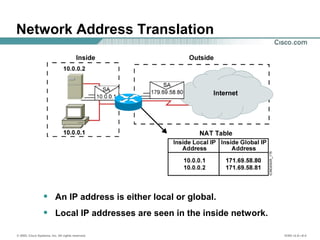
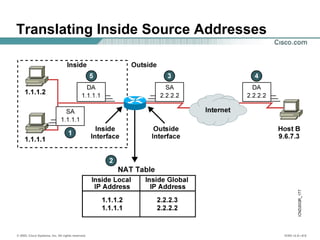
Network Address Translation
• An IP address is either local or global.
• Local IP addresses are seen in the inside network.
© 2002, Cisco Systems, Inc. All rights reserved. ICND v2.0—6-5
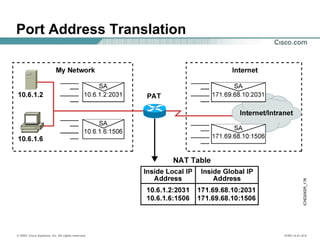
Port Address Translation
© 2002, Cisco Systems, Inc. All rights reserved. ICND v2.0—6-6
Translating Inside Source Addresses
© 2002, Cisco Systems, Inc. All rights reserved. ICND v2.0—6-7
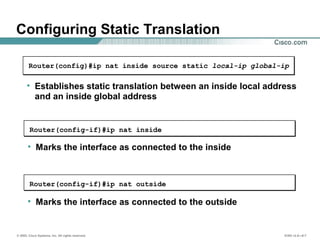
Configuring Static Translation
• Establishes static translation between an inside local address
and an inside global address
Router(config)#ip nat inside source static local-ip global-ip
• Marks the interface as connected to the inside
Router(config-if)#ip nat inside
• Marks the interface as connected to the outside
Router(config-if)#ip nat outside
© 2002, Cisco Systems, Inc. All rights reserved. ICND v2.0—6-8
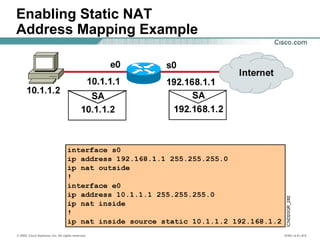
Enabling Static NAT
Address Mapping Example
© 2002, Cisco Systems, Inc. All rights reserved. ICND v2.0—6-9
Configuring Dynamic Translation
• Establishes dynamic source translation, specifying the access
list defined in the prior step
Router(config)#ip nat inside source list
access-list-number pool name
• Defines a pool of global addresses to be allocated as needed
Router(config)#ip nat pool name start-ip end-ip
{netmask netmask | prefix-length prefix-length}
• Defines a standard IP access list permitting those inside local
addresses that are to be translated
Router(config)#access-list access-list-number permit
source [source-wildcard]
© 2002, Cisco Systems, Inc. All rights reserved. ICND v2.0—6-10
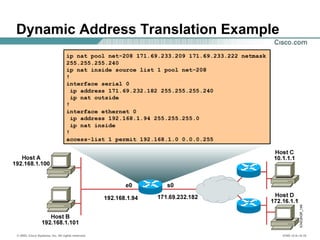
Dynamic Address Translation Example
© 2002, Cisco Systems, Inc. All rights reserved. ICND v2.0—6-11
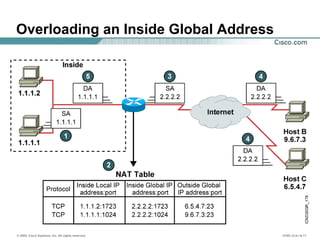
Overloading an Inside Global Address
© 2002, Cisco Systems, Inc. All rights reserved. ICND v2.0—6-12
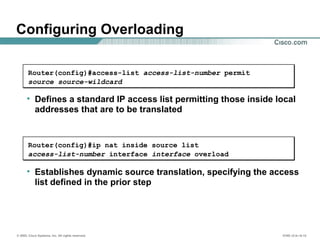
Configuring Overloading
• Establishes dynamic source translation, specifying the access
list defined in the prior step
Router(config)#ip nat inside source list
access-list-number interface interface overload
• Defines a standard IP access list permitting those inside local
addresses that are to be translated
Router(config)#access-list access-list-number permit
source source-wildcard
© 2002, Cisco Systems, Inc. All rights reserved. ICND v2.0—6-13
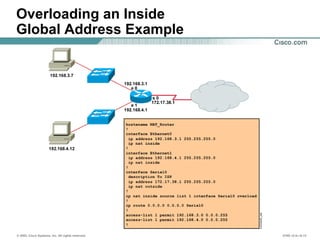
Overloading an Inside
Global Address Example
© 2002, Cisco Systems, Inc. All rights reserved. ICND v2.0—6-14
Clearing the NAT Translation Table
• Clears a simple dynamic translation entry containing an inside
translation, or both inside and outside translation
Router#clear ip nat translation inside global-ip
local-ip [outside local-ip global-ip]
• Clears all dynamic address translation entries
Router#clear ip nat translation *
• Clears a simple dynamic translation entry containing an outside translation
Router#clear ip nat translation outside
local-ip global-ip
• Clears an extended dynamic translation entry
Router#clear ip nat translation protocol inside global-ip
global-port local-ip local-port [outside local-ip
local-port global-ip global-port]
© 2002, Cisco Systems, Inc. All rights reserved. ICND v2.0—6-15
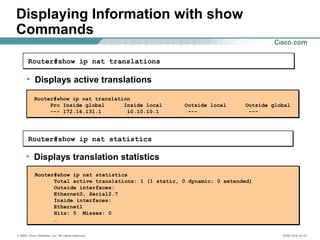
Displaying Information with show
Commands
• Displays translation statistics
Router#show ip nat statistics
• Displays active translations
Router#show ip nat translations
Router#show ip nat translation
Pro Inside global Inside local Outside local Outside global
--- 172.16.131.1 10.10.10.1 --- ---
Router#show ip nat statistics
Total active translations: 1 (1 static, 0 dynamic; 0 extended)
Outside interfaces:
Ethernet0, Serial2.7
Inside interfaces:
Ethernet1
Hits: 5 Misses: 0
…
© 2002, Cisco Systems, Inc. All rights reserved. ICND v2.0—6-16
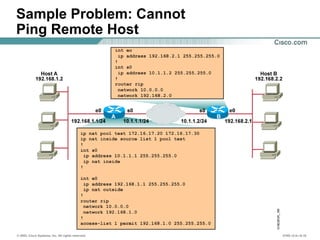
Sample Problem: Cannot
Ping Remote Host
© 2002, Cisco Systems, Inc. All rights reserved. ICND v2.0—6-17
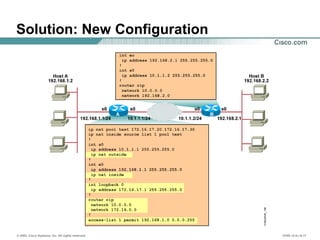
Solution: New Configuration
© 2002, Cisco Systems, Inc. All rights reserved. ICND v2.0—6-18
Using the debug ip nat Command
Router#debug ip nat
NAT: s=192.168.1.95->172.31.233.209, d=172.31.2.132 [6825]
NAT: s=172.31.2.132, d=172.31.233.209->192.168.1.95 [21852]
NAT: s=192.168.1.95->172.31.233.209, d=172.31.1.161 [6826]
NAT*: s=172.31.1.161, d=172.31.233.209->192.168.1.95 [23311]
NAT*: s=192.168.1.95->172.31.233.209, d=172.31.1.161 [6827]
NAT*: s=192.168.1.95->172.31.233.209, d=172.31.1.161 [6828]
NAT*: s=172.31.1.161, d=172.31.233.209->192.168.1.95 [23313]
NAT*: s=172.31.1.161, d=172.31.233.209->192.168.1.95 [23325]
© 2002, Cisco Systems, Inc. All rights reserved. ICND v2.0—6-19
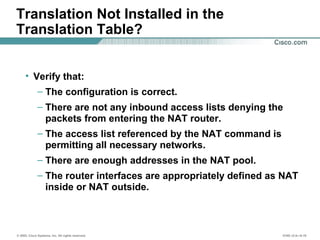
Translation Not Installed in the
Translation Table?
• Verify that:
– The configuration is correct.
– There are not any inbound access lists denying the
packets from entering the NAT router.
– The access list referenced by the NAT command is
permitting all necessary networks.
– There are enough addresses in the NAT pool.
– The router interfaces are appropriately defined as NAT
inside or NAT outside.
© 2002, Cisco Systems, Inc. All rights reserved. ICND v2.0—6-20
Summary
• Cisco IOS NAT allows an organization with unregistered
private addresses to connect to the Internet by translating
those addresses into globally registered IP addresses.
• You can translate your own IP addresses into globally
unique IP addresses when communicating outside of
your network.
• Overloading is a form of dynamic NAT that maps multiple
unregistered IP addresses to a single registered IP
address (many-to-one) by using different ports, known
also as PAT.
• Once you have configured NAT, verify that it is operating
as expected using the clear and show commands.
• Sometimes NAT is blamed for IP connectivity problems
when there is actually a routing problem.
© 2002, Cisco Systems, Inc. All rights reserved. ICND v2.0—6-21
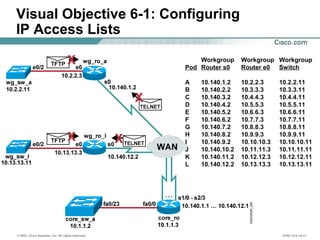
Visual Objective 6-1: Configuring
IP Access Lists
Workgroup Workgroup Workgroup
Pod Router s0 Router e0 Switch
A 10.140.1.2 10.2.2.3 10.2.2.11
B 10.140.2.2 10.3.3.3 10.3.3.11
C 10.140.3.2 10.4.4.3 10.4.4.11
D 10.140.4.2 10.5.5.3 10.5.5.11
E 10.140.5.2 10.6.6.3 10.6.6.11
F 10.140.6.2 10.7.7.3 10.7.7.11
G 10.140.7.2 10.8.8.3 10.8.8.11
H 10.140.8.2 10.9.9.3 10.9.9.11
I 10.140.9.2 10.10.10.3 10.10.10.11
J 10.140.10.2 10.11.11.3 10.11.11.11
K 10.140.11.2 10.12.12.3 10.12.12.11
L 10.140.12.2 10.13.13.3 10.13.13.11
© 2002, Cisco Systems, Inc. All rights reserved. ICND v2.0—6-22
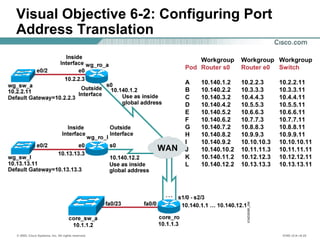
Visual Objective 6-2: Configuring Port
Address Translation
Workgroup Workgroup Workgroup
Pod Router s0 Router e0 Switch
A 10.140.1.2 10.2.2.3 10.2.2.11
B 10.140.2.2 10.3.3.3 10.3.3.11
C 10.140.3.2 10.4.4.3 10.4.4.11
D 10.140.4.2 10.5.5.3 10.5.5.11
E 10.140.5.2 10.6.6.3 10.6.6.11
F 10.140.6.2 10.7.7.3 10.7.7.11
G 10.140.7.2 10.8.8.3 10.8.8.11
H 10.140.8.2 10.9.9.3 10.9.9.11
I 10.140.9.2 10.10.10.3 10.10.10.11
J 10.140.10.2 10.11.11.3 10.11.11.11
K 10.140.11.2 10.12.12.3 10.12.12.11
L 10.140.12.2 10.13.13.3 10.13.13.11
Day 17.1 nat pat

Day 17.1 nat pat

  • 1.
    © 2002, CiscoSystems, Inc. All rights reserved.
  • 2.
    © 2002, CiscoSystems, Inc. All rights reserved. ICND v2.0—6-2© 2002, Cisco Systems, Inc. All rights reserved. 2 Scaling the Network with NAT and PAT
  • 3.
    © 2002, CiscoSystems, Inc. All rights reserved. ICND v2.0—6-3 Objectives Upon completing this lesson, you will be able to: • Describe the features and operation of NAT on Cisco routers • Use Cisco IOS commands to configure NAT, given a functioning router • Use show commands to identify anomalies in the NAT configuration, given an operational router • Use debug commands to identify events and anomalies in the NAT configuration, given an operational router
  • 4.
    © 2002, CiscoSystems, Inc. All rights reserved. ICND v2.0—6-4 Network Address Translation • An IP address is either local or global. • Local IP addresses are seen in the inside network.
  • 5.
    © 2002, CiscoSystems, Inc. All rights reserved. ICND v2.0—6-5 Port Address Translation
  • 6.
    © 2002, CiscoSystems, Inc. All rights reserved. ICND v2.0—6-6 Translating Inside Source Addresses
  • 7.
    © 2002, CiscoSystems, Inc. All rights reserved. ICND v2.0—6-7 Configuring Static Translation • Establishes static translation between an inside local address and an inside global address Router(config)#ip nat inside source static local-ip global-ip • Marks the interface as connected to the inside Router(config-if)#ip nat inside • Marks the interface as connected to the outside Router(config-if)#ip nat outside
  • 8.
    © 2002, CiscoSystems, Inc. All rights reserved. ICND v2.0—6-8 Enabling Static NAT Address Mapping Example
  • 9.
    © 2002, CiscoSystems, Inc. All rights reserved. ICND v2.0—6-9 Configuring Dynamic Translation • Establishes dynamic source translation, specifying the access list defined in the prior step Router(config)#ip nat inside source list access-list-number pool name • Defines a pool of global addresses to be allocated as needed Router(config)#ip nat pool name start-ip end-ip {netmask netmask | prefix-length prefix-length} • Defines a standard IP access list permitting those inside local addresses that are to be translated Router(config)#access-list access-list-number permit source [source-wildcard]
  • 10.
    © 2002, CiscoSystems, Inc. All rights reserved. ICND v2.0—6-10 Dynamic Address Translation Example
  • 11.
    © 2002, CiscoSystems, Inc. All rights reserved. ICND v2.0—6-11 Overloading an Inside Global Address
  • 12.
    © 2002, CiscoSystems, Inc. All rights reserved. ICND v2.0—6-12 Configuring Overloading • Establishes dynamic source translation, specifying the access list defined in the prior step Router(config)#ip nat inside source list access-list-number interface interface overload • Defines a standard IP access list permitting those inside local addresses that are to be translated Router(config)#access-list access-list-number permit source source-wildcard
  • 13.
    © 2002, CiscoSystems, Inc. All rights reserved. ICND v2.0—6-13 Overloading an Inside Global Address Example
  • 14.
    © 2002, CiscoSystems, Inc. All rights reserved. ICND v2.0—6-14 Clearing the NAT Translation Table • Clears a simple dynamic translation entry containing an inside translation, or both inside and outside translation Router#clear ip nat translation inside global-ip local-ip [outside local-ip global-ip] • Clears all dynamic address translation entries Router#clear ip nat translation * • Clears a simple dynamic translation entry containing an outside translation Router#clear ip nat translation outside local-ip global-ip • Clears an extended dynamic translation entry Router#clear ip nat translation protocol inside global-ip global-port local-ip local-port [outside local-ip local-port global-ip global-port]
  • 15.
    © 2002, CiscoSystems, Inc. All rights reserved. ICND v2.0—6-15 Displaying Information with show Commands • Displays translation statistics Router#show ip nat statistics • Displays active translations Router#show ip nat translations Router#show ip nat translation Pro Inside global Inside local Outside local Outside global --- 172.16.131.1 10.10.10.1 --- --- Router#show ip nat statistics Total active translations: 1 (1 static, 0 dynamic; 0 extended) Outside interfaces: Ethernet0, Serial2.7 Inside interfaces: Ethernet1 Hits: 5 Misses: 0 …
  • 16.
    © 2002, CiscoSystems, Inc. All rights reserved. ICND v2.0—6-16 Sample Problem: Cannot Ping Remote Host
  • 17.
    © 2002, CiscoSystems, Inc. All rights reserved. ICND v2.0—6-17 Solution: New Configuration
  • 18.
    © 2002, CiscoSystems, Inc. All rights reserved. ICND v2.0—6-18 Using the debug ip nat Command Router#debug ip nat NAT: s=192.168.1.95->172.31.233.209, d=172.31.2.132 [6825] NAT: s=172.31.2.132, d=172.31.233.209->192.168.1.95 [21852] NAT: s=192.168.1.95->172.31.233.209, d=172.31.1.161 [6826] NAT*: s=172.31.1.161, d=172.31.233.209->192.168.1.95 [23311] NAT*: s=192.168.1.95->172.31.233.209, d=172.31.1.161 [6827] NAT*: s=192.168.1.95->172.31.233.209, d=172.31.1.161 [6828] NAT*: s=172.31.1.161, d=172.31.233.209->192.168.1.95 [23313] NAT*: s=172.31.1.161, d=172.31.233.209->192.168.1.95 [23325]
  • 19.
    © 2002, CiscoSystems, Inc. All rights reserved. ICND v2.0—6-19 Translation Not Installed in the Translation Table? • Verify that: – The configuration is correct. – There are not any inbound access lists denying the packets from entering the NAT router. – The access list referenced by the NAT command is permitting all necessary networks. – There are enough addresses in the NAT pool. – The router interfaces are appropriately defined as NAT inside or NAT outside.
  • 20.
    © 2002, CiscoSystems, Inc. All rights reserved. ICND v2.0—6-20 Summary • Cisco IOS NAT allows an organization with unregistered private addresses to connect to the Internet by translating those addresses into globally registered IP addresses. • You can translate your own IP addresses into globally unique IP addresses when communicating outside of your network. • Overloading is a form of dynamic NAT that maps multiple unregistered IP addresses to a single registered IP address (many-to-one) by using different ports, known also as PAT. • Once you have configured NAT, verify that it is operating as expected using the clear and show commands. • Sometimes NAT is blamed for IP connectivity problems when there is actually a routing problem.
  • 21.
    © 2002, CiscoSystems, Inc. All rights reserved. ICND v2.0—6-21 Visual Objective 6-1: Configuring IP Access Lists Workgroup Workgroup Workgroup Pod Router s0 Router e0 Switch A 10.140.1.2 10.2.2.3 10.2.2.11 B 10.140.2.2 10.3.3.3 10.3.3.11 C 10.140.3.2 10.4.4.3 10.4.4.11 D 10.140.4.2 10.5.5.3 10.5.5.11 E 10.140.5.2 10.6.6.3 10.6.6.11 F 10.140.6.2 10.7.7.3 10.7.7.11 G 10.140.7.2 10.8.8.3 10.8.8.11 H 10.140.8.2 10.9.9.3 10.9.9.11 I 10.140.9.2 10.10.10.3 10.10.10.11 J 10.140.10.2 10.11.11.3 10.11.11.11 K 10.140.11.2 10.12.12.3 10.12.12.11 L 10.140.12.2 10.13.13.3 10.13.13.11
  • 22.
    © 2002, CiscoSystems, Inc. All rights reserved. ICND v2.0—6-22 Visual Objective 6-2: Configuring Port Address Translation Workgroup Workgroup Workgroup Pod Router s0 Router e0 Switch A 10.140.1.2 10.2.2.3 10.2.2.11 B 10.140.2.2 10.3.3.3 10.3.3.11 C 10.140.3.2 10.4.4.3 10.4.4.11 D 10.140.4.2 10.5.5.3 10.5.5.11 E 10.140.5.2 10.6.6.3 10.6.6.11 F 10.140.6.2 10.7.7.3 10.7.7.11 G 10.140.7.2 10.8.8.3 10.8.8.11 H 10.140.8.2 10.9.9.3 10.9.9.11 I 10.140.9.2 10.10.10.3 10.10.10.11 J 10.140.10.2 10.11.11.3 10.11.11.11 K 10.140.11.2 10.12.12.3 10.12.12.11 L 10.140.12.2 10.13.13.3 10.13.13.11