© 2008 Cisco Systems, Inc. All rights reserved. Cisco ConfidentialPresentation_ID 1
9.1 NAT Operation
Presentation_ID 2© 2008 Cisco Systems, Inc. All rights reserved. Cisco Confidential
NAT Operation
NAT Characteristics
 IPv4 Private Address Space
• 10.0.0.0 /8, 172.16.0.0 /12, and 192.168.0.0 /16
 What is NAT?
• Process to translate network IPv4 address
• Conserve public IPv4 addresses
• Configured at the border router for translation
 NAT Terminology
• Inside address
• Inside local address
• Inside global address
• Outside address
• Outside local address
• Outside global address
Presentation_ID 3© 2008 Cisco Systems, Inc. All rights reserved. Cisco Confidential
NAT Operation
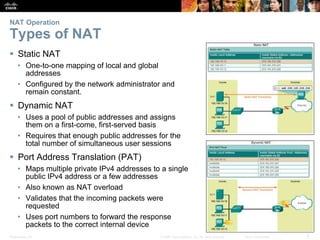
Types of NAT
 Static NAT
• One-to-one mapping of local and global
addresses
• Configured by the network administrator and
remain constant.
 Dynamic NAT
• Uses a pool of public addresses and assigns
them on a first-come, first-served basis
• Requires that enough public addresses for the
total number of simultaneous user sessions
 Port Address Translation (PAT)
• Maps multiple private IPv4 addresses to a single
public IPv4 address or a few addresses
• Also known as NAT overload
• Validates that the incoming packets were
requested
• Uses port numbers to forward the response
packets to the correct internal device
Presentation_ID 4© 2008 Cisco Systems, Inc. All rights reserved. Cisco Confidential
NAT Operation
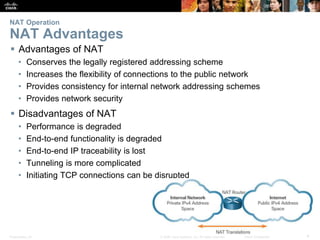
NAT Advantages
 Advantages of NAT
• Conserves the legally registered addressing scheme
• Increases the flexibility of connections to the public network
• Provides consistency for internal network addressing schemes
• Provides network security
 Disadvantages of NAT
• Performance is degraded
• End-to-end functionality is degraded
• End-to-end IP traceability is lost
• Tunneling is more complicated
• Initiating TCP connections can be disrupted
© 2008 Cisco Systems, Inc. All rights reserved. Cisco ConfidentialPresentation_ID 5
9.2 Configuring NAT
Presentation_ID 6© 2008 Cisco Systems, Inc. All rights reserved. Cisco Confidential
Configuring NAT
Configuring Static NAT
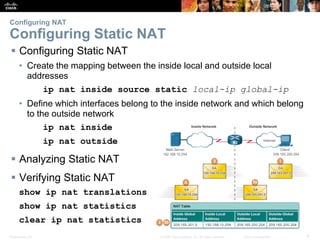
 Configuring Static NAT
• Create the mapping between the inside local and outside local
addresses
ip nat inside source static local-ip global-ip
• Define which interfaces belong to the inside network and which belong
to the outside network
ip nat inside
ip nat outside
 Analyzing Static NAT
 Verifying Static NAT
show ip nat translations
show ip nat statistics
clear ip nat statistics
Presentation_ID 7© 2008 Cisco Systems, Inc. All rights reserved. Cisco Confidential
Configuring NAT
Configuring Dynamic NAT
 Dynamic NAT Operation
• The pool of public IPv4 addresses (inside global address pool) is
available to any device on the inside network on a first-come, first-
served basis.
• With dynamic NAT, a single inside address is translated to a single
outside address.
• The pool must be large enough to accommodate all inside devices.
• A device is unable to communicate to any external networks if no
addresses are available in the pool.
Presentation_ID 8© 2008 Cisco Systems, Inc. All rights reserved. Cisco Confidential
Configuring NAT
Configuring Dynamic NAT (Cont.)
 Configuring Dynamic NAT
• Create the mapping between the inside local and outside local
addresses
ip nat pool name start-ip end-ip {netmask netmask
| prefix-length prefix-length}
• Create a standard ACL to permit those addresses to be translated
access-list access-list-number permit source
[source-wildcard]
• Bind the ACL to the pool
ip nat inside source list access-list-number pool
name
• Identify the inside and outside interfaces
ip nat inside
ip nat outside
Presentation_ID 9© 2008 Cisco Systems, Inc. All rights reserved. Cisco Confidential
Configuring NAT
Configuring Dynamic NAT (Cont.)
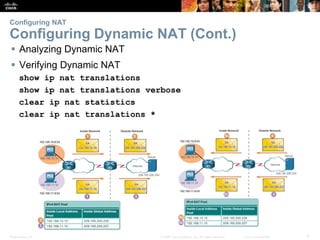
 Analyzing Dynamic NAT
 Verifying Dynamic NAT
show ip nat translations
show ip nat translations verbose
clear ip nat statistics
clear ip nat translations *
Presentation_ID 10© 2008 Cisco Systems, Inc. All rights reserved. Cisco Confidential
Configuring NAT
Configuring Port Address Translations (PAT)
 Configuring PAT: Address Pool
• Create the mapping between the inside local and outside local addresses
ip nat pool name start-ip end-ip {netmask netmask |
prefix-length prefix-length}
• Create a standard ACL to permit those addresses to be translated
access-list access-list-number permit source [source-
wildcard]
• Bind the ACL to the pool
ip nat inside source list access-list-number pool name
• Identify the inside and outside interfaces
ip nat inside
ip nat outside
Presentation_ID 11© 2008 Cisco Systems, Inc. All rights reserved. Cisco Confidential
Configuring NAT
Configuring Port Address Translations (PAT) (Cont.)
 Configuring PAT: Single Address
• Define a standard ACL to permit those addresses to be translated
access-list access-list-number permit source
[source-wildcard]
• Establish dynamic source translation, specify the ACL, exit interface, and
overload option
ip nat inside source list access-list-number
interface type name overload
• Identify the inside and outside interfaces
ip nat inside
ip nat outside
Presentation_ID 12© 2008 Cisco Systems, Inc. All rights reserved. Cisco Confidential
Configuring NAT
Configuring Port Address Translations (PAT) (Cont.)
 Analyzing PAT
 Verifying PAT
show ip nat translations
show ip nat statistics
slear ip nat statistics
Presentation_ID 13© 2008 Cisco Systems, Inc. All rights reserved. Cisco Confidential
Configuring NAT
Port Forwarding
 Port Forwarding
• Port forwarding is the act of forwarding a network port from one network node to
another.
• A packet sent to the public IP address and port of a router can be forwarded to a
private IP address and port in inside network.
• Port forwarding is helpful in situations where servers have private addresses, not
reachable from the outside networks.
 Wireless Router Example
 Configuring Port Forwarding with IOS
ip nat inside source [static {tcp | udp local-ip local-port
global-ip global-port} [extendable]
Presentation_ID 14© 2008 Cisco Systems, Inc. All rights reserved. Cisco Confidential
Configuring NAT
Configuring NAT and IPv6
 NAT for IPv6?
• IPv6 with a 128-bit address provides 340 undecillion addresses.
• Address space is not an issue for IPv6.
• IPv6 makes IPv4 public-private NAT unnecessary by design; however, IPv6 does implement a
form of private addresses, and it is implemented differently than they are for IPv4.
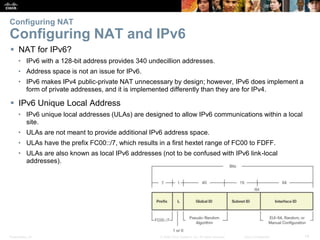
 IPv6 Unique Local Address
• IPv6 unique local addresses (ULAs) are designed to allow IPv6 communications within a local
site.
• ULAs are not meant to provide additional IPv6 address space.
• ULAs have the prefix FC00::/7, which results in a first hextet range of FC00 to FDFF.
• ULAs are also known as local IPv6 addresses (not to be confused with IPv6 link-local
addresses).
Presentation_ID 15© 2008 Cisco Systems, Inc. All rights reserved. Cisco Confidential
Configuring NAT
Configuring NAT and IPv6 (Cont.)
 NAT for IPv6
• IPv6 also uses NAT, but in a much different context.
• In IPv6, NAT is used to provide transparent communication between IPv6 and IPv4.
• NAT64 is not intended to be a permanent solution; it is meant to be a transition
mechanism.
• Network Address Translation-Protocol Translation (NAT-PT) was another NAT-
based transition mechanism for IPv6, but is now deprecated by IETF.
• NAT64 is now recommended.
© 2008 Cisco Systems, Inc. All rights reserved. Cisco ConfidentialPresentation_ID 16
9.3 Troubleshooting NAT
Presentation_ID 17© 2008 Cisco Systems, Inc. All rights reserved. Cisco Confidential
Troubleshooting NAT
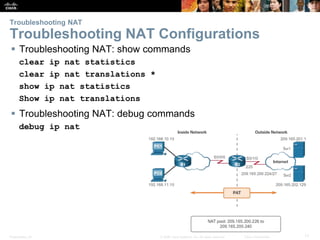
Troubleshooting NAT Configurations
 Troubleshooting NAT: show commands
clear ip nat statistics
clear ip nat translations *
show ip nat statistics
Show ip nat translations
 Troubleshooting NAT: debug commands
debug ip nat
© 2008 Cisco Systems, Inc. All rights reserved. Cisco ConfidentialPresentation_ID 18
9.4 Chapter Summary
Presentation_ID 19© 2008 Cisco Systems, Inc. All rights reserved. Cisco Confidential
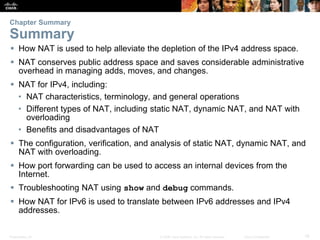
Chapter Summary
Summary
 How NAT is used to help alleviate the depletion of the IPv4 address space.
 NAT conserves public address space and saves considerable administrative
overhead in managing adds, moves, and changes.
 NAT for IPv4, including:
• NAT characteristics, terminology, and general operations
• Different types of NAT, including static NAT, dynamic NAT, and NAT with
overloading
• Benefits and disadvantages of NAT
 The configuration, verification, and analysis of static NAT, dynamic NAT, and
NAT with overloading.
 How port forwarding can be used to access an internal devices from the
Internet.
 Troubleshooting NAT using show and debug commands.
 How NAT for IPv6 is used to translate between IPv6 addresses and IPv4
addresses.
Presentation_ID 23© 2008 Cisco Systems, Inc. All rights reserved. Cisco Confidential
Presentation_ID 24© 2008 Cisco Systems, Inc. All rights reserved. Cisco Confidential

CCNA (R & S) Module 03 - Routing & Switching Essentials - Chapter 9

  • 1.
    © 2008 CiscoSystems, Inc. All rights reserved. Cisco ConfidentialPresentation_ID 1 9.1 NAT Operation
  • 2.
    Presentation_ID 2© 2008Cisco Systems, Inc. All rights reserved. Cisco Confidential NAT Operation NAT Characteristics  IPv4 Private Address Space • 10.0.0.0 /8, 172.16.0.0 /12, and 192.168.0.0 /16  What is NAT? • Process to translate network IPv4 address • Conserve public IPv4 addresses • Configured at the border router for translation  NAT Terminology • Inside address • Inside local address • Inside global address • Outside address • Outside local address • Outside global address
  • 3.
    Presentation_ID 3© 2008Cisco Systems, Inc. All rights reserved. Cisco Confidential NAT Operation Types of NAT  Static NAT • One-to-one mapping of local and global addresses • Configured by the network administrator and remain constant.  Dynamic NAT • Uses a pool of public addresses and assigns them on a first-come, first-served basis • Requires that enough public addresses for the total number of simultaneous user sessions  Port Address Translation (PAT) • Maps multiple private IPv4 addresses to a single public IPv4 address or a few addresses • Also known as NAT overload • Validates that the incoming packets were requested • Uses port numbers to forward the response packets to the correct internal device
  • 4.
    Presentation_ID 4© 2008Cisco Systems, Inc. All rights reserved. Cisco Confidential NAT Operation NAT Advantages  Advantages of NAT • Conserves the legally registered addressing scheme • Increases the flexibility of connections to the public network • Provides consistency for internal network addressing schemes • Provides network security  Disadvantages of NAT • Performance is degraded • End-to-end functionality is degraded • End-to-end IP traceability is lost • Tunneling is more complicated • Initiating TCP connections can be disrupted
  • 5.
    © 2008 CiscoSystems, Inc. All rights reserved. Cisco ConfidentialPresentation_ID 5 9.2 Configuring NAT
  • 6.
    Presentation_ID 6© 2008Cisco Systems, Inc. All rights reserved. Cisco Confidential Configuring NAT Configuring Static NAT  Configuring Static NAT • Create the mapping between the inside local and outside local addresses ip nat inside source static local-ip global-ip • Define which interfaces belong to the inside network and which belong to the outside network ip nat inside ip nat outside  Analyzing Static NAT  Verifying Static NAT show ip nat translations show ip nat statistics clear ip nat statistics
  • 7.
    Presentation_ID 7© 2008Cisco Systems, Inc. All rights reserved. Cisco Confidential Configuring NAT Configuring Dynamic NAT  Dynamic NAT Operation • The pool of public IPv4 addresses (inside global address pool) is available to any device on the inside network on a first-come, first- served basis. • With dynamic NAT, a single inside address is translated to a single outside address. • The pool must be large enough to accommodate all inside devices. • A device is unable to communicate to any external networks if no addresses are available in the pool.
  • 8.
    Presentation_ID 8© 2008Cisco Systems, Inc. All rights reserved. Cisco Confidential Configuring NAT Configuring Dynamic NAT (Cont.)  Configuring Dynamic NAT • Create the mapping between the inside local and outside local addresses ip nat pool name start-ip end-ip {netmask netmask | prefix-length prefix-length} • Create a standard ACL to permit those addresses to be translated access-list access-list-number permit source [source-wildcard] • Bind the ACL to the pool ip nat inside source list access-list-number pool name • Identify the inside and outside interfaces ip nat inside ip nat outside
  • 9.
    Presentation_ID 9© 2008Cisco Systems, Inc. All rights reserved. Cisco Confidential Configuring NAT Configuring Dynamic NAT (Cont.)  Analyzing Dynamic NAT  Verifying Dynamic NAT show ip nat translations show ip nat translations verbose clear ip nat statistics clear ip nat translations *
  • 10.
    Presentation_ID 10© 2008Cisco Systems, Inc. All rights reserved. Cisco Confidential Configuring NAT Configuring Port Address Translations (PAT)  Configuring PAT: Address Pool • Create the mapping between the inside local and outside local addresses ip nat pool name start-ip end-ip {netmask netmask | prefix-length prefix-length} • Create a standard ACL to permit those addresses to be translated access-list access-list-number permit source [source- wildcard] • Bind the ACL to the pool ip nat inside source list access-list-number pool name • Identify the inside and outside interfaces ip nat inside ip nat outside
  • 11.
    Presentation_ID 11© 2008Cisco Systems, Inc. All rights reserved. Cisco Confidential Configuring NAT Configuring Port Address Translations (PAT) (Cont.)  Configuring PAT: Single Address • Define a standard ACL to permit those addresses to be translated access-list access-list-number permit source [source-wildcard] • Establish dynamic source translation, specify the ACL, exit interface, and overload option ip nat inside source list access-list-number interface type name overload • Identify the inside and outside interfaces ip nat inside ip nat outside
  • 12.
    Presentation_ID 12© 2008Cisco Systems, Inc. All rights reserved. Cisco Confidential Configuring NAT Configuring Port Address Translations (PAT) (Cont.)  Analyzing PAT  Verifying PAT show ip nat translations show ip nat statistics slear ip nat statistics
  • 13.
    Presentation_ID 13© 2008Cisco Systems, Inc. All rights reserved. Cisco Confidential Configuring NAT Port Forwarding  Port Forwarding • Port forwarding is the act of forwarding a network port from one network node to another. • A packet sent to the public IP address and port of a router can be forwarded to a private IP address and port in inside network. • Port forwarding is helpful in situations where servers have private addresses, not reachable from the outside networks.  Wireless Router Example  Configuring Port Forwarding with IOS ip nat inside source [static {tcp | udp local-ip local-port global-ip global-port} [extendable]
  • 14.
    Presentation_ID 14© 2008Cisco Systems, Inc. All rights reserved. Cisco Confidential Configuring NAT Configuring NAT and IPv6  NAT for IPv6? • IPv6 with a 128-bit address provides 340 undecillion addresses. • Address space is not an issue for IPv6. • IPv6 makes IPv4 public-private NAT unnecessary by design; however, IPv6 does implement a form of private addresses, and it is implemented differently than they are for IPv4.  IPv6 Unique Local Address • IPv6 unique local addresses (ULAs) are designed to allow IPv6 communications within a local site. • ULAs are not meant to provide additional IPv6 address space. • ULAs have the prefix FC00::/7, which results in a first hextet range of FC00 to FDFF. • ULAs are also known as local IPv6 addresses (not to be confused with IPv6 link-local addresses).
  • 15.
    Presentation_ID 15© 2008Cisco Systems, Inc. All rights reserved. Cisco Confidential Configuring NAT Configuring NAT and IPv6 (Cont.)  NAT for IPv6 • IPv6 also uses NAT, but in a much different context. • In IPv6, NAT is used to provide transparent communication between IPv6 and IPv4. • NAT64 is not intended to be a permanent solution; it is meant to be a transition mechanism. • Network Address Translation-Protocol Translation (NAT-PT) was another NAT- based transition mechanism for IPv6, but is now deprecated by IETF. • NAT64 is now recommended.
  • 16.
    © 2008 CiscoSystems, Inc. All rights reserved. Cisco ConfidentialPresentation_ID 16 9.3 Troubleshooting NAT
  • 17.
    Presentation_ID 17© 2008Cisco Systems, Inc. All rights reserved. Cisco Confidential Troubleshooting NAT Troubleshooting NAT Configurations  Troubleshooting NAT: show commands clear ip nat statistics clear ip nat translations * show ip nat statistics Show ip nat translations  Troubleshooting NAT: debug commands debug ip nat
  • 18.
    © 2008 CiscoSystems, Inc. All rights reserved. Cisco ConfidentialPresentation_ID 18 9.4 Chapter Summary
  • 19.
    Presentation_ID 19© 2008Cisco Systems, Inc. All rights reserved. Cisco Confidential Chapter Summary Summary  How NAT is used to help alleviate the depletion of the IPv4 address space.  NAT conserves public address space and saves considerable administrative overhead in managing adds, moves, and changes.  NAT for IPv4, including: • NAT characteristics, terminology, and general operations • Different types of NAT, including static NAT, dynamic NAT, and NAT with overloading • Benefits and disadvantages of NAT  The configuration, verification, and analysis of static NAT, dynamic NAT, and NAT with overloading.  How port forwarding can be used to access an internal devices from the Internet.  Troubleshooting NAT using show and debug commands.  How NAT for IPv6 is used to translate between IPv6 addresses and IPv4 addresses.
  • 20.
    Presentation_ID 23© 2008Cisco Systems, Inc. All rights reserved. Cisco Confidential
  • 21.
    Presentation_ID 24© 2008Cisco Systems, Inc. All rights reserved. Cisco Confidential