1
ARCHITECTURE OF
8085 MICROPROCESSOR
Submitted By:-
AMAN SRIVASTAVA
EC-15, SRMSCET
BLY.
Guided By:-
Mr. MAHENDRA
SINGH
CONTENTS
2
S. No. TOPIC Slide No.
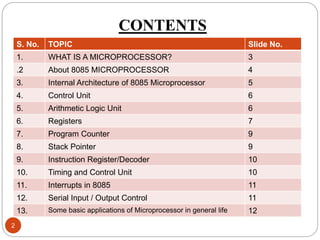
1. WHAT IS A MICROPROCESSOR? 3
.2 About 8085 MICROPROCESSOR 4
3. Internal Architecture of 8085 Microprocessor 5
4. Control Unit 6
5. Arithmetic Logic Unit 6
6. Registers 7
7. Program Counter 9
8. Stack Pointer 9
9. Instruction Register/Decoder 10
10. Timing and Control Unit 10
11. Interrupts in 8085 11
12. Serial Input / Output Control 11
13. Some basic applications of Microprocessor in general life 12
3
WHAT IS A
MICROPROCESSOR?
3
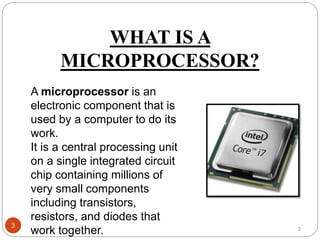
A microprocessor is an
electronic component that is
used by a computer to do its
work.
It is a central processing unit
on a single integrated circuit
chip containing millions of
very small components
including transistors,
resistors, and diodes that
work together.
About 8085 MICROPROCESSOR
4
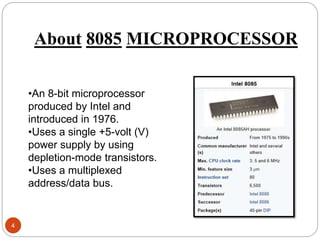
•An 8-bit microprocessor
produced by Intel and
introduced in 1976.
•Uses a single +5-volt (V)
power supply by using
depletion-mode transistors.
•Uses a multiplexed
address/data bus.
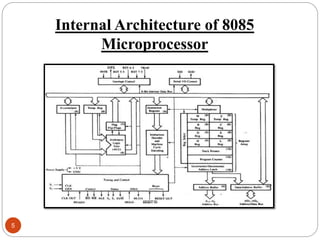
Internal Architecture of 8085
Microprocessor
5
6
Control Unit
Generates signals within uP to carry out the instruction, which
has been decoded. In reality causes certain connections
between blocks of the uP to be opened or closed, so that data
goes where it is required, and so that ALU operations occur.
Arithmetic Logic Unit
The ALU performs the actual numerical and logic operation such
as ‘add’, ‘subtract’, ‘AND’, ‘OR’, etc. Uses data from memory and
from Accumulator to perform arithmetic.
Always stores result of operation in Accumulator.
7
Registers
Register are used to quickly accept, store, and transfer
data and instructions that are being used immediately by
the CPU, there are various types of Registers those are
used for various purpose.
The 8085 uP includes:
•General Purpose Registers- B, C, D, E, H & L. They can
work in pair such as B-C, D-E, H-L to store 16-bit data.
•1 Accumulator
•1 Flag Register
•2 16-bit registers: the stack pointer(SP) and the program
counter(PC)
8
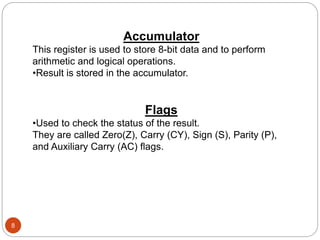
Accumulator
This register is used to store 8-bit data and to perform
arithmetic and logical operations.
•Result is stored in the accumulator.
Flags
•Used to check the status of the result.
They are called Zero(Z), Carry (CY), Sign (S), Parity (P),
and Auxiliary Carry (AC) flags.
9
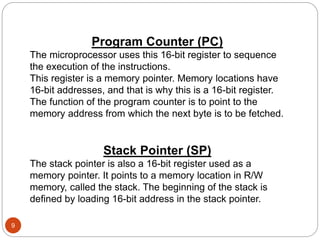
Program Counter (PC)
The microprocessor uses this 16-bit register to sequence
the execution of the instructions.
This register is a memory pointer. Memory locations have
16-bit addresses, and that is why this is a 16-bit register.
The function of the program counter is to point to the
memory address from which the next byte is to be fetched.
Stack Pointer (SP)
The stack pointer is also a 16-bit register used as a
memory pointer. It points to a memory location in R/W
memory, called the stack. The beginning of the stack is
defined by loading 16-bit address in the stack pointer.
10
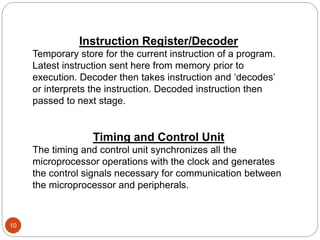
Instruction Register/Decoder
Temporary store for the current instruction of a program.
Latest instruction sent here from memory prior to
execution. Decoder then takes instruction and ‘decodes’
or interprets the instruction. Decoded instruction then
passed to next stage.
Timing and Control Unit
The timing and control unit synchronizes all the
microprocessor operations with the clock and generates
the control signals necessary for communication between
the microprocessor and peripherals.
11
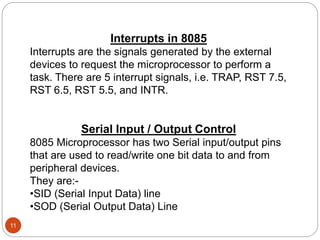
Interrupts in 8085
Interrupts are the signals generated by the external
devices to request the microprocessor to perform a
task. There are 5 interrupt signals, i.e. TRAP, RST 7.5,
RST 6.5, RST 5.5, and INTR.
Serial Input / Output Control
8085 Microprocessor has two Serial input/output pins
that are used to read/write one bit data to and from
peripheral devices.
They are:-
•SID (Serial Input Data) line
•SOD (Serial Output Data) Line
12
Some basic applications of
Microprocessor in general life
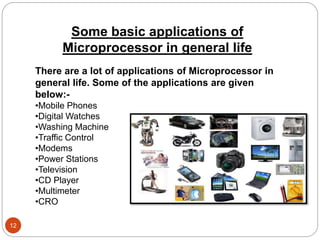
There are a lot of applications of Microprocessor in
general life. Some of the applications are given
below:-
•Mobile Phones
•Digital Watches
•Washing Machine
•Traffic Control
•Modems
•Power Stations
•Television
•CD Player
•Multimeter
•CRO
13
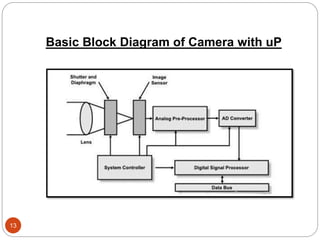
Basic Block Diagram of Camera with uP
14
References
•Book- Ramesh S. Gaonkar
•www.erode-sengunthar.ac.in
•https://en.wikipedia.org/wiki/Intel_8085
15
16

Architecture of 8085 microprocessor

  • 1.
    1 ARCHITECTURE OF 8085 MICROPROCESSOR SubmittedBy:- AMAN SRIVASTAVA EC-15, SRMSCET BLY. Guided By:- Mr. MAHENDRA SINGH
  • 2.
    CONTENTS 2 S. No. TOPICSlide No. 1. WHAT IS A MICROPROCESSOR? 3 .2 About 8085 MICROPROCESSOR 4 3. Internal Architecture of 8085 Microprocessor 5 4. Control Unit 6 5. Arithmetic Logic Unit 6 6. Registers 7 7. Program Counter 9 8. Stack Pointer 9 9. Instruction Register/Decoder 10 10. Timing and Control Unit 10 11. Interrupts in 8085 11 12. Serial Input / Output Control 11 13. Some basic applications of Microprocessor in general life 12
  • 3.
    3 WHAT IS A MICROPROCESSOR? 3 Amicroprocessor is an electronic component that is used by a computer to do its work. It is a central processing unit on a single integrated circuit chip containing millions of very small components including transistors, resistors, and diodes that work together.
  • 4.
    About 8085 MICROPROCESSOR 4 •An8-bit microprocessor produced by Intel and introduced in 1976. •Uses a single +5-volt (V) power supply by using depletion-mode transistors. •Uses a multiplexed address/data bus.
  • 5.
    Internal Architecture of8085 Microprocessor 5
  • 6.
    6 Control Unit Generates signalswithin uP to carry out the instruction, which has been decoded. In reality causes certain connections between blocks of the uP to be opened or closed, so that data goes where it is required, and so that ALU operations occur. Arithmetic Logic Unit The ALU performs the actual numerical and logic operation such as ‘add’, ‘subtract’, ‘AND’, ‘OR’, etc. Uses data from memory and from Accumulator to perform arithmetic. Always stores result of operation in Accumulator.
  • 7.
    7 Registers Register are usedto quickly accept, store, and transfer data and instructions that are being used immediately by the CPU, there are various types of Registers those are used for various purpose. The 8085 uP includes: •General Purpose Registers- B, C, D, E, H & L. They can work in pair such as B-C, D-E, H-L to store 16-bit data. •1 Accumulator •1 Flag Register •2 16-bit registers: the stack pointer(SP) and the program counter(PC)
  • 8.
    8 Accumulator This register isused to store 8-bit data and to perform arithmetic and logical operations. •Result is stored in the accumulator. Flags •Used to check the status of the result. They are called Zero(Z), Carry (CY), Sign (S), Parity (P), and Auxiliary Carry (AC) flags.
  • 9.
    9 Program Counter (PC) Themicroprocessor uses this 16-bit register to sequence the execution of the instructions. This register is a memory pointer. Memory locations have 16-bit addresses, and that is why this is a 16-bit register. The function of the program counter is to point to the memory address from which the next byte is to be fetched. Stack Pointer (SP) The stack pointer is also a 16-bit register used as a memory pointer. It points to a memory location in R/W memory, called the stack. The beginning of the stack is defined by loading 16-bit address in the stack pointer.
  • 10.
    10 Instruction Register/Decoder Temporary storefor the current instruction of a program. Latest instruction sent here from memory prior to execution. Decoder then takes instruction and ‘decodes’ or interprets the instruction. Decoded instruction then passed to next stage. Timing and Control Unit The timing and control unit synchronizes all the microprocessor operations with the clock and generates the control signals necessary for communication between the microprocessor and peripherals.
  • 11.
    11 Interrupts in 8085 Interruptsare the signals generated by the external devices to request the microprocessor to perform a task. There are 5 interrupt signals, i.e. TRAP, RST 7.5, RST 6.5, RST 5.5, and INTR. Serial Input / Output Control 8085 Microprocessor has two Serial input/output pins that are used to read/write one bit data to and from peripheral devices. They are:- •SID (Serial Input Data) line •SOD (Serial Output Data) Line
  • 12.
    12 Some basic applicationsof Microprocessor in general life There are a lot of applications of Microprocessor in general life. Some of the applications are given below:- •Mobile Phones •Digital Watches •Washing Machine •Traffic Control •Modems •Power Stations •Television •CD Player •Multimeter •CRO
  • 13.
    13 Basic Block Diagramof Camera with uP
  • 14.
    14 References •Book- Ramesh S.Gaonkar •www.erode-sengunthar.ac.in •https://en.wikipedia.org/wiki/Intel_8085
  • 15.
  • 16.