Likert scale
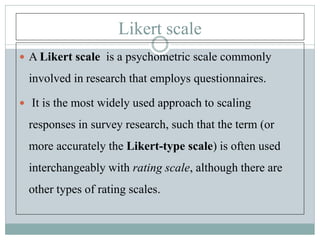
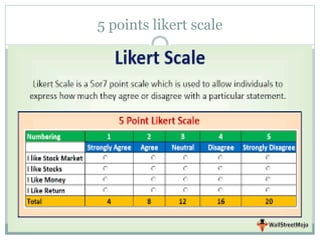
 A Likert scale is a psychometric scale commonly
involved in research that employs questionnaires.
 It is the most widely used approach to scaling
responses in survey research, such that the term (or
more accurately the Likert-type scale) is often used
interchangeably with rating scale, although there are
other types of rating scales.
 The scale is named after its inventor, psychologist Rensis
Likert.
 Likert distinguished between a scale proper, which emerges
from collective responses to a set of items (usually eight or
more), and the format in which responses are scored along a
range.
 Technically speaking, a Likert scale refers only to the former.
 The difference between these two concepts has to do with the
distinction Likert made between the underlying phenomenon
being investigated and the means of capturing variation that
points to the underlying phenomenon.
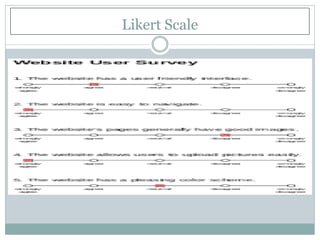
Likert Scale
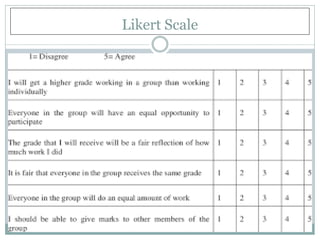
Likert Scale
5 points likert scale
Continueee….
 A Likert item is simply a statement that the respondent
is asked to evaluate by giving it a quantitative value on
any kind of subjective or objective dimension, with
level of agreement/disagreement being the dimension
most commonly used.
 Well-designed Likert items exhibit both "symmetry"
and "balance".
Continuee…
 Symmetry means that they contain equal numbers of
positive and negative positions whose respective
distances apart are bilaterally symmetric about the
"neutral"/zero value (whether or not that value is
presented as a candidate).
 Balance means that the distance between each
candidate value is the same, allowing for quantitative
comparisons such as averaging to be valid across
items containing more than two candidate values.
ADVANTAGES OF LIKERT SCALES
 One can easily make a wider market research to quite a
number of respondents or consumers.
 faster and quick to collect feedbacks within a short period of
time.
 can make informed decisions on the products and services
offered.
 honest feedbacks
 Future adjustments
 the researchers make predictions and create new market
strategies.
 Provision of direct and reliable assessments of respondents’
behaviors can be easily determined through well-constructed
scales.
DISADVANTAGES OF LIKERT SCALES
 Some respondents normally lie in the questionnaire
 wrong conclusions,
 sometimes respondents may misunderstand the questions asked and give wrong
feedbacks leading to skewed results, because in some cases someone might not be
available to explain.
 Questionnaires cannot fully determine the respondents’ emotions without
cooperating face to face conversations that can assist to know the facial expressions,
nevertheless some questions are difficult to answer due to their content nature
hence making it difficult for the respondents to give proper feedbacks this in turn
affects the survey.
 Skipping of questions is possible more so for online questionnaires, hence the need
to make the questions brief and precise.
 Occasionally, results are easily faked where individuals want to present a false
impression of their attitudes thereby compromising on the surveys
 Intervals between points on the scale do not present equal changes in attitude for all
individuals for example the differences between strongly agree and agree and even
internal consistency of the scale may be difficult to achieve therefore care must be
taken to have uni dimensional items aimed at a single person, groups, event or
method.
Likert scale

Likert scale

  • 1.
    Likert scale  ALikert scale is a psychometric scale commonly involved in research that employs questionnaires.  It is the most widely used approach to scaling responses in survey research, such that the term (or more accurately the Likert-type scale) is often used interchangeably with rating scale, although there are other types of rating scales.
  • 2.
     The scaleis named after its inventor, psychologist Rensis Likert.  Likert distinguished between a scale proper, which emerges from collective responses to a set of items (usually eight or more), and the format in which responses are scored along a range.  Technically speaking, a Likert scale refers only to the former.  The difference between these two concepts has to do with the distinction Likert made between the underlying phenomenon being investigated and the means of capturing variation that points to the underlying phenomenon.
  • 3.
  • 4.
  • 5.
  • 6.
    Continueee….  A Likertitem is simply a statement that the respondent is asked to evaluate by giving it a quantitative value on any kind of subjective or objective dimension, with level of agreement/disagreement being the dimension most commonly used.  Well-designed Likert items exhibit both "symmetry" and "balance".
  • 7.
    Continuee…  Symmetry meansthat they contain equal numbers of positive and negative positions whose respective distances apart are bilaterally symmetric about the "neutral"/zero value (whether or not that value is presented as a candidate).  Balance means that the distance between each candidate value is the same, allowing for quantitative comparisons such as averaging to be valid across items containing more than two candidate values.
  • 8.
    ADVANTAGES OF LIKERTSCALES  One can easily make a wider market research to quite a number of respondents or consumers.  faster and quick to collect feedbacks within a short period of time.  can make informed decisions on the products and services offered.  honest feedbacks  Future adjustments  the researchers make predictions and create new market strategies.  Provision of direct and reliable assessments of respondents’ behaviors can be easily determined through well-constructed scales.
  • 9.
    DISADVANTAGES OF LIKERTSCALES  Some respondents normally lie in the questionnaire  wrong conclusions,  sometimes respondents may misunderstand the questions asked and give wrong feedbacks leading to skewed results, because in some cases someone might not be available to explain.  Questionnaires cannot fully determine the respondents’ emotions without cooperating face to face conversations that can assist to know the facial expressions, nevertheless some questions are difficult to answer due to their content nature hence making it difficult for the respondents to give proper feedbacks this in turn affects the survey.  Skipping of questions is possible more so for online questionnaires, hence the need to make the questions brief and precise.  Occasionally, results are easily faked where individuals want to present a false impression of their attitudes thereby compromising on the surveys  Intervals between points on the scale do not present equal changes in attitude for all individuals for example the differences between strongly agree and agree and even internal consistency of the scale may be difficult to achieve therefore care must be taken to have uni dimensional items aimed at a single person, groups, event or method.