Prashant Bajpai (91)
Priyank Jain (92)
Radhika Sharma (93)
Rahul Sharma(94)
Ratanjeet Singh(95)
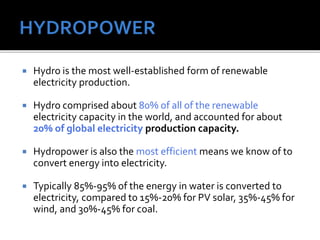
 Hydro is the most well-established form of renewable
electricity production.
 Hydro comprised about 80% of all of the renewable
electricity capacity in the world, and accounted for about
20% of global electricity production capacity.
 Hydropower is also the most efficient means we know of to
convert energy into electricity.
 Typically 85%-95% of the energy in water is converted to
electricity, compared to 15%-20% for PV solar, 35%-45% for
wind, and 30%-45% for coal.
Clean
Renewable
Demands Management
Emission-free.
Income Opportunities
Flood control
Irrigation
Employment
Operationally flexible
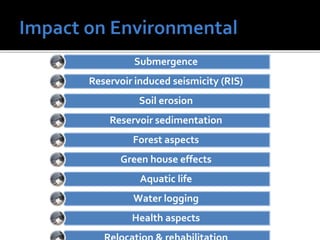
Submergence
Reservoir induced seismicity (RIS)
Soil erosion
Reservoir sedimentation
Forest aspects
Green house effects
Aquatic life
Water logging
Health aspects
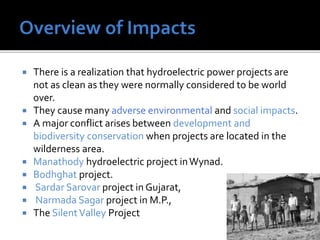
 There is a realization that hydroelectric power projects are
not as clean as they were normally considered to be world
over.
 They cause many adverse environmental and social impacts.
 A major conflict arises between development and
biodiversity conservation when projects are located in the
wilderness area.
 Manathody hydroelectric project inWynad.
 Bodhghat project.
 Sardar Sarovar project in Gujarat,
 Narmada Sagar project in M.P.,
 The SilentValley Project
 95million people have been physically displaced by dams
worldwide [Source:WorldCommission on Dams Report.]
 Development laid a firm policy approach and statutory
provision to strengthen the environmental conservation.
 The Wildlife (Protection) Act
 Forest (Conservation) Act
 Environment (Protection) Act
 National Forest Policy
 Guidelines for Hydropower and Siting of Industry
 Policy on Hydro Power
 Changes in the microclimate: At project site the stilling of
flowing waters leading to temperature stratification.
 Landslides and Soil erosion
 Variation in water table: Mostly the water table increased in
an around the dam sites.
 Instability of geo-physical landscapes: Changes in the
landform of the project areas.
 Siltation and nutrients variation: Eroded soil filled up the
reservoir after some time. water inhospitable to aquatic life.
 Decrease flow-rate of the river downstream: affect aquatic
life, reduced capacity for self-regeneration, enhanced
pollution levels etc.
 Submergence of land
 Air Pollution: Construction accelerates the rate of
suspended particulate matter (SPM)
 Solid Waste Problem: As the human activities increase in
waste products if there is a lack of adequate infrastructure to
deal with.
 Seismic activity: Enhanced seismic activities due to
pressure of water prominent highs of the order of 0.35-0.4g
in the seismically active zones of Northeastern India and
North-west Himalaya region and is included in the ZoneV. A
major earthquake rocked Manipur-Myanmar border in the
yearAugust 06, 1988 at a magnitude of 6.6 Richter scale.
 Loss of vegetal cover
 Decrease in the faunal speciesThe disturbance caused in
the nature, mainly due to excessive noise from blasting and
tunneling, etc. affecting the sensitive habitats of the fish
population in the river.
 Deforestation:Cutting of fuel woods for energy &
constructions.
 Cultural Environment
 Dislocation of people: Shifting of people from their original
village to another.
 Destruction of immovable property: Destruction of houses,
farms etc.
 Problems of host communities such as compensation,
employment, road construction, drinking water,
afforestation result due to the developmental works.
 Public agitations
 Project-Affected Persons, with the assistance of NGOs,
have become more conscious of their rights, both their
fundamental rights as citizens and their traditional
rights of use of river waters, forest produce and other
natural resources.
 The loss of vegetation caused by deforestation and the
impoundment of reservoirs constitutes the main impact of
hydroelectric projects on terrestrial plant life.
 The most negative impact of reservoirs on aquatic plant life
is the excessive proliferation of plants and algae, a problem
most likely to occur in reservoirs in tropical regions of high
biological productivity.
 Excessive biological productivity in reservoirs may induce
eutrophication and generate adverse impacts on the aquatic
environment.
 The presence of dams on streams and rivers may restrict the
movement of migratory species of fish, modify traditional
migration routes or fragment home ranges.
 Hydropower dams and reservoirs and their
accompanying modifications to local land uses, may
have a strong direct and indirect influence on human
health.
 The most perceptible changes are increase in the
frequency of occurrence of diseases and of the number
of people contracting diseases.
 Modifications to local and regional hydrological systems
in tropical or sub-tropical environments influence the
spread of waterborne diseases.
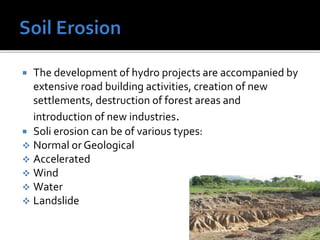
 The development of hydro projects are accompanied by
extensive road building activities, creation of new
settlements, destruction of forest areas and
introduction of new industries.
 Soli erosion can be of various types:
 Normal or Geological
 Accelerated
 Wind
 Water
 Landslide
 The development of a hydroelectric network involves
setting up of transmission lines and power poles in
specific corridors.
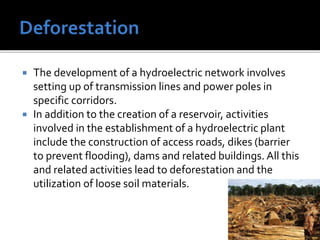
 In addition to the creation of a reservoir, activities
involved in the establishment of a hydroelectric plant
include the construction of access roads, dikes (barrier
to prevent flooding), dams and related buildings. All this
and related activities lead to deforestation and the
utilization of loose soil materials.
Hydro Power Envirentment interface

Hydro Power Envirentment interface

  • 1.
    Prashant Bajpai (91) PriyankJain (92) Radhika Sharma (93) Rahul Sharma(94) Ratanjeet Singh(95)
  • 2.
     Hydro isthe most well-established form of renewable electricity production.  Hydro comprised about 80% of all of the renewable electricity capacity in the world, and accounted for about 20% of global electricity production capacity.  Hydropower is also the most efficient means we know of to convert energy into electricity.  Typically 85%-95% of the energy in water is converted to electricity, compared to 15%-20% for PV solar, 35%-45% for wind, and 30%-45% for coal.
  • 3.
    Clean Renewable Demands Management Emission-free. Income Opportunities Floodcontrol Irrigation Employment Operationally flexible
  • 4.
    Submergence Reservoir induced seismicity(RIS) Soil erosion Reservoir sedimentation Forest aspects Green house effects Aquatic life Water logging Health aspects
  • 5.
     There isa realization that hydroelectric power projects are not as clean as they were normally considered to be world over.  They cause many adverse environmental and social impacts.  A major conflict arises between development and biodiversity conservation when projects are located in the wilderness area.  Manathody hydroelectric project inWynad.  Bodhghat project.  Sardar Sarovar project in Gujarat,  Narmada Sagar project in M.P.,  The SilentValley Project
  • 6.
     95million peoplehave been physically displaced by dams worldwide [Source:WorldCommission on Dams Report.]  Development laid a firm policy approach and statutory provision to strengthen the environmental conservation.  The Wildlife (Protection) Act  Forest (Conservation) Act  Environment (Protection) Act  National Forest Policy  Guidelines for Hydropower and Siting of Industry  Policy on Hydro Power
  • 7.
     Changes inthe microclimate: At project site the stilling of flowing waters leading to temperature stratification.  Landslides and Soil erosion  Variation in water table: Mostly the water table increased in an around the dam sites.  Instability of geo-physical landscapes: Changes in the landform of the project areas.  Siltation and nutrients variation: Eroded soil filled up the reservoir after some time. water inhospitable to aquatic life.  Decrease flow-rate of the river downstream: affect aquatic life, reduced capacity for self-regeneration, enhanced pollution levels etc.
  • 8.
     Submergence ofland  Air Pollution: Construction accelerates the rate of suspended particulate matter (SPM)  Solid Waste Problem: As the human activities increase in waste products if there is a lack of adequate infrastructure to deal with.  Seismic activity: Enhanced seismic activities due to pressure of water prominent highs of the order of 0.35-0.4g in the seismically active zones of Northeastern India and North-west Himalaya region and is included in the ZoneV. A major earthquake rocked Manipur-Myanmar border in the yearAugust 06, 1988 at a magnitude of 6.6 Richter scale.
  • 9.
     Loss ofvegetal cover  Decrease in the faunal speciesThe disturbance caused in the nature, mainly due to excessive noise from blasting and tunneling, etc. affecting the sensitive habitats of the fish population in the river.  Deforestation:Cutting of fuel woods for energy & constructions.  Cultural Environment  Dislocation of people: Shifting of people from their original village to another.  Destruction of immovable property: Destruction of houses, farms etc.
  • 10.
     Problems ofhost communities such as compensation, employment, road construction, drinking water, afforestation result due to the developmental works.  Public agitations  Project-Affected Persons, with the assistance of NGOs, have become more conscious of their rights, both their fundamental rights as citizens and their traditional rights of use of river waters, forest produce and other natural resources.
  • 11.
     The lossof vegetation caused by deforestation and the impoundment of reservoirs constitutes the main impact of hydroelectric projects on terrestrial plant life.  The most negative impact of reservoirs on aquatic plant life is the excessive proliferation of plants and algae, a problem most likely to occur in reservoirs in tropical regions of high biological productivity.  Excessive biological productivity in reservoirs may induce eutrophication and generate adverse impacts on the aquatic environment.  The presence of dams on streams and rivers may restrict the movement of migratory species of fish, modify traditional migration routes or fragment home ranges.
  • 12.
     Hydropower damsand reservoirs and their accompanying modifications to local land uses, may have a strong direct and indirect influence on human health.  The most perceptible changes are increase in the frequency of occurrence of diseases and of the number of people contracting diseases.  Modifications to local and regional hydrological systems in tropical or sub-tropical environments influence the spread of waterborne diseases.
  • 13.
     The developmentof hydro projects are accompanied by extensive road building activities, creation of new settlements, destruction of forest areas and introduction of new industries.  Soli erosion can be of various types:  Normal or Geological  Accelerated  Wind  Water  Landslide
  • 14.
     The developmentof a hydroelectric network involves setting up of transmission lines and power poles in specific corridors.  In addition to the creation of a reservoir, activities involved in the establishment of a hydroelectric plant include the construction of access roads, dikes (barrier to prevent flooding), dams and related buildings. All this and related activities lead to deforestation and the utilization of loose soil materials.

Editor's Notes

  • #6 was strongly opposed and eventually abandoned in the face of the threat it could cause to the biodiversity of virgin tropical rain forest.