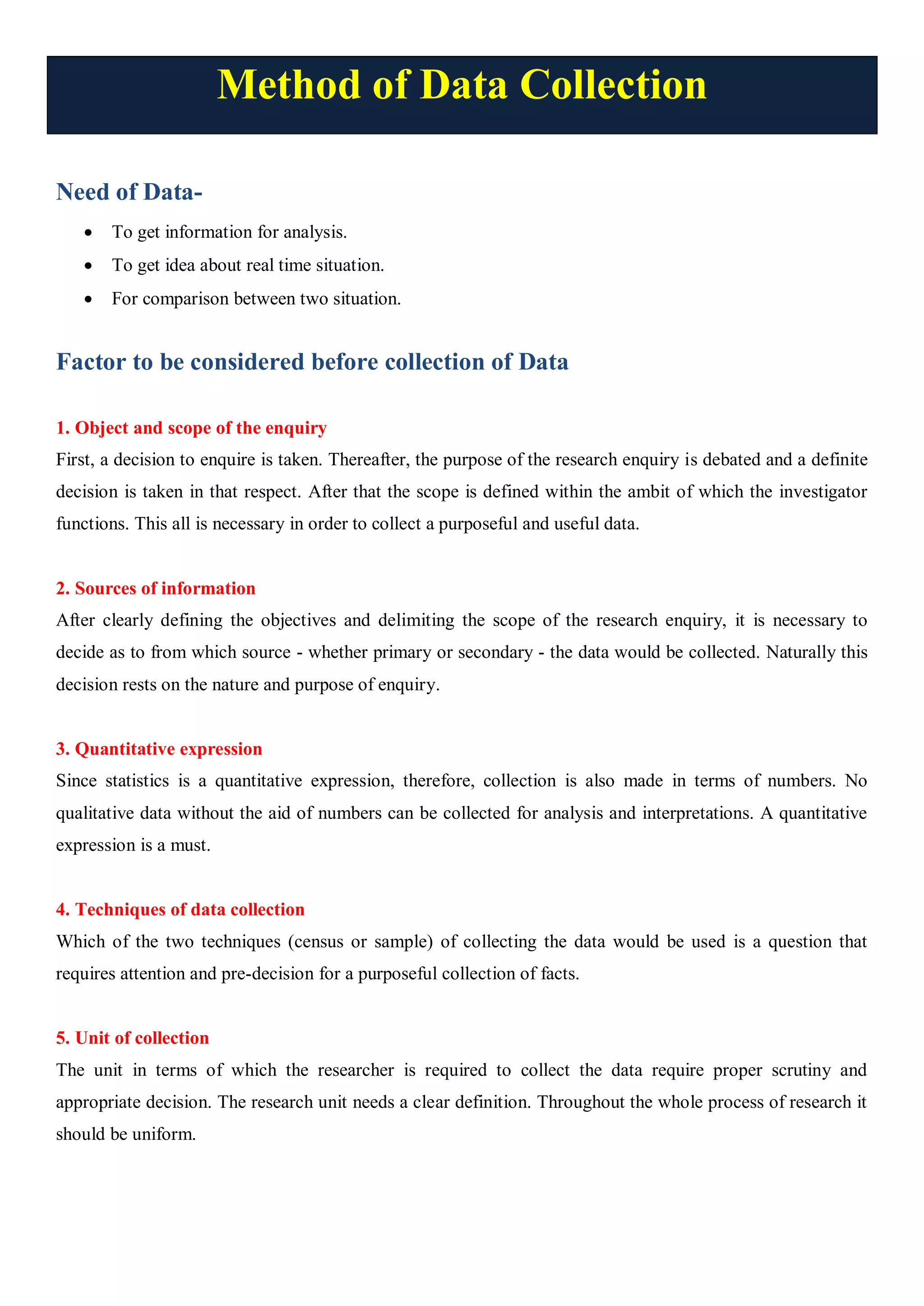
Method of Data Collection
Need of Data-
 To get information for analysis.
 To get idea about real time situation.
 For comparison between two situation.
Factor to be considered before collection of Data
1. Object and scope of the enquiry
First, a decision to enquire is taken. Thereafter, the purpose of the research enquiry is debated and a definite
decision is taken in that respect. After that the scope is defined within the ambit of which the investigator
functions. This all is necessary in order to collect a purposeful and useful data.
2. Sources of information
After clearly defining the objectives and delimiting the scope of the research enquiry, it is necessary to
decide as to from which source - whether primary or secondary - the data would be collected. Naturally this
decision rests on the nature and purpose of enquiry.
3. Quantitative expression
Since statistics is a quantitative expression, therefore, collection is also made in terms of numbers. No
qualitative data without the aid of numbers can be collected for analysis and interpretations. A quantitative
expression is a must.
4. Techniques of data collection
Which of the two techniques (census or sample) of collecting the data would be used is a question that
requires attention and pre-decision for a purposeful collection of facts.
5. Unit of collection
The unit in terms of which the researcher is required to collect the data require proper scrutiny and
appropriate decision. The research unit needs a clear definition. Throughout the whole process of research it
should be uniform.
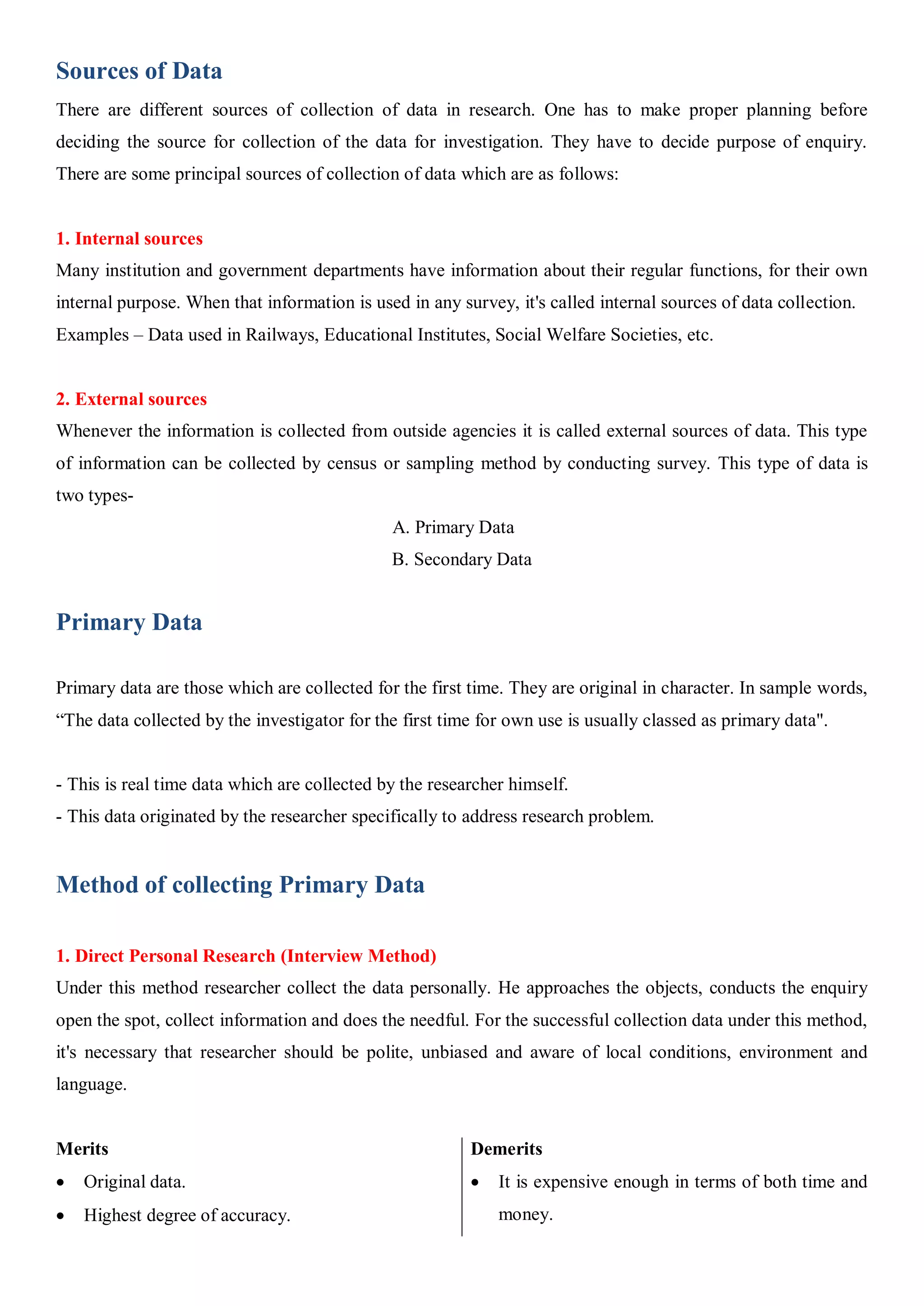
Sources of Data
There are different sources of collection of data in research. One has to make proper planning before
deciding the source for collection of the data for investigation. They have to decide purpose of enquiry.
There are some principal sources of collection of data which are as follows:
1. Internal sources
Many institution and government departments have information about their regular functions, for their own
internal purpose. When that information is used in any survey, it's called internal sources of data collection.
Examples – Data used in Railways, Educational Institutes, Social Welfare Societies, etc.
2. External sources
Whenever the information is collected from outside agencies it is called external sources of data. This type
of information can be collected by census or sampling method by conducting survey. This type of data is
two types-
A. Primary Data
B. Secondary Data
Primary Data
Primary data are those which are collected for the first time. They are original in character. In sample words,
“The data collected by the investigator for the first time for own use is usually classed as primary data".
- This is real time data which are collected by the researcher himself.
- This data originated by the researcher specifically to address research problem.
Method of collecting Primary Data
1. Direct Personal Research (Interview Method)
Under this method researcher collect the data personally. He approaches the objects, conducts the enquiry
open the spot, collect information and does the needful. For the successful collection data under this method,
it's necessary that researcher should be polite, unbiased and aware of local conditions, environment and
language.
Merits
 Original data.
 Highest degree of accuracy.
Demerits
 It is expensive enough in terms of both time and
money.
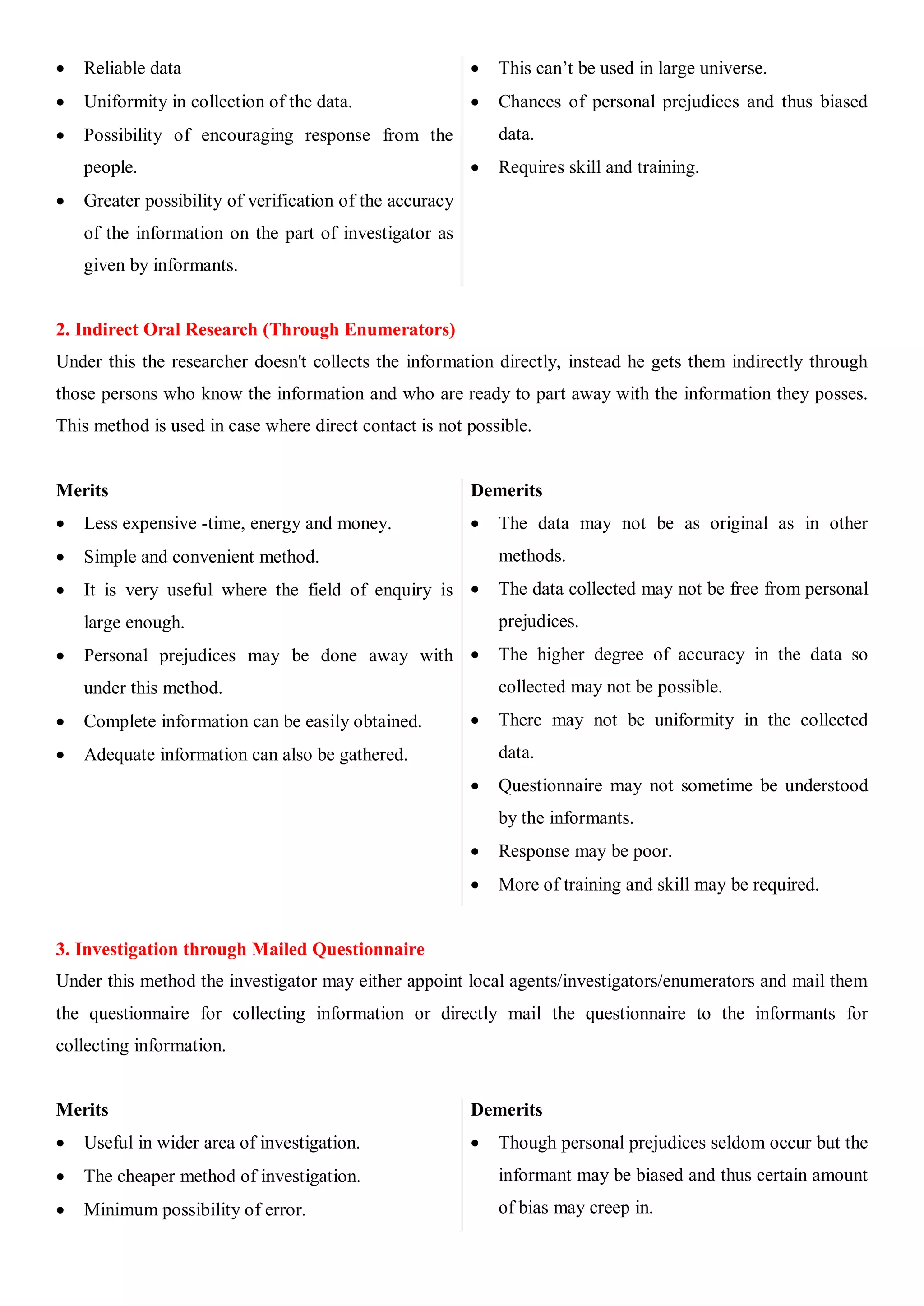
 Reliable data
 Uniformity in collection of the data.
 Possibility of encouraging response from the
people.
 Greater possibility of verification of the accuracy
of the information on the part of investigator as
given by informants.
 This can’t be used in large universe.
 Chances of personal prejudices and thus biased
data.
 Requires skill and training.
2. Indirect Oral Research (Through Enumerators)
Under this the researcher doesn't collects the information directly, instead he gets them indirectly through
those persons who know the information and who are ready to part away with the information they posses.
This method is used in case where direct contact is not possible.
Merits
 Less expensive -time, energy and money.
 Simple and convenient method.
 It is very useful where the field of enquiry is
large enough.
 Personal prejudices may be done away with
under this method.
 Complete information can be easily obtained.
 Adequate information can also be gathered.
Demerits
 The data may not be as original as in other
methods.
 The data collected may not be free from personal
prejudices.
 The higher degree of accuracy in the data so
collected may not be possible.
 There may not be uniformity in the collected
data.
 Questionnaire may not sometime be understood
by the informants.
 Response may be poor.
 More of training and skill may be required.
3. Investigation through Mailed Questionnaire
Under this method the investigator may either appoint local agents/investigators/enumerators and mail them
the questionnaire for collecting information or directly mail the questionnaire to the informants for
collecting information.
Merits
 Useful in wider area of investigation.
 The cheaper method of investigation.
 Minimum possibility of error.
Demerits
 Though personal prejudices seldom occur but the
informant may be biased and thus certain amount
of bias may creep in.
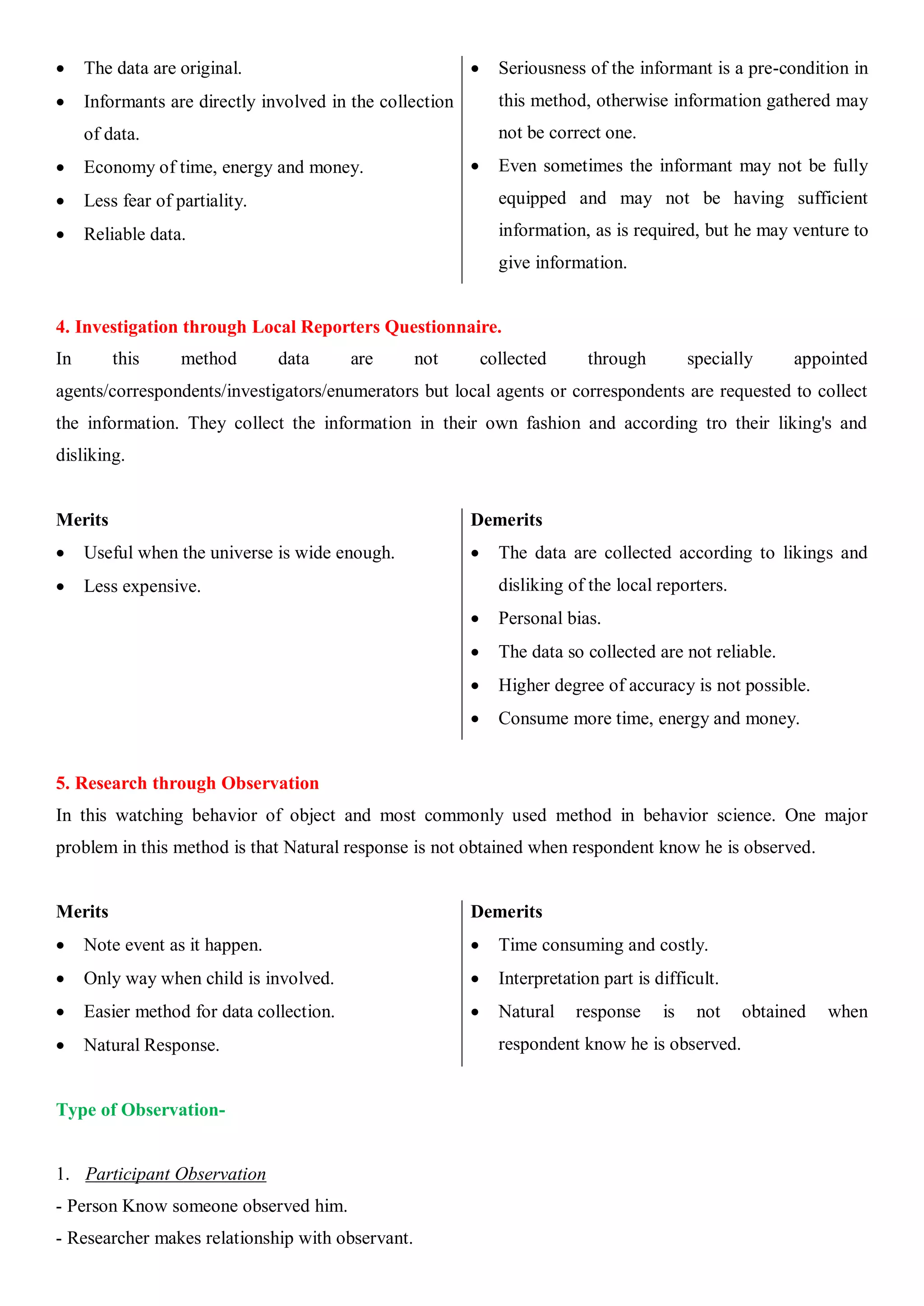
 The data are original.
 Informants are directly involved in the collection
of data.
 Economy of time, energy and money.
 Less fear of partiality.
 Reliable data.
 Seriousness of the informant is a pre-condition in
this method, otherwise information gathered may
not be correct one.
 Even sometimes the informant may not be fully
equipped and may not be having sufficient
information, as is required, but he may venture to
give information.
4. Investigation through Local Reporters Questionnaire.
In this method data are not collected through specially appointed
agents/correspondents/investigators/enumerators but local agents or correspondents are requested to collect
the information. They collect the information in their own fashion and according tro their liking's and
disliking.
Merits
 Useful when the universe is wide enough.
 Less expensive.
Demerits
 The data are collected according to likings and
disliking of the local reporters.
 Personal bias.
 The data so collected are not reliable.
 Higher degree of accuracy is not possible.
 Consume more time, energy and money.
5. Research through Observation
In this watching behavior of object and most commonly used method in behavior science. One major
problem in this method is that Natural response is not obtained when respondent know he is observed.
Merits
 Note event as it happen.
 Only way when child is involved.
 Easier method for data collection.
 Natural Response.
Demerits
 Time consuming and costly.
 Interpretation part is difficult.
 Natural response is not obtained when
respondent know he is observed.
Type of Observation-
1. Participant Observation
- Person Know someone observed him.
- Researcher makes relationship with observant.
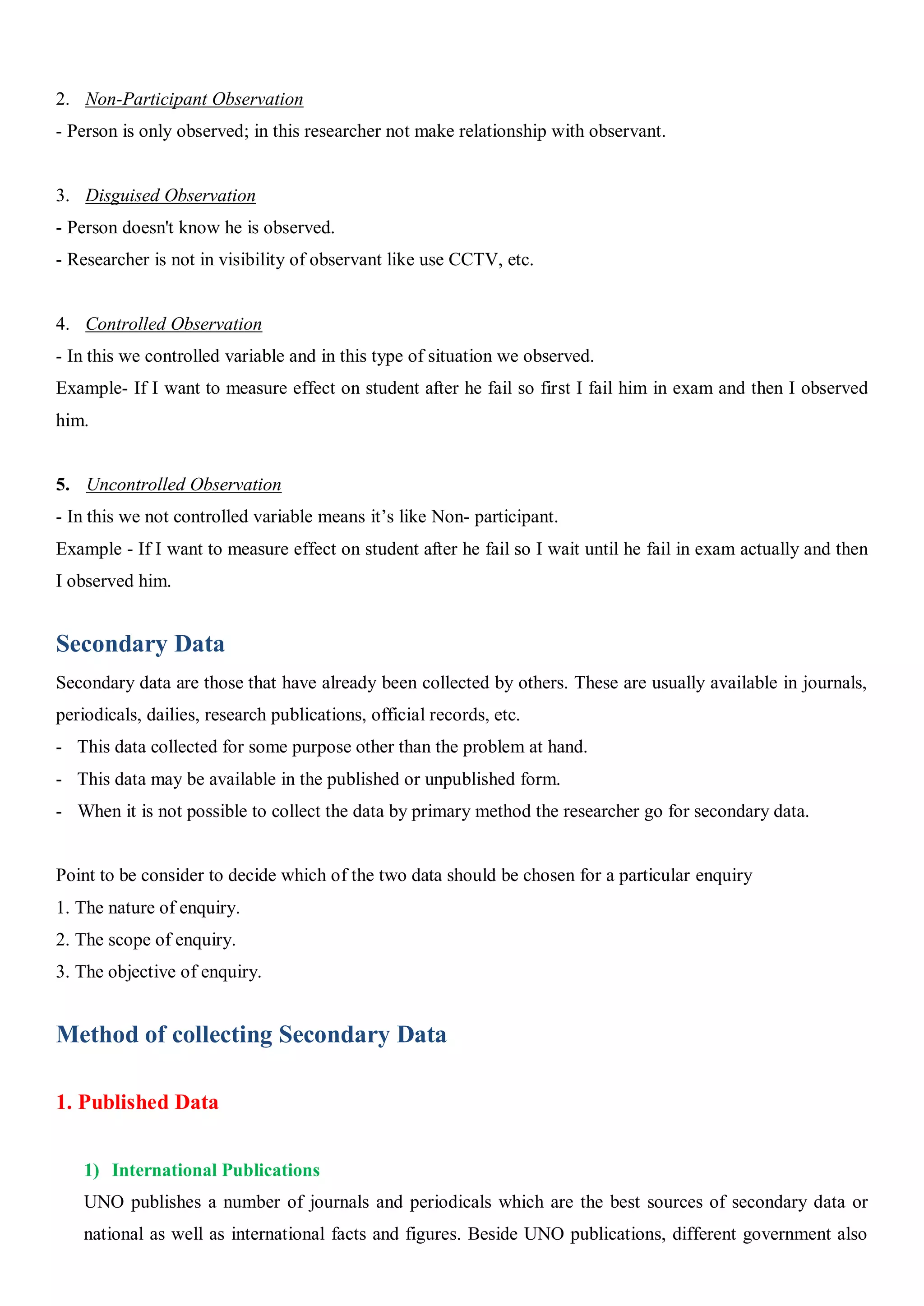
2. Non-Participant Observation
- Person is only observed; in this researcher not make relationship with observant.
3. Disguised Observation
- Person doesn't know he is observed.
- Researcher is not in visibility of observant like use CCTV, etc.
4. Controlled Observation
- In this we controlled variable and in this type of situation we observed.
Example- If I want to measure effect on student after he fail so first I fail him in exam and then I observed
him.
5. Uncontrolled Observation
- In this we not controlled variable means it’s like Non- participant.
Example - If I want to measure effect on student after he fail so I wait until he fail in exam actually and then
I observed him.
Secondary Data
Secondary data are those that have already been collected by others. These are usually available in journals,
periodicals, dailies, research publications, official records, etc.
- This data collected for some purpose other than the problem at hand.
- This data may be available in the published or unpublished form.
- When it is not possible to collect the data by primary method the researcher go for secondary data.
Point to be consider to decide which of the two data should be chosen for a particular enquiry
1. The nature of enquiry.
2. The scope of enquiry.
3. The objective of enquiry.
Method of collecting Secondary Data
1. Published Data
1) International Publications
UNO publishes a number of journals and periodicals which are the best sources of secondary data or
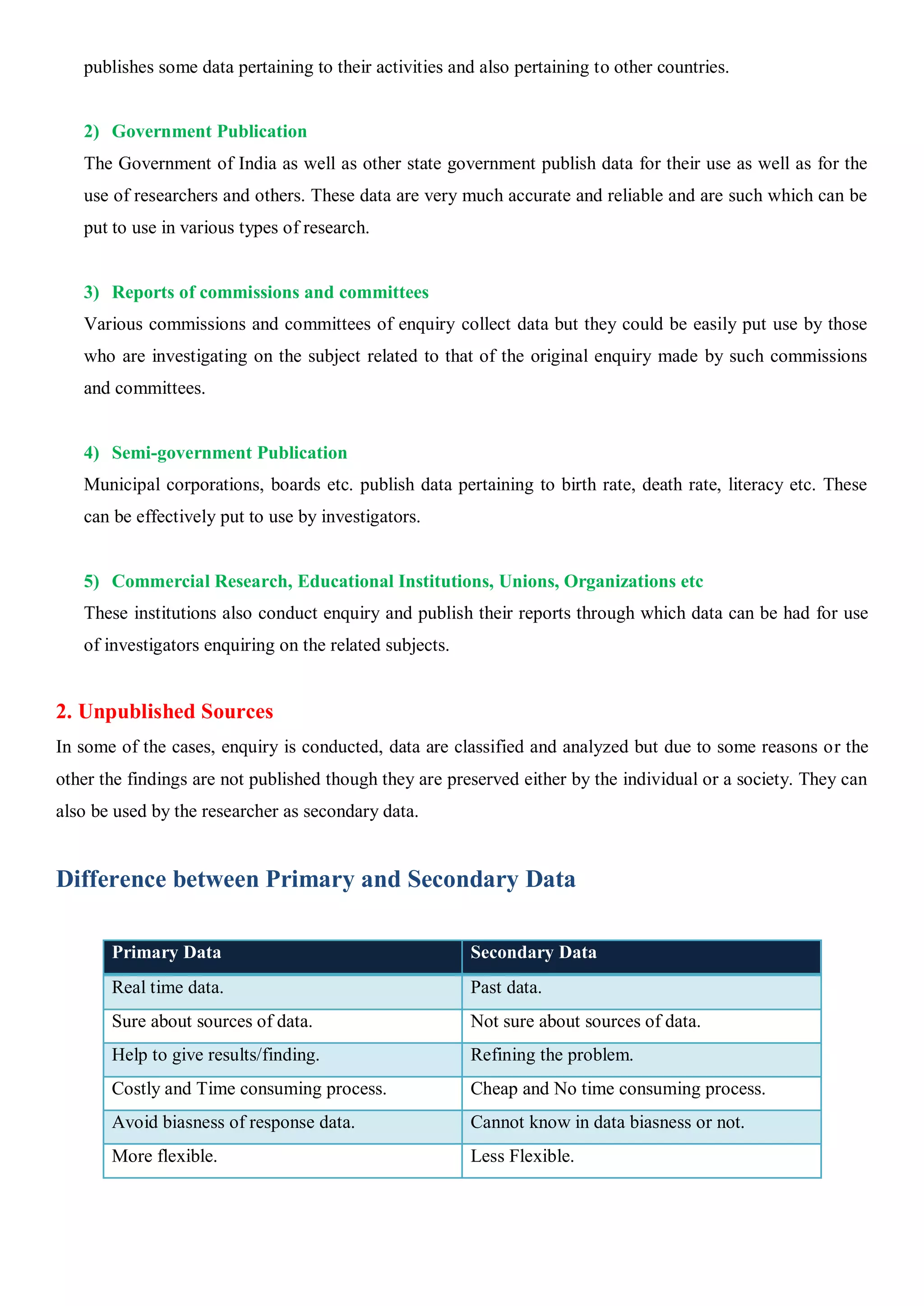
national as well as international facts and figures. Beside UNO publications, different government also
publishes some data pertaining to their activities and also pertaining to other countries.
2) Government Publication
The Government of India as well as other state government publish data for their use as well as for the
use of researchers and others. These data are very much accurate and reliable and are such which can be
put to use in various types of research.
3) Reports of commissions and committees
Various commissions and committees of enquiry collect data but they could be easily put use by those
who are investigating on the subject related to that of the original enquiry made by such commissions
and committees.
4) Semi-government Publication
Municipal corporations, boards etc. publish data pertaining to birth rate, death rate, literacy etc. These
can be effectively put to use by investigators.
5) Commercial Research, Educational Institutions, Unions, Organizations etc
These institutions also conduct enquiry and publish their reports through which data can be had for use
of investigators enquiring on the related subjects.
2. Unpublished Sources
In some of the cases, enquiry is conducted, data are classified and analyzed but due to some reasons or the
other the findings are not published though they are preserved either by the individual or a society. They can
also be used by the researcher as secondary data.
Difference between Primary and Secondary Data
Primary Data Secondary Data
Real time data. Past data.
Sure about sources of data. Not sure about sources of data.
Help to give results/finding. Refining the problem.
Costly and Time consuming process. Cheap and No time consuming process.
Avoid biasness of response data. Cannot know in data biasness or not.
More flexible. Less Flexible.

Method of Data Collection

  • 1.
    Method of DataCollection Need of Data-  To get information for analysis.  To get idea about real time situation.  For comparison between two situation. Factor to be considered before collection of Data 1. Object and scope of the enquiry First, a decision to enquire is taken. Thereafter, the purpose of the research enquiry is debated and a definite decision is taken in that respect. After that the scope is defined within the ambit of which the investigator functions. This all is necessary in order to collect a purposeful and useful data. 2. Sources of information After clearly defining the objectives and delimiting the scope of the research enquiry, it is necessary to decide as to from which source - whether primary or secondary - the data would be collected. Naturally this decision rests on the nature and purpose of enquiry. 3. Quantitative expression Since statistics is a quantitative expression, therefore, collection is also made in terms of numbers. No qualitative data without the aid of numbers can be collected for analysis and interpretations. A quantitative expression is a must. 4. Techniques of data collection Which of the two techniques (census or sample) of collecting the data would be used is a question that requires attention and pre-decision for a purposeful collection of facts. 5. Unit of collection The unit in terms of which the researcher is required to collect the data require proper scrutiny and appropriate decision. The research unit needs a clear definition. Throughout the whole process of research it should be uniform.
  • 2.
    Sources of Data Thereare different sources of collection of data in research. One has to make proper planning before deciding the source for collection of the data for investigation. They have to decide purpose of enquiry. There are some principal sources of collection of data which are as follows: 1. Internal sources Many institution and government departments have information about their regular functions, for their own internal purpose. When that information is used in any survey, it's called internal sources of data collection. Examples – Data used in Railways, Educational Institutes, Social Welfare Societies, etc. 2. External sources Whenever the information is collected from outside agencies it is called external sources of data. This type of information can be collected by census or sampling method by conducting survey. This type of data is two types- A. Primary Data B. Secondary Data Primary Data Primary data are those which are collected for the first time. They are original in character. In sample words, “The data collected by the investigator for the first time for own use is usually classed as primary data". - This is real time data which are collected by the researcher himself. - This data originated by the researcher specifically to address research problem. Method of collecting Primary Data 1. Direct Personal Research (Interview Method) Under this method researcher collect the data personally. He approaches the objects, conducts the enquiry open the spot, collect information and does the needful. For the successful collection data under this method, it's necessary that researcher should be polite, unbiased and aware of local conditions, environment and language. Merits  Original data.  Highest degree of accuracy. Demerits  It is expensive enough in terms of both time and money.
  • 3.
     Reliable data Uniformity in collection of the data.  Possibility of encouraging response from the people.  Greater possibility of verification of the accuracy of the information on the part of investigator as given by informants.  This can’t be used in large universe.  Chances of personal prejudices and thus biased data.  Requires skill and training. 2. Indirect Oral Research (Through Enumerators) Under this the researcher doesn't collects the information directly, instead he gets them indirectly through those persons who know the information and who are ready to part away with the information they posses. This method is used in case where direct contact is not possible. Merits  Less expensive -time, energy and money.  Simple and convenient method.  It is very useful where the field of enquiry is large enough.  Personal prejudices may be done away with under this method.  Complete information can be easily obtained.  Adequate information can also be gathered. Demerits  The data may not be as original as in other methods.  The data collected may not be free from personal prejudices.  The higher degree of accuracy in the data so collected may not be possible.  There may not be uniformity in the collected data.  Questionnaire may not sometime be understood by the informants.  Response may be poor.  More of training and skill may be required. 3. Investigation through Mailed Questionnaire Under this method the investigator may either appoint local agents/investigators/enumerators and mail them the questionnaire for collecting information or directly mail the questionnaire to the informants for collecting information. Merits  Useful in wider area of investigation.  The cheaper method of investigation.  Minimum possibility of error. Demerits  Though personal prejudices seldom occur but the informant may be biased and thus certain amount of bias may creep in.
  • 4.
     The dataare original.  Informants are directly involved in the collection of data.  Economy of time, energy and money.  Less fear of partiality.  Reliable data.  Seriousness of the informant is a pre-condition in this method, otherwise information gathered may not be correct one.  Even sometimes the informant may not be fully equipped and may not be having sufficient information, as is required, but he may venture to give information. 4. Investigation through Local Reporters Questionnaire. In this method data are not collected through specially appointed agents/correspondents/investigators/enumerators but local agents or correspondents are requested to collect the information. They collect the information in their own fashion and according tro their liking's and disliking. Merits  Useful when the universe is wide enough.  Less expensive. Demerits  The data are collected according to likings and disliking of the local reporters.  Personal bias.  The data so collected are not reliable.  Higher degree of accuracy is not possible.  Consume more time, energy and money. 5. Research through Observation In this watching behavior of object and most commonly used method in behavior science. One major problem in this method is that Natural response is not obtained when respondent know he is observed. Merits  Note event as it happen.  Only way when child is involved.  Easier method for data collection.  Natural Response. Demerits  Time consuming and costly.  Interpretation part is difficult.  Natural response is not obtained when respondent know he is observed. Type of Observation- 1. Participant Observation - Person Know someone observed him. - Researcher makes relationship with observant.
  • 5.
    2. Non-Participant Observation -Person is only observed; in this researcher not make relationship with observant. 3. Disguised Observation - Person doesn't know he is observed. - Researcher is not in visibility of observant like use CCTV, etc. 4. Controlled Observation - In this we controlled variable and in this type of situation we observed. Example- If I want to measure effect on student after he fail so first I fail him in exam and then I observed him. 5. Uncontrolled Observation - In this we not controlled variable means it’s like Non- participant. Example - If I want to measure effect on student after he fail so I wait until he fail in exam actually and then I observed him. Secondary Data Secondary data are those that have already been collected by others. These are usually available in journals, periodicals, dailies, research publications, official records, etc. - This data collected for some purpose other than the problem at hand. - This data may be available in the published or unpublished form. - When it is not possible to collect the data by primary method the researcher go for secondary data. Point to be consider to decide which of the two data should be chosen for a particular enquiry 1. The nature of enquiry. 2. The scope of enquiry. 3. The objective of enquiry. Method of collecting Secondary Data 1. Published Data 1) International Publications UNO publishes a number of journals and periodicals which are the best sources of secondary data or national as well as international facts and figures. Beside UNO publications, different government also
  • 6.
    publishes some datapertaining to their activities and also pertaining to other countries. 2) Government Publication The Government of India as well as other state government publish data for their use as well as for the use of researchers and others. These data are very much accurate and reliable and are such which can be put to use in various types of research. 3) Reports of commissions and committees Various commissions and committees of enquiry collect data but they could be easily put use by those who are investigating on the subject related to that of the original enquiry made by such commissions and committees. 4) Semi-government Publication Municipal corporations, boards etc. publish data pertaining to birth rate, death rate, literacy etc. These can be effectively put to use by investigators. 5) Commercial Research, Educational Institutions, Unions, Organizations etc These institutions also conduct enquiry and publish their reports through which data can be had for use of investigators enquiring on the related subjects. 2. Unpublished Sources In some of the cases, enquiry is conducted, data are classified and analyzed but due to some reasons or the other the findings are not published though they are preserved either by the individual or a society. They can also be used by the researcher as secondary data. Difference between Primary and Secondary Data Primary Data Secondary Data Real time data. Past data. Sure about sources of data. Not sure about sources of data. Help to give results/finding. Refining the problem. Costly and Time consuming process. Cheap and No time consuming process. Avoid biasness of response data. Cannot know in data biasness or not. More flexible. Less Flexible.