Applications of Integration 
Copyright Š Cengage Learning. All rights reserved.
Area of a Region Between 
Two Curves 
Copyright Š Cengage Learning. All rights reserved.
3 
Objectives 
 Find the area of a region between two curves using 
integration. 
 Find the area of a region between intersecting curves 
using integration. 
 Describe integration as an accumulation process.
4 
Area of a Region Between Two 
Curves
5 
Area of a Region Between Two Curves 
With a few modifications, you can extend the application of 
definite integrals from the area of a region under a curve to 
the area of a region between two curves. 
Consider two functions f and g that are continuous on the 
interval [a, b]. 
Also, the graphs of both f and g 
lie above the x-axis, and the graph 
of g lies below the graph of f, 
as shown in Figure 7.1. 
Figure 7.1
6 
Area of a Region Between Two Curves 
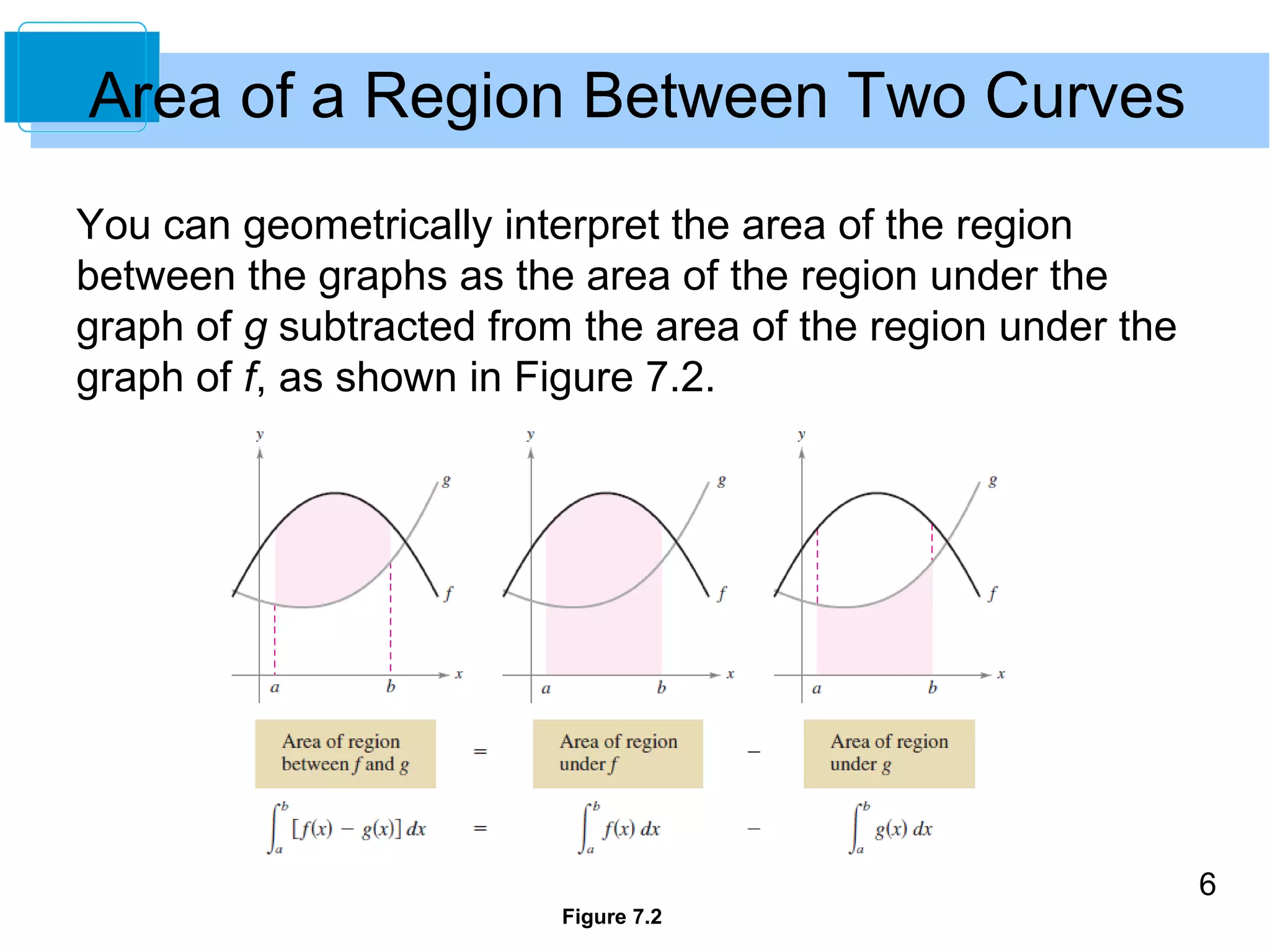
You can geometrically interpret the area of the region 
between the graphs as the area of the region under the 
graph of g subtracted from the area of the region under the 
graph of f, as shown in Figure 7.2. 
Figure 7.2
7 
Area of a Region Between Two Curves 
To verify the reasonableness of the result shown in 
Figure 7.2, you can partition the interval [a, b] into n 
subintervals, each of width Dx. 
Then, as shown in Figure 7.3, 
sketch a representative rectangle 
of width Dx and height f(xi) – g(xi), 
where xi is in the ith subinterval. 
Figure 7.3
8 
Area of a Region Between Two Curves 
The area of this representative rectangle is 
DAi = (height)(width) = [f(xi) – g(xi)]Dx. 
By adding the areas of the n rectangles and taking the limit 
as ||D||→0 (n→ ), you obtain 
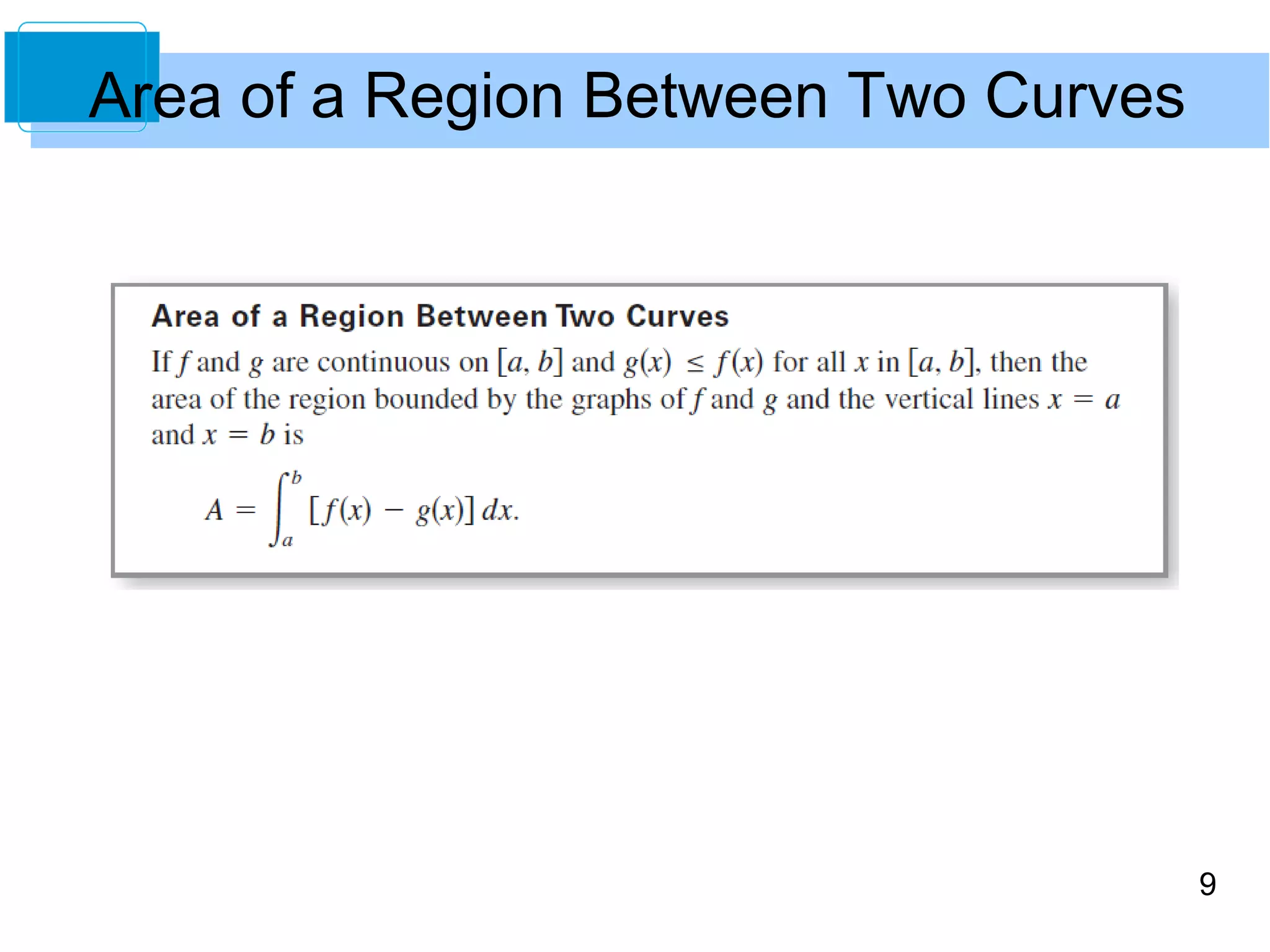
Because f and g are continuous on [a, b], f – g is also 
continuous on [a, b] and the limit exists. So, the area of the 
given region is
9 
Area of a Region Between Two Curves
10 
Area of a Region Between Two Curves 
In Figure 7.1, the graphs of f and g are shown above the 
x-axis. This, however, is not necessary. 
Figure 7.1 
The same integrand [f(x) – g(x)] can be used as long as 
f and g are continuous and g(x) ≤ f(x) for all x in the interval 
[a, b].
11 
Area of a Region Between Two Curves 
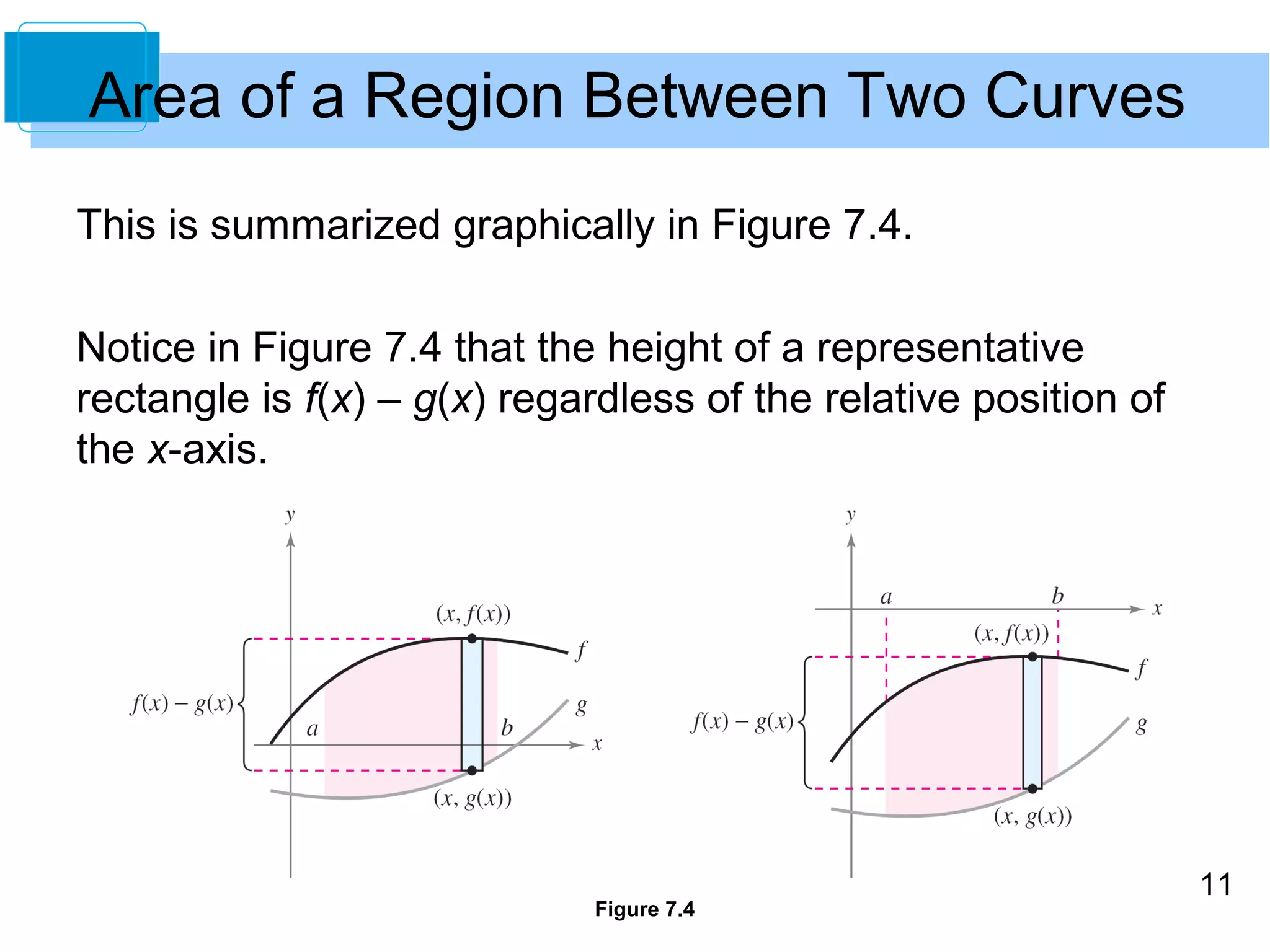
This is summarized graphically in Figure 7.4. 
Notice in Figure 7.4 that the height of a representative 
rectangle is f(x) – g(x) regardless of the relative position of 
the x-axis. 
Figure 7.4
12 
Area of a Region Between Two Curves 
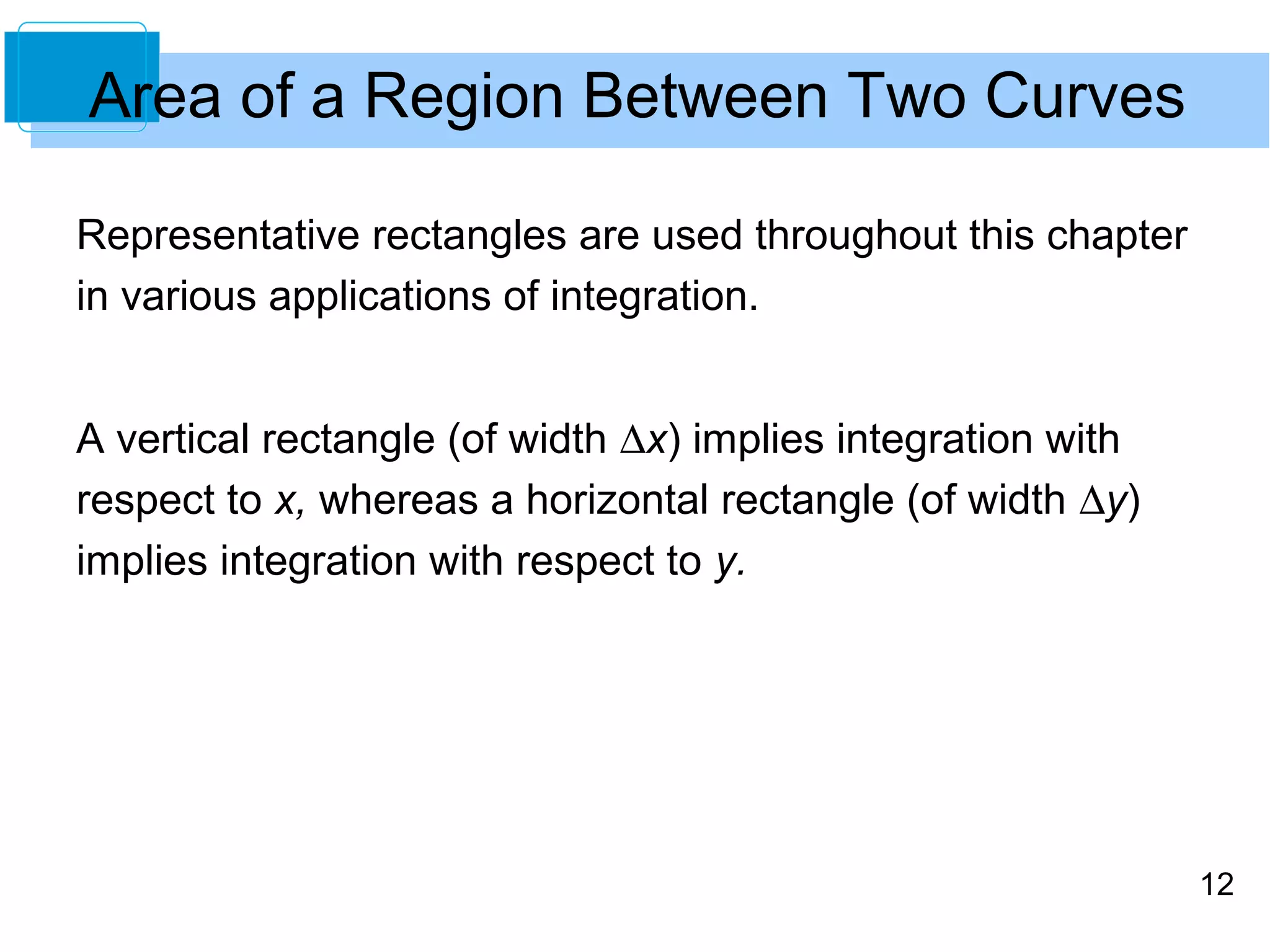
Representative rectangles are used throughout this chapter 
in various applications of integration. 
A vertical rectangle (of width Dx) implies integration with 
respect to x, whereas a horizontal rectangle (of width Dy) 
implies integration with respect to y.
13 
Example 1 – Finding the Area of a Region Between Two Curves 
Find the area of the region bounded by the graphs of 
f(x) = x2 + 2, g(x) = –x, x = 0, and x = 1. 
Solution: 
Let g(x) = –x and f(x) = x2 + 2. 
Then g(x) ≤ f(x) for all x in [0, 1], 
as shown in Figure 7.5. 
Figure 7.5
14 
Example 1 – Solution 
So, the area of the representative rectangle is 
DA = [f(x) – g(x)]Dx 
= [(x2 + 2) – (–x)]Dx 
and the area of the region is 
cont’d
15 
Area of a Region Between 
Intersecting Curves
16 
Area of a Region Between Intersecting Curves 
In Example 1, the graphs of f(x) = x2 + 2 and g(x) = –x do 
not intersect, and the values of a and b are given explicitly. 
A more common problem involves the area of a region 
bounded by two intersecting graphs, where the values of 
a and b must be calculated.
17 
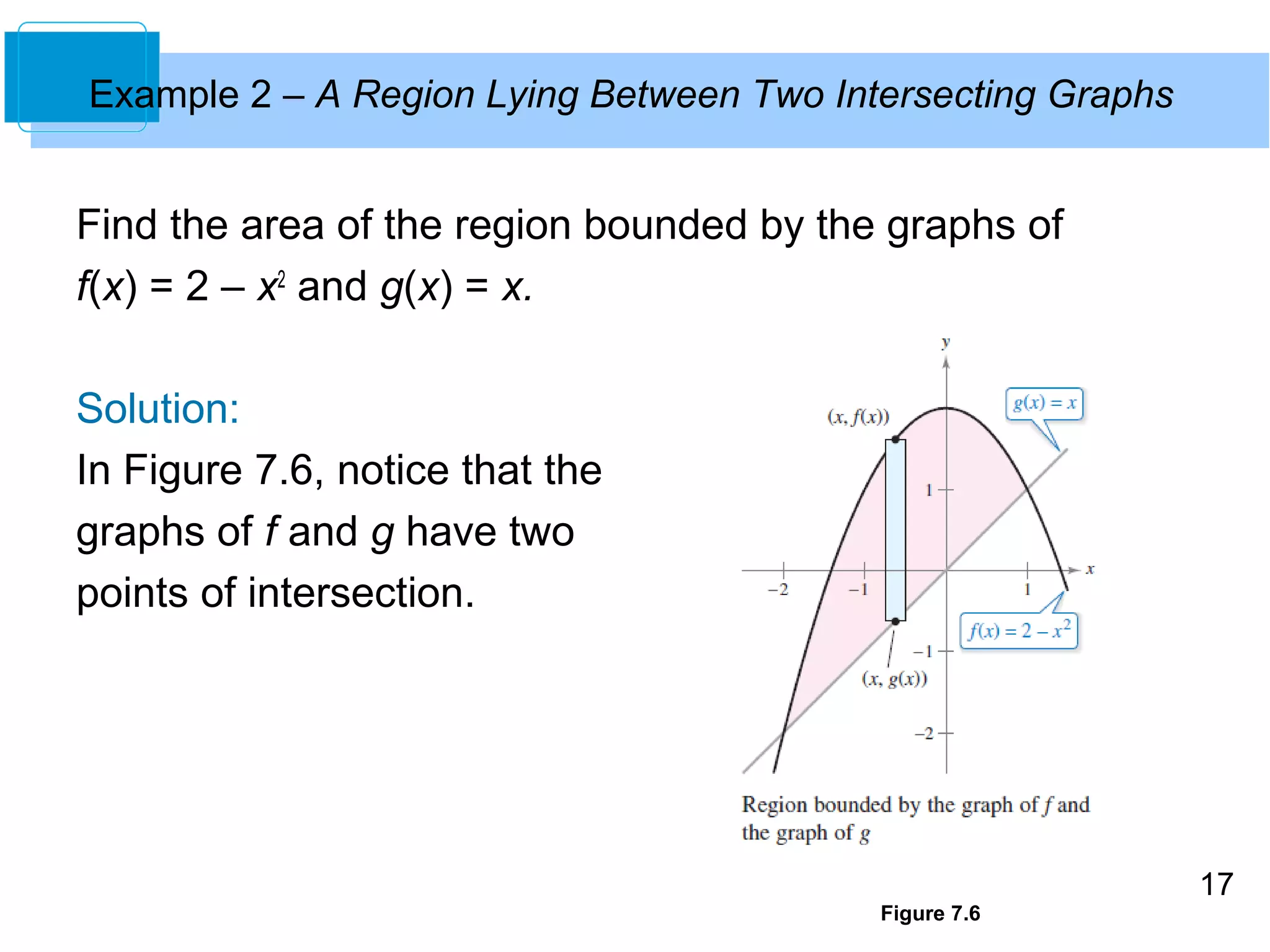
Example 2 – A Region Lying Between Two Intersecting Graphs 
Find the area of the region bounded by the graphs of 
f(x) = 2 – x2 and g(x) = x. 
Solution: 
In Figure 7.6, notice that the 
graphs of f and g have two 
points of intersection. 
Figure 7.6
Example 2 – Solution cont’d 
18 
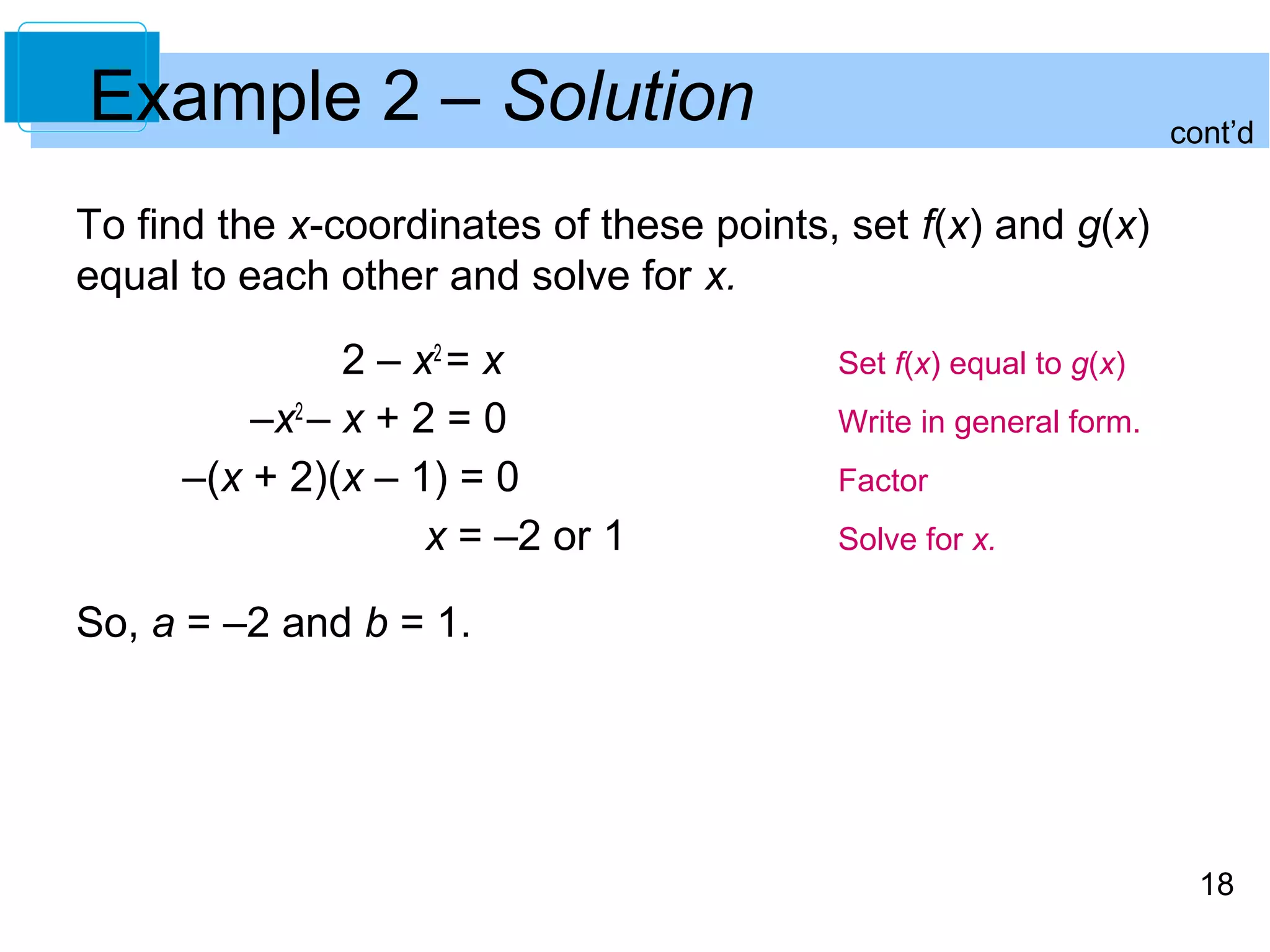
To find the x-coordinates of these points, set f(x) and g(x) 
equal to each other and solve for x. 
2 – x2 = x Set f(x) equal to g(x) 
–x2 – x + 2 = 0 Write in general form. 
–(x + 2)(x – 1) = 0 Factor 
x = –2 or 1 Solve for x. 
So, a = –2 and b = 1.
cont’d Example 2 – Solution 
19 
Because g(x) ≤ f(x) for all x in the interval [–2, 1], the 
representative rectangle has an area of 
DA = [f(x) – g(x)]Dx 
= [(2 – x2) – x]Dx 
and the area of the region is
20 
Integration as an Accumulation 
Process
21 
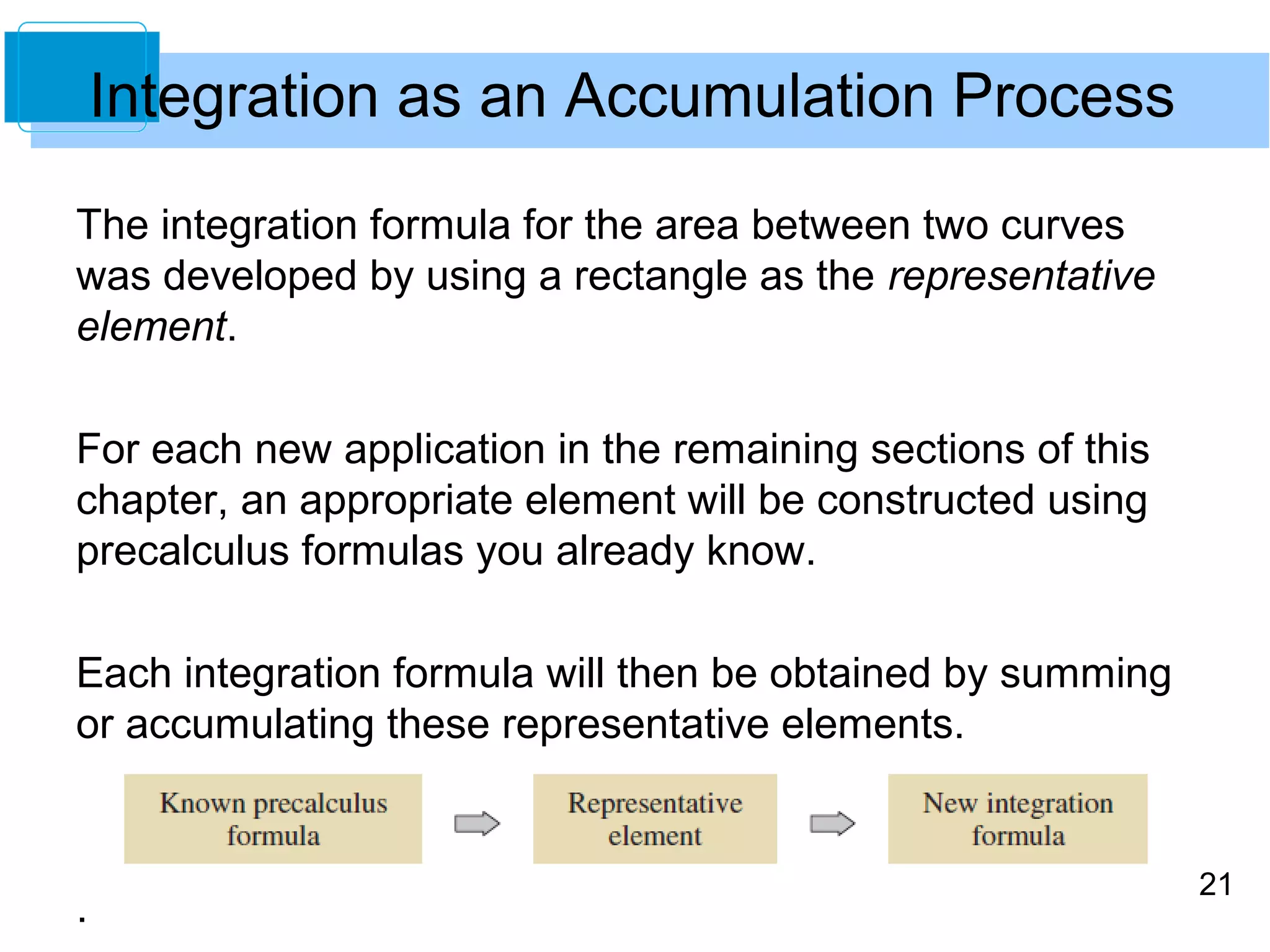
The integration formula for the area between two curves 
was developed by using a rectangle as the representative 
element. 
For each new application in the remaining sections of this 
chapter, an appropriate element will be constructed using 
precalculus formulas you already know. 
Each integration formula will then be obtained by summing 
or accumulating these representative elements. 
. 
Integration as an Accumulation Process
22 
Integration as an Accumulation Process 
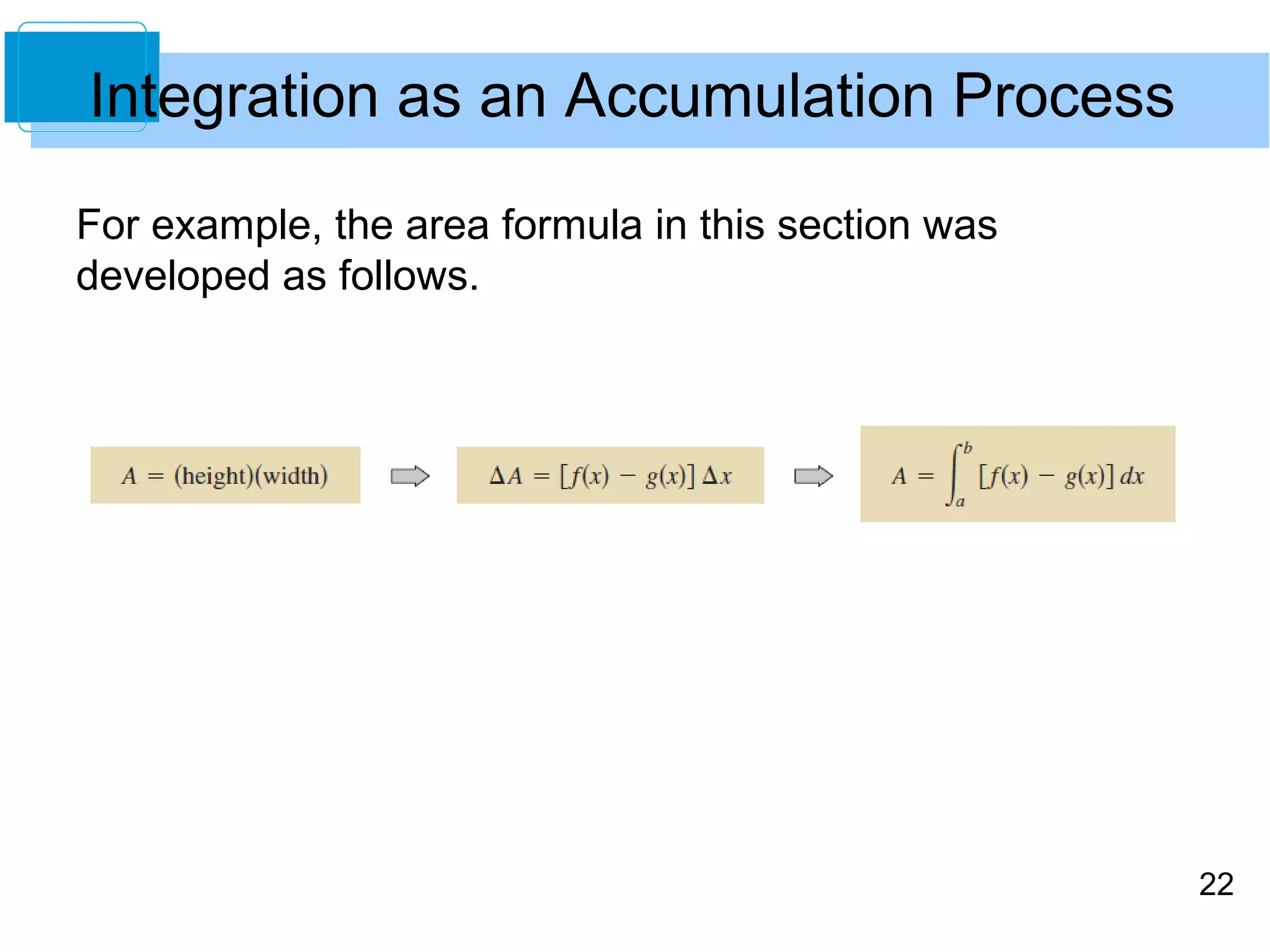
For example, the area formula in this section was 
developed as follows.
23 
Example 6 – Describing Integration as an Accumulation Process 
Find the area of the region bounded by the graph of 
y = 4 – x2 and the x-axis. Describe the integration as an 
accumulation process. 
Solution: 
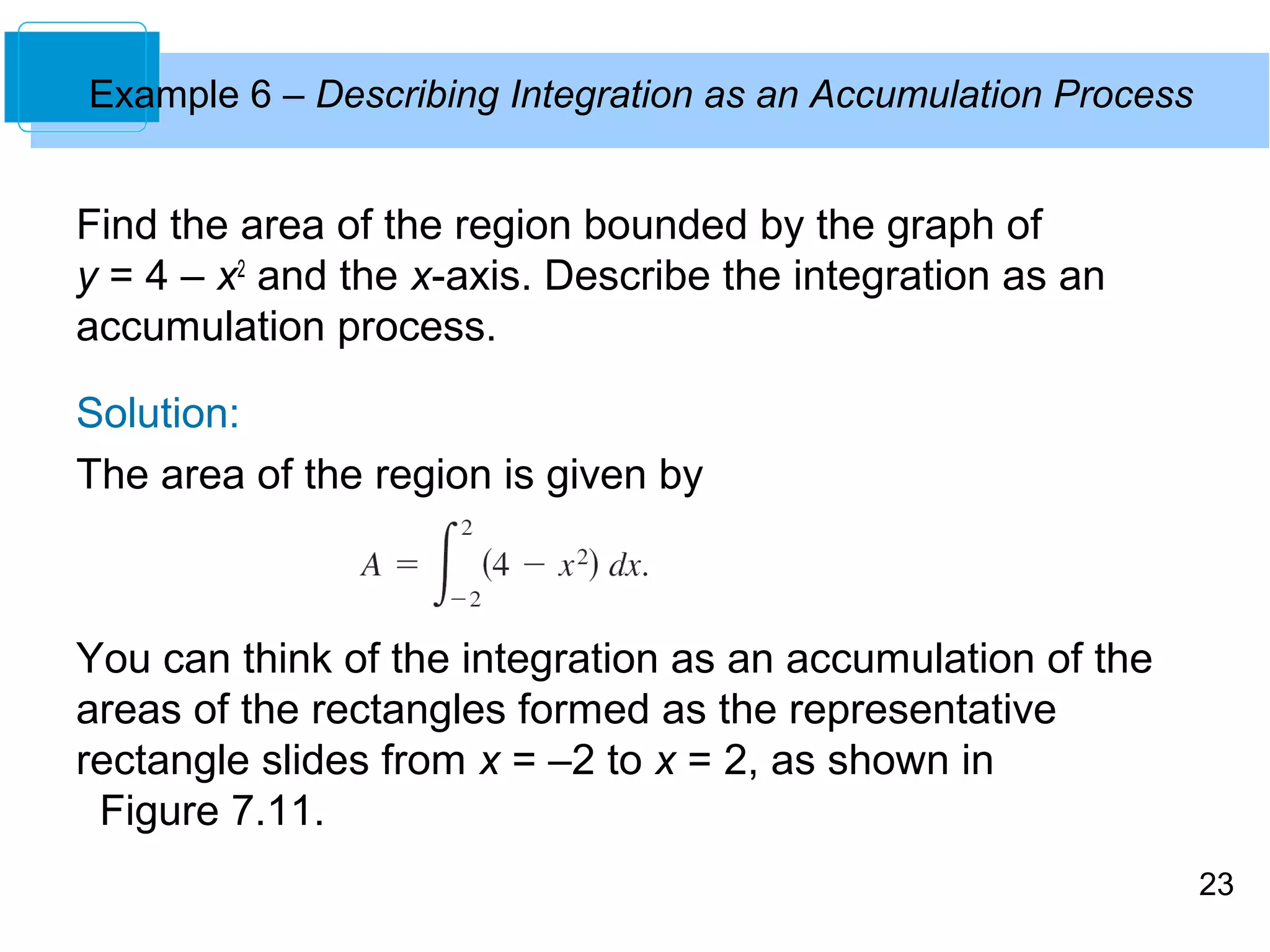
The area of the region is given by 
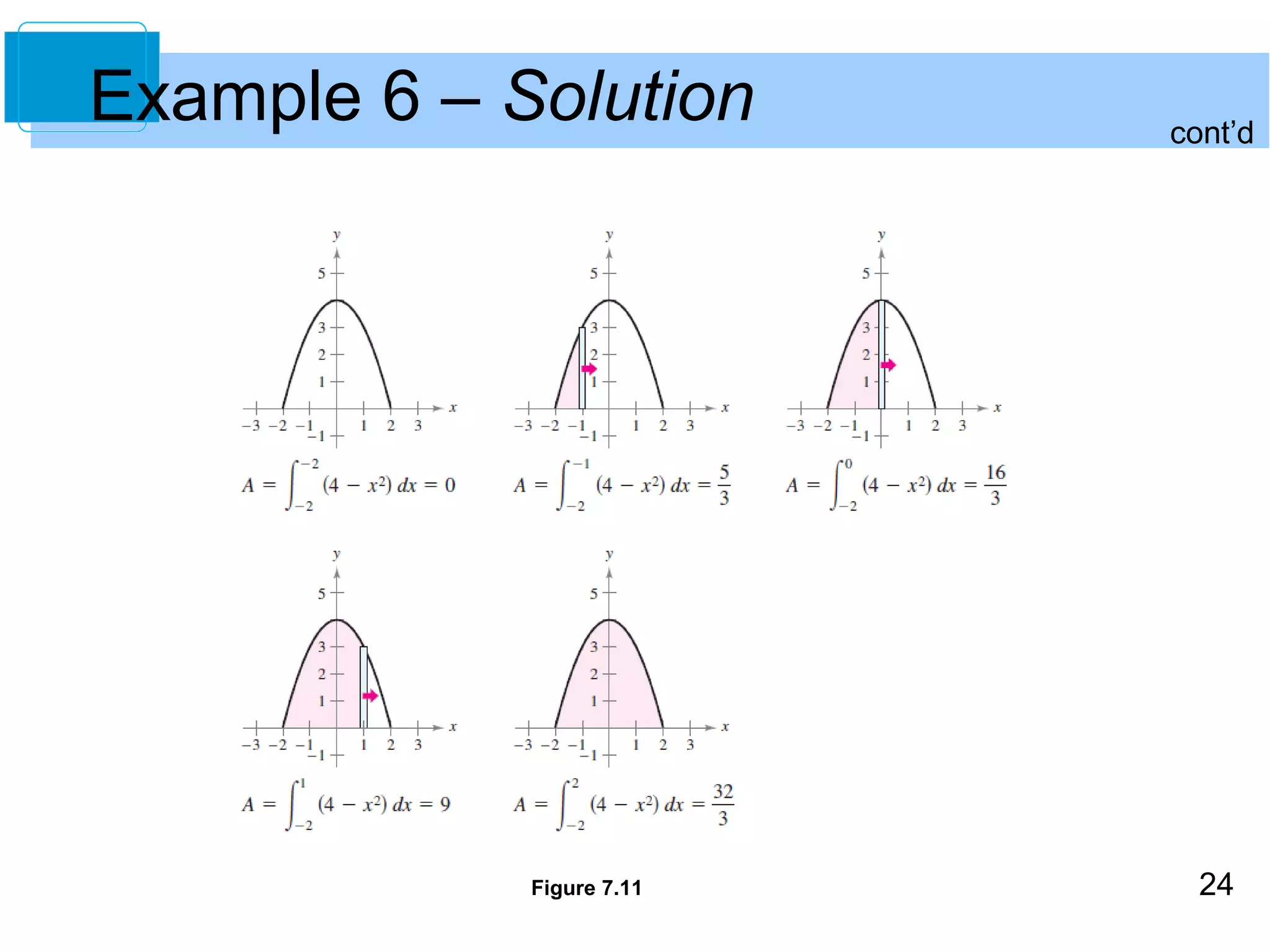
You can think of the integration as an accumulation of the 
areas of the rectangles formed as the representative 
rectangle slides from x = –2 to x = 2, as shown in 
Figure 7.11.
24 
Example 6 – Solution 
Figure 7.11 
cont’d

Lar calc10 ch07_sec1

  • 1.
    Applications of Integration Copyright Š Cengage Learning. All rights reserved.
  • 2.
    Area of aRegion Between Two Curves Copyright Š Cengage Learning. All rights reserved.
  • 3.
    3 Objectives Find the area of a region between two curves using integration.  Find the area of a region between intersecting curves using integration.  Describe integration as an accumulation process.
  • 4.
    4 Area ofa Region Between Two Curves
  • 5.
    5 Area ofa Region Between Two Curves With a few modifications, you can extend the application of definite integrals from the area of a region under a curve to the area of a region between two curves. Consider two functions f and g that are continuous on the interval [a, b]. Also, the graphs of both f and g lie above the x-axis, and the graph of g lies below the graph of f, as shown in Figure 7.1. Figure 7.1
  • 6.
    6 Area ofa Region Between Two Curves You can geometrically interpret the area of the region between the graphs as the area of the region under the graph of g subtracted from the area of the region under the graph of f, as shown in Figure 7.2. Figure 7.2
  • 7.
    7 Area ofa Region Between Two Curves To verify the reasonableness of the result shown in Figure 7.2, you can partition the interval [a, b] into n subintervals, each of width Dx. Then, as shown in Figure 7.3, sketch a representative rectangle of width Dx and height f(xi) – g(xi), where xi is in the ith subinterval. Figure 7.3
  • 8.
    8 Area ofa Region Between Two Curves The area of this representative rectangle is DAi = (height)(width) = [f(xi) – g(xi)]Dx. By adding the areas of the n rectangles and taking the limit as ||D||→0 (n→ ), you obtain Because f and g are continuous on [a, b], f – g is also continuous on [a, b] and the limit exists. So, the area of the given region is
  • 9.
    9 Area ofa Region Between Two Curves
  • 10.
    10 Area ofa Region Between Two Curves In Figure 7.1, the graphs of f and g are shown above the x-axis. This, however, is not necessary. Figure 7.1 The same integrand [f(x) – g(x)] can be used as long as f and g are continuous and g(x) ≤ f(x) for all x in the interval [a, b].
  • 11.
    11 Area ofa Region Between Two Curves This is summarized graphically in Figure 7.4. Notice in Figure 7.4 that the height of a representative rectangle is f(x) – g(x) regardless of the relative position of the x-axis. Figure 7.4
  • 12.
    12 Area ofa Region Between Two Curves Representative rectangles are used throughout this chapter in various applications of integration. A vertical rectangle (of width Dx) implies integration with respect to x, whereas a horizontal rectangle (of width Dy) implies integration with respect to y.
  • 13.
    13 Example 1– Finding the Area of a Region Between Two Curves Find the area of the region bounded by the graphs of f(x) = x2 + 2, g(x) = –x, x = 0, and x = 1. Solution: Let g(x) = –x and f(x) = x2 + 2. Then g(x) ≤ f(x) for all x in [0, 1], as shown in Figure 7.5. Figure 7.5
  • 14.
    14 Example 1– Solution So, the area of the representative rectangle is DA = [f(x) – g(x)]Dx = [(x2 + 2) – (–x)]Dx and the area of the region is cont’d
  • 15.
    15 Area ofa Region Between Intersecting Curves
  • 16.
    16 Area ofa Region Between Intersecting Curves In Example 1, the graphs of f(x) = x2 + 2 and g(x) = –x do not intersect, and the values of a and b are given explicitly. A more common problem involves the area of a region bounded by two intersecting graphs, where the values of a and b must be calculated.
  • 17.
    17 Example 2– A Region Lying Between Two Intersecting Graphs Find the area of the region bounded by the graphs of f(x) = 2 – x2 and g(x) = x. Solution: In Figure 7.6, notice that the graphs of f and g have two points of intersection. Figure 7.6
  • 18.
    Example 2 –Solution cont’d 18 To find the x-coordinates of these points, set f(x) and g(x) equal to each other and solve for x. 2 – x2 = x Set f(x) equal to g(x) –x2 – x + 2 = 0 Write in general form. –(x + 2)(x – 1) = 0 Factor x = –2 or 1 Solve for x. So, a = –2 and b = 1.
  • 19.
    cont’d Example 2– Solution 19 Because g(x) ≤ f(x) for all x in the interval [–2, 1], the representative rectangle has an area of DA = [f(x) – g(x)]Dx = [(2 – x2) – x]Dx and the area of the region is
  • 20.
    20 Integration asan Accumulation Process
  • 21.
    21 The integrationformula for the area between two curves was developed by using a rectangle as the representative element. For each new application in the remaining sections of this chapter, an appropriate element will be constructed using precalculus formulas you already know. Each integration formula will then be obtained by summing or accumulating these representative elements. . Integration as an Accumulation Process
  • 22.
    22 Integration asan Accumulation Process For example, the area formula in this section was developed as follows.
  • 23.
    23 Example 6– Describing Integration as an Accumulation Process Find the area of the region bounded by the graph of y = 4 – x2 and the x-axis. Describe the integration as an accumulation process. Solution: The area of the region is given by You can think of the integration as an accumulation of the areas of the rectangles formed as the representative rectangle slides from x = –2 to x = 2, as shown in Figure 7.11.
  • 24.
    24 Example 6– Solution Figure 7.11 cont’d