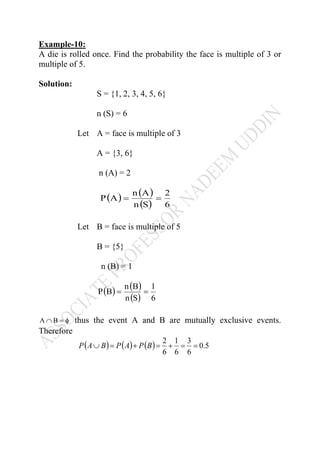
Example-10:
A die is rolled once. Find the probability the face is multiple of 3 or
multiple of 5.
Solution:
S = {1, 2, 3, 4, 5, 6}
n (S) = 6
Let A = face is multiple of 3
A = {3, 6}
n (A) = 2
Let B = face is multiple of 5
B = {5}
n (B) = 1
thus the event A and B are mutually exclusive events.
Therefore
( ) ( )
( ) 6
2
Sn
An
AP ==
( ) ( )
( ) 6
1
Sn
Bn
BP ==
= BA
( ) ( ) ( ) 5.0
6
3
6
1
6
2
==+=+= BPAPBAP
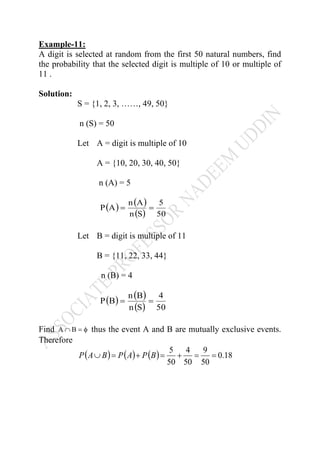
Example-11:
A digit is selected at random from the first 50 natural numbers, find
the probability that the selected digit is multiple of 10 or multiple of
11 .
Solution:
S = {1, 2, 3, ……, 49, 50}
n (S) = 50
Let A = digit is multiple of 10
A = {10, 20, 30, 40, 50}
n (A) = 5
Let B = digit is multiple of 11
B = {11, 22, 33, 44}
n (B) = 4
Find thus the event A and B are mutually exclusive events.
Therefore
( ) ( )
( ) 50
5
Sn
An
AP ==
( ) ( )
( ) 50
4
Sn
Bn
BP ==
= BA
( ) ( ) ( ) 18.0
50
9
50
4
50
5
==+=+= BPAPBAP
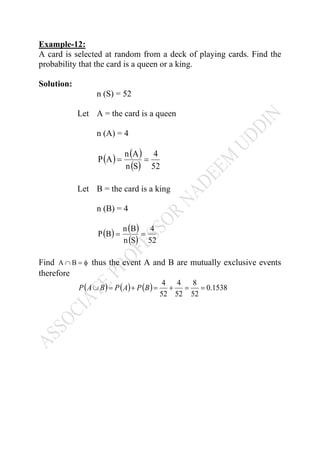
Example-12:
A card is selected at random from a deck of playing cards. Find the
probability that the card is a queen or a king.
Solution:
n (S) = 52
Let A = the card is a queen
n (A) = 4
Let B = the card is a king
n (B) = 4
Find thus the event A and B are mutually exclusive events
therefore
( ) ( )
( ) 52
4
Sn
An
AP ==
( ) ( )
( ) 52
4
Sn
Bn
BP ==
= BA
( ) ( ) ( ) 1538.0
52
8
52
4
52
4
==+=+= BPAPBAP

Probability(mutually exclusive events)

  • 2.
    Example-10: A die isrolled once. Find the probability the face is multiple of 3 or multiple of 5. Solution: S = {1, 2, 3, 4, 5, 6} n (S) = 6 Let A = face is multiple of 3 A = {3, 6} n (A) = 2 Let B = face is multiple of 5 B = {5} n (B) = 1 thus the event A and B are mutually exclusive events. Therefore ( ) ( ) ( ) 6 2 Sn An AP == ( ) ( ) ( ) 6 1 Sn Bn BP == = BA ( ) ( ) ( ) 5.0 6 3 6 1 6 2 ==+=+= BPAPBAP
  • 3.
    Example-11: A digit isselected at random from the first 50 natural numbers, find the probability that the selected digit is multiple of 10 or multiple of 11 . Solution: S = {1, 2, 3, ……, 49, 50} n (S) = 50 Let A = digit is multiple of 10 A = {10, 20, 30, 40, 50} n (A) = 5 Let B = digit is multiple of 11 B = {11, 22, 33, 44} n (B) = 4 Find thus the event A and B are mutually exclusive events. Therefore ( ) ( ) ( ) 50 5 Sn An AP == ( ) ( ) ( ) 50 4 Sn Bn BP == = BA ( ) ( ) ( ) 18.0 50 9 50 4 50 5 ==+=+= BPAPBAP
  • 4.
    Example-12: A card isselected at random from a deck of playing cards. Find the probability that the card is a queen or a king. Solution: n (S) = 52 Let A = the card is a queen n (A) = 4 Let B = the card is a king n (B) = 4 Find thus the event A and B are mutually exclusive events therefore ( ) ( ) ( ) 52 4 Sn An AP == ( ) ( ) ( ) 52 4 Sn Bn BP == = BA ( ) ( ) ( ) 1538.0 52 8 52 4 52 4 ==+=+= BPAPBAP