Integration 
Copyright © Cengage Learning. All rights reserved.
Integration by Substitution 
Copyright © Cengage Learning. All rights reserved. 
4.5
3 
Objectives 
 Use pattern recognition to find an indefinite integral. 
 Use a change of variables to find an indefinite integral. 
 Use the General Power Rule for Integration to find an 
indefinite integral. 
 Use a change of variables to evaluate a definite integral. 
 Evaluate a definite integral involving an even or odd 
function.
4 
Pattern Recognition
5 
Pattern Recognition 
In this section you will study techniques for integrating 
composite functions. 
The discussion is split into two parts—pattern recognition 
and change of variables. Both techniques involve a 
u-substitution. 
With pattern recognition, you perform the substitution 
mentally, and with change of variables, you write the 
substitution steps. 
The role of substitution in integration is comparable to the 
role of the Chain Rule in differentiation.
6 
Pattern Recognition 
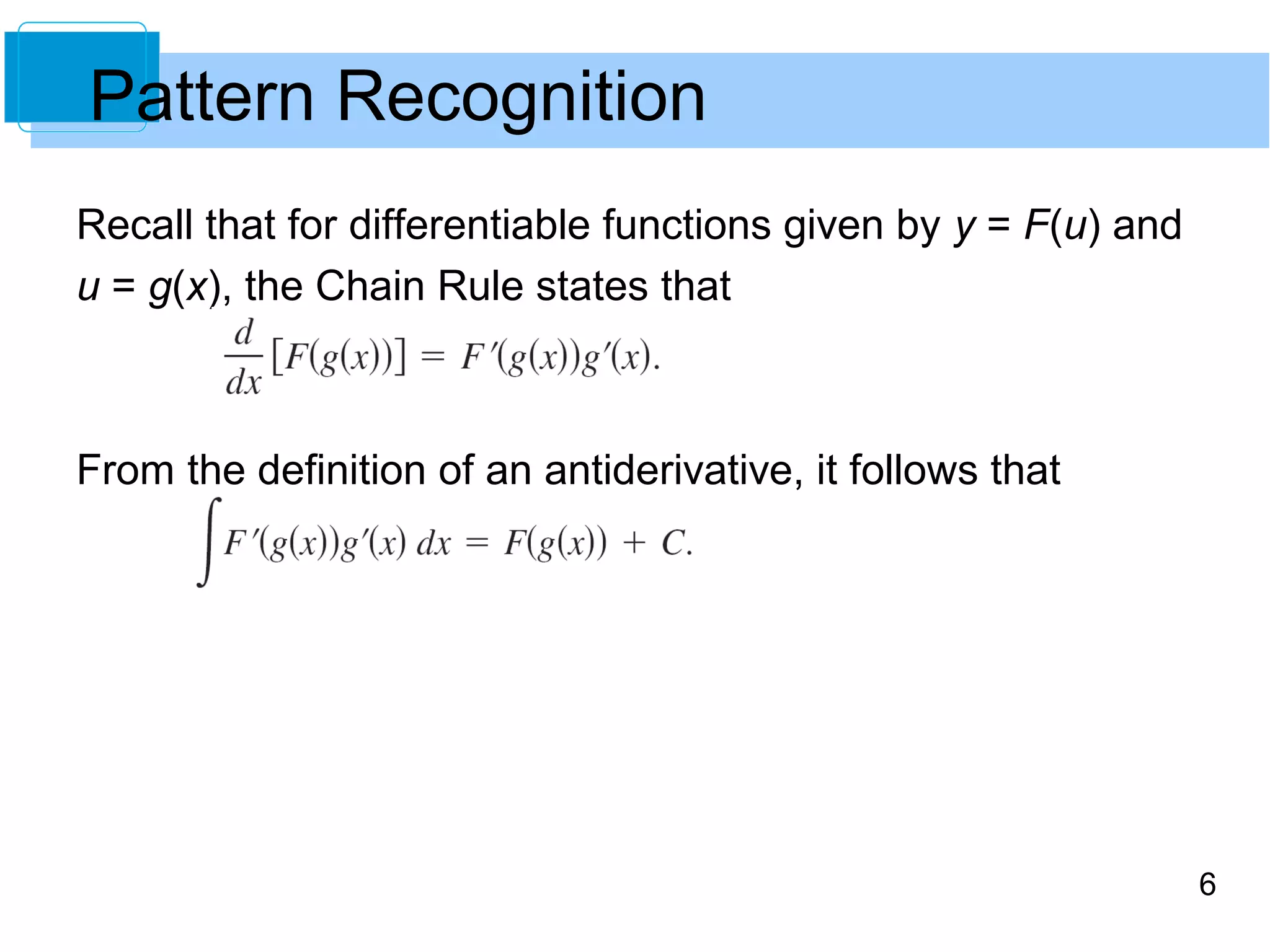
Recall that for differentiable functions given by y = F(u) and 
u = g(x), the Chain Rule states that 
From the definition of an antiderivative, it follows that
7 
Pattern Recognition 
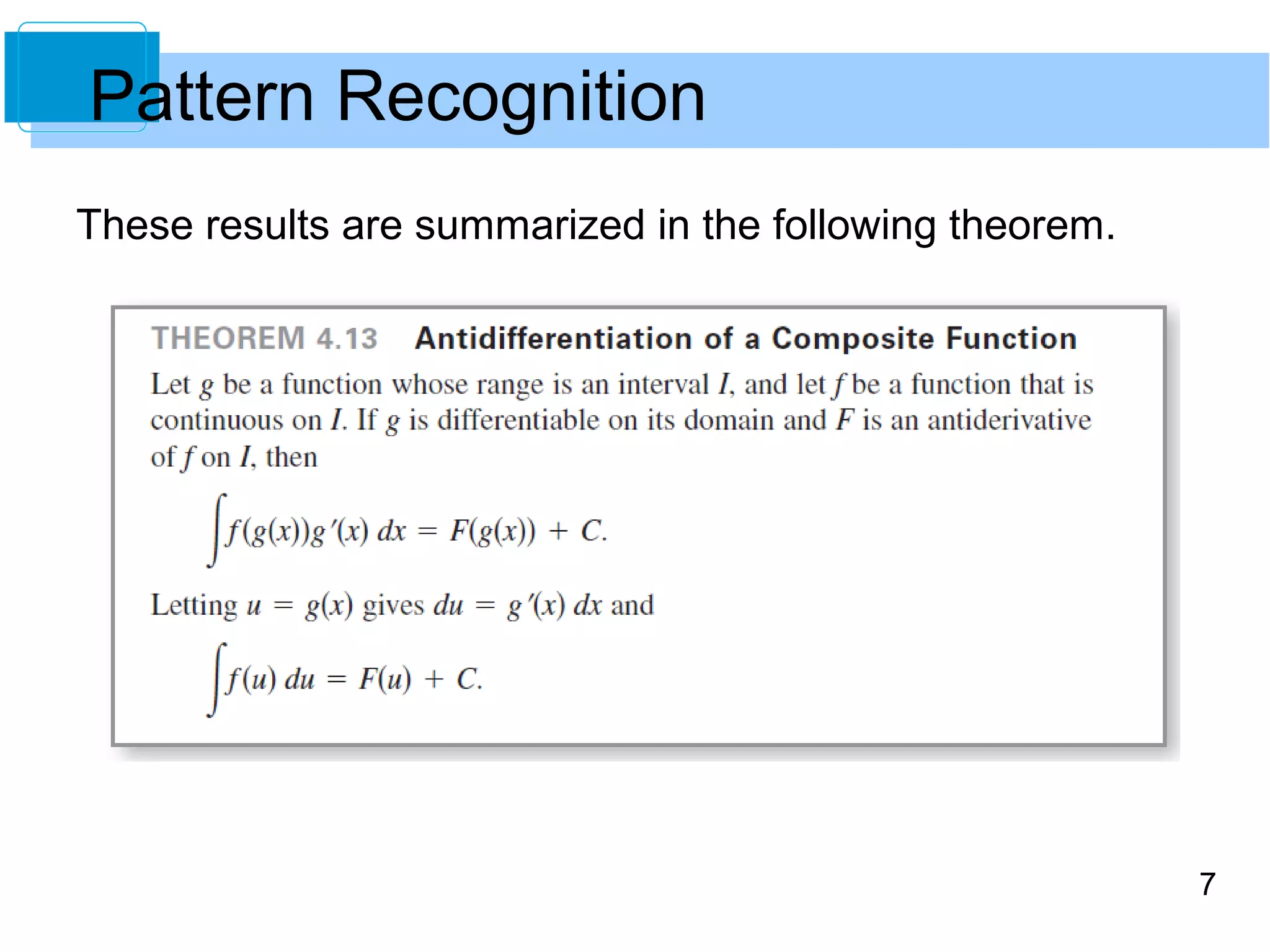
These results are summarized in the following theorem.
8 
Pattern Recognition 
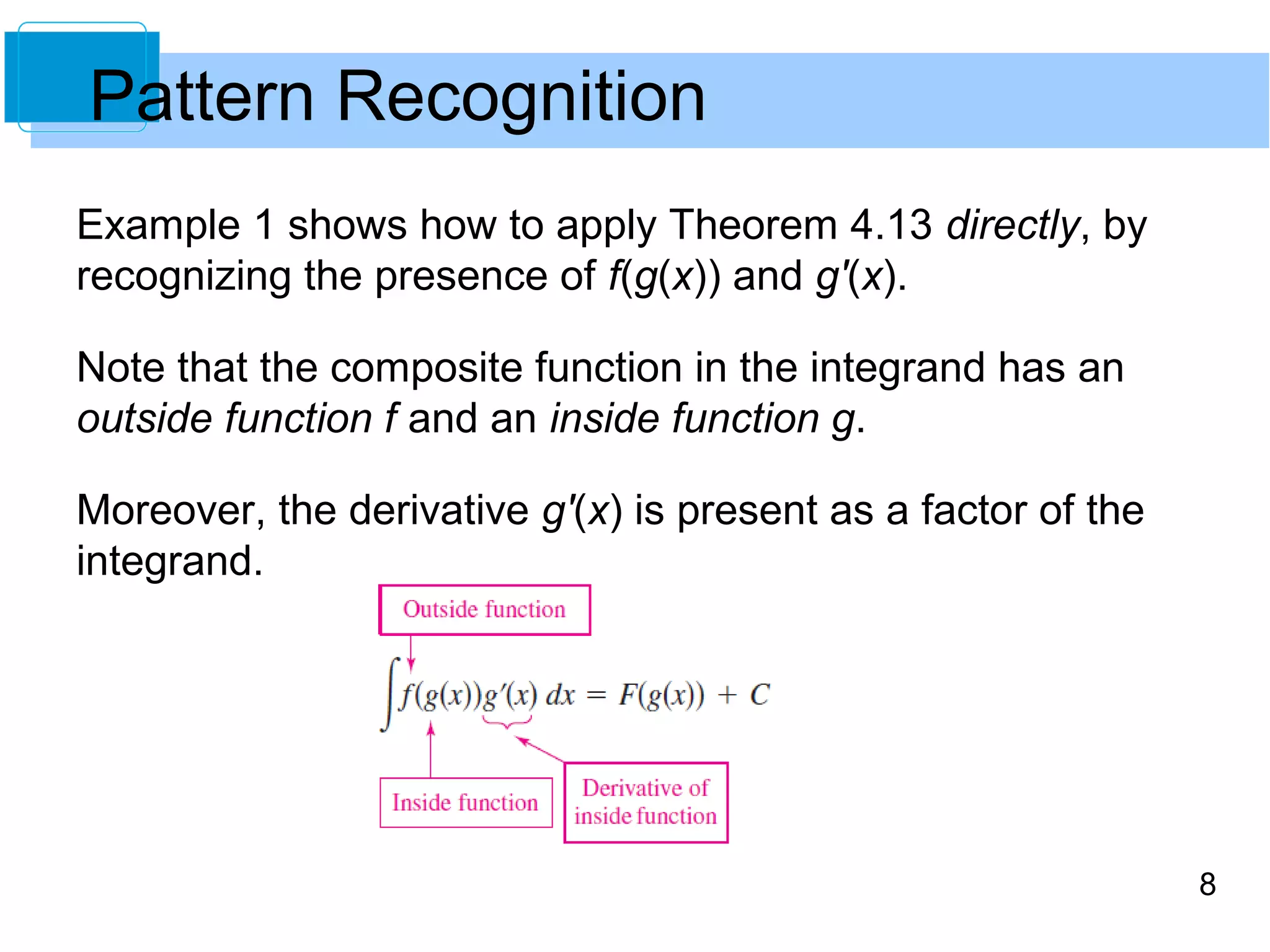
Example 1 shows how to apply Theorem 4.13 directly, by 
recognizing the presence of f(g(x)) and g'(x). 
Note that the composite function in the integrand has an 
outside function f and an inside function g. 
Moreover, the derivative g'(x) is present as a factor of the 
integrand.
9 
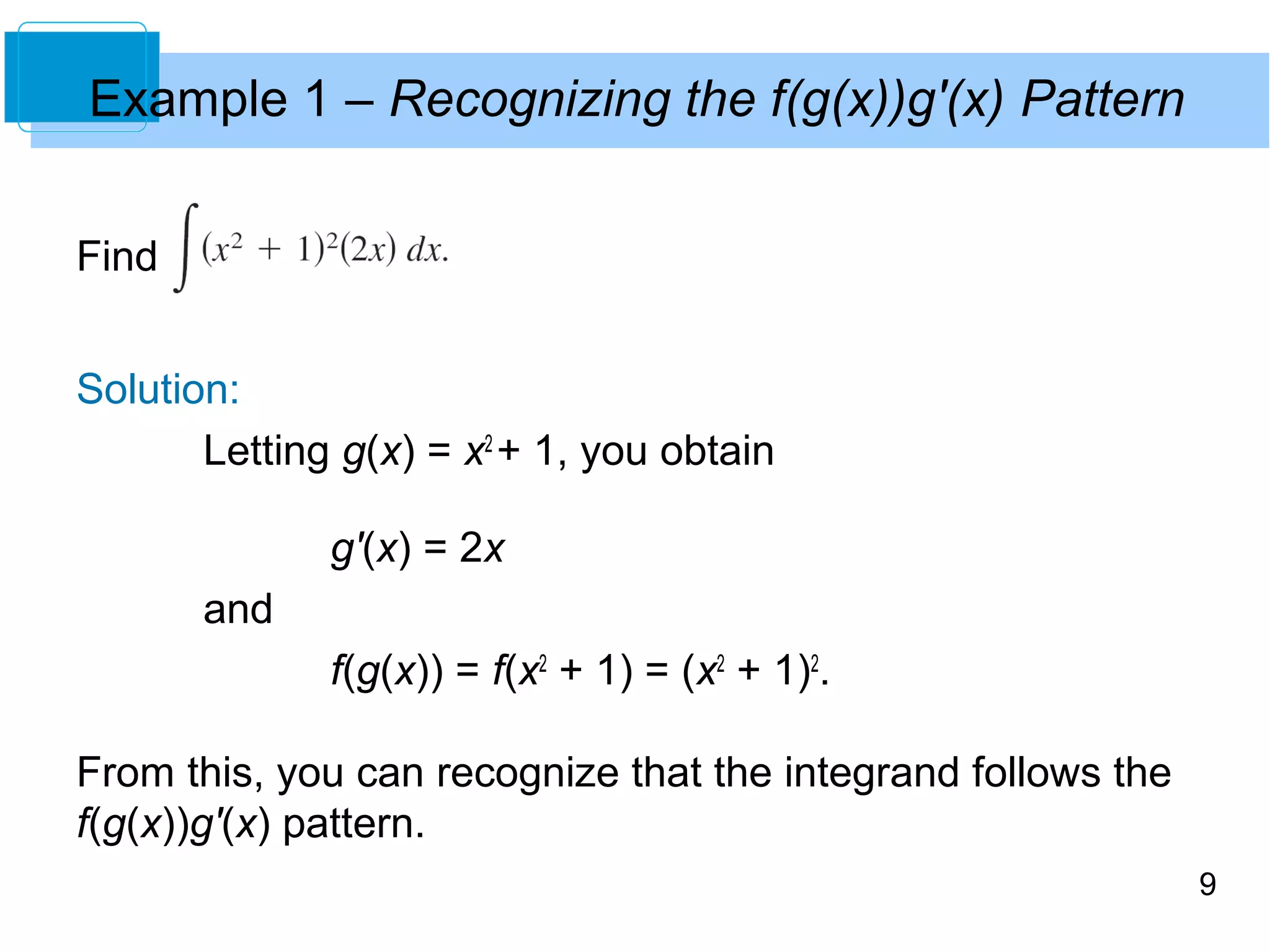
Example 1 – Recognizing the f(g(x))g'(x) Pattern 
Find 
Solution: 
Letting g(x) = x2 + 1, you obtain 
g'(x) = 2x 
and 
f(g(x)) = f(x2 + 1) = (x2 + 1)2. 
From this, you can recognize that the integrand follows the 
f(g(x))g'(x) pattern.
10 
Example 1 – Solution 
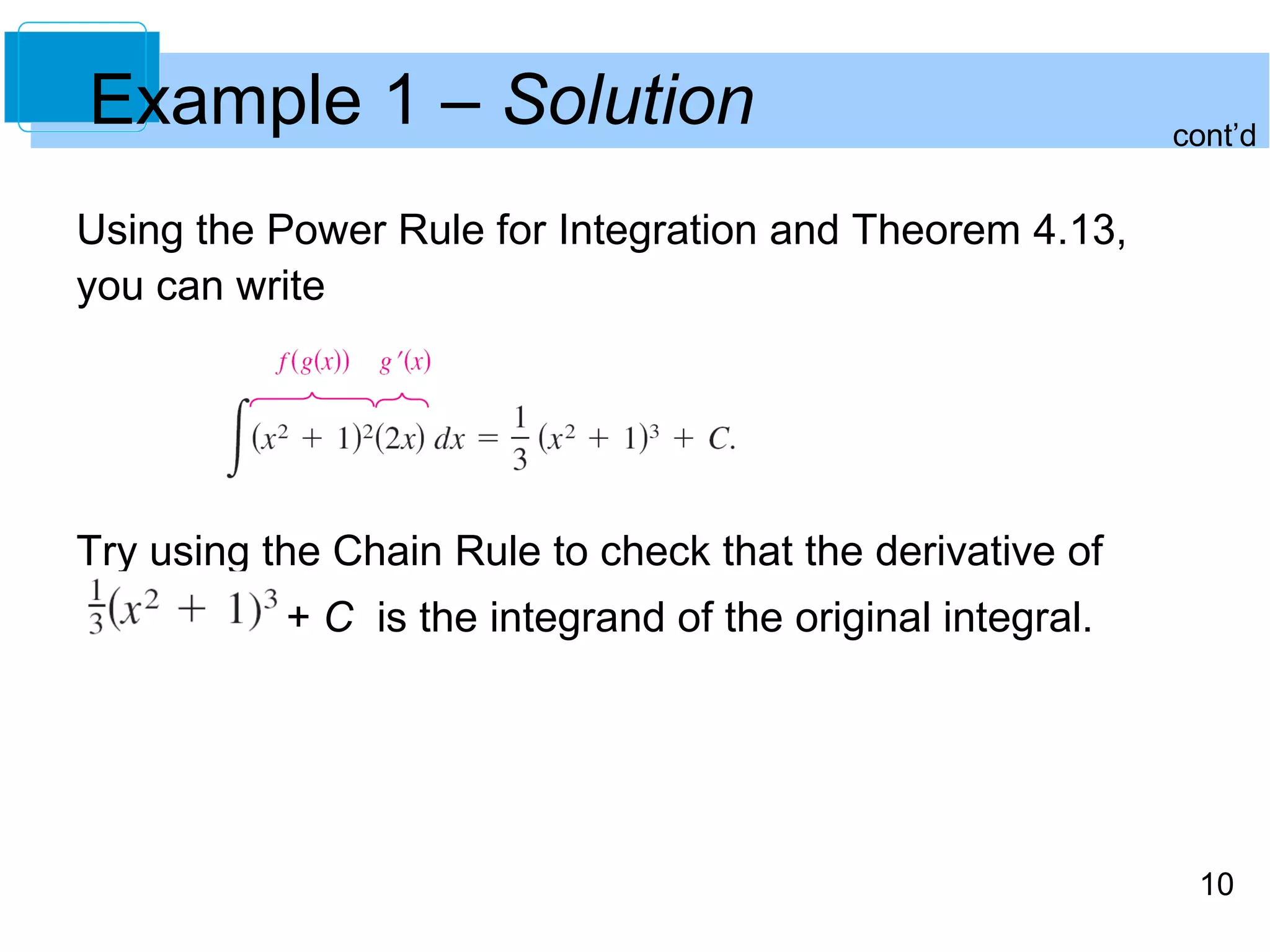
Using the Power Rule for Integration and Theorem 4.13, 
you can write 
Try using the Chain Rule to check that the derivative of 
+ C is the integrand of the original integral. 
cont’d
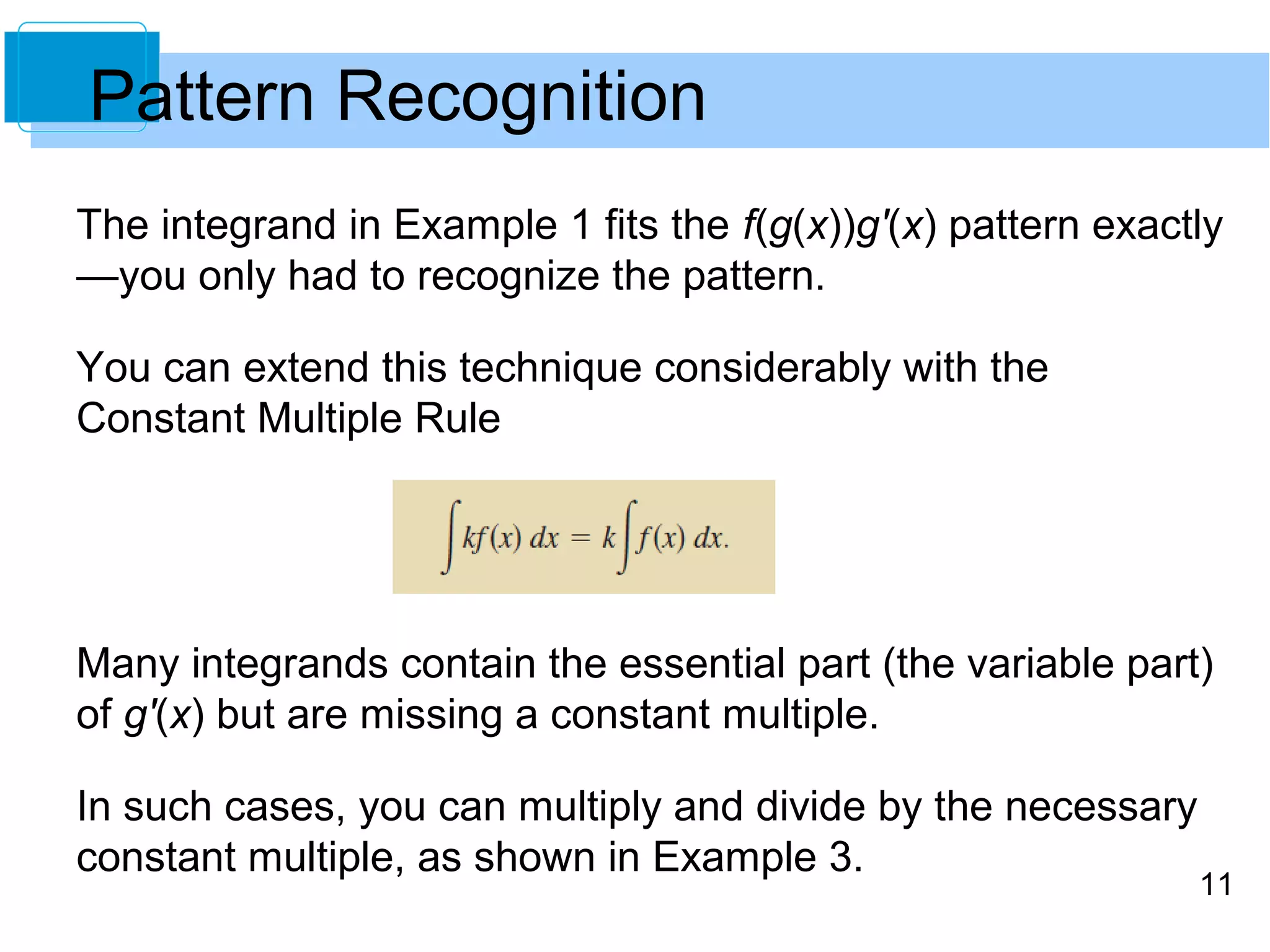
The integrand in Example 1 fits the f(g(x))g'(x) pattern exactly 
—you only had to recognize the pattern. 
You can extend this technique considerably with the 
Constant Multiple Rule 
Many integrands contain the essential part (the variable part) 
of g'(x) but are missing a constant multiple. 
In such cases, you can multiply and divide by the necessary 
constant multiple, as shown in Example 3. 
11 
Pattern Recognition
12 
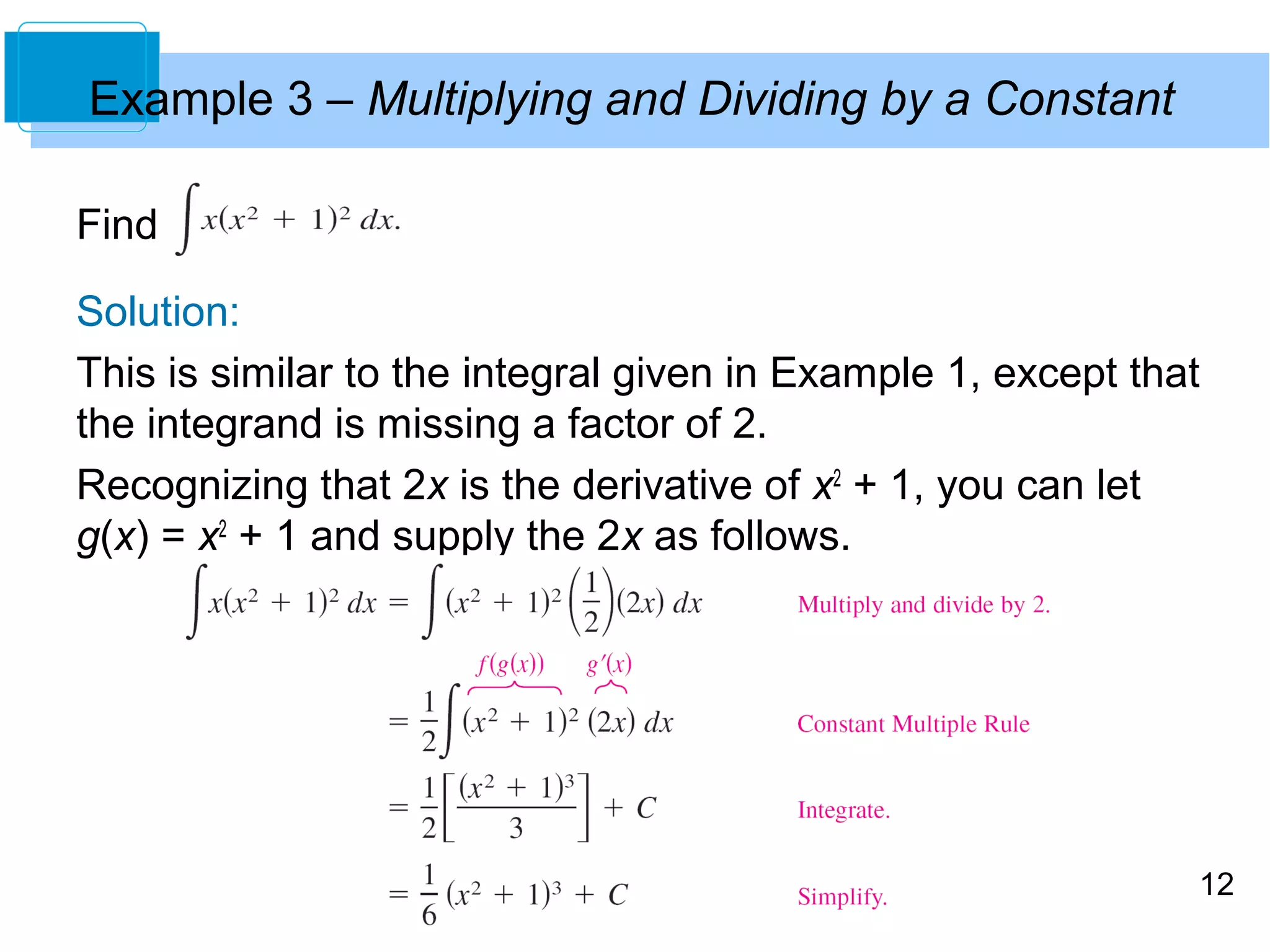
Example 3 – Multiplying and Dividing by a Constant 
Find 
Solution: 
This is similar to the integral given in Example 1, except that 
the integrand is missing a factor of 2. 
Recognizing that 2x is the derivative of x2 + 1, you can let 
g(x) = x2 + 1 and supply the 2x as follows.
13 
Change of Variables
Change of Variables 
With a formal change of variables, you completely rewrite 
the integral in terms of u and du (or any other convenient 
variable). 
Although this procedure can involve more written steps than 
the pattern recognition illustrated in Examples 1 and 3, it is 
useful for complicated integrands. 
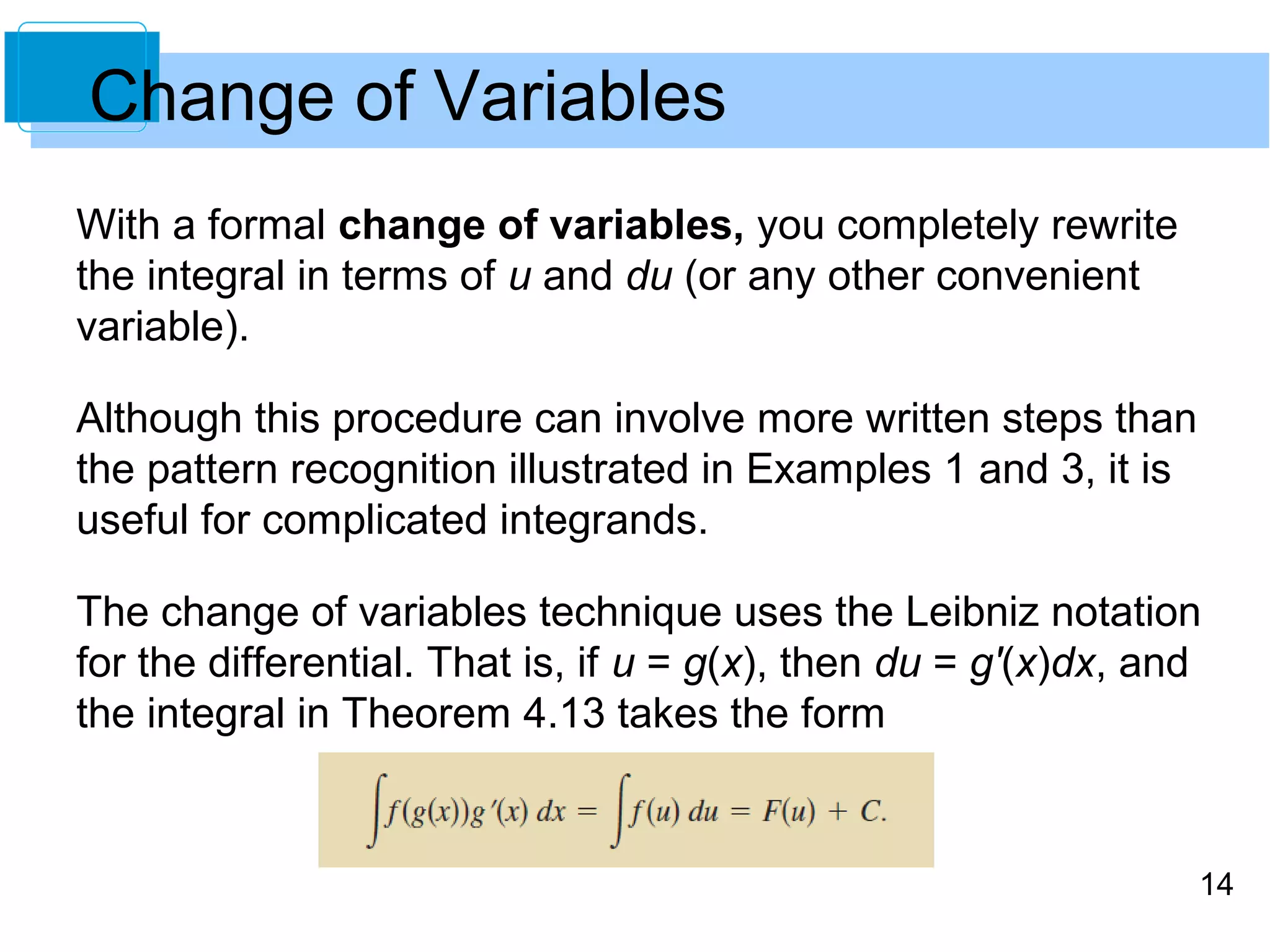
The change of variables technique uses the Leibniz notation 
for the differential. That is, if u = g(x), then du = g'(x)dx, and 
the integral in Theorem 4.13 takes the form 
14
15 
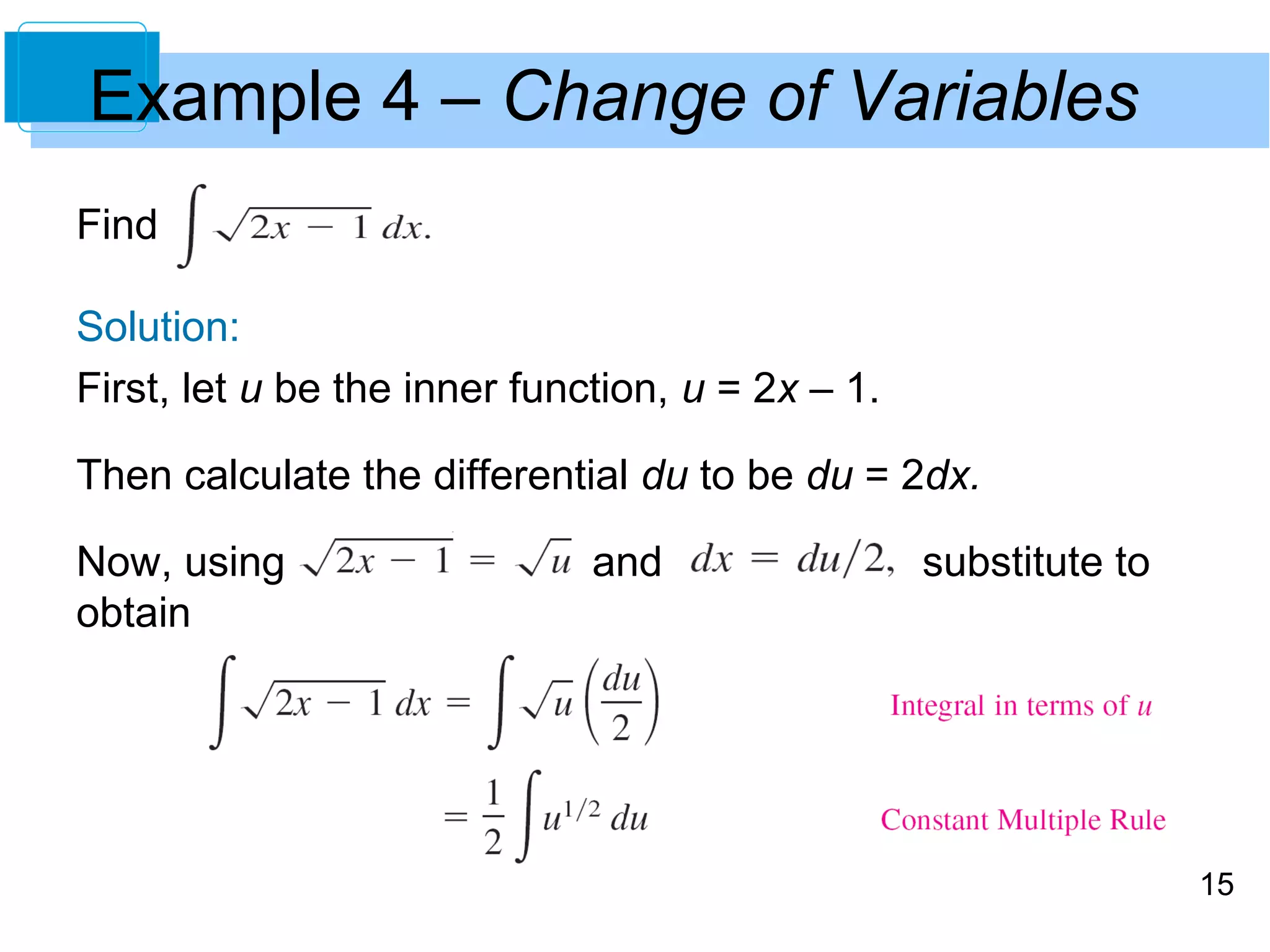
Example 4 – Change of Variables 
Find 
Solution: 
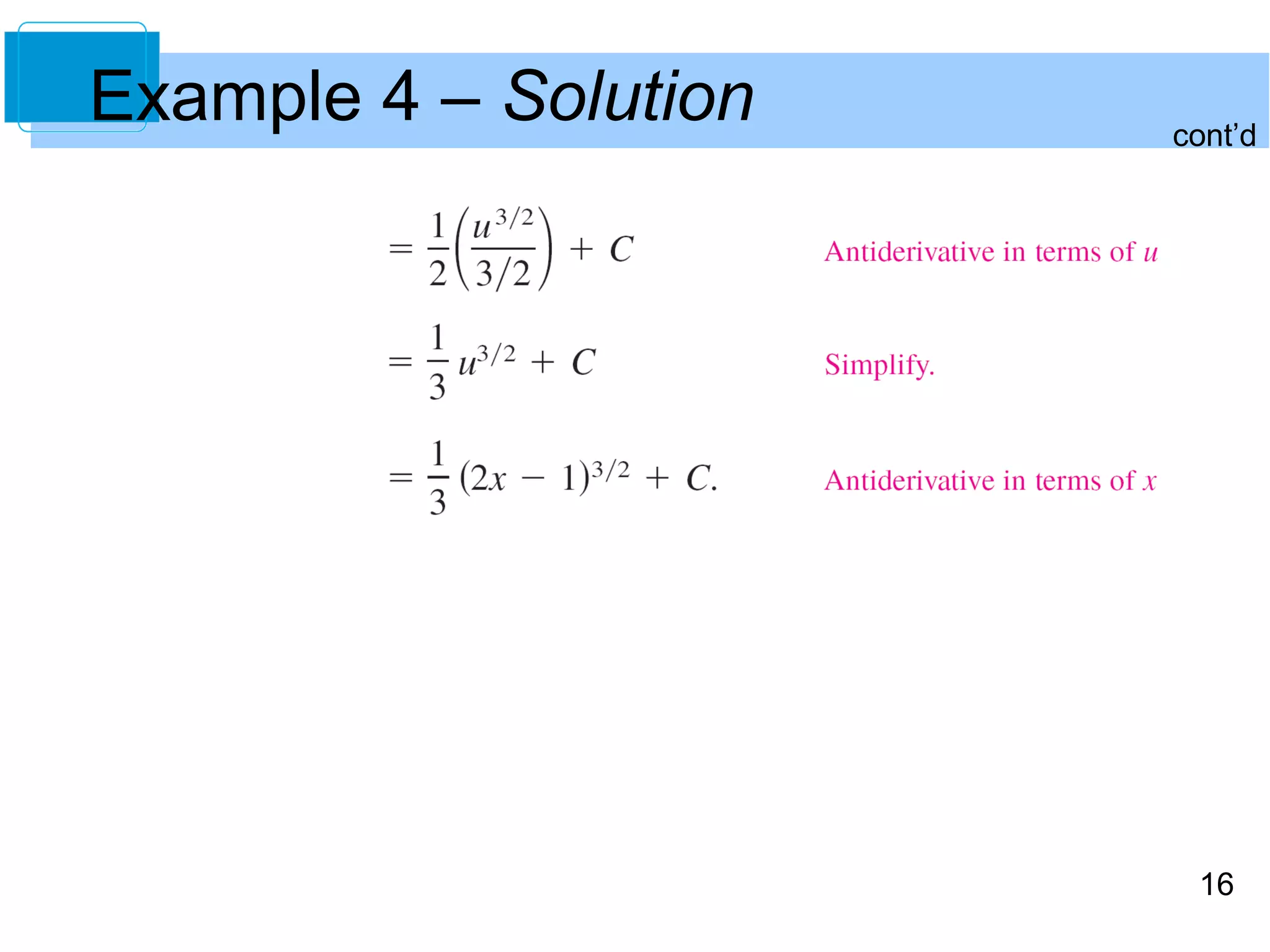
First, let u be the inner function, u = 2x – 1. 
Then calculate the differential du to be du = 2dx. 
Now, using and substitute to 
obtain
Example 4 – Solution cont’d 
16
17 
Change of Variables 
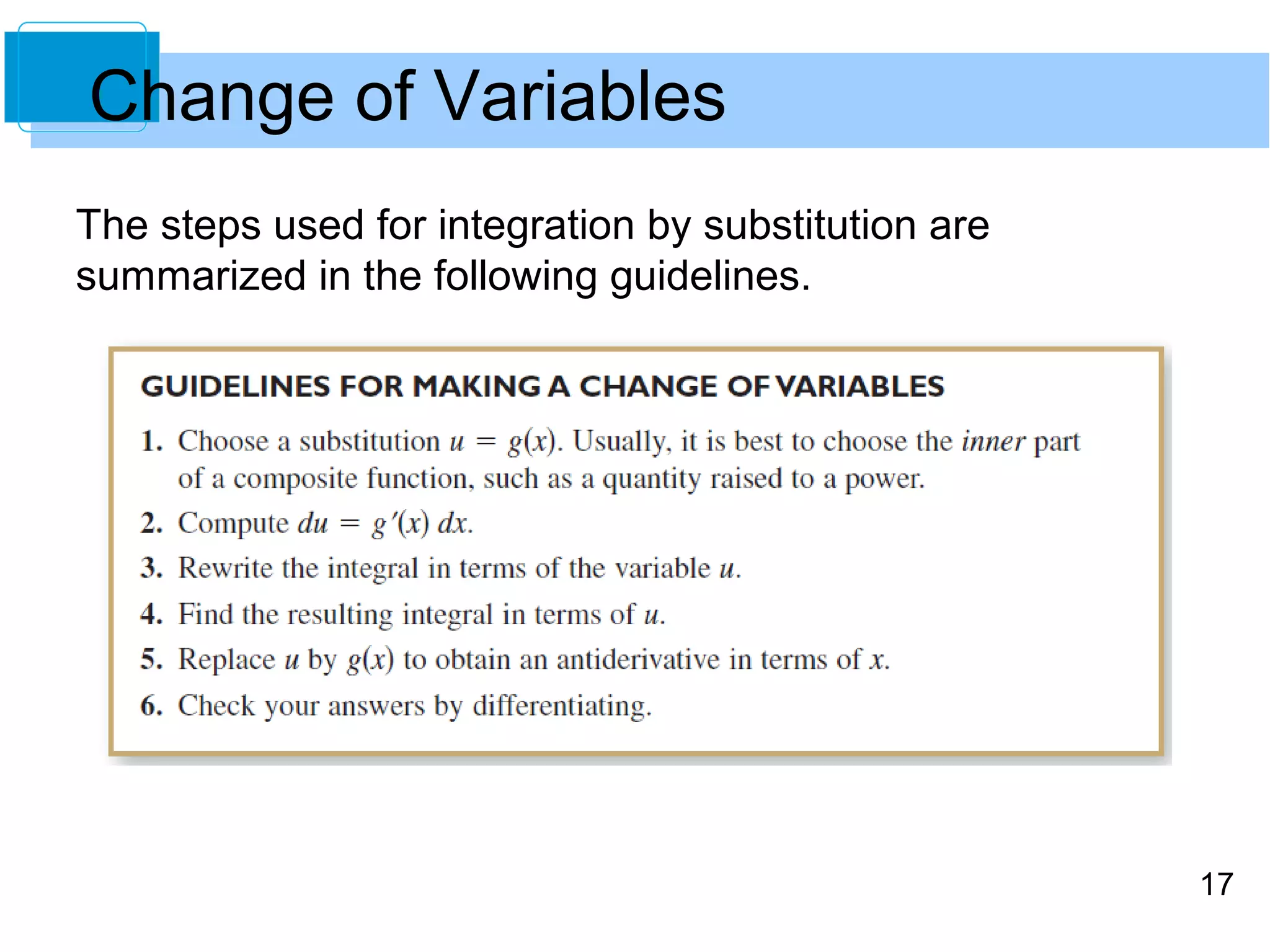
The steps used for integration by substitution are 
summarized in the following guidelines.
18 
The General Power Rule for 
Integration
19 
The General Power Rule for Integration 
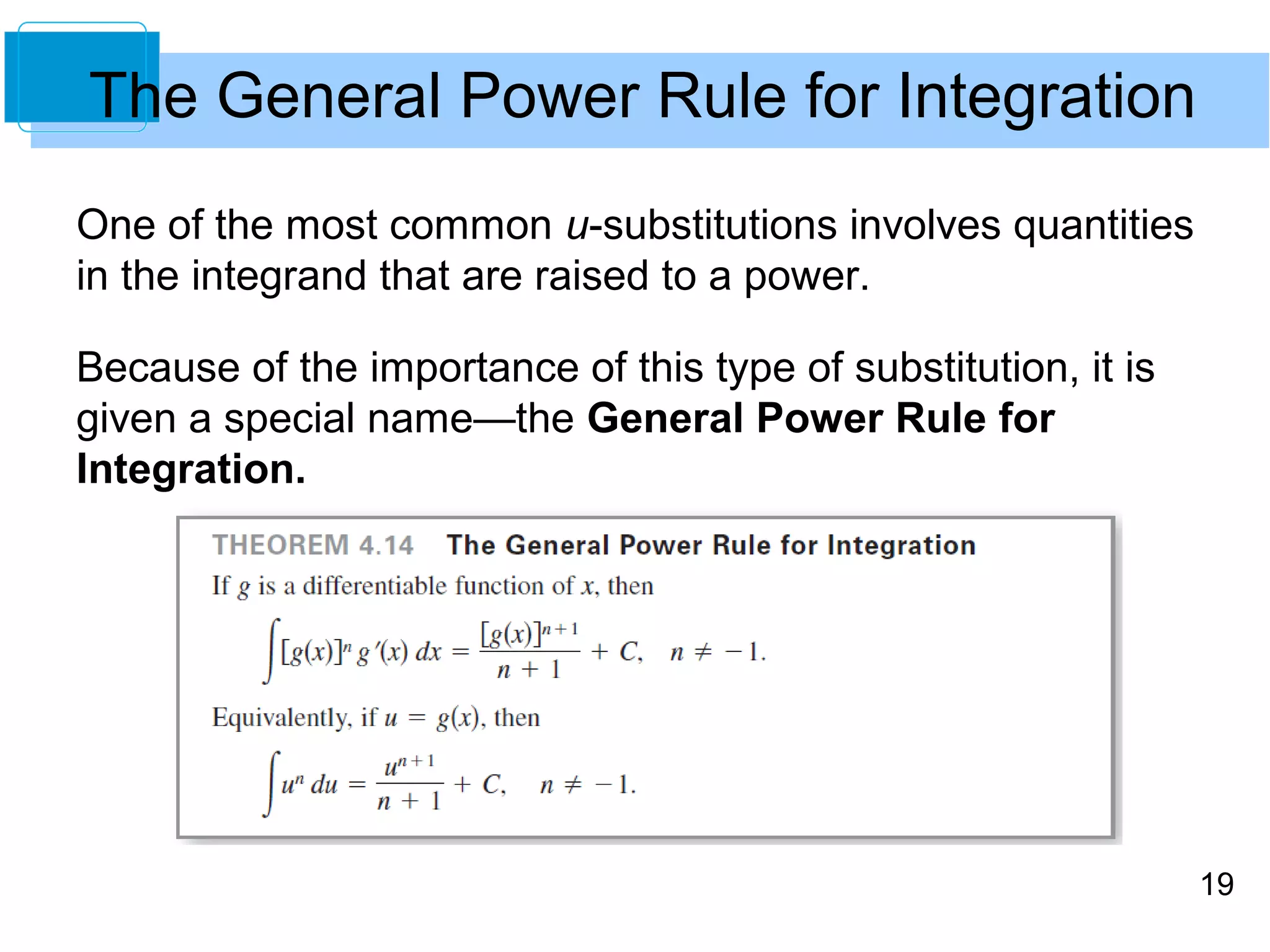
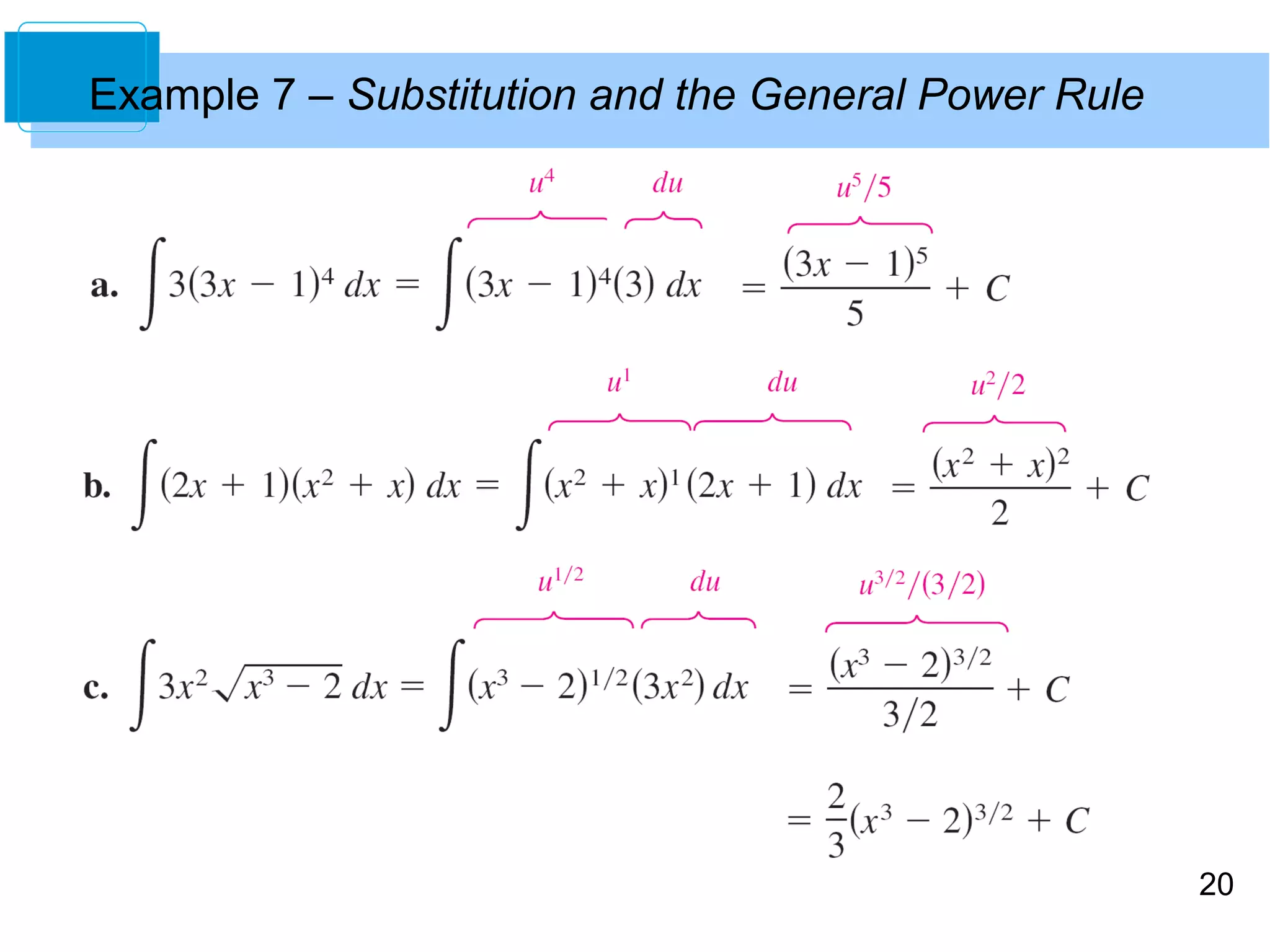
One of the most common u-substitutions involves quantities 
in the integrand that are raised to a power. 
Because of the importance of this type of substitution, it is 
given a special name—the General Power Rule for 
Integration.
20 
Example 7 – Substitution and the General Power Rule
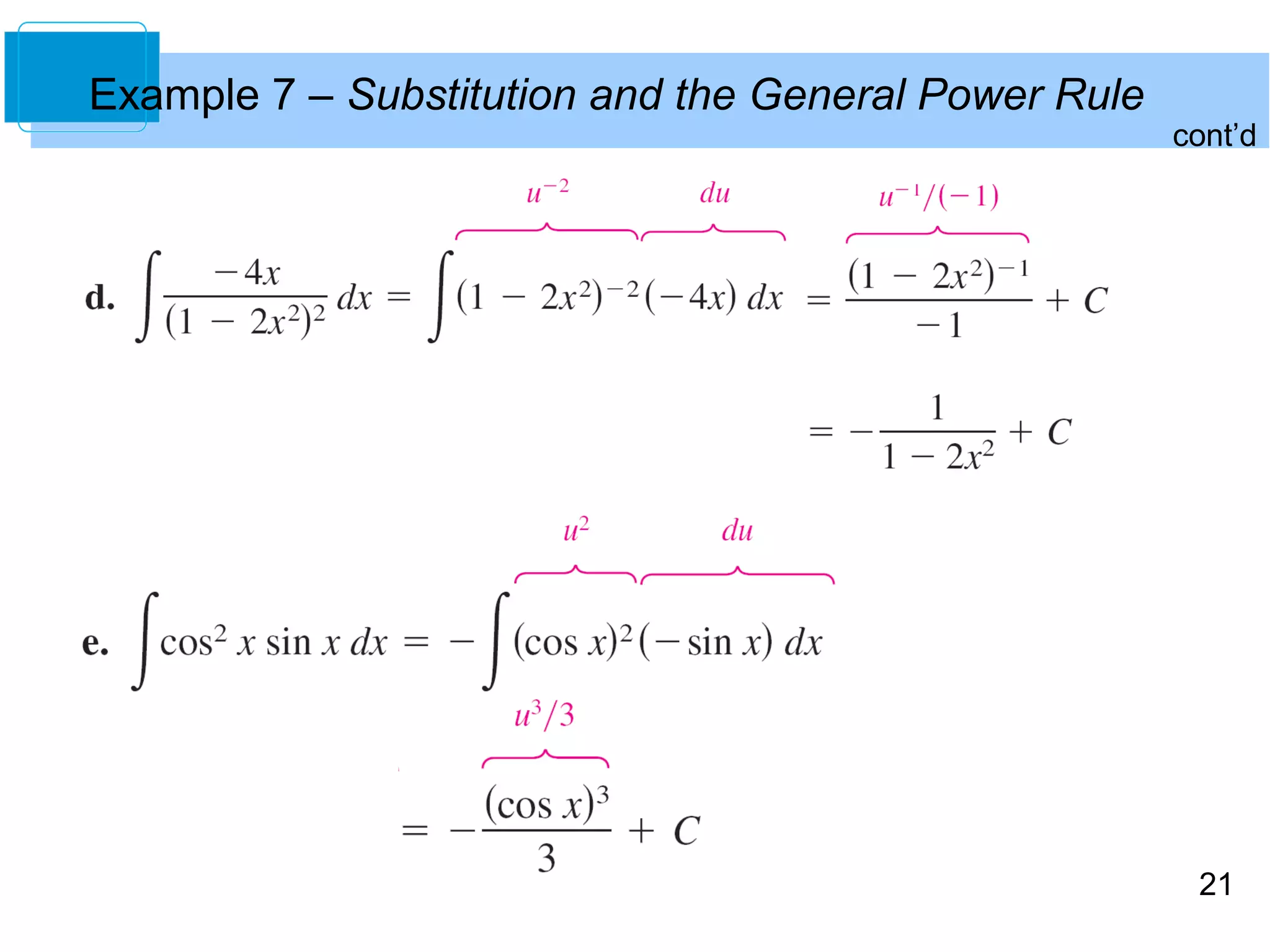
cont’d 
21 
Example 7 – Substitution and the General Power Rule
22 
Change of Variables for Definite 
Integrals
23 
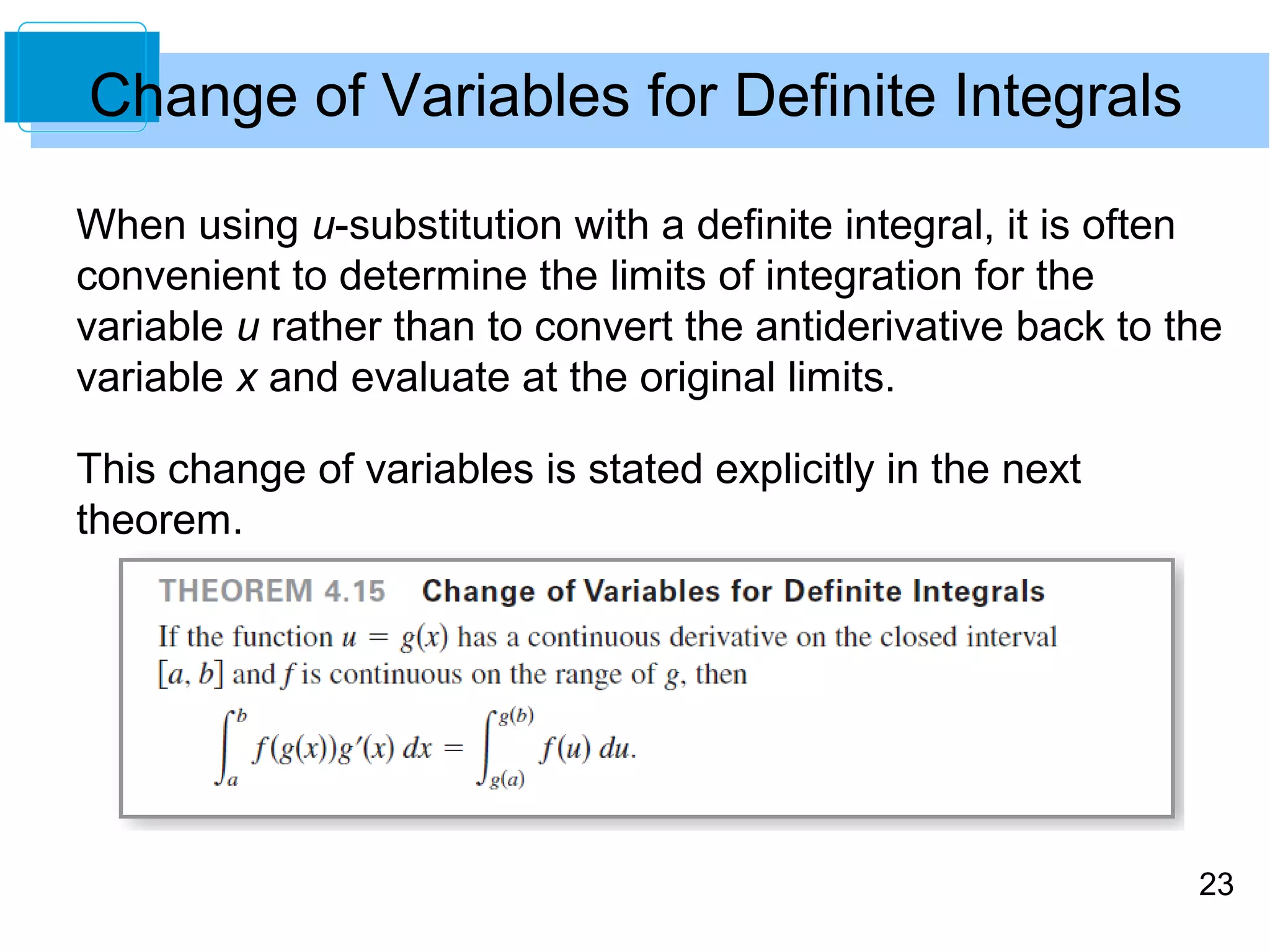
Change of Variables for Definite Integrals 
When using u-substitution with a definite integral, it is often 
convenient to determine the limits of integration for the 
variable u rather than to convert the antiderivative back to the 
variable x and evaluate at the original limits. 
This change of variables is stated explicitly in the next 
theorem.
24 
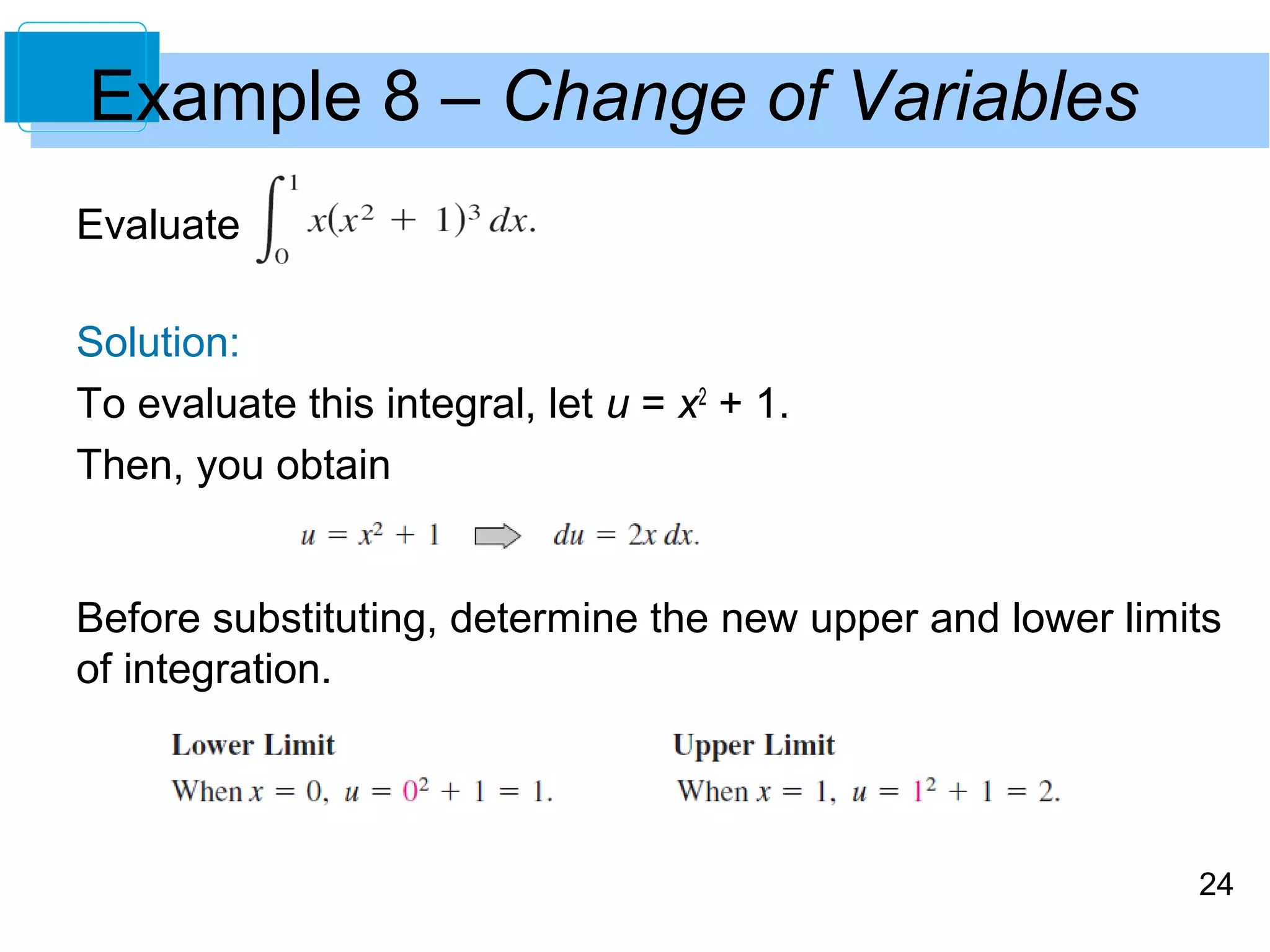
Example 8 – Change of Variables 
Evaluate 
Solution: 
To evaluate this integral, let u = x2 + 1. 
Then, you obtain 
Before substituting, determine the new upper and lower limits 
of integration.
25 
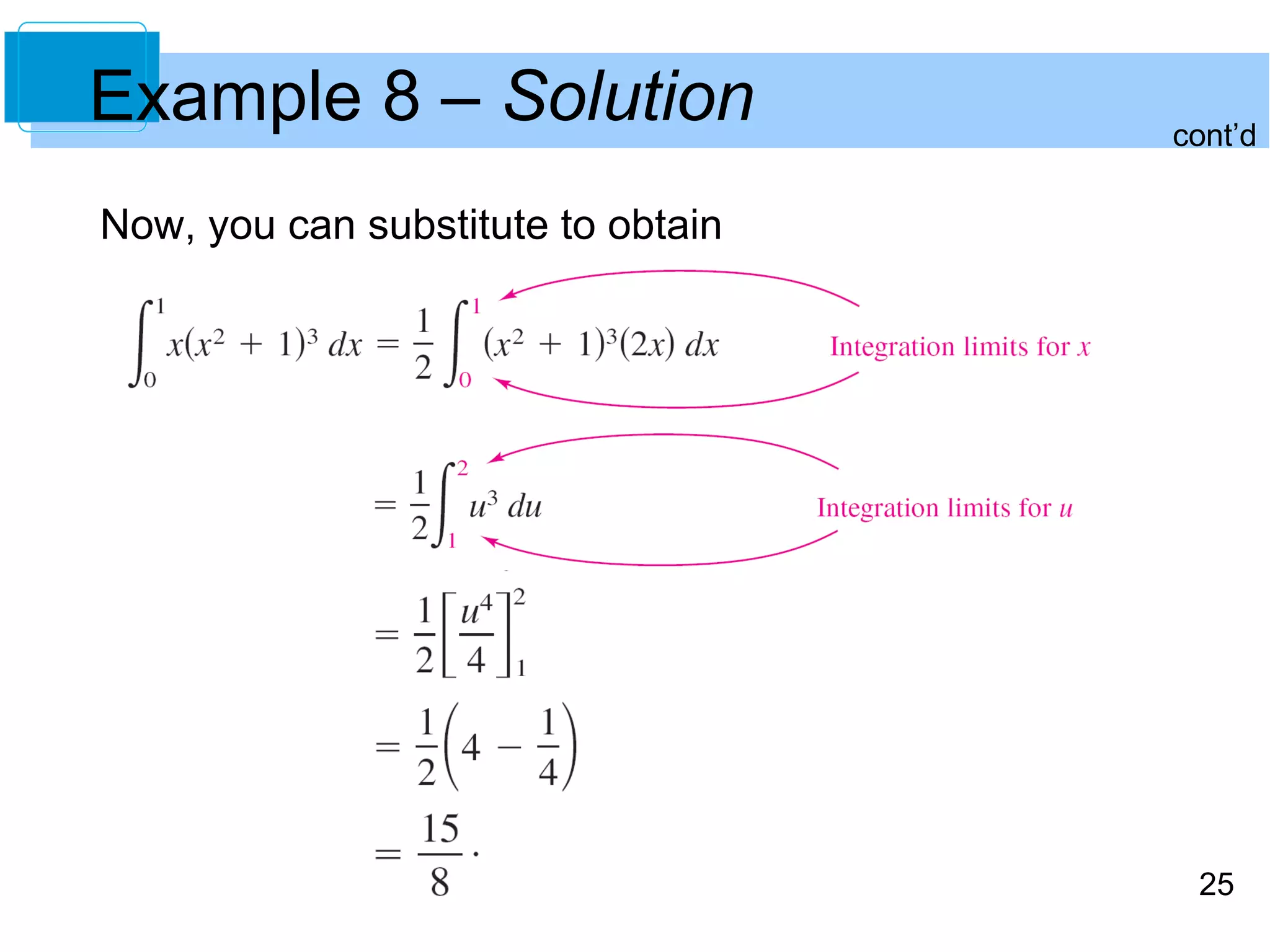
Example 8 – Solution 
Now, you can substitute to obtain 
cont’d
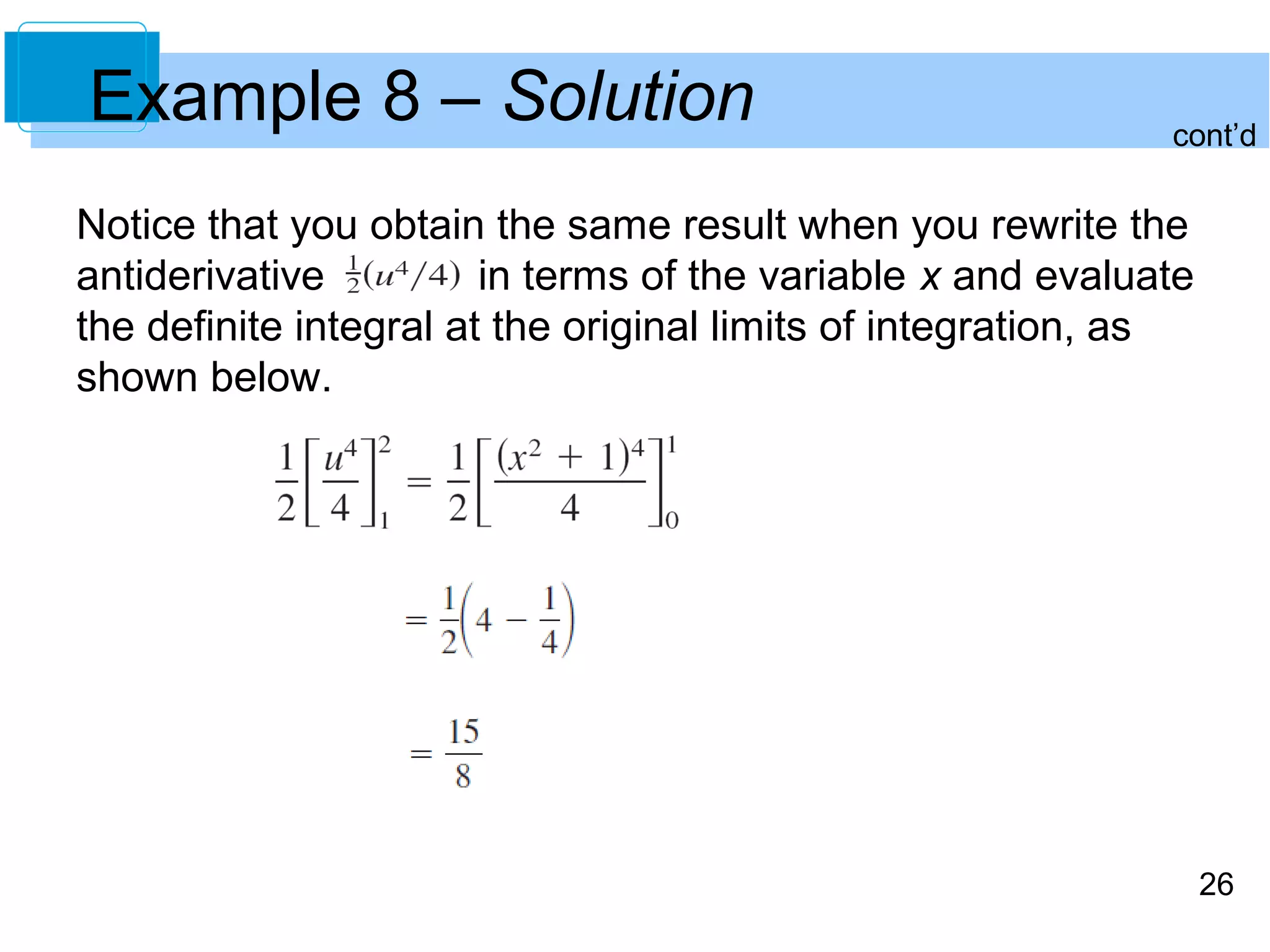
Example 8 – Solution cont’d 
26 
Notice that you obtain the same result when you rewrite the 
antiderivative in terms of the variable x and evaluate 
the definite integral at the original limits of integration, as 
shown below.
27 
Integration of Even and Odd 
Functions
Integration of Even and Odd Functions 
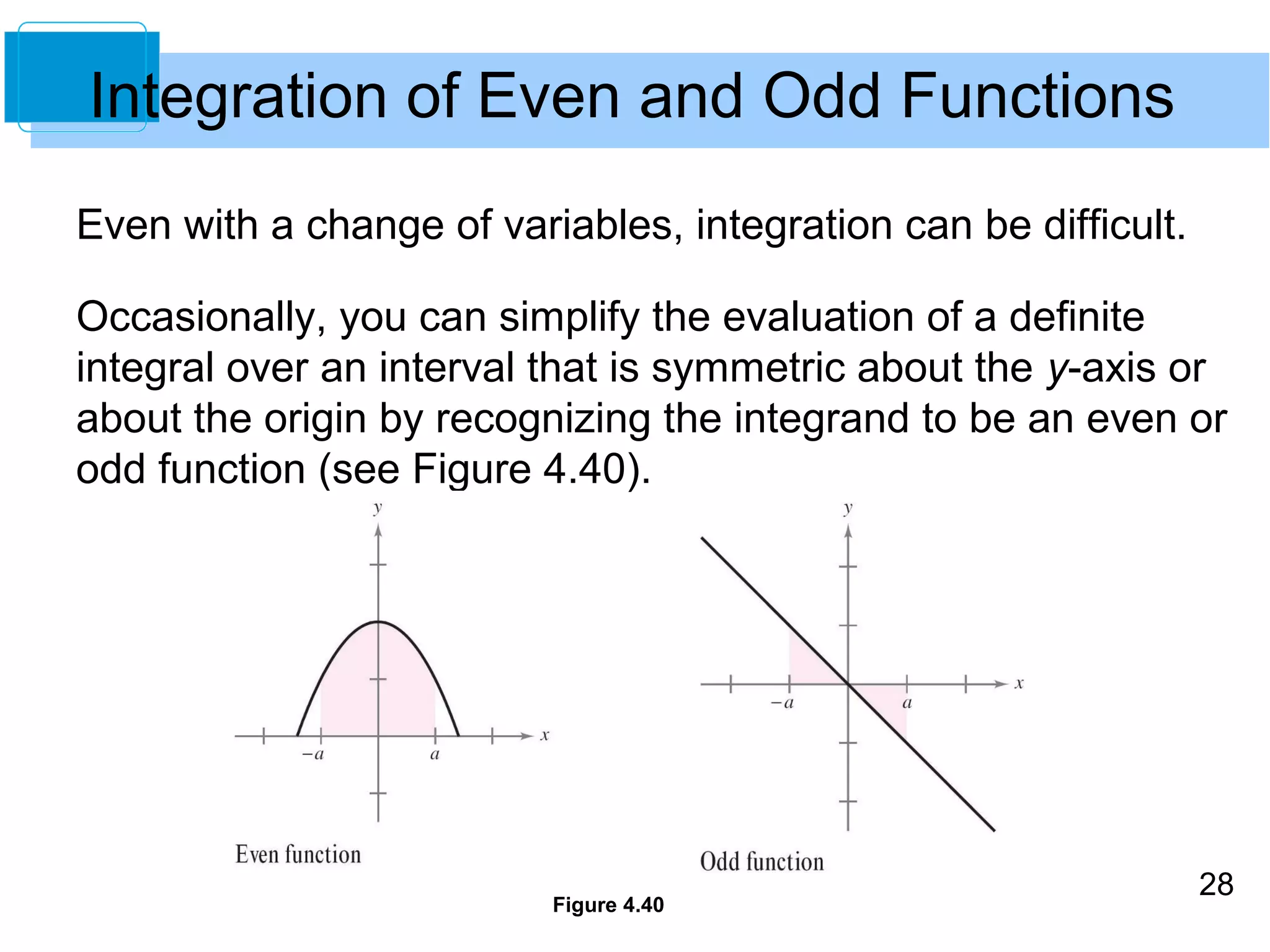
Even with a change of variables, integration can be difficult. 
Occasionally, you can simplify the evaluation of a definite 
integral over an interval that is symmetric about the y-axis or 
about the origin by recognizing the integrand to be an even or 
odd function (see Figure 4.40). 
28 
Figure 4.40
29 
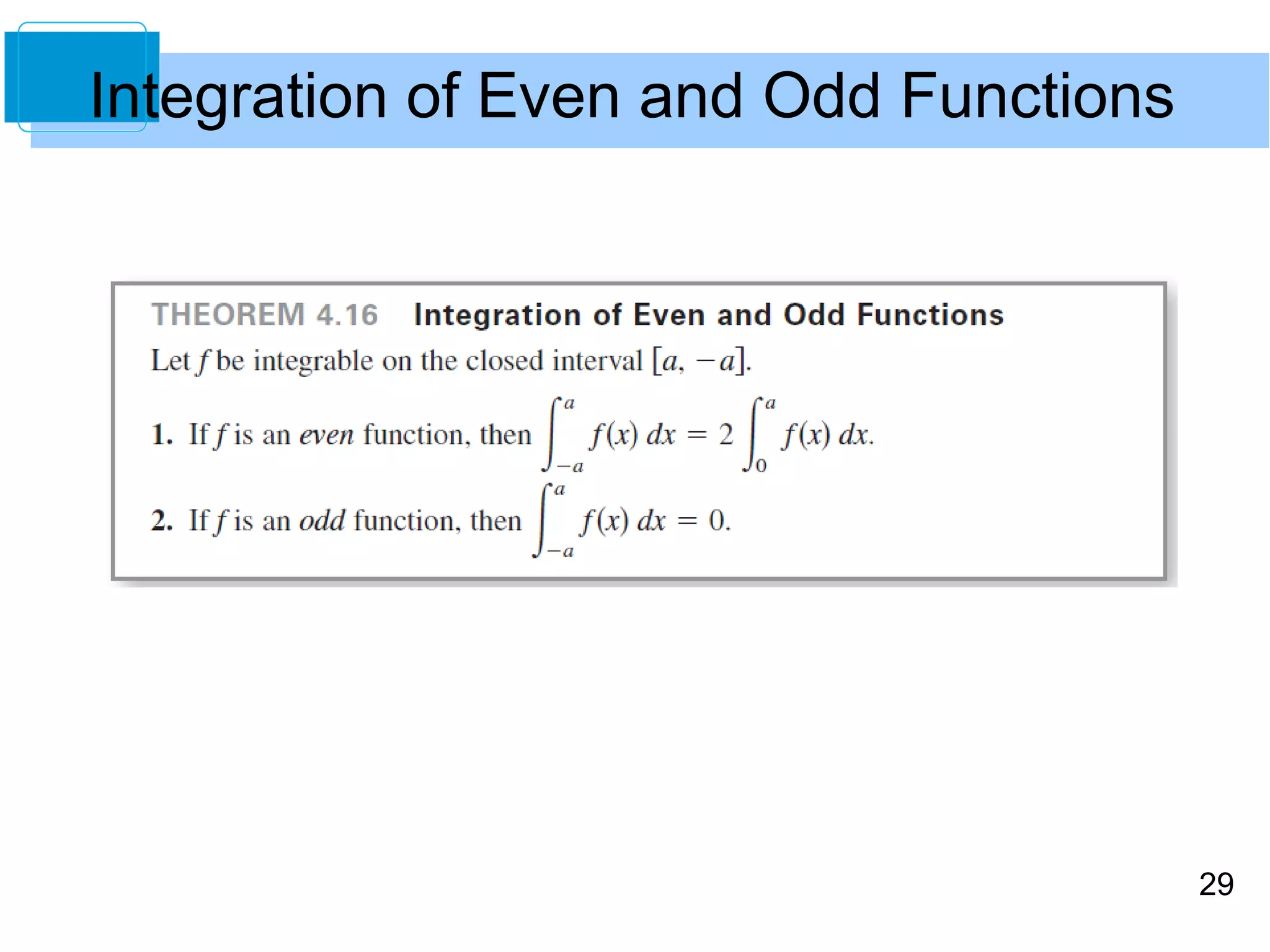
Integration of Even and Odd Functions
30 
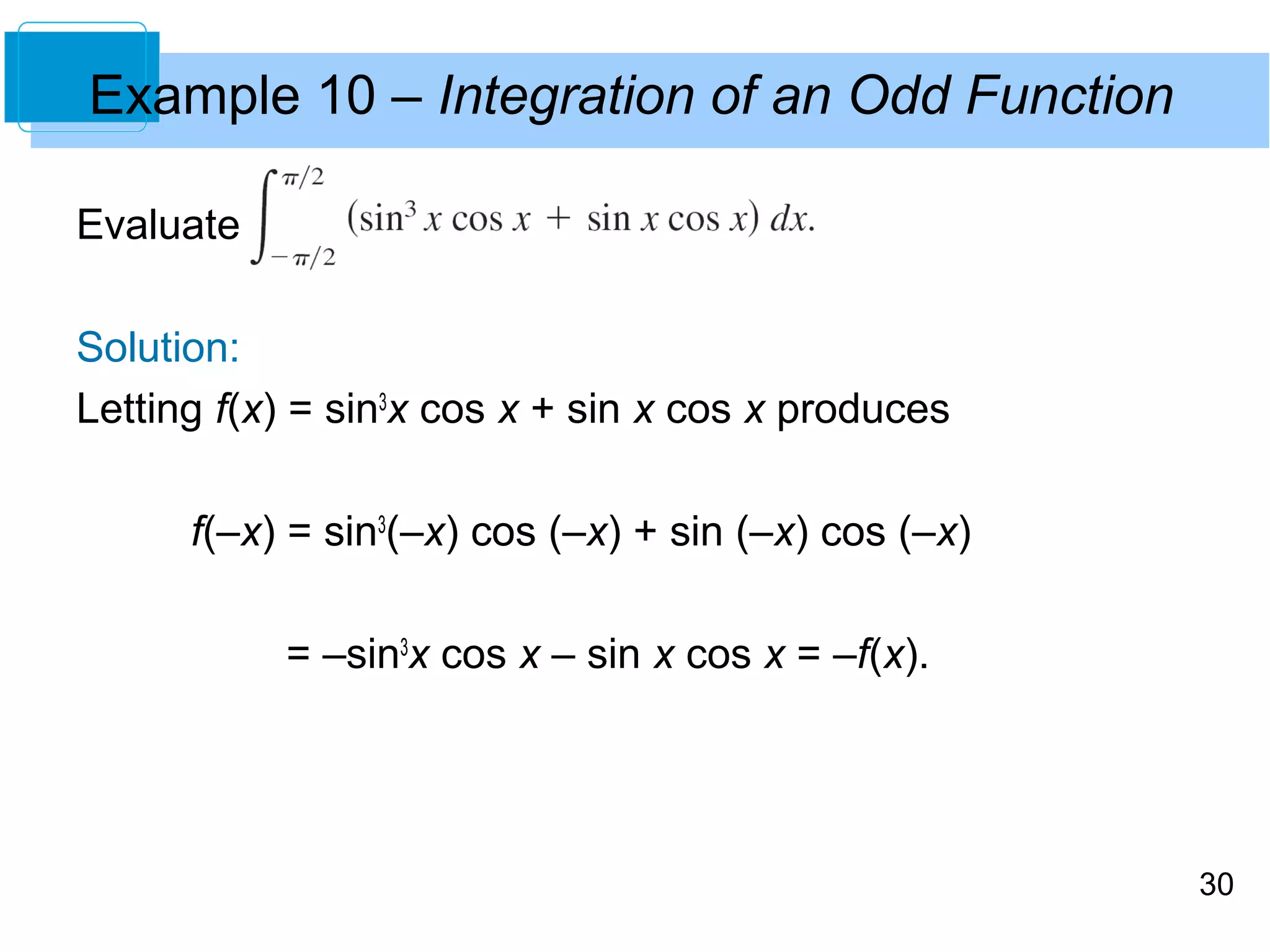
Example 10 – Integration of an Odd Function 
Evaluate 
Solution: 
Letting f(x) = sin3x cos x + sin x cos x produces 
f(–x) = sin3(–x) cos (–x) + sin (–x) cos (–x) 
= –sin3x cos x – sin x cos x = –f(x).
31 
Example 10 – Solution 
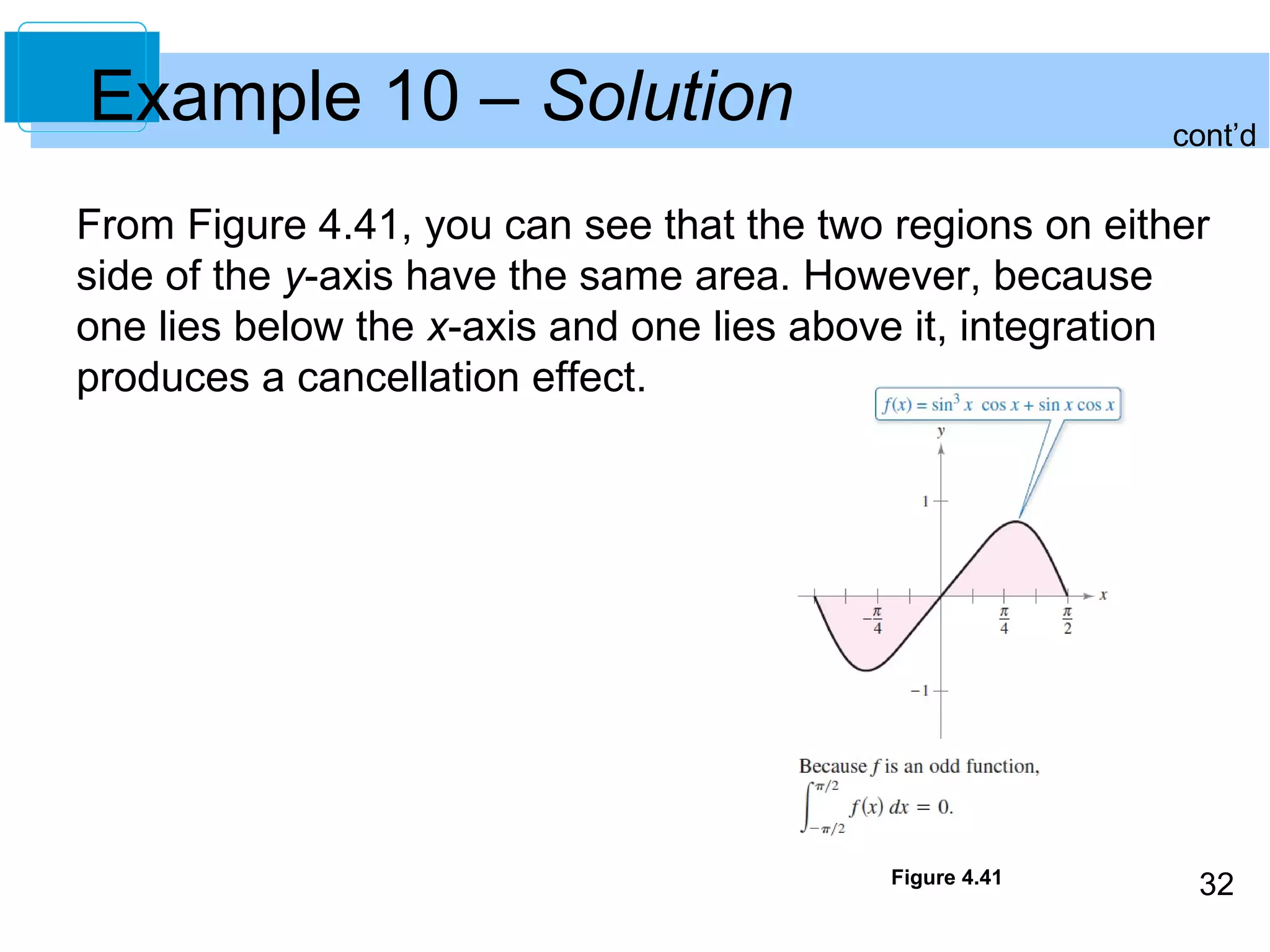
So, f is an odd function, and because f is symmetric about 
the origin over [–π/2, π/2], you can apply Theorem 4.16 to 
conclude that 
Figure 4.41 
cont’d
Example 10 – Solution 
From Figure 4.41, you can see that the two regions on either 
side of the y-axis have the same area. However, because 
one lies below the x-axis and one lies above it, integration 
produces a cancellation effect. 
32 
Figure 4.41 
cont’d

Lar calc10 ch04_sec5

  • 1.
    Integration Copyright ©Cengage Learning. All rights reserved.
  • 2.
    Integration by Substitution Copyright © Cengage Learning. All rights reserved. 4.5
  • 3.
    3 Objectives Use pattern recognition to find an indefinite integral.  Use a change of variables to find an indefinite integral.  Use the General Power Rule for Integration to find an indefinite integral.  Use a change of variables to evaluate a definite integral.  Evaluate a definite integral involving an even or odd function.
  • 4.
  • 5.
    5 Pattern Recognition In this section you will study techniques for integrating composite functions. The discussion is split into two parts—pattern recognition and change of variables. Both techniques involve a u-substitution. With pattern recognition, you perform the substitution mentally, and with change of variables, you write the substitution steps. The role of substitution in integration is comparable to the role of the Chain Rule in differentiation.
  • 6.
    6 Pattern Recognition Recall that for differentiable functions given by y = F(u) and u = g(x), the Chain Rule states that From the definition of an antiderivative, it follows that
  • 7.
    7 Pattern Recognition These results are summarized in the following theorem.
  • 8.
    8 Pattern Recognition Example 1 shows how to apply Theorem 4.13 directly, by recognizing the presence of f(g(x)) and g'(x). Note that the composite function in the integrand has an outside function f and an inside function g. Moreover, the derivative g'(x) is present as a factor of the integrand.
  • 9.
    9 Example 1– Recognizing the f(g(x))g'(x) Pattern Find Solution: Letting g(x) = x2 + 1, you obtain g'(x) = 2x and f(g(x)) = f(x2 + 1) = (x2 + 1)2. From this, you can recognize that the integrand follows the f(g(x))g'(x) pattern.
  • 10.
    10 Example 1– Solution Using the Power Rule for Integration and Theorem 4.13, you can write Try using the Chain Rule to check that the derivative of + C is the integrand of the original integral. cont’d
  • 11.
    The integrand inExample 1 fits the f(g(x))g'(x) pattern exactly —you only had to recognize the pattern. You can extend this technique considerably with the Constant Multiple Rule Many integrands contain the essential part (the variable part) of g'(x) but are missing a constant multiple. In such cases, you can multiply and divide by the necessary constant multiple, as shown in Example 3. 11 Pattern Recognition
  • 12.
    12 Example 3– Multiplying and Dividing by a Constant Find Solution: This is similar to the integral given in Example 1, except that the integrand is missing a factor of 2. Recognizing that 2x is the derivative of x2 + 1, you can let g(x) = x2 + 1 and supply the 2x as follows.
  • 13.
    13 Change ofVariables
  • 14.
    Change of Variables With a formal change of variables, you completely rewrite the integral in terms of u and du (or any other convenient variable). Although this procedure can involve more written steps than the pattern recognition illustrated in Examples 1 and 3, it is useful for complicated integrands. The change of variables technique uses the Leibniz notation for the differential. That is, if u = g(x), then du = g'(x)dx, and the integral in Theorem 4.13 takes the form 14
  • 15.
    15 Example 4– Change of Variables Find Solution: First, let u be the inner function, u = 2x – 1. Then calculate the differential du to be du = 2dx. Now, using and substitute to obtain
  • 16.
    Example 4 –Solution cont’d 16
  • 17.
    17 Change ofVariables The steps used for integration by substitution are summarized in the following guidelines.
  • 18.
    18 The GeneralPower Rule for Integration
  • 19.
    19 The GeneralPower Rule for Integration One of the most common u-substitutions involves quantities in the integrand that are raised to a power. Because of the importance of this type of substitution, it is given a special name—the General Power Rule for Integration.
  • 20.
    20 Example 7– Substitution and the General Power Rule
  • 21.
    cont’d 21 Example7 – Substitution and the General Power Rule
  • 22.
    22 Change ofVariables for Definite Integrals
  • 23.
    23 Change ofVariables for Definite Integrals When using u-substitution with a definite integral, it is often convenient to determine the limits of integration for the variable u rather than to convert the antiderivative back to the variable x and evaluate at the original limits. This change of variables is stated explicitly in the next theorem.
  • 24.
    24 Example 8– Change of Variables Evaluate Solution: To evaluate this integral, let u = x2 + 1. Then, you obtain Before substituting, determine the new upper and lower limits of integration.
  • 25.
    25 Example 8– Solution Now, you can substitute to obtain cont’d
  • 26.
    Example 8 –Solution cont’d 26 Notice that you obtain the same result when you rewrite the antiderivative in terms of the variable x and evaluate the definite integral at the original limits of integration, as shown below.
  • 27.
    27 Integration ofEven and Odd Functions
  • 28.
    Integration of Evenand Odd Functions Even with a change of variables, integration can be difficult. Occasionally, you can simplify the evaluation of a definite integral over an interval that is symmetric about the y-axis or about the origin by recognizing the integrand to be an even or odd function (see Figure 4.40). 28 Figure 4.40
  • 29.
    29 Integration ofEven and Odd Functions
  • 30.
    30 Example 10– Integration of an Odd Function Evaluate Solution: Letting f(x) = sin3x cos x + sin x cos x produces f(–x) = sin3(–x) cos (–x) + sin (–x) cos (–x) = –sin3x cos x – sin x cos x = –f(x).
  • 31.
    31 Example 10– Solution So, f is an odd function, and because f is symmetric about the origin over [–π/2, π/2], you can apply Theorem 4.16 to conclude that Figure 4.41 cont’d
  • 32.
    Example 10 –Solution From Figure 4.41, you can see that the two regions on either side of the y-axis have the same area. However, because one lies below the x-axis and one lies above it, integration produces a cancellation effect. 32 Figure 4.41 cont’d