1. University of California, San Diego
2. Tsinghua University
An Algorithmic Framework of
Large-Scale Circuit Simulation Using
Exponential Integrators
Hao Zhuang1, Wenjian Yu2, Ilgweon Kang1, Xinan
Wang1, and Chung-Kuan Cheng1
2
Outline
• Motivation & Contributions
• Background of time-domain circuit
simulation
• Our algorithmic framework
• Exponential integrators
• Invert Krylov subspace method
• Experimental results
• Conclusions & future directions
Motivation
• SPICE
– critical to wide ranges of IC
• Modern IC
– billions of transistors
– complex interconnects
• Requirement:
– new structures e.g., FinFET, 3D
– strong coupled
– post-layout effects
– capability & accuracy
• Simulation runtime
– Long or ∞
3
From Dick Sites, “Datacenter
Computers modern challenges in CPU
design” Google Inc. 2015 & Intel i7
From Synopsys Inc. Issue 3, 2012
Technology Update FinFET: The Promises
and the Challenges
• Target of matrix factorization:
conductance matrix 𝐺 ONLY Less expensive
4
Contributions
• Exponential Integration
Stable, Explicit No Newton-Raphson
• Handling tasks (even when traditional schemes
FAIL)
• large-scale, strong coupled, post-layout
A promising framework
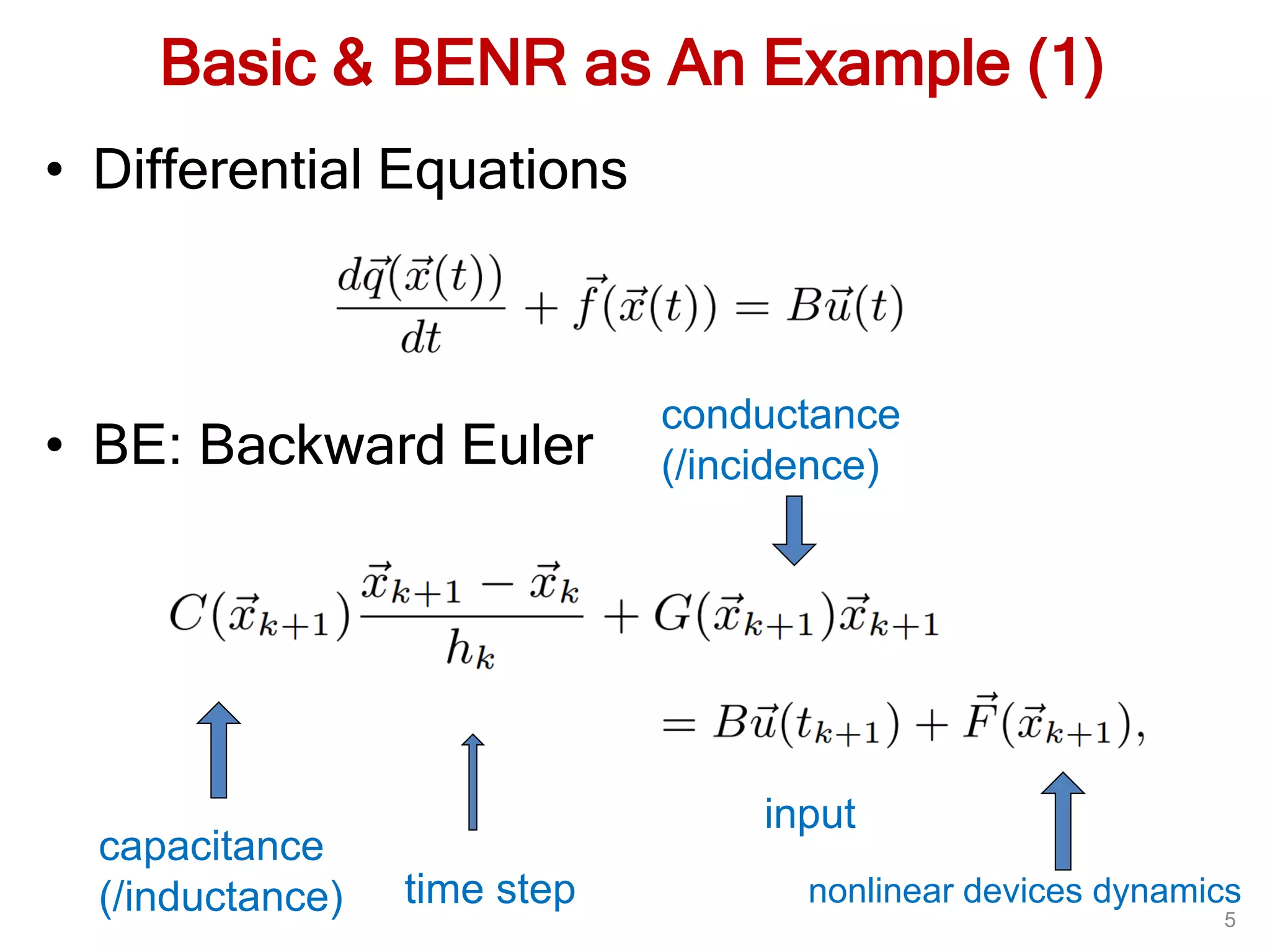
Basic & BENR as An Example (1)
• Differential Equations
• BE: Backward Euler
5
capacitance
(/inductance)
conductance
(/incidence)
time step
input
nonlinear devices dynamics
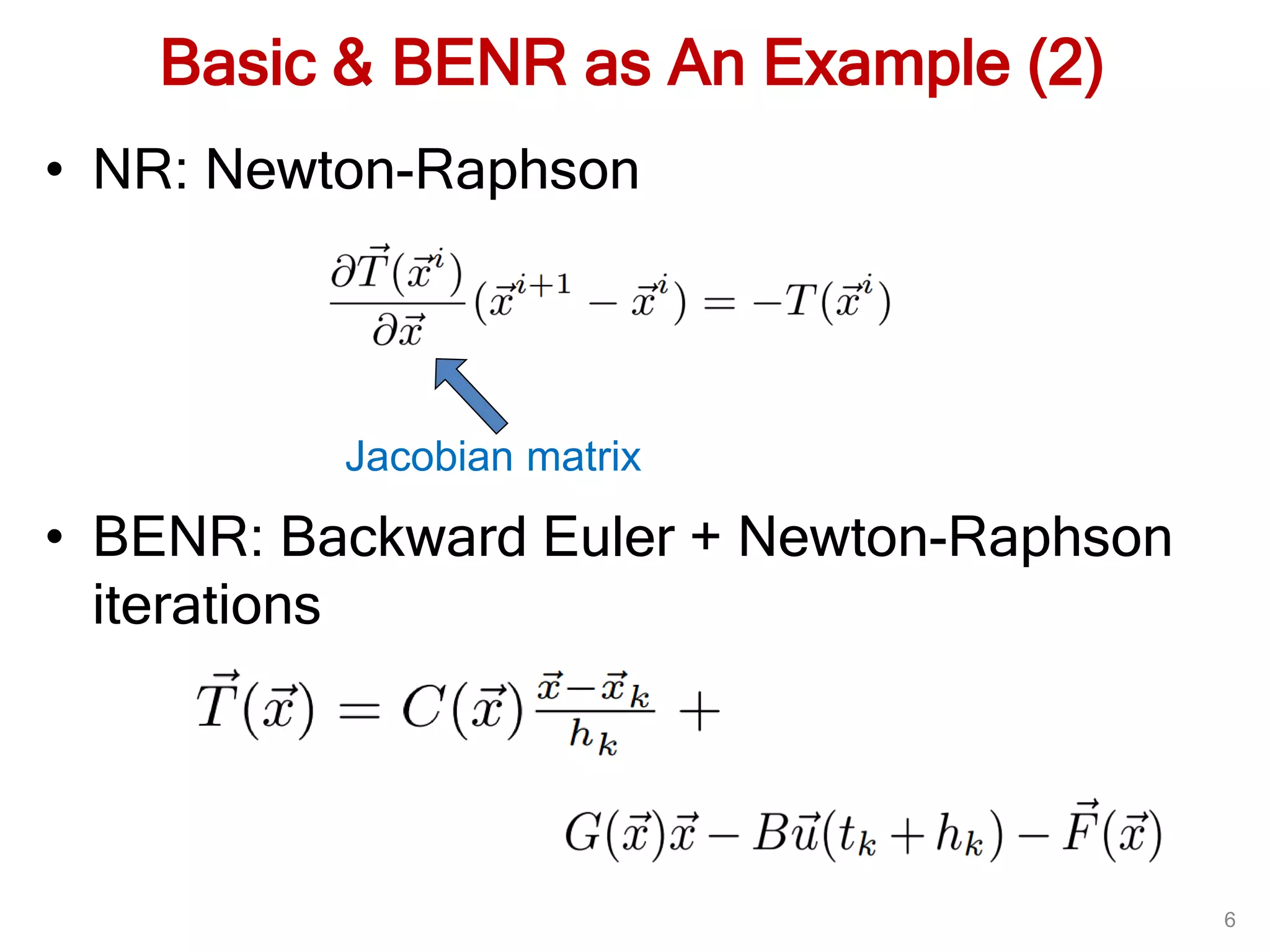
Basic & BENR as An Example (2)
• NR: Newton-Raphson
• BENR: Backward Euler + Newton-Raphson
iterations
6
Jacobian matrix
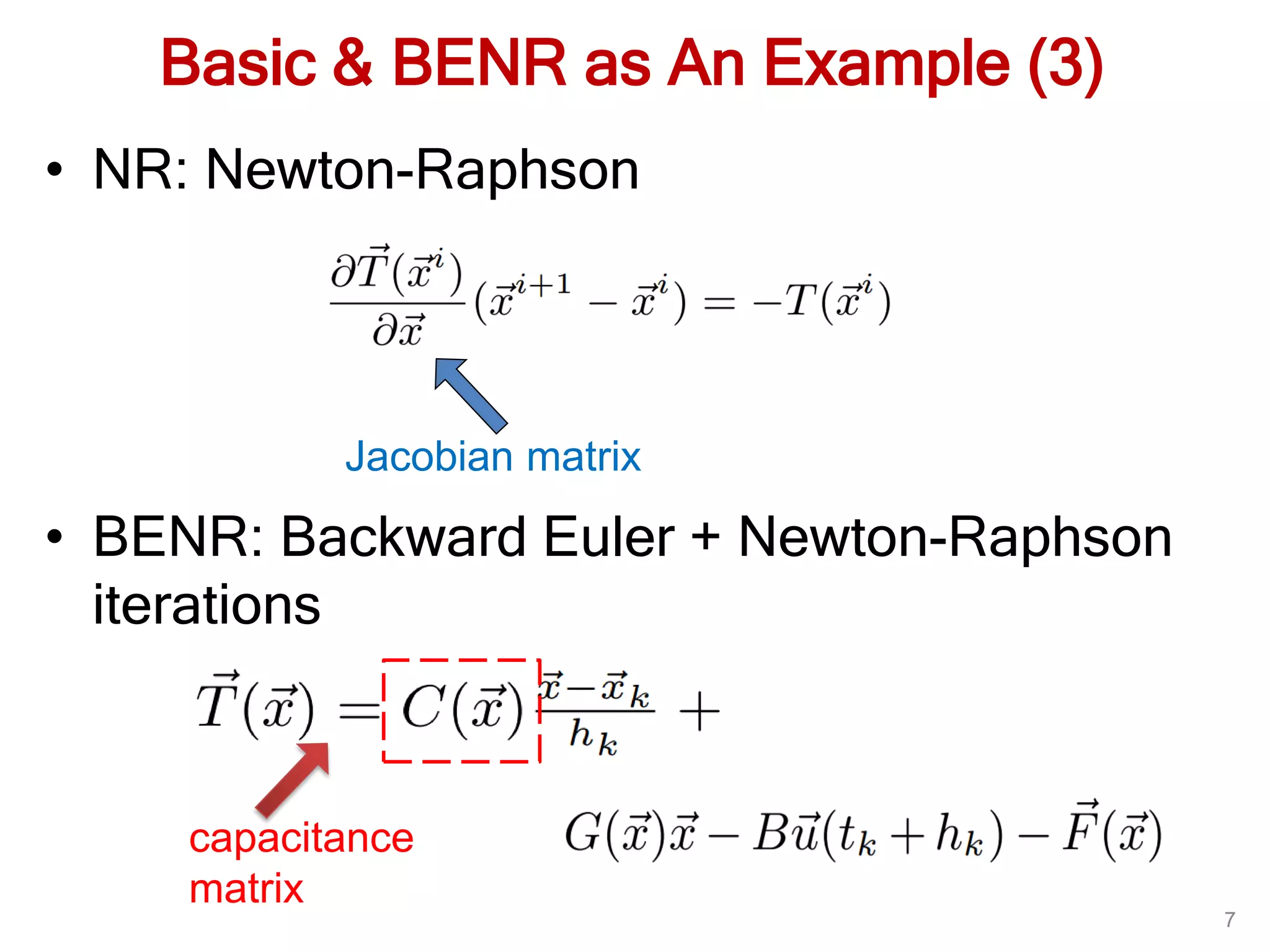
Basic & BENR as An Example (3)
• NR: Newton-Raphson
• BENR: Backward Euler + Newton-Raphson
iterations
7
Jacobian matrix
capacitance
matrix
Matrix Exponential Method
• Our previous attempt [Weng12]
where
8
Matrix Exponential Method
• Our previous attempt [Weng12]
where
• It also uses NR
The Jacobian matrix
9
capacitance matrix
10
𝐶, 𝐺 matrices from FreeCPU [Zhang, Yu TCAD 2013]
nnz: non-zero terms
𝐺𝐶
Matrices from a Post-Layout Case
11𝑙𝑢(𝐶)
𝐶, 𝐺 matrices
𝐺𝐶
𝐿 𝑈
Matrices from a Post-Layout Case
12
𝑙𝑢(
𝐶
𝑕
+ 𝐺)
𝐶, 𝐺 matrices
𝐺𝐶 𝐿 𝑈
Matrices from a Post-Layout Case
13
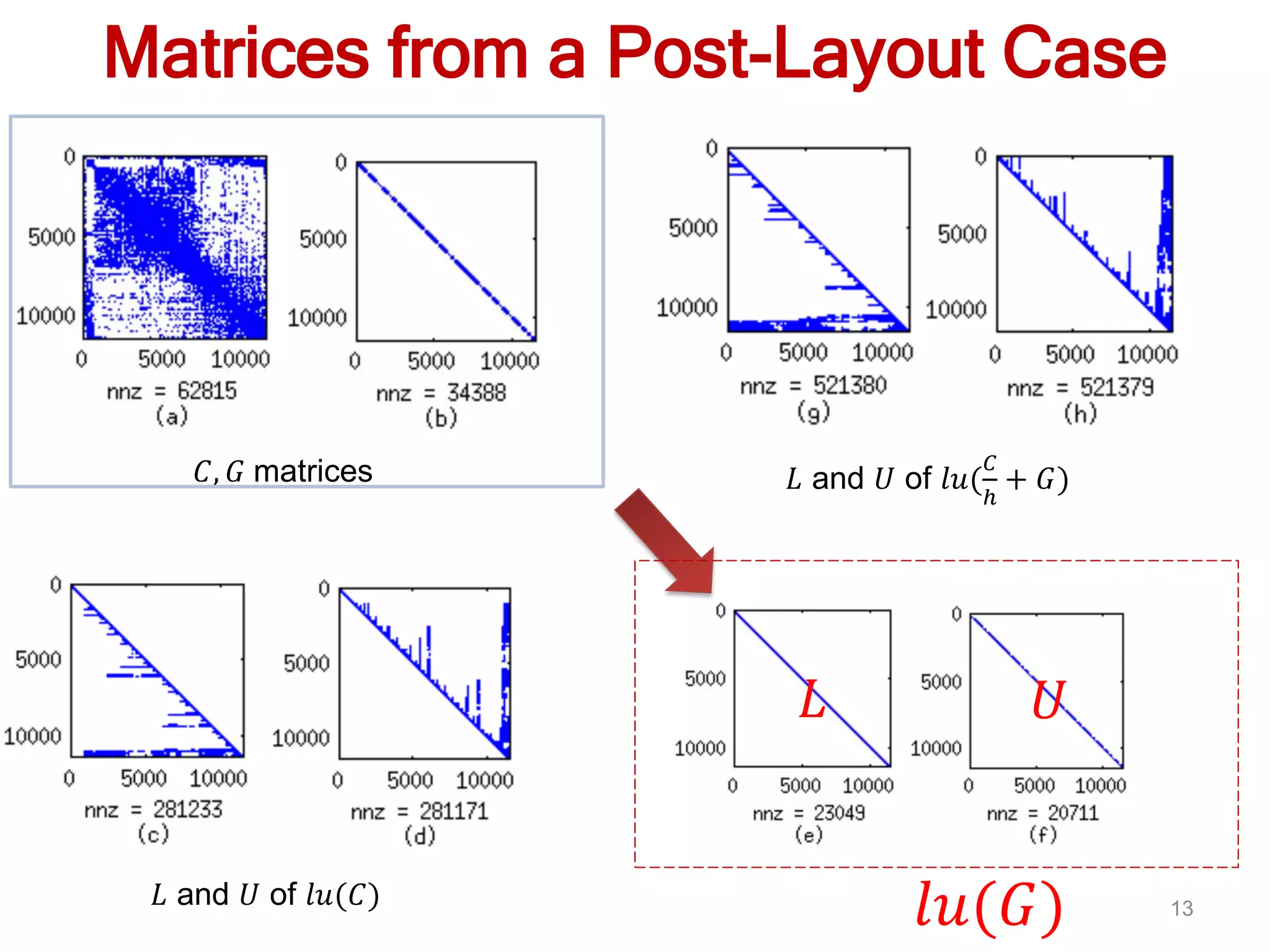
Matrices from a Post-Layout Case
𝐿 and 𝑈 of 𝑙𝑢(𝐶)
𝐿 and 𝑈 of 𝑙𝑢(
𝐶
ℎ
+ 𝐺)
𝑙𝑢(𝐺)
𝐿 𝑈
𝐶, 𝐺 matrices
14
𝐿 and 𝑈 of 𝑙𝑢(
𝐶
ℎ
+ 𝐺)
𝐿 and 𝑈 of 𝑙𝑢(𝐺)
In this example, 𝑙𝑢(𝐺)
• contains less nnz (~10%)
&
• less complicated nnz
distributions
Matrices from a Post-Layout Case
• Traditional methods are
all challenged by 𝐶,
when 𝐶 is complicated,
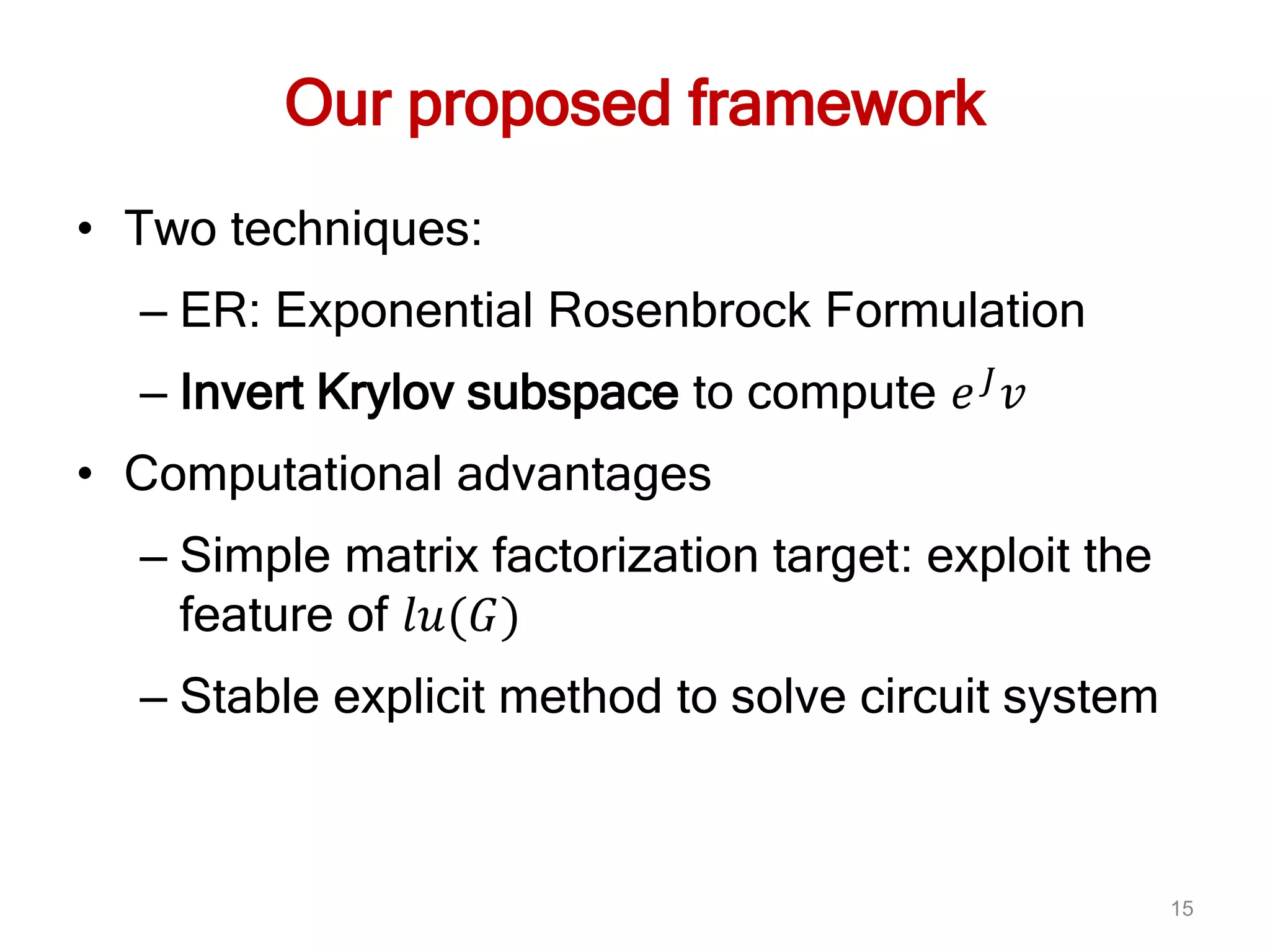
• Two techniques:
– ER: Exponential Rosenbrock Formulation
– Invert Krylov subspace to compute 𝑒 𝐽 𝑣
• Computational advantages
– Simple matrix factorization target: exploit the
feature of 𝑙𝑢(𝐺)
– Stable explicit method to solve circuit system
15
Our proposed framework
ER: Exponential Rosenbrock
Start from
𝑑𝑥 𝑡
𝑑𝑡
= 𝑔(𝑥, 𝑢, 𝑡)
• The next time step solution [Hochbruck, et. al. SIAM09]
𝑥 𝑘+1 = 𝑥 𝑘 + 𝑕 𝑘 𝜙1 𝑕 𝑘 𝐽 𝑘 𝑔(𝑥 𝑘, 𝑢, 𝑡 𝑘) + 𝑕 𝑘
2
𝜙2 𝑕 𝑘 𝐽 𝑘 𝑏k
where 𝐽 𝑘 = 𝜕𝑔/𝜕𝑥, 𝑏 𝑘 = 𝜕𝑔/𝜕𝑡
𝜙1 𝑕 𝑘 𝐽 𝑘 = (𝑒ℎ 𝑘 𝐽 𝑘−𝐼 𝑛)/𝑕 𝑘 𝐽 𝑘
𝜙2 𝑕 𝑘 𝐽 𝑘 = (𝑒ℎ 𝑘 𝐽 𝑘−𝐼 𝑛)/𝑕 𝑘
2
𝐽 𝑘
2
− 𝐼 𝑛/𝑕 𝑘 𝐽 𝑘
16
Exponential Integrators:
Proved to be Stable, Explicit, High-Order Accuracy for ODE
ER in Circuit Simulation
Chain rule:
𝑑𝑞 𝑥 𝑡
𝑑𝑥
𝑑𝑥 𝑡
𝑑𝑡
= 𝐵𝑢 𝑡 − 𝑓(𝑥)
where
𝑑𝑞 𝑥 𝑡
𝑑𝑥
= 𝐶 𝑥 𝑡 = 𝐶 𝑘, 𝐽 𝑘 = −𝐶 𝑘
−1
𝐺 𝑘,
𝑔 𝑘 = 𝐽 𝑘 + 𝐶 𝑘
−1
𝐹𝑘 + 𝐵𝑢 𝑡 , 𝑏 𝑘 = 𝐶 𝑘
−1 𝐵𝑢 𝑡 𝑘+1 −𝐵𝑢 𝑡 𝑘
ℎ 𝑘
We have ALL the components to obtain 𝑥 𝑘+1
𝑥 𝑘+1(𝑕 𝑘) = 𝑥 𝑘 + 𝑕 𝑘 𝜙1 𝑕 𝑘 𝐽 𝑘 𝑔(𝑥 𝑘, 𝑢, 𝑡) + 𝑕 𝑘
2
𝜙2 𝑕 𝑘 𝐽 𝑘 𝑏k
17
Local Nonlinear Error Control
The local nonlinear error estimator [Caliari09]
𝑒 𝑟𝑟 𝑥 𝑘+1, 𝑥 𝑘 = 𝜙1 𝑕 𝑘 𝐽 𝑘 𝐶 𝑘
−1
Δ𝐹𝑘
where Δ𝐹𝑘 = 𝐹 𝑥 𝑘+1 − 𝐹(𝑥 𝑘)
18
ER-C: ER with Correction Term
Reuse Δ𝐹𝑘 to improve the accuracy by padding
the extra term
𝐷 𝑘 = 𝛾𝑕 𝑘 𝜙2 𝑕 𝑘 𝐽 𝑘 𝐶 𝑘
−1
Δ𝐹𝑘
The further corrected solution is
𝑥 𝑘+1,𝑐 = 𝑥 𝑘+1 − 𝐷 𝑘
Krylov Method for MEVP 𝑒 𝐽
𝑣
• 𝑒 𝐽 𝑣: Matrix Exponential and Vector Product
(MEVP) via standard Krylov subspace [Weng12]
𝐾 𝑚 𝐽, 𝑣 ≔ 𝑠𝑝𝑎𝑛 𝑣, 𝐽𝑣, 𝐽2 𝑣, … , 𝐽 𝑚−1 𝑣
– Arnoldi process and Matrix reduction:
𝐽𝑉𝑚 = 𝑉𝑚 𝐻 𝑚 + 𝑕 𝑚+1,𝑚 𝑣 𝑚+1 𝑒 𝑚
T
• MEVP is computed by
𝑒 𝐽 𝑣 ≈ 𝑣 2 𝑉𝑚 𝑒 𝐻 𝑚 𝑒1
• Explicit feature: time stepping only by scaling 𝐻 𝑚
with h,
𝑒ℎ𝐽 𝑣 ≈ 𝑣 2 𝑉𝑚 𝑒ℎ𝐻 𝑚 𝑒1
19
20
Standard Krylov subspace
Im
Re0
“like” these eigenvalues
Eigenvalues of J: small magnitude of Re
Eigenvalues of J: large magnitude of Re
(a) Standard Krylov Basis [Weng12]
𝐾 𝑚 𝐽, 𝑣 ≔ 𝑠𝑝𝑎𝑛 𝑣, 𝐽𝑣, 𝐽2
𝑣, … , 𝐽 𝑚−1
𝑣
spectrum of
𝐽 = −𝑪−𝟏
𝑮
21
Standard Krylov subspace
Im
Re0
• these eigenvalues
defines the major
dynamical behavior
• demand more bases to
characterize
Eigenvalues of J: small magnitude of Re
Eigenvalues of J: large magnitude of Re
(a) Standard Krylov Basis [Weng12]
𝐾 𝑚 𝐽, 𝑣 ≔ 𝑠𝑝𝑎𝑛 𝑣, 𝐽𝑣, 𝐽2
𝑣, … , 𝐽 𝑚−1
𝑣
spectrum of
𝐽 = −𝑪−𝟏
𝑮
22
Im
Re
Im
Re00
Invert Krylov subspace method captures
“important” eigenvalues in the original spectrum
Eigenvalues of J: small magnitude of Re
Eigenvalues of J: large magnitude of Re
Invert Krylov subspace
Invert Krylov Basis [Zhuang, et. al. DAC14]
𝐾 𝑚 𝐽−1, 𝑣 ≔ 𝑠𝑝𝑎𝑛 𝑣, 𝐽−1 𝑣, 𝐽−2 𝑣, … , 𝐽−𝑚+1 𝑣
spectrum of 𝐽−1
spectrum of 𝐽
Simple Matrix Fct. Taget
23
Invert Krylov Subspace approach transfers
𝐽 = −𝐶−1
𝐺 𝐽−1
= −𝐺−1
𝐶
At each iteration, we
generate invert
Krylov subspace
𝑉𝑚 = 𝑣1, 𝑣2, ⋯ , 𝑣 𝑚
by solving
−𝑮𝒘 = 𝑪𝒗𝒊−𝟏
24
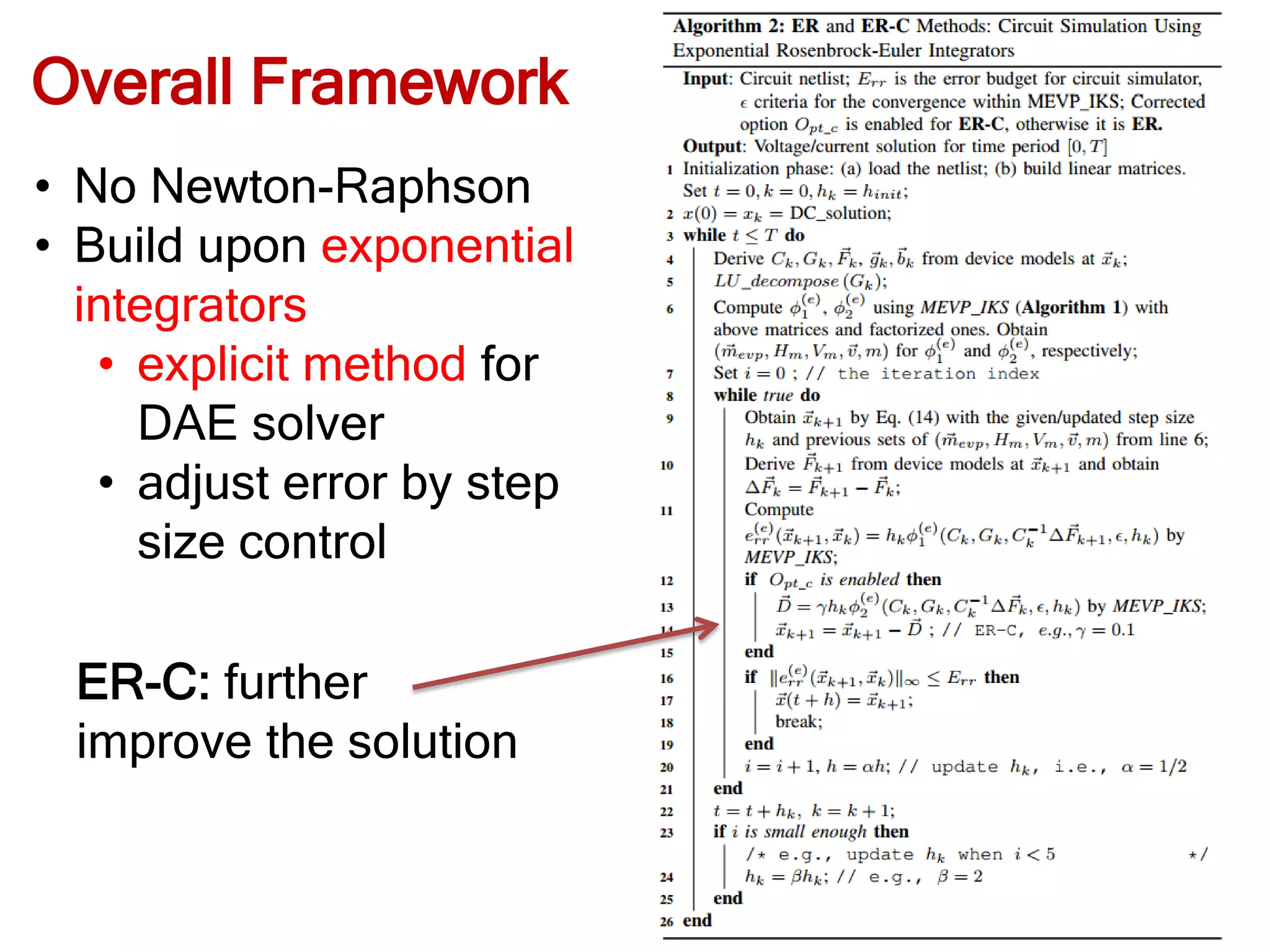
Overall Framework
ER-C: further
improve the solution
• No Newton-Raphson
• Build upon exponential
integrators
• explicit method for
DAE solver
• adjust error by step
size control
Experimental Results
• Implemented in MATLAB2013a & C/C++ (GCC
4.7.3)
– Opensource BSIM3 device model with C
– MATLAB Executable (MEX) external interface
between device evaluation and matrix solvers
• Linux workstation
– Intel CPU i7 3.4GHZ
– 32GB memory.
– Utilize single thread mode.
25
Accuracy
26
27
Runtime Performance
• #Dev.: the number of devices.
• nnzC & nnzG: the number of non-zero
elements in linear C and G.
• #step: the number of steps for transient
simulation;
For each time step,
• #NRa: the average NR iterations
• #ma: the average dimension of invert
Krylov subspace
• RT(s): the runtime.
• SP: the runtime speedup Test circuits
28
Conclusions and Future Directions
Accelerate SPICE-level time-domain simulation
• Exponential Integrators
• Stable explicit formulation
• 𝑒 𝐽 𝑣 w/ invert Krylov Subspace & Less expensive
matrix factorizations.
• Handling tasks even when traditional methods fail.
Future directions:
• parallelism, can be accelerated further by
multicore/many-core computing systems.
• many derivatives & tools can be built upon.
Thanks and Q&A
29

SPICE-MATEX @ DAC15

  • 1.
    1. University ofCalifornia, San Diego 2. Tsinghua University An Algorithmic Framework of Large-Scale Circuit Simulation Using Exponential Integrators Hao Zhuang1, Wenjian Yu2, Ilgweon Kang1, Xinan Wang1, and Chung-Kuan Cheng1
  • 2.
    2 Outline • Motivation &Contributions • Background of time-domain circuit simulation • Our algorithmic framework • Exponential integrators • Invert Krylov subspace method • Experimental results • Conclusions & future directions
  • 3.
    Motivation • SPICE – criticalto wide ranges of IC • Modern IC – billions of transistors – complex interconnects • Requirement: – new structures e.g., FinFET, 3D – strong coupled – post-layout effects – capability & accuracy • Simulation runtime – Long or ∞ 3 From Dick Sites, “Datacenter Computers modern challenges in CPU design” Google Inc. 2015 & Intel i7 From Synopsys Inc. Issue 3, 2012 Technology Update FinFET: The Promises and the Challenges
  • 4.
    • Target ofmatrix factorization: conductance matrix 𝐺 ONLY Less expensive 4 Contributions • Exponential Integration Stable, Explicit No Newton-Raphson • Handling tasks (even when traditional schemes FAIL) • large-scale, strong coupled, post-layout A promising framework
  • 5.
    Basic & BENRas An Example (1) • Differential Equations • BE: Backward Euler 5 capacitance (/inductance) conductance (/incidence) time step input nonlinear devices dynamics
  • 6.
    Basic & BENRas An Example (2) • NR: Newton-Raphson • BENR: Backward Euler + Newton-Raphson iterations 6 Jacobian matrix
  • 7.
    Basic & BENRas An Example (3) • NR: Newton-Raphson • BENR: Backward Euler + Newton-Raphson iterations 7 Jacobian matrix capacitance matrix
  • 8.
    Matrix Exponential Method •Our previous attempt [Weng12] where 8
  • 9.
    Matrix Exponential Method •Our previous attempt [Weng12] where • It also uses NR The Jacobian matrix 9 capacitance matrix
  • 10.
    10 𝐶, 𝐺 matricesfrom FreeCPU [Zhang, Yu TCAD 2013] nnz: non-zero terms 𝐺𝐶 Matrices from a Post-Layout Case
  • 11.
    11𝑙𝑢(𝐶) 𝐶, 𝐺 matrices 𝐺𝐶 𝐿𝑈 Matrices from a Post-Layout Case
  • 12.
    12 𝑙𝑢( 𝐶 𝑕 + 𝐺) 𝐶, 𝐺matrices 𝐺𝐶 𝐿 𝑈 Matrices from a Post-Layout Case
  • 13.
    13 Matrices from aPost-Layout Case 𝐿 and 𝑈 of 𝑙𝑢(𝐶) 𝐿 and 𝑈 of 𝑙𝑢( 𝐶 ℎ + 𝐺) 𝑙𝑢(𝐺) 𝐿 𝑈 𝐶, 𝐺 matrices
  • 14.
    14 𝐿 and 𝑈of 𝑙𝑢( 𝐶 ℎ + 𝐺) 𝐿 and 𝑈 of 𝑙𝑢(𝐺) In this example, 𝑙𝑢(𝐺) • contains less nnz (~10%) & • less complicated nnz distributions Matrices from a Post-Layout Case • Traditional methods are all challenged by 𝐶, when 𝐶 is complicated,
  • 15.
    • Two techniques: –ER: Exponential Rosenbrock Formulation – Invert Krylov subspace to compute 𝑒 𝐽 𝑣 • Computational advantages – Simple matrix factorization target: exploit the feature of 𝑙𝑢(𝐺) – Stable explicit method to solve circuit system 15 Our proposed framework
  • 16.
    ER: Exponential Rosenbrock Startfrom 𝑑𝑥 𝑡 𝑑𝑡 = 𝑔(𝑥, 𝑢, 𝑡) • The next time step solution [Hochbruck, et. al. SIAM09] 𝑥 𝑘+1 = 𝑥 𝑘 + 𝑕 𝑘 𝜙1 𝑕 𝑘 𝐽 𝑘 𝑔(𝑥 𝑘, 𝑢, 𝑡 𝑘) + 𝑕 𝑘 2 𝜙2 𝑕 𝑘 𝐽 𝑘 𝑏k where 𝐽 𝑘 = 𝜕𝑔/𝜕𝑥, 𝑏 𝑘 = 𝜕𝑔/𝜕𝑡 𝜙1 𝑕 𝑘 𝐽 𝑘 = (𝑒ℎ 𝑘 𝐽 𝑘−𝐼 𝑛)/𝑕 𝑘 𝐽 𝑘 𝜙2 𝑕 𝑘 𝐽 𝑘 = (𝑒ℎ 𝑘 𝐽 𝑘−𝐼 𝑛)/𝑕 𝑘 2 𝐽 𝑘 2 − 𝐼 𝑛/𝑕 𝑘 𝐽 𝑘 16 Exponential Integrators: Proved to be Stable, Explicit, High-Order Accuracy for ODE
  • 17.
    ER in CircuitSimulation Chain rule: 𝑑𝑞 𝑥 𝑡 𝑑𝑥 𝑑𝑥 𝑡 𝑑𝑡 = 𝐵𝑢 𝑡 − 𝑓(𝑥) where 𝑑𝑞 𝑥 𝑡 𝑑𝑥 = 𝐶 𝑥 𝑡 = 𝐶 𝑘, 𝐽 𝑘 = −𝐶 𝑘 −1 𝐺 𝑘, 𝑔 𝑘 = 𝐽 𝑘 + 𝐶 𝑘 −1 𝐹𝑘 + 𝐵𝑢 𝑡 , 𝑏 𝑘 = 𝐶 𝑘 −1 𝐵𝑢 𝑡 𝑘+1 −𝐵𝑢 𝑡 𝑘 ℎ 𝑘 We have ALL the components to obtain 𝑥 𝑘+1 𝑥 𝑘+1(𝑕 𝑘) = 𝑥 𝑘 + 𝑕 𝑘 𝜙1 𝑕 𝑘 𝐽 𝑘 𝑔(𝑥 𝑘, 𝑢, 𝑡) + 𝑕 𝑘 2 𝜙2 𝑕 𝑘 𝐽 𝑘 𝑏k 17
  • 18.
    Local Nonlinear ErrorControl The local nonlinear error estimator [Caliari09] 𝑒 𝑟𝑟 𝑥 𝑘+1, 𝑥 𝑘 = 𝜙1 𝑕 𝑘 𝐽 𝑘 𝐶 𝑘 −1 Δ𝐹𝑘 where Δ𝐹𝑘 = 𝐹 𝑥 𝑘+1 − 𝐹(𝑥 𝑘) 18 ER-C: ER with Correction Term Reuse Δ𝐹𝑘 to improve the accuracy by padding the extra term 𝐷 𝑘 = 𝛾𝑕 𝑘 𝜙2 𝑕 𝑘 𝐽 𝑘 𝐶 𝑘 −1 Δ𝐹𝑘 The further corrected solution is 𝑥 𝑘+1,𝑐 = 𝑥 𝑘+1 − 𝐷 𝑘
  • 19.
    Krylov Method forMEVP 𝑒 𝐽 𝑣 • 𝑒 𝐽 𝑣: Matrix Exponential and Vector Product (MEVP) via standard Krylov subspace [Weng12] 𝐾 𝑚 𝐽, 𝑣 ≔ 𝑠𝑝𝑎𝑛 𝑣, 𝐽𝑣, 𝐽2 𝑣, … , 𝐽 𝑚−1 𝑣 – Arnoldi process and Matrix reduction: 𝐽𝑉𝑚 = 𝑉𝑚 𝐻 𝑚 + 𝑕 𝑚+1,𝑚 𝑣 𝑚+1 𝑒 𝑚 T • MEVP is computed by 𝑒 𝐽 𝑣 ≈ 𝑣 2 𝑉𝑚 𝑒 𝐻 𝑚 𝑒1 • Explicit feature: time stepping only by scaling 𝐻 𝑚 with h, 𝑒ℎ𝐽 𝑣 ≈ 𝑣 2 𝑉𝑚 𝑒ℎ𝐻 𝑚 𝑒1 19
  • 20.
    20 Standard Krylov subspace Im Re0 “like”these eigenvalues Eigenvalues of J: small magnitude of Re Eigenvalues of J: large magnitude of Re (a) Standard Krylov Basis [Weng12] 𝐾 𝑚 𝐽, 𝑣 ≔ 𝑠𝑝𝑎𝑛 𝑣, 𝐽𝑣, 𝐽2 𝑣, … , 𝐽 𝑚−1 𝑣 spectrum of 𝐽 = −𝑪−𝟏 𝑮
  • 21.
    21 Standard Krylov subspace Im Re0 •these eigenvalues defines the major dynamical behavior • demand more bases to characterize Eigenvalues of J: small magnitude of Re Eigenvalues of J: large magnitude of Re (a) Standard Krylov Basis [Weng12] 𝐾 𝑚 𝐽, 𝑣 ≔ 𝑠𝑝𝑎𝑛 𝑣, 𝐽𝑣, 𝐽2 𝑣, … , 𝐽 𝑚−1 𝑣 spectrum of 𝐽 = −𝑪−𝟏 𝑮
  • 22.
    22 Im Re Im Re00 Invert Krylov subspacemethod captures “important” eigenvalues in the original spectrum Eigenvalues of J: small magnitude of Re Eigenvalues of J: large magnitude of Re Invert Krylov subspace Invert Krylov Basis [Zhuang, et. al. DAC14] 𝐾 𝑚 𝐽−1, 𝑣 ≔ 𝑠𝑝𝑎𝑛 𝑣, 𝐽−1 𝑣, 𝐽−2 𝑣, … , 𝐽−𝑚+1 𝑣 spectrum of 𝐽−1 spectrum of 𝐽
  • 23.
    Simple Matrix Fct.Taget 23 Invert Krylov Subspace approach transfers 𝐽 = −𝐶−1 𝐺 𝐽−1 = −𝐺−1 𝐶 At each iteration, we generate invert Krylov subspace 𝑉𝑚 = 𝑣1, 𝑣2, ⋯ , 𝑣 𝑚 by solving −𝑮𝒘 = 𝑪𝒗𝒊−𝟏
  • 24.
    24 Overall Framework ER-C: further improvethe solution • No Newton-Raphson • Build upon exponential integrators • explicit method for DAE solver • adjust error by step size control
  • 25.
    Experimental Results • Implementedin MATLAB2013a & C/C++ (GCC 4.7.3) – Opensource BSIM3 device model with C – MATLAB Executable (MEX) external interface between device evaluation and matrix solvers • Linux workstation – Intel CPU i7 3.4GHZ – 32GB memory. – Utilize single thread mode. 25
  • 26.
  • 27.
    27 Runtime Performance • #Dev.:the number of devices. • nnzC & nnzG: the number of non-zero elements in linear C and G. • #step: the number of steps for transient simulation; For each time step, • #NRa: the average NR iterations • #ma: the average dimension of invert Krylov subspace • RT(s): the runtime. • SP: the runtime speedup Test circuits
  • 28.
    28 Conclusions and FutureDirections Accelerate SPICE-level time-domain simulation • Exponential Integrators • Stable explicit formulation • 𝑒 𝐽 𝑣 w/ invert Krylov Subspace & Less expensive matrix factorizations. • Handling tasks even when traditional methods fail. Future directions: • parallelism, can be accelerated further by multicore/many-core computing systems. • many derivatives & tools can be built upon.
  • 29.