Cluster-Promoting Quantization with Bit-Drop
for Minimizing Network Quantization Loss
Jung Hyun Lee*, Jihun Yun*, Sung Ju Hwang, and Eunho Yang
Korea Advanced Institute of Science and Technology
Quantization
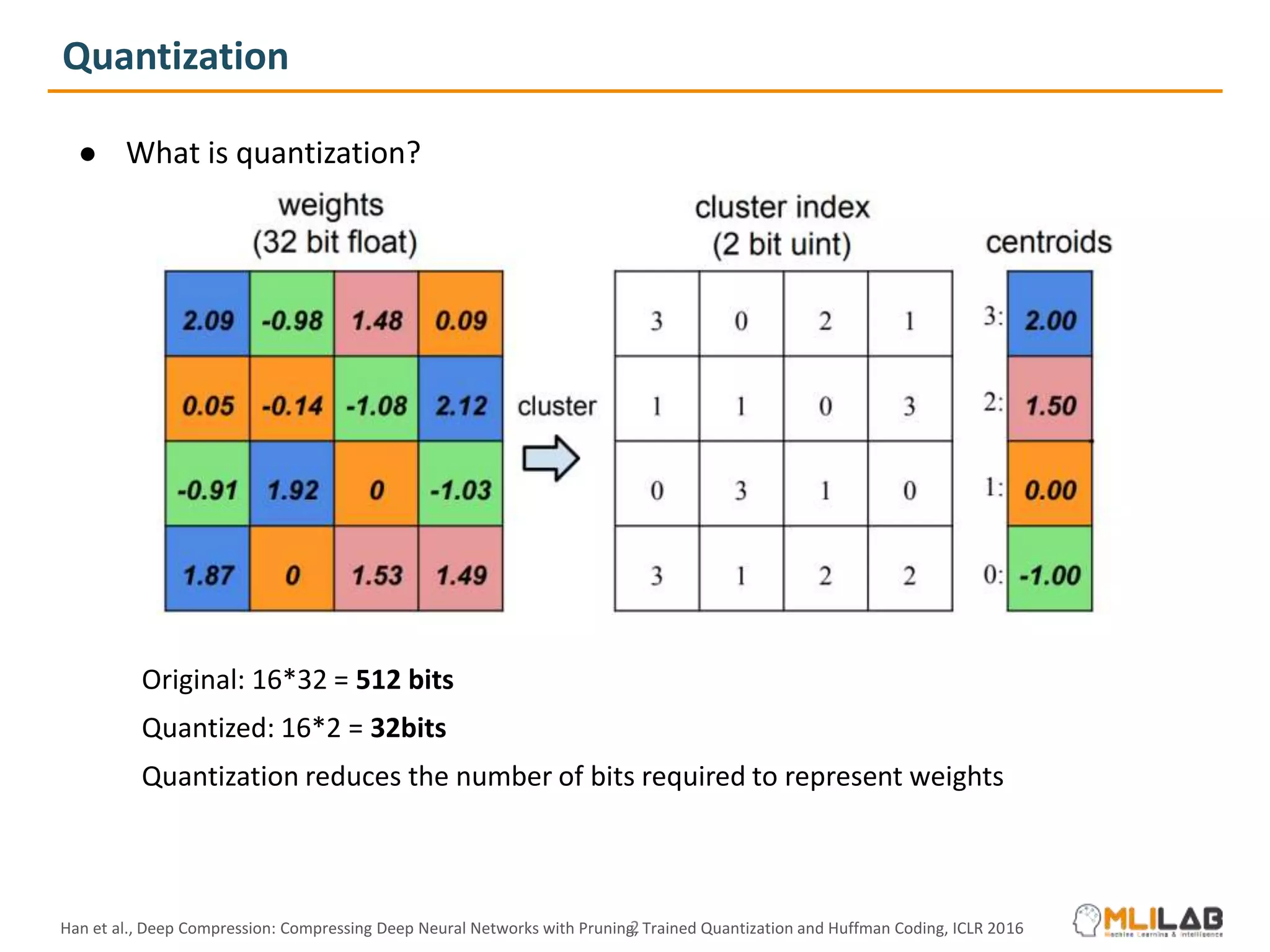
● What is quantization?
Original: 16*32 = 512 bits
Quantized: 16*2 = 32bits
Quantization reduces the number of bits required to represent weights
2
Han et al., Deep Compression: Compressing Deep Neural Networks with Pruning, Trained Quantization and Huffman Coding, ICLR 2016
Quantization
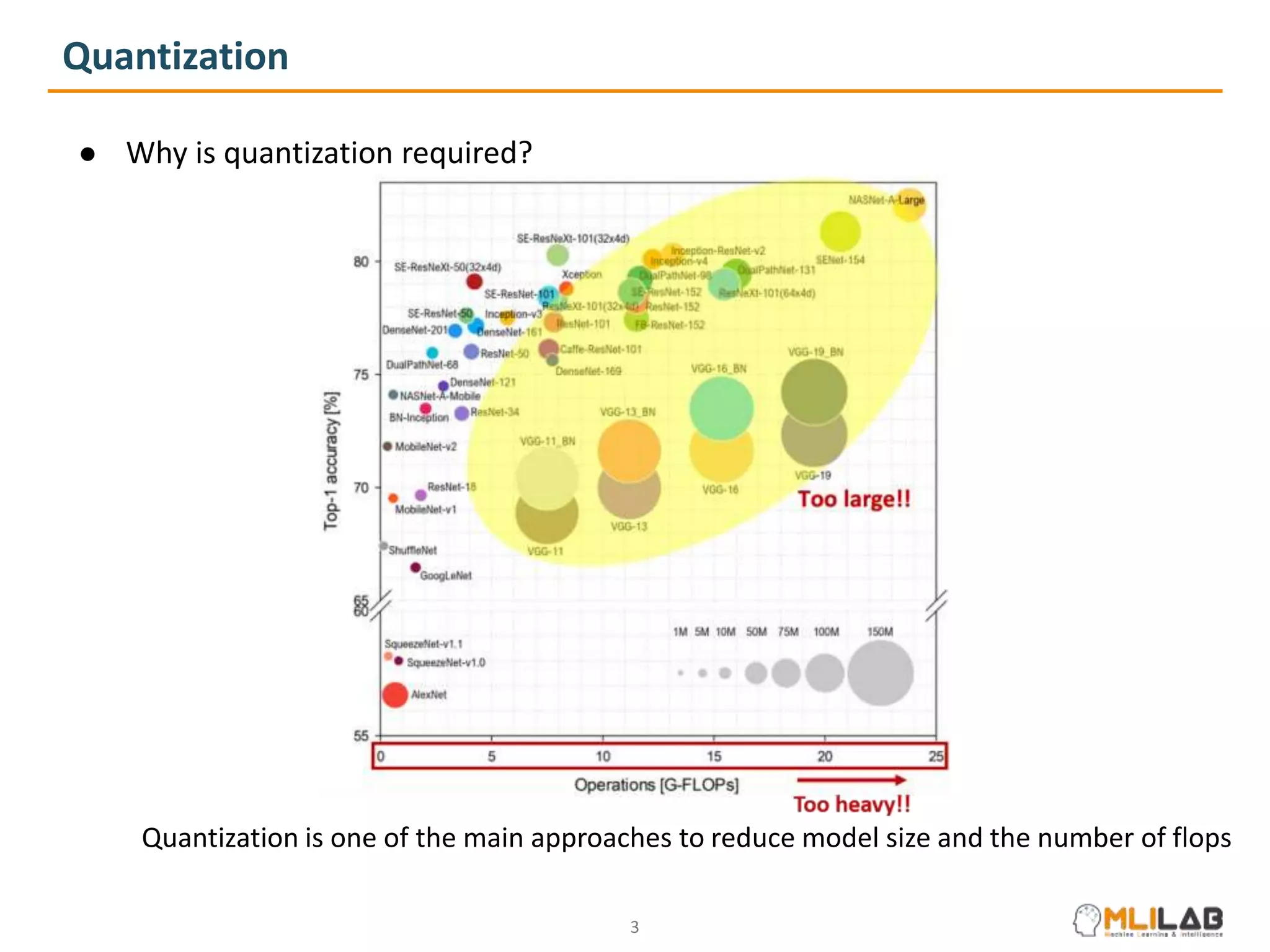
● Why is quantization required?
Quantization is one of the main approaches to reduce model size and the number of flops
3
Motivation
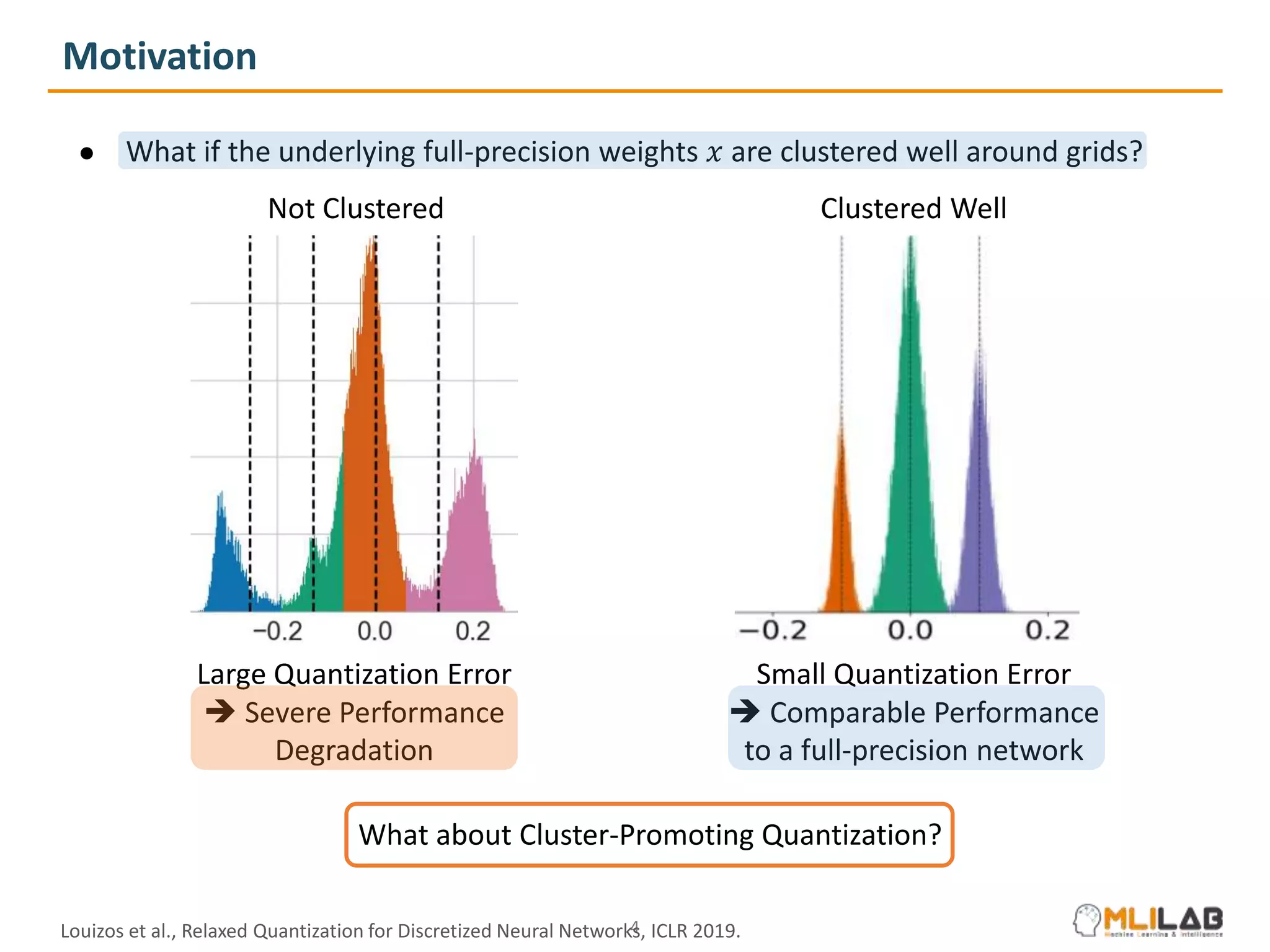
● What if the underlying full-precision weights 𝑥 are clustered well around grids?
What about Cluster-Promoting Quantization?
4
Louizos et al., Relaxed Quantization for Discretized Neural Networks, ICLR 2019.
Not Clustered Clustered Well
Large Quantization Error
 Severe Performance
Degradation
Small Quantization Error
 Comparable Performance
to a full-precision network
Contribution
● Cluster-Promoting Quantization (CPQ)
● enables the underlying full-precision weights to be clustered well
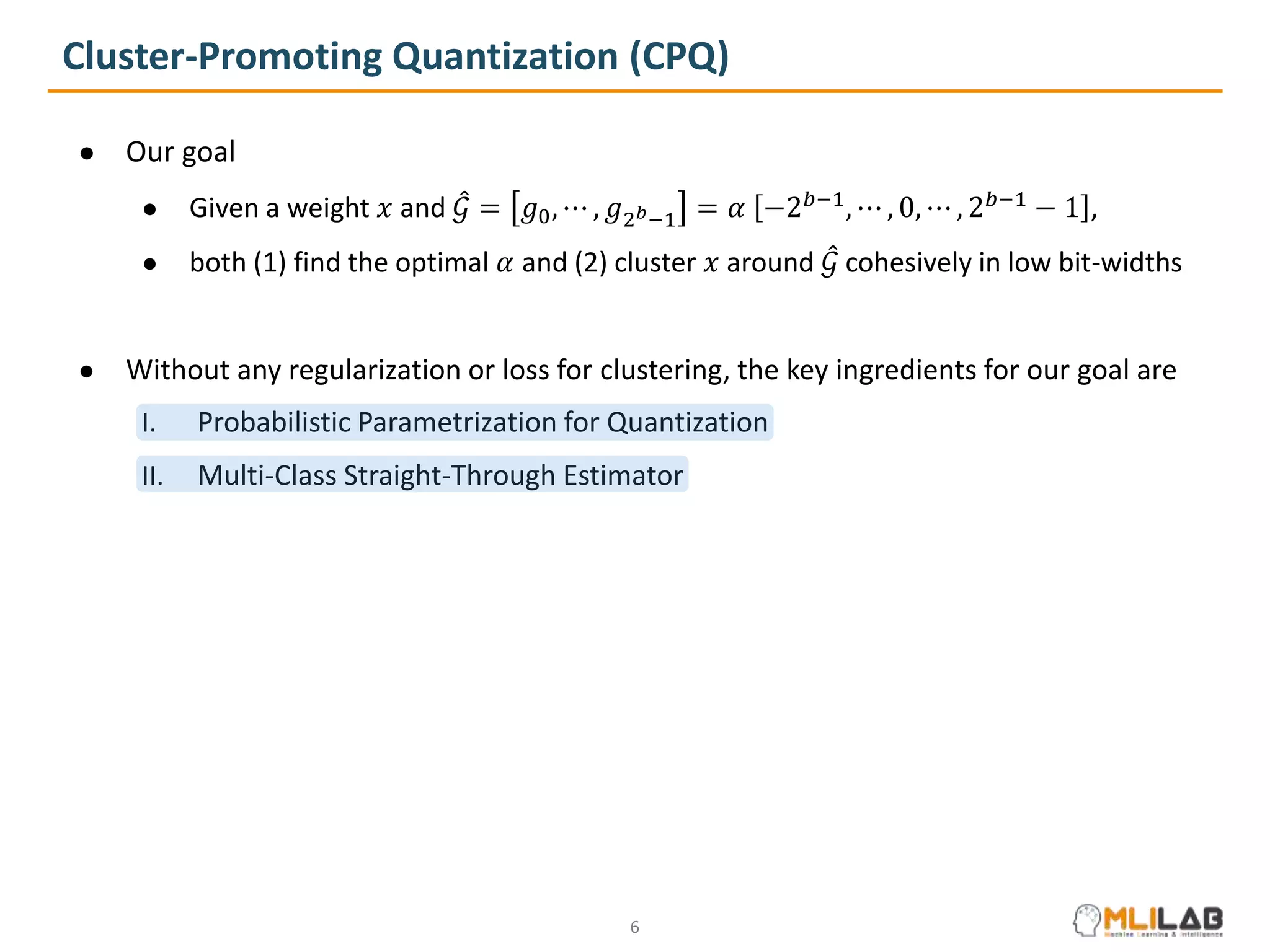
● jointly finds the optimal quantization grids 𝒢 = 𝛼 −2𝑏−1
, ⋯ , 0, ⋯ , 2𝑏−1
− 1
according to clustered full-precision weights
● DropBits
● Our straight-through estimator (STE) in CPQ is biased like the original STE
● To compensate the defect of CPQ, we present a novel bit-drop technique, DropBits
● CPQ + DropBits
● CPQ + DropBits achieves the state-of-the-art results for ResNet-18 and
MobileNetV2 on the ImageNet dataset when all layers are uniformly quantized
5
Cluster-Promoting Quantization (CPQ)
● Our goal
● Given a weight 𝑥 and 𝒢 = 𝑔0, ⋯ , 𝑔2𝑏−1 = 𝛼 −2𝑏−1
, ⋯ , 0, ⋯ , 2𝑏−1
− 1 ,
● both (1) find the optimal 𝛼 and (2) cluster 𝑥 around 𝒢 cohesively in low bit-widths
● Without any regularization or loss for clustering, the key ingredients for our goal are
I. Probabilistic Parametrization for Quantization
II. Multi-Class Straight-Through Estimator
6
Cluster-Promoting Quantization (CPQ)
I. Probabilistic Parametrization for Quantization
● For each grid point 𝑔𝑖 ∈ 𝒢 = 𝑔0, ⋯ , 𝑔2𝑏−1 = 𝛼 −2𝑏−1
, ⋯ , 0, ⋯ , 2𝑏−1
− 1 ,
● compute the unnormalized probability that 𝑥 will be quantized to 𝑔𝑖 as follows:
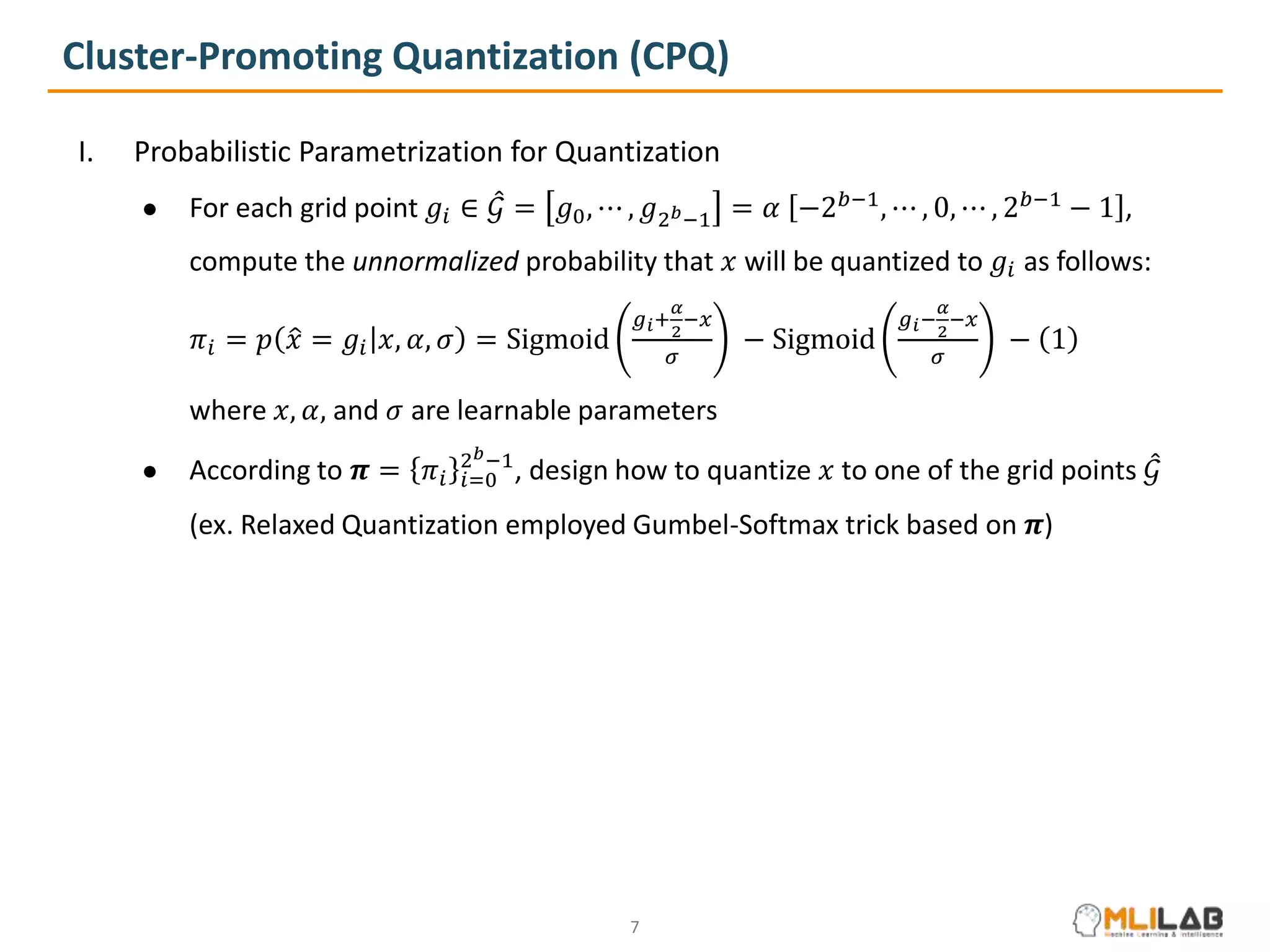
𝜋𝑖 = 𝑝 𝑥 = 𝑔𝑖 𝑥, 𝛼, 𝜎 = Sigmoid
𝑔𝑖+
𝛼
2
−𝑥
𝜎
− Sigmoid
𝑔𝑖−
𝛼
2
−𝑥
𝜎
− 1
● where 𝑥, 𝛼, and 𝜎 are learnable parameters
● According to 𝝅 = 𝜋𝑖 𝑖=0
2𝑏−1
, design how to quantize 𝑥 to one of the grid points 𝒢
● (ex. Relaxed Quantization employed Gumbel-Softmax trick based on 𝝅)
7
Cluster-Promoting Quantization (CPQ)
II. Multi-Class Straight-Through Estimator (STE)
● Given 𝜋𝑖 = Sigmoid
𝑔𝑖+
𝛼
2
−𝑥
𝜎
− Sigmoid
𝑔𝑖−
𝛼
2
−𝑥
𝜎
, define a new STE as below:
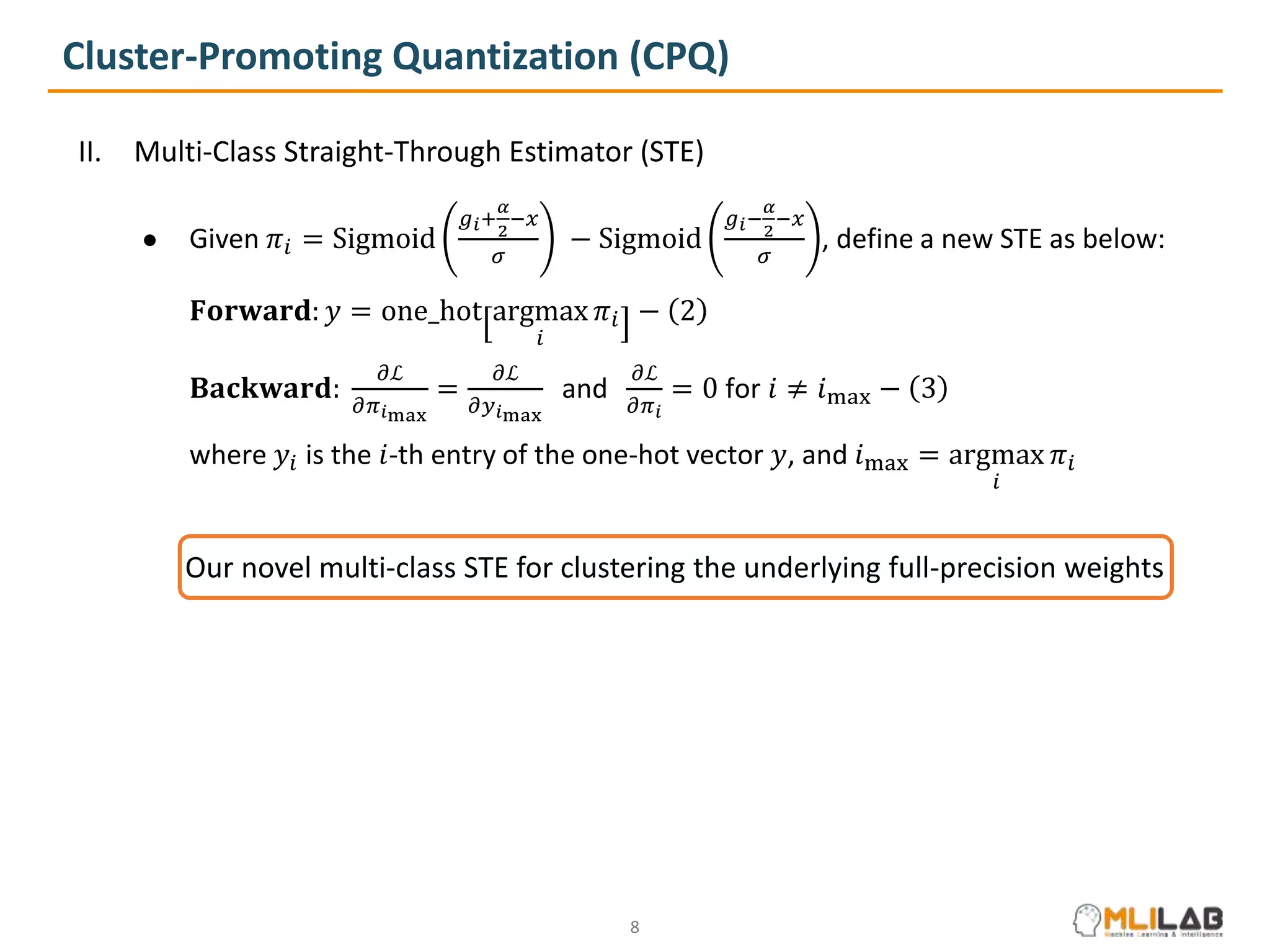
𝐅𝐨𝐫𝐰𝐚𝐫𝐝: 𝑦 = one_hot argmax
𝑖
𝜋𝑖 − 2
𝐁𝐚𝐜𝐤𝐰𝐚𝐫𝐝:
𝜕ℒ
𝜕𝜋𝑖max
=
𝜕ℒ
𝜕𝑦𝑖max
and
𝜕ℒ
𝜕𝜋𝑖
= 0 for 𝑖 ≠ 𝑖max − 3
where 𝑦𝑖 is the 𝑖-th entry of the one-hot vector 𝑦, and 𝑖max = argmax
𝑖
𝜋𝑖
Our novel multi-class STE for clustering the underlying full-precision weights
8
Cluster-Promoting Quantization (CPQ)
II. Multi-Class Straight-Through Estimator (STE)
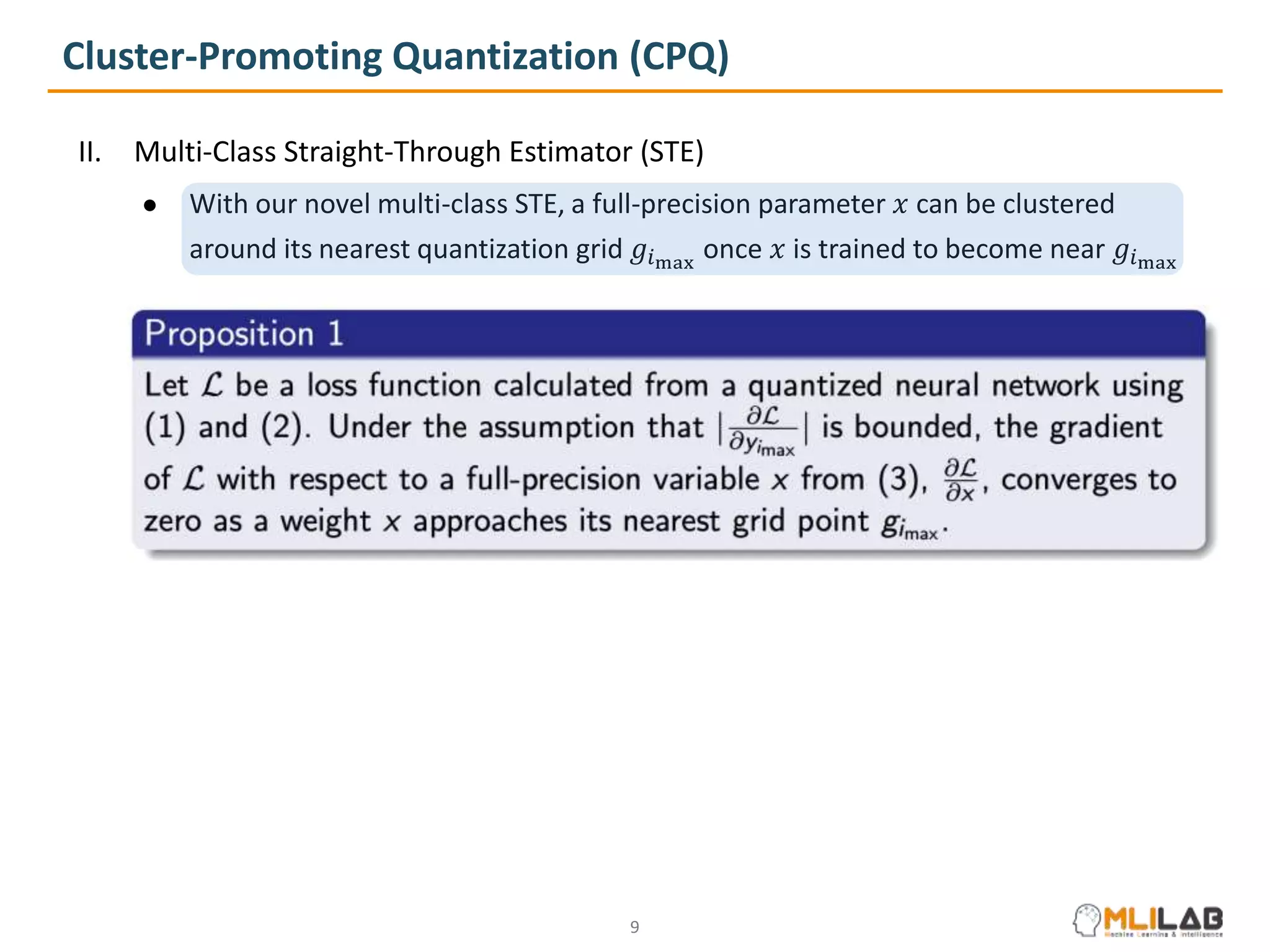
● With our novel multi-class STE, a full-precision parameter 𝑥 can be clustered
around its nearest quantization grid 𝑔𝑖max
once 𝑥 is trained to become near 𝑔𝑖max
9
Cluster-Promoting Quantization (CPQ)
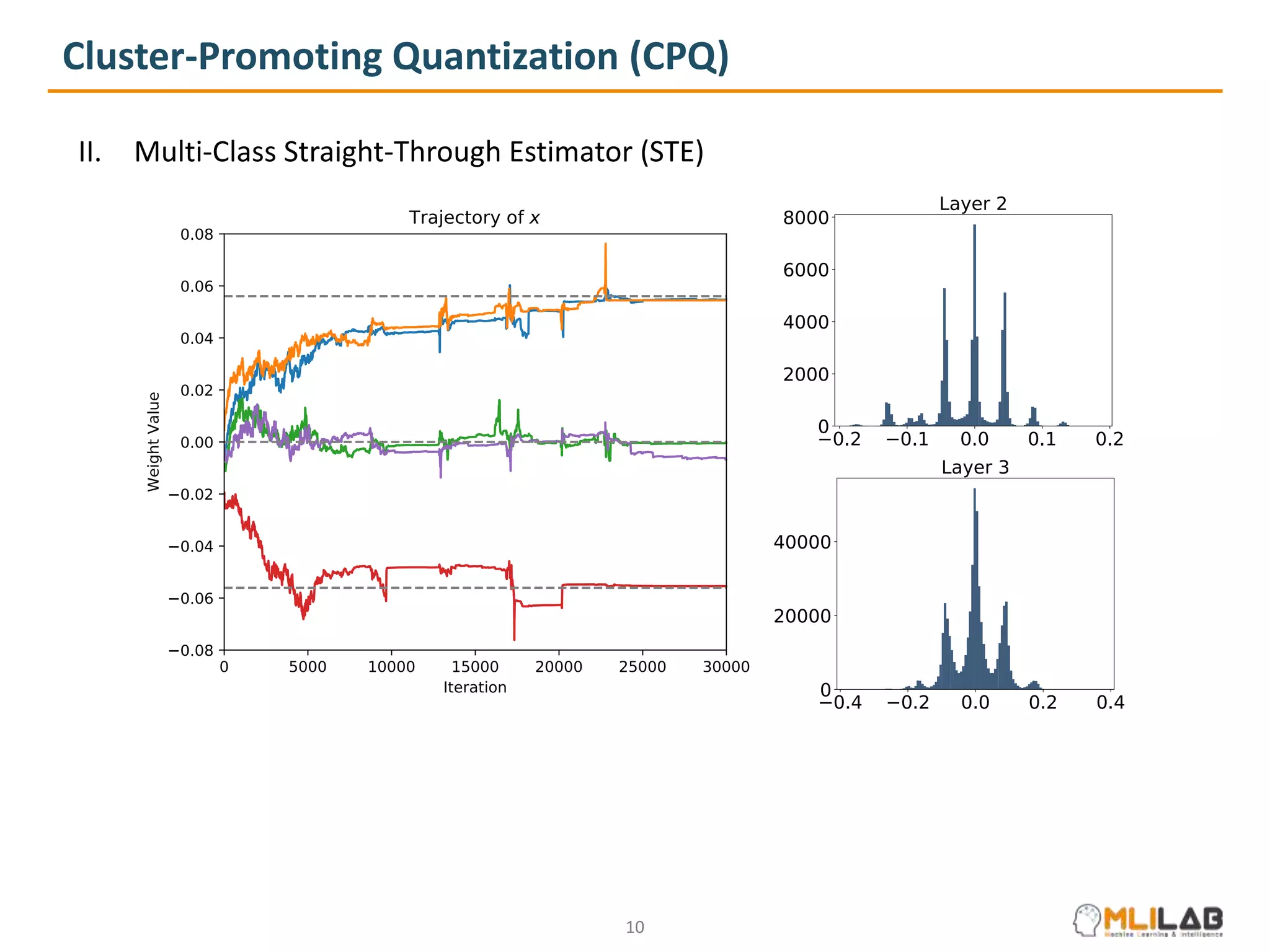
II. Multi-Class Straight-Through Estimator (STE)
10
DropBits
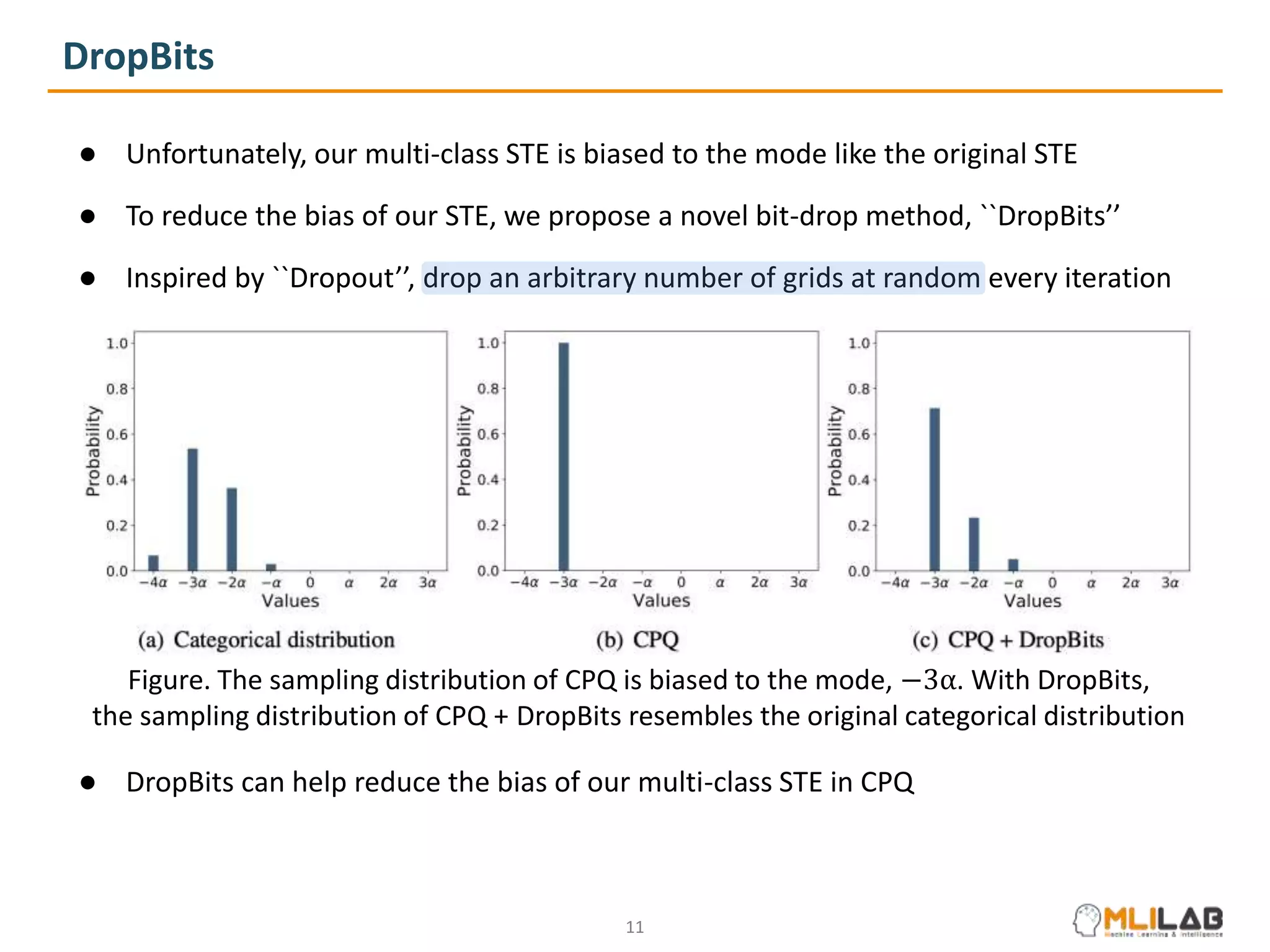
● Unfortunately, our multi-class STE is biased to the mode like the original STE
● To reduce the bias of our STE, we propose a novel bit-drop method, ``DropBits’’
● Inspired by ``Dropout’’, drop an arbitrary number of grids at random every iteration
● DropBits can help reduce the bias of our multi-class STE in CPQ
11
Figure. The sampling distribution of CPQ is biased to the mode, −3α. With DropBits,
the sampling distribution of CPQ + DropBits resembles the original categorical distribution
Cluster-Promoting Quantization with DropBits (CPQ + DropBits)
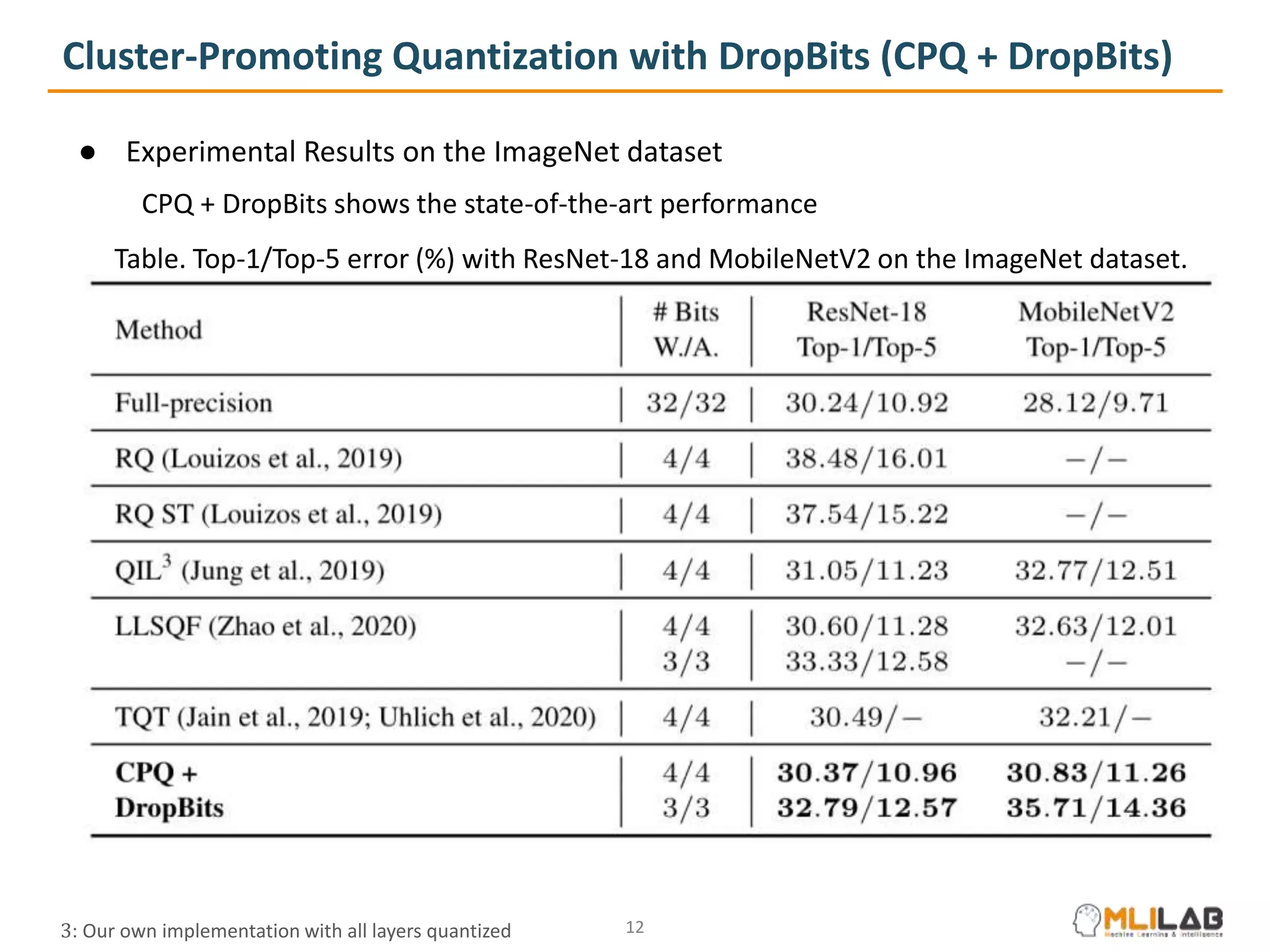
● Experimental Results on the ImageNet dataset
CPQ + DropBits shows the state-of-the-art performance
12
3: Our own implementation with all layers quantized
Table. Top-1/Top-5 error (%) with ResNet-18 and MobileNetV2 on the ImageNet dataset.

CPQ_presentation_ICCV2021

  • 1.
    Cluster-Promoting Quantization withBit-Drop for Minimizing Network Quantization Loss Jung Hyun Lee*, Jihun Yun*, Sung Ju Hwang, and Eunho Yang Korea Advanced Institute of Science and Technology
  • 2.
    Quantization ● What isquantization? Original: 16*32 = 512 bits Quantized: 16*2 = 32bits Quantization reduces the number of bits required to represent weights 2 Han et al., Deep Compression: Compressing Deep Neural Networks with Pruning, Trained Quantization and Huffman Coding, ICLR 2016
  • 3.
    Quantization ● Why isquantization required? Quantization is one of the main approaches to reduce model size and the number of flops 3
  • 4.
    Motivation ● What ifthe underlying full-precision weights 𝑥 are clustered well around grids? What about Cluster-Promoting Quantization? 4 Louizos et al., Relaxed Quantization for Discretized Neural Networks, ICLR 2019. Not Clustered Clustered Well Large Quantization Error  Severe Performance Degradation Small Quantization Error  Comparable Performance to a full-precision network
  • 5.
    Contribution ● Cluster-Promoting Quantization(CPQ) ● enables the underlying full-precision weights to be clustered well ● jointly finds the optimal quantization grids 𝒢 = 𝛼 −2𝑏−1 , ⋯ , 0, ⋯ , 2𝑏−1 − 1 according to clustered full-precision weights ● DropBits ● Our straight-through estimator (STE) in CPQ is biased like the original STE ● To compensate the defect of CPQ, we present a novel bit-drop technique, DropBits ● CPQ + DropBits ● CPQ + DropBits achieves the state-of-the-art results for ResNet-18 and MobileNetV2 on the ImageNet dataset when all layers are uniformly quantized 5
  • 6.
    Cluster-Promoting Quantization (CPQ) ●Our goal ● Given a weight 𝑥 and 𝒢 = 𝑔0, ⋯ , 𝑔2𝑏−1 = 𝛼 −2𝑏−1 , ⋯ , 0, ⋯ , 2𝑏−1 − 1 , ● both (1) find the optimal 𝛼 and (2) cluster 𝑥 around 𝒢 cohesively in low bit-widths ● Without any regularization or loss for clustering, the key ingredients for our goal are I. Probabilistic Parametrization for Quantization II. Multi-Class Straight-Through Estimator 6
  • 7.
    Cluster-Promoting Quantization (CPQ) I.Probabilistic Parametrization for Quantization ● For each grid point 𝑔𝑖 ∈ 𝒢 = 𝑔0, ⋯ , 𝑔2𝑏−1 = 𝛼 −2𝑏−1 , ⋯ , 0, ⋯ , 2𝑏−1 − 1 , ● compute the unnormalized probability that 𝑥 will be quantized to 𝑔𝑖 as follows: 𝜋𝑖 = 𝑝 𝑥 = 𝑔𝑖 𝑥, 𝛼, 𝜎 = Sigmoid 𝑔𝑖+ 𝛼 2 −𝑥 𝜎 − Sigmoid 𝑔𝑖− 𝛼 2 −𝑥 𝜎 − 1 ● where 𝑥, 𝛼, and 𝜎 are learnable parameters ● According to 𝝅 = 𝜋𝑖 𝑖=0 2𝑏−1 , design how to quantize 𝑥 to one of the grid points 𝒢 ● (ex. Relaxed Quantization employed Gumbel-Softmax trick based on 𝝅) 7
  • 8.
    Cluster-Promoting Quantization (CPQ) II.Multi-Class Straight-Through Estimator (STE) ● Given 𝜋𝑖 = Sigmoid 𝑔𝑖+ 𝛼 2 −𝑥 𝜎 − Sigmoid 𝑔𝑖− 𝛼 2 −𝑥 𝜎 , define a new STE as below: 𝐅𝐨𝐫𝐰𝐚𝐫𝐝: 𝑦 = one_hot argmax 𝑖 𝜋𝑖 − 2 𝐁𝐚𝐜𝐤𝐰𝐚𝐫𝐝: 𝜕ℒ 𝜕𝜋𝑖max = 𝜕ℒ 𝜕𝑦𝑖max and 𝜕ℒ 𝜕𝜋𝑖 = 0 for 𝑖 ≠ 𝑖max − 3 where 𝑦𝑖 is the 𝑖-th entry of the one-hot vector 𝑦, and 𝑖max = argmax 𝑖 𝜋𝑖 Our novel multi-class STE for clustering the underlying full-precision weights 8
  • 9.
    Cluster-Promoting Quantization (CPQ) II.Multi-Class Straight-Through Estimator (STE) ● With our novel multi-class STE, a full-precision parameter 𝑥 can be clustered around its nearest quantization grid 𝑔𝑖max once 𝑥 is trained to become near 𝑔𝑖max 9
  • 10.
    Cluster-Promoting Quantization (CPQ) II.Multi-Class Straight-Through Estimator (STE) 10
  • 11.
    DropBits ● Unfortunately, ourmulti-class STE is biased to the mode like the original STE ● To reduce the bias of our STE, we propose a novel bit-drop method, ``DropBits’’ ● Inspired by ``Dropout’’, drop an arbitrary number of grids at random every iteration ● DropBits can help reduce the bias of our multi-class STE in CPQ 11 Figure. The sampling distribution of CPQ is biased to the mode, −3α. With DropBits, the sampling distribution of CPQ + DropBits resembles the original categorical distribution
  • 12.
    Cluster-Promoting Quantization withDropBits (CPQ + DropBits) ● Experimental Results on the ImageNet dataset CPQ + DropBits shows the state-of-the-art performance 12 3: Our own implementation with all layers quantized Table. Top-1/Top-5 error (%) with ResNet-18 and MobileNetV2 on the ImageNet dataset.