




Survey of Distributed Amplifier
ADVISER:DR.M.KAMAREISTUDENT: M.BAHRAMI
‫توزیع‬ ‫کننده‬ ‫تقویت‬ ‫بررسی‬
‫شده‬
Contents:
 INTRODUCTION
 REVIEW
 NEW PAPERS
 REFERENCES
2
INTRODUCTION
Shanon law
C=BWLog(1+SNR)
Distributed Amplifier
a method for wideband implemention
The key idea
divide and conquer
3
REVIEW
Basic circuit :
The key idea :
absorb parasitic capacitance
to artificial Transmission-lines overcome to substantiality tradeoff
Distributed amplifiers are attractive candidates
for UWB systems
wide input-matching
wide gain bandwidth
excellent linearity
4
Figure 1 :basic DAFigure 2 :OFDM Receiver
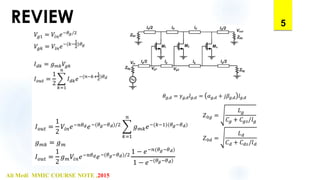
REVIEW 5
Ali Medi MMIC COURSE NOTE ,2015
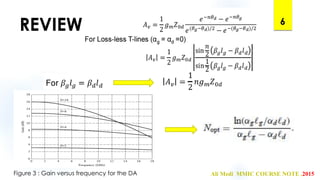
REVIEW 6
Ali Medi MMIC COURSE NOTE ,2015Figure 3 : Gain versus frequency for the DA
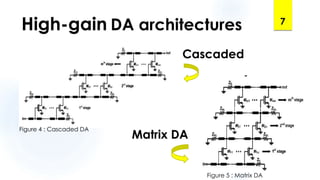
High-gain DA architectures 7
Cascaded
Matrix DA
Figure 4 : Cascaded DA
Figure 5 : Matrix DA
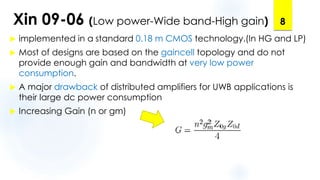
Xin 09-06 (Low power-Wide band-High gain)
 implemented in a standard 0.18 m CMOS technology.(In HG and LP)
 Most of designs are based on the gaincell topology and do not
provide enough gain and bandwidth at very low power
consumption.
 A major drawback of distributed amplifiers for UWB applications is
their large dc power consumption
 Increasing Gain (n or gm)
8
Xin 09-06
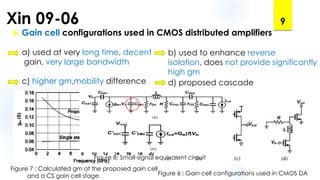
 Gain cell configurations used in CMOS distributed amplifiers
a) used at very long time, decent
gain, very large bandwidth
c) higher gm,mobility difference
9
Figure 6 : Gain cell configurations used in CMOS DA
Figure 7 : Calculated gm of the proposed gain cell
and a CS gain cell stage.
Figure 8: Small-signal equivalent circuit
b) used to enhance reverse
isolation, does not provide significantly
high gm
d) proposed cascade
Xin 09-06
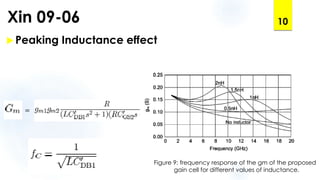
Peaking Inductance effect
10
=
Figure 9: frequency response of the gm of the proposed
gain cell for different values of inductance.
Xin 09-06
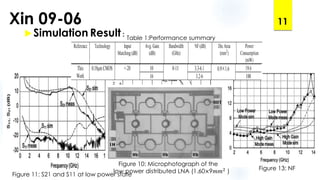
Simulation Result :
11
Figure 11: S21 and S11 at low power state
Figure 12: S21 and S11
at high gain state
Figure 13: NF
Table 1:Performance summary
Figure 10: Microphotograph of the
low power distributed LNA (1.60×9𝑚𝑚2
)
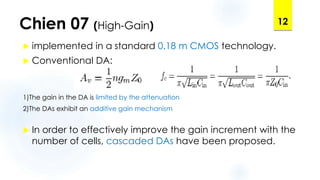
Chien 07 (High-Gain)
 implemented in a standard 0.18 m CMOS technology.
 Conventional DA:
1)The gain in the DA is limited by the attenuation
2)The DAs exhibit an additive gain mechanism
 In order to effectively improve the gain increment with the
number of cells, cascaded DAs have been proposed.
12
Chien 07
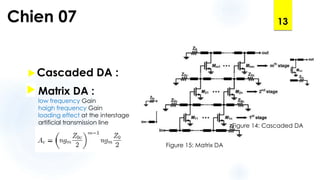
Cascaded DA :
13
Figure 14: Cascaded DA
Figure 15: Matrix DA
Matrix DA :
low frequency Gain
haigh frequency Gain
loading effect at the interstage
artificial transmission line
Chien 07
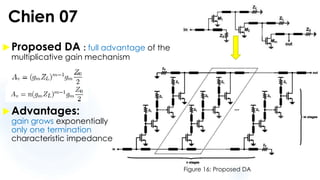
Proposed DA : full advantage of the
multiplicative gain mechanism
Advantages:
gain grows exponentially
only one termination
characteristic impedance
14
Figure 16: Proposed DA
Chien 07
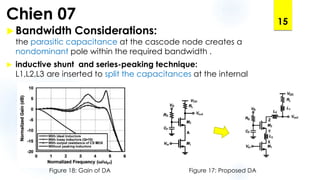
Bandwidth Considerations:
the parasitic capacitance at the cascode node creates a
nondominant pole within the required bandwidth .
 inductive shunt and series-peaking technique:
L1,L2,L3 are inserted to split the capacitances at the internal
15
Figure 17: Proposed DAFigure 18: Gain of DA
Chien 07
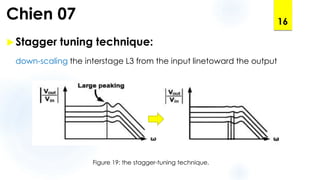
Stagger tuning technique:
down-scaling the interstage L3 from the input linetoward the output
16
Figure 19: the stagger-tuning technique.
Chien 07
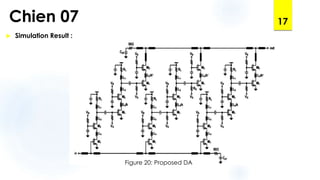
 Simulation Result :
17
Figure 20: Proposed DA
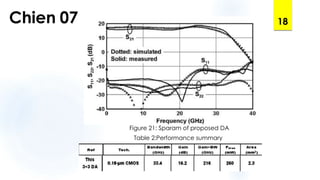
Chien 07 18
Table 2:Performance summary
Figure 21: Sparam of proposed DA
Moez 08 (Low-Noise)
 implemented in a standard 0.13 m CMOS technology.
 Used a technique for the design of ultra-wide-band
low-noise amplifiers.
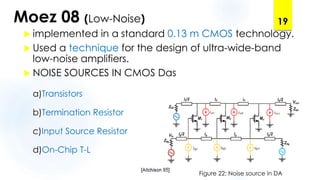
 NOISE SOURCES IN CMOS Das
a)Transistors
b)Termination Resistor
c)Input Source Resistor
d)On-Chip T-L
19
Figure 22: Noise source in DA
Moez 08
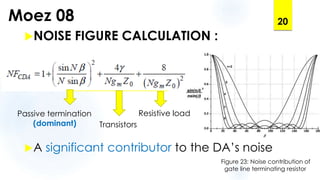
NOISE FIGURE CALCULATION :
A significant contributor to the DA’s noise
20
Figure 23: Noise contribution of
gate line terminating resistor
Passive termination
(dominant) Transistors
Resistive load
Moez 08
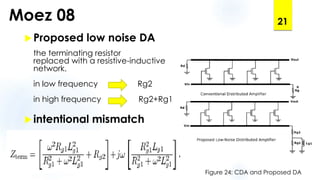
Proposed low noise DA
the terminating resistor
replaced with a resistive-inductive
network.
in low frequency Rg2
in high frequency Rg2+Rg1
intentional mismatch
21
Figure 24: CDA and Proposed DA
Moez 08
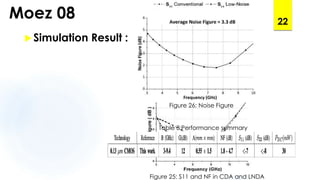
Simulation Result :
22
Figure 25: S11 and NF in CDA and LNDA
Figure 26: Noise Figure
Table 3:Performance summary
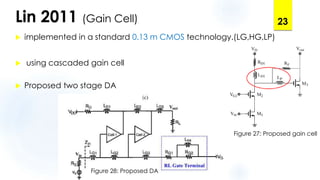
Lin 2011 (Gain Cell)
 implemented in a standard 0.13 m CMOS technology.(LG,HG,LP)
 using cascaded gain cell
 Proposed two stage DA
23
Figure 27: Proposed gain cell
Figure 28: Proposed DA
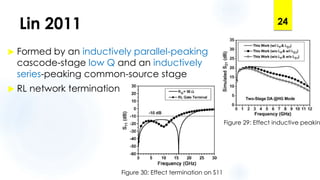
Lin 2011
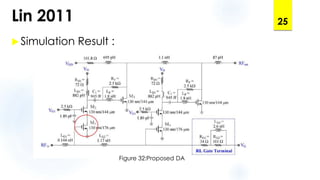
 Formed by an inductively parallel-peaking
cascode-stage low Q and an inductively
series-peaking common-source stage
 RL network termination
24
Figure 29: Effect inductive peakin
Figure 30: Effect termination on S11
Lin 2011
Simulation Result :
25
Figure 32:Proposed DA
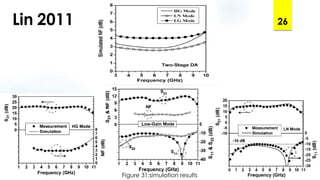
Lin 2011 26
Figure 31:simulation results
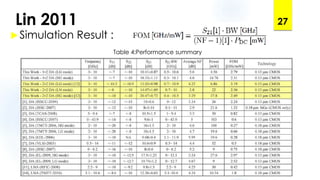
Lin 2011
Simulation Result :
27
Table 4:Performance summary
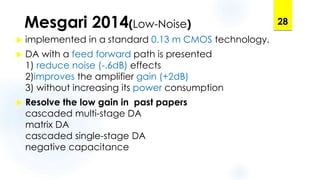
Mesgari 2014(Low-Noise)
 implemented in a standard 0.13 m CMOS technology.
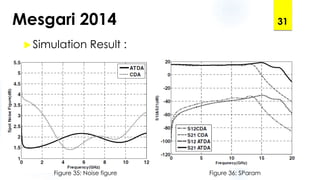
 DA with a feed forward path is presented
1) reduce noise (-.6dB) effects
2)improves the amplifier gain (+2dB)
3) without increasing its power consumption
 Resolve the low gain in past papers
cascaded multi-stage DA
matrix DA
cascaded single-stage DA
negative capacitance
28
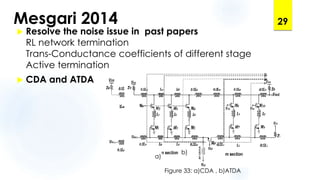
Mesgari 2014
 Resolve the noise issue in past papers
RL network termination
Trans-Conductance coefficients of different stage
Active termination
 CDA and ATDA
29
Figure 33: a)CDA , b)ATDA
a)
b)
Mesgari 2014
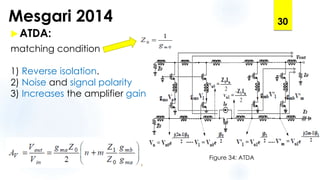
ATDA:
matching condition
1) Reverse isolation.
2) Noise and signal polarity
3) Increases the amplifier gain
30
Figure 34: ATDA
Mesgari 2014
Simulation Result :
31
Figure 35: Noise figure Figure 36: SParam
Mesgari 2014
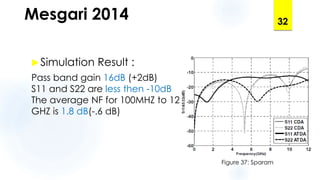
Simulation Result :
Pass band gain 16dB (+2dB)
S11 and S22 are less then -10dB
The average NF for 100MHZ to 12
GHZ is 1.8 dB(-.6 dB)
32
Figure 37: Sparam
Chen 2014
 DC-8O GHz Distributed Amplifier
 DA plays a critical building block in many system
applications
high data-rate communications
broadband radio transceivers
high-resolution imaging systems
 40-nm CMOS digital process
 based on the CDA with CSSDA gain cell
33
Chen 2014
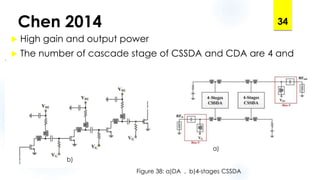
 High gain and output power
 The number of cascade stage of CSSDA and CDA are 4 and
2
34
Figure 38: a)DA , b)4-stages CSSDA
b)
a)
Chen 2014
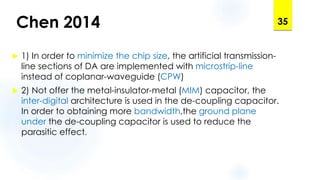
 1) In order to minimize the chip size, the artificial transmission-
line sections of DA are implemented with microstrip-line
instead of coplanar-waveguide (CPW)
 2) Not offer the metal-insulator-metal (MIM) capacitor, the
inter-digital architecture is used in the de-coupling capacitor.
In order to obtaining more bandwidth,the ground plane
under the de-coupling capacitor is used to reduce the
parasitic effect.
35
Chen 2014
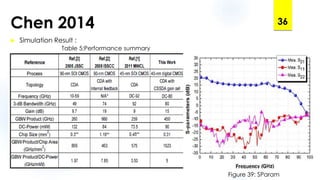
 Simulation Result :
36
Table 5:Performance summary
Figure 39: SParam
REFERENCES:
 [1] D. M. Pozar, Microwave Engineering, 3rd ed. New York: Wiley, 2005, pp.
422–496, 632–641.
 [2] Ali Hajimiri, “Distributed Integrated Circuits: An Alternative Approach to
High-Frequency Design,” IEEE communication Magazine, vol. 40,no. 2, pp.
168-173, Feb 2002
 [3] Behzad Razavi, Design of Integrated Circuits for Optical communication
Systems , 2nd ed. McGraw-Hill, 2012.
 [4] K. Moez and M. I. Elmasry, “A low-noise CMOS distributed amplifier for
ultra-wide-band applications,” IEEE Trans. Circuits Syst. II, Exp. Briefs, vol. 55,
no. 2, pp. 126–130, Feb. 2008.
 [5] X. Guan and C. Nguyen, “Low-power-consumption and high-gain
CMOS distributed amplifiers using cascade of inductively coupled
common-source gain cells for UWB systems,” IEEE Trans. Microw. Theory
Tech., vol. 54, no. 8, pp. 3278–3283, Aug. 2006.
37
REFERENCES:
 [6] Mesgari, B.; Saeedi, S.; Jannesari, A., "A wideband low noise distributed
amplifier with active termination," Telecommunications (IST), 2014 7th
International Symposium on , vol., no., pp.170,174, 9-11 Sept. 2014.
 [7]Y. –S. Lin , J. –F. Chang and S. –S. Lu “Analysis and Design of CMOS Distributed
Amplifier Using Inductively Peaking Cascaded Gain Cell for UWB Systems” , IEEE
Trans. Microw. Theory Techn., vol. 59, no. 10, pp.2513 -2524 2011
 [8] J.-C. Chien and L.-H. Lu, “40-Gb/s high-gain distributed amplifiers with
cascaded gain stages in 0.18-nmCMOS,” IEEE J. Solid-State Circuits, vol. 42, no.
12, pp. 2715–2725, Dec. 2007.
 [9] Po-Han Chen; Kuang-Sheng Yeh; Jui-Chih Kao; Huei Wang, "A high
performance DC-80 GHz distributed amplifier in 40-nm CMOS digital process,"
Microwave Symposium (IMS), 2014 IEEE MTT-S International , vol., no., pp.1,3, 1-6
June 2014.
 [10] Ali Medi MMIC COURSE NOTE ,2015
38
Thank You
39

Distributed amplifier

  • 1.
    Survey of DistributedAmplifier ADVISER:DR.M.KAMAREISTUDENT: M.BAHRAMI ‫توزیع‬ ‫کننده‬ ‫تقویت‬ ‫بررسی‬ ‫شده‬
  • 2.
    Contents:  INTRODUCTION  REVIEW NEW PAPERS  REFERENCES 2
  • 3.
    INTRODUCTION Shanon law C=BWLog(1+SNR) Distributed Amplifier amethod for wideband implemention The key idea divide and conquer 3
  • 4.
    REVIEW Basic circuit : Thekey idea : absorb parasitic capacitance to artificial Transmission-lines overcome to substantiality tradeoff Distributed amplifiers are attractive candidates for UWB systems wide input-matching wide gain bandwidth excellent linearity 4 Figure 1 :basic DAFigure 2 :OFDM Receiver
  • 5.
    REVIEW 5 Ali MediMMIC COURSE NOTE ,2015
  • 6.
    REVIEW 6 Ali MediMMIC COURSE NOTE ,2015Figure 3 : Gain versus frequency for the DA
  • 7.
    High-gain DA architectures7 Cascaded Matrix DA Figure 4 : Cascaded DA Figure 5 : Matrix DA
  • 8.
    Xin 09-06 (Lowpower-Wide band-High gain)  implemented in a standard 0.18 m CMOS technology.(In HG and LP)  Most of designs are based on the gaincell topology and do not provide enough gain and bandwidth at very low power consumption.  A major drawback of distributed amplifiers for UWB applications is their large dc power consumption  Increasing Gain (n or gm) 8
  • 9.
    Xin 09-06  Gaincell configurations used in CMOS distributed amplifiers a) used at very long time, decent gain, very large bandwidth c) higher gm,mobility difference 9 Figure 6 : Gain cell configurations used in CMOS DA Figure 7 : Calculated gm of the proposed gain cell and a CS gain cell stage. Figure 8: Small-signal equivalent circuit b) used to enhance reverse isolation, does not provide significantly high gm d) proposed cascade
  • 10.
    Xin 09-06 Peaking Inductanceeffect 10 = Figure 9: frequency response of the gm of the proposed gain cell for different values of inductance.
  • 11.
    Xin 09-06 Simulation Result: 11 Figure 11: S21 and S11 at low power state Figure 12: S21 and S11 at high gain state Figure 13: NF Table 1:Performance summary Figure 10: Microphotograph of the low power distributed LNA (1.60×9𝑚𝑚2 )
  • 12.
    Chien 07 (High-Gain) implemented in a standard 0.18 m CMOS technology.  Conventional DA: 1)The gain in the DA is limited by the attenuation 2)The DAs exhibit an additive gain mechanism  In order to effectively improve the gain increment with the number of cells, cascaded DAs have been proposed. 12
  • 13.
    Chien 07 Cascaded DA: 13 Figure 14: Cascaded DA Figure 15: Matrix DA Matrix DA : low frequency Gain haigh frequency Gain loading effect at the interstage artificial transmission line
  • 14.
    Chien 07 Proposed DA: full advantage of the multiplicative gain mechanism Advantages: gain grows exponentially only one termination characteristic impedance 14 Figure 16: Proposed DA
  • 15.
    Chien 07 Bandwidth Considerations: theparasitic capacitance at the cascode node creates a nondominant pole within the required bandwidth .  inductive shunt and series-peaking technique: L1,L2,L3 are inserted to split the capacitances at the internal 15 Figure 17: Proposed DAFigure 18: Gain of DA
  • 16.
    Chien 07 Stagger tuningtechnique: down-scaling the interstage L3 from the input linetoward the output 16 Figure 19: the stagger-tuning technique.
  • 17.
    Chien 07  SimulationResult : 17 Figure 20: Proposed DA
  • 18.
    Chien 07 18 Table2:Performance summary Figure 21: Sparam of proposed DA
  • 19.
    Moez 08 (Low-Noise) implemented in a standard 0.13 m CMOS technology.  Used a technique for the design of ultra-wide-band low-noise amplifiers.  NOISE SOURCES IN CMOS Das a)Transistors b)Termination Resistor c)Input Source Resistor d)On-Chip T-L 19 Figure 22: Noise source in DA
  • 20.
    Moez 08 NOISE FIGURECALCULATION : A significant contributor to the DA’s noise 20 Figure 23: Noise contribution of gate line terminating resistor Passive termination (dominant) Transistors Resistive load
  • 21.
    Moez 08 Proposed lownoise DA the terminating resistor replaced with a resistive-inductive network. in low frequency Rg2 in high frequency Rg2+Rg1 intentional mismatch 21 Figure 24: CDA and Proposed DA
  • 22.
    Moez 08 Simulation Result: 22 Figure 25: S11 and NF in CDA and LNDA Figure 26: Noise Figure Table 3:Performance summary
  • 23.
    Lin 2011 (GainCell)  implemented in a standard 0.13 m CMOS technology.(LG,HG,LP)  using cascaded gain cell  Proposed two stage DA 23 Figure 27: Proposed gain cell Figure 28: Proposed DA
  • 24.
    Lin 2011  Formedby an inductively parallel-peaking cascode-stage low Q and an inductively series-peaking common-source stage  RL network termination 24 Figure 29: Effect inductive peakin Figure 30: Effect termination on S11
  • 25.
    Lin 2011 Simulation Result: 25 Figure 32:Proposed DA
  • 26.
    Lin 2011 26 Figure31:simulation results
  • 27.
    Lin 2011 Simulation Result: 27 Table 4:Performance summary
  • 28.
    Mesgari 2014(Low-Noise)  implementedin a standard 0.13 m CMOS technology.  DA with a feed forward path is presented 1) reduce noise (-.6dB) effects 2)improves the amplifier gain (+2dB) 3) without increasing its power consumption  Resolve the low gain in past papers cascaded multi-stage DA matrix DA cascaded single-stage DA negative capacitance 28
  • 29.
    Mesgari 2014  Resolvethe noise issue in past papers RL network termination Trans-Conductance coefficients of different stage Active termination  CDA and ATDA 29 Figure 33: a)CDA , b)ATDA a) b)
  • 30.
    Mesgari 2014 ATDA: matching condition 1)Reverse isolation. 2) Noise and signal polarity 3) Increases the amplifier gain 30 Figure 34: ATDA
  • 31.
    Mesgari 2014 Simulation Result: 31 Figure 35: Noise figure Figure 36: SParam
  • 32.
    Mesgari 2014 Simulation Result: Pass band gain 16dB (+2dB) S11 and S22 are less then -10dB The average NF for 100MHZ to 12 GHZ is 1.8 dB(-.6 dB) 32 Figure 37: Sparam
  • 33.
    Chen 2014  DC-8OGHz Distributed Amplifier  DA plays a critical building block in many system applications high data-rate communications broadband radio transceivers high-resolution imaging systems  40-nm CMOS digital process  based on the CDA with CSSDA gain cell 33
  • 34.
    Chen 2014  Highgain and output power  The number of cascade stage of CSSDA and CDA are 4 and 2 34 Figure 38: a)DA , b)4-stages CSSDA b) a)
  • 35.
    Chen 2014  1)In order to minimize the chip size, the artificial transmission- line sections of DA are implemented with microstrip-line instead of coplanar-waveguide (CPW)  2) Not offer the metal-insulator-metal (MIM) capacitor, the inter-digital architecture is used in the de-coupling capacitor. In order to obtaining more bandwidth,the ground plane under the de-coupling capacitor is used to reduce the parasitic effect. 35
  • 36.
    Chen 2014  SimulationResult : 36 Table 5:Performance summary Figure 39: SParam
  • 37.
    REFERENCES:  [1] D.M. Pozar, Microwave Engineering, 3rd ed. New York: Wiley, 2005, pp. 422–496, 632–641.  [2] Ali Hajimiri, “Distributed Integrated Circuits: An Alternative Approach to High-Frequency Design,” IEEE communication Magazine, vol. 40,no. 2, pp. 168-173, Feb 2002  [3] Behzad Razavi, Design of Integrated Circuits for Optical communication Systems , 2nd ed. McGraw-Hill, 2012.  [4] K. Moez and M. I. Elmasry, “A low-noise CMOS distributed amplifier for ultra-wide-band applications,” IEEE Trans. Circuits Syst. II, Exp. Briefs, vol. 55, no. 2, pp. 126–130, Feb. 2008.  [5] X. Guan and C. Nguyen, “Low-power-consumption and high-gain CMOS distributed amplifiers using cascade of inductively coupled common-source gain cells for UWB systems,” IEEE Trans. Microw. Theory Tech., vol. 54, no. 8, pp. 3278–3283, Aug. 2006. 37
  • 38.
    REFERENCES:  [6] Mesgari,B.; Saeedi, S.; Jannesari, A., "A wideband low noise distributed amplifier with active termination," Telecommunications (IST), 2014 7th International Symposium on , vol., no., pp.170,174, 9-11 Sept. 2014.  [7]Y. –S. Lin , J. –F. Chang and S. –S. Lu “Analysis and Design of CMOS Distributed Amplifier Using Inductively Peaking Cascaded Gain Cell for UWB Systems” , IEEE Trans. Microw. Theory Techn., vol. 59, no. 10, pp.2513 -2524 2011  [8] J.-C. Chien and L.-H. Lu, “40-Gb/s high-gain distributed amplifiers with cascaded gain stages in 0.18-nmCMOS,” IEEE J. Solid-State Circuits, vol. 42, no. 12, pp. 2715–2725, Dec. 2007.  [9] Po-Han Chen; Kuang-Sheng Yeh; Jui-Chih Kao; Huei Wang, "A high performance DC-80 GHz distributed amplifier in 40-nm CMOS digital process," Microwave Symposium (IMS), 2014 IEEE MTT-S International , vol., no., pp.1,3, 1-6 June 2014.  [10] Ali Medi MMIC COURSE NOTE ,2015 38
  • 39.