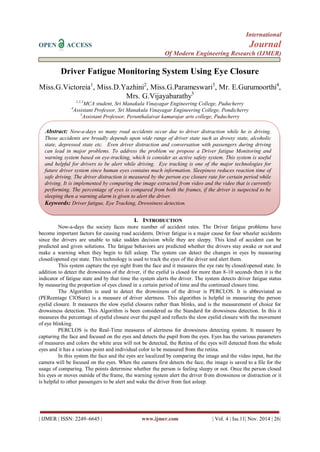

International 
OPEN ACCESS Journal 
Of Modern Engineering Research (IJMER) 
| IJMER | ISSN: 2249–6645 | www.ijmer.com | Vol. 4 | Iss.11| Nov. 2014 | 26| 
Driver Fatigue Monitoring System Using Eye Closure Miss.G.Victoreia1, Miss.D.Yazhini2, Miss.G.Parameswari3, Mr. E.Gurumoorthi4, Mrs. G.Vijayabarathy5 1,2,3MCA student, Sri Manakula Vinayagar Engineering College, Puducherry 4Assistant Professor, Sri Manakula Vinayagar Engineering College, Pondicherry 5Assistant Professor, Perunthalaivar kamarajar arts college, Puducherry 
I. INTRODUCTION 
Now-a-days the society faces more number of accident rates. The Driver fatigue problems have become important factors for causing road accidents. Driver fatigue is a major cause for four wheeler accidents since the drivers are unable to take sudden decision while they are sleepy. This kind of accident can be predicted and given solutions. The fatigue behaviors are predicted whether the drivers stay awake or not and make a warning when they begin to fall asleep. The system can detect the changes in eyes by measuring closed/opened eye state. This technology is used to track the eyes of the driver and alert them. This system capture the eye sight from the face and it measures the eye rate by closed/opened state. In addition to detect the drowsiness of the driver, if the eyelid is closed for more than 8-10 seconds then it is the indicator of fatigue state and by that time the system alerts the driver. The system detects driver fatigue status by measuring the proportion of eyes closed in a certain period of time and the continued closure time. The Algorithm is used to detect the drowsiness of the driver is PERCLOS. It is abbreviated as (PERcentage ClOSure) is a measure of driver alertness. This algorithm is helpful in measuring the person eyelid closure. It measures the slow eyelid closures rather than blinks, and is the measurement of choice for drowsiness detection. This Algorithm is been considered as the Standard for drowsiness detection. In this it measures the percentage of eyelid closure over the pupil and reflects the slow eyelid closure with the movement of eye blinking. PERCLOS is the Real-Time measures of alertness for drowsiness detecting system. It measure by capturing the face and focused on the eyes and detects the pupil from the eyes. Eyes has the various parameters of measures and colors the white area will not be detected, the Retina of the eyes will detected from the whole eyes and it has a various point and individual color to be measured from the retina. In this system the face and the eyes are localized by comparing the image and the video input, but the camera will be focused on the eyes. When the camera first detects the face, the image is saved to a file for the usage of comparing. The points determine whether the person is feeling sleepy or not. Once the person closed his eyes or moves outside of the frame, the warning system alert the driver from drowsiness or distraction or it is helpful to other passengers to be alert and wake the driver from fast asleep. 
A Abstract: Now-a-days so many road accidents occur due to driver distraction while he is driving. Those accidents are broadly depends upon wide range of driver state such as drowsy state, alcoholic state, depressed state etc. Even driver distraction and conversation with passengers during driving can lead in major problems. To address the problem we propose a Driver fatigue Monitoring and warning system based on eye-tracking, which is consider as active safety system. This system is useful and helpful for drivers to be alert while driving. Eye tracking is one of the major technologies for future driver system since human eyes contains much information. Sleepiness reduces reaction time of safe driving. The driver distraction is measured by the person eye closure rate for certain period while driving. It is implemented by comparing the image extracted from video and the video that is currently performing. The percentage of eyes is compared from both the frames, if the driver is suspected to be sleeping then a warning alarm is given to alert the driver. 
Keywords: Driver fatigue, Eye Tracking, Drowsiness detection.
Driver Fatigue Monitoring System Using Eye Closure 
| IJMER | ISSN: 2249–6645 | www.ijmer.com | Vol. 4 | Iss.11| Nov. 2014 | 27| 
II. EXISTING SYSTEM 
The existing system evaluate whether changes in the eye-steering correlation that can indicate distraction. The auto-correlation and cross-correlation of horizontal eye position and steering wheel angle show that eye movements associated with road scanning procedure a low eye steering correlation. The eye steering correlation will control the relationship on a straight road. The straight road led to a low correlation between the steering movement and eye glances. In this system it is aim to detect the driver distraction based on visual behavior or the performance of the driver so for this purpose it is used to define the relationship between the visual behavior and the vehicle control. This system evaluates the eye-steering correlation associated with the straight road with the assumption that it might show a qualitatively and quantitatively different relationship compared with curvy road and that it might be sensitive to distraction. Here in the visual behavior and vehicle control relationship reflects a fundamental perception-control mechanism which plays a major role in driving and a strong eye- steering correlation associated with this process has been observed on curvy roads. 
1. Driver Distraction Detection Algorithm 
Driver Distraction Detection Algorithm is used in earlier system which is the combination of glance behavior and vehicle control. Two types of distraction are focused: 
a) Cognitive b) Visual 
Cognitive described as “Mind-off-road” and Visual has been described as “Eye-off-road”. Cognitive tasks tend to reduce the lane position variance and visual tasks tend to increase the variance. Although both can determine the driving performance, their effects are different. 
2. Disadvantage in Cognitive distraction detection 
Although it improves drive performance it degrades. Longitudinal control with hazards perception. It is complex because the mechanism involved in cognitive distraction has not been precisely described. There are two approach has given in distraction detection algorithm. First approach focuses distraction detection systems on visual behavior and another approach focuses on driver behavior such as speed, lane position and steering. Considering a combination of both glance behavior and vehicle control might increase algorithm sensitivity to detecting different types of inattention. This paper presents a new approach to algorithm design that focuses on the relationship between the eye movement and steering wheel movement. 
3. Eye-steering coordination 
Two modeling approaches are there to describe and predict the allocation of driver‟s visual attention. They are: 
a) Models of visual search: 
This model describes how people locate targets in the environment to complete the task. 
b) Models of visual sampling: 
This model describes a scanning pattern of particular areas to find relevant information 4. Problems related with existing system 
 For identifying the driver‟s fatigue level, detecting the eye state is important more than detecting the eye- steering correlation. 
 Correlation between the eye-steering is complex and might produce wrong results undetermined cases. 
 Steering movements consists of large calculations and graphs and it is difficult to merge with eye movements in all type of roads. Lane determination is not necessary for driver distraction. 
III. PROPOSED SYSTEM 
In the proposed system, the driver fatigue and distraction is detected only by processing of eye region. The main symptoms of driver fatigue and distraction appear in the driver‟s eyes because of sleeping while driving. Nowadays, there are many fatigue detection methods and the best is capturing the eyes in real time using web camera to detect the physical responses in eyes. Moreover, the processing of the eye region instead of the processing of the face region has less computational complexity.
Driver Fatigue Monitoring System Using Eye Closure 
| IJMER | ISSN: 2249–6645 | www.ijmer.com | Vol. 4 | Iss.11| Nov. 2014 | 28| 
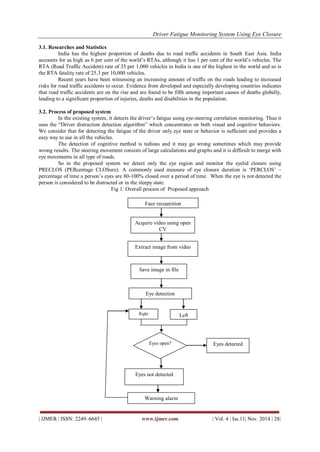
3.1. Researches and Statistics India has the highest proportion of deaths due to road traffic accidents in South East Asia. India accounts for as high as 6 per cent of the world‟s RTAs, although it has 1 per cent of the world‟s vehicles. The RTA (Road Traffic Accident) rate of 35 per 1,000 vehicles in India is one of the highest in the world and so is the RTA fatality rate of 25.3 per 10,000 vehicles. Recent years have been witnessing an increasing amount of traffic on the roads leading to increased risks for road traffic accidents to occur. Evidence from developed and especially developing countries indicates that road traffic accidents are on the rise and are found to be fifth among important causes of deaths globally, leading to a significant proportion of injuries, deaths and disabilities in the population. 3.2. Process of proposed system In the existing system, it detects the driver‟s fatigue using eye-steering correlation monitoring. Thus it uses the “Driver distraction detection algorithm” which concentrates on both visual and cognitive behaviors. We consider that for detecting the fatigue of the driver only eye state or behavior is sufficient and provides a easy way to use in all the vehicles. The detection of cognitive method is tedious and it may go wrong sometimes which may provide wrong results. The steering movement consists of large calculations and graphs and it is difficult to merge with eye movements in all type of roads. So in the proposed system we detect only the eye region and monitor the eyelid closure using PRECLOS (PERcentage CLOSure). A commonly used measure of eye closure duration is „PERCLOS‟ – percentage of time a person‟s eyes are 80-100% closed over a period of time. When the eye is not detected the person is considered to be distracted or in the sleepy state. Fig 1: Overall process of Proposed approach 
Face recognition 
Acquire video using open CV 
Extract image from video 
Save image in file 
Eyes open? 
Eye detection 
Right 
Left 
Eyes not detected 
Eyes detected 
Warning alarm
Driver Fatigue Monitoring System Using Eye Closure 
| IJMER | ISSN: 2249–6645 | www.ijmer.com | Vol. 4 | Iss.11| Nov. 2014 | 29| 
3.3 PERCLOS algorithm 
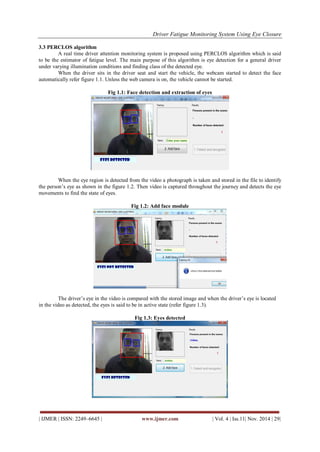
A real time driver attention monitoring system is proposed using PERCLOS algorithm which is said to be the estimator of fatigue level. The main purpose of this algorithm is eye detection for a general driver under varying illumination conditions and finding class of the detected eye. When the driver sits in the driver seat and start the vehicle, the webcam started to detect the face automatically refer figure 1.1. Unless the web camera is on, the vehicle cannot be started. Fig 1.1: Face detection and extraction of eyes When the eye region is detected from the video a photograph is taken and stored in the file to identify the person‟s eye as shown in the figure 1.2. Then video is captured throughout the journey and detects the eye movements to find the state of eyes. Fig 1.2: Add face module The driver‟s eye in the video is compared with the stored image and when the driver‟s eye is located in the video as detected, the eyes is said to be in active state (refer figure 1.3). Fig 1.3: Eyes detected
Driver Fatigue Monitoring System Using Eye Closure 
| IJMER | ISSN: 2249–6645 | www.ijmer.com | Vol. 4 | Iss.11| Nov. 2014 | 30| 
The driver‟s eye in the video is compared with the stored image and when the driver‟s eye is not located in the video then he is said to be distracted and a message is given as shown in figure 1.4. When the eye‟s is found to be in the closed state automatically an alarm signal is given to awaken the driver. This system not only detects the drowsiness of the driver it also detects the driver distraction such as moving, looking around etc. The timely warning alerts the driver as well as the passengers to be aware of the happening. Fig 1.4: Eyes not detected 3.4 Advantages 
 Accidents can be avoided by alerting the driver‟s distraction and drowsiness using warning signals. 
 Comparing to the driver detection algorithm this PERCLOS system reduces the time complexity. 
 It is used to track the alertness of the driver throughout the journey. 
 The warning alarm alerts the driver as well as the passengers to be conscious about the driver‟s behavior. 
 This system typically behaves as a user-friendly application. 
IV. CONCLUSION 
This system will analyze the state of driver‟s eye state whether it is closed or opened. If it is closed then produce the warning alarm to awaken the driver and prevent the vehicle from accident. By monitoring the driver‟s eye state using the PRECLOS algorithm by web camera the system can detect symptoms of driver fatigue early enough to avoid an accident and save people life by detecting the distraction an drowsiness. So this project is useful and easy to detect the driver‟s fatigue level and give the warning output in the form of sound to alert the driver as well as the passengers. 
REFERENCES 
Journal Papers: 
[1] Lora yekhshatyan, John D.Lee, ” Changes in correlation between eye and sterring movements indicate driver distraction” IEEE trans. Intell. Transp. Syst.,vol .14, no.1,pp. 136-145,Mar 2013. 
[2] Mohamad-Hoseyn Sigari, Mahmood Fathy, Mohsen Soryani, “A Driver Face Monitoring System for Fatigue and Distraction Detection” International Journal of Vehicular Technology, Volume 2013 (2013), Article ID 263983. 
[3] Boon-Giin Lee , Wan-Young Chung, “Driver Alertness Monitoring Using Fusion of Facial Features and Bio- Signals” IEEE sensor journal., vol. 12, no. 7, pp. 2416-2422, july. 2012. 
[4] Yanchao Dong, Zhencheng Hu ,Uchimura K, Murayama. N “Driver Inattention Monitoring system for Intelligent Vehicles” IEEE trans. Intell.Transp. Syst., vol .12, Issue . 2, no.1,pp. 596-614, 2011. 
[5] M.Omidyeganesh,Javadtalab.A,Shirmohammadhi.S “Intelligent driver drowsiness detection through fusion of yawning and eye closure” Virtual Environments Human-Computer Interfaces and Measurement Systems (VECIMS), 2011 IEEE International Conference on Sep-2011 
[6] I.Daza, N. Hernandez, L. Bergasa, I. Parra, J. Yebes, M. Gavilan, R. Quintero, D. Llorca, and M. Sotelo, "Drowsiness monitoring based on driver and driving data fusion" in Intelligent Transportation Systems (ITSC), 2011 14th International IEEE Conference on, oct. 2011, pp. 1199-1204. 
[7] M.Wollmer, C.Blaschke, T.Schindl, B.Schuller, B.farber, S.Mayer, and B.Treffich. ”Online Driver Distraction Detection using short-term Memory” IEEE trans.intell. transp.syst., vol.12, no.2, pp.574-582, jun 2011. 
[8] Hardeep Singh, J,S Bhatia, Jasbir Kaur, “Eye Tracking based driver fatigue monitoring and Warning System” Power electronics (IICPE),2010 India International Conference on Jan-2011, ISBN:978-1-4244-7883-5, INSPEC Accession no: 11873780, publisher: IEEE.
Driver Fatigue Monitoring System Using Eye Closure 
| IJMER | ISSN: 2249–6645 | www.ijmer.com | Vol. 4 | Iss.11| Nov. 2014 | 31| 
[9] Marco Javier Flores, Jose Maria Armingol, Arturo de la Escalera, “Real Time Warning System for Driver Drowsiness Detection Using Visual Information” Vol. 59, Issue. 2, pp. 103-125, August 2010. 
[10] L. Yunqi, Y. Meiling, S. Xiaobing, L.Xiuxia, O. Jiangfan, “Recognition Of Eye States in Real Time Video” in Proceedings of the International Conference on Computer Engineering and Technology, IEEE Computer Society, Vol. 10, No.105, 2009, pp. 554-559. 
[11] M. Wilson, M. Chattington, and D. E. Marple-Horvat, “Eye movements drive steering: Reduced eye movement distribution impairs steering and driving performance” J. Motor Behav., vol. 40, no. 3, pp. 190–202, May 2008. 
[12] E. Rogado, J.L. García, R. Barea, L.M. Bergasa, E. López, “Driver Fatigue Detection System” in the Proceedings of the IEEE International Conference on Robotics and Biomimetics Bangkok, Thailand, 2009, pp.1105-1110. 
[13] M.H Sigari, “Driver Hypo-Vigilance Detection based on Eyelid Behavior” in Proceedings of the Seventh International Conference on Advances in Pattern Recognition, IEEE Computer Society, 2009. pp. 426-429. 
[14] Dr. P.R Bajaj, M.S Devi, “Driver Fatigue Detection Based on Eye Tracking” in Proceedings of the First International Conference on Emerging Trends in Engineering and Technology, IEEE Computer Society, 2008, pp. 649-652. 
[15] Branzan, A., Widsten, B., Wang, T., Lan, J., Mah, J. “A computer vision-based system for real-time detection of sleep onset in fatigued drivers” In: IEEE Intelligent Vehicles Symposium, pp. 25–30 (2008).

Driver Fatigue Monitoring System Using Eye Closure

  • 1.
    International OPEN ACCESSJournal Of Modern Engineering Research (IJMER) | IJMER | ISSN: 2249–6645 | www.ijmer.com | Vol. 4 | Iss.11| Nov. 2014 | 26| Driver Fatigue Monitoring System Using Eye Closure Miss.G.Victoreia1, Miss.D.Yazhini2, Miss.G.Parameswari3, Mr. E.Gurumoorthi4, Mrs. G.Vijayabarathy5 1,2,3MCA student, Sri Manakula Vinayagar Engineering College, Puducherry 4Assistant Professor, Sri Manakula Vinayagar Engineering College, Pondicherry 5Assistant Professor, Perunthalaivar kamarajar arts college, Puducherry I. INTRODUCTION Now-a-days the society faces more number of accident rates. The Driver fatigue problems have become important factors for causing road accidents. Driver fatigue is a major cause for four wheeler accidents since the drivers are unable to take sudden decision while they are sleepy. This kind of accident can be predicted and given solutions. The fatigue behaviors are predicted whether the drivers stay awake or not and make a warning when they begin to fall asleep. The system can detect the changes in eyes by measuring closed/opened eye state. This technology is used to track the eyes of the driver and alert them. This system capture the eye sight from the face and it measures the eye rate by closed/opened state. In addition to detect the drowsiness of the driver, if the eyelid is closed for more than 8-10 seconds then it is the indicator of fatigue state and by that time the system alerts the driver. The system detects driver fatigue status by measuring the proportion of eyes closed in a certain period of time and the continued closure time. The Algorithm is used to detect the drowsiness of the driver is PERCLOS. It is abbreviated as (PERcentage ClOSure) is a measure of driver alertness. This algorithm is helpful in measuring the person eyelid closure. It measures the slow eyelid closures rather than blinks, and is the measurement of choice for drowsiness detection. This Algorithm is been considered as the Standard for drowsiness detection. In this it measures the percentage of eyelid closure over the pupil and reflects the slow eyelid closure with the movement of eye blinking. PERCLOS is the Real-Time measures of alertness for drowsiness detecting system. It measure by capturing the face and focused on the eyes and detects the pupil from the eyes. Eyes has the various parameters of measures and colors the white area will not be detected, the Retina of the eyes will detected from the whole eyes and it has a various point and individual color to be measured from the retina. In this system the face and the eyes are localized by comparing the image and the video input, but the camera will be focused on the eyes. When the camera first detects the face, the image is saved to a file for the usage of comparing. The points determine whether the person is feeling sleepy or not. Once the person closed his eyes or moves outside of the frame, the warning system alert the driver from drowsiness or distraction or it is helpful to other passengers to be alert and wake the driver from fast asleep. A Abstract: Now-a-days so many road accidents occur due to driver distraction while he is driving. Those accidents are broadly depends upon wide range of driver state such as drowsy state, alcoholic state, depressed state etc. Even driver distraction and conversation with passengers during driving can lead in major problems. To address the problem we propose a Driver fatigue Monitoring and warning system based on eye-tracking, which is consider as active safety system. This system is useful and helpful for drivers to be alert while driving. Eye tracking is one of the major technologies for future driver system since human eyes contains much information. Sleepiness reduces reaction time of safe driving. The driver distraction is measured by the person eye closure rate for certain period while driving. It is implemented by comparing the image extracted from video and the video that is currently performing. The percentage of eyes is compared from both the frames, if the driver is suspected to be sleeping then a warning alarm is given to alert the driver. Keywords: Driver fatigue, Eye Tracking, Drowsiness detection.
  • 2.
    Driver Fatigue MonitoringSystem Using Eye Closure | IJMER | ISSN: 2249–6645 | www.ijmer.com | Vol. 4 | Iss.11| Nov. 2014 | 27| II. EXISTING SYSTEM The existing system evaluate whether changes in the eye-steering correlation that can indicate distraction. The auto-correlation and cross-correlation of horizontal eye position and steering wheel angle show that eye movements associated with road scanning procedure a low eye steering correlation. The eye steering correlation will control the relationship on a straight road. The straight road led to a low correlation between the steering movement and eye glances. In this system it is aim to detect the driver distraction based on visual behavior or the performance of the driver so for this purpose it is used to define the relationship between the visual behavior and the vehicle control. This system evaluates the eye-steering correlation associated with the straight road with the assumption that it might show a qualitatively and quantitatively different relationship compared with curvy road and that it might be sensitive to distraction. Here in the visual behavior and vehicle control relationship reflects a fundamental perception-control mechanism which plays a major role in driving and a strong eye- steering correlation associated with this process has been observed on curvy roads. 1. Driver Distraction Detection Algorithm Driver Distraction Detection Algorithm is used in earlier system which is the combination of glance behavior and vehicle control. Two types of distraction are focused: a) Cognitive b) Visual Cognitive described as “Mind-off-road” and Visual has been described as “Eye-off-road”. Cognitive tasks tend to reduce the lane position variance and visual tasks tend to increase the variance. Although both can determine the driving performance, their effects are different. 2. Disadvantage in Cognitive distraction detection Although it improves drive performance it degrades. Longitudinal control with hazards perception. It is complex because the mechanism involved in cognitive distraction has not been precisely described. There are two approach has given in distraction detection algorithm. First approach focuses distraction detection systems on visual behavior and another approach focuses on driver behavior such as speed, lane position and steering. Considering a combination of both glance behavior and vehicle control might increase algorithm sensitivity to detecting different types of inattention. This paper presents a new approach to algorithm design that focuses on the relationship between the eye movement and steering wheel movement. 3. Eye-steering coordination Two modeling approaches are there to describe and predict the allocation of driver‟s visual attention. They are: a) Models of visual search: This model describes how people locate targets in the environment to complete the task. b) Models of visual sampling: This model describes a scanning pattern of particular areas to find relevant information 4. Problems related with existing system  For identifying the driver‟s fatigue level, detecting the eye state is important more than detecting the eye- steering correlation.  Correlation between the eye-steering is complex and might produce wrong results undetermined cases.  Steering movements consists of large calculations and graphs and it is difficult to merge with eye movements in all type of roads. Lane determination is not necessary for driver distraction. III. PROPOSED SYSTEM In the proposed system, the driver fatigue and distraction is detected only by processing of eye region. The main symptoms of driver fatigue and distraction appear in the driver‟s eyes because of sleeping while driving. Nowadays, there are many fatigue detection methods and the best is capturing the eyes in real time using web camera to detect the physical responses in eyes. Moreover, the processing of the eye region instead of the processing of the face region has less computational complexity.
  • 3.
    Driver Fatigue MonitoringSystem Using Eye Closure | IJMER | ISSN: 2249–6645 | www.ijmer.com | Vol. 4 | Iss.11| Nov. 2014 | 28| 3.1. Researches and Statistics India has the highest proportion of deaths due to road traffic accidents in South East Asia. India accounts for as high as 6 per cent of the world‟s RTAs, although it has 1 per cent of the world‟s vehicles. The RTA (Road Traffic Accident) rate of 35 per 1,000 vehicles in India is one of the highest in the world and so is the RTA fatality rate of 25.3 per 10,000 vehicles. Recent years have been witnessing an increasing amount of traffic on the roads leading to increased risks for road traffic accidents to occur. Evidence from developed and especially developing countries indicates that road traffic accidents are on the rise and are found to be fifth among important causes of deaths globally, leading to a significant proportion of injuries, deaths and disabilities in the population. 3.2. Process of proposed system In the existing system, it detects the driver‟s fatigue using eye-steering correlation monitoring. Thus it uses the “Driver distraction detection algorithm” which concentrates on both visual and cognitive behaviors. We consider that for detecting the fatigue of the driver only eye state or behavior is sufficient and provides a easy way to use in all the vehicles. The detection of cognitive method is tedious and it may go wrong sometimes which may provide wrong results. The steering movement consists of large calculations and graphs and it is difficult to merge with eye movements in all type of roads. So in the proposed system we detect only the eye region and monitor the eyelid closure using PRECLOS (PERcentage CLOSure). A commonly used measure of eye closure duration is „PERCLOS‟ – percentage of time a person‟s eyes are 80-100% closed over a period of time. When the eye is not detected the person is considered to be distracted or in the sleepy state. Fig 1: Overall process of Proposed approach Face recognition Acquire video using open CV Extract image from video Save image in file Eyes open? Eye detection Right Left Eyes not detected Eyes detected Warning alarm
  • 4.
    Driver Fatigue MonitoringSystem Using Eye Closure | IJMER | ISSN: 2249–6645 | www.ijmer.com | Vol. 4 | Iss.11| Nov. 2014 | 29| 3.3 PERCLOS algorithm A real time driver attention monitoring system is proposed using PERCLOS algorithm which is said to be the estimator of fatigue level. The main purpose of this algorithm is eye detection for a general driver under varying illumination conditions and finding class of the detected eye. When the driver sits in the driver seat and start the vehicle, the webcam started to detect the face automatically refer figure 1.1. Unless the web camera is on, the vehicle cannot be started. Fig 1.1: Face detection and extraction of eyes When the eye region is detected from the video a photograph is taken and stored in the file to identify the person‟s eye as shown in the figure 1.2. Then video is captured throughout the journey and detects the eye movements to find the state of eyes. Fig 1.2: Add face module The driver‟s eye in the video is compared with the stored image and when the driver‟s eye is located in the video as detected, the eyes is said to be in active state (refer figure 1.3). Fig 1.3: Eyes detected
  • 5.
    Driver Fatigue MonitoringSystem Using Eye Closure | IJMER | ISSN: 2249–6645 | www.ijmer.com | Vol. 4 | Iss.11| Nov. 2014 | 30| The driver‟s eye in the video is compared with the stored image and when the driver‟s eye is not located in the video then he is said to be distracted and a message is given as shown in figure 1.4. When the eye‟s is found to be in the closed state automatically an alarm signal is given to awaken the driver. This system not only detects the drowsiness of the driver it also detects the driver distraction such as moving, looking around etc. The timely warning alerts the driver as well as the passengers to be aware of the happening. Fig 1.4: Eyes not detected 3.4 Advantages  Accidents can be avoided by alerting the driver‟s distraction and drowsiness using warning signals.  Comparing to the driver detection algorithm this PERCLOS system reduces the time complexity.  It is used to track the alertness of the driver throughout the journey.  The warning alarm alerts the driver as well as the passengers to be conscious about the driver‟s behavior.  This system typically behaves as a user-friendly application. IV. CONCLUSION This system will analyze the state of driver‟s eye state whether it is closed or opened. If it is closed then produce the warning alarm to awaken the driver and prevent the vehicle from accident. By monitoring the driver‟s eye state using the PRECLOS algorithm by web camera the system can detect symptoms of driver fatigue early enough to avoid an accident and save people life by detecting the distraction an drowsiness. So this project is useful and easy to detect the driver‟s fatigue level and give the warning output in the form of sound to alert the driver as well as the passengers. REFERENCES Journal Papers: [1] Lora yekhshatyan, John D.Lee, ” Changes in correlation between eye and sterring movements indicate driver distraction” IEEE trans. Intell. Transp. Syst.,vol .14, no.1,pp. 136-145,Mar 2013. [2] Mohamad-Hoseyn Sigari, Mahmood Fathy, Mohsen Soryani, “A Driver Face Monitoring System for Fatigue and Distraction Detection” International Journal of Vehicular Technology, Volume 2013 (2013), Article ID 263983. [3] Boon-Giin Lee , Wan-Young Chung, “Driver Alertness Monitoring Using Fusion of Facial Features and Bio- Signals” IEEE sensor journal., vol. 12, no. 7, pp. 2416-2422, july. 2012. [4] Yanchao Dong, Zhencheng Hu ,Uchimura K, Murayama. N “Driver Inattention Monitoring system for Intelligent Vehicles” IEEE trans. Intell.Transp. Syst., vol .12, Issue . 2, no.1,pp. 596-614, 2011. [5] M.Omidyeganesh,Javadtalab.A,Shirmohammadhi.S “Intelligent driver drowsiness detection through fusion of yawning and eye closure” Virtual Environments Human-Computer Interfaces and Measurement Systems (VECIMS), 2011 IEEE International Conference on Sep-2011 [6] I.Daza, N. Hernandez, L. Bergasa, I. Parra, J. Yebes, M. Gavilan, R. Quintero, D. Llorca, and M. Sotelo, "Drowsiness monitoring based on driver and driving data fusion" in Intelligent Transportation Systems (ITSC), 2011 14th International IEEE Conference on, oct. 2011, pp. 1199-1204. [7] M.Wollmer, C.Blaschke, T.Schindl, B.Schuller, B.farber, S.Mayer, and B.Treffich. ”Online Driver Distraction Detection using short-term Memory” IEEE trans.intell. transp.syst., vol.12, no.2, pp.574-582, jun 2011. [8] Hardeep Singh, J,S Bhatia, Jasbir Kaur, “Eye Tracking based driver fatigue monitoring and Warning System” Power electronics (IICPE),2010 India International Conference on Jan-2011, ISBN:978-1-4244-7883-5, INSPEC Accession no: 11873780, publisher: IEEE.
  • 6.
    Driver Fatigue MonitoringSystem Using Eye Closure | IJMER | ISSN: 2249–6645 | www.ijmer.com | Vol. 4 | Iss.11| Nov. 2014 | 31| [9] Marco Javier Flores, Jose Maria Armingol, Arturo de la Escalera, “Real Time Warning System for Driver Drowsiness Detection Using Visual Information” Vol. 59, Issue. 2, pp. 103-125, August 2010. [10] L. Yunqi, Y. Meiling, S. Xiaobing, L.Xiuxia, O. Jiangfan, “Recognition Of Eye States in Real Time Video” in Proceedings of the International Conference on Computer Engineering and Technology, IEEE Computer Society, Vol. 10, No.105, 2009, pp. 554-559. [11] M. Wilson, M. Chattington, and D. E. Marple-Horvat, “Eye movements drive steering: Reduced eye movement distribution impairs steering and driving performance” J. Motor Behav., vol. 40, no. 3, pp. 190–202, May 2008. [12] E. Rogado, J.L. García, R. Barea, L.M. Bergasa, E. López, “Driver Fatigue Detection System” in the Proceedings of the IEEE International Conference on Robotics and Biomimetics Bangkok, Thailand, 2009, pp.1105-1110. [13] M.H Sigari, “Driver Hypo-Vigilance Detection based on Eyelid Behavior” in Proceedings of the Seventh International Conference on Advances in Pattern Recognition, IEEE Computer Society, 2009. pp. 426-429. [14] Dr. P.R Bajaj, M.S Devi, “Driver Fatigue Detection Based on Eye Tracking” in Proceedings of the First International Conference on Emerging Trends in Engineering and Technology, IEEE Computer Society, 2008, pp. 649-652. [15] Branzan, A., Widsten, B., Wang, T., Lan, J., Mah, J. “A computer vision-based system for real-time detection of sleep onset in fatigued drivers” In: IEEE Intelligent Vehicles Symposium, pp. 25–30 (2008).