Pranav Mandani
Driver drowsiness detection
Presented by
Modern Education Society college of Engineering
A seminar on
Content
• Introduction
• Motivation
• Problem Statement
• Objective
• Literature Survey
• Methodology
• Conclusion
• References
Introduction
• Driver drowsiness detection is a car safety technology which helps prevent accidents caused by the
driver getting drowsy
• Drowsiness is the state of feeling tired or sleepy.
• These happens on most factors if the driver drowsy or if it is alcoholic.
• The number of accidents as a result of drowsiness is increasing day by day.
• Recent statistics estimate that annually 76,000 injuries and 1200 deaths can be attributed to
drowsiness related crashes.
• The advancement of technology in detecting the drowsiness of the driver is a noteworthy challenge
as it can help reduce the probability of accidents taking place resulting in decrease in the death and
injuries caused due to drowsy driving.
• Detection in real-time is the major challenge in the field of accident prevention system.
Motivation
• There is a Huge increase in private transportation day by day in today’s world.
• It is tedious or bored to drive for a long period of time.
• Tired driver can get drowsy while driving. Every fraction of seconds drowsiness can turn into
dangerous and life-threatening accidents may lead to death also.
• To prevent this type of incidents, it is required to monitor driver’s alertness continuously and
when it detects drowsiness, the driver should be alerted.
• Through this we can reduce significant number of accidents and can save lives of people.
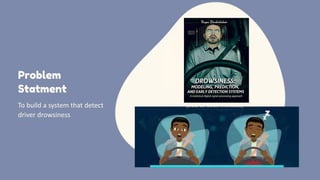
To build a system that detect
driver drowsiness
Problem
Statment
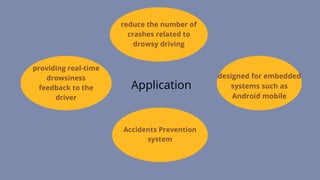
Application
reduce the number of
crashes related to
drowsy driving
providing real-time
drowsiness
feedback to the
driver
designed for embedded
systems such as
Android mobile
Accidents Prevention
system
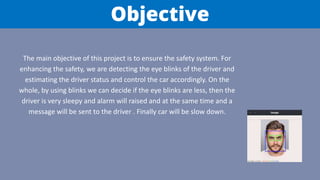
The main objective of this project is to ensure the safety system. For
enhancing the safety, we are detecting the eye blinks of the driver and
estimating the driver status and control the car accordingly. On the
whole, by using blinks we can decide if the eye blinks are less, then the
driver is very sleepy and alarm will raised and at the same time and a
message will be sent to the driver . Finally car will be slow down.
Objective
Literature Survey
This survey is done to comprehend the need and prerequisite of the general population, and to do
as such, we went through different sites and applications and looked for the fundamental data.
Based on these data, that helped us get new thoughts and make different arrangements for our
task. We reached the decision that there is a need of such application According to the experts it
has been observed that when the drivers do not take break they tend to run a high risk of
becoming drowsy. Study shows that accidents occur due to sleepy drivers in need of a rest, which
means that road accidents occurs more due to drowsiness rather than drink-driving. Attention
assist can warn of inattentiveness and drowsiness in an extended speed range and notify drivers of
their current state of fatigue and the driving time since the last break, offers adjustable sensitivity
and, if a warning is emitted, indicates nearby service areas in the COMAND navigation system
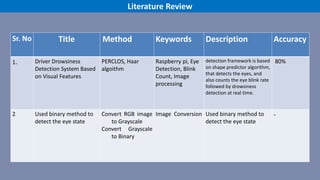
Sr. No Title Method Keywords Description Accuracy
1. Driver Drowsiness
Detection System Based
on Visual Features
PERCLOS, Haar
algoithm
Raspberry pi, Eye
Detection, Blink
Count, Image
processing
detection framework is based
on shape predictor algorithm,
that detects the eyes, and
also counts the eye blink rate
followed by drowsiness
detection at real time.
80%
2. Used binary method to
detect the eye state
Convert RGB image
to Grayscale
Convert Grayscale
to Binary
Image Conversion Used binary method to
detect the eye state
-
Literature Review
Sr. No Title Method Keywords Description Accuracy
3. Driver fatigue detection
based on eye state
recognition
AdaBoost, LBF and
PERCLOS
Raspberry pi, Eye
Detection, Blink
Count, Image
processing
detection framework is based
on shape predictor algorithm,
that detects the eyes, and
also counts the eye blink rate
followed by drowsiness
detection at real time.
80%
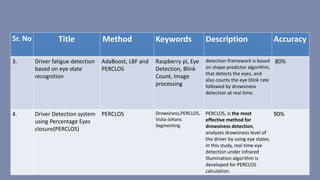
4. Driver Detection system
using Percentage Eyes
closure(PERCLOS)
PERCLOS Drowsiness,PERCLOS,
Viola-Johans
Segmenting
PERCLOS, is the most
effective method for
drowsiness detection,
analyzes drowsiness level of
the driver by using eye states.
In this study, real time eye
detection under infrared
illumination algorithm is
developed for PERCLOS
calculation.
90%
Sr. No Title Method Keywords Description Accuracy
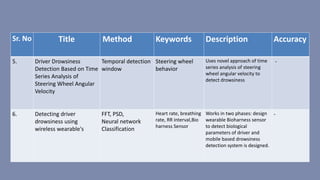
5. Driver Drowsiness
Detection Based on Time
Series Analysis of
Steering Wheel Angular
Velocity
Temporal detection
window
Steering wheel
behavior
Uses novel approach of time
series analysis of steering
wheel angular velocity to
detect drowsiness
-
6. Detecting driver
drowsiness using
wireless wearable's
FFT, PSD,
Neural network
Classification
Heart rate, breathing
rate, RR interval,Bio
harness Sensor
Works in two phases: design
wearable Bioharness sensor
to detect biological
parameters of driver and
mobile based drowsiness
detection system is designed.
-
Methodology
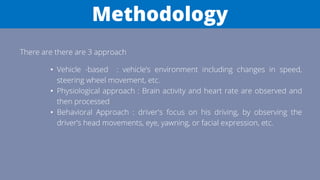
There are there are 3 approach
• Vehicle -based : vehicle’s environment including changes in speed,
steering wheel movement, etc.
• Physiological approach : Brain activity and heart rate are observed and
then processed
• Behavioral Approach : driver's focus on his driving, by observing the
driver’s head movements, eye, yawning, or facial expression, etc.
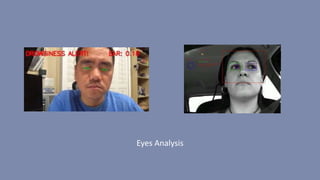
Behavioral-Approach
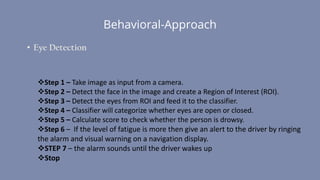
• Eye Detection
Step 1 – Take image as input from a camera.
Step 2 – Detect the face in the image and create a Region of Interest (ROI).
Step 3 – Detect the eyes from ROI and feed it to the classifier.
Step 4 – Classifier will categorize whether eyes are open or closed.
Step 5 – Calculate score to check whether the person is drowsy.
Step 6 – If the level of fatigue is more then give an alert to the driver by ringing
the alarm and visual warning on a navigation display.
STEP 7 – the alarm sounds until the driver wakes up
Stop
Eyes Analysis
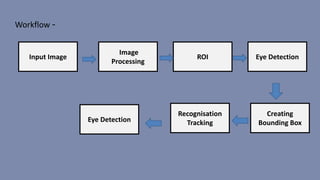
Workflow -
Input Image
Image
Processing
ROI Eye Detection
Creating
Bounding Box
Recognisation
Tracking
Eye Detection
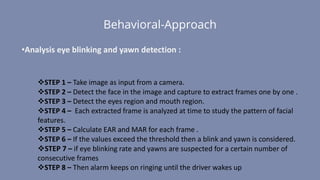
Behavioral-Approach
STEP 1 – Take image as input from a camera.
STEP 2 – Detect the face in the image and capture to extract frames one by one .
STEP 3 – Detect the eyes region and mouth region.
STEP 4 – Each extracted frame is analyzed at time to study the pattern of facial
features.
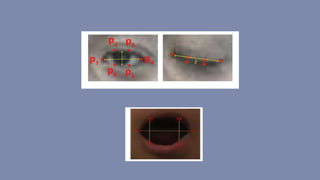
STEP 5 – Calculate EAR and MAR for each frame .
STEP 6 – If the values exceed the threshold then a blink and yawn is considered.
STEP 7 – if eye blinking rate and yawns are suspected for a certain number of
consecutive frames
STEP 8 – Then alarm keeps on ringing until the driver wakes up
•Analysis eye blinking and yawn detection :
Conclusion
In order for the system to detect sleepiness successfully, a set of parameters need to be given to the
system manually, and it detects the drowsiness based on values that are being calculated
Thus with 3 measures or approaches we can detect driver’s drowsiness , where we seen the behavioral
approach , as it cost low.
The work is based on behavior analysis, high end camera installation and conventional algorithm to detect
the possible coordinate to identify eyes and mouth.
Wearing glasses (of any kind) cause the system to fail.
. In future, wearable device should be proposed in order to have more accuracy and efficiency for
detecting the drowsiness and fatigue of the driver to minimize the rate of road accidents.
References
• Sankaran, K.Sakthidasan; Vasudevan, N.; Nagarajan, V. (2020). [IEEE 2020 International Conference on Communication and Signal Processing (ICCSP) - Chennai, India
(2020.7.28-2020.7.30)] 2020 International Conference on Communication and Signal Processing (ICCSP) - Driver Drowsiness Detection using Percentage Eye Closure
Method. , (), 1422–1425.
• G. Zhenhai, L. DinhDat, H. Hongyu, Y. Ziwen, and W. Xingu, “Driver Drowsiness Detection Based on Time Series Analysis of Steering Wheel Angular Velocity,” in
Measuring Technology and Mechatronics Automation (ICMTMA), 2017 9th International Conference on, 2017, pp. 99–101.
• ] B. Warwick, N. Symons, X. Chen, and K. Xiong, “Detecting driver drowsiness using wireless wearable's,” in Mobile Ad Hoc and Sensor Systems (MASS), 2015 IEEE
12th International Conference on, 2015, pp. 585–588
• Fouzia, ; Roopalakshmi, R.; Rathod, Jayantkumar A.; Shetty, Ashwitha S.; Supriya, K. (2018). [IEEE 2018 Second International Conference on Inventive Communication
and Computational Technologies (ICICCT) - Coimbatore (2018.4.20-2018.4.21)] 2018 Second International Conference on Inventive Communication and
Computational Technologies (ICICCT) - Driver Drowsiness Detection System Based on Visual Features.
• Jie, Zhuoni; Mahmoud, Marwa; Stafford-Fraser, Quentin; Robinson, Peter; Dias, Eduardo; Skrypchuk, Lee (2018). [IEEE 2018 13th IEEE International Conference on
Automatic Face & Gesture Recognition (FG 2018) - Xi'an (2018.5.15-2018.5.19)] 2018 13th IEEE International Conference on Automatic Face & Gesture Recognition
(FG 2018) - Analysis of Yawning Behaviour in Spontaneous Expressions of Drowsy Drivers. , (), 571–576. doi:10.1109/FG.2018.00091
• Gong, Do-Hyun; Kwak, Keun-Chang (2017). [IEEE 2017 International Conference on Advanced Informatics, Concepts, Theory, and Applications (ICAICTA) - Denpasar,
Indonesia (2017.8.16-2017.8.18)] 2017 International Conference on Advanced Informatics, Concepts, Theory, and Applications (ICAICTA) - Face detection and status
analysis algorithms in day and night enivironments. , (), 1–4. doi:10.1109/ICAICTA.2017.8090965
• Baek, Jang Woon; Han, Byung-Gil; Kim, Kwang-Ju; Chung, Yun-Su; Lee, Soo-In (2018). [IEEE 2018 Tenth International Conference on Ubiquitous and Future Networks
(ICUFN) - Prague, Czech Republic (2018.7.3-2018.7.6)] 2018 Tenth International Conference on Ubiquitous and Future Networks (ICUFN) - Real-Time Drowsiness
Detection Algorithm for Driver State Monitoring Systems. , (), 73–75. doi:10.1109/ICUFN.2018.8436988
• Baek, Jang Woon; Han, Byung-Gil; Kim, Kwang-Ju; Chung, Yun-Su; Lee, Soo-In (2018). [IEEE 2018 Tenth International Conference on Ubiquitous and Future Networks
(ICUFN) - Prague, Czech Republic (2018.7.3-2018.7.6)] 2018 Tenth International Conference on Ubiquitous and Future Networks (ICUFN) - Real-Time Drowsiness
Detection Algorithm for Driver State Monitoring Systems. , (), 73–75. doi:10.1109/ICUFN.2018.8436988
• Kahlon, Maninder; Ganesan, Subramaniam (2018). [IEEE 2018 IEEE International Conference on Electro/Information Technology (EIT) - Rochester, MI, USA (2018.5.3-
2018.5.5)] 2018 IEEE International Conference on Electro/Information Technology (EIT) - Driver Drowsiness Detection System Based on Binary Eyes Image Data. , (),
0209–0215. doi:10.1109/EIT.2018.8500272
• Garg, Hitendra (2020). [IEEE 2020 International Conference on Power Electronics & IoT Applications in Renewable Energy and its Control (PARC) - Mathura, Uttar
Pradesh, India (2020.2.28-2020.2.29)] 2020 International Conference on Power Electronics & IoT Applications in Renewable Energy and its Control (PARC) -
Drowsiness Detection of a Driver using Conventional Computer Vision Application. , (), 50–53. doi:10.1109/PARC49193.2020.236556
Driver detection system_final.ppt

Driver detection system_final.ppt

  • 1.
    Pranav Mandani Driver drowsinessdetection Presented by Modern Education Society college of Engineering A seminar on
  • 2.
    Content • Introduction • Motivation •Problem Statement • Objective • Literature Survey • Methodology • Conclusion • References
  • 3.
    Introduction • Driver drowsinessdetection is a car safety technology which helps prevent accidents caused by the driver getting drowsy • Drowsiness is the state of feeling tired or sleepy. • These happens on most factors if the driver drowsy or if it is alcoholic. • The number of accidents as a result of drowsiness is increasing day by day. • Recent statistics estimate that annually 76,000 injuries and 1200 deaths can be attributed to drowsiness related crashes. • The advancement of technology in detecting the drowsiness of the driver is a noteworthy challenge as it can help reduce the probability of accidents taking place resulting in decrease in the death and injuries caused due to drowsy driving. • Detection in real-time is the major challenge in the field of accident prevention system.
  • 4.
    Motivation • There isa Huge increase in private transportation day by day in today’s world. • It is tedious or bored to drive for a long period of time. • Tired driver can get drowsy while driving. Every fraction of seconds drowsiness can turn into dangerous and life-threatening accidents may lead to death also. • To prevent this type of incidents, it is required to monitor driver’s alertness continuously and when it detects drowsiness, the driver should be alerted. • Through this we can reduce significant number of accidents and can save lives of people.
  • 5.
    To build asystem that detect driver drowsiness Problem Statment
  • 6.
    Application reduce the numberof crashes related to drowsy driving providing real-time drowsiness feedback to the driver designed for embedded systems such as Android mobile Accidents Prevention system
  • 7.
    The main objectiveof this project is to ensure the safety system. For enhancing the safety, we are detecting the eye blinks of the driver and estimating the driver status and control the car accordingly. On the whole, by using blinks we can decide if the eye blinks are less, then the driver is very sleepy and alarm will raised and at the same time and a message will be sent to the driver . Finally car will be slow down. Objective
  • 8.
    Literature Survey This surveyis done to comprehend the need and prerequisite of the general population, and to do as such, we went through different sites and applications and looked for the fundamental data. Based on these data, that helped us get new thoughts and make different arrangements for our task. We reached the decision that there is a need of such application According to the experts it has been observed that when the drivers do not take break they tend to run a high risk of becoming drowsy. Study shows that accidents occur due to sleepy drivers in need of a rest, which means that road accidents occurs more due to drowsiness rather than drink-driving. Attention assist can warn of inattentiveness and drowsiness in an extended speed range and notify drivers of their current state of fatigue and the driving time since the last break, offers adjustable sensitivity and, if a warning is emitted, indicates nearby service areas in the COMAND navigation system
  • 9.
    Sr. No TitleMethod Keywords Description Accuracy 1. Driver Drowsiness Detection System Based on Visual Features PERCLOS, Haar algoithm Raspberry pi, Eye Detection, Blink Count, Image processing detection framework is based on shape predictor algorithm, that detects the eyes, and also counts the eye blink rate followed by drowsiness detection at real time. 80% 2. Used binary method to detect the eye state Convert RGB image to Grayscale Convert Grayscale to Binary Image Conversion Used binary method to detect the eye state - Literature Review
  • 10.
    Sr. No TitleMethod Keywords Description Accuracy 3. Driver fatigue detection based on eye state recognition AdaBoost, LBF and PERCLOS Raspberry pi, Eye Detection, Blink Count, Image processing detection framework is based on shape predictor algorithm, that detects the eyes, and also counts the eye blink rate followed by drowsiness detection at real time. 80% 4. Driver Detection system using Percentage Eyes closure(PERCLOS) PERCLOS Drowsiness,PERCLOS, Viola-Johans Segmenting PERCLOS, is the most effective method for drowsiness detection, analyzes drowsiness level of the driver by using eye states. In this study, real time eye detection under infrared illumination algorithm is developed for PERCLOS calculation. 90%
  • 11.
    Sr. No TitleMethod Keywords Description Accuracy 5. Driver Drowsiness Detection Based on Time Series Analysis of Steering Wheel Angular Velocity Temporal detection window Steering wheel behavior Uses novel approach of time series analysis of steering wheel angular velocity to detect drowsiness - 6. Detecting driver drowsiness using wireless wearable's FFT, PSD, Neural network Classification Heart rate, breathing rate, RR interval,Bio harness Sensor Works in two phases: design wearable Bioharness sensor to detect biological parameters of driver and mobile based drowsiness detection system is designed. -
  • 12.
    Methodology There are thereare 3 approach • Vehicle -based : vehicle’s environment including changes in speed, steering wheel movement, etc. • Physiological approach : Brain activity and heart rate are observed and then processed • Behavioral Approach : driver's focus on his driving, by observing the driver’s head movements, eye, yawning, or facial expression, etc.
  • 13.
    Behavioral-Approach • Eye Detection Step1 – Take image as input from a camera. Step 2 – Detect the face in the image and create a Region of Interest (ROI). Step 3 – Detect the eyes from ROI and feed it to the classifier. Step 4 – Classifier will categorize whether eyes are open or closed. Step 5 – Calculate score to check whether the person is drowsy. Step 6 – If the level of fatigue is more then give an alert to the driver by ringing the alarm and visual warning on a navigation display. STEP 7 – the alarm sounds until the driver wakes up Stop
  • 14.
  • 15.
    Workflow - Input Image Image Processing ROIEye Detection Creating Bounding Box Recognisation Tracking Eye Detection
  • 16.
    Behavioral-Approach STEP 1 –Take image as input from a camera. STEP 2 – Detect the face in the image and capture to extract frames one by one . STEP 3 – Detect the eyes region and mouth region. STEP 4 – Each extracted frame is analyzed at time to study the pattern of facial features. STEP 5 – Calculate EAR and MAR for each frame . STEP 6 – If the values exceed the threshold then a blink and yawn is considered. STEP 7 – if eye blinking rate and yawns are suspected for a certain number of consecutive frames STEP 8 – Then alarm keeps on ringing until the driver wakes up •Analysis eye blinking and yawn detection :
  • 18.
    Conclusion In order forthe system to detect sleepiness successfully, a set of parameters need to be given to the system manually, and it detects the drowsiness based on values that are being calculated Thus with 3 measures or approaches we can detect driver’s drowsiness , where we seen the behavioral approach , as it cost low. The work is based on behavior analysis, high end camera installation and conventional algorithm to detect the possible coordinate to identify eyes and mouth. Wearing glasses (of any kind) cause the system to fail. . In future, wearable device should be proposed in order to have more accuracy and efficiency for detecting the drowsiness and fatigue of the driver to minimize the rate of road accidents.
  • 19.
    References • Sankaran, K.Sakthidasan;Vasudevan, N.; Nagarajan, V. (2020). [IEEE 2020 International Conference on Communication and Signal Processing (ICCSP) - Chennai, India (2020.7.28-2020.7.30)] 2020 International Conference on Communication and Signal Processing (ICCSP) - Driver Drowsiness Detection using Percentage Eye Closure Method. , (), 1422–1425. • G. Zhenhai, L. DinhDat, H. Hongyu, Y. Ziwen, and W. Xingu, “Driver Drowsiness Detection Based on Time Series Analysis of Steering Wheel Angular Velocity,” in Measuring Technology and Mechatronics Automation (ICMTMA), 2017 9th International Conference on, 2017, pp. 99–101. • ] B. Warwick, N. Symons, X. Chen, and K. Xiong, “Detecting driver drowsiness using wireless wearable's,” in Mobile Ad Hoc and Sensor Systems (MASS), 2015 IEEE 12th International Conference on, 2015, pp. 585–588 • Fouzia, ; Roopalakshmi, R.; Rathod, Jayantkumar A.; Shetty, Ashwitha S.; Supriya, K. (2018). [IEEE 2018 Second International Conference on Inventive Communication and Computational Technologies (ICICCT) - Coimbatore (2018.4.20-2018.4.21)] 2018 Second International Conference on Inventive Communication and Computational Technologies (ICICCT) - Driver Drowsiness Detection System Based on Visual Features. • Jie, Zhuoni; Mahmoud, Marwa; Stafford-Fraser, Quentin; Robinson, Peter; Dias, Eduardo; Skrypchuk, Lee (2018). [IEEE 2018 13th IEEE International Conference on Automatic Face & Gesture Recognition (FG 2018) - Xi'an (2018.5.15-2018.5.19)] 2018 13th IEEE International Conference on Automatic Face & Gesture Recognition (FG 2018) - Analysis of Yawning Behaviour in Spontaneous Expressions of Drowsy Drivers. , (), 571–576. doi:10.1109/FG.2018.00091 • Gong, Do-Hyun; Kwak, Keun-Chang (2017). [IEEE 2017 International Conference on Advanced Informatics, Concepts, Theory, and Applications (ICAICTA) - Denpasar, Indonesia (2017.8.16-2017.8.18)] 2017 International Conference on Advanced Informatics, Concepts, Theory, and Applications (ICAICTA) - Face detection and status analysis algorithms in day and night enivironments. , (), 1–4. doi:10.1109/ICAICTA.2017.8090965 • Baek, Jang Woon; Han, Byung-Gil; Kim, Kwang-Ju; Chung, Yun-Su; Lee, Soo-In (2018). [IEEE 2018 Tenth International Conference on Ubiquitous and Future Networks (ICUFN) - Prague, Czech Republic (2018.7.3-2018.7.6)] 2018 Tenth International Conference on Ubiquitous and Future Networks (ICUFN) - Real-Time Drowsiness Detection Algorithm for Driver State Monitoring Systems. , (), 73–75. doi:10.1109/ICUFN.2018.8436988 • Baek, Jang Woon; Han, Byung-Gil; Kim, Kwang-Ju; Chung, Yun-Su; Lee, Soo-In (2018). [IEEE 2018 Tenth International Conference on Ubiquitous and Future Networks (ICUFN) - Prague, Czech Republic (2018.7.3-2018.7.6)] 2018 Tenth International Conference on Ubiquitous and Future Networks (ICUFN) - Real-Time Drowsiness Detection Algorithm for Driver State Monitoring Systems. , (), 73–75. doi:10.1109/ICUFN.2018.8436988 • Kahlon, Maninder; Ganesan, Subramaniam (2018). [IEEE 2018 IEEE International Conference on Electro/Information Technology (EIT) - Rochester, MI, USA (2018.5.3- 2018.5.5)] 2018 IEEE International Conference on Electro/Information Technology (EIT) - Driver Drowsiness Detection System Based on Binary Eyes Image Data. , (), 0209–0215. doi:10.1109/EIT.2018.8500272 • Garg, Hitendra (2020). [IEEE 2020 International Conference on Power Electronics & IoT Applications in Renewable Energy and its Control (PARC) - Mathura, Uttar Pradesh, India (2020.2.28-2020.2.29)] 2020 International Conference on Power Electronics & IoT Applications in Renewable Energy and its Control (PARC) - Drowsiness Detection of a Driver using Conventional Computer Vision Application. , (), 50–53. doi:10.1109/PARC49193.2020.236556