Download to read offline
![International Research Journal of Engineering and Technology (IRJET) e-ISSN: 2395-0056
Volume: 09 Issue: 05 | May 2022 www.irjet.net p-ISSN: 2395-0072
© 2022, IRJET | Impact Factor value: 7.529 | ISO 9001:2008 Certified Journal | Page 3676
Driver Drowsiness Detection System Using Image Processing
Saily Joshi, Anirudh Nair, Rasika Dongare
Saily Joshi, 411045, India
Anirudh Nair, Pune, 411061, India
Rasika Dongare, Pune, 411012, India
Under the guidance of: Prof. Swati Kale, Dept. of E&TC Engineering, JSPM’s RSCOE, Maharashtra, India
---------------------------------------------------------------------***---------------------------------------------------------------------
Abstract - We propose to diminish the number of disasters
realized by driver weariness and along these lines improve
road prosperity. This structure treats the modified disclosure
of driver sluggishness subject to visual information what’s
more, man-made awareness. We discover, track and explore
both the driver face and eyes to measurePERCLOS(levelof eye
end) with Softmax for neural trade work. It will be in like
manner uses liqour and beat acknowledgement to take a
gander at the individual is average or odd. Driver’sexhaustion
is one of the huge purposes behind carcrashes, particularly for
drivers of gigantic vehicles (for instance, transports and
overpowering trucks) due to deferred driving periods and
weakness in included conditions. This method can be inferred
as a low cost and reliable way to minimize the number of
injuries related to the driver’s drowsiness in order to improve
the health of travel.
Key Words: Raspberry Pi, Eye tracking, Driver, Image
Processing.
1. INTRODUCTION
The tendency of drivers to fall asleep is one of the main
causes of road accidents. The data from various countries
shows that around 20 percent of road injuries are a result of
road accidents which are caused by the driversfallingasleep
while driving. It is evident that the number of fatalities in
road accidents is in a great way contributed bythishazardof
drivers falling asleep when driving. Consumption of alcohol,
fatigue during driving and a casual approach to driving are
the main contributors to this risky behavior. It is due to this
that, several people across various nations are adversely
impacted. It is monitoring of drivers for drowsinessthatwill
be an important tool in training and controllingthebehavior
of drivers to fall asleep when driving. It is this monitoring
tool that will give an early warning of the tendency of a
driver to fall asleep and prevent an accident. This paper
presents a project for monitoring the sleepiness of a driver
that is liable to cause an accident. The technology used is
Open CV, Raspberry Pi and Image Processing. There is
imperial evidence to showthattherearevariouspossibilities
that can be implemented to detect sleepiness within the
drivers. The measurement of sleepiness can be done by
using eye response, vital biological parameters and the
effectiveness of driving itself. Of these, eye response and
biological monitoring are more reliable forms of
measurement. However, biological parametermeasurement
is part invasive in nature requiring probes and direct
physical measurement which has limited practicality. The
advantage of monitoring the driver’s eye response is that
there is no probe or physical contact required with the
driver besides it being completely non-disturbing kind of a
measurement. Absence of any interference, disturbance,
attachment of probes and ease of implementation makes
monitoring of eyes for closure patterns the best tool to
detect sleepiness of a driver. The data of eye closure
gathered can be used in an algorithm that can correlate the
pattern of eye closure to detect the sleepiness or otherwise
of a driver during active driving phases or also during rest
intervals.
2. RELATED WORK
There has been a lot of development recently in the area of
smart vehicle software. Due to the driver sleepiness by
exhaustion, which also results in frequent accidents,
research is being done in the area. In some research papers,
an ensemble deep learning architecture has been proposed
which not only looks at the eyes and mouth samples of the
driver but also includes the fitness of the driver in the
decision structure. [1] There are also some works in which
eye retina detection and facial feature extraction is used. [2]
Prevention of driver drowsiness is the main area of focus of
all of these works.
The number one causes for driver sleepiness are fatigue,
consumption of alcohol, all of which can be prevented bythe
use of technology, especially artificial intelligence.
Furthermore, artificial intelligence has also been previously
used to detect the rate at which the driver is becoming
drowsy.[3]
There have also been more invasive ways of preventing
driver sleepiness, which result in a more uncomfortable
driving experience, hence the need for the proposedsystem.
EEG has been used for the driver sleepiness detection. Here,
raw EEG is taken and multiple functions are performedon it.
[4]
3. PROPOSED METHODOLOGY
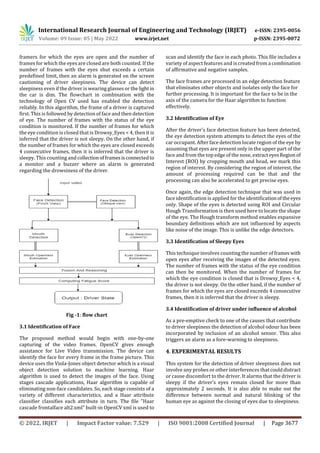
Given below is a flowchart that can quickly analyze the
information to detect sleepiness of a driver. The number of](https://image.slidesharecdn.com/irjet-v9i5755-221006072704-8584c709/85/Driver-Drowsiness-Detection-System-Using-Image-Processing-1-320.jpg)
![International Research Journal of Engineering and Technology (IRJET) e-ISSN: 2395-0056
Volume: 09 Issue: 05 | May 2022 www.irjet.net p-ISSN: 2395-0072
© 2022, IRJET | Impact Factor value: 7.529 | ISO 9001:2008 Certified Journal | Page 3676
Driver Drowsiness Detection System Using Image Processing
Saily Joshi, Anirudh Nair, Rasika Dongare
Saily Joshi, 411045, India
Anirudh Nair, Pune, 411061, India
Rasika Dongare, Pune, 411012, India
Under the guidance of: Prof. Swati Kale, Dept. of E&TC Engineering, JSPM’s RSCOE, Maharashtra, India
---------------------------------------------------------------------***---------------------------------------------------------------------
Abstract - We propose to diminish the number of disasters
realized by driver weariness and along these lines improve
road prosperity. This structure treats the modified disclosure
of driver sluggishness subject to visual information what’s
more, man-made awareness. We discover, track and explore
both the driver face and eyes to measurePERCLOS(levelof eye
end) with Softmax for neural trade work. It will be in like
manner uses liqour and beat acknowledgement to take a
gander at the individual is average or odd. Driver’sexhaustion
is one of the huge purposes behind carcrashes, particularly for
drivers of gigantic vehicles (for instance, transports and
overpowering trucks) due to deferred driving periods and
weakness in included conditions. This method can be inferred
as a low cost and reliable way to minimize the number of
injuries related to the driver’s drowsiness in order to improve
the health of travel.
Key Words: Raspberry Pi, Eye tracking, Driver, Image
Processing.
1. INTRODUCTION
The tendency of drivers to fall asleep is one of the main
causes of road accidents. The data from various countries
shows that around 20 percent of road injuries are a result of
road accidents which are caused by the driversfallingasleep
while driving. It is evident that the number of fatalities in
road accidents is in a great way contributed bythishazardof
drivers falling asleep when driving. Consumption of alcohol,
fatigue during driving and a casual approach to driving are
the main contributors to this risky behavior. It is due to this
that, several people across various nations are adversely
impacted. It is monitoring of drivers for drowsinessthatwill
be an important tool in training and controllingthebehavior
of drivers to fall asleep when driving. It is this monitoring
tool that will give an early warning of the tendency of a
driver to fall asleep and prevent an accident. This paper
presents a project for monitoring the sleepiness of a driver
that is liable to cause an accident. The technology used is
Open CV, Raspberry Pi and Image Processing. There is
imperial evidence to showthattherearevariouspossibilities
that can be implemented to detect sleepiness within the
drivers. The measurement of sleepiness can be done by
using eye response, vital biological parameters and the
effectiveness of driving itself. Of these, eye response and
biological monitoring are more reliable forms of
measurement. However, biological parametermeasurement
is part invasive in nature requiring probes and direct
physical measurement which has limited practicality. The
advantage of monitoring the driver’s eye response is that
there is no probe or physical contact required with the
driver besides it being completely non-disturbing kind of a
measurement. Absence of any interference, disturbance,
attachment of probes and ease of implementation makes
monitoring of eyes for closure patterns the best tool to
detect sleepiness of a driver. The data of eye closure
gathered can be used in an algorithm that can correlate the
pattern of eye closure to detect the sleepiness or otherwise
of a driver during active driving phases or also during rest
intervals.
2. RELATED WORK
There has been a lot of development recently in the area of
smart vehicle software. Due to the driver sleepiness by
exhaustion, which also results in frequent accidents,
research is being done in the area. In some research papers,
an ensemble deep learning architecture has been proposed
which not only looks at the eyes and mouth samples of the
driver but also includes the fitness of the driver in the
decision structure. [1] There are also some works in which
eye retina detection and facial feature extraction is used. [2]
Prevention of driver drowsiness is the main area of focus of
all of these works.
The number one causes for driver sleepiness are fatigue,
consumption of alcohol, all of which can be prevented bythe
use of technology, especially artificial intelligence.
Furthermore, artificial intelligence has also been previously
used to detect the rate at which the driver is becoming
drowsy.[3]
There have also been more invasive ways of preventing
driver sleepiness, which result in a more uncomfortable
driving experience, hence the need for the proposedsystem.
EEG has been used for the driver sleepiness detection. Here,
raw EEG is taken and multiple functions are performedon it.
[4]
3. PROPOSED METHODOLOGY
Given below is a flowchart that can quickly analyze the
information to detect sleepiness of a driver. The number of](https://image.slidesharecdn.com/irjet-v9i5755-221006072704-8584c709/75/Driver-Drowsiness-Detection-System-Using-Image-Processing-1-2048.jpg)
![International Research Journal of Engineering and Technology (IRJET) e-ISSN: 2395-0056
Volume: 09 Issue: 05 | May 2022 www.irjet.net p-ISSN: 2395-0072
© 2022, IRJET | Impact Factor value: 7.529 | ISO 9001:2008 Certified Journal | Page 3678
Fig. 2 - (a) simulation result
The simulation results show the successful detection of the
sleepiness of the driver as captured in the figure above. The
upper part of the figure has not generated a drowsiness
alarm when the eyes were closed for less than 2 seconds.
Whereas, in the lower partof theimage,sleepinessalarmhas
been appropriately generated.
4. CONCLUSIONS
The growing number of fatalities and road accidents have
driver sleepiness as an underlying cause. The prevention of
these fatal accidents would in turn require that driver
sleepiness is reliably detected and relevant stakeholders are
alarmed about the possibility of an untoward incident. The
effectiveness of the proposed system would qualify it to be
included as a standard feature in vehicles where the
possibility of driver sleepiness exists. There is a huge
potential to significantly reduce the number of road
accidents and related fatalities using thisora similarsystem.
REFERENCES
[1] Ahmed, Muneeb, et al. "Intelligent Driver Drowsiness
Detection for Traffic Safety Based on Multi CNN Deep Model
and Facial Subsampling." IEEE Transactions on Intelligent
Transportation Systems (2021).
[2] Satish, K., et al. "Driver drowsiness detection." 2020
International Conference on Communication and Signal
Processing (ICCSP). IEEE, 2020.
[3] Yashwanth, Challa, and Jyoti Singh Kirar. "Driver's
Drowsiness Detection." TENCON 2019-2019IEEERegion 10
Conference (TENCON). IEEE, 2019.
[4] Budak, Umit, et al. "An effective hybrid model for EEG-
based drowsiness detection." IEEE sensors journal 19.17
(2019): 7624-7631.](https://image.slidesharecdn.com/irjet-v9i5755-221006072704-8584c709/85/Driver-Drowsiness-Detection-System-Using-Image-Processing-3-320.jpg)

This document describes a driver drowsiness detection system using image processing. The system uses a Raspberry Pi camera to capture video frames of the driver's face. It then uses computer vision techniques like Haar cascade classifiers and the Hough transform to detect and track the face and eyes in each frame. It monitors the number of consecutive frames where the eyes are closed to determine if the driver is drowsy. If the eyes are closed for more than 2 seconds, it will trigger an alarm. The system aims to reduce road accidents caused by driver fatigue by providing an early warning of drowsiness without any physical probes contacting the driver.


