Cardiovascular
System
Assessment
By
Mr. R. Vijayaraj, M.Sc.(N).,
Dept. of MSN.
History Taking
Physical Examination
HISTORY TAKING
 Interview
Patient, caregiver, records, investigation reports
 Socio economic status
 Family History
 Personal History
 Past health history
Past medical and surgical history
 Present health status
 Clinical Examination Findings
 Provisional Diagnosis
PATIENT PROFILE
Name :
Age :
Sex :
Religion :
Occupation :
Income :
Marital status :
Hospital No :
Inpatient No :
Ward name :
Date & Time of admission :
Address :
Provisional Diagnosis :
Date of care started :
Date of care ended :
 If operated
Name of the surgery:
Date of the surgery :
Type of anaesthesia :
Post operative day :
 Present Complaints
Pain – Location, radiation, description
Dyspnea
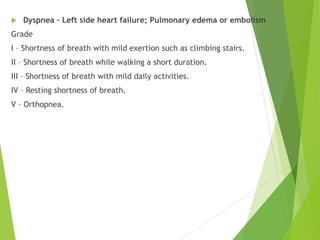
 Dyspnea – Left side heart failure; Pulmonary edema or embolism
Grade
I – Shortness of breath with mild exertion such as climbing stairs.
II – Shortness of breath while walking a short duration.
III – Shortness of breath with mild daily activities.
IV – Resting shortness of breath.
V – Orthopnea.
 Fatigue – Decreased cardiac output
 Palpitations – Dysrhythmias
 Dizziness – Dysrhythmias
 Weight gain – Right sided heart failure
SOCIO ECONOMIC STATUS:
Economic status of the family, bread winner of the family, type of
occupation, income per month, type of house( kutcha / pucca / hut),
presence of facilities like electricity/ water drainage/ latrine, kitchen garden
& method waste disposal.
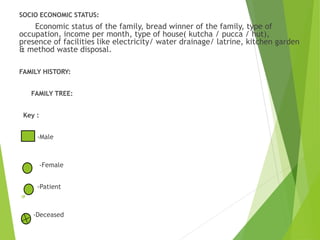
FAMILY HISTORY:
FAMILY TREE:
Key :
-Male
-Female
-Patient
-Deceased
Contd..
Assess all patients with cardiovascular symptoms for coronary artery
disease, regardless of age (early-onset CAD occurs).
• Assess family history of sudden death in persons who may or may
not have been diagnosed with coronary disease (especially of early
onset).
• Ask about sudden death in a previously asymptomatic child,
adolescent, or adult.
• Ask about other family members with biochemical or neuro-
muscular conditions (eg, hemochromatosis or muscular dystrophy). •
Assess whether DNA mutation or other genetic testing has been
performed on an affected family member
PERSONAL HISTORY:
Body built, dietary pattern- veg / non veg, unhealthy
habits of drinking, smoking and tobacco chewing,
sleeping pattern, bowel & bladder pattern and any
allergies (food & drug).
PAST HEALTH HISTORY
 Previous hospitalization with date, place of
admission, complaints during that period,
diagnosis, intake of medications & period of
hospitalization and treatment, name of surgery,
surgery outcome, history of blood borne diseases
like hepatitis B, HIV, history of blood transfusion
and any complication.
PRESENT HEALTH STATUS
Body built, reason for seeking hospitalization with
date, name of the hospital & ward, presenting
complaints with duration, investigations, physician
assessment & final diagnosis & treatment plan,
surgery name with date of surgery, type of
anaesthesia, condition of patient & operation notes.
Physical Examination
General
 Patient level of Consciousness
 Oriented to the environment
Anthropometric Measurement
 Height
 Weight
GENERAL PHYSICAL
EXAMINATION
Vital signs
 Temperature
 Pulse rate
0-Not palpable
1+ Faintly palpable (Weak and Thready)
2+ Normal/Palpable
3+ Bounding (Hyperdynamic pulse)
 Blood Pressure
 Respiration
Head
 Headache
 Trauma
Eyes
 Assess for vision
Ears
 Assess for hearing ability
Nose
 Assess for breathing
 Nasal flarring
Mouth
 Sore tongue nutritional
deficiency)
 Cyanosis
Respiratory
 Inspection
 Palpation
 Percussion
 Auscultation
CVS
Inspection
 Shortness of breath when the patient speaks or moves
 Color of skin is noted for oxygenation status through the color of
skin, mucous membranes, lips, earlobes and nail beds.
 Pallor may indicate anemia or lack of arterial blood flow
 Venous return is assessed by inspecting extremities for varicose
veins, stasis ulcers or scar around the ankles and swelling, redness,
or a hard, tender vein
 Surgical scar
 Internal and external jugular neck veins are observed for
distention in a 45 to 90 degree upright position. Normally veins or
not visible in this position.
 Distention indicates an increase in the venous volume, often
caused by right sided heart failure.
 Assess for clubbing of nailbeds, it is often caused by congenital
heart defects, normal 160 degree angle.
 Due lack of blood supply, the angle exceeds 180 degree and nail
feels spongy when squeezed.
Palpation
 Capillary refilling time, normal is 3 sec or less and
indicates arterial blood flow to the extremities
 Longer time indicate anemia or a decrease in
blood flow to the extremity.
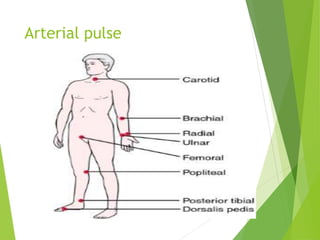
 Pulse palpation
Radial
Temporal
Dorsalis pedal
Apical pulse
Arterial pulse
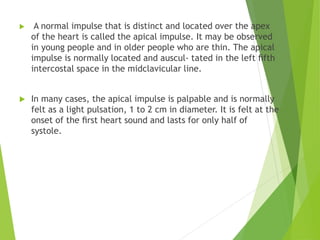
 A normal impulse that is distinct and located over the apex
of the heart is called the apical impulse. It may be observed
in young people and in older people who are thin. The apical
impulse is normally located and auscul- tated in the left fifth
intercostal space in the midclavicular line.
 In many cases, the apical impulse is palpable and is normally
felt as a light pulsation, 1 to 2 cm in diameter. It is felt at the
onset of the first heart sound and lasts for only half of
systole.
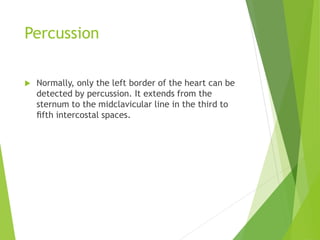
Percussion
 Normally, only the left border of the heart can be
detected by percussion. It extends from the
sternum to the midclavicular line in the third to
fifth intercostal spaces.
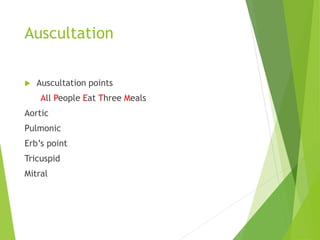
Auscultation
 Auscultation points
All People Eat Three Meals
Aortic
Pulmonic
Erb’s point
Tricuspid
Mitral
 S1—First Heart Sound. Closure of the mitral and tricuspid valves
creates the first heart sound (S1), although vibration of the myo-
cardial wall also may contribute to this sound.
 S2—Second Heart Sound. Closing of the aortic and pulmonic valves
produces the second heart sound (S2).
 S3 – It sounds like a gallop and low pitched sound heard early in
diastole, it is normal in children and younger adults. In older adults
S3 may be heard with left side heart failure.
 S4- sound is also a low pitched sound, similar to gallop but heard
late in diastole, it occurs with hyper tension, CAD and pulmonary
stenosis.
 Snaps and Clicks - Stenosis of the mitral valve resulting from
rheumatic heart disease gives rise to an unusual sound very early in
diastole that is high-pitched and is best heard along the left sternal
border. The sound is caused by high pressure in the left atrium with
abrupt displacement of a rigid mitral valve. The sound is called an
opening snap.
 Murmurs - Murmurs are created by the turbulent flow of blood. The
causes of the turbulence may be a critically narrowed valve, a
malfunctioning valve that allows regurgitant blood flow, a con-
genital defect of the ventricular wall, a defect between the aorta
and the pulmonary artery, or an increased flow of blood through a
normal structure.
 Friction Rub - In pericarditis, a harsh, grating sound that
can be heard in both systole and diastole is called a
friction rub. It is caused by abrasion of the pericardial
surfaces during the cardiac cycle. Because a friction rub
may be confused with a murmur, care should be taken to
identify the sound and to distinguish it from murmurs
that may be heard in both systole and diastole.
Gastrointestinal
 Appetite
change(hypothalamic
lesion)
 Excessive
thirst(DI/DM)
 dysphagia
 Constipation(dysauton
omia)
 Vomiting(ICP)
 Hepatitis
Genitourinary
 Urinary
incontinence(neuroge
nic bladder)
 Impotence(DM/DI)
 STD(syphilis)
Extremities
 Edema is palpated in the lower extremities.
 Edema can occur from right sided heart failure,
gravity, or altered venous blood return
Thank you

Cvs assessment by. vj

  • 1.
  • 2.
  • 3.
    HISTORY TAKING  Interview Patient,caregiver, records, investigation reports  Socio economic status  Family History  Personal History  Past health history Past medical and surgical history
  • 4.
     Present healthstatus  Clinical Examination Findings  Provisional Diagnosis
  • 5.
    PATIENT PROFILE Name : Age: Sex : Religion : Occupation : Income : Marital status : Hospital No : Inpatient No : Ward name : Date & Time of admission : Address : Provisional Diagnosis : Date of care started : Date of care ended :
  • 6.
     If operated Nameof the surgery: Date of the surgery : Type of anaesthesia : Post operative day :  Present Complaints Pain – Location, radiation, description Dyspnea
  • 7.
     Dyspnea –Left side heart failure; Pulmonary edema or embolism Grade I – Shortness of breath with mild exertion such as climbing stairs. II – Shortness of breath while walking a short duration. III – Shortness of breath with mild daily activities. IV – Resting shortness of breath. V – Orthopnea.
  • 8.
     Fatigue –Decreased cardiac output  Palpitations – Dysrhythmias  Dizziness – Dysrhythmias  Weight gain – Right sided heart failure
  • 9.
    SOCIO ECONOMIC STATUS: Economicstatus of the family, bread winner of the family, type of occupation, income per month, type of house( kutcha / pucca / hut), presence of facilities like electricity/ water drainage/ latrine, kitchen garden & method waste disposal. FAMILY HISTORY: FAMILY TREE: Key : -Male -Female -Patient -Deceased
  • 10.
    Contd.. Assess all patientswith cardiovascular symptoms for coronary artery disease, regardless of age (early-onset CAD occurs). • Assess family history of sudden death in persons who may or may not have been diagnosed with coronary disease (especially of early onset). • Ask about sudden death in a previously asymptomatic child, adolescent, or adult. • Ask about other family members with biochemical or neuro- muscular conditions (eg, hemochromatosis or muscular dystrophy). • Assess whether DNA mutation or other genetic testing has been performed on an affected family member
  • 11.
    PERSONAL HISTORY: Body built,dietary pattern- veg / non veg, unhealthy habits of drinking, smoking and tobacco chewing, sleeping pattern, bowel & bladder pattern and any allergies (food & drug).
  • 12.
    PAST HEALTH HISTORY Previous hospitalization with date, place of admission, complaints during that period, diagnosis, intake of medications & period of hospitalization and treatment, name of surgery, surgery outcome, history of blood borne diseases like hepatitis B, HIV, history of blood transfusion and any complication.
  • 13.
    PRESENT HEALTH STATUS Bodybuilt, reason for seeking hospitalization with date, name of the hospital & ward, presenting complaints with duration, investigations, physician assessment & final diagnosis & treatment plan, surgery name with date of surgery, type of anaesthesia, condition of patient & operation notes.
  • 14.
    Physical Examination General  Patientlevel of Consciousness  Oriented to the environment Anthropometric Measurement  Height  Weight
  • 15.
    GENERAL PHYSICAL EXAMINATION Vital signs Temperature  Pulse rate 0-Not palpable 1+ Faintly palpable (Weak and Thready) 2+ Normal/Palpable 3+ Bounding (Hyperdynamic pulse)  Blood Pressure  Respiration
  • 16.
    Head  Headache  Trauma Eyes Assess for vision Ears  Assess for hearing ability Nose  Assess for breathing  Nasal flarring Mouth  Sore tongue nutritional deficiency)  Cyanosis Respiratory  Inspection  Palpation  Percussion  Auscultation
  • 17.
    CVS Inspection  Shortness ofbreath when the patient speaks or moves  Color of skin is noted for oxygenation status through the color of skin, mucous membranes, lips, earlobes and nail beds.  Pallor may indicate anemia or lack of arterial blood flow  Venous return is assessed by inspecting extremities for varicose veins, stasis ulcers or scar around the ankles and swelling, redness, or a hard, tender vein
  • 18.
     Surgical scar Internal and external jugular neck veins are observed for distention in a 45 to 90 degree upright position. Normally veins or not visible in this position.  Distention indicates an increase in the venous volume, often caused by right sided heart failure.  Assess for clubbing of nailbeds, it is often caused by congenital heart defects, normal 160 degree angle.  Due lack of blood supply, the angle exceeds 180 degree and nail feels spongy when squeezed.
  • 19.
    Palpation  Capillary refillingtime, normal is 3 sec or less and indicates arterial blood flow to the extremities  Longer time indicate anemia or a decrease in blood flow to the extremity.  Pulse palpation Radial Temporal Dorsalis pedal Apical pulse
  • 20.
  • 21.
     A normalimpulse that is distinct and located over the apex of the heart is called the apical impulse. It may be observed in young people and in older people who are thin. The apical impulse is normally located and auscul- tated in the left fifth intercostal space in the midclavicular line.  In many cases, the apical impulse is palpable and is normally felt as a light pulsation, 1 to 2 cm in diameter. It is felt at the onset of the first heart sound and lasts for only half of systole.
  • 22.
    Percussion  Normally, onlythe left border of the heart can be detected by percussion. It extends from the sternum to the midclavicular line in the third to fifth intercostal spaces.
  • 23.
    Auscultation  Auscultation points AllPeople Eat Three Meals Aortic Pulmonic Erb’s point Tricuspid Mitral
  • 24.
     S1—First HeartSound. Closure of the mitral and tricuspid valves creates the first heart sound (S1), although vibration of the myo- cardial wall also may contribute to this sound.  S2—Second Heart Sound. Closing of the aortic and pulmonic valves produces the second heart sound (S2).  S3 – It sounds like a gallop and low pitched sound heard early in diastole, it is normal in children and younger adults. In older adults S3 may be heard with left side heart failure.  S4- sound is also a low pitched sound, similar to gallop but heard late in diastole, it occurs with hyper tension, CAD and pulmonary stenosis.
  • 25.
     Snaps andClicks - Stenosis of the mitral valve resulting from rheumatic heart disease gives rise to an unusual sound very early in diastole that is high-pitched and is best heard along the left sternal border. The sound is caused by high pressure in the left atrium with abrupt displacement of a rigid mitral valve. The sound is called an opening snap.  Murmurs - Murmurs are created by the turbulent flow of blood. The causes of the turbulence may be a critically narrowed valve, a malfunctioning valve that allows regurgitant blood flow, a con- genital defect of the ventricular wall, a defect between the aorta and the pulmonary artery, or an increased flow of blood through a normal structure.
  • 26.
     Friction Rub- In pericarditis, a harsh, grating sound that can be heard in both systole and diastole is called a friction rub. It is caused by abrasion of the pericardial surfaces during the cardiac cycle. Because a friction rub may be confused with a murmur, care should be taken to identify the sound and to distinguish it from murmurs that may be heard in both systole and diastole.
  • 27.
    Gastrointestinal  Appetite change(hypothalamic lesion)  Excessive thirst(DI/DM) dysphagia  Constipation(dysauton omia)  Vomiting(ICP)  Hepatitis Genitourinary  Urinary incontinence(neuroge nic bladder)  Impotence(DM/DI)  STD(syphilis)
  • 28.
    Extremities  Edema ispalpated in the lower extremities.  Edema can occur from right sided heart failure, gravity, or altered venous blood return
  • 29.