PERICARDITIS
Presented By:
Mr. Nandish.S
Asso. Professor
Mandya Institute of Nursing Sciences
DEFINITION :
 It is a condition caused by inflammation of the pericardial sac, which
may occur on acute or chronic basis.
 It is the inflammation of the pericardium, a sac like structure with two
thin layers of tissue that surround the heart.
 It is the swelling and irritation of pericardium, a thin sac like
membrane that surround your heart.
INCIDENCE :
- It is seen in 5 to 30 % cases after pericardectomy.
- 1 to 3% cases develop after acute Myocardial Infarction.
- There are 40 patients with pericarditis for every 1,00,000 population.
CLASSIFICATION :
Based on the duration and symptoms :
1. Acute Pericarditis (< 6 weeks)
2. Subacute Pericarditis ( 6 weeks to 6 months)
3. Chronic Pericarditis (> 6 months)
4. Recurrent Pericarditis
CLASSIFICATION :
Based on the Causes :
Constrictive Pericarditis
Viral Pericarditis
Tuberculous Pericarditis
Purulent / Suppurative Pericarditis
Radiation Pericarditis
Traumatic Pericarditis
Serous Pericarditis
Fibrous Pericarditis
Hemorrhagic Pericarditis
Adhesive Mediastino Pericarditis
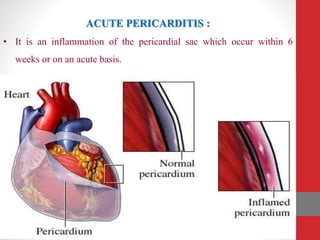
ACUTE PERICARDITIS :
• It is an inflammation of the pericardial sac which occur within 6
weeks or on an acute basis.
Etiology :
1) Infection :
Viral – Coxsackievirus A & B, Echovirus, Adenovirus, Epstein – Barr
Virus, Varicella Zoster, HIV, Mumps, Hepatitis B
Bacterial – Pneumococci, Staphylococci, Streptococci, N.Gonorrhoeae,
Legionella Pneumophila, M.Tuberculosis.
Fungal – Histoplasma, Candida species
Other infections like Toxoplasmosis, Lyme disease.
2) Non infectious factors :
• Uremia
• Acute Myocardial Infection
• Neoplasms : Lung cancer, Breast cancer, Leukemia, Hodgkin’s
Disease
• Trauma : thoracic surgery, pacemaker insertion, cardiac diagnostic
procedures
• Radiation
• Dissecting Aortic Aneurysm
• Myxedema
3) Hypersensitive or Autoimmune :
- Delayed post myocardial Injury
- Postpericardiotomy syndrome
- Rheumatic Fever
- Drug reactions (procainamide, Hydralazine)
- Systemic Lupus Erythematosus, Scleroderma, Ankylosing Spondylitis
PATHOPHYSIOLOGY :
Due to Etiological factors
An influx of Neutrophils
Increased Pericardial vascularity
Fibrin deposition on the Visceral Pericardium
Clinical features
CLINICAL FEATURES :
 Chest pain (intense, sharpest retrosternally) – pain will increase by
lying on supine, deep breathing, coughing, swallowing)
 Dyspnoea
 Pericardial friction rub – it is scratching, grating, high pitched sound
arise due to friction between pericardial & Epicardial surfaces.
 Ewart’s or Pins sign : an area of dullness with bronchial breath
sounds & increased tactile fremitus below left scapular angle.
 Fever with chills, night sweats.
 Malaise and Myalgia
 Palpitation
DIAGNOSTIC STUDIES :
o History collection & Physical Examination
o ECG
o BUN
o Tuberculin Test / Mantoux Test
o Chest X – Ray
o Echocardiogram
o Pericardial Biopsy
o CT Scan
o Cardiac Nuclear Scan
MANAGEMENT :
- It is directed towards identification and treatment of underlying causes.
- Antibiotics
- Corticosteroids (prednisone)
- NSAID’s (Indomethacin)
- Adequate bed rest
- Pericardocentesis is usually performed when systolic BP is reduced
30mm of Hg. A 16 – 18 gauze needle is inserted into the pericardial
space to remove fluid for analysis and to relieve cardiac pressure.
NURSING MANAGEMENT :
Pain, acute, chest related to transmission & perception of impulses.
Decreased cardiac output related to reduced systolic blood pressure.
Anxiety related to disease condition outcome.
Activity intolerance related to poor heart functioning.
Ineffective therapeutic regimen management related to unawareness
regarding treatment and follow up care.
CHRONIC CONSTRICTIVE PERICARDITIS :
• It results from scarring with consequent loss of elasticity of the
pericardial sac.
• It caused due to frequent acute pericarditis.
Common etiological factors are :
 Neoplasia
 Radiation
 Previous surgery
 Idiopathic factors.
PATHOPHYSIOLOGY :
Due to etiological factors
Fibrin deposition with clinically undetected pericardial effusion
Resorption of effusion
Chronic fibrous scarring
Calcium deposition causes more thickening of pericardium
Impairing the ability of atria & ventricle to stretch during diastole
CLINICAL MANIFESTATIONS :
Many of the symptoms are due to decreased cardiac output.
 Dyspnoea on exertion
 Pedal edema & ascites
 Fatigue
 Anorexia
 Weight loss
 Hepatomegaly
 JVD(Jugular vein distension)
 Kussmaul’s sign
 Pericardial Knock (early diastolic sound) heard at apex of heart.
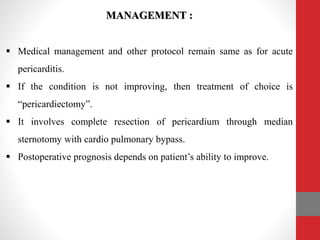
MANAGEMENT :
 Medical management and other protocol remain same as for acute
pericarditis.
 If the condition is not improving, then treatment of choice is
“pericardiectomy”.
 It involves complete resection of pericardium through median
sternotomy with cardio pulmonary bypass.
 Postoperative prognosis depends on patient’s ability to improve.
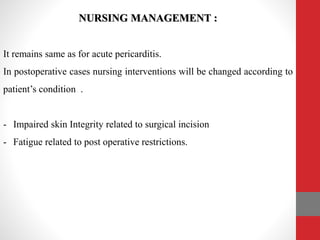
NURSING MANAGEMENT :
It remains same as for acute pericarditis.
In postoperative cases nursing interventions will be changed according to
patient’s condition .
- Impaired skin Integrity related to surgical incision
- Fatigue related to post operative restrictions.
Pericarditis.pptx

Pericarditis.pptx

  • 1.
    PERICARDITIS Presented By: Mr. Nandish.S Asso.Professor Mandya Institute of Nursing Sciences
  • 3.
    DEFINITION :  Itis a condition caused by inflammation of the pericardial sac, which may occur on acute or chronic basis.  It is the inflammation of the pericardium, a sac like structure with two thin layers of tissue that surround the heart.  It is the swelling and irritation of pericardium, a thin sac like membrane that surround your heart.
  • 4.
    INCIDENCE : - Itis seen in 5 to 30 % cases after pericardectomy. - 1 to 3% cases develop after acute Myocardial Infarction. - There are 40 patients with pericarditis for every 1,00,000 population.
  • 6.
    CLASSIFICATION : Based onthe duration and symptoms : 1. Acute Pericarditis (< 6 weeks) 2. Subacute Pericarditis ( 6 weeks to 6 months) 3. Chronic Pericarditis (> 6 months) 4. Recurrent Pericarditis
  • 7.
    CLASSIFICATION : Based onthe Causes : Constrictive Pericarditis Viral Pericarditis Tuberculous Pericarditis Purulent / Suppurative Pericarditis Radiation Pericarditis Traumatic Pericarditis Serous Pericarditis Fibrous Pericarditis Hemorrhagic Pericarditis Adhesive Mediastino Pericarditis
  • 8.
    ACUTE PERICARDITIS : •It is an inflammation of the pericardial sac which occur within 6 weeks or on an acute basis.
  • 9.
    Etiology : 1) Infection: Viral – Coxsackievirus A & B, Echovirus, Adenovirus, Epstein – Barr Virus, Varicella Zoster, HIV, Mumps, Hepatitis B Bacterial – Pneumococci, Staphylococci, Streptococci, N.Gonorrhoeae, Legionella Pneumophila, M.Tuberculosis. Fungal – Histoplasma, Candida species Other infections like Toxoplasmosis, Lyme disease.
  • 10.
    2) Non infectiousfactors : • Uremia • Acute Myocardial Infection • Neoplasms : Lung cancer, Breast cancer, Leukemia, Hodgkin’s Disease • Trauma : thoracic surgery, pacemaker insertion, cardiac diagnostic procedures • Radiation • Dissecting Aortic Aneurysm • Myxedema
  • 11.
    3) Hypersensitive orAutoimmune : - Delayed post myocardial Injury - Postpericardiotomy syndrome - Rheumatic Fever - Drug reactions (procainamide, Hydralazine) - Systemic Lupus Erythematosus, Scleroderma, Ankylosing Spondylitis
  • 12.
    PATHOPHYSIOLOGY : Due toEtiological factors An influx of Neutrophils Increased Pericardial vascularity Fibrin deposition on the Visceral Pericardium Clinical features
  • 13.
    CLINICAL FEATURES : Chest pain (intense, sharpest retrosternally) – pain will increase by lying on supine, deep breathing, coughing, swallowing)  Dyspnoea  Pericardial friction rub – it is scratching, grating, high pitched sound arise due to friction between pericardial & Epicardial surfaces.  Ewart’s or Pins sign : an area of dullness with bronchial breath sounds & increased tactile fremitus below left scapular angle.  Fever with chills, night sweats.  Malaise and Myalgia  Palpitation
  • 14.
    DIAGNOSTIC STUDIES : oHistory collection & Physical Examination o ECG o BUN o Tuberculin Test / Mantoux Test o Chest X – Ray o Echocardiogram o Pericardial Biopsy o CT Scan o Cardiac Nuclear Scan
  • 15.
    MANAGEMENT : - Itis directed towards identification and treatment of underlying causes. - Antibiotics - Corticosteroids (prednisone) - NSAID’s (Indomethacin) - Adequate bed rest - Pericardocentesis is usually performed when systolic BP is reduced 30mm of Hg. A 16 – 18 gauze needle is inserted into the pericardial space to remove fluid for analysis and to relieve cardiac pressure.
  • 17.
    NURSING MANAGEMENT : Pain,acute, chest related to transmission & perception of impulses. Decreased cardiac output related to reduced systolic blood pressure. Anxiety related to disease condition outcome. Activity intolerance related to poor heart functioning. Ineffective therapeutic regimen management related to unawareness regarding treatment and follow up care.
  • 18.
    CHRONIC CONSTRICTIVE PERICARDITIS: • It results from scarring with consequent loss of elasticity of the pericardial sac. • It caused due to frequent acute pericarditis. Common etiological factors are :  Neoplasia  Radiation  Previous surgery  Idiopathic factors.
  • 20.
    PATHOPHYSIOLOGY : Due toetiological factors Fibrin deposition with clinically undetected pericardial effusion Resorption of effusion Chronic fibrous scarring Calcium deposition causes more thickening of pericardium Impairing the ability of atria & ventricle to stretch during diastole
  • 21.
    CLINICAL MANIFESTATIONS : Manyof the symptoms are due to decreased cardiac output.  Dyspnoea on exertion  Pedal edema & ascites  Fatigue  Anorexia  Weight loss  Hepatomegaly  JVD(Jugular vein distension)  Kussmaul’s sign  Pericardial Knock (early diastolic sound) heard at apex of heart.
  • 22.
    MANAGEMENT :  Medicalmanagement and other protocol remain same as for acute pericarditis.  If the condition is not improving, then treatment of choice is “pericardiectomy”.  It involves complete resection of pericardium through median sternotomy with cardio pulmonary bypass.  Postoperative prognosis depends on patient’s ability to improve.
  • 23.
    NURSING MANAGEMENT : Itremains same as for acute pericarditis. In postoperative cases nursing interventions will be changed according to patient’s condition . - Impaired skin Integrity related to surgical incision - Fatigue related to post operative restrictions.