CURRICULUM DEVELOPMENT
PRESENTATION
By: Iqra Ansari
1
CURRICULUM =
Of any LEARNING INSTITUTION
"Total learning experiences of individuals not
only in SCHOOL, but in SOCIETY as well".
2
DEFINITION
Curriculum Development is defined as planned, purposeful,
progressive and systematic process in order to create positive
improvements in the educational system.
Planned - identifying and assessing the needs and skills of
learners and society.
Purposeful- Purpose to built a curriculum for the overall
development of the learners.
Progressive- Focuses on experience-based learning and it adapts
to the ideas prevailing at a particular time in the society.
Systematic- As it follows a process for developing the
curriculum. 3
Curriculum Development Process
PLANNING
•Curriculum development committee
•Identifying
•Assessing
ARTICULATING & DEVELOPING
IMPLEMENTING
EVALUATING
4
5
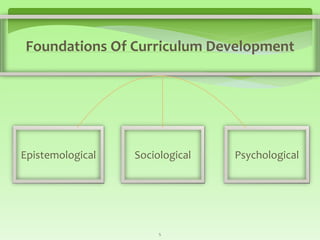
Foundations Of Curriculum Development
Epistemological Sociological Psychological
Epistemological Foundation of Curriculum Development
Epistemology- The study of the nature and grounds of
knowledge especially with reference to its limits and
validity.
Different Schools of Thoughts:
1) IDEALISM
•Idealism supports Apriori knowledge.
•Extracting the ideas already existing in our mind and
applying to physical world.
•One of the ways of acquiring knowledge is Intuition.
•Approach- Teacher centered
•Teaching Method- Lecture method6
•Teaching Method- Lecture method
•Role of learner in classroom - Passive, blank board
•Role of teacher- Recalling the latent knowledge and ideas to
the consciousness
•Basic assumptions- Explanation of the world = Moral and
Spiritual reality
-Give importance to Abstraction.
•Curriculum- Hierarchical: Top level -General and abstract
subjects
Lower level- Natural and physical
sciences (dealing with cause and effect relationship)
-Language is an important subject for
communication & conception of thoughts.
REALISM
• Objects of our senses exist independently of their
being known or perceived.
OBJECT➡EXISTED
then, Senses ➡Captured And Mind ➡ Understood
•Reality is not only what we perceive.
•Example
•From concrete objects to abstract concepts .
•Reality exists independent of human mind and
ultimate reality is the world of physical objects.
•Human behaviour is supported by rational thought.
•Curriculum- Subject matter of the physical world,
particularly science and maths.
- Scientifically approached.
•Reality and truth emanate from both science(logic
& reasoning) and arts(represents subject matter
truthfully without artificiality)..
•Authority- Subject matter experts.
•Teaching method- observation,
experimentation.[Example]
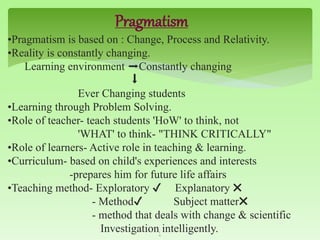
Pragmatism
•Pragmatism is based on : Change, Process and Relativity.
•Reality is constantly changing.
Learning environment ➡Constantly changing
⬇
Ever Changing students
•Learning through Problem Solving.
•Role of teacher- teach students 'HoW' to think, not
'WHAT' to think- "THINK CRITICALLY"
•Role of learners- Active role in teaching & learning.
•Curriculum- based on child's experiences and interests
-prepares him for future life affairs
•Teaching method- Exploratory ✔ Explanatory ✖
- Method✔ Subject matter✖
- method that deals with change & scientific
Investigation intelligently.1
0
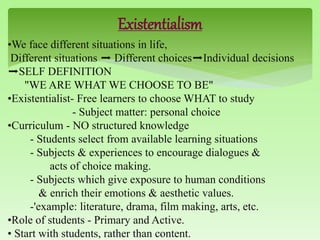
Existentialism
•We face different situations in life,
Different situations ➡ Different choices➡Individual decisions
➡SELF DEFINITION
"WE ARE WHAT WE CHOOSE TO BE"
•Existentialist- Free learners to choose WHAT to study
- Subject matter: personal choice
•Curriculum - NO structured knowledge
- Students select from available learning situations
- Subjects & experiences to encourage dialogues &
acts of choice making.
- Subjects which give exposure to human conditions
& enrich their emotions & aesthetic values.
-'example: literature, drama, film making, arts, etc.
•Role of students - Primary and Active.
• Start with students, rather than content.1
1
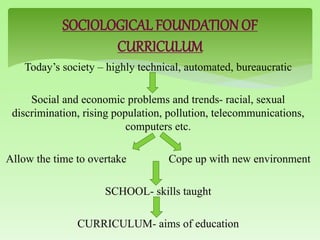
SOCIOLOGICAL FOUNDATION OF
CURRICULUM
Today’s society – highly technical, automated, bureaucratic
Social and economic problems and trends- racial, sexual
discrimination, rising population, pollution, telecommunications,
computers etc.
Allow the time to overtake Cope up with new environment
SCHOOL- skills taught
CURRICULUM- aims of education
Today’s society – highly technical, automated, bureaucratic
Social and economic problems and trends- racial, sexual
discrimination, rising population, pollution, telecommunications,
computers etc.
Allow the time to overtake Cope up with new environment
SCHOOL- skills taught
CURRICULUM- aims of education
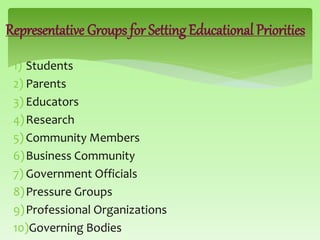
Representative Groups for Setting Educational Priorities
1) Students
2) Parents
3) Educators
4)Research
5) Community Members
6)Business Community
7) Government Officials
8)Pressure Groups
9)Professional Organizations
10)Governing Bodies
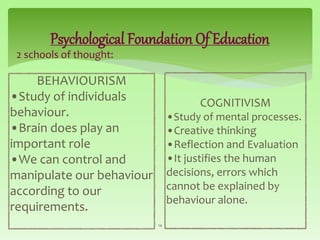
Psychological Foundation Of Education
2 schools of thought:
14
BEHAVIOURISM
•Study of individuals
behaviour.
•Brain does play an
important role
•We can control and
manipulate our behaviour
according to our
requirements.
COGNITIVISM
•Study of mental processes.
•Creative thinking
•Reflection and Evaluation
•It justifies the human
decisions, errors which
cannot be explained by
behaviour alone.
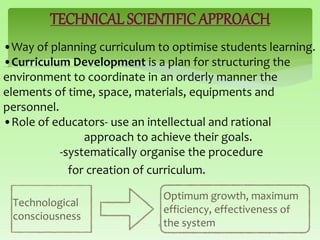
TECHNICAL SCIENTIFIC APPROACH
•Way of planning curriculum to optimise students learning.
•Curriculum Development is a plan for structuring the
environment to coordinate in an orderly manner the
elements of time, space, materials, equipments and
personnel.
•Role of educators- use an intellectual and rational
approach to achieve their goals.
-systematically organise the procedure
for creation of curriculum.
15
Technological
consciousness
Optimum growth, maximum
efficiency, effectiveness of
the system
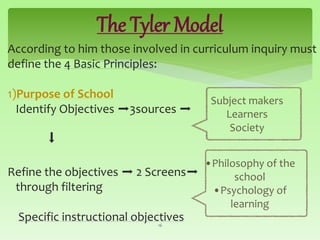
The Tyler Model
According to him those involved in curriculum inquiry must
define the 4 Basic Principles:
1)Purpose of School
Identify Objectives ➡3sources ➡
⬇
Refine the objectives ➡ 2 Screens➡
through filtering
Specific instructional objectives16
Subject makers
Learners
Society
•Philosophy of the
school
•Psychology of
learning
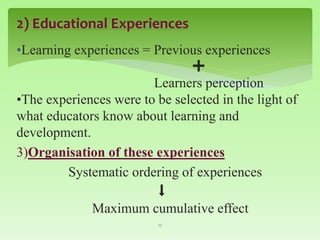
2) Educational Experiences
•Learning experiences = Previous experiences
➕
Learners perception
•The experiences were to be selected in the light of
what educators know about learning and
development.
3)Organisation of these experiences
Systematic ordering of experiences
⬇
Maximum cumulative effect
17
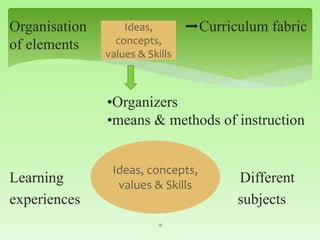
Organisation ➡Curriculum fabric
of elements
•Organizers
•means & methods of instruction
Learning Different
experiences subjects
18
Ideas,
concepts,
values & Skills
Ideas, concepts,
values & Skills
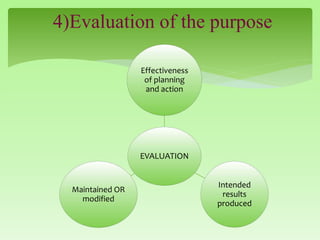
4)Evaluation of the purpose
EVALUATION
Effectiveness
of planning
and action
Intended
results
produced
Maintained OR
modified
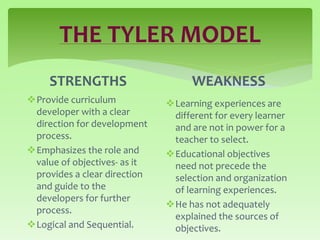
THE TYLER MODEL
STRENGTHS
Provide curriculum
developer with a clear
direction for development
process.
Emphasizes the role and
value of objectives- as it
provides a clear direction
and guide to the
developers for further
process.
Logical and Sequential.
WEAKNESS
Learning experiences are
different for every learner
and are not in power for a
teacher to select.
Educational objectives
need not precede the
selection and organization
of learning experiences.
He has not adequately
explained the sources of
objectives.
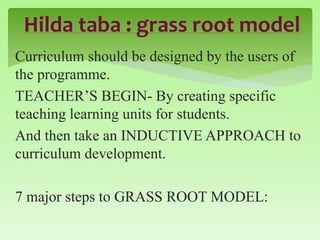
Hilda taba : grass root model
Curriculum should be designed by the users of
the programme.
TEACHER’S BEGIN- By creating specific
teaching learning units for students.
And then take an INDUCTIVE APPROACH to
curriculum development.
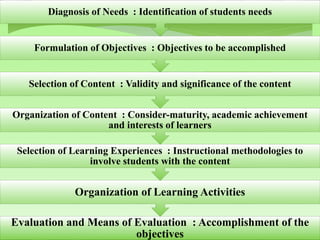
7 major steps to GRASS ROOT MODEL:
Evaluation and Means of Evaluation : Accomplishment of the
objectives
Organization of Learning Activities
Selection of Learning Experiences : Instructional methodologies to
involve students with the content
Organization of Content : Consider-maturity, academic achievement
and interests of learners
Selection of Content : Validity and significance of the content
Formulation of Objectives : Objectives to be accomplished
Diagnosis of Needs : Identification of students needs
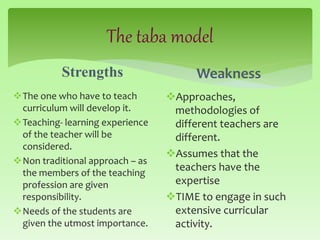
The taba model
Strengths
The one who have to teach
curriculum will develop it.
Teaching- learning experience
of the teacher will be
considered.
Non traditional approach – as
the members of the teaching
profession are given
responsibility.
Needs of the students are
given the utmost importance.
Weakness
Approaches,
methodologies of
different teachers are
different.
Assumes that the
teachers have the
expertise
TIME to engage in such
extensive curricular
activity.
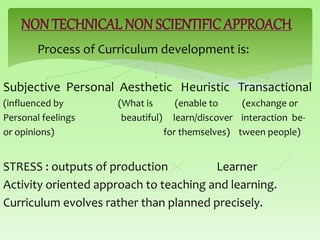
NON TECHNICAL NON SCIENTIFIC APPROACH
Process of Curriculum development is:
Subjective Personal Aesthetic Heuristic Transactional
(influenced by (What is (enable to (exchange or
Personal feelings beautiful) learn/discover interaction be-
or opinions) for themselves) tween people)
STRESS : outputs of production Learner
Activity oriented approach to teaching and learning.
Curriculum evolves rather than planned precisely.
Q) Who know best about US?
WE, ourselves know us best… So let the learners
themselves select their learning experiences that will
facilitate their cognitive growth and social
development.
FOCUS ON: Self perceptions
Personal preferences
Own assessment of self needs
Self integration
Child centered approach
OPEN CLASSROOM MODEL
Based on Activity curriculum.
Did not supported THE FORMAL PREPARATION OF
PLANS before the learners arrival.
Only teacher actively engaged, learner-passive
Learner learn by doing, active involvement
 “Make choices and pursue what interests them”
-Herbert Kohl
The best thing that works for student’s are the
unplanned and spontaneous ones because of their
sudden perception.

Curriculum ppt

  • 1.
  • 2.
    CURRICULUM = Of anyLEARNING INSTITUTION "Total learning experiences of individuals not only in SCHOOL, but in SOCIETY as well". 2
  • 3.
    DEFINITION Curriculum Development isdefined as planned, purposeful, progressive and systematic process in order to create positive improvements in the educational system. Planned - identifying and assessing the needs and skills of learners and society. Purposeful- Purpose to built a curriculum for the overall development of the learners. Progressive- Focuses on experience-based learning and it adapts to the ideas prevailing at a particular time in the society. Systematic- As it follows a process for developing the curriculum. 3
  • 4.
    Curriculum Development Process PLANNING •Curriculumdevelopment committee •Identifying •Assessing ARTICULATING & DEVELOPING IMPLEMENTING EVALUATING 4
  • 5.
    5 Foundations Of CurriculumDevelopment Epistemological Sociological Psychological
  • 6.
    Epistemological Foundation ofCurriculum Development Epistemology- The study of the nature and grounds of knowledge especially with reference to its limits and validity. Different Schools of Thoughts: 1) IDEALISM •Idealism supports Apriori knowledge. •Extracting the ideas already existing in our mind and applying to physical world. •One of the ways of acquiring knowledge is Intuition. •Approach- Teacher centered •Teaching Method- Lecture method6
  • 7.
    •Teaching Method- Lecturemethod •Role of learner in classroom - Passive, blank board •Role of teacher- Recalling the latent knowledge and ideas to the consciousness •Basic assumptions- Explanation of the world = Moral and Spiritual reality -Give importance to Abstraction. •Curriculum- Hierarchical: Top level -General and abstract subjects Lower level- Natural and physical sciences (dealing with cause and effect relationship) -Language is an important subject for communication & conception of thoughts.
  • 8.
    REALISM • Objects ofour senses exist independently of their being known or perceived. OBJECT➡EXISTED then, Senses ➡Captured And Mind ➡ Understood •Reality is not only what we perceive. •Example •From concrete objects to abstract concepts . •Reality exists independent of human mind and ultimate reality is the world of physical objects.
  • 9.
    •Human behaviour issupported by rational thought. •Curriculum- Subject matter of the physical world, particularly science and maths. - Scientifically approached. •Reality and truth emanate from both science(logic & reasoning) and arts(represents subject matter truthfully without artificiality).. •Authority- Subject matter experts. •Teaching method- observation, experimentation.[Example]
  • 10.
    Pragmatism •Pragmatism is basedon : Change, Process and Relativity. •Reality is constantly changing. Learning environment ➡Constantly changing ⬇ Ever Changing students •Learning through Problem Solving. •Role of teacher- teach students 'HoW' to think, not 'WHAT' to think- "THINK CRITICALLY" •Role of learners- Active role in teaching & learning. •Curriculum- based on child's experiences and interests -prepares him for future life affairs •Teaching method- Exploratory ✔ Explanatory ✖ - Method✔ Subject matter✖ - method that deals with change & scientific Investigation intelligently.1 0
  • 11.
    Existentialism •We face differentsituations in life, Different situations ➡ Different choices➡Individual decisions ➡SELF DEFINITION "WE ARE WHAT WE CHOOSE TO BE" •Existentialist- Free learners to choose WHAT to study - Subject matter: personal choice •Curriculum - NO structured knowledge - Students select from available learning situations - Subjects & experiences to encourage dialogues & acts of choice making. - Subjects which give exposure to human conditions & enrich their emotions & aesthetic values. -'example: literature, drama, film making, arts, etc. •Role of students - Primary and Active. • Start with students, rather than content.1 1
  • 12.
    SOCIOLOGICAL FOUNDATION OF CURRICULUM Today’ssociety – highly technical, automated, bureaucratic Social and economic problems and trends- racial, sexual discrimination, rising population, pollution, telecommunications, computers etc. Allow the time to overtake Cope up with new environment SCHOOL- skills taught CURRICULUM- aims of education Today’s society – highly technical, automated, bureaucratic Social and economic problems and trends- racial, sexual discrimination, rising population, pollution, telecommunications, computers etc. Allow the time to overtake Cope up with new environment SCHOOL- skills taught CURRICULUM- aims of education
  • 13.
    Representative Groups forSetting Educational Priorities 1) Students 2) Parents 3) Educators 4)Research 5) Community Members 6)Business Community 7) Government Officials 8)Pressure Groups 9)Professional Organizations 10)Governing Bodies
  • 14.
    Psychological Foundation OfEducation 2 schools of thought: 14 BEHAVIOURISM •Study of individuals behaviour. •Brain does play an important role •We can control and manipulate our behaviour according to our requirements. COGNITIVISM •Study of mental processes. •Creative thinking •Reflection and Evaluation •It justifies the human decisions, errors which cannot be explained by behaviour alone.
  • 15.
    TECHNICAL SCIENTIFIC APPROACH •Wayof planning curriculum to optimise students learning. •Curriculum Development is a plan for structuring the environment to coordinate in an orderly manner the elements of time, space, materials, equipments and personnel. •Role of educators- use an intellectual and rational approach to achieve their goals. -systematically organise the procedure for creation of curriculum. 15 Technological consciousness Optimum growth, maximum efficiency, effectiveness of the system
  • 16.
    The Tyler Model Accordingto him those involved in curriculum inquiry must define the 4 Basic Principles: 1)Purpose of School Identify Objectives ➡3sources ➡ ⬇ Refine the objectives ➡ 2 Screens➡ through filtering Specific instructional objectives16 Subject makers Learners Society •Philosophy of the school •Psychology of learning
  • 17.
    2) Educational Experiences •Learningexperiences = Previous experiences ➕ Learners perception •The experiences were to be selected in the light of what educators know about learning and development. 3)Organisation of these experiences Systematic ordering of experiences ⬇ Maximum cumulative effect 17
  • 18.
    Organisation ➡Curriculum fabric ofelements •Organizers •means & methods of instruction Learning Different experiences subjects 18 Ideas, concepts, values & Skills Ideas, concepts, values & Skills
  • 19.
    4)Evaluation of thepurpose EVALUATION Effectiveness of planning and action Intended results produced Maintained OR modified
  • 20.
    THE TYLER MODEL STRENGTHS Providecurriculum developer with a clear direction for development process. Emphasizes the role and value of objectives- as it provides a clear direction and guide to the developers for further process. Logical and Sequential. WEAKNESS Learning experiences are different for every learner and are not in power for a teacher to select. Educational objectives need not precede the selection and organization of learning experiences. He has not adequately explained the sources of objectives.
  • 21.
    Hilda taba :grass root model Curriculum should be designed by the users of the programme. TEACHER’S BEGIN- By creating specific teaching learning units for students. And then take an INDUCTIVE APPROACH to curriculum development. 7 major steps to GRASS ROOT MODEL:
  • 22.
    Evaluation and Meansof Evaluation : Accomplishment of the objectives Organization of Learning Activities Selection of Learning Experiences : Instructional methodologies to involve students with the content Organization of Content : Consider-maturity, academic achievement and interests of learners Selection of Content : Validity and significance of the content Formulation of Objectives : Objectives to be accomplished Diagnosis of Needs : Identification of students needs
  • 23.
    The taba model Strengths Theone who have to teach curriculum will develop it. Teaching- learning experience of the teacher will be considered. Non traditional approach – as the members of the teaching profession are given responsibility. Needs of the students are given the utmost importance. Weakness Approaches, methodologies of different teachers are different. Assumes that the teachers have the expertise TIME to engage in such extensive curricular activity.
  • 24.
    NON TECHNICAL NONSCIENTIFIC APPROACH Process of Curriculum development is: Subjective Personal Aesthetic Heuristic Transactional (influenced by (What is (enable to (exchange or Personal feelings beautiful) learn/discover interaction be- or opinions) for themselves) tween people) STRESS : outputs of production Learner Activity oriented approach to teaching and learning. Curriculum evolves rather than planned precisely.
  • 25.
    Q) Who knowbest about US? WE, ourselves know us best… So let the learners themselves select their learning experiences that will facilitate their cognitive growth and social development. FOCUS ON: Self perceptions Personal preferences Own assessment of self needs Self integration Child centered approach
  • 26.
    OPEN CLASSROOM MODEL Basedon Activity curriculum. Did not supported THE FORMAL PREPARATION OF PLANS before the learners arrival. Only teacher actively engaged, learner-passive Learner learn by doing, active involvement  “Make choices and pursue what interests them” -Herbert Kohl The best thing that works for student’s are the unplanned and spontaneous ones because of their sudden perception.