CARDIOTOCOGRAPHY
By: Dr Sana
Lodhi
Features of the CTG
 Basic patterns:
1. Baseline heart Rate
2. Variability
 Periodic Changes
1.Accelerations
4.Decelerations
APPROACH TO CTG
 DR >determine risk (Pre Eclampsia, Chorio, Meconium)
 C > Contractions >Tachysystole,HyperStimulation
 B > Baseline heart Rate
 V > Variability
 A > Accelerations
 D > Decelerations
 O > Overall Impression
BRA>
Baseline fetal heart rate
 Reassuring: 110 to 160 b/m
 Non-Reassuring: 100 to 109 b/m or 161 to 180 b/m
 Abnormal: <100 b/m or >180 b/m
V > Baseline variability
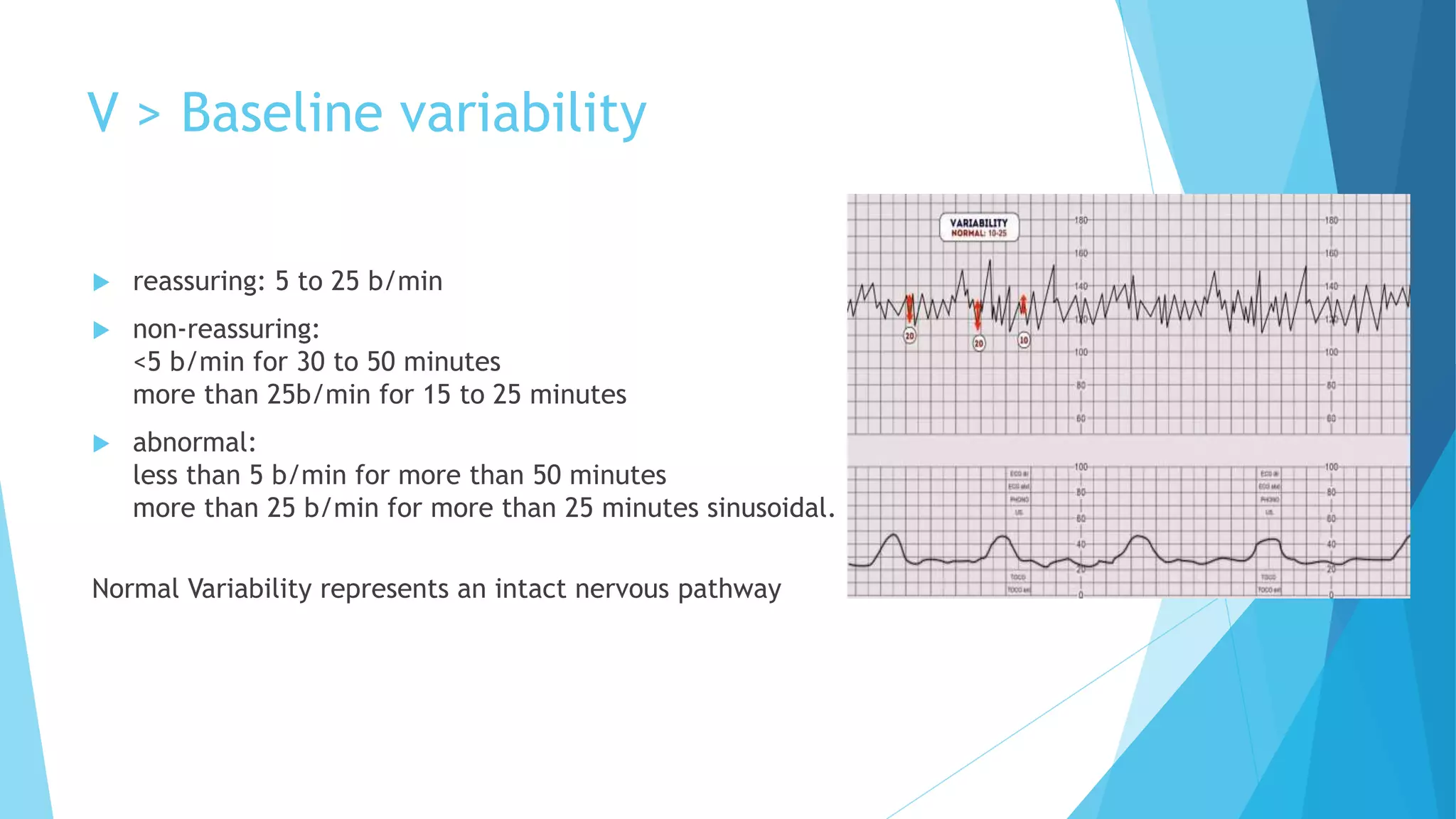
 reassuring: 5 to 25 b/min
 non-reassuring:
<5 b/min for 30 to 50 minutes
more than 25b/min for 15 to 25 minutes
 abnormal:
less than 5 b/min for more than 50 minutes
more than 25 b/min for more than 25 minutes sinusoidal.
Normal Variability represents an intact nervous pathway
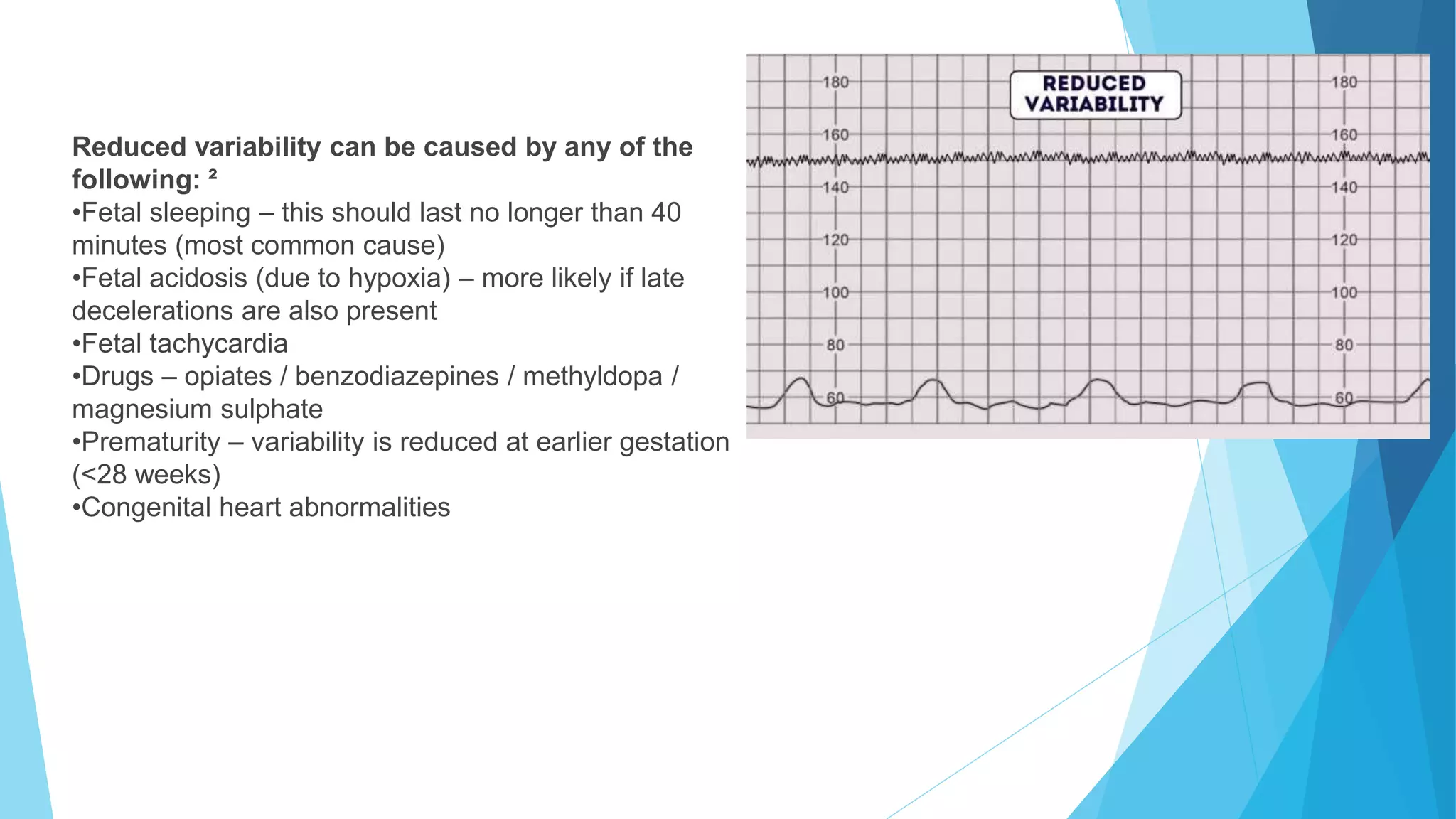
Reduced variability can be caused by any of the
following: ²
•Fetal sleeping – this should last no longer than 40
minutes (most common cause)
•Fetal acidosis (due to hypoxia) – more likely if late
decelerations are also present
•Fetal tachycardia
•Drugs – opiates / benzodiazepines / methyldopa /
magnesium sulphate
•Prematurity – variability is reduced at earlier gestation
(<28 weeks)
•Congenital heart abnormalities
A >>Accelerations
 Inc in FHR of 15bpm or more,lasting for atleast 15sec
 the presence of FHR accelerations, even with reduced baseline variability, is generally a sign that the
baby is healthy
 absence of accelerations on an otherwise normal cardiotocograph trace does not indicate fetal
acidosis.
 If digital fetal scalp stimulation (during vaginal examination) leads to an acceleration in fetal heart
rate, regard this as a sign that the baby is healthy. Take this into account when reviewing the whole
clinical picture.
D>>Decelerations
 Slowing of FHR of 15bpm for atleast 15sec
 EARLY DECELERATIONS:
Early decelerations tend to be uniform in shape &
occur with each contraction
Mirror image of contraction
caused by compression of the fetal head during a
contraction
Inc in ICP > dec blood flow & oxygenation > Inc
parasympathetic activity > Dec FHR
 Late Decelerations
are usually uniform in shape & depth and
occur after each contraction
Lowest point occurs >15sec after the peak of
contraction
Aetiology: Dec in uterine bood flow &
therefore oxygen transfer during a uterine
contraction
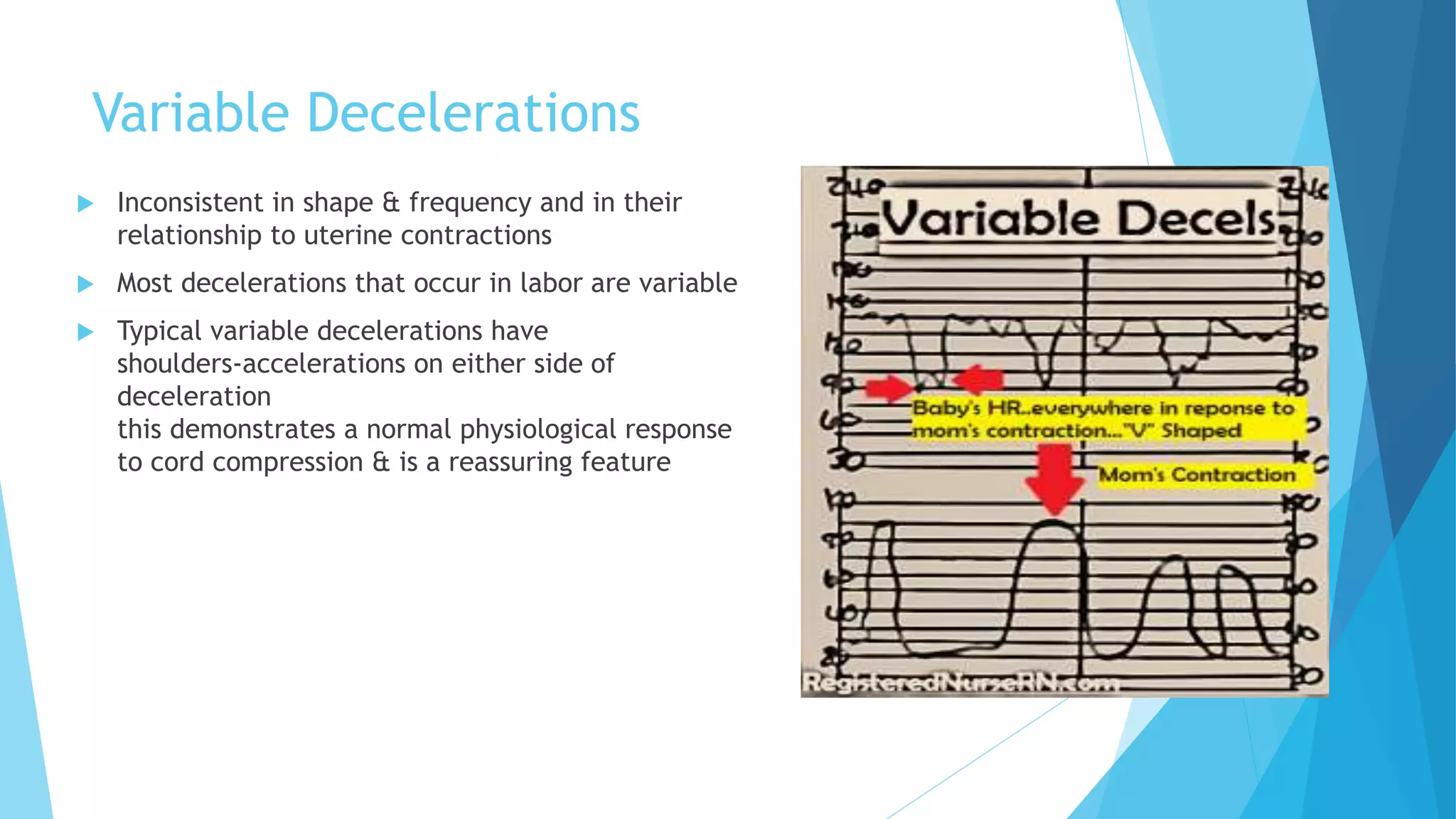
Variable Decelerations
 Inconsistent in shape & frequency and in their
relationship to uterine contractions
 Most decelerations that occur in labor are variable
 Typical variable decelerations have
shoulders-accelerations on either side of
deceleration
this demonstrates a normal physiological response
to cord compression & is a reassuring feature
DECELERATIONS
 Reassuring:
None or early Variable decelerations with no concerning characteristics for less than 90 minutes
 Nonreassuring: Variable decelerations with no concerning characteristics for 90min or more
OR Variable decelerations with any concerning characteristics in up to 50% of contractions for 30
minutes or more
OR Variable decelerations with any concerning characteristics in over 50% of contractions for less
than 30 minutes
OR Late decelerations in over 50% of contractions for less than 30 minutes, with no maternal or
fetal clinical risk factors such as vaginal bleeding or significant meconium
DECELERATIONS
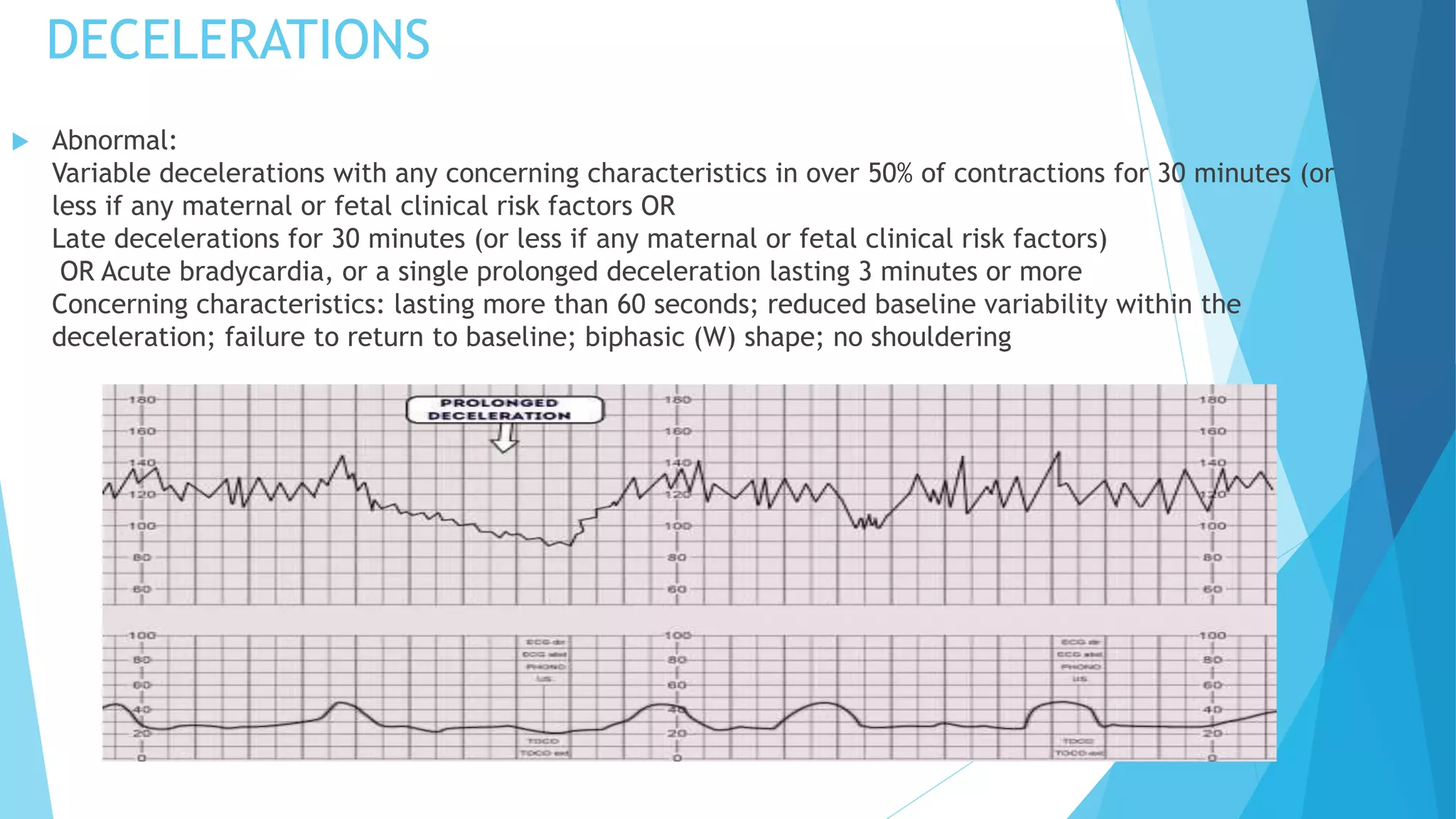
 Abnormal:
Variable decelerations with any concerning characteristics in over 50% of contractions for 30 minutes (or
less if any maternal or fetal clinical risk factors OR
Late decelerations for 30 minutes (or less if any maternal or fetal clinical risk factors)
OR Acute bradycardia, or a single prolonged deceleration lasting 3 minutes or more
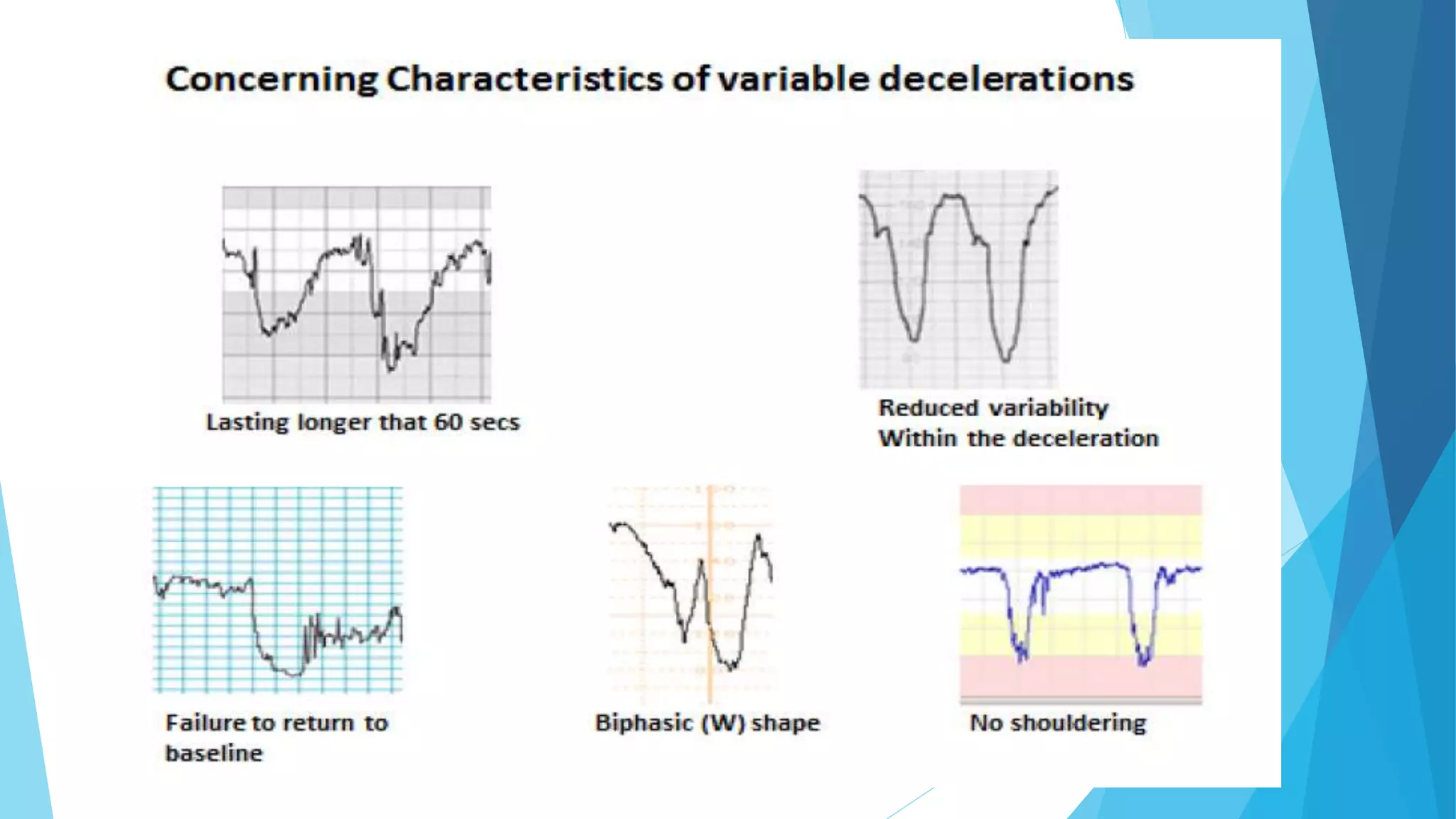
Concerning characteristics: lasting more than 60 seconds; reduced baseline variability within the
deceleration; failure to return to baseline; biphasic (W) shape; no shouldering
Category Definition Management
Normal All features are
reassuring
Continue cardiotocography (unless it was started because of concerns
arising from intermittent auscultation and there are no ongoing risk
factors) and usual care
Talk to the woman and her birth companion(s) about what is happening
Suspicious 1 non-reassuring
feature
AND
2 normal/reassuring
features
Correct any underlying causes, such as hypotension or uterine
hyperstimulation
Perform a full set of maternal observations
Start 1 or more conservative measures
Inform an obstetrician or the senior midwife
Document a plan for reviewing the whole clinical picture and the CTG
findings Talk to the woman and her birth companion(s) about what is
happening and take her preferences into account
Pathological 1 abnormal feature
OR 2 non-reassuring
features
• Obtain a review by an obstetrician and a senior midwife
• Exclude acute events (for example, cord prolapse, suspected
placental abruption or suspected uterine rupture)
• Correct any underlying causes, such as hypotension or uterine
hyperstimulation
• Start 1 or more conservative measures*
• Talk to the woman and her birth companion(s) about what is
happening and take her preferences into account
• If the cardiotocograph trace is still pathological after
implementing conservative measures obtain a further review by
an obstetrician and a senior midwife
offer digital scalp stimulation and document the outcome
• If the cardiotocograph trace is still pathological after fetal scalp
stimulation:
consider fetal blood sampling
consider expediting the birth
take the woman's preferences into account.
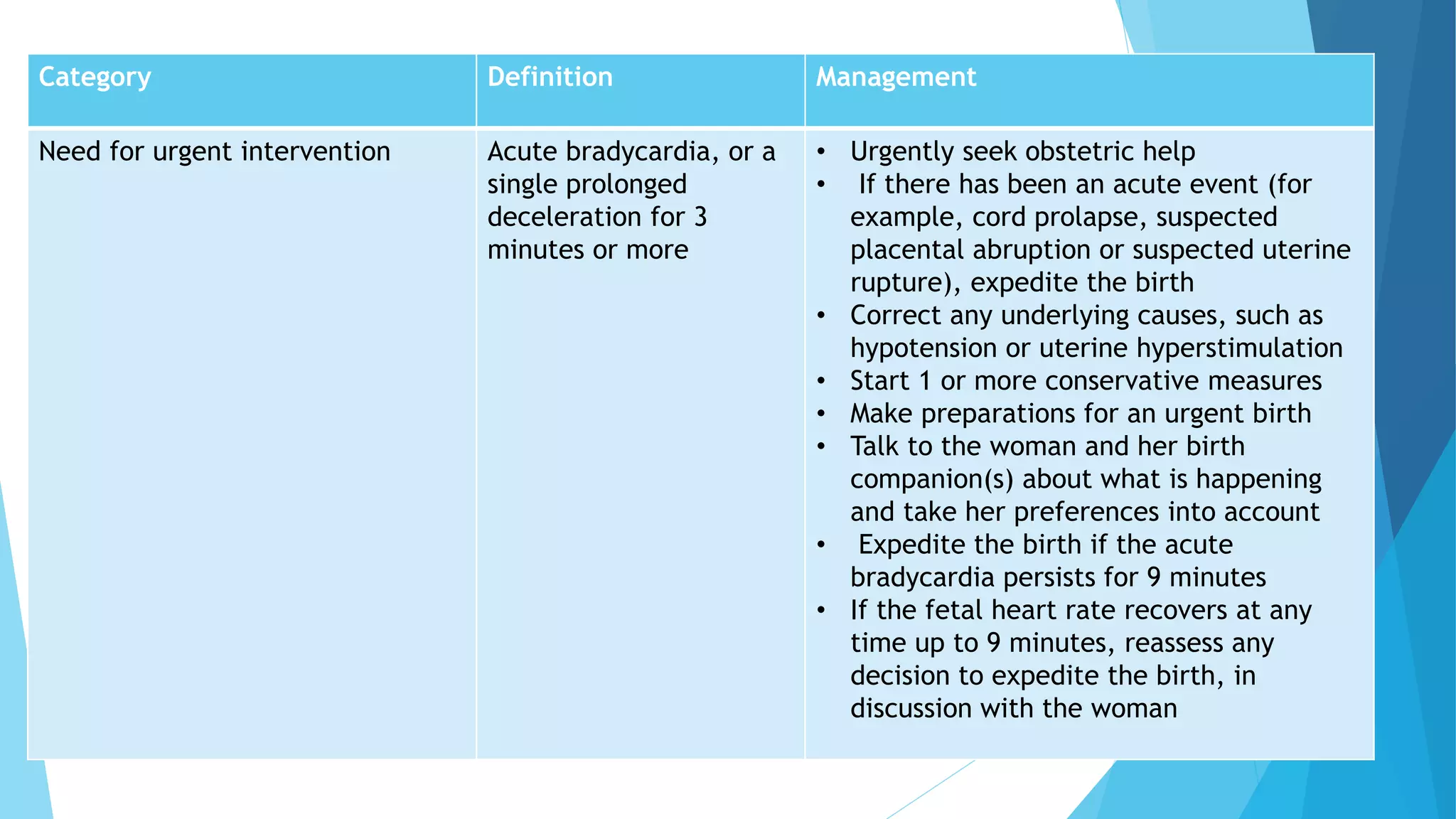
Category Definition Management
Need for urgent intervention Acute bradycardia, or a
single prolonged
deceleration for 3
minutes or more
• Urgently seek obstetric help
• If there has been an acute event (for
example, cord prolapse, suspected
placental abruption or suspected uterine
rupture), expedite the birth
• Correct any underlying causes, such as
hypotension or uterine hyperstimulation
• Start 1 or more conservative measures
• Make preparations for an urgent birth
• Talk to the woman and her birth
companion(s) about what is happening
and take her preferences into account
• Expedite the birth if the acute
bradycardia persists for 9 minutes
• If the fetal heart rate recovers at any
time up to 9 minutes, reassess any
decision to expedite the birth, in
discussion with the woman
Conservative Measures
 based on an assessment of the most likely cause(s):
encourage the woman to mobilise or adopt an alternative position (and to
avoid being supine)
offer intravenous fluids if the woman is hypotensive
reduce contraction frequency by reducing or stopping oxytocin if it is being
used and/or
offering a tocolytic drug (a suggested regimen is subcutaneous terbutaline
0.25 mg)

Cardiotocography

  • 1.
  • 2.
    Features of theCTG  Basic patterns: 1. Baseline heart Rate 2. Variability  Periodic Changes 1.Accelerations 4.Decelerations
  • 3.
    APPROACH TO CTG DR >determine risk (Pre Eclampsia, Chorio, Meconium)  C > Contractions >Tachysystole,HyperStimulation  B > Baseline heart Rate  V > Variability  A > Accelerations  D > Decelerations  O > Overall Impression
  • 4.
    BRA> Baseline fetal heartrate  Reassuring: 110 to 160 b/m  Non-Reassuring: 100 to 109 b/m or 161 to 180 b/m  Abnormal: <100 b/m or >180 b/m
  • 5.
    V > Baselinevariability  reassuring: 5 to 25 b/min  non-reassuring: <5 b/min for 30 to 50 minutes more than 25b/min for 15 to 25 minutes  abnormal: less than 5 b/min for more than 50 minutes more than 25 b/min for more than 25 minutes sinusoidal. Normal Variability represents an intact nervous pathway
  • 6.
    Reduced variability canbe caused by any of the following: ² •Fetal sleeping – this should last no longer than 40 minutes (most common cause) •Fetal acidosis (due to hypoxia) – more likely if late decelerations are also present •Fetal tachycardia •Drugs – opiates / benzodiazepines / methyldopa / magnesium sulphate •Prematurity – variability is reduced at earlier gestation (<28 weeks) •Congenital heart abnormalities
  • 7.
    A >>Accelerations  Incin FHR of 15bpm or more,lasting for atleast 15sec  the presence of FHR accelerations, even with reduced baseline variability, is generally a sign that the baby is healthy  absence of accelerations on an otherwise normal cardiotocograph trace does not indicate fetal acidosis.  If digital fetal scalp stimulation (during vaginal examination) leads to an acceleration in fetal heart rate, regard this as a sign that the baby is healthy. Take this into account when reviewing the whole clinical picture.
  • 8.
    D>>Decelerations  Slowing ofFHR of 15bpm for atleast 15sec  EARLY DECELERATIONS: Early decelerations tend to be uniform in shape & occur with each contraction Mirror image of contraction caused by compression of the fetal head during a contraction Inc in ICP > dec blood flow & oxygenation > Inc parasympathetic activity > Dec FHR
  • 9.
     Late Decelerations areusually uniform in shape & depth and occur after each contraction Lowest point occurs >15sec after the peak of contraction Aetiology: Dec in uterine bood flow & therefore oxygen transfer during a uterine contraction
  • 10.
    Variable Decelerations  Inconsistentin shape & frequency and in their relationship to uterine contractions  Most decelerations that occur in labor are variable  Typical variable decelerations have shoulders-accelerations on either side of deceleration this demonstrates a normal physiological response to cord compression & is a reassuring feature
  • 12.
    DECELERATIONS  Reassuring: None orearly Variable decelerations with no concerning characteristics for less than 90 minutes  Nonreassuring: Variable decelerations with no concerning characteristics for 90min or more OR Variable decelerations with any concerning characteristics in up to 50% of contractions for 30 minutes or more OR Variable decelerations with any concerning characteristics in over 50% of contractions for less than 30 minutes OR Late decelerations in over 50% of contractions for less than 30 minutes, with no maternal or fetal clinical risk factors such as vaginal bleeding or significant meconium
  • 13.
    DECELERATIONS  Abnormal: Variable decelerationswith any concerning characteristics in over 50% of contractions for 30 minutes (or less if any maternal or fetal clinical risk factors OR Late decelerations for 30 minutes (or less if any maternal or fetal clinical risk factors) OR Acute bradycardia, or a single prolonged deceleration lasting 3 minutes or more Concerning characteristics: lasting more than 60 seconds; reduced baseline variability within the deceleration; failure to return to baseline; biphasic (W) shape; no shouldering
  • 14.
    Category Definition Management NormalAll features are reassuring Continue cardiotocography (unless it was started because of concerns arising from intermittent auscultation and there are no ongoing risk factors) and usual care Talk to the woman and her birth companion(s) about what is happening Suspicious 1 non-reassuring feature AND 2 normal/reassuring features Correct any underlying causes, such as hypotension or uterine hyperstimulation Perform a full set of maternal observations Start 1 or more conservative measures Inform an obstetrician or the senior midwife Document a plan for reviewing the whole clinical picture and the CTG findings Talk to the woman and her birth companion(s) about what is happening and take her preferences into account
  • 15.
    Pathological 1 abnormalfeature OR 2 non-reassuring features • Obtain a review by an obstetrician and a senior midwife • Exclude acute events (for example, cord prolapse, suspected placental abruption or suspected uterine rupture) • Correct any underlying causes, such as hypotension or uterine hyperstimulation • Start 1 or more conservative measures* • Talk to the woman and her birth companion(s) about what is happening and take her preferences into account • If the cardiotocograph trace is still pathological after implementing conservative measures obtain a further review by an obstetrician and a senior midwife offer digital scalp stimulation and document the outcome • If the cardiotocograph trace is still pathological after fetal scalp stimulation: consider fetal blood sampling consider expediting the birth take the woman's preferences into account.
  • 16.
    Category Definition Management Needfor urgent intervention Acute bradycardia, or a single prolonged deceleration for 3 minutes or more • Urgently seek obstetric help • If there has been an acute event (for example, cord prolapse, suspected placental abruption or suspected uterine rupture), expedite the birth • Correct any underlying causes, such as hypotension or uterine hyperstimulation • Start 1 or more conservative measures • Make preparations for an urgent birth • Talk to the woman and her birth companion(s) about what is happening and take her preferences into account • Expedite the birth if the acute bradycardia persists for 9 minutes • If the fetal heart rate recovers at any time up to 9 minutes, reassess any decision to expedite the birth, in discussion with the woman
  • 17.
    Conservative Measures  basedon an assessment of the most likely cause(s): encourage the woman to mobilise or adopt an alternative position (and to avoid being supine) offer intravenous fluids if the woman is hypotensive reduce contraction frequency by reducing or stopping oxytocin if it is being used and/or offering a tocolytic drug (a suggested regimen is subcutaneous terbutaline 0.25 mg)

Editor's Notes

  • #5 Estimated over a 5 to 10 min period of ctg excluding accelerations or decelerations although a baseline fetal heart rate between 100 and 109 beats/minute is a non-reassuring feature, continue usual care if there is normal baseline variability and no variable or late decelerations
  • #6 intermittent periods of reduced baseline variability are normal, especially during periods of quiescence ('sleep').