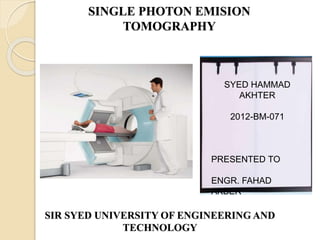
SINGLE PHOTON EMISION
TOMOGRAPHY
SIR SYED UNIVERSITY OF ENGINEERING AND
TECHNOLOGY
SYED HAMMAD
AKHTER
2012-BM-071
PRESENTED TO
ENGR. FAHAD
AKBER
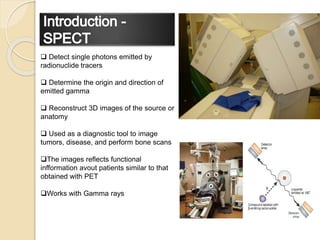
 Detect single photons emitted by
radionuclide tracers
 Determine the origin and direction of
emitted gamma
 Reconstruct 3D images of the source or
anatomy
 Used as a diagnostic tool to image
tumors, disease, and perform bone scans
The images reflects functional
infformation avout patients similar to that
obtained with PET
Works with Gamma rays
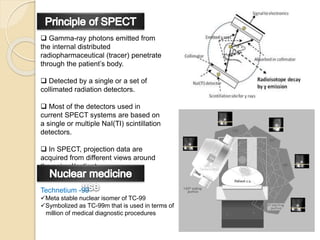
 Gamma-ray photons emitted from
the internal distributed
radiopharmaceutical (tracer) penetrate
through the patient’s body.
 Detected by a single or a set of
collimated radiation detectors.
 Most of the detectors used in
current SPECT systems are based on
a single or multiple NaI(TI) scintillation
detectors.
 In SPECT, projection data are
acquired from different views around
the animal/patient.
Technetium -99
Meta stable nuclear isomer of TC-99
Symbolized as TC-99m that is used in terms of
million of medical diagnostic procedures
Thallium activated Sodium Iodide
Detectors of gamma rays
It is sensitive to gamma rays and convert into light
Radionucleotide Main emision
energy
Half life
Tc-99m 140 6.02 hrs
Ti-201 69,71,80 73 hrs
I-123 159 13 hrs
In-111 1,7,245 2.83 days
Xe-133 81 5.25 days
• SPECT imaging is inferior to PET because of attainable resolution and
sensitivity. Different radionuclide is used for SPECT imaging that emits a
single photon rather than positron emission as in PET.
• The use of collimator results in a tremendous decrease in the detection
efficiency as compared to PET
SPECT Scan
Uses• Pre-surgical evaluations of uncontrolled
seizures
• Finding stress fractures in spine
(Spondylolysis)
• Blood deprived areas of the brain after a
stroke
• Detects tumors
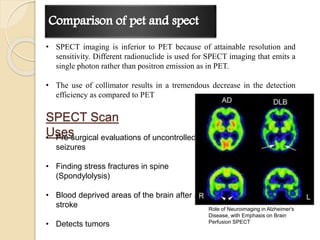
Role of Neuroimaging in Alzheimer's
Disease, with Emphasis on Brain
Perfusion SPECT

Single photon emission computed tomography (spect)

  • 1.
    SINGLE PHOTON EMISION TOMOGRAPHY SIRSYED UNIVERSITY OF ENGINEERING AND TECHNOLOGY SYED HAMMAD AKHTER 2012-BM-071 PRESENTED TO ENGR. FAHAD AKBER
  • 2.
     Detect singlephotons emitted by radionuclide tracers  Determine the origin and direction of emitted gamma  Reconstruct 3D images of the source or anatomy  Used as a diagnostic tool to image tumors, disease, and perform bone scans The images reflects functional infformation avout patients similar to that obtained with PET Works with Gamma rays
  • 3.
     Gamma-ray photonsemitted from the internal distributed radiopharmaceutical (tracer) penetrate through the patient’s body.  Detected by a single or a set of collimated radiation detectors.  Most of the detectors used in current SPECT systems are based on a single or multiple NaI(TI) scintillation detectors.  In SPECT, projection data are acquired from different views around the animal/patient. Technetium -99 Meta stable nuclear isomer of TC-99 Symbolized as TC-99m that is used in terms of million of medical diagnostic procedures
  • 4.
    Thallium activated SodiumIodide Detectors of gamma rays It is sensitive to gamma rays and convert into light Radionucleotide Main emision energy Half life Tc-99m 140 6.02 hrs Ti-201 69,71,80 73 hrs I-123 159 13 hrs In-111 1,7,245 2.83 days Xe-133 81 5.25 days
  • 5.
    • SPECT imagingis inferior to PET because of attainable resolution and sensitivity. Different radionuclide is used for SPECT imaging that emits a single photon rather than positron emission as in PET. • The use of collimator results in a tremendous decrease in the detection efficiency as compared to PET SPECT Scan Uses• Pre-surgical evaluations of uncontrolled seizures • Finding stress fractures in spine (Spondylolysis) • Blood deprived areas of the brain after a stroke • Detects tumors Role of Neuroimaging in Alzheimer's Disease, with Emphasis on Brain Perfusion SPECT