BY
MUNA BUDHATHOKI
B.SC. MIT 2ND YEAR
CMCTH,CHITWAN
HISTORICAL PERSPECTIVE
oG.N Hounsfield (an engineer with
EMI) is credited with the invention of
CT
oAllan MacLeod Cormack of united
state developed solution to the
mathematical problem in CT
oIn 1972, the first head CT scanner
was invented by Goldfrey Hounsfield
AVI00719
GN Hounsfield
2
oin 1972, Hounsfield shared the
Nobel prize in medicine and
physiology with Allan Cormack
AVI00719
Allan Cormack
3
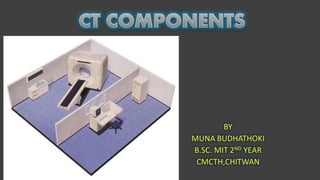
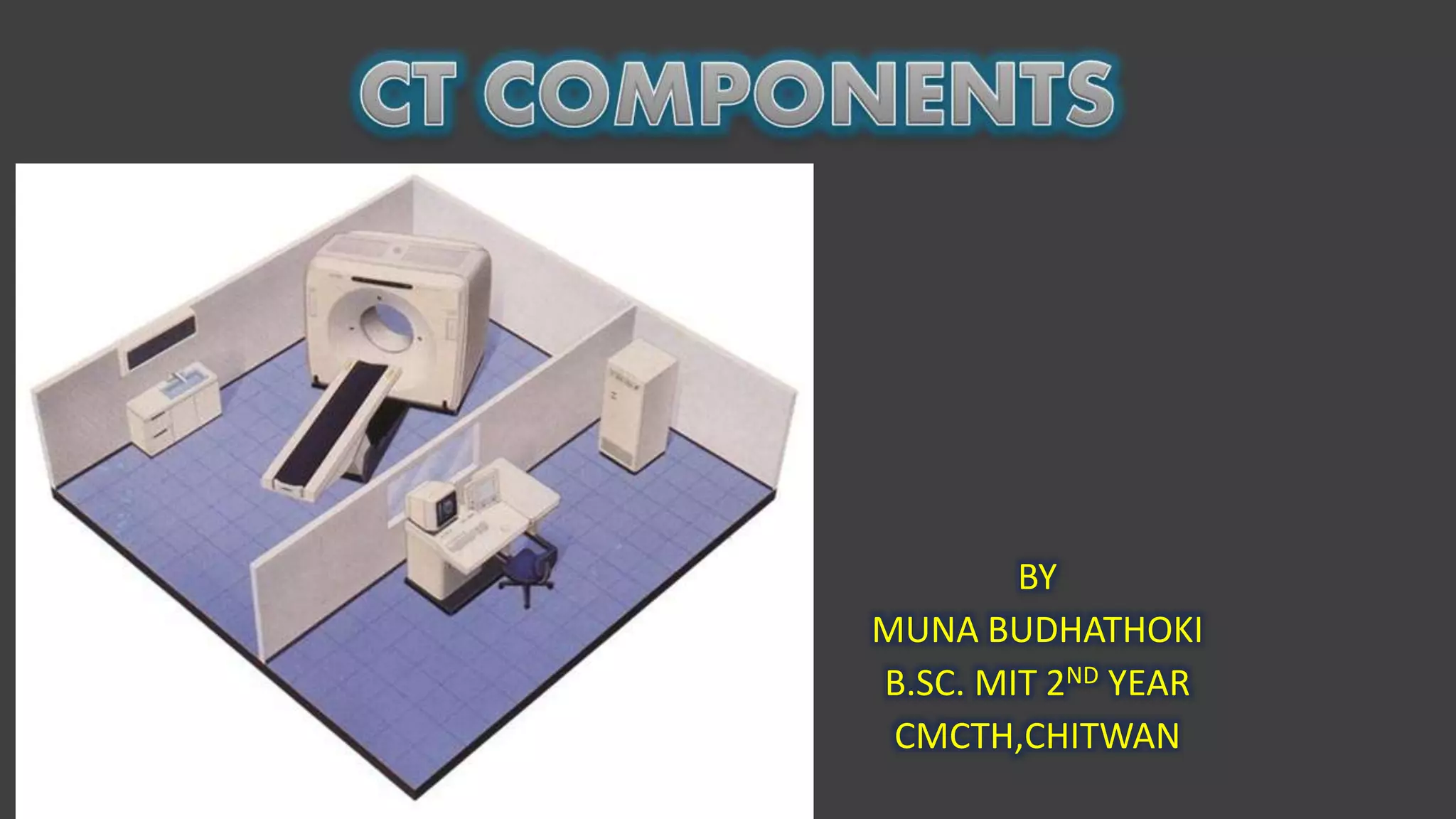
COMPONENTS OF CT
• CT has three major systems
1) Imaging system
a. Gantry b) table
2)Computer system
3)Operating system
IMAGING SYSTEM
A)GANTRY
• A mounted framework that surrounds the patient in a vertical plane
• The gantry includes :-a)slip ring
b) x-ray tube
c)high voltage generator
d)collimator
e)detector
d) data aquisition system
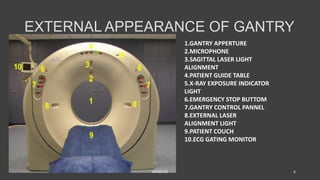
EXTERNAL APPEARANCE OF GANTRY
1.GANTRY APPERTURE
2.MICROPHONE
3.SAGITTAL LASER LIGHT
ALIGNMENT
4.PATIENT GUIDE TABLE
5.X-RAY EXPOSURE INDICATOR
LIGHT
6.EMERGENCY STOP BUTTOM
7.GANTRY CONTROL PANNEL
8.EXTERNAL LASER
ALIGNMENT LIGHT
9.PATIENT COUCH
10.ECG GATING MONITOR
6AVI00719
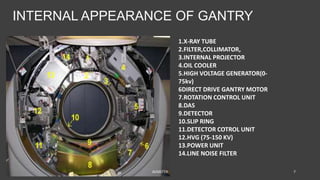
INTERNAL APPEARANCE OF GANTRY
1.X-RAY TUBE
2.FILTER,COLLIMATOR,
3.INTERNAL PROJECTOR
4.OIL COOLER
5.HIGH VOLTAGE GENERATOR(0-
75kv)
6DIRECT DRIVE GANTRY MOTOR
7.ROTATION CONTROL UNIT
8.DAS
9.DETECTOR
10.SLIP RING
11.DETECTOR COTROL UNIT
12.HVG (75-150 KV)
13.POWER UNIT
14.LINE NOISE FILTER
7AVI00719
Cont……
• Two important features of gantry :-
oGantry aperture :-50cm -90cm
oTilting range :- 30 degree towards or away from the patient table
• Three intense white or low power laser light
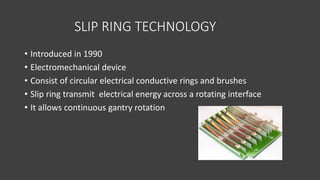
SLIP RING TECHNOLOGY
• Introduced in 1990
• Electromechanical device
• Consist of circular electrical conductive rings and brushes
• Slip ring transmit electrical energy across a rotating interface
• It allows continuous gantry rotation
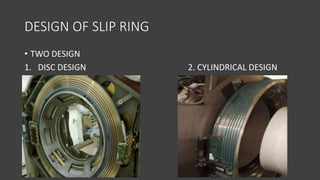
DESIGN OF SLIP RING
• TWO DESIGN
1. DISC DESIGN 2. CYLINDRICAL DESIGN
CYLINDRICAL DESIGN
CT X-RAY TUBE
• Located in the heart of the gantry
• Provide radiation source for CT
• First and second generation scanner used fixed anode , oil cooled x-
ray tube
• Borosilicate used as glass envelope in early CT
• Nowadays metal ceramic x-ray tube is used
Cont…..
• In modern CT x-ray tube
- heat capacity : above 5MHU
- Has large anode with graphite backing
- Utilize a bigger filament
- Anode angle is 7-10 degree
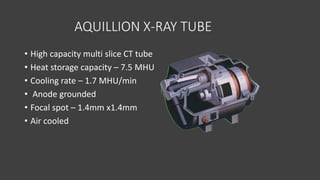
AQUILLION X-RAY TUBE
• High capacity multi slice CT tube
• Heat storage capacity – 7.5 MHU
• Cooling rate – 1.7 MHU/min
• Anode grounded
• Focal spot – 1.4mm x1.4mm
• Air cooled
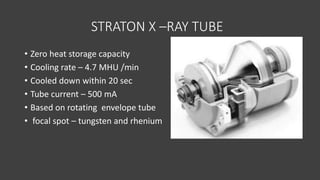
STRATON X –RAY TUBE
• Zero heat storage capacity
• Cooling rate – 4.7 MHU /min
• Cooled down within 20 sec
• Tube current – 500 mA
• Based on rotating envelope tube
• focal spot – tungsten and rhenium
GENERATOR
• conventional generator for CT scanner were based on the 60 Hz
voltage frequency
• CT scanner now use high frequency generator
• HVG circuit is referred to as high frequency inverter circuit
• Mounted on the rotating frame with the x-ray tube
• Have very low ripple <1 %
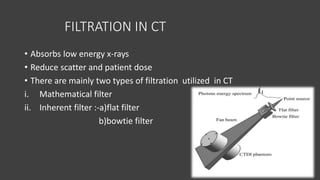
FILTRATION IN CT
• Absorbs low energy x-rays
• Reduce scatter and patient dose
• There are mainly two types of filtration utilized in CT
i. Mathematical filter
ii. Inherent filter :-a)flat filter
b)bowtie filter
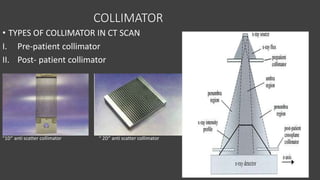
COLLIMATOR
• TYPES OF COLLIMATOR IN CT SCAN
I. Pre-patient collimator
II. Post- patient collimator
“1D” anti scatter collimator “ 2D” anti scatter collimator
CT DETECTORS
• TYPES OF DETECTOR :-
1. Gas ionization detector
convert x-ray energy directly into electrical signal
2. Scintillation detector
convert x-ray energy into light
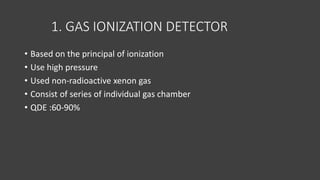
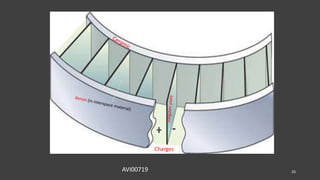
1. GAS IONIZATION DETECTOR
• Based on the principal of ionization
• Use high pressure
• Used non-radioactive xenon gas
• Consist of series of individual gas chamber
• QDE :60-90%
AVI00719 20
Charges
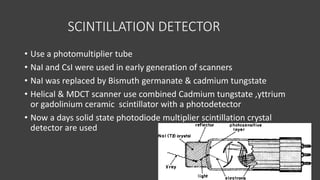
SCINTILLATION DETECTOR
• Use a photomultiplier tube
• NaI and CsI were used in early generation of scanners
• NaI was replaced by Bismuth germanate & cadmium tungstate
• Helical & MDCT scanner use combined Cadmium tungstate ,yttrium
or gadolinium ceramic scintillator with a photodetector
• Now a days solid state photodiode multiplier scintillation crystal
detector are used
DETECTOR CHARACTERISTIC
• Efficiency
• Stability
• Response time
• After glow
• Dynamic range
DATA AQUISTISTION SYSTEM
• DETECTOR - ELETRICAL SIGNAL – DAS – COMPUTER - DIGITAL SIGNAL-
ARRAY PROCESSOR (IMAGE GENERATOR OR RECONSTOCTOR
GENERATOR)
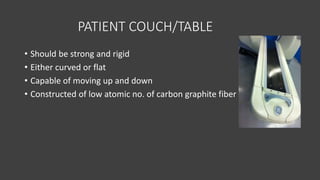
PATIENT COUCH/TABLE
• Should be strong and rigid
• Either curved or flat
• Capable of moving up and down
• Constructed of low atomic no. of carbon graphite fiber
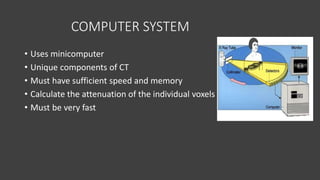
COMPUTER SYSTEM
• Uses minicomputer
• Unique components of CT
• Must have sufficient speed and memory
• Calculate the attenuation of the individual voxels using algorithm
• Must be very fast
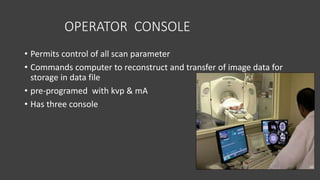
OPERATOR CONSOLE
• Permits control of all scan parameter
• Commands computer to reconstruct and transfer of image data for
storage in data file
• pre-programed with kvp & mA
• Has three console
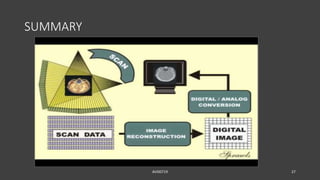
SUMMARY
AVI00719 27
Components of ct

Components of ct

  • 1.
    BY MUNA BUDHATHOKI B.SC. MIT2ND YEAR CMCTH,CHITWAN
  • 2.
    HISTORICAL PERSPECTIVE oG.N Hounsfield(an engineer with EMI) is credited with the invention of CT oAllan MacLeod Cormack of united state developed solution to the mathematical problem in CT oIn 1972, the first head CT scanner was invented by Goldfrey Hounsfield AVI00719 GN Hounsfield 2
  • 3.
    oin 1972, Hounsfieldshared the Nobel prize in medicine and physiology with Allan Cormack AVI00719 Allan Cormack 3
  • 4.
    COMPONENTS OF CT •CT has three major systems 1) Imaging system a. Gantry b) table 2)Computer system 3)Operating system
  • 5.
    IMAGING SYSTEM A)GANTRY • Amounted framework that surrounds the patient in a vertical plane • The gantry includes :-a)slip ring b) x-ray tube c)high voltage generator d)collimator e)detector d) data aquisition system
  • 6.
    EXTERNAL APPEARANCE OFGANTRY 1.GANTRY APPERTURE 2.MICROPHONE 3.SAGITTAL LASER LIGHT ALIGNMENT 4.PATIENT GUIDE TABLE 5.X-RAY EXPOSURE INDICATOR LIGHT 6.EMERGENCY STOP BUTTOM 7.GANTRY CONTROL PANNEL 8.EXTERNAL LASER ALIGNMENT LIGHT 9.PATIENT COUCH 10.ECG GATING MONITOR 6AVI00719
  • 7.
    INTERNAL APPEARANCE OFGANTRY 1.X-RAY TUBE 2.FILTER,COLLIMATOR, 3.INTERNAL PROJECTOR 4.OIL COOLER 5.HIGH VOLTAGE GENERATOR(0- 75kv) 6DIRECT DRIVE GANTRY MOTOR 7.ROTATION CONTROL UNIT 8.DAS 9.DETECTOR 10.SLIP RING 11.DETECTOR COTROL UNIT 12.HVG (75-150 KV) 13.POWER UNIT 14.LINE NOISE FILTER 7AVI00719
  • 8.
    Cont…… • Two importantfeatures of gantry :- oGantry aperture :-50cm -90cm oTilting range :- 30 degree towards or away from the patient table • Three intense white or low power laser light
  • 9.
    SLIP RING TECHNOLOGY •Introduced in 1990 • Electromechanical device • Consist of circular electrical conductive rings and brushes • Slip ring transmit electrical energy across a rotating interface • It allows continuous gantry rotation
  • 10.
    DESIGN OF SLIPRING • TWO DESIGN 1. DISC DESIGN 2. CYLINDRICAL DESIGN CYLINDRICAL DESIGN
  • 11.
    CT X-RAY TUBE •Located in the heart of the gantry • Provide radiation source for CT • First and second generation scanner used fixed anode , oil cooled x- ray tube • Borosilicate used as glass envelope in early CT • Nowadays metal ceramic x-ray tube is used
  • 12.
    Cont….. • In modernCT x-ray tube - heat capacity : above 5MHU - Has large anode with graphite backing - Utilize a bigger filament - Anode angle is 7-10 degree
  • 13.
    AQUILLION X-RAY TUBE •High capacity multi slice CT tube • Heat storage capacity – 7.5 MHU • Cooling rate – 1.7 MHU/min • Anode grounded • Focal spot – 1.4mm x1.4mm • Air cooled
  • 14.
    STRATON X –RAYTUBE • Zero heat storage capacity • Cooling rate – 4.7 MHU /min • Cooled down within 20 sec • Tube current – 500 mA • Based on rotating envelope tube • focal spot – tungsten and rhenium
  • 15.
    GENERATOR • conventional generatorfor CT scanner were based on the 60 Hz voltage frequency • CT scanner now use high frequency generator • HVG circuit is referred to as high frequency inverter circuit • Mounted on the rotating frame with the x-ray tube • Have very low ripple <1 %
  • 16.
    FILTRATION IN CT •Absorbs low energy x-rays • Reduce scatter and patient dose • There are mainly two types of filtration utilized in CT i. Mathematical filter ii. Inherent filter :-a)flat filter b)bowtie filter
  • 17.
    COLLIMATOR • TYPES OFCOLLIMATOR IN CT SCAN I. Pre-patient collimator II. Post- patient collimator “1D” anti scatter collimator “ 2D” anti scatter collimator
  • 18.
    CT DETECTORS • TYPESOF DETECTOR :- 1. Gas ionization detector convert x-ray energy directly into electrical signal 2. Scintillation detector convert x-ray energy into light
  • 19.
    1. GAS IONIZATIONDETECTOR • Based on the principal of ionization • Use high pressure • Used non-radioactive xenon gas • Consist of series of individual gas chamber • QDE :60-90%
  • 20.
  • 21.
    SCINTILLATION DETECTOR • Usea photomultiplier tube • NaI and CsI were used in early generation of scanners • NaI was replaced by Bismuth germanate & cadmium tungstate • Helical & MDCT scanner use combined Cadmium tungstate ,yttrium or gadolinium ceramic scintillator with a photodetector • Now a days solid state photodiode multiplier scintillation crystal detector are used
  • 22.
    DETECTOR CHARACTERISTIC • Efficiency •Stability • Response time • After glow • Dynamic range
  • 23.
    DATA AQUISTISTION SYSTEM •DETECTOR - ELETRICAL SIGNAL – DAS – COMPUTER - DIGITAL SIGNAL- ARRAY PROCESSOR (IMAGE GENERATOR OR RECONSTOCTOR GENERATOR)
  • 24.
    PATIENT COUCH/TABLE • Shouldbe strong and rigid • Either curved or flat • Capable of moving up and down • Constructed of low atomic no. of carbon graphite fiber
  • 25.
    COMPUTER SYSTEM • Usesminicomputer • Unique components of CT • Must have sufficient speed and memory • Calculate the attenuation of the individual voxels using algorithm • Must be very fast
  • 26.
    OPERATOR CONSOLE • Permitscontrol of all scan parameter • Commands computer to reconstruct and transfer of image data for storage in data file • pre-programed with kvp & mA • Has three console
  • 27.

Editor's Notes