IFETCE/M.E CSE/CS7202-NIS/Unit 1 Slide #2-1
Access Control Matrix
• Overview
• Access Control Matrix Model
– Boolean Expression Evaluation
– History
• Protection State Transitions
– Commands
– Conditional Commands
• Special Rights
– Principle of Attenuation of Privilege
2
Access Control and Authorization
• Access control is a process to determine “Who
does what to what,” based on a policy.
• It is controlling access of who gets in and out
of the system and who uses what resources,
when, and in what amounts.
• Access control is restricting access to a system
or system resources based on something other
than the identity of the user
IFETCE/M.E CSE/CS7202-NIS/Unit 1
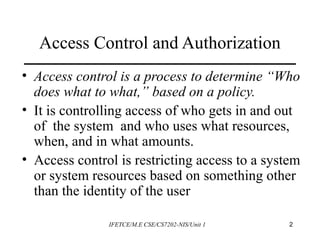
Access Operations
• Unix
read read from a file list directory contents
write write to a file create or rename a file in a directory
execute execute a (program) file search the directory
file directory
Access rights specific to a file are changed by my
modifying the file’s entry in its directory
IFETCE/M.E CSE/CS7202-NIS/Unit 1 Slide #2-3
Access Operations
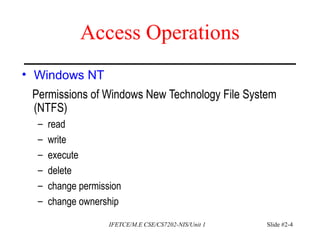
• Windows NT
Permissions of Windows New Technology File System
(NTFS)
– read
– write
– execute
– delete
– change permission
– change ownership
IFETCE/M.E CSE/CS7202-NIS/Unit 1 Slide #2-4
IFETCE/M.E CSE/CS7202-NIS/Unit 1 Slide #2-5
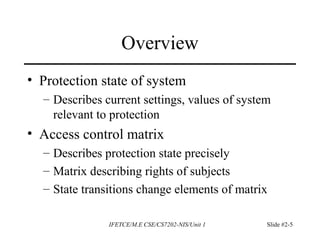
Overview
• Protection state of system
– Describes current settings, values of system
relevant to protection
• Access control matrix
– Describes protection state precisely
– Matrix describing rights of subjects
– State transitions change elements of matrix
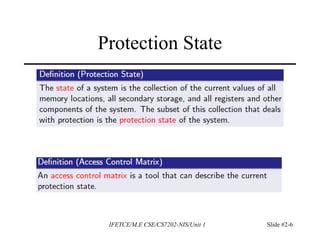
Protection State
IFETCE/M.E CSE/CS7202-NIS/Unit 1 Slide #2-6
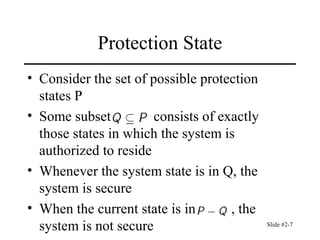
Protection State
• Consider the set of possible protection
states P
• Some subset consists of exactly
those states in which the system is
authorized to reside
• Whenever the system state is in Q, the
system is secure
• When the current state is in , the
system is not secure Slide #2-7
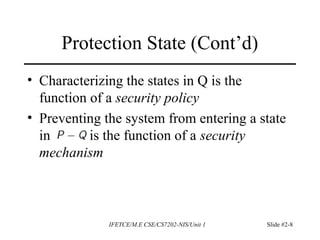
• Characterizing the states in Q is the
function of a security policy
• Preventing the system from entering a state
in is the function of a security
mechanism
Protection State (Cont’d)
IFETCE/M.E CSE/CS7202-NIS/Unit 1 Slide #2-8
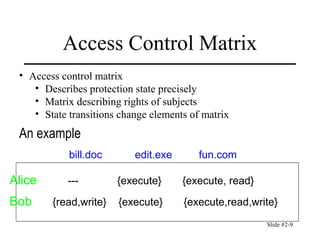
Access Control Matrix
An example
Alice --- {execute} {execute, read}
Bob {read,write} {execute} {execute,read,write}
bill.doc edit.exe fun.com
• Access control matrix
• Describes protection state precisely
• Matrix describing rights of subjects
• State transitions change elements of matrix
Slide #2-9
IFETCE/M.E CSE/CS7202-NIS/Unit 1 Slide #2-10
Description
objects (entities)
subjects
s1
s2
…
sn
o1 … om s1 … sn
• Subjects S = { s1,…,sn }
• Objects O = { o1,…,om }
• Rights R = { r1,…,rk }
• Entries A[si, oj] ⊆ R
• A[si, oj] = { rx, …, ry }
means subject sihas rights
rx, …, ry over object oj
IFETCE/M.E CSE/CS7202-NIS/Unit 1 Slide #2-11
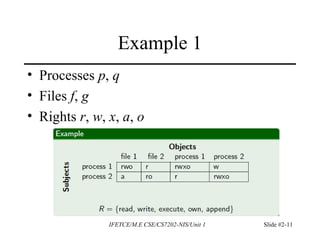
Example 1
• Processes p, q
• Files f, g
• Rights r, w, x, a, o
IFETCE/M.E CSE/CS7202-NIS/Unit 1 Slide #2-12
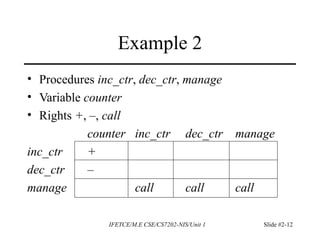
Example 2
• Procedures inc_ctr, dec_ctr, manage
• Variable counter
• Rights +, –, call
counter inc_ctr dec_ctr manage
inc_ctr +
dec_ctr –
manage call call call
IFETCE/M.E CSE/CS7202-NIS/Unit 1 Slide #2-13
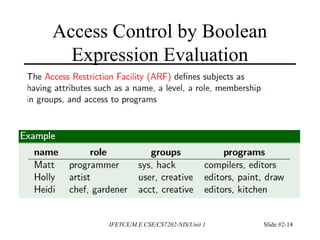
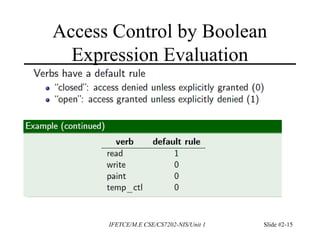
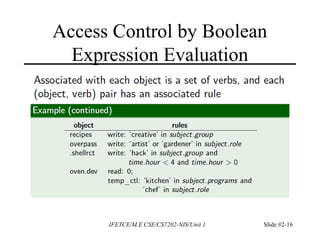
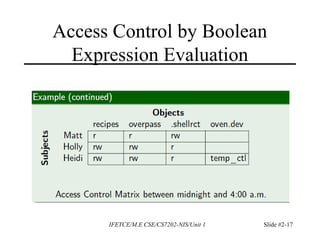
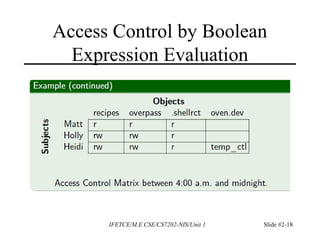
Boolean Expression Evaluation
• ACM controls access to database fields
– Subjects have attributes
– Verbs define type of access
– Rules associated with objects, verb pair
• Subject attempts to access object
– Rule for object, verb evaluated, grants or denies
access
Access Control by Boolean
Expression Evaluation
IFETCE/M.E CSE/CS7202-NIS/Unit 1 Slide #2-14
Access Control by Boolean
Expression Evaluation
IFETCE/M.E CSE/CS7202-NIS/Unit 1 Slide #2-15
Access Control by Boolean
Expression Evaluation
IFETCE/M.E CSE/CS7202-NIS/Unit 1 Slide #2-16
Access Control by Boolean
Expression Evaluation
IFETCE/M.E CSE/CS7202-NIS/Unit 1 Slide #2-17
Access Control by Boolean
Expression Evaluation
IFETCE/M.E CSE/CS7202-NIS/Unit 1 Slide #2-18
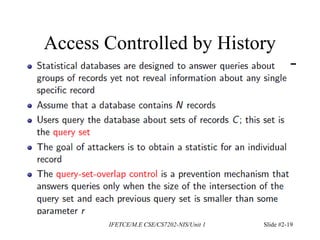
Access Controlled by History
IFETCE/M.E CSE/CS7202-NIS/Unit 1 Slide #2-19
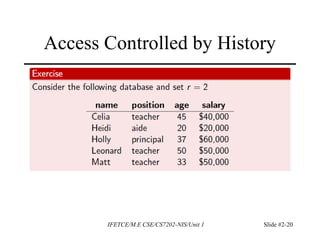
Access Controlled by History
IFETCE/M.E CSE/CS7202-NIS/Unit 1 Slide #2-20
IFETCE/M.E CSE/CS7202-NIS/Unit 1 Slide #2-21
ACM of Database Queries
Oi = { objects referenced in query i }
f(oi) = { read } for oj ∈ Oi, if |∪j =1,…,i Oj| < 2
f(oi) = ∅ for oj ∈ Oi, otherwise
1. O1 = { Celia, Leonard, Matt} and no previous query set,
so:
A[asker, Celia, Leonard, Matt] = { read }
and query can be answered
IFETCE/M.E CSE/CS7202-NIS/Unit 1 Slide #2-22
Query 2
From last slide:
f(oi) = { read } for oj in Oi, if |∪j =1,…,i Oj| > 1
f(oi) = ∅ for oj in Oi, otherwise
2. O2 = { Matt} but | O2 ∪ O1 | = 2 so
A[asker, (Holly,Leonard)] = read
and query can be answered
But Query 3
From last slide:
f(oi) = { read } for oj in Oi, if |∪j=1,…,i Oj| > 1
f(oi) = ∅ for oj in Oi, otherwise
3. O3 = { Matt} but |O3∪ O2 ∪ O1 | = 1 so
A[asker, (Holly, Leonard,Matt)] = ∅
and query cannot be answered
IFETCE/M.E CSE/CS7202-NIS/Unit 1 Slide #2-23
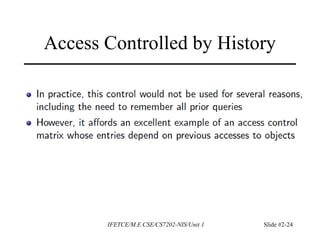
Access Controlled by History
IFETCE/M.E CSE/CS7202-NIS/Unit 1 Slide #2-24
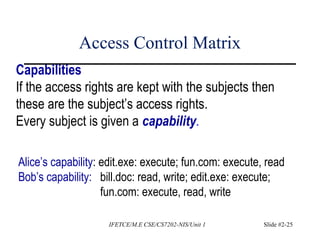
Access Control Matrix
Capabilities
If the access rights are kept with the subjects then
these are the subject’s access rights.
Every subject is given a capability.
Alice’s capability: edit.exe: execute; fun.com: execute, read
Bob’s capability: bill.doc: read, write; edit.exe: execute;
fun.com: execute, read, write
IFETCE/M.E CSE/CS7202-NIS/Unit 1 Slide #2-25
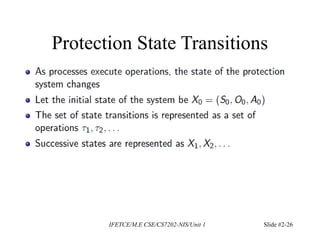
Protection State Transitions
IFETCE/M.E CSE/CS7202-NIS/Unit 1 Slide #2-26
IFETCE/M.E CSE/CS7202-NIS/Unit 1 Slide #2-27
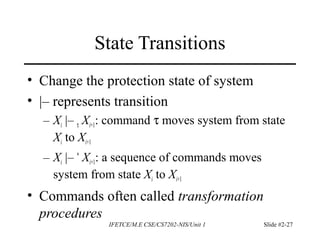
State Transitions
• Change the protection state of system
• |– represents transition
– Xi |– τ Xi+1: command τ moves system from state
Xi to Xi+1
– Xi |– *
Xi+1: a sequence of commands moves
system from state Xi to Xi+1
• Commands often called transformation
procedures
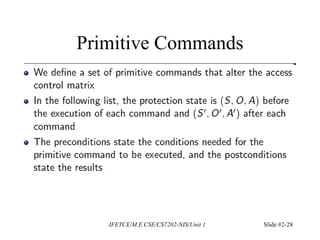
Primitive Commands
IFETCE/M.E CSE/CS7202-NIS/Unit 1 Slide #2-28
IFETCE/M.E CSE/CS7202-NIS/Unit 1 Slide #2-29
Primitive Operations
• create subject s; create object o
– Creates new row, column in ACM; creates new column in ACM
• destroy subject s; destroy object o
– Deletes row, column from ACM; deletes column from ACM
• enter r into A[s, o]
– Adds r rights for subject s over object o
• delete r from A[s, o]
– Removes r rights from subject s over object o
IFETCE/M.E CSE/CS7202-NIS/Unit 1 Slide #2-30
Create Subject
• Precondition: s ∉ S
• Primitive command: create subject s
• Postconditions:
– S′ = S ∪{ s }, O′ = O ∪{ s }
– (∀y ∈ O′)[a′[s, y] = ∅], (∀x ∈ S′)[a′[x, s] = ∅]
– (∀x ∈ S)(∀y ∈ O)[a′[x, y] = a[x, y]]
IFETCE/M.E CSE/CS7202-NIS/Unit 1 Slide #2-31
Create Object
• Precondition: o ∉ O
• Primitive command: create object o
• Postconditions:
– S′ = S, O′ = O ∪ { o }
– (∀x ∈ S′)[a′[x, o] = ∅]
– (∀x ∈ S)(∀y ∈ O)[a′[x, y] = a[x, y]]
IFETCE/M.E CSE/CS7202-NIS/Unit 1 Slide #2-32
Add Right
• Precondition: s ∈ S, o ∈ O
• Primitive command: enter r into a[s, o]
• Postconditions:
– S′ = S, O′ = O
– a′[s, o] = a[s, o] ∪ { r }
– (∀x ∈ S′)(∀y ∈ O′ – { o }) [a′[x, y] = a[x, y]]
– (∀x ∈ S′ – { s })(∀y ∈ O′) [a′[x, y] = a[x, y]]
IFETCE/M.E CSE/CS7202-NIS/Unit 1 Slide #2-33
Delete Right
• Precondition: s ∈ S, o ∈ O
• Primitive command: delete r from a[s, o]
• Postconditions:
– S′ = S, O′ = O
– a′[s, o] = a[s, o] – { r }
– (∀x ∈ S′)(∀y ∈ O′ – { o }) [a′[x, y] = a[x, y]]
– (∀x ∈ S′ – { s })(∀y ∈ O′) [a′[x, y] = a[x, y]]
IFETCE/M.E CSE/CS7202-NIS/Unit 1 Slide #2-34
Destroy Subject
• Precondition: s ∈ S
• Primitive command: destroy subject s
• Postconditions:
– S′ = S – { s }, O′ = O – { s }
– (∀y ∈ O′)[a′[s, y] = ∅], (∀x ∈ S′)[a´[x, s] = ∅]
– (∀x ∈ S′)(∀y ∈ O′) [a′[x, y] = a[x, y]]
IFETCE/M.E CSE/CS7202-NIS/Unit 1 Slide #2-35
Destroy Object
• Precondition: o ∈ O
• Primitive command: destroy object o
• Postconditions:
– S′ = S, O′ = O – { o }
– (∀x ∈ S′)[a′[x, o] = ∅]
– (∀x ∈ S′)(∀y ∈ O′) [a′[x, y] = a[x, y]]
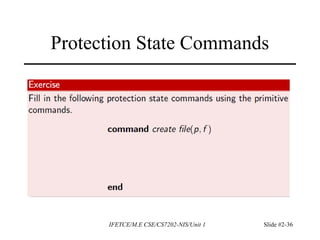
Protection State Commands
IFETCE/M.E CSE/CS7202-NIS/Unit 1 Slide #2-36
IFETCE/M.E CSE/CS7202-NIS/Unit 1 Slide #2-37
Creating File
• Process p creates file f with r and w
permission
command create•file(p, f)
create object f;
enter own into A[p, f];
enter r into A[p, f];
enter w into A[p, f];
end
IFETCE/M.E CSE/CS7202-NIS/Unit 1 Slide #2-38
Mono-Operational Commands
• Make process p the owner of file g
command make•owner(p, g)
enter own into A[p, g];
end
• Mono-operational command
– Single primitive operation in this command
IFETCE/M.E CSE/CS7202-NIS/Unit 1 Slide #2-39
Conditional Commands
• Let p give q r rights over f, if p owns f
command grant•read•file•1(p, f, q)
if own in A[p, f]
then
enter r into A[q, f];
end
• Mono-conditional command
– Single condition in this command
IFETCE/M.E CSE/CS7202-NIS/Unit 1 Slide #2-40
Multiple Conditions
• Let p give q r and w rights over f, if p owns
f and p has c rights over q
command grant•read•file•2(p, f, q)
if own in A[p, f] and c in A[p, q]
then
enter r into A[q, f];
enter w into A[q, f];
end
IFETCE/M.E CSE/CS7202-NIS/Unit 1 Slide #2-41
Copy Right
• Allows possessor to give rights to another
• Often attached to a right, so only applies to
that right
– r is read right that cannot be copied
– rc is read right that can be copied
• Is copy flag copied when giving r rights?
– Depends on model, instantiation of model
IFETCE/M.E CSE/CS7202-NIS/Unit 1 Slide #2-42
Own Right
• Usually allows possessor to change entries
in ACM column
– So owner of object can add, delete rights for
others
– May depend on what system allows
• Can’t give rights to specific (set of) users
• Can’t pass copy flag to specific (set of) users
Principle of Attenuation Privilege
IFETCE/M.E CSE/CS7202-NIS/Unit 1 Slide #2-43
IFETCE/M.E CSE/CS7202-NIS/Unit 1 Slide #2-44
Attenuation of Privilege
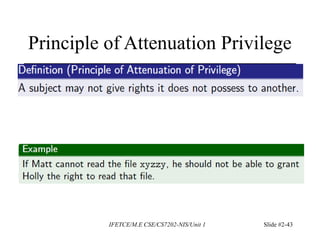
• Principle says you can’t give rights you do
not possess
– Restricts addition of rights within a system
– Usually ignored for owner
• Why? Owner gives herself rights, gives them to
others, deletes her rights.
IFETCE/M.E CSE/CS7202-NIS/Unit 1 Slide #2-45
Key Points
• Access control matrix simplest abstraction
mechanism for representing protection state
• Transitions alter protection state
• 6 primitive operations alter matrix
– Transitions can be expressed as commands
composed of these operations and, possibly,
conditions
Access Control Matrix
Access rights can be kept with the
• subjects or the
• objects.
IFETCE/M.E CSE/CS7202-NIS/Unit 1 Slide #2-46
Access Control Matrix
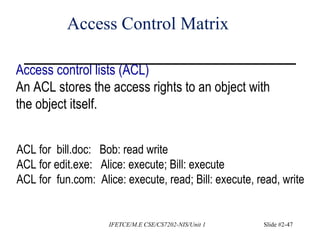
Access control lists (ACL)
An ACL stores the access rights to an object with
the object itself.
ACL for bill.doc: Bob: read write
ACL for edit.exe: Alice: execute; Bill: execute
ACL for fun.com: Alice: execute, read; Bill: execute, read, write
IFETCE/M.E CSE/CS7202-NIS/Unit 1 Slide #2-47
Access Control Matrix
Access control lists (ACL)
Management of access rights can be cumbersome.
Therefore users are placed in groups, and derive
access from a user’s group.
IFETCE/M.E CSE/CS7202-NIS/Unit 1 Slide #2-48

Access control matrix

  • 1.
    IFETCE/M.E CSE/CS7202-NIS/Unit 1Slide #2-1 Access Control Matrix • Overview • Access Control Matrix Model – Boolean Expression Evaluation – History • Protection State Transitions – Commands – Conditional Commands • Special Rights – Principle of Attenuation of Privilege
  • 2.
    2 Access Control andAuthorization • Access control is a process to determine “Who does what to what,” based on a policy. • It is controlling access of who gets in and out of the system and who uses what resources, when, and in what amounts. • Access control is restricting access to a system or system resources based on something other than the identity of the user IFETCE/M.E CSE/CS7202-NIS/Unit 1
  • 3.
    Access Operations • Unix readread from a file list directory contents write write to a file create or rename a file in a directory execute execute a (program) file search the directory file directory Access rights specific to a file are changed by my modifying the file’s entry in its directory IFETCE/M.E CSE/CS7202-NIS/Unit 1 Slide #2-3
  • 4.
    Access Operations • WindowsNT Permissions of Windows New Technology File System (NTFS) – read – write – execute – delete – change permission – change ownership IFETCE/M.E CSE/CS7202-NIS/Unit 1 Slide #2-4
  • 5.
    IFETCE/M.E CSE/CS7202-NIS/Unit 1Slide #2-5 Overview • Protection state of system – Describes current settings, values of system relevant to protection • Access control matrix – Describes protection state precisely – Matrix describing rights of subjects – State transitions change elements of matrix
  • 6.
  • 7.
    Protection State • Considerthe set of possible protection states P • Some subset consists of exactly those states in which the system is authorized to reside • Whenever the system state is in Q, the system is secure • When the current state is in , the system is not secure Slide #2-7
  • 8.
    • Characterizing thestates in Q is the function of a security policy • Preventing the system from entering a state in is the function of a security mechanism Protection State (Cont’d) IFETCE/M.E CSE/CS7202-NIS/Unit 1 Slide #2-8
  • 9.
    Access Control Matrix Anexample Alice --- {execute} {execute, read} Bob {read,write} {execute} {execute,read,write} bill.doc edit.exe fun.com • Access control matrix • Describes protection state precisely • Matrix describing rights of subjects • State transitions change elements of matrix Slide #2-9
  • 10.
    IFETCE/M.E CSE/CS7202-NIS/Unit 1Slide #2-10 Description objects (entities) subjects s1 s2 … sn o1 … om s1 … sn • Subjects S = { s1,…,sn } • Objects O = { o1,…,om } • Rights R = { r1,…,rk } • Entries A[si, oj] ⊆ R • A[si, oj] = { rx, …, ry } means subject sihas rights rx, …, ry over object oj
  • 11.
    IFETCE/M.E CSE/CS7202-NIS/Unit 1Slide #2-11 Example 1 • Processes p, q • Files f, g • Rights r, w, x, a, o
  • 12.
    IFETCE/M.E CSE/CS7202-NIS/Unit 1Slide #2-12 Example 2 • Procedures inc_ctr, dec_ctr, manage • Variable counter • Rights +, –, call counter inc_ctr dec_ctr manage inc_ctr + dec_ctr – manage call call call
  • 13.
    IFETCE/M.E CSE/CS7202-NIS/Unit 1Slide #2-13 Boolean Expression Evaluation • ACM controls access to database fields – Subjects have attributes – Verbs define type of access – Rules associated with objects, verb pair • Subject attempts to access object – Rule for object, verb evaluated, grants or denies access
  • 14.
    Access Control byBoolean Expression Evaluation IFETCE/M.E CSE/CS7202-NIS/Unit 1 Slide #2-14
  • 15.
    Access Control byBoolean Expression Evaluation IFETCE/M.E CSE/CS7202-NIS/Unit 1 Slide #2-15
  • 16.
    Access Control byBoolean Expression Evaluation IFETCE/M.E CSE/CS7202-NIS/Unit 1 Slide #2-16
  • 17.
    Access Control byBoolean Expression Evaluation IFETCE/M.E CSE/CS7202-NIS/Unit 1 Slide #2-17
  • 18.
    Access Control byBoolean Expression Evaluation IFETCE/M.E CSE/CS7202-NIS/Unit 1 Slide #2-18
  • 19.
    Access Controlled byHistory IFETCE/M.E CSE/CS7202-NIS/Unit 1 Slide #2-19
  • 20.
    Access Controlled byHistory IFETCE/M.E CSE/CS7202-NIS/Unit 1 Slide #2-20
  • 21.
    IFETCE/M.E CSE/CS7202-NIS/Unit 1Slide #2-21 ACM of Database Queries Oi = { objects referenced in query i } f(oi) = { read } for oj ∈ Oi, if |∪j =1,…,i Oj| < 2 f(oi) = ∅ for oj ∈ Oi, otherwise 1. O1 = { Celia, Leonard, Matt} and no previous query set, so: A[asker, Celia, Leonard, Matt] = { read } and query can be answered
  • 22.
    IFETCE/M.E CSE/CS7202-NIS/Unit 1Slide #2-22 Query 2 From last slide: f(oi) = { read } for oj in Oi, if |∪j =1,…,i Oj| > 1 f(oi) = ∅ for oj in Oi, otherwise 2. O2 = { Matt} but | O2 ∪ O1 | = 2 so A[asker, (Holly,Leonard)] = read and query can be answered
  • 23.
    But Query 3 Fromlast slide: f(oi) = { read } for oj in Oi, if |∪j=1,…,i Oj| > 1 f(oi) = ∅ for oj in Oi, otherwise 3. O3 = { Matt} but |O3∪ O2 ∪ O1 | = 1 so A[asker, (Holly, Leonard,Matt)] = ∅ and query cannot be answered IFETCE/M.E CSE/CS7202-NIS/Unit 1 Slide #2-23
  • 24.
    Access Controlled byHistory IFETCE/M.E CSE/CS7202-NIS/Unit 1 Slide #2-24
  • 25.
    Access Control Matrix Capabilities Ifthe access rights are kept with the subjects then these are the subject’s access rights. Every subject is given a capability. Alice’s capability: edit.exe: execute; fun.com: execute, read Bob’s capability: bill.doc: read, write; edit.exe: execute; fun.com: execute, read, write IFETCE/M.E CSE/CS7202-NIS/Unit 1 Slide #2-25
  • 26.
    Protection State Transitions IFETCE/M.ECSE/CS7202-NIS/Unit 1 Slide #2-26
  • 27.
    IFETCE/M.E CSE/CS7202-NIS/Unit 1Slide #2-27 State Transitions • Change the protection state of system • |– represents transition – Xi |– τ Xi+1: command τ moves system from state Xi to Xi+1 – Xi |– * Xi+1: a sequence of commands moves system from state Xi to Xi+1 • Commands often called transformation procedures
  • 28.
  • 29.
    IFETCE/M.E CSE/CS7202-NIS/Unit 1Slide #2-29 Primitive Operations • create subject s; create object o – Creates new row, column in ACM; creates new column in ACM • destroy subject s; destroy object o – Deletes row, column from ACM; deletes column from ACM • enter r into A[s, o] – Adds r rights for subject s over object o • delete r from A[s, o] – Removes r rights from subject s over object o
  • 30.
    IFETCE/M.E CSE/CS7202-NIS/Unit 1Slide #2-30 Create Subject • Precondition: s ∉ S • Primitive command: create subject s • Postconditions: – S′ = S ∪{ s }, O′ = O ∪{ s } – (∀y ∈ O′)[a′[s, y] = ∅], (∀x ∈ S′)[a′[x, s] = ∅] – (∀x ∈ S)(∀y ∈ O)[a′[x, y] = a[x, y]]
  • 31.
    IFETCE/M.E CSE/CS7202-NIS/Unit 1Slide #2-31 Create Object • Precondition: o ∉ O • Primitive command: create object o • Postconditions: – S′ = S, O′ = O ∪ { o } – (∀x ∈ S′)[a′[x, o] = ∅] – (∀x ∈ S)(∀y ∈ O)[a′[x, y] = a[x, y]]
  • 32.
    IFETCE/M.E CSE/CS7202-NIS/Unit 1Slide #2-32 Add Right • Precondition: s ∈ S, o ∈ O • Primitive command: enter r into a[s, o] • Postconditions: – S′ = S, O′ = O – a′[s, o] = a[s, o] ∪ { r } – (∀x ∈ S′)(∀y ∈ O′ – { o }) [a′[x, y] = a[x, y]] – (∀x ∈ S′ – { s })(∀y ∈ O′) [a′[x, y] = a[x, y]]
  • 33.
    IFETCE/M.E CSE/CS7202-NIS/Unit 1Slide #2-33 Delete Right • Precondition: s ∈ S, o ∈ O • Primitive command: delete r from a[s, o] • Postconditions: – S′ = S, O′ = O – a′[s, o] = a[s, o] – { r } – (∀x ∈ S′)(∀y ∈ O′ – { o }) [a′[x, y] = a[x, y]] – (∀x ∈ S′ – { s })(∀y ∈ O′) [a′[x, y] = a[x, y]]
  • 34.
    IFETCE/M.E CSE/CS7202-NIS/Unit 1Slide #2-34 Destroy Subject • Precondition: s ∈ S • Primitive command: destroy subject s • Postconditions: – S′ = S – { s }, O′ = O – { s } – (∀y ∈ O′)[a′[s, y] = ∅], (∀x ∈ S′)[a´[x, s] = ∅] – (∀x ∈ S′)(∀y ∈ O′) [a′[x, y] = a[x, y]]
  • 35.
    IFETCE/M.E CSE/CS7202-NIS/Unit 1Slide #2-35 Destroy Object • Precondition: o ∈ O • Primitive command: destroy object o • Postconditions: – S′ = S, O′ = O – { o } – (∀x ∈ S′)[a′[x, o] = ∅] – (∀x ∈ S′)(∀y ∈ O′) [a′[x, y] = a[x, y]]
  • 36.
    Protection State Commands IFETCE/M.ECSE/CS7202-NIS/Unit 1 Slide #2-36
  • 37.
    IFETCE/M.E CSE/CS7202-NIS/Unit 1Slide #2-37 Creating File • Process p creates file f with r and w permission command create•file(p, f) create object f; enter own into A[p, f]; enter r into A[p, f]; enter w into A[p, f]; end
  • 38.
    IFETCE/M.E CSE/CS7202-NIS/Unit 1Slide #2-38 Mono-Operational Commands • Make process p the owner of file g command make•owner(p, g) enter own into A[p, g]; end • Mono-operational command – Single primitive operation in this command
  • 39.
    IFETCE/M.E CSE/CS7202-NIS/Unit 1Slide #2-39 Conditional Commands • Let p give q r rights over f, if p owns f command grant•read•file•1(p, f, q) if own in A[p, f] then enter r into A[q, f]; end • Mono-conditional command – Single condition in this command
  • 40.
    IFETCE/M.E CSE/CS7202-NIS/Unit 1Slide #2-40 Multiple Conditions • Let p give q r and w rights over f, if p owns f and p has c rights over q command grant•read•file•2(p, f, q) if own in A[p, f] and c in A[p, q] then enter r into A[q, f]; enter w into A[q, f]; end
  • 41.
    IFETCE/M.E CSE/CS7202-NIS/Unit 1Slide #2-41 Copy Right • Allows possessor to give rights to another • Often attached to a right, so only applies to that right – r is read right that cannot be copied – rc is read right that can be copied • Is copy flag copied when giving r rights? – Depends on model, instantiation of model
  • 42.
    IFETCE/M.E CSE/CS7202-NIS/Unit 1Slide #2-42 Own Right • Usually allows possessor to change entries in ACM column – So owner of object can add, delete rights for others – May depend on what system allows • Can’t give rights to specific (set of) users • Can’t pass copy flag to specific (set of) users
  • 43.
    Principle of AttenuationPrivilege IFETCE/M.E CSE/CS7202-NIS/Unit 1 Slide #2-43
  • 44.
    IFETCE/M.E CSE/CS7202-NIS/Unit 1Slide #2-44 Attenuation of Privilege • Principle says you can’t give rights you do not possess – Restricts addition of rights within a system – Usually ignored for owner • Why? Owner gives herself rights, gives them to others, deletes her rights.
  • 45.
    IFETCE/M.E CSE/CS7202-NIS/Unit 1Slide #2-45 Key Points • Access control matrix simplest abstraction mechanism for representing protection state • Transitions alter protection state • 6 primitive operations alter matrix – Transitions can be expressed as commands composed of these operations and, possibly, conditions
  • 46.
    Access Control Matrix Accessrights can be kept with the • subjects or the • objects. IFETCE/M.E CSE/CS7202-NIS/Unit 1 Slide #2-46
  • 47.
    Access Control Matrix Accesscontrol lists (ACL) An ACL stores the access rights to an object with the object itself. ACL for bill.doc: Bob: read write ACL for edit.exe: Alice: execute; Bill: execute ACL for fun.com: Alice: execute, read; Bill: execute, read, write IFETCE/M.E CSE/CS7202-NIS/Unit 1 Slide #2-47
  • 48.
    Access Control Matrix Accesscontrol lists (ACL) Management of access rights can be cumbersome. Therefore users are placed in groups, and derive access from a user’s group. IFETCE/M.E CSE/CS7202-NIS/Unit 1 Slide #2-48

Editor's Notes

  • #10 The access control matrix model is the most precise model used to describe a protection state It characterizes the rights of each subject with respect to every other entity As the system changes, the protection state changes When a command changes the state of the system, a state transition occurs In practice, any operation on a real system causes multiple state transitions