Unit V: Design of
Ancillary Systems
Chapter 10
ELECTRIC VEHICLE TECHNOLOGY EXPLAINED
SECOND EDITION
Introduction
• An important issue in ordinary IC engine vehicles is the ever-
rising amount of electrical power required to drive the auxiliary
systems.
• Indeed, this problem is very likely to cause a gradual moving
over from 14 to 42 V electrical systems.
• The average power taken by the electrical systems on even a
very ordinary car can be as much as 2 kW.
• Clearly, this is particularly important in battery electric vehicles,
and most of the problems addressed here are a particular
concern to this type of electric vehicle.
• The aim will always be to use systems of the lowest possible
electrical power.
Heating and Cooling Systems
Why, it is important to have energy efficient cooling systems in BEVs?
• There is little point in producing the ultimate energy-efficient electric vehicle,
light, aerodynamic and with high motor and transmission efficiencies and then
waste precious energy by passing current directly through a resistance to heat
the vehicle.
• With IC engine vehicles, copious waste heat will quickly warm the vehicle,
although starting off on a cold morning may be unpleasant. For fuel cell vehicles
or hybrids with IC engines waste heat is also available, but with battery-powered
electric vehicles there is little waste heat, and where heating is required this
must be supplied from a suitable source.
• Of course, heating does not need to be supplied for electric vehicles such as
bikes and golf buggies.
• Vehicle cooling is often needed in hot climates and this can also absorb
considerable energy.
Heating and Cooling Systems
Using specific heat, or latent heat of materials for heating
• Batteries have a low specific energy and are expensive. It is better to store heat energy by using
the specific heat, or latent heat of materials.
• As an example, 1 kg of water housed in a suitable insulated container and raised through 70 ◦C
above ambient contains 293 kJ or 81 Wh of heat. At 81 Wh/kg this is a considerably better
specific energy than both lead acid and NiCAD batteries.
• Earlier, night storage heaters used the same principle for storing heat, but they used brick rather
than water.
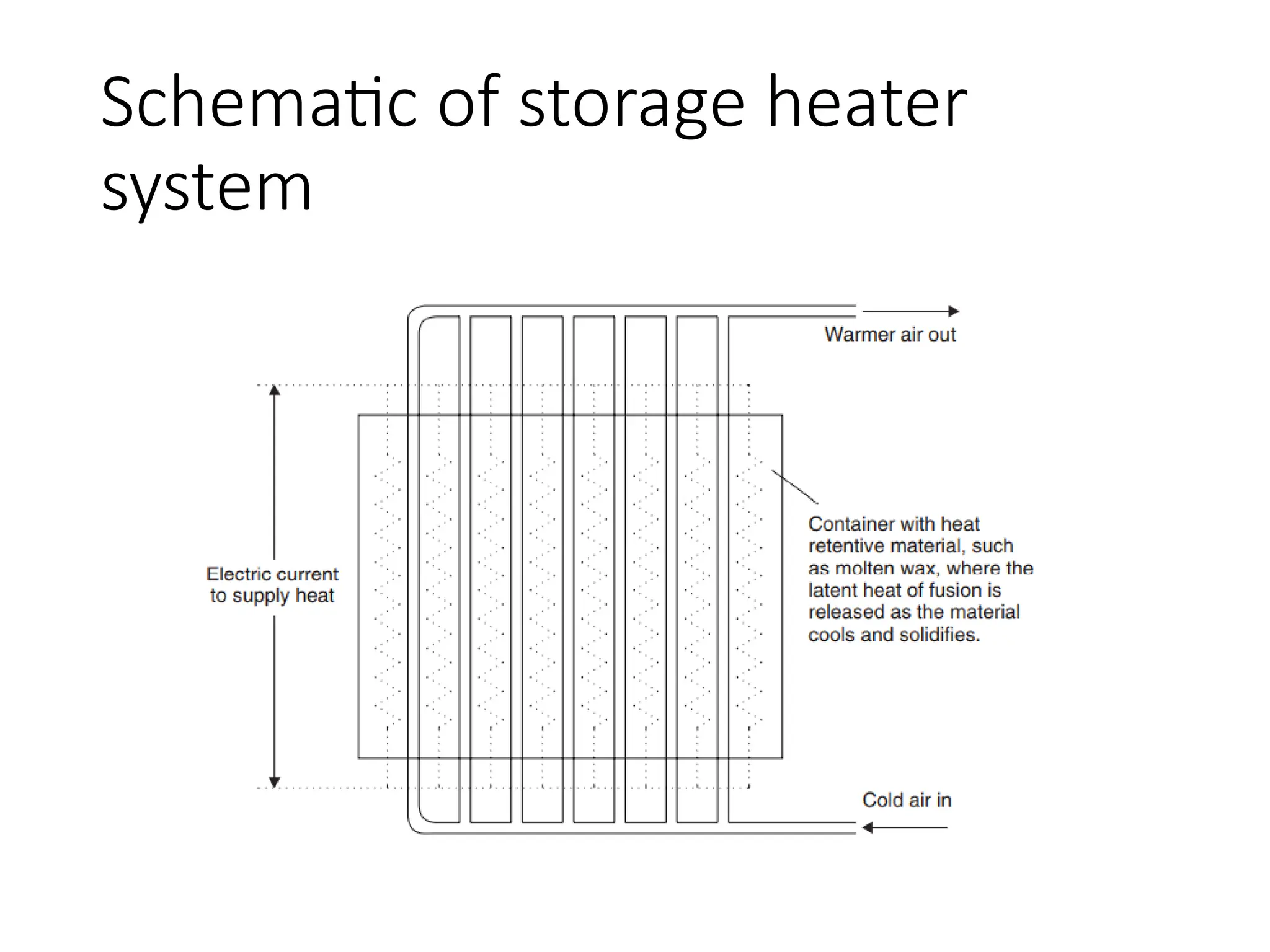
• More modern night storage heaters use the latent heat of fusion of materials such as wax, which
gives an even higher specific energy than that obtained by heating water.
• Basically the wax is melted and kept in an insulated container. The heat can be drawn from the
wax when required. A variation on this theme could be successfully used for storing heat in a
vehicle. The heater could be recharged at the same time that the batteries were topped up and
heat could be taken off as required.
• For commuter vehicles this method of heating using thermal stores does have an advantage. A
consequence would be that on cold days the vehicle would be warm as soon as the driver gets
in, which would be a boon for short journeys.
Schematic of storage heater
system
Heating and Cooling Systems
Using specific heat, or latent heat of materials for cooling
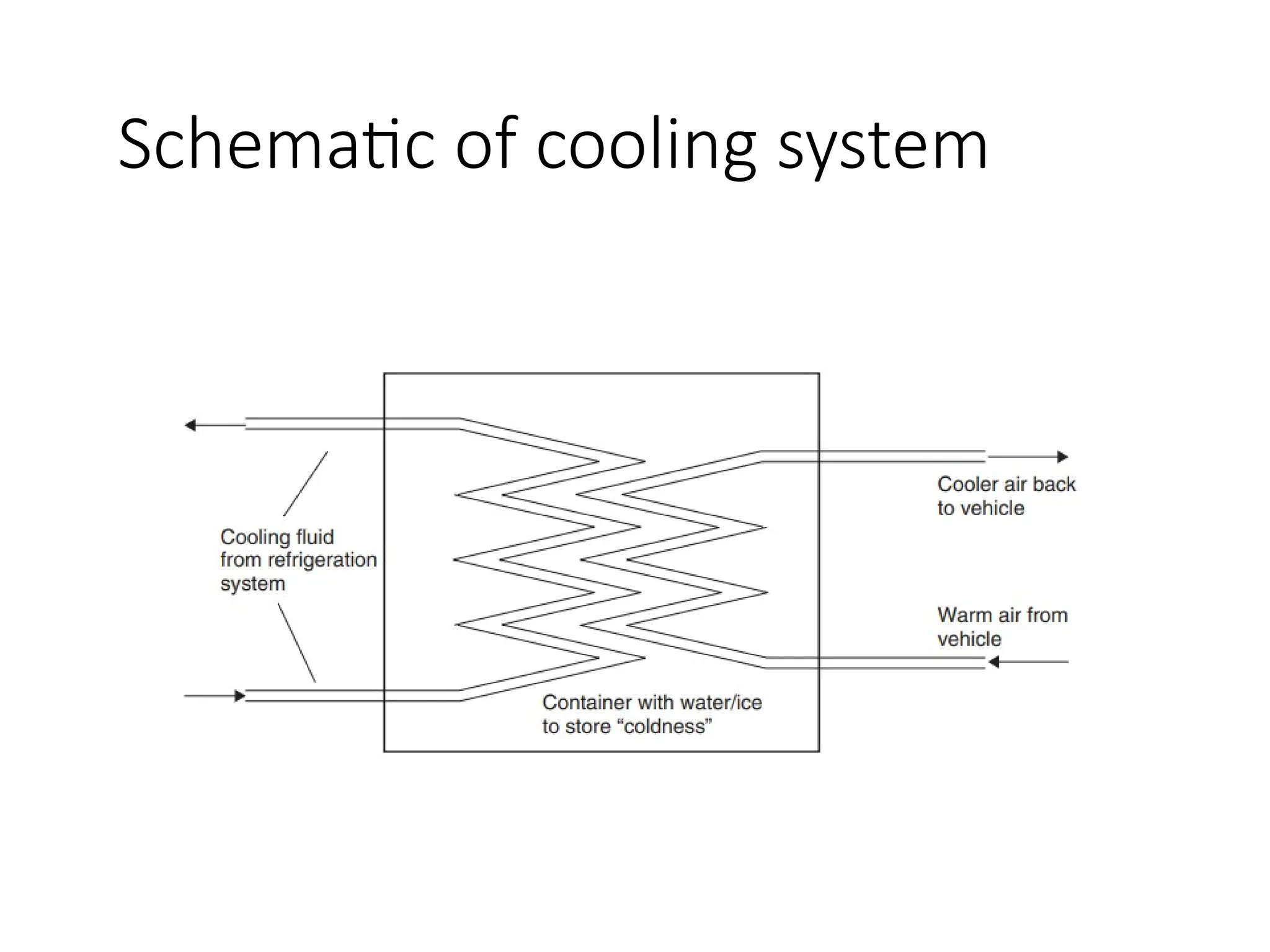
• A similar technique could be used for storing ‘coolth’. For
example, ice could be created at night and the latent heat
of fusion released when required.
• The latent heat of fusion of ice/water is 92.7 Wh/kg and a
further 17.3 Wh/kg can be obtained from heating the
water to 15 ◦C giving a total specific energy of 110 Wh/kg.
• Both of these systems are relatively simple and are worth
remembering as methods of heating and cooling electric
vehicles.
Schematic of cooling system
Heating and Cooling Systems
• Fuel burning heaters can be used to provide warmth.
Such heaters have been used in battery vehicles used
by the US postal service.
• It was said that such heaters could only be controlled
by opening the doors and letting the heat out – and
the result was that the vehicles ended up using almost
as much fuel as the diesel-powered vehicles they
replaced!
• For all sorts of reasons, this option must be considered
a last resort. For one thing, the vehicle can no longer
be classified as ‘zero emission’.
Heating and Cooling Systems
Heat Pumps
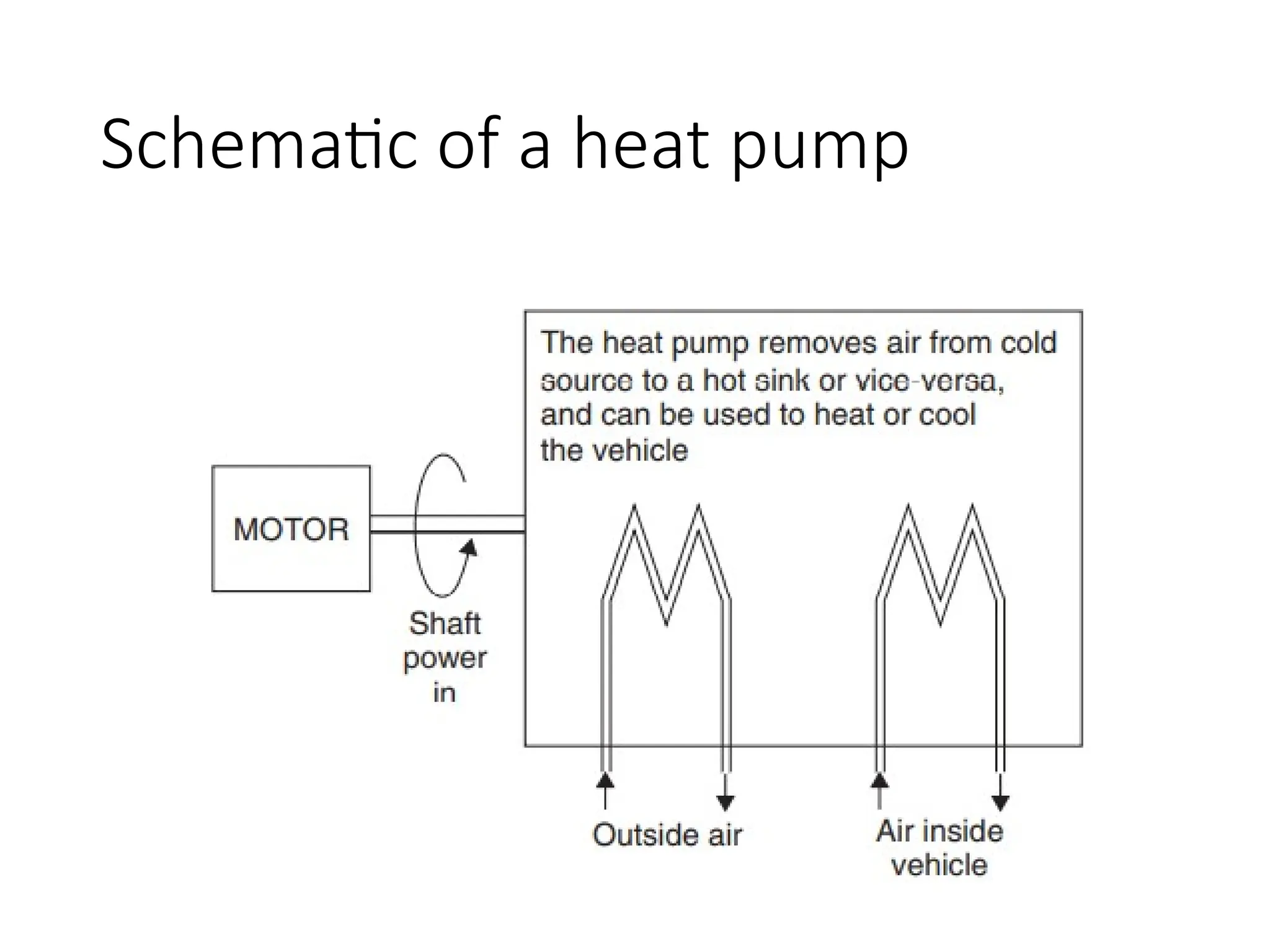
• Another way of heating and cooling an electric vehicle is to use a heat
pump, as was done on the GM EV1. A heat pump is a device that actually
provides more heat energy than the shaft or electrical energy put in.
• As its name implies, a heat pump pumps heat from one location to another.
• When heating an electric vehicle, the heat pump would take heat from the
outside air and pump the heat to the car interior.
• A reversible heat pump takes heat from the car and pumps it to the outside
air, cooling the car.
• Heat pumps have a coefficient of performance which is typically three or
more; in other words, for every kilowatt of electrical input, 3 kW or more of
heat will be pumped into, or taken from, the car.
• Refrigerators and air-conditioning units are examples of heat pumps. When
air-conditioning both heats and cools it is a reversible heat pump.
Schematic of a heat pump
Heating and Cooling Systems
Are heat pumps necessary?
• The design of heat pumps is complicated; however, there are many
air-conditioning systems available which can be used as a basis.
• Firms which specialise in heat pumps and air-conditioning should
be consulted if a heat pump is needed for an electric car.
• Car heating is clearly necessary, particularly in cold climates, but
there is always some debate as to whether cooling is needed.
Normally on a hot day, the windows are opened. However, this will
affect the aerodynamics, considerably increasing the drag and
shortening the range.
• It would make better sense to install air-conditioning in all electric
vehicles where long range is required.
Heating and Cooling Systems
Use of Thermal Insulation
• Most building designers know that the best way to heat a building is to keep
the heat in and the best way to cool the building is to keep heat out.
• They also will tell you that the heating needs to come on half an hour before
you get up. However, with cars they are either freezing cold, or when in
strong sunlight get so hot that pets and small children who cannot free
themselves can easily die from the extreme temperatures.
• Before a heating/cooling system is installed it is worth thinking about the
best method of keeping the heat in and out hence minimising both the size
of system and the amount of power used.
• Certainly insulating material can be placed around the vehicle. Some
modern insulating materials are very thin and would add little to the vehicle
mass. Structural foam sandwich materials would have good insulating
properties and these materials would therefore serve two purposes.
Heating and Cooling Systems
Use of coated glasses
• The big problem with overheating stems from the fact that most cars are
highly efficient passive solar heating systems – most would make good
greenhouses.
• There is a large glazed area allowing sunlight into the vehicle where it is
absorbed by the interior as heat.
• This heat cannot be radiated, convected and conducted away at the same
rate and so the vehicle temperature rises, often quite considerably.
• The sunlight will also hit the vehicle roof and be conducted through it,
but this can be cut down by insulating the roof as discussed earlier.
• This problem can be considerably reduced by using glass covered with a
selective coating, which considerably cuts down the amount of solar
radiation that enters the vehicle.
Heating and Cooling Systems
Other ways in which vehicle heating and cooling can be aided.
• When the vehicle is at rest in sunshine in hot climates, air can
be drawn through it bringing the internal temperature nearer
to the outside air temperature. If the vehicle is being charged
from external sources the fan can be powered from this. One
neat design is to incorporate a solar panel in the roof to
power the fan.
• It is also worth cooling or heating the vehicle half an hour or
so before it is used – by using either a remote control or a
time switch.
• Where a heat pump system is used the electricity would
come from the charge point.
Design of the Controls
• Traditional mechanical controls can be used in a
traditional way, that is steering wheel, and floor-
mounted accelerator and brake pedals (there is no
need for a clutch with an electric vehicle).
• However, some modern vehicles, such as the GM
Hy-wire use more sophisticated modern systems
using ‘drive by wire’.
• This is a system which has come from the aircraft
industry where it is known as ‘fly by wire’.
• In this system the controls are effectively
movement transducers that convert movement
into an electrical signal.
• The electrical signal is normally fed into an
electronic controller, or a computer, which in turn
controls servos on the brakes, steering, throttle,
and so on.
Design of the Controls
• There are various configurations for the controls, and they can be configured perfectly normally –
steering wheel, accelerator and brake pedals, and the type of ‘gear lever’ normally found on an
automatic transmission car.
• However, with an all-electric car it is possible to break out of this standard, and use different
systems such as the stick controller.
• Normally a four-quadrant electronic controller is used to control the motor, the first quadrant
providing forward power and the second providing regenerative braking (the other two quadrants
are used in reverse).
• Because one electronic controller is used for both acceleration and normal braking it is easier to use
one lever to accelerate and brake the vehicle.
• The mechanical brakes could then be added to the extreme lever position. Some manufacturers
have experimented with a one stick control, which incorporates the steering, accelerator and
brakes.
• A stick controller can also be used where it is coupled mechanically to the brakes and steering.
• This system has the advantage that some mechanical control is kept in the event of a breakdown of
the power-assisted servos.
• ‘Drive by wire’ normally brings out fears of what happens in the event of a failure, but it should be
borne in mind that ‘fly by wire’ has been used successfully on aircraft for years.
Design of the Controls
• An advantage of more modern types of control system that are appropriate for
electric vehicles is that computer systems could be used to override user commands.
• For example, the motor power of a vehicle is normally fixed to allow it to ascend
steep hills at reasonable speed, but this power can be used to provide excessive
acceleration and speed, which wastes energy and reduces range.
• It is quite practical to provide electronic speed control so that excessive speeds and
acceleration are avoided.
• This could also be linked to satellite navigation systems to ensure that the car never
exceeded statutory speed restrictions, increasing road safety as well as maximising
vehicle range.
• With electric vehicles, where the aim is always to save energy, onboard computers
coupled to satellite navigation systems can be even more advantageous.
• The latter can keep journeys to a minimum by giving precise directions to any
destination.
• They could also direct drivers to nearby charging points.
Power Steering
• Power steering is now standard on many cars, particularly heavier vehicles.
• With IC engine vehicles it is conventional to use a hydraulic system, the hydraulic pump
being powered mechanically from the engine. A typical hydraulic power steering system is
continually placing a small load on the engine, even when no steering assist is required.
• With electric cars where there is an electrical power source it is easier and more efficient
to use electrically powered power steering.
• The Honda Insight, for example, uses a variable assist, rack and pinion electric power
steering (EPS) system instead of a hydraulic power steering system.
• Because the EPS system only needs to draw electric power when steering assist is
required, no extra energy is needed when cruising, improving fuel efficiency.
• EPS is mechanically simpler than a hydraulic system, meaning that it should be more
reliable. The EPS system is also designed to provide good road feel and responsiveness.
• The system’s compactness and simplicity offer more design freedom in terms of placement
within the chassis.
• The steering rack, electric drive and forged-aluminium tie rods are all mounted high on the
bulkhead, and steer the wheels via steering links on each front suspension strut. This
location was chosen in order to achieve a more compact engine compartment, while
improving safety.
Choice of Tyres
• Michelin Proxima RR as used on the GM EV1 have a very low rolling resistance and it is
worthwhile to use low-energy tyres such as these.
• There is no compromise in handling and safety stemming from the use of energy-
efficient tyres.
• Hybrid IC/electric vehicles are also normally fitted with such tyres.
• Low-energy tyres are normally inflated to fairly high pressure, typically 3.5 bar, and this
means the ride of the car may be slightly less comfortable, equivalent to a harder
suspension.
• The Proxima RR has a special sealant under the tread area that automatically seals small
tread punctures.
• This avoids the need for a spare wheel, which represents a saving in weight, cost and
space – all-important parameters in electric vehicle design. Low-energy tyres such as the
Proxima RR, for example, are designed to be inherently quiet.
• This is in itself important as electric vehicles are normally introduced to save
environmental pollution, and noise pollution is unpleasant.
• Obviously, it is important for designers to discuss their needs with tyre manufacturers.
Wing Mirrors, Aerials and Luggage
Racks
• It is obviously illogical to spend endless time and effort perfecting the aerodynamics
of vehicles and then to stick wing mirrors, aerials and luggage racks out of their sides.
• This immediately increases the aerodynamic drag coefficient, which in turn reduces
range.
• Modern video systems can be used to replace wing mirrors. Small video cameras are
placed at critical spots and relayed to a screen where the driver’s mirror is
traditionally located. This system has the added advantage of giving better all-round
visibility. The screen can be split to give information from all round the car at a
glance, which would be very useful for city driving where electric vehicles are liable to
be used. This system is used on the GM Hy-wire experimental electric car. The rear
view screen is placed in the middle of the steering device.
• Aerials can be incorporated on one of the rear windows to avoid external protrusions.
• Luggage racks are a more difficult subject as they may sometimes be needed. Their
use will considerably reduce the range of rechargeable battery vehicles. It may be
better to design battery vehicles so that they do not have the option of any luggage
rack or external fitting.
End of UNIT V
Thank You

Design of Ancillary Systems .

  • 1.
    Unit V: Designof Ancillary Systems Chapter 10 ELECTRIC VEHICLE TECHNOLOGY EXPLAINED SECOND EDITION
  • 2.
    Introduction • An importantissue in ordinary IC engine vehicles is the ever- rising amount of electrical power required to drive the auxiliary systems. • Indeed, this problem is very likely to cause a gradual moving over from 14 to 42 V electrical systems. • The average power taken by the electrical systems on even a very ordinary car can be as much as 2 kW. • Clearly, this is particularly important in battery electric vehicles, and most of the problems addressed here are a particular concern to this type of electric vehicle. • The aim will always be to use systems of the lowest possible electrical power.
  • 3.
    Heating and CoolingSystems Why, it is important to have energy efficient cooling systems in BEVs? • There is little point in producing the ultimate energy-efficient electric vehicle, light, aerodynamic and with high motor and transmission efficiencies and then waste precious energy by passing current directly through a resistance to heat the vehicle. • With IC engine vehicles, copious waste heat will quickly warm the vehicle, although starting off on a cold morning may be unpleasant. For fuel cell vehicles or hybrids with IC engines waste heat is also available, but with battery-powered electric vehicles there is little waste heat, and where heating is required this must be supplied from a suitable source. • Of course, heating does not need to be supplied for electric vehicles such as bikes and golf buggies. • Vehicle cooling is often needed in hot climates and this can also absorb considerable energy.
  • 4.
    Heating and CoolingSystems Using specific heat, or latent heat of materials for heating • Batteries have a low specific energy and are expensive. It is better to store heat energy by using the specific heat, or latent heat of materials. • As an example, 1 kg of water housed in a suitable insulated container and raised through 70 ◦C above ambient contains 293 kJ or 81 Wh of heat. At 81 Wh/kg this is a considerably better specific energy than both lead acid and NiCAD batteries. • Earlier, night storage heaters used the same principle for storing heat, but they used brick rather than water. • More modern night storage heaters use the latent heat of fusion of materials such as wax, which gives an even higher specific energy than that obtained by heating water. • Basically the wax is melted and kept in an insulated container. The heat can be drawn from the wax when required. A variation on this theme could be successfully used for storing heat in a vehicle. The heater could be recharged at the same time that the batteries were topped up and heat could be taken off as required. • For commuter vehicles this method of heating using thermal stores does have an advantage. A consequence would be that on cold days the vehicle would be warm as soon as the driver gets in, which would be a boon for short journeys.
  • 5.
    Schematic of storageheater system
  • 6.
    Heating and CoolingSystems Using specific heat, or latent heat of materials for cooling • A similar technique could be used for storing ‘coolth’. For example, ice could be created at night and the latent heat of fusion released when required. • The latent heat of fusion of ice/water is 92.7 Wh/kg and a further 17.3 Wh/kg can be obtained from heating the water to 15 ◦C giving a total specific energy of 110 Wh/kg. • Both of these systems are relatively simple and are worth remembering as methods of heating and cooling electric vehicles.
  • 7.
  • 8.
    Heating and CoolingSystems • Fuel burning heaters can be used to provide warmth. Such heaters have been used in battery vehicles used by the US postal service. • It was said that such heaters could only be controlled by opening the doors and letting the heat out – and the result was that the vehicles ended up using almost as much fuel as the diesel-powered vehicles they replaced! • For all sorts of reasons, this option must be considered a last resort. For one thing, the vehicle can no longer be classified as ‘zero emission’.
  • 9.
    Heating and CoolingSystems Heat Pumps • Another way of heating and cooling an electric vehicle is to use a heat pump, as was done on the GM EV1. A heat pump is a device that actually provides more heat energy than the shaft or electrical energy put in. • As its name implies, a heat pump pumps heat from one location to another. • When heating an electric vehicle, the heat pump would take heat from the outside air and pump the heat to the car interior. • A reversible heat pump takes heat from the car and pumps it to the outside air, cooling the car. • Heat pumps have a coefficient of performance which is typically three or more; in other words, for every kilowatt of electrical input, 3 kW or more of heat will be pumped into, or taken from, the car. • Refrigerators and air-conditioning units are examples of heat pumps. When air-conditioning both heats and cools it is a reversible heat pump.
  • 10.
    Schematic of aheat pump
  • 11.
    Heating and CoolingSystems Are heat pumps necessary? • The design of heat pumps is complicated; however, there are many air-conditioning systems available which can be used as a basis. • Firms which specialise in heat pumps and air-conditioning should be consulted if a heat pump is needed for an electric car. • Car heating is clearly necessary, particularly in cold climates, but there is always some debate as to whether cooling is needed. Normally on a hot day, the windows are opened. However, this will affect the aerodynamics, considerably increasing the drag and shortening the range. • It would make better sense to install air-conditioning in all electric vehicles where long range is required.
  • 12.
    Heating and CoolingSystems Use of Thermal Insulation • Most building designers know that the best way to heat a building is to keep the heat in and the best way to cool the building is to keep heat out. • They also will tell you that the heating needs to come on half an hour before you get up. However, with cars they are either freezing cold, or when in strong sunlight get so hot that pets and small children who cannot free themselves can easily die from the extreme temperatures. • Before a heating/cooling system is installed it is worth thinking about the best method of keeping the heat in and out hence minimising both the size of system and the amount of power used. • Certainly insulating material can be placed around the vehicle. Some modern insulating materials are very thin and would add little to the vehicle mass. Structural foam sandwich materials would have good insulating properties and these materials would therefore serve two purposes.
  • 13.
    Heating and CoolingSystems Use of coated glasses • The big problem with overheating stems from the fact that most cars are highly efficient passive solar heating systems – most would make good greenhouses. • There is a large glazed area allowing sunlight into the vehicle where it is absorbed by the interior as heat. • This heat cannot be radiated, convected and conducted away at the same rate and so the vehicle temperature rises, often quite considerably. • The sunlight will also hit the vehicle roof and be conducted through it, but this can be cut down by insulating the roof as discussed earlier. • This problem can be considerably reduced by using glass covered with a selective coating, which considerably cuts down the amount of solar radiation that enters the vehicle.
  • 14.
    Heating and CoolingSystems Other ways in which vehicle heating and cooling can be aided. • When the vehicle is at rest in sunshine in hot climates, air can be drawn through it bringing the internal temperature nearer to the outside air temperature. If the vehicle is being charged from external sources the fan can be powered from this. One neat design is to incorporate a solar panel in the roof to power the fan. • It is also worth cooling or heating the vehicle half an hour or so before it is used – by using either a remote control or a time switch. • Where a heat pump system is used the electricity would come from the charge point.
  • 15.
    Design of theControls • Traditional mechanical controls can be used in a traditional way, that is steering wheel, and floor- mounted accelerator and brake pedals (there is no need for a clutch with an electric vehicle). • However, some modern vehicles, such as the GM Hy-wire use more sophisticated modern systems using ‘drive by wire’. • This is a system which has come from the aircraft industry where it is known as ‘fly by wire’. • In this system the controls are effectively movement transducers that convert movement into an electrical signal. • The electrical signal is normally fed into an electronic controller, or a computer, which in turn controls servos on the brakes, steering, throttle, and so on.
  • 16.
    Design of theControls • There are various configurations for the controls, and they can be configured perfectly normally – steering wheel, accelerator and brake pedals, and the type of ‘gear lever’ normally found on an automatic transmission car. • However, with an all-electric car it is possible to break out of this standard, and use different systems such as the stick controller. • Normally a four-quadrant electronic controller is used to control the motor, the first quadrant providing forward power and the second providing regenerative braking (the other two quadrants are used in reverse). • Because one electronic controller is used for both acceleration and normal braking it is easier to use one lever to accelerate and brake the vehicle. • The mechanical brakes could then be added to the extreme lever position. Some manufacturers have experimented with a one stick control, which incorporates the steering, accelerator and brakes. • A stick controller can also be used where it is coupled mechanically to the brakes and steering. • This system has the advantage that some mechanical control is kept in the event of a breakdown of the power-assisted servos. • ‘Drive by wire’ normally brings out fears of what happens in the event of a failure, but it should be borne in mind that ‘fly by wire’ has been used successfully on aircraft for years.
  • 17.
    Design of theControls • An advantage of more modern types of control system that are appropriate for electric vehicles is that computer systems could be used to override user commands. • For example, the motor power of a vehicle is normally fixed to allow it to ascend steep hills at reasonable speed, but this power can be used to provide excessive acceleration and speed, which wastes energy and reduces range. • It is quite practical to provide electronic speed control so that excessive speeds and acceleration are avoided. • This could also be linked to satellite navigation systems to ensure that the car never exceeded statutory speed restrictions, increasing road safety as well as maximising vehicle range. • With electric vehicles, where the aim is always to save energy, onboard computers coupled to satellite navigation systems can be even more advantageous. • The latter can keep journeys to a minimum by giving precise directions to any destination. • They could also direct drivers to nearby charging points.
  • 18.
    Power Steering • Powersteering is now standard on many cars, particularly heavier vehicles. • With IC engine vehicles it is conventional to use a hydraulic system, the hydraulic pump being powered mechanically from the engine. A typical hydraulic power steering system is continually placing a small load on the engine, even when no steering assist is required. • With electric cars where there is an electrical power source it is easier and more efficient to use electrically powered power steering. • The Honda Insight, for example, uses a variable assist, rack and pinion electric power steering (EPS) system instead of a hydraulic power steering system. • Because the EPS system only needs to draw electric power when steering assist is required, no extra energy is needed when cruising, improving fuel efficiency. • EPS is mechanically simpler than a hydraulic system, meaning that it should be more reliable. The EPS system is also designed to provide good road feel and responsiveness. • The system’s compactness and simplicity offer more design freedom in terms of placement within the chassis. • The steering rack, electric drive and forged-aluminium tie rods are all mounted high on the bulkhead, and steer the wheels via steering links on each front suspension strut. This location was chosen in order to achieve a more compact engine compartment, while improving safety.
  • 19.
    Choice of Tyres •Michelin Proxima RR as used on the GM EV1 have a very low rolling resistance and it is worthwhile to use low-energy tyres such as these. • There is no compromise in handling and safety stemming from the use of energy- efficient tyres. • Hybrid IC/electric vehicles are also normally fitted with such tyres. • Low-energy tyres are normally inflated to fairly high pressure, typically 3.5 bar, and this means the ride of the car may be slightly less comfortable, equivalent to a harder suspension. • The Proxima RR has a special sealant under the tread area that automatically seals small tread punctures. • This avoids the need for a spare wheel, which represents a saving in weight, cost and space – all-important parameters in electric vehicle design. Low-energy tyres such as the Proxima RR, for example, are designed to be inherently quiet. • This is in itself important as electric vehicles are normally introduced to save environmental pollution, and noise pollution is unpleasant. • Obviously, it is important for designers to discuss their needs with tyre manufacturers.
  • 20.
    Wing Mirrors, Aerialsand Luggage Racks • It is obviously illogical to spend endless time and effort perfecting the aerodynamics of vehicles and then to stick wing mirrors, aerials and luggage racks out of their sides. • This immediately increases the aerodynamic drag coefficient, which in turn reduces range. • Modern video systems can be used to replace wing mirrors. Small video cameras are placed at critical spots and relayed to a screen where the driver’s mirror is traditionally located. This system has the added advantage of giving better all-round visibility. The screen can be split to give information from all round the car at a glance, which would be very useful for city driving where electric vehicles are liable to be used. This system is used on the GM Hy-wire experimental electric car. The rear view screen is placed in the middle of the steering device. • Aerials can be incorporated on one of the rear windows to avoid external protrusions. • Luggage racks are a more difficult subject as they may sometimes be needed. Their use will considerably reduce the range of rechargeable battery vehicles. It may be better to design battery vehicles so that they do not have the option of any luggage rack or external fitting.
  • 21.
    End of UNITV Thank You