Electromagnetic
Braking SystemName: William Gaskey, Sandip Mistry, Duy Nguyen, Jee Yoon
Team No.: 4
Course/Section: ELET4308/12652
Instructor: Dr. Farrokh Attarzadeh
University of Houston
College of Technology
Semester: Fall 2006
Outline
• Executive Summary
• Product Requirements
• Design Alternatives
• Design Specifications
• Design Description
• Construction Details
• Costs
• Conclusions
• Questions & Comments
ELET 4308 Team 4 Slide 1 of 13
Executive Summary
• Objective: Design an electromagnetic
braking system
– Replacing the conventional braking system
– Less cost with greater performance
– No need for maintenance and/or replacement
• Research: Other types of electromagnetic
braking system
– Electromagnetic braking system with brake pads
– Eddy-current braking system
ELET 4308 Team 4 Slide 2 of 13
Product Requirements
• Overall
– Power supply to power the system
– Hub and spindle assembly to simulate the actual
spinning of the rotor
– Custom made rotor with metal arranged for the
most effective result
– Brake pedal to simulate the real environment
– Three electromagnets to generate braking force
ELET 4308 Team 4 Slide 3 of 13
Product Requirements (cont’d)
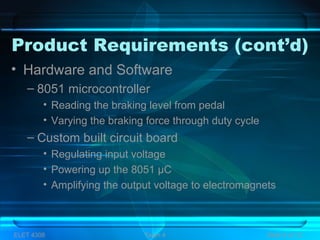
• Hardware and Software
– 8051 microcontroller
• Reading the braking level from pedal
• Varying the braking force through duty cycle
– Custom built circuit board
• Regulating input voltage
• Powering up the 8051 µC
• Amplifying the output voltage to electromagnets
ELET 4308 Team 4 Slide 4 of 13
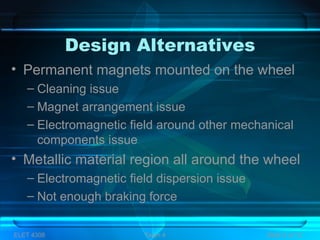
Design Alternatives
• Permanent magnets mounted on the wheel
– Cleaning issue
– Magnet arrangement issue
– Electromagnetic field around other mechanical
components issue
• Metallic material region all around the wheel
– Electromagnetic field dispersion issue
– Not enough braking force
ELET 4308 Team 4 Slide 5 of 13
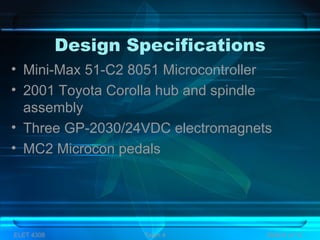
Design Specifications
ELET 4308 Team 4 Slide 6 of 13
• Mini-Max 51-C2 8051 Microcontroller
• 2001 Toyota Corolla hub and spindle
assembly
• Three GP-2030/24VDC electromagnets
• MC2 Microcon pedals
Design Specifications (cont’d)
• General view
– Pedal
– 8015 Microcontroller
– Circuit board
– Electromagnets
– DC power supply
Pedal
8051 µC
EM
DC
power
supply
Circuit
board
5 [V]
output
Input
Square
Wave
12 [V]
power
42 [V]
power
Amplified
output
ELET 4308 Team 4 Slide 7 of 13
Design Description
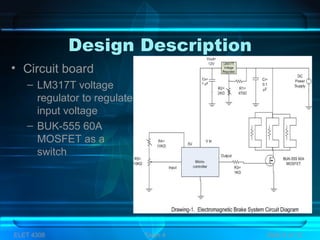
• Circuit board
– LM317T voltage
regulator to regulate
input voltage
– BUK-555 60A
MOSFET as a
switch
ELET 4308 Team 4 Slide 8 of 13
Design Description
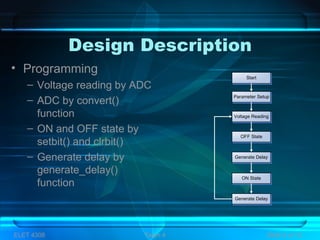
• Programming
– Voltage reading by ADC
– ADC by convert()
function
– ON and OFF state by
setbit() and clrbit()
– Generate delay by
generate_delay()
function
ELET 4308 Team 4 Slide 9 of 13
Start
Parameter Setup
Voltage Reading
Generate Delay
Generate Delay
OFF State
ON State
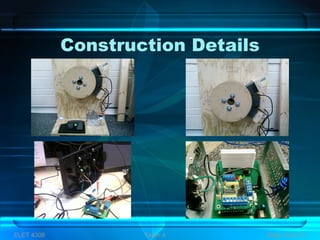
Construction Details
ELET 4308 Team 4 Slide 10 of 13
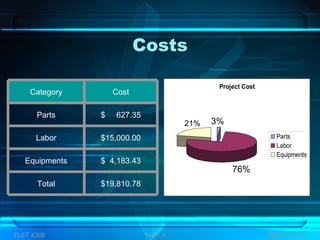
Costs
ELET 4308 Team 4 Slide 11 of 13
Project Cost
Parts
Labor
Equipments
21% 3%
76%
$19,810.78Total
$ 4,183.43Equipments
$15,000.00Labor
$ 627.35Parts
CostCategory
Conclusions
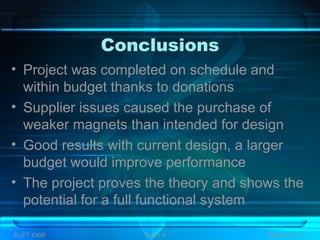
• Project was completed on schedule and
within budget thanks to donations
• Supplier issues caused the purchase of
weaker magnets than intended for design
• Good results with current design, a larger
budget would improve performance
• The project proves the theory and shows the
potential for a full functional system
ELET 4308 Team 4 Slide 12 of 13
Questions & Comments
ELET 4308 Team 4 Slide 13 of 13

Electromagnetic braking system

  • 1.
    Electromagnetic Braking SystemName: WilliamGaskey, Sandip Mistry, Duy Nguyen, Jee Yoon Team No.: 4 Course/Section: ELET4308/12652 Instructor: Dr. Farrokh Attarzadeh University of Houston College of Technology Semester: Fall 2006
  • 2.
    Outline • Executive Summary •Product Requirements • Design Alternatives • Design Specifications • Design Description • Construction Details • Costs • Conclusions • Questions & Comments ELET 4308 Team 4 Slide 1 of 13
  • 3.
    Executive Summary • Objective:Design an electromagnetic braking system – Replacing the conventional braking system – Less cost with greater performance – No need for maintenance and/or replacement • Research: Other types of electromagnetic braking system – Electromagnetic braking system with brake pads – Eddy-current braking system ELET 4308 Team 4 Slide 2 of 13
  • 4.
    Product Requirements • Overall –Power supply to power the system – Hub and spindle assembly to simulate the actual spinning of the rotor – Custom made rotor with metal arranged for the most effective result – Brake pedal to simulate the real environment – Three electromagnets to generate braking force ELET 4308 Team 4 Slide 3 of 13
  • 5.
    Product Requirements (cont’d) •Hardware and Software – 8051 microcontroller • Reading the braking level from pedal • Varying the braking force through duty cycle – Custom built circuit board • Regulating input voltage • Powering up the 8051 µC • Amplifying the output voltage to electromagnets ELET 4308 Team 4 Slide 4 of 13
  • 6.
    Design Alternatives • Permanentmagnets mounted on the wheel – Cleaning issue – Magnet arrangement issue – Electromagnetic field around other mechanical components issue • Metallic material region all around the wheel – Electromagnetic field dispersion issue – Not enough braking force ELET 4308 Team 4 Slide 5 of 13
  • 7.
    Design Specifications ELET 4308Team 4 Slide 6 of 13 • Mini-Max 51-C2 8051 Microcontroller • 2001 Toyota Corolla hub and spindle assembly • Three GP-2030/24VDC electromagnets • MC2 Microcon pedals
  • 8.
    Design Specifications (cont’d) •General view – Pedal – 8015 Microcontroller – Circuit board – Electromagnets – DC power supply Pedal 8051 µC EM DC power supply Circuit board 5 [V] output Input Square Wave 12 [V] power 42 [V] power Amplified output ELET 4308 Team 4 Slide 7 of 13
  • 9.
    Design Description • Circuitboard – LM317T voltage regulator to regulate input voltage – BUK-555 60A MOSFET as a switch ELET 4308 Team 4 Slide 8 of 13
  • 10.
    Design Description • Programming –Voltage reading by ADC – ADC by convert() function – ON and OFF state by setbit() and clrbit() – Generate delay by generate_delay() function ELET 4308 Team 4 Slide 9 of 13 Start Parameter Setup Voltage Reading Generate Delay Generate Delay OFF State ON State
  • 11.
    Construction Details ELET 4308Team 4 Slide 10 of 13
  • 12.
    Costs ELET 4308 Team4 Slide 11 of 13 Project Cost Parts Labor Equipments 21% 3% 76% $19,810.78Total $ 4,183.43Equipments $15,000.00Labor $ 627.35Parts CostCategory
  • 13.
    Conclusions • Project wascompleted on schedule and within budget thanks to donations • Supplier issues caused the purchase of weaker magnets than intended for design • Good results with current design, a larger budget would improve performance • The project proves the theory and shows the potential for a full functional system ELET 4308 Team 4 Slide 12 of 13
  • 14.
    Questions & Comments ELET4308 Team 4 Slide 13 of 13