ACTIVE CRUISE
CONTROL
HARISH C
IMTHIYAZ M
ISHAN S MARAIKAR
WHAT IS ADAPTIVE CRUISE CONTROL?
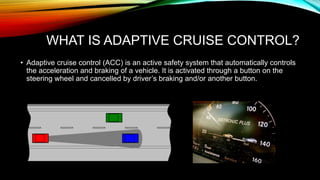
• Adaptive cruise control (ACC) is an active safety system that automatically controls
the acceleration and braking of a vehicle. It is activated through a button on the
steering wheel and cancelled by driver’s braking and/or another button.
HOW ADAPTIVE CRUISE CONTROL WORKS
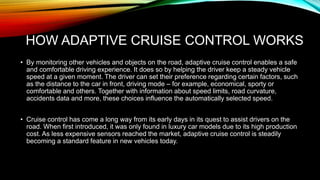
• By monitoring other vehicles and objects on the road, adaptive cruise control enables a safe
and comfortable driving experience. It does so by helping the driver keep a steady vehicle
speed at a given moment. The driver can set their preference regarding certain factors, such
as the distance to the car in front, driving mode – for example, economical, sporty or
comfortable and others. Together with information about speed limits, road curvature,
accidents data and more, these choices influence the automatically selected speed.
• Cruise control has come a long way from its early days in its quest to assist drivers on the
road. When first introduced, it was only found in luxury car models due to its high production
cost. As less expensive sensors reached the market, adaptive cruise control is steadily
becoming a standard feature in new vehicles today.
History of Adaptive Cruise Control
U.S. News says Mitsubishi first introduced adaptive cruise control in Japan in 1992. This was a lidar-based
distance detection system that detected objects that were getting too close. It was labeled as 'Debonair' and it
was programmed to provide a warning to the driver about oncoming objects. The main difference was that it
was the driver's job to apply the brakes and reduce their speed.
However, two years later in 1995, the Mitsubishi Diamante featured an upgraded approach to the Debonair
called 'Preview Distance Control.' Unlike the original technology, this laser-powered system could adjust a
driver's speed by downshifting or controlling the throttle. The driver was still responsible for applying the
brakes.
From the early 2000s onward, big names in the car industry, such as Ford, BMW, Mercedes, Cadillac,
Volkswagen, Infinity, Hyundai, Toyota, and Audi, created their versions of adaptive cruise control in their
vehicles. These individual features have evolved into a high-tech system with automatic braking and speed
control.
TYPES
Assisting systems
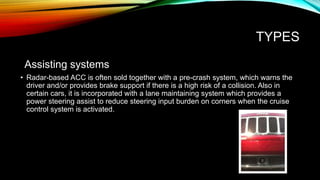
• Radar-based ACC is often sold together with a pre-crash system, which warns the
driver and/or provides brake support if there is a high risk of a collision. Also in
certain cars, it is incorporated with a lane maintaining system which provides a
power steering assist to reduce steering input burden on corners when the cruise
control system is activated.
Multi-sensor systems
Systems with multiple sensors can practice sensor fusion to integrate
the data to improve safety and/or driving experience. GPS data can
inform the system of geographic features such as a freeway off ramp. A
camera system could notice driver behavior such as brake lights and/or
a turn signal. This could allow the following car to interpret a turn signal
by an exit as not requiring the following car to slow down, as the leading
car will exit. Multi-sensor systems could also take note of traffic
signs/signals and not, e.g., violate a red light while following a vehicle
that crossed before the signal changed.
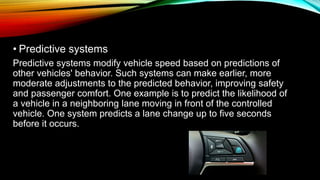
• Predictive systems
Predictive systems modify vehicle speed based on predictions of
other vehicles' behavior. Such systems can make earlier, more
moderate adjustments to the predicted behavior, improving safety
and passenger comfort. One example is to predict the likelihood of
a vehicle in a neighboring lane moving in front of the controlled
vehicle. One system predicts a lane change up to five seconds
before it occurs.
Radar-Based Systems
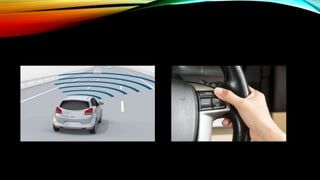
• Radar-based systems work by placing radar-based sensors on or around plastic
fascias to detect your vehicle's surroundings. Each radar sensor works together to
create a comprehensive picture of the vehicle's proximity to other cars or potentially
hazardous objects. This type of sensor can look different depending on the design
and model of the car.
Laser-Based Systems
• As mentioned by Electronic Design, this type of ACC system operates out of a large
black box typically placed in the grille of your vehicle. It uses laser technology to
detect the proximity of objects to your car. It does not operate well during rainstorms
and other weather conditions.
ADVANTAGES OF ADAPTIVE
CRUISE CONTROL
• cars with this technology will keep the adequate spacing between them and other
vehicles. These space-mindful features will also help prevent accidents that result
from an obstructed view or close following distance. Similarly, ACC will help
maximize traffic flow because of its spatial awareness. As a driver, you don't have to
worry about your speed, and instead, you can focus on what is going on around
you.
LIMITATIONS OF ADAPTIVE
CRUISE CONTROL
• Although there are many advantages to adaptive cruise control, there are still
limitations to consider. One of the main faults in this system is the fact that it is not
entirely autonomous. The driver of the vehicle still needs to practice safe driving
habits that will work in tandem with this technology to produce the best results.
Similarly, adverse weather conditions like snow, rain, or fog might confuse the
system's sensors, as well as environmental factors such as driving through tunnels.
THANK YOU

Active cruise control

  • 1.
  • 2.
    WHAT IS ADAPTIVECRUISE CONTROL? • Adaptive cruise control (ACC) is an active safety system that automatically controls the acceleration and braking of a vehicle. It is activated through a button on the steering wheel and cancelled by driver’s braking and/or another button.
  • 3.
    HOW ADAPTIVE CRUISECONTROL WORKS • By monitoring other vehicles and objects on the road, adaptive cruise control enables a safe and comfortable driving experience. It does so by helping the driver keep a steady vehicle speed at a given moment. The driver can set their preference regarding certain factors, such as the distance to the car in front, driving mode – for example, economical, sporty or comfortable and others. Together with information about speed limits, road curvature, accidents data and more, these choices influence the automatically selected speed. • Cruise control has come a long way from its early days in its quest to assist drivers on the road. When first introduced, it was only found in luxury car models due to its high production cost. As less expensive sensors reached the market, adaptive cruise control is steadily becoming a standard feature in new vehicles today.
  • 5.
    History of AdaptiveCruise Control U.S. News says Mitsubishi first introduced adaptive cruise control in Japan in 1992. This was a lidar-based distance detection system that detected objects that were getting too close. It was labeled as 'Debonair' and it was programmed to provide a warning to the driver about oncoming objects. The main difference was that it was the driver's job to apply the brakes and reduce their speed. However, two years later in 1995, the Mitsubishi Diamante featured an upgraded approach to the Debonair called 'Preview Distance Control.' Unlike the original technology, this laser-powered system could adjust a driver's speed by downshifting or controlling the throttle. The driver was still responsible for applying the brakes. From the early 2000s onward, big names in the car industry, such as Ford, BMW, Mercedes, Cadillac, Volkswagen, Infinity, Hyundai, Toyota, and Audi, created their versions of adaptive cruise control in their vehicles. These individual features have evolved into a high-tech system with automatic braking and speed control.
  • 6.
    TYPES Assisting systems • Radar-basedACC is often sold together with a pre-crash system, which warns the driver and/or provides brake support if there is a high risk of a collision. Also in certain cars, it is incorporated with a lane maintaining system which provides a power steering assist to reduce steering input burden on corners when the cruise control system is activated.
  • 7.
    Multi-sensor systems Systems withmultiple sensors can practice sensor fusion to integrate the data to improve safety and/or driving experience. GPS data can inform the system of geographic features such as a freeway off ramp. A camera system could notice driver behavior such as brake lights and/or a turn signal. This could allow the following car to interpret a turn signal by an exit as not requiring the following car to slow down, as the leading car will exit. Multi-sensor systems could also take note of traffic signs/signals and not, e.g., violate a red light while following a vehicle that crossed before the signal changed.
  • 8.
    • Predictive systems Predictivesystems modify vehicle speed based on predictions of other vehicles' behavior. Such systems can make earlier, more moderate adjustments to the predicted behavior, improving safety and passenger comfort. One example is to predict the likelihood of a vehicle in a neighboring lane moving in front of the controlled vehicle. One system predicts a lane change up to five seconds before it occurs.
  • 9.
    Radar-Based Systems • Radar-basedsystems work by placing radar-based sensors on or around plastic fascias to detect your vehicle's surroundings. Each radar sensor works together to create a comprehensive picture of the vehicle's proximity to other cars or potentially hazardous objects. This type of sensor can look different depending on the design and model of the car. Laser-Based Systems • As mentioned by Electronic Design, this type of ACC system operates out of a large black box typically placed in the grille of your vehicle. It uses laser technology to detect the proximity of objects to your car. It does not operate well during rainstorms and other weather conditions.
  • 11.
    ADVANTAGES OF ADAPTIVE CRUISECONTROL • cars with this technology will keep the adequate spacing between them and other vehicles. These space-mindful features will also help prevent accidents that result from an obstructed view or close following distance. Similarly, ACC will help maximize traffic flow because of its spatial awareness. As a driver, you don't have to worry about your speed, and instead, you can focus on what is going on around you.
  • 12.
    LIMITATIONS OF ADAPTIVE CRUISECONTROL • Although there are many advantages to adaptive cruise control, there are still limitations to consider. One of the main faults in this system is the fact that it is not entirely autonomous. The driver of the vehicle still needs to practice safe driving habits that will work in tandem with this technology to produce the best results. Similarly, adverse weather conditions like snow, rain, or fog might confuse the system's sensors, as well as environmental factors such as driving through tunnels.
  • 13.