
COHORT STUDY
HOD
Dr. SHANKAR GOWDA,
M.D (Ayu),
PROFESSOR AND HOD
(PG),
DEPT OF P.G STUDIES
IN RASASHASTRA
& BHAISHAJYA
KALPANA,
TGAMC, BALLARI.
8/8/2021 TGAMC Ballari 1
GUIDE
Dr. RAVI R.
CHAVAN, M.D (Ayu)
ASSOCIATE
PROFESSOR,
DEPT OF P.G
STUDIES IN RS &
BK
TGAMC, BALLARI.
Presented by
Dr.Priyanka. B. Patil
1st year PG Dept of RS
& BK
TGAMC Ballari.
Concept of cohort study
 The word cohort is derived from the latin
cohorts meaning a company, crowd or
group of persons with common statistical
characterstic. E.g: age, birth date.
 Cohort study is undertaken to support
the existence of association between
suspected cause and disease.
 In epidemiological terms the cohort is a
group of people with something in
common, usually an exposure or
involvement in a defined population
group within defined period of time.
8/8/2021 TGAMC Ballari 2
Definition
 Cohort study is a type of analytical study
which is undertaken to obtain additional
evidence to support existence of association
between suspected cause and diseases.
 Synonyms of cohort study are Longitudinal
study, Incidence study and Forward looking
study.
 Presence or absence of risk factor is
determined before outcome occurs.
 It comes under observational/ non
experimental/ non interventional study design.
8/8/2021 TGAMC Ballari 3
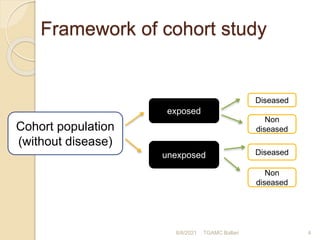
Framework of cohort study
8/8/2021 TGAMC Ballari 4
Cohort population
(without disease)
exposed
unexposed
Diseased
Non
diseased
Diseased
Non
diseased
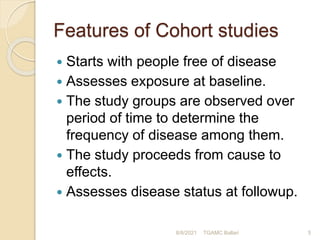
Features of Cohort studies
 Starts with people free of disease
 Assesses exposure at baseline.
 The study groups are observed over
period of time to determine the
frequency of disease among them.
 The study proceeds from cause to
effects.
 Assesses disease status at followup.
8/8/2021 TGAMC Ballari 5
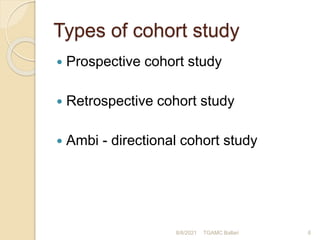
Types of cohort study
 Prospective cohort study
 Retrospective cohort study
 Ambi - directional cohort study
8/8/2021 TGAMC Ballari 6
Prospective cohort study
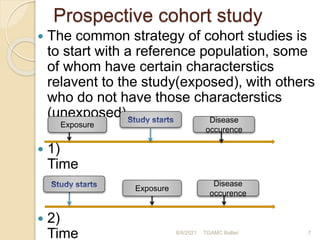
 The common strategy of cohort studies is
to start with a reference population, some
of whom have certain characterstics
relavent to the study(exposed), with others
who do not have those characterstics
(unexposed).
 1)
Time
 2)
Time 8/8/2021 TGAMC Ballari 7
Exposure
Disease
occurence
Exposure
Disease
occurence
Example of Prospective Cohort study
 Framingham heart study:
• Initiated in 1948 to study the relationship of a
variety of factors to the subsequent development
of heart disease with 5127 samples(30-59yrs) at
Framingham.
• Study subjects were examined every 2yrs for
20yrs
• Daily surveillance of hospitalization at
Framingham hospital.
• Study found that hypertension, tobacco smoking,
elevated blood cholesterol are associated to CHD.
• Increased physical activity associated with
decreased risk of CHD.
8/8/2021 TGAMC Ballari 8
Drawback of PCS
 Study might take long duration
 Sufficient amount of funding for long
duration
 Missing of study subjects.
8/8/2021 TGAMC Ballari 9
Retrospective cohort studies
 A retrospective cohort study is one in which
the outcome have all occurred before the
start of investigation.
 Investigator goes back to the past to select
study group from existing records of the past
employment, medical and other records and
traces them forward through time from the
past date fixed on the records usually to the
present.
 Known with name of historical cohort and non
current cohort.
8/8/2021 TGAMC Ballari 10
Example of Retrospective study
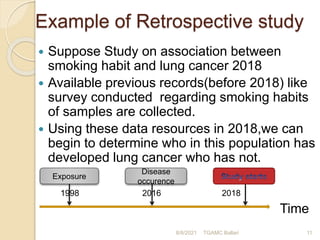
 Suppose Study on association between
smoking habit and lung cancer 2018
 Available previous records(before 2018) like
survey conducted regarding smoking habits
of samples are collected.
 Using these data resources in 2018,we can
begin to determine who in this population has
developed lung cancer who has not.
1998 2016 2018
Time
8/8/2021 TGAMC Ballari 11
Exposure
Disease
occurence
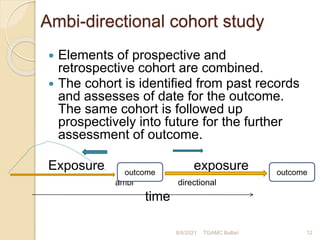
Ambi-directional cohort study
 Elements of prospective and
retrospective cohort are combined.
 The cohort is identified from past records
and assesses of date for the outcome.
The same cohort is followed up
prospectively into future for the further
assessment of outcome.
Exposure exposure
ambi directional
time
8/8/2021 TGAMC Ballari 12
outcome outcome
General consideration while
selection of cohorts
 Both the cohorts are free of the
disease
 Both the groups should equally
susceptible to disease.
 Both the groups should be
comparable.
 Diagnostic eligibility criteria for the
disease should be well in advance.
8/8/2021 TGAMC Ballari 13
Elements of cohort study
 Selection of study subjects
 Obtaining data on exposure
 Selection of comparison group
 Follow up
 Analysis
8/8/2021 TGAMC Ballari 14
Selection of study subjects
 General population
Whole population in an area
A representative sample
 Special group of population
Select group:
occupational/professional group
Exposure groups: X-ray exposure to
radiologists
8/8/2021 TGAMC Ballari 15
Obtaining data on exposure
 Personal interview.
 Review of records.
• Dose of drug, radiation, type of
surgery.
 Medical examination of special tests
 Blood pressure, serum cholesterol.
8/8/2021 TGAMC Ballari 16
Selection of comparison
group
 Internal comparison
only one cohort involved in study.
sub classified and internal comparison done.
 External comparison
More than one cohort in study for the purpose of
comparison.
e.g. Cohort of radiologist compared with cohort of
opthalmologists.
 Comparison with general population rates
if no comparison group is available we can
compare the rates of study cohort with general
population.
8/8/2021 TGAMC Ballari 17
Follow up
 To obtain data about outcome to be determined
a. Mailed questionnaire, telephone calls, personal
interviews
b. Periodic medical examination.
c. Reviewing records.
d. Surveillance of death records.
e. Follow up is most critical part of the study.
f. Some loss to follow up is inevitable due to death
change of address, migration, change of
occupation.
g. Loss of follow-up is one of the draw back of the
cohort study.
8/8/2021 TGAMC Ballari 18
Analysis
 Calculation of incidence rates among
exposed and non exposed groups.
 Estimation of risk
8/8/2021 TGAMC Ballari 19
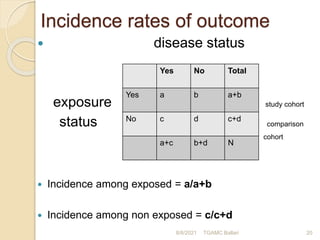
Incidence rates of outcome
 disease status
exposure study cohort
status comparison
cohort
 Incidence among exposed = a/a+b
 Incidence among non exposed = c/c+d
8/8/2021 TGAMC Ballari 20
Yes No Total
Yes a b a+b
No c d c+d
a+c b+d N
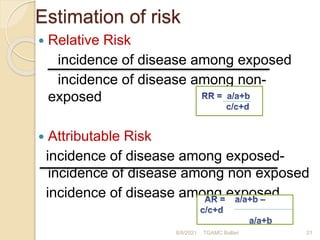
Estimation of risk
 Relative Risk
incidence of disease among exposed
incidence of disease among non-
exposed
 Attributable Risk
incidence of disease among exposed-
incidence of disease among non exposed
incidence of disease among exposed
8/8/2021 TGAMC Ballari 21
Strength of cohort studies
 Can establish population-based incidence
 Accurate relative risk estimation
 Can examine rare exposures(asbestos>lung
cancer)
 Can establish cause-effect
 Minimizes selection and information bias
 Can be used where randomization is not
possible
 Magnitude of a risk factor’s effect can be
quantified
 More than one disease related to single
exposure
 Multiple outcomes can be
8/8/2021 TGAMC Ballari 22
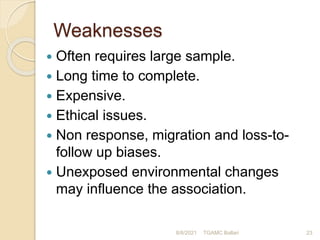
Weaknesses
 Often requires large sample.
 Long time to complete.
 Expensive.
 Ethical issues.
 Non response, migration and loss-to-
follow up biases.
 Unexposed environmental changes
may influence the association.
8/8/2021 TGAMC Ballari 23
CONCLUSION
 The cohort design has great potential
for answering research questions in
the field of health sciences
librarianship, particularly evidence
based librarianship although that
potential has been fully explored.
8/8/2021 TGAMC Ballari 24
8/8/2021 TGAMC Ballari 25

Cohort study

  • 1.
    COHORT STUDY HOD Dr. SHANKARGOWDA, M.D (Ayu), PROFESSOR AND HOD (PG), DEPT OF P.G STUDIES IN RASASHASTRA & BHAISHAJYA KALPANA, TGAMC, BALLARI. 8/8/2021 TGAMC Ballari 1 GUIDE Dr. RAVI R. CHAVAN, M.D (Ayu) ASSOCIATE PROFESSOR, DEPT OF P.G STUDIES IN RS & BK TGAMC, BALLARI. Presented by Dr.Priyanka. B. Patil 1st year PG Dept of RS & BK TGAMC Ballari.
  • 2.
    Concept of cohortstudy  The word cohort is derived from the latin cohorts meaning a company, crowd or group of persons with common statistical characterstic. E.g: age, birth date.  Cohort study is undertaken to support the existence of association between suspected cause and disease.  In epidemiological terms the cohort is a group of people with something in common, usually an exposure or involvement in a defined population group within defined period of time. 8/8/2021 TGAMC Ballari 2
  • 3.
    Definition  Cohort studyis a type of analytical study which is undertaken to obtain additional evidence to support existence of association between suspected cause and diseases.  Synonyms of cohort study are Longitudinal study, Incidence study and Forward looking study.  Presence or absence of risk factor is determined before outcome occurs.  It comes under observational/ non experimental/ non interventional study design. 8/8/2021 TGAMC Ballari 3
  • 4.
    Framework of cohortstudy 8/8/2021 TGAMC Ballari 4 Cohort population (without disease) exposed unexposed Diseased Non diseased Diseased Non diseased
  • 5.
    Features of Cohortstudies  Starts with people free of disease  Assesses exposure at baseline.  The study groups are observed over period of time to determine the frequency of disease among them.  The study proceeds from cause to effects.  Assesses disease status at followup. 8/8/2021 TGAMC Ballari 5
  • 6.
    Types of cohortstudy  Prospective cohort study  Retrospective cohort study  Ambi - directional cohort study 8/8/2021 TGAMC Ballari 6
  • 7.
    Prospective cohort study The common strategy of cohort studies is to start with a reference population, some of whom have certain characterstics relavent to the study(exposed), with others who do not have those characterstics (unexposed).  1) Time  2) Time 8/8/2021 TGAMC Ballari 7 Exposure Disease occurence Exposure Disease occurence
  • 8.
    Example of ProspectiveCohort study  Framingham heart study: • Initiated in 1948 to study the relationship of a variety of factors to the subsequent development of heart disease with 5127 samples(30-59yrs) at Framingham. • Study subjects were examined every 2yrs for 20yrs • Daily surveillance of hospitalization at Framingham hospital. • Study found that hypertension, tobacco smoking, elevated blood cholesterol are associated to CHD. • Increased physical activity associated with decreased risk of CHD. 8/8/2021 TGAMC Ballari 8
  • 9.
    Drawback of PCS Study might take long duration  Sufficient amount of funding for long duration  Missing of study subjects. 8/8/2021 TGAMC Ballari 9
  • 10.
    Retrospective cohort studies A retrospective cohort study is one in which the outcome have all occurred before the start of investigation.  Investigator goes back to the past to select study group from existing records of the past employment, medical and other records and traces them forward through time from the past date fixed on the records usually to the present.  Known with name of historical cohort and non current cohort. 8/8/2021 TGAMC Ballari 10
  • 11.
    Example of Retrospectivestudy  Suppose Study on association between smoking habit and lung cancer 2018  Available previous records(before 2018) like survey conducted regarding smoking habits of samples are collected.  Using these data resources in 2018,we can begin to determine who in this population has developed lung cancer who has not. 1998 2016 2018 Time 8/8/2021 TGAMC Ballari 11 Exposure Disease occurence
  • 12.
    Ambi-directional cohort study Elements of prospective and retrospective cohort are combined.  The cohort is identified from past records and assesses of date for the outcome. The same cohort is followed up prospectively into future for the further assessment of outcome. Exposure exposure ambi directional time 8/8/2021 TGAMC Ballari 12 outcome outcome
  • 13.
    General consideration while selectionof cohorts  Both the cohorts are free of the disease  Both the groups should equally susceptible to disease.  Both the groups should be comparable.  Diagnostic eligibility criteria for the disease should be well in advance. 8/8/2021 TGAMC Ballari 13
  • 14.
    Elements of cohortstudy  Selection of study subjects  Obtaining data on exposure  Selection of comparison group  Follow up  Analysis 8/8/2021 TGAMC Ballari 14
  • 15.
    Selection of studysubjects  General population Whole population in an area A representative sample  Special group of population Select group: occupational/professional group Exposure groups: X-ray exposure to radiologists 8/8/2021 TGAMC Ballari 15
  • 16.
    Obtaining data onexposure  Personal interview.  Review of records. • Dose of drug, radiation, type of surgery.  Medical examination of special tests  Blood pressure, serum cholesterol. 8/8/2021 TGAMC Ballari 16
  • 17.
    Selection of comparison group Internal comparison only one cohort involved in study. sub classified and internal comparison done.  External comparison More than one cohort in study for the purpose of comparison. e.g. Cohort of radiologist compared with cohort of opthalmologists.  Comparison with general population rates if no comparison group is available we can compare the rates of study cohort with general population. 8/8/2021 TGAMC Ballari 17
  • 18.
    Follow up  Toobtain data about outcome to be determined a. Mailed questionnaire, telephone calls, personal interviews b. Periodic medical examination. c. Reviewing records. d. Surveillance of death records. e. Follow up is most critical part of the study. f. Some loss to follow up is inevitable due to death change of address, migration, change of occupation. g. Loss of follow-up is one of the draw back of the cohort study. 8/8/2021 TGAMC Ballari 18
  • 19.
    Analysis  Calculation ofincidence rates among exposed and non exposed groups.  Estimation of risk 8/8/2021 TGAMC Ballari 19
  • 20.
    Incidence rates ofoutcome  disease status exposure study cohort status comparison cohort  Incidence among exposed = a/a+b  Incidence among non exposed = c/c+d 8/8/2021 TGAMC Ballari 20 Yes No Total Yes a b a+b No c d c+d a+c b+d N
  • 21.
    Estimation of risk Relative Risk incidence of disease among exposed incidence of disease among non- exposed  Attributable Risk incidence of disease among exposed- incidence of disease among non exposed incidence of disease among exposed 8/8/2021 TGAMC Ballari 21
  • 22.
    Strength of cohortstudies  Can establish population-based incidence  Accurate relative risk estimation  Can examine rare exposures(asbestos>lung cancer)  Can establish cause-effect  Minimizes selection and information bias  Can be used where randomization is not possible  Magnitude of a risk factor’s effect can be quantified  More than one disease related to single exposure  Multiple outcomes can be 8/8/2021 TGAMC Ballari 22
  • 23.
    Weaknesses  Often requireslarge sample.  Long time to complete.  Expensive.  Ethical issues.  Non response, migration and loss-to- follow up biases.  Unexposed environmental changes may influence the association. 8/8/2021 TGAMC Ballari 23
  • 24.
    CONCLUSION  The cohortdesign has great potential for answering research questions in the field of health sciences librarianship, particularly evidence based librarianship although that potential has been fully explored. 8/8/2021 TGAMC Ballari 24
  • 25.