Cross-Sectional
Study
ALL INDIA INSTITUTE OF MEDICAL SCIENCES, GORAKHPUR
Presenter:- Dr Sukanya Majumder
Moderator:- Dr Anand Mohan Dixit
Contents
 Types of epidemiological studies
 What is cross sectional study
 Design of the cross sectional study
 Steps of the cross sectional study
 Variables and it’s types
 Examples of cross sectional study
 Measurements in cross sectional study
 Sample size calculation
 Strengths and weakness of cross sectional study
 Serial cross sectional study
 Conclusion
Types of Epidemiological studies
Observatio
nal studies
Analytical
studies
Cross
sectional
study
Case
control
study
Cohort
study
Descriptiv
e studies
Ecological
study
Longitudonal
study
Cross
sectional
study
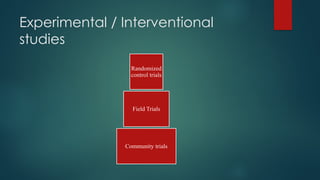
Experimental / Interventional
studies
Randomized
control trials
Field Trials
Community trials
What is Cross sectional
Study/prevalence study
 Its basically the simplest form of observational study. It tells the distribution of the disease
rather than aetiology.
Prevalence :- Number of prevailing cases (old and new) at a point of time x1000
Estimated population at the same point of time
Types of prevalence:-
1. Point prevalence:- Prevalence of the disease at a certain point of time
2. Period prevalence:- Prevalence of the disease during a certain time period
 Chronic>> short lived Diseases
 Usually exposure ascertained simultaneously with the disease and need not have etiologic
objectives. These studies can be conducted before planning a cohort study.
Cross sectional study design
 Unlike in case–control studies (participants selected based on the outcome status)
or cohort studies (participants selected based on the exposure status), the
participants in a cross-sectional study are just selected based on the inclusion and
exclusion criteria set for the study. Once the participants have been selected for
the study, the investigator follows the study to assess the exposure and the
outcomes.
 The investigator can study the association between these variables. It is also
possible that the investigator will recruit the study participants and examine the
outcomes in this population. The investigator may also estimate the prevalence of
the outcome in those surveyed.
Types of Cross Sectional Studies
 DESCRIPTIVE STUDY:- Information about single or multiple variables and estimate the
problem that is prevalence.
 ANALYTICAL STUDY:- To test the presence and the strength of the association and for
testing the hypothesis.
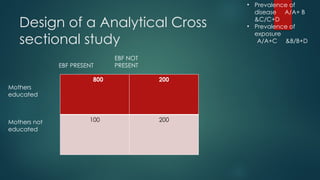
Design of a Analytical Cross
sectional study
800 200
100 200
EBF NOT
PRESENT
EBF PRESENT
Mothers
educated
Mothers not
educated
• Prevalence of
disease A/A+ B
&C/C+D
• Prevalence of
exposure
A/A+C &B/B+D
Steps of cross sectional study
 State the clinical /diagnostic criteria accurately.
 Define the variables to be measured
 Examine ethical issues
 Identify reference population
 Inclusion and exclusion criteria
 Sample size calculation
 Define measurement procedures and carry out data collection
1. Clinical records and other documents
2. Interviews and Questionnaires
 Summarize , analyze and interpret data accordingly
Variables and its types
 In statistical research, a variable is defined as an attribute of an object of study.
 Broadly divided into two types
1. Independent Variable :-Independent of other variables in study. Are of 2 types
Experimental independent variable and Subject Variable.
2. Dependent Variable:- Depends on changes of independent variables.
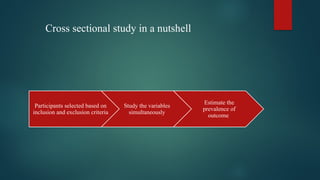
Participants selected based on
inclusion and exclusion criteria
Study the variables
simultaneously
Estimate the
prevalence of
outcome
Cross sectional study in a nutshell
Measurements in cross sectional
studies
 Cross-sectional study designs may be used for population-based surveys
We are interested to know the prevalence of vitiligo in a village. We design a
population-based survey to assess the prevalence of this condition. We go to all the
houses that were supposed to be included in the study and examine the population.
 Cross-sectional studies may also be used for estimating the prevalence in clinic-
based studies.
We evaluate patients at STI clinic. We record this history, clinical examination, and
test them for HIV antibodies (using ELISA) during their first visit to the clinic.
Cross sectional studies sample size
calculation
 In such studies, data are collected at a particular time to answer questions about
the status of population at that particular time. Such studies include
questionnaires, disease prevalence surveys, meta-analysis, etc. Cross-sectional
studies are also frequently used to show association Cross-sectional studies
usually involves estimation of prevalence and estimation of mean
 Sample size calculation
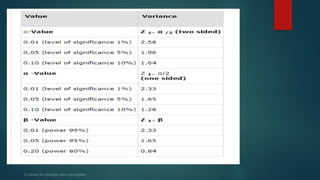
 Where Z1– α/2 is the standard normal variate (1.96 at 5% error; ), p is the expected
proportion in the population, and d is precision.
Z values for sample size calculation
Cross sectional study examples
 Example 1 :- Delivery of health services often requires knowledge of only how
many items needed without reference to the causes of disease
 Example 2:- In a study of hypertension we can collect data during the survey
about age , sex , physical exercise, salt intake and other variables of interest. The
identify how its prevention is related to these variables simultaneously measured.
 Hence we can see since this is a 1-time measurement of exposure and outcome, it
is difficult to derive causal relationships from cross-sectional analysis.
Another example of cross sectional
study
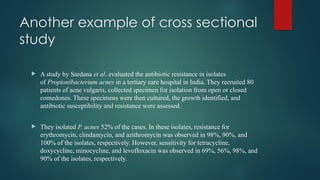
 A study by Sardana et al. evaluated the antibiotic resistance in isolates
of Propionibacterium acnes in a tertiary care hospital in India. They recruited 80
patients of acne vulgaris, collected specimen for isolation from open or closed
comedones. These specimens were then cultured, the growth identified, and
antibiotic susceptibility and resistance were assessed.
 They isolated P. acnes 52% of the cases. In these isolates, resistance for
erythromycin, clindamycin, and azithromycin was observed in 98%, 90%, and
100% of the isolates, respectively. However, sensitivity for tetracycline,
doxycycline, minocycline, and levofloxacin was observed in 69%, 56%, 98%, and
90% of the isolates, respectively.
Advantages
1. Relatively of short duration and are inexpensive.
2. Estimation of disease burden ( Prevalence of outcomes or exposures)
3. Starting point of a cohort study or a baseline in a cohort study.
4. These study designs may be useful for public health planning, monitoring, and
evaluation.
For example, the National AIDS Program conducts cross-sectional sentinel
surveys among 'high-risk groups and ante-natal mothers' every year to monitor the
prevalence of HIV in these groups.
5. Useful for Chronic conditions with low case fatality rate.
Disadvantages
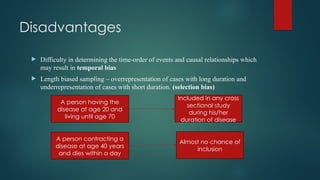
 Difficulty in determining the time-order of events and causal relationships which
may result in temporal bias
 Length biased sampling – overrepresentation of cases with long duration and
underrepresentation of cases with short duration. (selection bias)
A person having the
disease at age 20 and
living until age 70
Included in any cross
sectional study
during his/her
duration of disease
A person contracting a
disease at age 40 years
and dies within a day
Almost no chance of
inclusion
Disadvantages continued
 Prevalence-incidence bias also seen here.
Suppose there are emphysema cases due to smoking
have worse prognosis than patients of emphysema not caused
due to smoking. As a result the prevalent cases of
emphysema past history of smoking will be observed less
frequently than in incident cases.
 Not good for studying rare diseases
 Unable to measure the incidence (disease occurence)
Serial cross sectional study
 Are multiple cross sectional studies over a period of time.
 To evaluate trends in disease prevalence over time.
 Less expensive compared with a cohort study
 The study by Sardana et al. They conducted one cross-sectional survey to assess
the resistance patterns in P. acnes. If the authors conduct the same study
consecutively for two more years, they will provide information on the changing
resistance patterns in P. acnes. This will be an example of a serial cross-sectional
study.
Summary
We can understand from the previously mentioned slides that incidence cant be
estimated and temporal sequence of the progress of the outcome cant be determined.
The results of a cross sectional study should be used to generate hypothesis that can
be evaluated using a study design that includes incident cases and allows establishing
the temporal sequence of the exposure and the outcome.
This can be done before moving on to more valid study designs.
References
 Setia MS. Methodology Series Module 3: Cross-sectional Studies. Indian J Dermatol. 2016 May-
Jun;61(3):261-4. doi: 10.4103/0019-5154.182410. PMID: 27293245; PMCID: PMC4885177.
 Park textbook of preventive and community medicine 25th
edition
 Modern epidemiology (third edition) Kenneth J Rothman Wolters Kluwer
 Charan J, Biswas T. How to calculate sample size for different study designs in medical research? Indian
J Psychol Med. 2013 Apr;35(2):121-6. doi: 10.4103/0253-7176.116232. PMID: 24049221; PMCID:
PMC3775042.
 Sardana K, Gupta T, Kumar B, Gautam HK, Garg VK. Cross-sectional Pilot Study of Antibiotic
Resistance in Propionibacterium Acnes Strains in Indian Acne Patients Using 16S-RNA Polymerase
Chain Reaction: A Comparison Among Treatment Modalities Including Antibiotics, Benzoyl Peroxide,
and Isotretinoin. Indian J Dermatol. 2016 Jan-Feb;61(1):45-52. doi: 10.4103/0019-5154.174025. PMID:
26955094; PMCID: PMC4763694.
 Gordis Epidemiology 6th
edition
 https://www.scribbr.com/methodology/types-of-variables/
THANK YOU!!!

Cross sectional study.pptx community medicine

  • 1.
    Cross-Sectional Study ALL INDIA INSTITUTEOF MEDICAL SCIENCES, GORAKHPUR Presenter:- Dr Sukanya Majumder Moderator:- Dr Anand Mohan Dixit
  • 2.
    Contents  Types ofepidemiological studies  What is cross sectional study  Design of the cross sectional study  Steps of the cross sectional study  Variables and it’s types  Examples of cross sectional study  Measurements in cross sectional study  Sample size calculation  Strengths and weakness of cross sectional study  Serial cross sectional study  Conclusion
  • 3.
    Types of Epidemiologicalstudies Observatio nal studies Analytical studies Cross sectional study Case control study Cohort study Descriptiv e studies Ecological study Longitudonal study Cross sectional study
  • 4.
  • 5.
    What is Crosssectional Study/prevalence study  Its basically the simplest form of observational study. It tells the distribution of the disease rather than aetiology. Prevalence :- Number of prevailing cases (old and new) at a point of time x1000 Estimated population at the same point of time Types of prevalence:- 1. Point prevalence:- Prevalence of the disease at a certain point of time 2. Period prevalence:- Prevalence of the disease during a certain time period  Chronic>> short lived Diseases  Usually exposure ascertained simultaneously with the disease and need not have etiologic objectives. These studies can be conducted before planning a cohort study.
  • 6.
    Cross sectional studydesign  Unlike in case–control studies (participants selected based on the outcome status) or cohort studies (participants selected based on the exposure status), the participants in a cross-sectional study are just selected based on the inclusion and exclusion criteria set for the study. Once the participants have been selected for the study, the investigator follows the study to assess the exposure and the outcomes.  The investigator can study the association between these variables. It is also possible that the investigator will recruit the study participants and examine the outcomes in this population. The investigator may also estimate the prevalence of the outcome in those surveyed.
  • 7.
    Types of CrossSectional Studies  DESCRIPTIVE STUDY:- Information about single or multiple variables and estimate the problem that is prevalence.  ANALYTICAL STUDY:- To test the presence and the strength of the association and for testing the hypothesis.
  • 8.
    Design of aAnalytical Cross sectional study 800 200 100 200 EBF NOT PRESENT EBF PRESENT Mothers educated Mothers not educated • Prevalence of disease A/A+ B &C/C+D • Prevalence of exposure A/A+C &B/B+D
  • 9.
    Steps of crosssectional study  State the clinical /diagnostic criteria accurately.  Define the variables to be measured  Examine ethical issues  Identify reference population  Inclusion and exclusion criteria  Sample size calculation  Define measurement procedures and carry out data collection 1. Clinical records and other documents 2. Interviews and Questionnaires  Summarize , analyze and interpret data accordingly
  • 10.
    Variables and itstypes  In statistical research, a variable is defined as an attribute of an object of study.  Broadly divided into two types 1. Independent Variable :-Independent of other variables in study. Are of 2 types Experimental independent variable and Subject Variable. 2. Dependent Variable:- Depends on changes of independent variables.
  • 11.
    Participants selected basedon inclusion and exclusion criteria Study the variables simultaneously Estimate the prevalence of outcome Cross sectional study in a nutshell
  • 12.
    Measurements in crosssectional studies  Cross-sectional study designs may be used for population-based surveys We are interested to know the prevalence of vitiligo in a village. We design a population-based survey to assess the prevalence of this condition. We go to all the houses that were supposed to be included in the study and examine the population.  Cross-sectional studies may also be used for estimating the prevalence in clinic- based studies. We evaluate patients at STI clinic. We record this history, clinical examination, and test them for HIV antibodies (using ELISA) during their first visit to the clinic.
  • 13.
    Cross sectional studiessample size calculation  In such studies, data are collected at a particular time to answer questions about the status of population at that particular time. Such studies include questionnaires, disease prevalence surveys, meta-analysis, etc. Cross-sectional studies are also frequently used to show association Cross-sectional studies usually involves estimation of prevalence and estimation of mean  Sample size calculation  Where Z1– α/2 is the standard normal variate (1.96 at 5% error; ), p is the expected proportion in the population, and d is precision.
  • 14.
    Z values forsample size calculation
  • 15.
    Cross sectional studyexamples  Example 1 :- Delivery of health services often requires knowledge of only how many items needed without reference to the causes of disease  Example 2:- In a study of hypertension we can collect data during the survey about age , sex , physical exercise, salt intake and other variables of interest. The identify how its prevention is related to these variables simultaneously measured.  Hence we can see since this is a 1-time measurement of exposure and outcome, it is difficult to derive causal relationships from cross-sectional analysis.
  • 16.
    Another example ofcross sectional study  A study by Sardana et al. evaluated the antibiotic resistance in isolates of Propionibacterium acnes in a tertiary care hospital in India. They recruited 80 patients of acne vulgaris, collected specimen for isolation from open or closed comedones. These specimens were then cultured, the growth identified, and antibiotic susceptibility and resistance were assessed.  They isolated P. acnes 52% of the cases. In these isolates, resistance for erythromycin, clindamycin, and azithromycin was observed in 98%, 90%, and 100% of the isolates, respectively. However, sensitivity for tetracycline, doxycycline, minocycline, and levofloxacin was observed in 69%, 56%, 98%, and 90% of the isolates, respectively.
  • 17.
    Advantages 1. Relatively ofshort duration and are inexpensive. 2. Estimation of disease burden ( Prevalence of outcomes or exposures) 3. Starting point of a cohort study or a baseline in a cohort study. 4. These study designs may be useful for public health planning, monitoring, and evaluation. For example, the National AIDS Program conducts cross-sectional sentinel surveys among 'high-risk groups and ante-natal mothers' every year to monitor the prevalence of HIV in these groups. 5. Useful for Chronic conditions with low case fatality rate.
  • 18.
    Disadvantages  Difficulty indetermining the time-order of events and causal relationships which may result in temporal bias  Length biased sampling – overrepresentation of cases with long duration and underrepresentation of cases with short duration. (selection bias) A person having the disease at age 20 and living until age 70 Included in any cross sectional study during his/her duration of disease A person contracting a disease at age 40 years and dies within a day Almost no chance of inclusion
  • 19.
    Disadvantages continued  Prevalence-incidencebias also seen here. Suppose there are emphysema cases due to smoking have worse prognosis than patients of emphysema not caused due to smoking. As a result the prevalent cases of emphysema past history of smoking will be observed less frequently than in incident cases.  Not good for studying rare diseases  Unable to measure the incidence (disease occurence)
  • 20.
    Serial cross sectionalstudy  Are multiple cross sectional studies over a period of time.  To evaluate trends in disease prevalence over time.  Less expensive compared with a cohort study  The study by Sardana et al. They conducted one cross-sectional survey to assess the resistance patterns in P. acnes. If the authors conduct the same study consecutively for two more years, they will provide information on the changing resistance patterns in P. acnes. This will be an example of a serial cross-sectional study.
  • 21.
    Summary We can understandfrom the previously mentioned slides that incidence cant be estimated and temporal sequence of the progress of the outcome cant be determined. The results of a cross sectional study should be used to generate hypothesis that can be evaluated using a study design that includes incident cases and allows establishing the temporal sequence of the exposure and the outcome. This can be done before moving on to more valid study designs.
  • 22.
    References  Setia MS.Methodology Series Module 3: Cross-sectional Studies. Indian J Dermatol. 2016 May- Jun;61(3):261-4. doi: 10.4103/0019-5154.182410. PMID: 27293245; PMCID: PMC4885177.  Park textbook of preventive and community medicine 25th edition  Modern epidemiology (third edition) Kenneth J Rothman Wolters Kluwer  Charan J, Biswas T. How to calculate sample size for different study designs in medical research? Indian J Psychol Med. 2013 Apr;35(2):121-6. doi: 10.4103/0253-7176.116232. PMID: 24049221; PMCID: PMC3775042.  Sardana K, Gupta T, Kumar B, Gautam HK, Garg VK. Cross-sectional Pilot Study of Antibiotic Resistance in Propionibacterium Acnes Strains in Indian Acne Patients Using 16S-RNA Polymerase Chain Reaction: A Comparison Among Treatment Modalities Including Antibiotics, Benzoyl Peroxide, and Isotretinoin. Indian J Dermatol. 2016 Jan-Feb;61(1):45-52. doi: 10.4103/0019-5154.174025. PMID: 26955094; PMCID: PMC4763694.  Gordis Epidemiology 6th edition  https://www.scribbr.com/methodology/types-of-variables/
  • 23.