Study Designs in
Epidemiology
For formation and evaluation of causal hypothesis and
for
Comparison of groups of animals
Dr. Bhoj R Singh, Principal Scientist (VM)
I/C Epidemiology; Centre for Animal Disease Research and Diagnosis
Indian Veterinary Research Institute, Izatnagar-243122, Bareilly, UP,
India.
TeleFax +91-581-2302188
Types
• Qualitative
– Formulation of hypothesis about causes (unknown) of
diseases
– Source of infection
– Medical detectives
• Quantitative
– Surveys
– Monitoring and surveillance
– Modeling
– Biological and economic evaluation of disease control
programmes
– Armchair epidemiology
Several study designs
• Experimental
• Observational
– Cohort
– Case Control
– Cross-sectional
– Case-Crossover
Experimental
• Trials
– Systematic study to establish the procedure’s
prophylactic or therapeutic effect,
improvement in production or amelioration of
clinical disease.
• Full control of investigator on selecting the
study population
• Most reliable and scientific information in
properly designed experiments
Types of trials
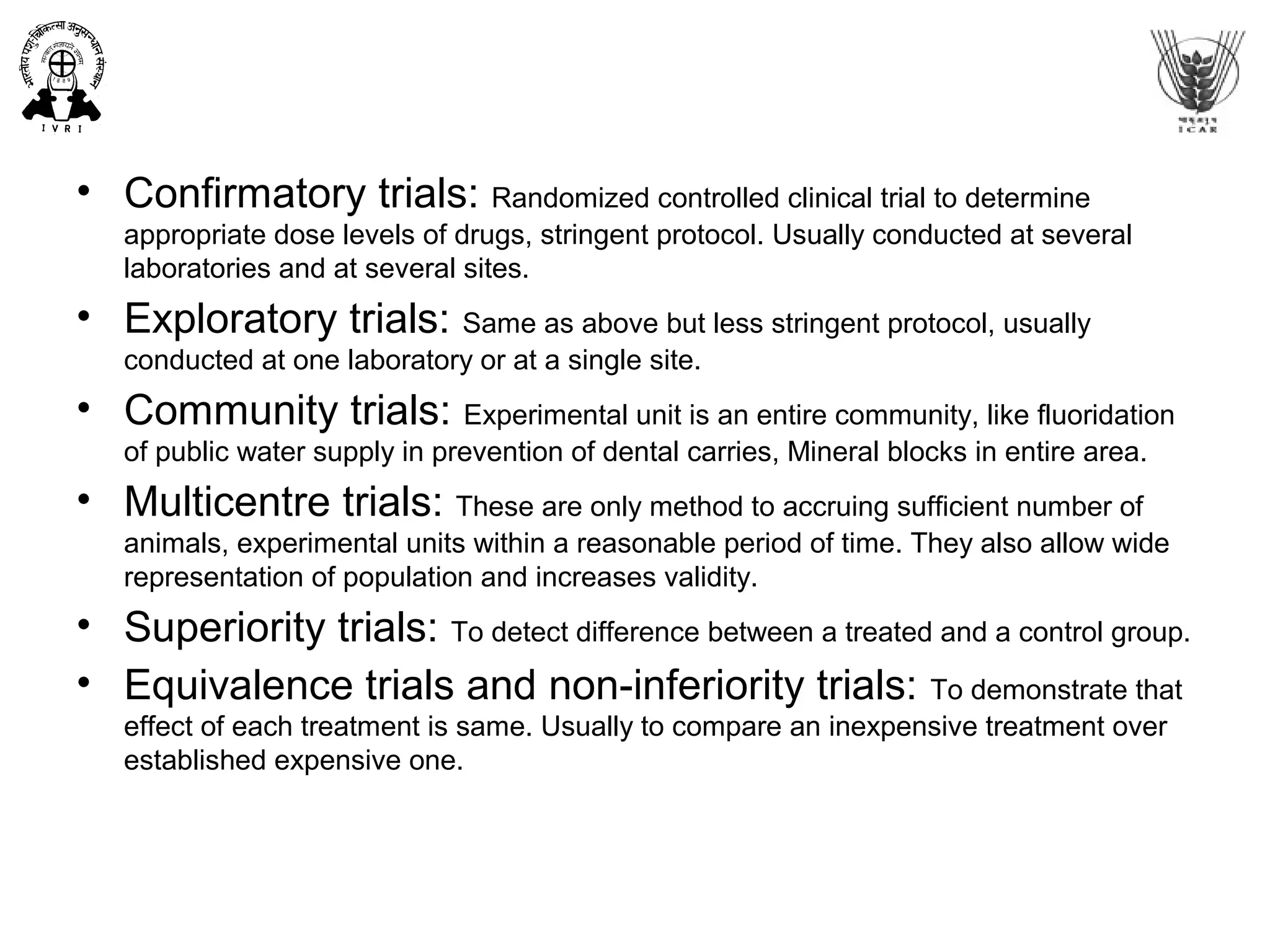
• Pharmacological and toxicity trials: On experimental animals or on target species
• Initial trials of therapeutic effect and safety: On target species, on small scale, in
controlled environment, usually to compare and find the best drug, dose, route of
administration, formulation etc.
• Clinical evaluation of efficacy (Field trials): On large scale in field, under operational
conditions, management and environment can affect the results.
– Clinical trial: Subject must be selected randomly. On patients, either (mostly) therapeutic or
prevention of sequelae.
• Open trial: Clinical condition of a patients is compared before and after treatment, interpretation is difficult,
uncontrolled clinical trial
• Controlled clinical trials: Group getting treatment is compared with one not getting the treatment (control). The
control may be concurrent or historical (often criticized)
– Field trial: Mostly on clinically healthy individuals to determine prophylactic efficacy.
• Controls:
– Positive control: getting standard treatment for the disease
– Negative control: Getting no treatment
– Placebo: Inert substance visually similar to treatment. (John Haygarth, 1800, to evaluate electromagnetic
influence of metal rods (perkins) insertion for treatment of diseases )
– Concurrent control: At the same time (Pasteur’s trail of Anthrax vaccine, 1922)
– Randomized controls (Bradford Hill for Pertusis vaccine and for efficacy of Streptomycin in TB)
• Post authorization surveillance: To monitor adverse effect during use.
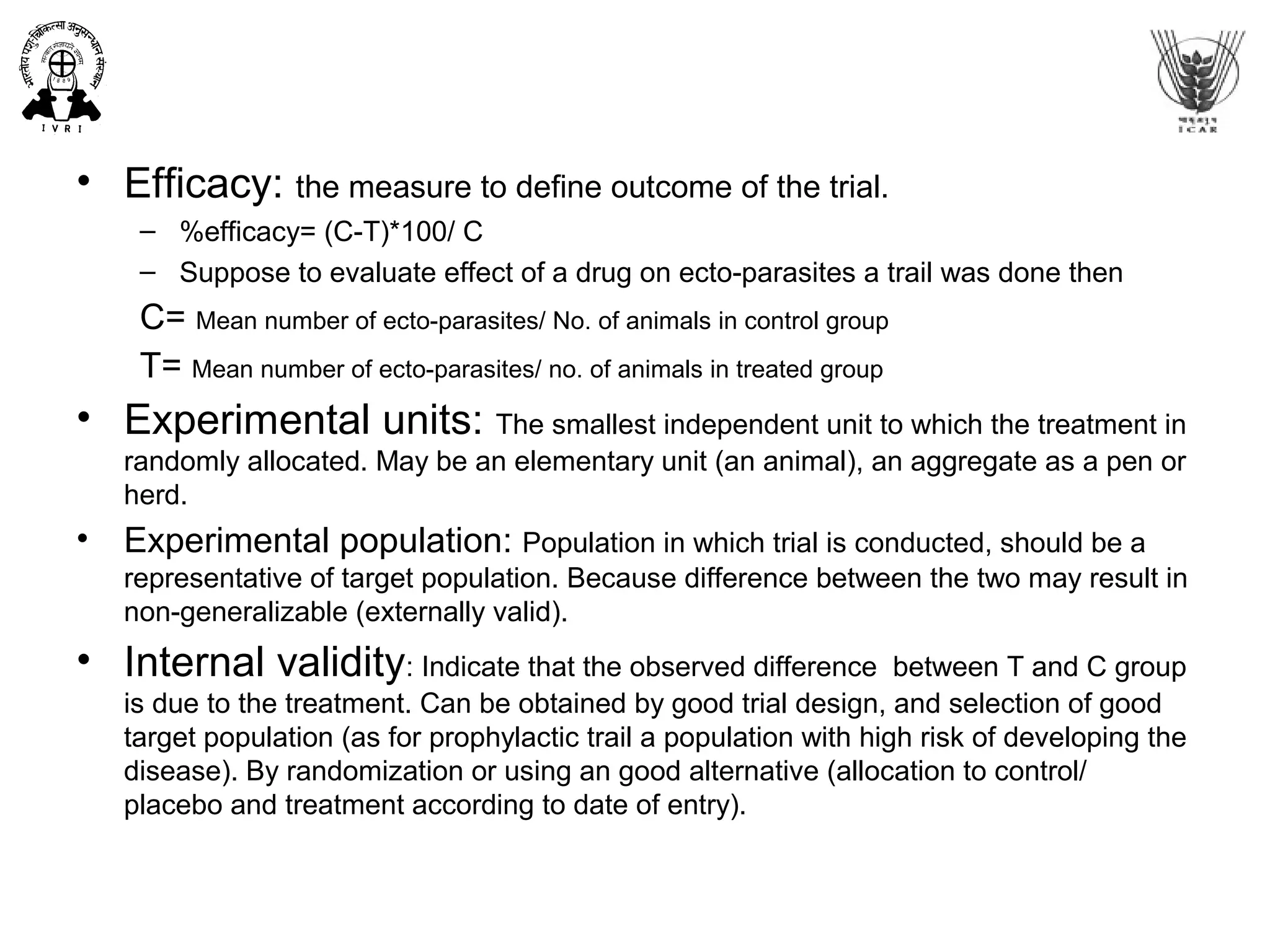
• Confirmatory trials: Randomized controlled clinical trial to determine
appropriate dose levels of drugs, stringent protocol. Usually conducted at several
laboratories and at several sites.
• Exploratory trials: Same as above but less stringent protocol, usually
conducted at one laboratory or at a single site.
• Community trials: Experimental unit is an entire community, like fluoridation
of public water supply in prevention of dental carries, Mineral blocks in entire area.
• Multicentre trials: These are only method to accruing sufficient number of
animals, experimental units within a reasonable period of time. They also allow wide
representation of population and increases validity.
• Superiority trials: To detect difference between a treated and a control group.
• Equivalence trials and non-inferiority trials: To demonstrate that
effect of each treatment is same. Usually to compare an inexpensive treatment over
established expensive one.
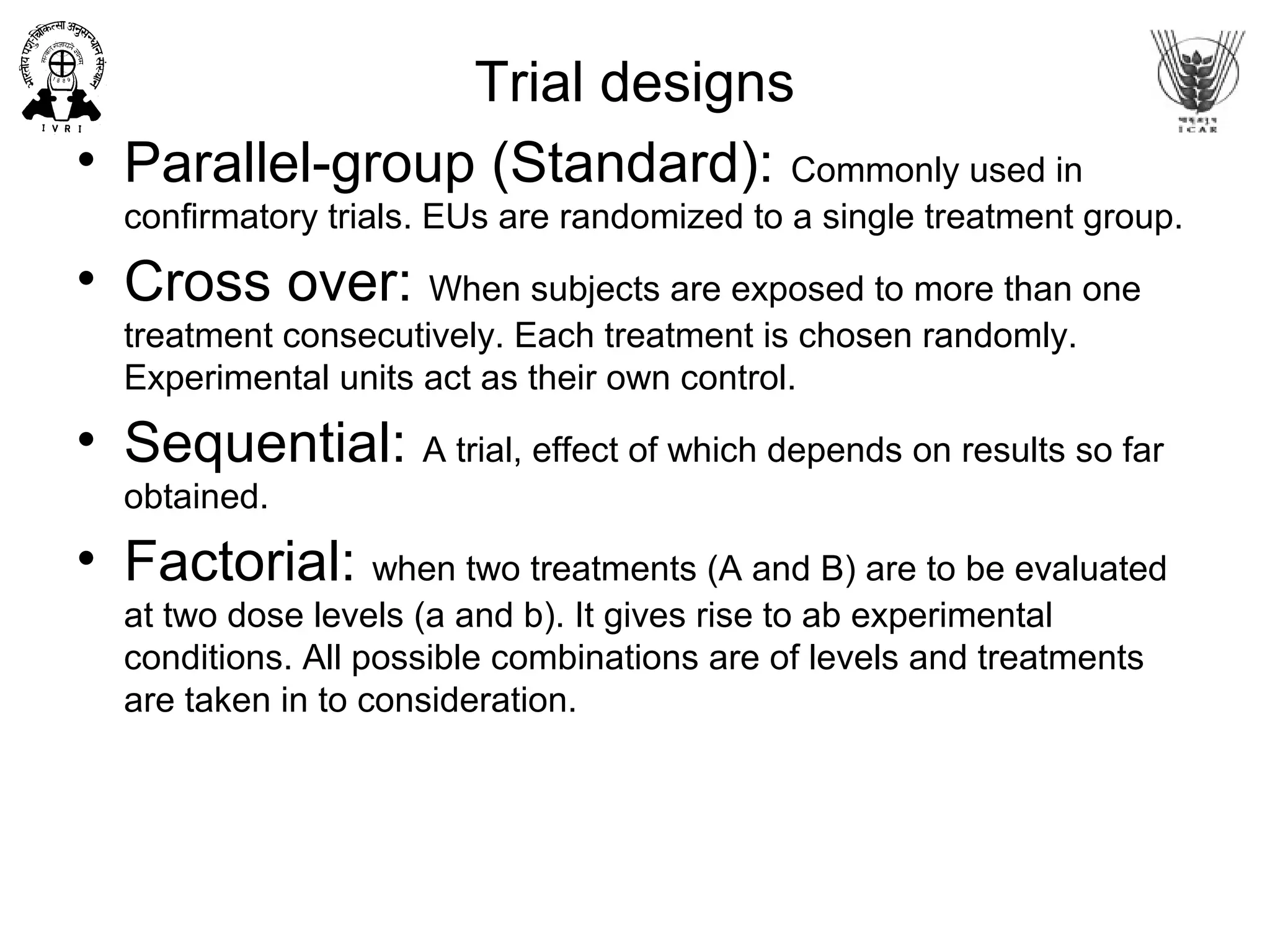
• Efficacy: the measure to define outcome of the trial.
– %efficacy= (C-T)*100/ C
– Suppose to evaluate effect of a drug on ecto-parasites a trail was done then
C= Mean number of ecto-parasites/ No. of animals in control group
T= Mean number of ecto-parasites/ no. of animals in treated group
• Experimental units: The smallest independent unit to which the treatment in
randomly allocated. May be an elementary unit (an animal), an aggregate as a pen or
herd.
• Experimental population: Population in which trial is conducted, should be a
representative of target population. Because difference between the two may result in
non-generalizable (externally valid).
• Internal validity: Indicate that the observed difference between T and C group
is due to the treatment. Can be obtained by good trial design, and selection of good
target population (as for prophylactic trail a population with high risk of developing the
disease). By randomization or using an good alternative (allocation to control/
placebo and treatment according to date of entry).
Trial designs
• Parallel-group (Standard): Commonly used in
confirmatory trials. EUs are randomized to a single treatment group.
• Cross over: When subjects are exposed to more than one
treatment consecutively. Each treatment is chosen randomly.
Experimental units act as their own control.
• Sequential: A trial, effect of which depends on results so far
obtained.
• Factorial: when two treatments (A and B) are to be evaluated
at two dose levels (a and b). It gives rise to ab experimental
conditions. All possible combinations are of levels and treatments
are taken in to consideration.
• Termination of trials: Trials last as long as it takes to enlist the units
and for the last unit to complete the trial. Trial is terminated because of:
– Serious adverse effect evident in a trial
– If specified difference is detected to the predetermined level of
significance (particularly in sequential trials).
• Meta-analysis: Statistical analysis of data pooled from several studies
to integrate findings with goals:
– To increase statistical power of primary end points.
– To resolve uncertainty in case of conflicting observations.
– To improve estimates of therapeutic effect and their precision
– To answer question not posed at the beginning of individual trial
– To give a ‘state of art’ literature review
– To facilitate analysis of subgroups when individual experiment has low power.
– To guide researchers in planning new trials
– To offer rigorous support for generalization of a treatment.
– To balance ‘overflow of enthusiasm associated with introduction of new
procedure following single or first beneficial report.
Cross-Sectional
• Relationship of diseases is investigated in
a population with hypothesized causal
factor.
• X 2
test, 2x2 tables are often used to draw
conclusion
• Investigator do not have much control over
the selection of the study population as
almost whole population in a defined
region is included in the study.
Co-Hort
• Groups having exposure or no exposure
are compared to find out the causal
association of the exposure.
• No control of investigator on study sample
however adjustments to age, sex, breed
etc. are to be made to make the two
groups comparable.
Case-Control
• Groups with or without disease are
compared and relative and attributable
risks are compared to find out the causal
association with predicted or hypothesized
causal factor.
• Investigator can not exercise control over
selection of a case however a bit on
control to find the comparable control.
Case-Crossover
• A variant of the case-control design
• used to study the effects of transient exposures
on acute events.
• This design samples only cases and compares
each case’s exposure during a time period just
before the case-defining event (hazard period)
with that subject’s own exposure in other
reference periods (control periods).
• Each subject serves as its own control; there is
perfect matching on all measured or
unmeasured subject characteristics that do not
vary over time.
• Unidirectional case-crossover design
Less used designed, only unidirectional comparison is possible.
• Symmetric bidirectional case-crossover
design
• In this design, reference periods are symmetrically spaced in
time, both before and after the hazard period, which minimizes
potential time-varying confounding by season or time trends.
• In this study, the hazard period is defined as the day of death,
and exposure is modeled as the mean of exposure on the day of
death (lag0) and the day before death (lag1).
• Reference days (one or more) are matched to each hazard
day. Hazard days that could not be matched to the full complement
of reference days are excluded rather than sacrificing the symmetry
of the matching.
• Selection bias is possible in case-crossover studies when
some days in a time series are unevenly sampled as hazard or
reference (control) days.
Surveys
• Examination of aggregates of EU (a herd may be
an example of an aggregate).
• An epidemiological survey essentially include
determination and counting of a certain or all
diseases, death, determinants and attributes of
disease, health and production.
• Survey may be on sample or on whole population
(census)
• Types
– Cross sectional
– Longitudinal
• Prospective
• Retrospective
• Screening: Specific type of diagnostic
survey with aim to diagnose undiagnosed
cases so that healthy and sick (infected)
can be separated. Screening test not
necessarily a diagnostic test.
– Mass screening: TB-JD testing in a population
– Strategic screening: Screening in the areas
where presence of a disease is suspected
– Prescriptive screening: Testing for suclinical
mastitis, pap-smear test for cervical cancer
Monitoring and Surveillance
• Monitoring:
– Routine observation on health, productivity and
environmental factors.
– Recoding the observations
– Transmission of of the observations
• Surveillance:
– More intensive form of data monitoring and recording
– Usually part of a disease control programme
– It include Collation and interpretation of data collected
during monitoring programme.

Study designs in epidemiology

  • 1.
    Study Designs in Epidemiology Forformation and evaluation of causal hypothesis and for Comparison of groups of animals Dr. Bhoj R Singh, Principal Scientist (VM) I/C Epidemiology; Centre for Animal Disease Research and Diagnosis Indian Veterinary Research Institute, Izatnagar-243122, Bareilly, UP, India. TeleFax +91-581-2302188
  • 2.
    Types • Qualitative – Formulationof hypothesis about causes (unknown) of diseases – Source of infection – Medical detectives • Quantitative – Surveys – Monitoring and surveillance – Modeling – Biological and economic evaluation of disease control programmes – Armchair epidemiology
  • 3.
    Several study designs •Experimental • Observational – Cohort – Case Control – Cross-sectional – Case-Crossover
  • 4.
    Experimental • Trials – Systematicstudy to establish the procedure’s prophylactic or therapeutic effect, improvement in production or amelioration of clinical disease. • Full control of investigator on selecting the study population • Most reliable and scientific information in properly designed experiments
  • 5.
    Types of trials •Pharmacological and toxicity trials: On experimental animals or on target species • Initial trials of therapeutic effect and safety: On target species, on small scale, in controlled environment, usually to compare and find the best drug, dose, route of administration, formulation etc. • Clinical evaluation of efficacy (Field trials): On large scale in field, under operational conditions, management and environment can affect the results. – Clinical trial: Subject must be selected randomly. On patients, either (mostly) therapeutic or prevention of sequelae. • Open trial: Clinical condition of a patients is compared before and after treatment, interpretation is difficult, uncontrolled clinical trial • Controlled clinical trials: Group getting treatment is compared with one not getting the treatment (control). The control may be concurrent or historical (often criticized) – Field trial: Mostly on clinically healthy individuals to determine prophylactic efficacy. • Controls: – Positive control: getting standard treatment for the disease – Negative control: Getting no treatment – Placebo: Inert substance visually similar to treatment. (John Haygarth, 1800, to evaluate electromagnetic influence of metal rods (perkins) insertion for treatment of diseases ) – Concurrent control: At the same time (Pasteur’s trail of Anthrax vaccine, 1922) – Randomized controls (Bradford Hill for Pertusis vaccine and for efficacy of Streptomycin in TB) • Post authorization surveillance: To monitor adverse effect during use.
  • 6.
    • Confirmatory trials:Randomized controlled clinical trial to determine appropriate dose levels of drugs, stringent protocol. Usually conducted at several laboratories and at several sites. • Exploratory trials: Same as above but less stringent protocol, usually conducted at one laboratory or at a single site. • Community trials: Experimental unit is an entire community, like fluoridation of public water supply in prevention of dental carries, Mineral blocks in entire area. • Multicentre trials: These are only method to accruing sufficient number of animals, experimental units within a reasonable period of time. They also allow wide representation of population and increases validity. • Superiority trials: To detect difference between a treated and a control group. • Equivalence trials and non-inferiority trials: To demonstrate that effect of each treatment is same. Usually to compare an inexpensive treatment over established expensive one.
  • 7.
    • Efficacy: themeasure to define outcome of the trial. – %efficacy= (C-T)*100/ C – Suppose to evaluate effect of a drug on ecto-parasites a trail was done then C= Mean number of ecto-parasites/ No. of animals in control group T= Mean number of ecto-parasites/ no. of animals in treated group • Experimental units: The smallest independent unit to which the treatment in randomly allocated. May be an elementary unit (an animal), an aggregate as a pen or herd. • Experimental population: Population in which trial is conducted, should be a representative of target population. Because difference between the two may result in non-generalizable (externally valid). • Internal validity: Indicate that the observed difference between T and C group is due to the treatment. Can be obtained by good trial design, and selection of good target population (as for prophylactic trail a population with high risk of developing the disease). By randomization or using an good alternative (allocation to control/ placebo and treatment according to date of entry).
  • 8.
    Trial designs • Parallel-group(Standard): Commonly used in confirmatory trials. EUs are randomized to a single treatment group. • Cross over: When subjects are exposed to more than one treatment consecutively. Each treatment is chosen randomly. Experimental units act as their own control. • Sequential: A trial, effect of which depends on results so far obtained. • Factorial: when two treatments (A and B) are to be evaluated at two dose levels (a and b). It gives rise to ab experimental conditions. All possible combinations are of levels and treatments are taken in to consideration.
  • 9.
    • Termination oftrials: Trials last as long as it takes to enlist the units and for the last unit to complete the trial. Trial is terminated because of: – Serious adverse effect evident in a trial – If specified difference is detected to the predetermined level of significance (particularly in sequential trials). • Meta-analysis: Statistical analysis of data pooled from several studies to integrate findings with goals: – To increase statistical power of primary end points. – To resolve uncertainty in case of conflicting observations. – To improve estimates of therapeutic effect and their precision – To answer question not posed at the beginning of individual trial – To give a ‘state of art’ literature review – To facilitate analysis of subgroups when individual experiment has low power. – To guide researchers in planning new trials – To offer rigorous support for generalization of a treatment. – To balance ‘overflow of enthusiasm associated with introduction of new procedure following single or first beneficial report.
  • 10.
    Cross-Sectional • Relationship ofdiseases is investigated in a population with hypothesized causal factor. • X 2 test, 2x2 tables are often used to draw conclusion • Investigator do not have much control over the selection of the study population as almost whole population in a defined region is included in the study.
  • 11.
    Co-Hort • Groups havingexposure or no exposure are compared to find out the causal association of the exposure. • No control of investigator on study sample however adjustments to age, sex, breed etc. are to be made to make the two groups comparable.
  • 12.
    Case-Control • Groups withor without disease are compared and relative and attributable risks are compared to find out the causal association with predicted or hypothesized causal factor. • Investigator can not exercise control over selection of a case however a bit on control to find the comparable control.
  • 13.
    Case-Crossover • A variantof the case-control design • used to study the effects of transient exposures on acute events. • This design samples only cases and compares each case’s exposure during a time period just before the case-defining event (hazard period) with that subject’s own exposure in other reference periods (control periods). • Each subject serves as its own control; there is perfect matching on all measured or unmeasured subject characteristics that do not vary over time.
  • 14.
    • Unidirectional case-crossoverdesign Less used designed, only unidirectional comparison is possible. • Symmetric bidirectional case-crossover design • In this design, reference periods are symmetrically spaced in time, both before and after the hazard period, which minimizes potential time-varying confounding by season or time trends. • In this study, the hazard period is defined as the day of death, and exposure is modeled as the mean of exposure on the day of death (lag0) and the day before death (lag1). • Reference days (one or more) are matched to each hazard day. Hazard days that could not be matched to the full complement of reference days are excluded rather than sacrificing the symmetry of the matching. • Selection bias is possible in case-crossover studies when some days in a time series are unevenly sampled as hazard or reference (control) days.
  • 15.
    Surveys • Examination ofaggregates of EU (a herd may be an example of an aggregate). • An epidemiological survey essentially include determination and counting of a certain or all diseases, death, determinants and attributes of disease, health and production. • Survey may be on sample or on whole population (census) • Types – Cross sectional – Longitudinal • Prospective • Retrospective
  • 16.
    • Screening: Specifictype of diagnostic survey with aim to diagnose undiagnosed cases so that healthy and sick (infected) can be separated. Screening test not necessarily a diagnostic test. – Mass screening: TB-JD testing in a population – Strategic screening: Screening in the areas where presence of a disease is suspected – Prescriptive screening: Testing for suclinical mastitis, pap-smear test for cervical cancer
  • 17.
    Monitoring and Surveillance •Monitoring: – Routine observation on health, productivity and environmental factors. – Recoding the observations – Transmission of of the observations • Surveillance: – More intensive form of data monitoring and recording – Usually part of a disease control programme – It include Collation and interpretation of data collected during monitoring programme.