Medical Research
methodology
Dr. Waled Al-Dubai
Associate professor
Sana’a University
1437-2016
Definition of research
Research is a Systematic and an Organized method to
Finding Answers to Questions
OR:
Research is a systematic investigation into a subject in order to
discover new information or new fact or reach a new
understanding or to collect information on a subject
Research consist of the previx Re which means
( again , or a new ) And Search (verb) means ( to
examine, or to try(
Definition of research
RESEARCH IS IS SYSTEMATIC
because there is a definite set of procedures and steps which you will
follow in order to get the most accurate results.
Research is ORGANIZED
because there is a structure of research
Definition of research
FINDING ANSWERS
Finding answers to a hypothesis or to the question of the research is the
end of all research, because, research is successful when we find
answers. Sometimes the answer is no association or no corelation or no
significant differences , but it is still an answer.
QUESTIONS
Question is central to research , because research with-out
a question, has no aims.
The researcher
Should be patient
Should be ambitious
Remember it is research
Classification of Medical Research
Medical research
1-Primary research
Primary research is a research which involves the collection of data
that does not yet exist
2-Secondary research
Secondary research is a research which involves the collection of data
from studies of other researchers
Classification of Experimental Medical
Research
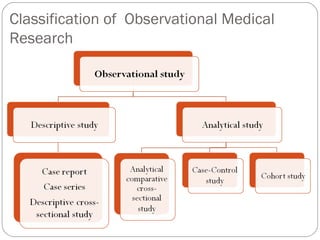
Classification of Observational Medical
Research
Notes
1-Descriptive study is an observational study which
describes the distribution of characteristics of a disease or outcome,
like percentage of (male , female) or (children, adult) in acute
leukemia, …etc
2-Analytical study is an observational study which is looking for
associations between exposure and outcome and analyze them for
possible causes and effects by using case and control groups.
3-The best feature that distinguishes an analytic study from a descriptive
study is a using comparison Group in analytic study
Descriptive study
1-Case report ( on one patient(
Case reports often describe new case that cannot be explained by known
diseases or syndromes or describe case that show an important variation of a
disease or condition.
Advantages
1-Can help in the identification of new syndrome or disease
2Help in detecting new drug side effects and (adverse or potential uses
beneficial(
Disadvantages
1-Cases may not be generalizable
2-Not based on systematic studies(consider as non-resaerch by most
epidemiologist.
3-Causes or associations may have other explanations

Example of case report Haemorrhagic-fever-like changes and normal chest radiograph
in a doctor with SARS. Wu EB1
,Sung JJ.
Lancet.2003May 3;361(9368):1520-1.
Abstract
A 33-year-old doctor contracted severe acute respiratory syndrome
presenting with features of disseminated intravascular coagulopathy without
changes in the chest radiograph initially. A CT scan of his chest showed
marked lung changes. His condition improved with intravenous
methylprednisolone 500 mg daily and ribavirin 1.2 g orally thrice daily. The
case illustrates the importance of a break in fever between the viraemic and
lung inflammatory phases of the illness that occurs before radiographic
changes and which may obscure diagnosis. Careful quarantine and follow-up
of these patients are necessary. Coagulopathy is usually uncomplicated and
early CT of the chest may elucidate hidden lung changes and facilitate a rapid
diagnosis.
2-Case series
Case series are the same of case report in advantages and disadvantages
but Case series are collections of different case reports of different
patients of the same case or condition or disease or syndrome.
3-Discreptive cross-sectional study
A descriptive cross-sectional study may be purely descriptive and used
to assess the prevelance and distribution of a particular disease in a
defined population,It also called prevalence study or Cross-
sectional survey They may cover, for example:
1-Physical characteristics of people (weight, height), or the environment
(everything about environment , like temperature), as in
a- prevalence surveys (of bilharzia, leprosy, HIV(,
b- evaluation of coverage of immunization,
2-Socio-economic characteristics of people such as their age, education,
marital status, number of children and income,
If a cross-sectional study covers the total population it is called a.
census
.
3-Discreptive cross-sectional study
Adventage
1-provides snap shot about outcome
2-Simple and quick
3-Is first line of epidemiological research
4-It estimates the prevalence of disease
Prevalence is the total number of new and old cases in defined population
5-Good for common and chronic diseases(hypertension, diabetes(
Disadventage
1-We can not establish causality because we do not know whether the
agent causes the outcome or not (We do not know who come first(

Example of descriptive cross sectional
study
Type II Diabetes Mellitus and impaired glucose tolerance in
Yemen: prevalence, associated metabolic changes and risk
factors
Al-Habori M1
,Al-Mamari M,Al-Meeri A
Diabetes Res Clin Pract.2004Sep;65(3):275-81.
Abstract
OBJECTIVE:
To investigate the prevalence of type II Diabetes Mellitus (DM) and impaired glucose tolerance (IGT)
and identify the metabolic abnormalities and risk factors associated with these conditions in an urban city
of Yemen.
RESEARCH DESIGN AND METHODS:
Cross-sectional, population-based study investigating 498 adults (245 males and 253 females) aged 25-65
years. The 1999 modified World Health Organization criteria were adopted for the diagnosis of Diabetes
Mellitus and IGT. A standard questionnaire was applied and blood lipids, blood pressure, body mass
index (BMI) and waist/hip ratio (WHR) were determined.
RESULTS:
The overall prevalence of type II Diabetes Mellitus was 4.6% (7.4% in males and 2% in
females). Impaired glucose tolerance (IGT) and impaired fasting glucose (IFG) were found in 2% and
2.2% of the study population. Factors independently related to any abnormality in glucose tolerance,
using logistic regression analysis, were sex, hyperlipidaemia, hypertriglyceridaemia, and hypertension;
whereas sex and age related to DM. More than 80% of the type II diabetics were over the age of 40,
35% being hyperlipidaemic, 22% being hypertensive and 18% obese. Sixty percent of IGT subjects were
hyperlipidaemic and 20% were obese. Approximately 78% of obese individuals (>/=30 kg/m(2)) had
normal glucose tolerance.
CONCLUSION:
The prevalence of type II DM and its potential increase reflected by the high prevalence of obesity in
normal glucose tolerance subjects in the Yemeni population constitutes a major public health problem.
Important NOTES
1-Outecome means disease or dependent variable
2-Exposure means risk factors or independent variable
3-Case : A person with the disease or outcome of interest.
4-Control:A person who does not have the disease or outcome.
5-Independent variable is a variables which may cause or affect the outcome
( disease or dependent variable) .e.g independent variable is smoking but the
outcome or dependent variable is lung cancer.
6-Dependent variable is the outcome in the study which undergoes to the effect of
independent variable.
7-Risk factor is any factor whose presence is associated with an increased risk of a
disease or condition

Notes
1-Non-intervention study is study (observational study)
in which the researcher just observes and analyses researchable
objects or situations but does not intervene;
2-Intervention study is study(Expermental study) in which
the researcher manipulates objects or situations and measures the
outcome of his manipulations
Classification of Observational Medical
Research
Analytical studies
Analytical study is study attempts to establish causes or
risk factors for certain problems.
This is done by comparing two or more groups, some of
which have or develop the problem and some of which have
not
1-Analytical comparative Cross-sectional
study
Analytical comparative Cross-sectional study investigate the association
between the putative risk factors and the outcome in the same time
by both describing and comparing between groups. 
Example of analytical comparative
cross- sectional study
Prevalence and factors associated with low birth weight in
Axum and Laelay Maichew Districts, North Ethiopia:A
comparative cross sectional study
Negassi Teklehaimanot1, Tesfay Hailu2, Huruy Assefa2, *
International Journal of Nutrition and Food Sciences
2014:3)6:(560-566
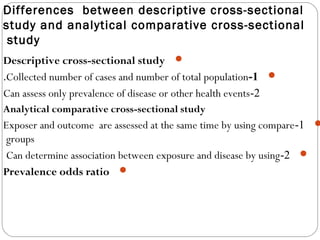
Differences between descriptive cross-sectional
study and analytical comparative cross-sectional
study
Descriptive cross-sectional study
1-Collected number of cases and number of total population.
2-Can assess only prevalence of disease or other health events
Analytical comparative cross-sectional study
1-Exposer and outcome are assessed at the same time by using compare
groups
2-Can determine association between exposure and disease by using
Prevalence odds ratio
Analytical study
Case Control Study
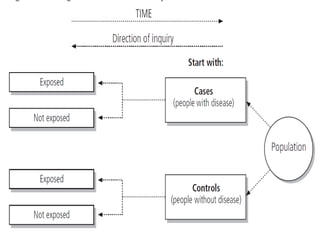
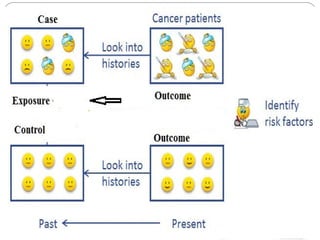
Case control study is a retrospective study which compares patients
who have a disease or outcome of interest (cases) with persons who do
not have the disease or outcome (controls), and looks back
retrospectively to compare how frequently the exposure to a risk factor
is present in each group to determine the relationship between the risk
factor and the disease.
Case-control studies have been called retrospective studies because the
investigator is looking backward from the disease to a possible
cause(exposure(
Case Control Study
Case control studies are observational because no intervention is
attempted and no attempt is made to alter the course of the disease. The
goal is to retrospectively determine the exposure to the risk factor of
interest from each of the two groups of individuals: cases and controls.
These studies are designed to estimate odds ratio which determine the
association between risk factors and outcome. 
 
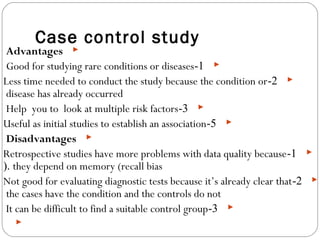
Case control study
Advantages
1-Good for studying rare conditions or diseases
2-Less time needed to conduct the study because the condition or
disease has already occurred
3-Help you to look at multiple risk factors
5-Useful as initial studies to establish an association
Disadvantages
1-Retrospective studies have more problems with data quality because
they depend on memory (recall bias(.
2-Not good for evaluating diagnostic tests because it’s already clear that
the cases have the condition and the controls do not
3-It can be difficult to find a suitable control group

Odds ratio
Odds ratio is the odds of disease in individuals exposed and unexposed
to a factor).
Example :DDT (insecticide) and breast cancer
Interpretation of odds ratio
1-If odds ratio is = 1, this mean, there is no association
between risk factors and outcome.
2-If odds ratio is > 1, this mean, the exposure or the risk
factor may increase the risk of occurring of the outcome or disease.
From previous example,
persons who exposed to DDT could be more likely to develop Lung
cancer by 3.7 times than unexposed group.
3-If odds ratio is < 1, this mean, the exposure or the risk
factor may decrease the risk of occurring of the outcome or disease
(protective effect(.
CASE-CONTROL EXAMPLE
PROTECTIVE EFFECT OF GREEN TEA ON THE RISKS OF
CHRONIC GASTRITIS AND STOMACH CANCER
Veronica Wendy SETIAWAN1, Zuo-Feng ZHANG1*, Guo-Pei YU2,
Qing-Yi LU3, Yong-Liang LI4, Ming-Lan LU5, Ming-Rong
WANG6,Chun Hua GUO6, Shun-Zhang YU7, Robert C. KURTZ8 and
Chung-Cheng HSIEH9
Int. J. Cancer: 92, 600–604 (2001(
Case control example
Abstracts
Despite the declining trend, stomach cancer remains the second most
common cancer worldwide. We examined the role of green tea
consumption on chronic gastritis and stomach cancer risks. A
population-based case-control study was conducted in Yangzhong,
China, with 133 stomach cancer cases, 166 chronic gastritis cases, and
433 healthy controls.Epidemiologic data were collected by standard
questionnaireand odds ratios (OR) and 95% confidence intervals (CI)
wereestimated using logistic regression models in SAS. Inverse
association was observed between green tea drinking and chronic
gastritis and stomach cancer risks. After adjusting forage, gender,
education, body mass index, pack-years of smoking and alcohol
drinking,

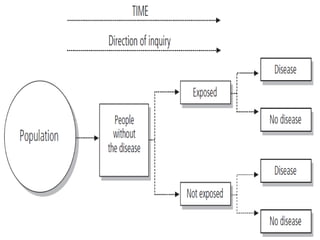
3-Cohort Study
In a cohort study , a group of individuals that is exposed to a risk factor
(called study group or case group) is compared to a group of individuals
not exposed to the risk factor (control group). The researcher follows
both groups over time and compares the occurrence of the outcome.
Cohort study is called incidence study or follow up study, it is the
best study of observational studies
Cohort study
Advantage
1-used to determine incidence
Incidence is the total number of new cases of a disease)
which occur during a specified period of time in a defined
population
2-It shows that the exposure occurred first and the
disease occurred second (temporality(
3-Good for rare exposure
4-Possible to study multiple outcomes

Disadvantages
1-Take too much time, money and efforts
2-Not good for rare diseases
3-Problem of non-response and drop-out
4-Difficult to study multiple exposures
5-Ethical Issue may arise
Types of Cohort Studies
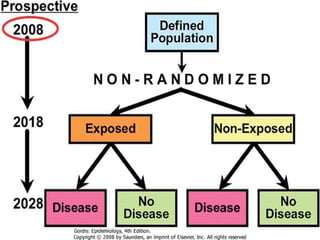
1-prospective cohort study
Determine the exposure group and non-exposure group and follow-up
starts
2-Retrospective cohort study
Both the exposure and outcome occurred in the past
It needs medical records
Measures the Association in Cohort
study
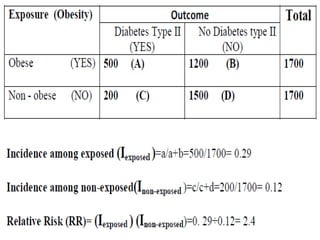
Relative Risk (RR) or called Risk Ratio is the risk of getting the
disease in the group with the risk factor divided by the risk of getting the
disease in the group without the risk factor.
Interpretation of Relative Risk
1-If Relative Risk is = 1, this mean, there is no association between
risk factors and outcome. Risk factor does not increase or decrease the risk of
the disease.
2-If Relative Risk is > 1, this mean, the exposure or the risk factor
(predisposing risk factor) may increase the risk of occurring of the outcome or
disease. Risk factor increase the risk of the disease. From previous example,
persons who are obese could be more likely to develop diabetes mellitus type
2 by 2.4 times than unexposed group.
3-If Relative Risk is < 1, this mean, Risk factor decrease the risk of
the occurring of disease (protective factor(
RISK is the same as incidence rate
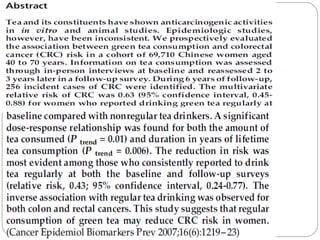
Cohort study example
Prospective Cohort Study of Green Tea Consumption and
Colorectal Cancer Risk in Women
Gong Yang, Xiao-Ou Shu, Honglan Li, Wong-Ho Chow, Bu-Tian
Ji,Xianglan Zhang, Yu-Tang Gao, and Wei Zheng
Cancer Epidemiol Biomarkers Prev 2007;16(6). June
Confounding factors

Confounding
When an exposure and an outcome are both strongly
associated with a third variable.
Experimental studies(clinical trials(
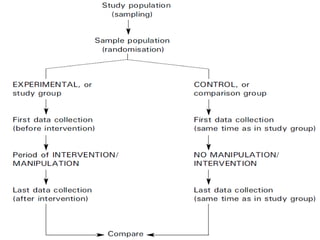
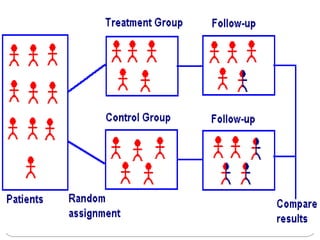
In Experimental study individuals are randomly selected to at least two
groups.One group is subject to an intervention (case ), or experiment,
while the another group is not (control). The effect of the intervention
is obtained by comparing the two groups
Experimental study gives the most reliable proof for causation
(RCT(
In this study we randomly distributes participants into an
experimental group and a control group.
1-For example if the experimental group is HCV positive, we give
them new drugs and the control group (HCV negative) we give them
nothing or placebo,
)placebo is a substance having no pharmacological effect(
And then we compare the result between the two groups and Measures
of the association between the two groups like Cohort Study (Using
relative risk (RR((

Exapmle2
2-For example, a researcher plans to study the effect of a new drug. (The
drug has already been tested extensively on animals and has been approved for
trial use.) He plans to include 300 patients in the study who are currently
receiving the standard treatment for the same condition for which the
new drug has been designed. He explains the study to the patientsa sking their
consent to be divided into two groups on a random basis. One group will
receivethe experimental drug while the other group will continue to receive
the standard treatment. He makes sure that the medications are disguised and
labelled in such a manner that neitherthe research assistant administering them
nor the patient know which drug is used. (This is called a double blind
experiment.(
Randomized controlled Trial
Advantages
1-Good randomization will remove any population bias
2-Easier to blind(mask) than observational studies
3-Populations of participating individuals are clearly identified

Note :Clinical trial is look like cohort study but in clincal trials we have
intervention but in cohort study we have observation
Randomized controlled Trial
Disadvantages
1-Expensive in terms of time and money
2-Loss to follow-up attributed to treatment
Example
Vitamins C and E for prevention of pre-eclampsia in women
with type 1 diabetes (DAPIT): a randomised placebo-
controlled trial
McCance DR1
, Holmes VA, Maresh MJ, Patterson CC, Walker JD,
Pearson DW, Young
Lancet. 2010 Jul 24;376(9737):259-66
Abstract
BACKGROUND:
Results of several trials of antioxidant use during pregnancy have not shown a reduction in pre-eclampsia, but the
effect in women with diabetes is unknown. We aimed to assess whether supplementation with vitamins C and E
reduced incidence of pre-eclampsia in women with type 1 diabetes.
METHODS:
We enrolled women from 25 UK antenatal metabolic clinics in a multicentre randomised placebo-controlled trial.
Eligibility criteria were type 1 diabetes preceding pregnancy, presentation between 8 weeks' and 22 weeks' gestation,
singleton pregnancy, and age 16 years or older. Women were randomly allocated in a 1:1 ratio to receive 1000 mg
vitamin C and 400 IU vitamin E (alpha-tocopherol) or matched placebo daily until delivery. The randomisation
sequence was stratified by centre with balanced blocks of eight patients. All trial personnel and participants were
masked to treatment allocation. The primary endpoint was pre-eclampsia, which we defined as gestational
hypertension with proteinuria. Analysis was by modified intention to treat. This study is registered,
ISRCTN27214045.
FINDINGS:
Between April, 2003, and June, 2008, 762 women were randomly allocated to treatment groups (379 vitamin
supplementation, 383 placebo). The primary endpoint was assessed for 375 women allocated to receive vitamins, and
374 allocated to placebo. Rates of pre-eclampsia did not differ between vitamin (15%, n=57) and placebo (19%, 70)
groups (risk ratio 0.81, 95% CI 0.59-1.12). No adverse maternal or neonatal outcomes were reported
Secondary Research
1-A systematic review is a study which provides a
comprehensive review of all relevant studies on a particular clinical or
health-related topic/question. The systematic review is created after
reviewing and combining all the information from both published and
unpublished studies.
1-A systematic review
Advantages
1-Coparhensive review of the current literature and other sources
(unpublished studies, ongoing research(
2-Low coast
Disadvantages
1-Very time-consuming
2-May not be easy to combine studies
Secondary Research
2-A meta-analysis is a statistical approach to combine the data
derived from a systematic-review. Therefore, every meta-analysis
should be based on an underlying systematic review, but not every
systematic review leads to a meta-analysis
meta-analysis
Advantages
1-Has Greater statistical power
2-Confirmatory data analysis
Disadvantages
1-Difficult and time consuming to identify appropriate studies

Medical research methodology

Medical research methodology

  • 1.
    Medical Research methodology Dr. WaledAl-Dubai Associate professor Sana’a University 1437-2016
  • 2.
    Definition of research Researchis a Systematic and an Organized method to Finding Answers to Questions OR: Research is a systematic investigation into a subject in order to discover new information or new fact or reach a new understanding or to collect information on a subject Research consist of the previx Re which means ( again , or a new ) And Search (verb) means ( to examine, or to try(
  • 3.
    Definition of research RESEARCHIS IS SYSTEMATIC because there is a definite set of procedures and steps which you will follow in order to get the most accurate results. Research is ORGANIZED because there is a structure of research
  • 4.
    Definition of research FINDINGANSWERS Finding answers to a hypothesis or to the question of the research is the end of all research, because, research is successful when we find answers. Sometimes the answer is no association or no corelation or no significant differences , but it is still an answer. QUESTIONS Question is central to research , because research with-out a question, has no aims.
  • 5.
    The researcher Should bepatient Should be ambitious Remember it is research
  • 6.
  • 7.
    Medical research 1-Primary research Primaryresearch is a research which involves the collection of data that does not yet exist 2-Secondary research Secondary research is a research which involves the collection of data from studies of other researchers
  • 8.
  • 9.
  • 10.
    Notes 1-Descriptive study isan observational study which describes the distribution of characteristics of a disease or outcome, like percentage of (male , female) or (children, adult) in acute leukemia, …etc 2-Analytical study is an observational study which is looking for associations between exposure and outcome and analyze them for possible causes and effects by using case and control groups. 3-The best feature that distinguishes an analytic study from a descriptive study is a using comparison Group in analytic study
  • 11.
    Descriptive study 1-Case report( on one patient( Case reports often describe new case that cannot be explained by known diseases or syndromes or describe case that show an important variation of a disease or condition. Advantages 1-Can help in the identification of new syndrome or disease 2Help in detecting new drug side effects and (adverse or potential uses beneficial( Disadvantages 1-Cases may not be generalizable 2-Not based on systematic studies(consider as non-resaerch by most epidemiologist. 3-Causes or associations may have other explanations 
  • 12.
    Example of casereport Haemorrhagic-fever-like changes and normal chest radiograph in a doctor with SARS. Wu EB1 ,Sung JJ. Lancet.2003May 3;361(9368):1520-1. Abstract A 33-year-old doctor contracted severe acute respiratory syndrome presenting with features of disseminated intravascular coagulopathy without changes in the chest radiograph initially. A CT scan of his chest showed marked lung changes. His condition improved with intravenous methylprednisolone 500 mg daily and ribavirin 1.2 g orally thrice daily. The case illustrates the importance of a break in fever between the viraemic and lung inflammatory phases of the illness that occurs before radiographic changes and which may obscure diagnosis. Careful quarantine and follow-up of these patients are necessary. Coagulopathy is usually uncomplicated and early CT of the chest may elucidate hidden lung changes and facilitate a rapid diagnosis.
  • 13.
    2-Case series Case seriesare the same of case report in advantages and disadvantages but Case series are collections of different case reports of different patients of the same case or condition or disease or syndrome.
  • 14.
    3-Discreptive cross-sectional study Adescriptive cross-sectional study may be purely descriptive and used to assess the prevelance and distribution of a particular disease in a defined population,It also called prevalence study or Cross- sectional survey They may cover, for example: 1-Physical characteristics of people (weight, height), or the environment (everything about environment , like temperature), as in a- prevalence surveys (of bilharzia, leprosy, HIV(, b- evaluation of coverage of immunization, 2-Socio-economic characteristics of people such as their age, education, marital status, number of children and income, If a cross-sectional study covers the total population it is called a. census .
  • 15.
    3-Discreptive cross-sectional study Adventage 1-providessnap shot about outcome 2-Simple and quick 3-Is first line of epidemiological research 4-It estimates the prevalence of disease Prevalence is the total number of new and old cases in defined population 5-Good for common and chronic diseases(hypertension, diabetes( Disadventage 1-We can not establish causality because we do not know whether the agent causes the outcome or not (We do not know who come first( 
  • 17.
    Example of descriptivecross sectional study Type II Diabetes Mellitus and impaired glucose tolerance in Yemen: prevalence, associated metabolic changes and risk factors Al-Habori M1 ,Al-Mamari M,Al-Meeri A Diabetes Res Clin Pract.2004Sep;65(3):275-81.
  • 18.
    Abstract OBJECTIVE: To investigate theprevalence of type II Diabetes Mellitus (DM) and impaired glucose tolerance (IGT) and identify the metabolic abnormalities and risk factors associated with these conditions in an urban city of Yemen. RESEARCH DESIGN AND METHODS: Cross-sectional, population-based study investigating 498 adults (245 males and 253 females) aged 25-65 years. The 1999 modified World Health Organization criteria were adopted for the diagnosis of Diabetes Mellitus and IGT. A standard questionnaire was applied and blood lipids, blood pressure, body mass index (BMI) and waist/hip ratio (WHR) were determined. RESULTS: The overall prevalence of type II Diabetes Mellitus was 4.6% (7.4% in males and 2% in females). Impaired glucose tolerance (IGT) and impaired fasting glucose (IFG) were found in 2% and 2.2% of the study population. Factors independently related to any abnormality in glucose tolerance, using logistic regression analysis, were sex, hyperlipidaemia, hypertriglyceridaemia, and hypertension; whereas sex and age related to DM. More than 80% of the type II diabetics were over the age of 40, 35% being hyperlipidaemic, 22% being hypertensive and 18% obese. Sixty percent of IGT subjects were hyperlipidaemic and 20% were obese. Approximately 78% of obese individuals (>/=30 kg/m(2)) had normal glucose tolerance. CONCLUSION: The prevalence of type II DM and its potential increase reflected by the high prevalence of obesity in normal glucose tolerance subjects in the Yemeni population constitutes a major public health problem.
  • 19.
    Important NOTES 1-Outecome meansdisease or dependent variable 2-Exposure means risk factors or independent variable 3-Case : A person with the disease or outcome of interest. 4-Control:A person who does not have the disease or outcome. 5-Independent variable is a variables which may cause or affect the outcome ( disease or dependent variable) .e.g independent variable is smoking but the outcome or dependent variable is lung cancer. 6-Dependent variable is the outcome in the study which undergoes to the effect of independent variable. 7-Risk factor is any factor whose presence is associated with an increased risk of a disease or condition 
  • 20.
    Notes 1-Non-intervention study isstudy (observational study) in which the researcher just observes and analyses researchable objects or situations but does not intervene; 2-Intervention study is study(Expermental study) in which the researcher manipulates objects or situations and measures the outcome of his manipulations
  • 21.
  • 22.
    Analytical studies Analytical studyis study attempts to establish causes or risk factors for certain problems. This is done by comparing two or more groups, some of which have or develop the problem and some of which have not
  • 23.
    1-Analytical comparative Cross-sectional study Analyticalcomparative Cross-sectional study investigate the association between the putative risk factors and the outcome in the same time by both describing and comparing between groups. 
  • 24.
    Example of analyticalcomparative cross- sectional study Prevalence and factors associated with low birth weight in Axum and Laelay Maichew Districts, North Ethiopia:A comparative cross sectional study Negassi Teklehaimanot1, Tesfay Hailu2, Huruy Assefa2, * International Journal of Nutrition and Food Sciences 2014:3)6:(560-566
  • 26.
    Differences between descriptivecross-sectional study and analytical comparative cross-sectional study Descriptive cross-sectional study 1-Collected number of cases and number of total population. 2-Can assess only prevalence of disease or other health events Analytical comparative cross-sectional study 1-Exposer and outcome are assessed at the same time by using compare groups 2-Can determine association between exposure and disease by using Prevalence odds ratio
  • 27.
    Analytical study Case ControlStudy Case control study is a retrospective study which compares patients who have a disease or outcome of interest (cases) with persons who do not have the disease or outcome (controls), and looks back retrospectively to compare how frequently the exposure to a risk factor is present in each group to determine the relationship between the risk factor and the disease. Case-control studies have been called retrospective studies because the investigator is looking backward from the disease to a possible cause(exposure(
  • 31.
    Case Control Study Casecontrol studies are observational because no intervention is attempted and no attempt is made to alter the course of the disease. The goal is to retrospectively determine the exposure to the risk factor of interest from each of the two groups of individuals: cases and controls. These studies are designed to estimate odds ratio which determine the association between risk factors and outcome.   
  • 32.
    Case control study Advantages 1-Goodfor studying rare conditions or diseases 2-Less time needed to conduct the study because the condition or disease has already occurred 3-Help you to look at multiple risk factors 5-Useful as initial studies to establish an association Disadvantages 1-Retrospective studies have more problems with data quality because they depend on memory (recall bias(. 2-Not good for evaluating diagnostic tests because it’s already clear that the cases have the condition and the controls do not 3-It can be difficult to find a suitable control group 
  • 33.
    Odds ratio Odds ratiois the odds of disease in individuals exposed and unexposed to a factor). Example :DDT (insecticide) and breast cancer
  • 35.
    Interpretation of oddsratio 1-If odds ratio is = 1, this mean, there is no association between risk factors and outcome. 2-If odds ratio is > 1, this mean, the exposure or the risk factor may increase the risk of occurring of the outcome or disease. From previous example, persons who exposed to DDT could be more likely to develop Lung cancer by 3.7 times than unexposed group. 3-If odds ratio is < 1, this mean, the exposure or the risk factor may decrease the risk of occurring of the outcome or disease (protective effect(.
  • 36.
    CASE-CONTROL EXAMPLE PROTECTIVE EFFECTOF GREEN TEA ON THE RISKS OF CHRONIC GASTRITIS AND STOMACH CANCER Veronica Wendy SETIAWAN1, Zuo-Feng ZHANG1*, Guo-Pei YU2, Qing-Yi LU3, Yong-Liang LI4, Ming-Lan LU5, Ming-Rong WANG6,Chun Hua GUO6, Shun-Zhang YU7, Robert C. KURTZ8 and Chung-Cheng HSIEH9 Int. J. Cancer: 92, 600–604 (2001(
  • 37.
    Case control example Abstracts Despitethe declining trend, stomach cancer remains the second most common cancer worldwide. We examined the role of green tea consumption on chronic gastritis and stomach cancer risks. A population-based case-control study was conducted in Yangzhong, China, with 133 stomach cancer cases, 166 chronic gastritis cases, and 433 healthy controls.Epidemiologic data were collected by standard questionnaireand odds ratios (OR) and 95% confidence intervals (CI) wereestimated using logistic regression models in SAS. Inverse association was observed between green tea drinking and chronic gastritis and stomach cancer risks. After adjusting forage, gender, education, body mass index, pack-years of smoking and alcohol drinking, 
  • 38.
    3-Cohort Study In acohort study , a group of individuals that is exposed to a risk factor (called study group or case group) is compared to a group of individuals not exposed to the risk factor (control group). The researcher follows both groups over time and compares the occurrence of the outcome. Cohort study is called incidence study or follow up study, it is the best study of observational studies
  • 39.
    Cohort study Advantage 1-used todetermine incidence Incidence is the total number of new cases of a disease) which occur during a specified period of time in a defined population 2-It shows that the exposure occurred first and the disease occurred second (temporality( 3-Good for rare exposure 4-Possible to study multiple outcomes 
  • 40.
    Disadvantages 1-Take too muchtime, money and efforts 2-Not good for rare diseases 3-Problem of non-response and drop-out 4-Difficult to study multiple exposures 5-Ethical Issue may arise
  • 44.
    Types of CohortStudies 1-prospective cohort study Determine the exposure group and non-exposure group and follow-up starts 2-Retrospective cohort study Both the exposure and outcome occurred in the past It needs medical records
  • 45.
    Measures the Associationin Cohort study Relative Risk (RR) or called Risk Ratio is the risk of getting the disease in the group with the risk factor divided by the risk of getting the disease in the group without the risk factor.
  • 48.
    Interpretation of RelativeRisk 1-If Relative Risk is = 1, this mean, there is no association between risk factors and outcome. Risk factor does not increase or decrease the risk of the disease. 2-If Relative Risk is > 1, this mean, the exposure or the risk factor (predisposing risk factor) may increase the risk of occurring of the outcome or disease. Risk factor increase the risk of the disease. From previous example, persons who are obese could be more likely to develop diabetes mellitus type 2 by 2.4 times than unexposed group. 3-If Relative Risk is < 1, this mean, Risk factor decrease the risk of the occurring of disease (protective factor( RISK is the same as incidence rate
  • 49.
    Cohort study example ProspectiveCohort Study of Green Tea Consumption and Colorectal Cancer Risk in Women Gong Yang, Xiao-Ou Shu, Honglan Li, Wong-Ho Chow, Bu-Tian Ji,Xianglan Zhang, Yu-Tang Gao, and Wei Zheng Cancer Epidemiol Biomarkers Prev 2007;16(6). June
  • 52.
    Confounding factors  Confounding When anexposure and an outcome are both strongly associated with a third variable.
  • 54.
    Experimental studies(clinical trials( InExperimental study individuals are randomly selected to at least two groups.One group is subject to an intervention (case ), or experiment, while the another group is not (control). The effect of the intervention is obtained by comparing the two groups Experimental study gives the most reliable proof for causation
  • 55.
    (RCT( In this studywe randomly distributes participants into an experimental group and a control group. 1-For example if the experimental group is HCV positive, we give them new drugs and the control group (HCV negative) we give them nothing or placebo, )placebo is a substance having no pharmacological effect( And then we compare the result between the two groups and Measures of the association between the two groups like Cohort Study (Using relative risk (RR(( 
  • 56.
    Exapmle2 2-For example, aresearcher plans to study the effect of a new drug. (The drug has already been tested extensively on animals and has been approved for trial use.) He plans to include 300 patients in the study who are currently receiving the standard treatment for the same condition for which the new drug has been designed. He explains the study to the patientsa sking their consent to be divided into two groups on a random basis. One group will receivethe experimental drug while the other group will continue to receive the standard treatment. He makes sure that the medications are disguised and labelled in such a manner that neitherthe research assistant administering them nor the patient know which drug is used. (This is called a double blind experiment.(
  • 59.
    Randomized controlled Trial Advantages 1-Goodrandomization will remove any population bias 2-Easier to blind(mask) than observational studies 3-Populations of participating individuals are clearly identified  Note :Clinical trial is look like cohort study but in clincal trials we have intervention but in cohort study we have observation
  • 60.
    Randomized controlled Trial Disadvantages 1-Expensivein terms of time and money 2-Loss to follow-up attributed to treatment
  • 61.
    Example Vitamins C andE for prevention of pre-eclampsia in women with type 1 diabetes (DAPIT): a randomised placebo- controlled trial McCance DR1 , Holmes VA, Maresh MJ, Patterson CC, Walker JD, Pearson DW, Young Lancet. 2010 Jul 24;376(9737):259-66
  • 62.
    Abstract BACKGROUND: Results of severaltrials of antioxidant use during pregnancy have not shown a reduction in pre-eclampsia, but the effect in women with diabetes is unknown. We aimed to assess whether supplementation with vitamins C and E reduced incidence of pre-eclampsia in women with type 1 diabetes. METHODS: We enrolled women from 25 UK antenatal metabolic clinics in a multicentre randomised placebo-controlled trial. Eligibility criteria were type 1 diabetes preceding pregnancy, presentation between 8 weeks' and 22 weeks' gestation, singleton pregnancy, and age 16 years or older. Women were randomly allocated in a 1:1 ratio to receive 1000 mg vitamin C and 400 IU vitamin E (alpha-tocopherol) or matched placebo daily until delivery. The randomisation sequence was stratified by centre with balanced blocks of eight patients. All trial personnel and participants were masked to treatment allocation. The primary endpoint was pre-eclampsia, which we defined as gestational hypertension with proteinuria. Analysis was by modified intention to treat. This study is registered, ISRCTN27214045. FINDINGS: Between April, 2003, and June, 2008, 762 women were randomly allocated to treatment groups (379 vitamin supplementation, 383 placebo). The primary endpoint was assessed for 375 women allocated to receive vitamins, and 374 allocated to placebo. Rates of pre-eclampsia did not differ between vitamin (15%, n=57) and placebo (19%, 70) groups (risk ratio 0.81, 95% CI 0.59-1.12). No adverse maternal or neonatal outcomes were reported
  • 63.
    Secondary Research 1-A systematicreview is a study which provides a comprehensive review of all relevant studies on a particular clinical or health-related topic/question. The systematic review is created after reviewing and combining all the information from both published and unpublished studies.
  • 64.
    1-A systematic review Advantages 1-Coparhensivereview of the current literature and other sources (unpublished studies, ongoing research( 2-Low coast Disadvantages 1-Very time-consuming 2-May not be easy to combine studies
  • 65.
    Secondary Research 2-A meta-analysisis a statistical approach to combine the data derived from a systematic-review. Therefore, every meta-analysis should be based on an underlying systematic review, but not every systematic review leads to a meta-analysis
  • 66.
    meta-analysis Advantages 1-Has Greater statisticalpower 2-Confirmatory data analysis Disadvantages 1-Difficult and time consuming to identify appropriate studies 