PADMA SHREE SCHOOL OF PUBLIC HEALTH
CROSS-SECTIONAL
STUDY DESIGN
B Y -
D R . R A H U L S H R I V A S T A V A
B D S , M P H
INTRODUCTION
A cross-sectional studies
• A type of observational study
• The investigator has no control over the exposure of
interest (eg. diet).
It involves
• Identifying a defined population at a particular point in
time
• Measuring a range of variables on an individual basis
eg. include past and current dietary intake
• At the same time measuring outcome of interest
eg. obesity
• Measurement of exposure of interest and outcome of
interest is carried out at the same time (e.g. Obesity
and Hypertension).
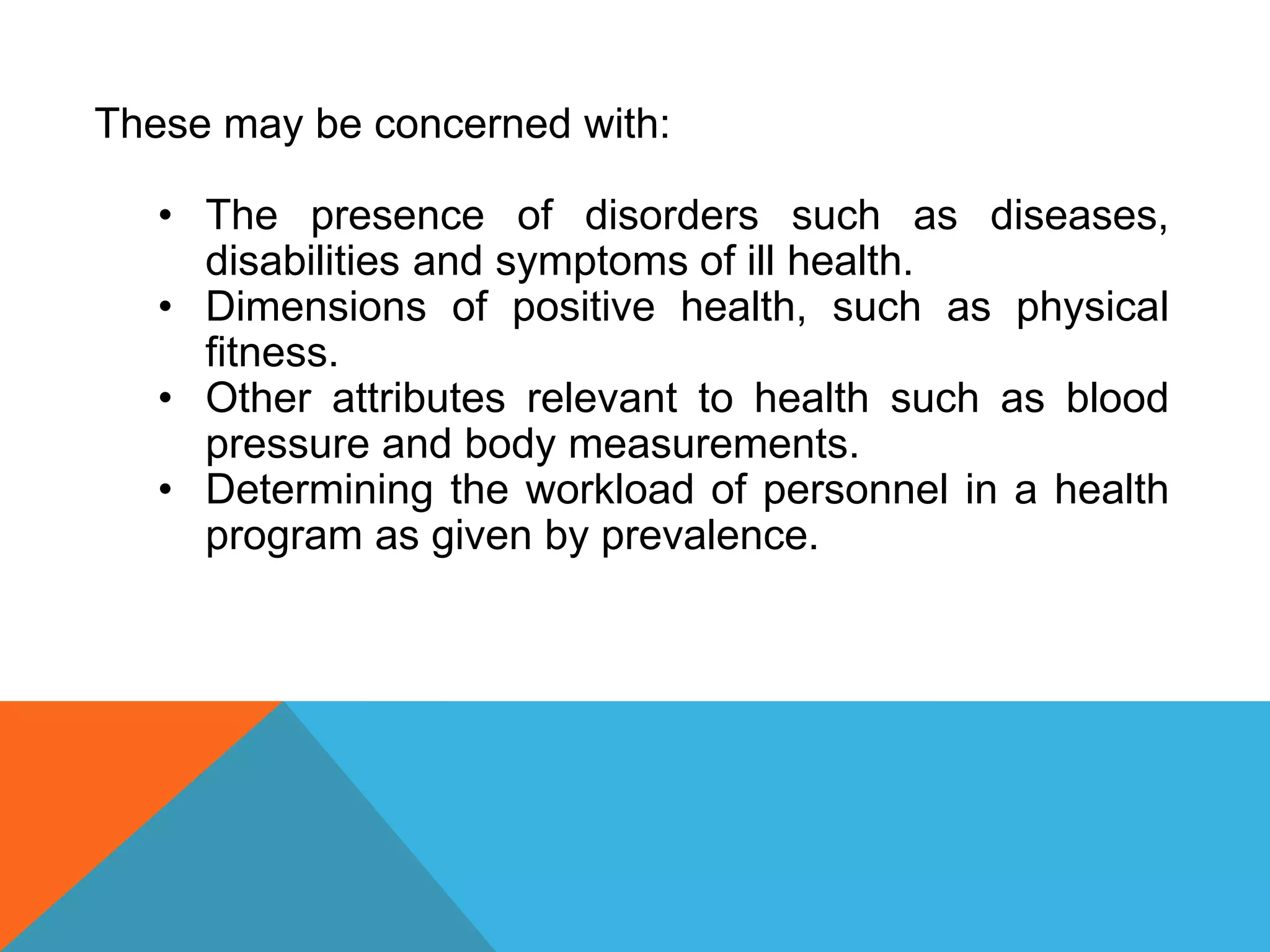
• There is no in-built directionality as both exposure and
outcome are present in the study subject for quite
some time .
• Deals with the situation existing at a given time (or
during a given period) in a group or population.
These may be concerned with:
• The presence of disorders such as diseases,
disabilities and symptoms of ill health.
• Dimensions of positive health, such as physical
fitness.
• Other attributes relevant to health such as blood
pressure and body measurements.
• Determining the workload of personnel in a health
program as given by prevalence.
TYPES
• May be
• Descriptive
• Analytical or
• Both
• At descriptive level, it yields information about a single
variable, or about each of number of separate variables in a
study population.
• At analytic level, it provides information about the presence
and strength of associations between variables, permitting
testing of hypothesis.
• Essential feature of cross-sectional studies -They
collect information relating to a single specified
time.
• But, often extended to include historical information
which leads to demonstration of statistical
associations with past experience e.g. investigation
of an epidemic.
SYNONYMS
• Instantaneous study
• Prevalence study
• Simultaneous study
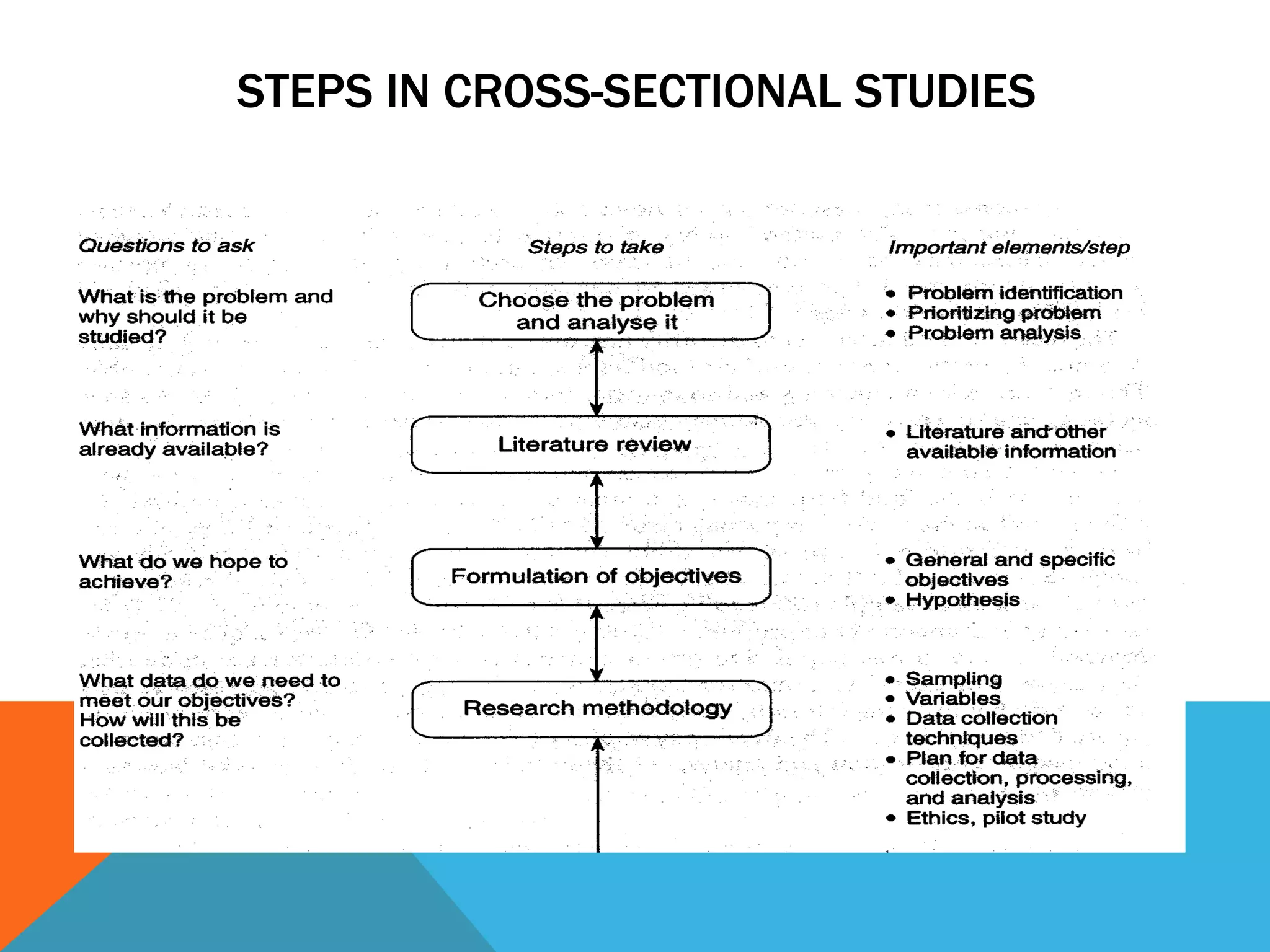
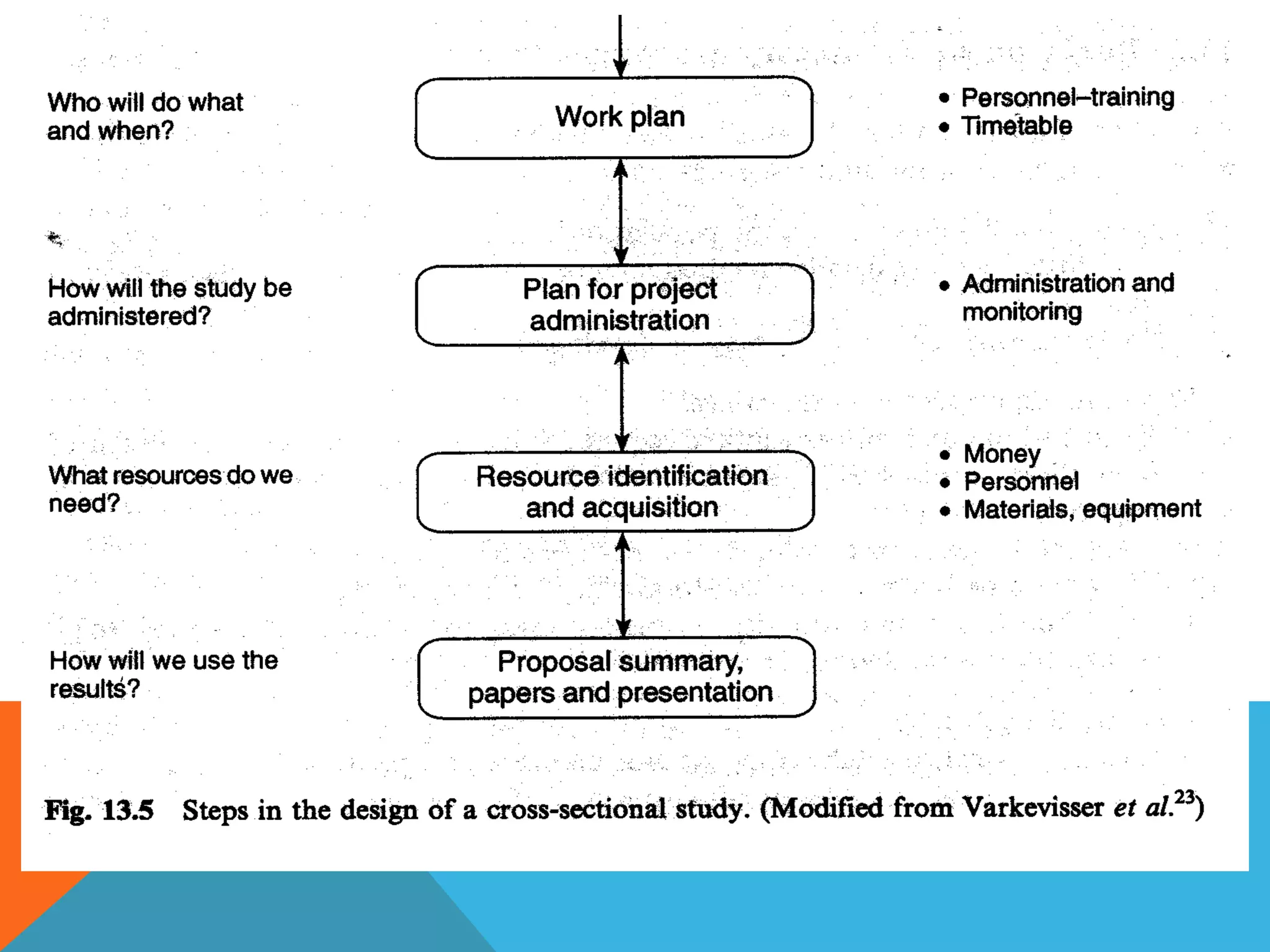
STEPS IN CROSS-SECTIONAL STUDIES
CROSS-SECTIONAL STUDY DESIGN
• Cross-Sectional Studies measure existing disease
and current exposure levels.
• They provide some indication of the relationship
between the disease and exposure or non-
exposure.
• Sample without knowledge of Exposure or Disease.
• Sample at one point in time.
• Mostly prevalence studies/surveys.
ADVANTAGES
• Good design for hypothesis generation.
• Can estimate overall and specific disease prevalence and
sometimes rates.
• Can estimate exposure proportions in the population.
• Can study multiple exposures or multiple outcomes or diseases.
• Relatively easy, quick and inexpensive.
• No issue of subjecting any animals or producers to particular
treatments.
• Best suited to studying permanent factors (breed, sex, blood-
type).
• Often good first step for new study issue.
DISADVANTAGES
• Impractical for rare diseases.
• Not a useful type of study for establishing causal relationships.
• Confounding is difficult to control.
• No control over sample size for each exposure by disease subclass.
• Problems with temporal sequence of data.
• Hard to decide when disease was actually acquired.
• Disease may cure the exposure.
• Miss diseases still in latent period.
• Recall of previous exposure may be faulty.
WHAT TYPE OF STUDY TO CHOSE DEPENDS ON:
• what is the research question/ objective
• Time available for study
• Resources available for the study
• Common/rare disease or production problem
• Type of outcome of interest
• Quality of data from various sources
• Often there are multiple approaches which will all
work
• Choosing an established design gives you a huge
head start in design, analysis and eliminating
biases
ANALYSIS & INTERPRETATION
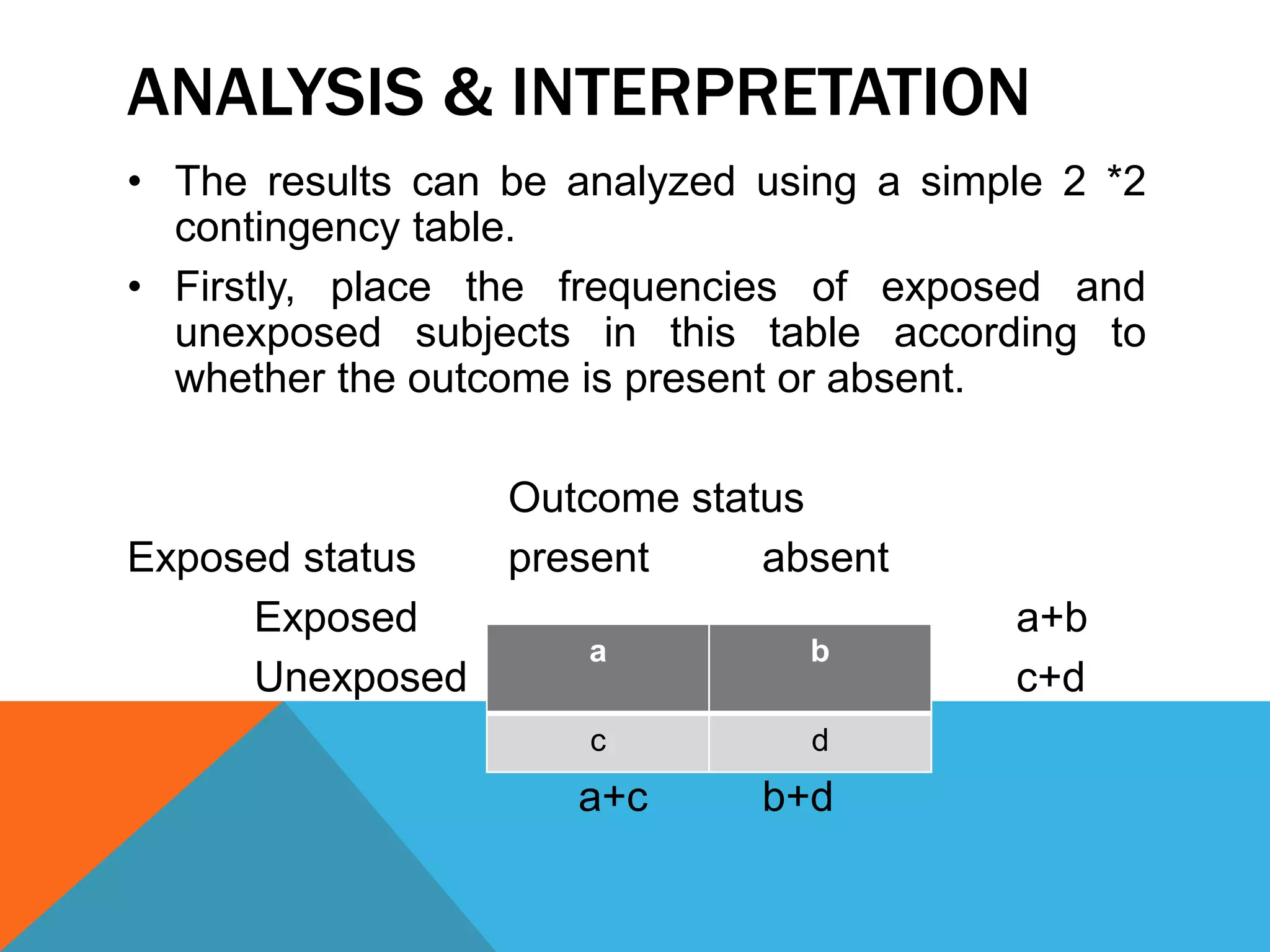
• The results can be analyzed using a simple 2 *2
contingency table.
• Firstly, place the frequencies of exposed and
unexposed subjects in this table according to
whether the outcome is present or absent.
Outcome status
Exposed status present absent
Exposed a+b
Unexposed c+d
a+c b+d
a b
c d
• The frequencies a,b,c & d represents the no. of
exposed person with disease , the no. of exposed
person without disease, the no. of unexposed person
with disease, and the no. of unexposed person
wihtout disease, respectively.
• These values helps to calculate the prevalence rate
and measures the association.
• Crude prevalence rate (overall prevalence rate) is
calculated as,
PR = [(a+c) / n] * 10ⁿ
• Prevalence Rate among exposed subjects
PRe = [a / (a+b) ] * 10ⁿ
• Prevalence Rate among unexposed subjects
PRue = [c / (c+d) ] *10ⁿ
Now, these rates can be used to calculate the Prevalence
rate ratio (Prevalence ratio) and Prevalence rate
difference as under,
PRR = PRe / PRue
PRD = PRe - PRue
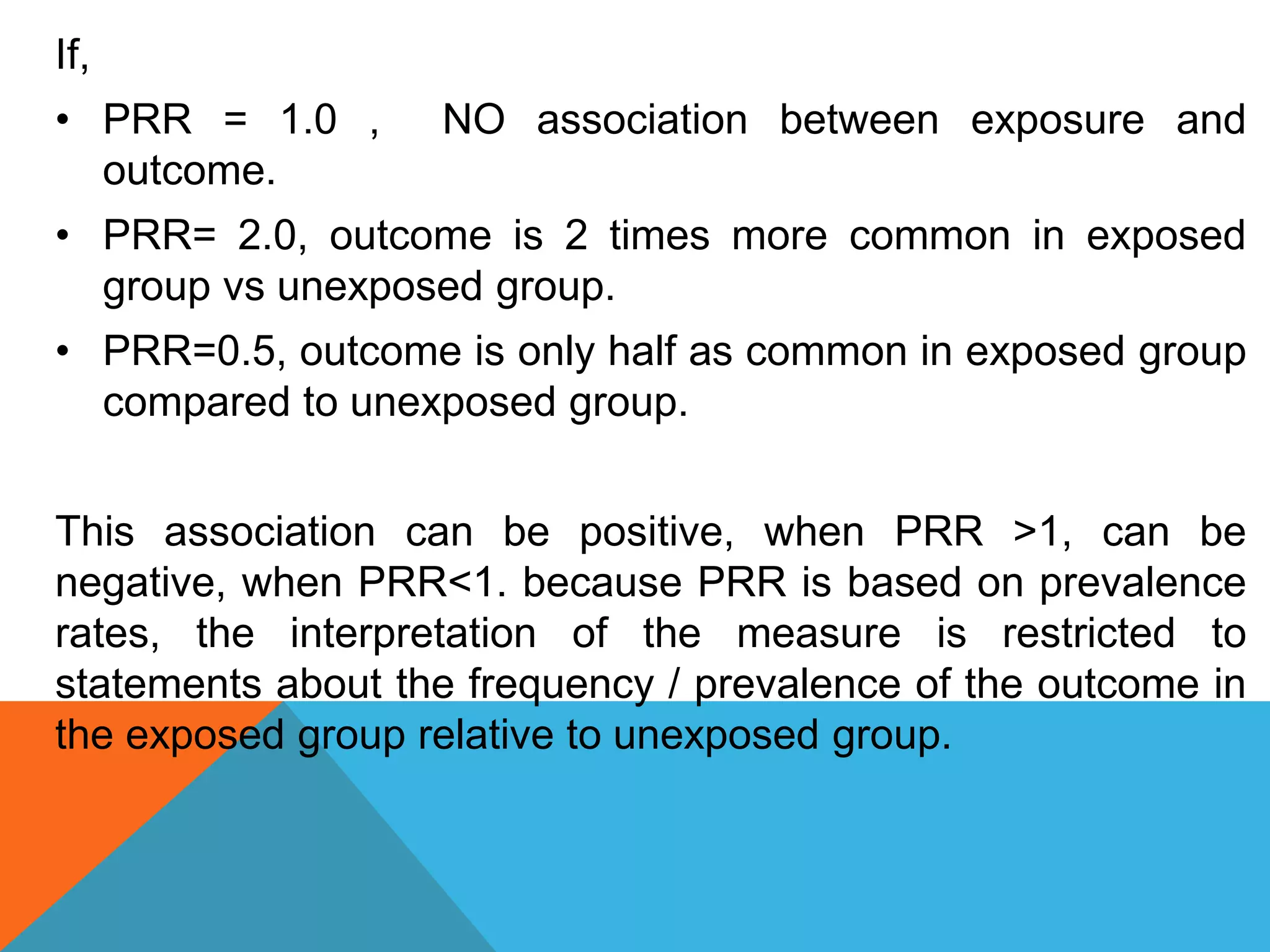
If,
• PRR = 1.0 , NO association between exposure and
outcome.
• PRR= 2.0, outcome is 2 times more common in exposed
group vs unexposed group.
• PRR=0.5, outcome is only half as common in exposed group
compared to unexposed group.
This association can be positive, when PRR >1, can be
negative, when PRR<1. because PRR is based on prevalence
rates, the interpretation of the measure is restricted to
statements about the frequency / prevalence of the outcome in
the exposed group relative to unexposed group.
The statistical significance of PRR can be determined by the
chi square test of independence (X²), which for a 2*2
contingency table can be calculated by,
X² = n (ad - bc) ²
(a+b) (c+d) (a+c) (b+d)
If value of X²,
• From 3.84 to 6.63, association is considered as statistically
significant at p <=0.5
• From 6.64 to 10.82, association is significant at p <=0.01
• >=10.83, association is significant at p <=0.001
A 95%confidence intervall for PRR can be estimated using a
formula developed by D.Katz and associates.
95%CI = exp {ln(PRR) ± 1.96 √ [(b/a) / (a+b)] + [(d/c) (c+d)]}
Thank you

Cross sec study dr rahul

  • 1.
    PADMA SHREE SCHOOLOF PUBLIC HEALTH CROSS-SECTIONAL STUDY DESIGN B Y - D R . R A H U L S H R I V A S T A V A B D S , M P H
  • 2.
    INTRODUCTION A cross-sectional studies •A type of observational study • The investigator has no control over the exposure of interest (eg. diet). It involves • Identifying a defined population at a particular point in time • Measuring a range of variables on an individual basis eg. include past and current dietary intake • At the same time measuring outcome of interest eg. obesity
  • 3.
    • Measurement ofexposure of interest and outcome of interest is carried out at the same time (e.g. Obesity and Hypertension). • There is no in-built directionality as both exposure and outcome are present in the study subject for quite some time . • Deals with the situation existing at a given time (or during a given period) in a group or population.
  • 4.
    These may beconcerned with: • The presence of disorders such as diseases, disabilities and symptoms of ill health. • Dimensions of positive health, such as physical fitness. • Other attributes relevant to health such as blood pressure and body measurements. • Determining the workload of personnel in a health program as given by prevalence.
  • 5.
    TYPES • May be •Descriptive • Analytical or • Both • At descriptive level, it yields information about a single variable, or about each of number of separate variables in a study population. • At analytic level, it provides information about the presence and strength of associations between variables, permitting testing of hypothesis.
  • 6.
    • Essential featureof cross-sectional studies -They collect information relating to a single specified time. • But, often extended to include historical information which leads to demonstration of statistical associations with past experience e.g. investigation of an epidemic.
  • 7.
    SYNONYMS • Instantaneous study •Prevalence study • Simultaneous study
  • 8.
  • 10.
    CROSS-SECTIONAL STUDY DESIGN •Cross-Sectional Studies measure existing disease and current exposure levels. • They provide some indication of the relationship between the disease and exposure or non- exposure. • Sample without knowledge of Exposure or Disease. • Sample at one point in time. • Mostly prevalence studies/surveys.
  • 11.
    ADVANTAGES • Good designfor hypothesis generation. • Can estimate overall and specific disease prevalence and sometimes rates. • Can estimate exposure proportions in the population. • Can study multiple exposures or multiple outcomes or diseases. • Relatively easy, quick and inexpensive. • No issue of subjecting any animals or producers to particular treatments. • Best suited to studying permanent factors (breed, sex, blood- type). • Often good first step for new study issue.
  • 12.
    DISADVANTAGES • Impractical forrare diseases. • Not a useful type of study for establishing causal relationships. • Confounding is difficult to control. • No control over sample size for each exposure by disease subclass. • Problems with temporal sequence of data. • Hard to decide when disease was actually acquired. • Disease may cure the exposure. • Miss diseases still in latent period. • Recall of previous exposure may be faulty.
  • 13.
    WHAT TYPE OFSTUDY TO CHOSE DEPENDS ON: • what is the research question/ objective • Time available for study • Resources available for the study • Common/rare disease or production problem • Type of outcome of interest • Quality of data from various sources • Often there are multiple approaches which will all work • Choosing an established design gives you a huge head start in design, analysis and eliminating biases
  • 14.
    ANALYSIS & INTERPRETATION •The results can be analyzed using a simple 2 *2 contingency table. • Firstly, place the frequencies of exposed and unexposed subjects in this table according to whether the outcome is present or absent. Outcome status Exposed status present absent Exposed a+b Unexposed c+d a+c b+d a b c d
  • 15.
    • The frequenciesa,b,c & d represents the no. of exposed person with disease , the no. of exposed person without disease, the no. of unexposed person with disease, and the no. of unexposed person wihtout disease, respectively. • These values helps to calculate the prevalence rate and measures the association. • Crude prevalence rate (overall prevalence rate) is calculated as, PR = [(a+c) / n] * 10ⁿ
  • 16.
    • Prevalence Rateamong exposed subjects PRe = [a / (a+b) ] * 10ⁿ • Prevalence Rate among unexposed subjects PRue = [c / (c+d) ] *10ⁿ Now, these rates can be used to calculate the Prevalence rate ratio (Prevalence ratio) and Prevalence rate difference as under, PRR = PRe / PRue PRD = PRe - PRue
  • 17.
    If, • PRR =1.0 , NO association between exposure and outcome. • PRR= 2.0, outcome is 2 times more common in exposed group vs unexposed group. • PRR=0.5, outcome is only half as common in exposed group compared to unexposed group. This association can be positive, when PRR >1, can be negative, when PRR<1. because PRR is based on prevalence rates, the interpretation of the measure is restricted to statements about the frequency / prevalence of the outcome in the exposed group relative to unexposed group.
  • 18.
    The statistical significanceof PRR can be determined by the chi square test of independence (X²), which for a 2*2 contingency table can be calculated by, X² = n (ad - bc) ² (a+b) (c+d) (a+c) (b+d) If value of X², • From 3.84 to 6.63, association is considered as statistically significant at p <=0.5 • From 6.64 to 10.82, association is significant at p <=0.01 • >=10.83, association is significant at p <=0.001 A 95%confidence intervall for PRR can be estimated using a formula developed by D.Katz and associates. 95%CI = exp {ln(PRR) ± 1.96 √ [(b/a) / (a+b)] + [(d/c) (c+d)]}
  • 19.