2011-2025 Orangescrum Research Lab, San Jose, California | www.orangescrum.com 1
In project management, every second counts. Whether you’re managing a construction
project, a software release, or a product launch, understanding the Critical Path Method
(CPM) can make the difference between success and costly delays.
By identifying the longest path in your project and optimizing task sequencing, you
ensure that deadlines are realistic, resources are aligned, and risks are minimized.
What is the Critical Path Method (CPM)?
The Critical Path Method (CPM) is a project scheduling technique used to identify the
sequence of essential tasks that determine the project’s total duration.
2011-2025 Orangescrum Research Lab, San Jose, California | www.orangescrum.com 2
Simply put, it helps you find the longest path through the project’s activity network —
the one that directly impacts your delivery date.
In CPM, each task is defined with its start time, end time, and dependencies. By
mapping these relationships, you can see which activities are critical (cannot be
delayed) and which have float or slack time (can be delayed without affecting the
overall timeline).
For example, if a construction project has tasks like “Lay Foundation,” “Install
Plumbing,” and “Paint Walls,” any delay in the first two will directly push the final
completion date. CPM identifies this exact chain so you can manage it proactively.
Why Use Critical Path Analysis?
Using critical path analysis gives project managers the visibility they need to focus on
what truly matters.
Instead of juggling all tasks equally, CPM highlights the most time-sensitive ones —
allowing you to prioritize efforts where delays would hurt most.
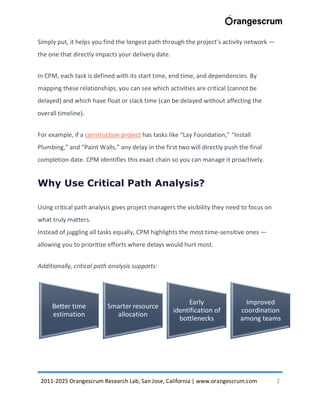
Additionally, critical path analysis supports:
Better time
estimation
Smarter resource
allocation
Early
identification of
bottlenecks
Improved
coordination
among teams
2011-2025 Orangescrum Research Lab, San Jose, California | www.orangescrum.com 3
By optimizing the critical path, you don’t just meet deadlines — you build predictability
and confidence across your entire project ecosystem.
 Significance of the Critical Path Method in Project Management
 The Critical Path Method is not just a scheduling tool; it’s a strategic decision-
making framework.
 Project managers use it to forecast timelines, adjust workloads, and control
scope creep effectively.
2011-2025 Orangescrum Research Lab, San Jose, California | www.orangescrum.com 4
Here’s why it’s significant:
In industries like construction, IT, and manufacturing, the Critical Path Method ensures
that teams stay synchronized, budgets remain intact, and deliveries happen on time.
Benefits of Using the Critical Path Method in Project Management
The benefits of CPM go beyond timelines. When implemented well, it transforms how
organizations manage complexity.
Key Benefits Include:
Accurate Scheduling: It provides a clear visual map of tasks and dependencies.
Efficient Resource Utilization: Resources can be reallocated to critical tasks
when needed.
Proactive Risk Management: Early visibility into delays allows corrective
action.
Enhanced Collaboration: Everyone knows which tasks are priorities.
Clarity in Planning
• It visualizes all tasks, dependencies, and milestones
Real-Time Monitoring
• As projects evolve, CPM helps identify which delays will affect completion
Predictive Insight
• It enables teams to simulate “what-if” scenarios for better contingency
planning
2011-2025 Orangescrum Research Lab, San Jose, California | www.orangescrum.com 5
Improved Accountability: Clear deadlines make team ownership stronger.
When you apply the Critical Path Method, you shift from reactive firefighting to
proactive control — a crucial shift for large-scale project success.
How to Implement the Critical Path Method
Implementing CPM involves structured steps. Here’s how to do it:
 List All Project Activities - Identify every task required to complete the project.
 Define Task Dependencies - Determine which activities depend on others to
start or finish.
 Estimate Task Duration - Assign realistic time estimates to each task.
 Create a Network Diagram - Visualize tasks as nodes and dependencies as
arrows.
 Identify the Critical Path - Calculate the longest path from start to finish — this
defines your project duration.
 Monitor and Optimize - Regularly update progress and adjust task sequencing
to maintain efficiency.
With digital project management tools, CPM implementation becomes seamless.
Software platforms like Orangescrum, CRMLeaf, or OConstruction automate
dependency mapping, duration tracking, and real-time recalculations.
2011-2025 Orangescrum Research Lab, San Jose, California | www.orangescrum.com 6
How to Find a Project’s Critical Path
To find your project’s critical path, follow these steps:
 Map All Tasks: Create a complete list with dependencies.
 Estimate Durations: Use realistic timelines, not optimistic guesses.
 Calculate Early and Late Start/Finish Times: Determine when each activity can
start or must finish without delaying the project.
 Identify the Longest Sequence: The path with zero slack is your critical path.
Once identified, monitor this path closely. Any delay in these tasks will affect the overall
project duration — so optimize them first.
2011-2025 Orangescrum Research Lab, San Jose, California | www.orangescrum.com 7
Critical Path Method vs. PERT
Both CPM and PERT (Program Evaluation Review Technique) help in project scheduling,
but they differ in focus and application.
Aspect Critical Path Method (CPM) PERT
Purpose
Focuses on project control
and optimization
Focuses on time estimation under
uncertainty
Approach
Deterministic (uses fixed task
durations)
Probabilistic (uses optimistic,
pessimistic, and most likely times)
Usage Construction, IT, engineering
R&D, innovation, and exploratory
projects
Output
Clear project duration and
critical path
Expected time with probability range
In short, CPM suits predictable projects with defined tasks, while PERT fits projects with
high uncertainty and flexible estimates.
2011-2025 Orangescrum Research Lab, San Jose, California | www.orangescrum.com 8
Critical Path Method vs. Gantt Chart
While both tools visualize project timelines, their purposes are distinct:
Feature Critical Path Method Gantt Chart
Focus
Identifies dependencies and
critical tasks
Shows task schedules and
progress
Representation Network diagram Bar chart
Primary Use Analyzing task relationships
Tracking timelines and
milestones
Level of Detail Analytical and strategic Visual and progress-oriented
Many project managers use both together — CPM for analysis and Gantt charts for
presentation. Together, they create a complete view of project performance.
2011-2025 Orangescrum Research Lab, San Jose, California | www.orangescrum.com 9
Challenges and Limitations of the Critical Path Method
Despite its advantages, the Critical Path Method has certain limitations:
 Complexity in Large Projects: When hundreds of tasks are involved, diagrams can
become difficult to manage.
 Inaccurate Estimates: If task durations are guessed incorrectly, the entire analysis
weakens.
 Rigid Dependencies: CPM assumes fixed relationships, which might not fit agile
workflows.
 Maintenance Effort: Frequent updates are required to keep the plan accurate.
However, modern project management software mitigates many of these issues with
automated updates, predictive analytics, and AI-driven forecasting.
Conclusion
The Critical Path Method remains one of the most reliable techniques for project
scheduling and optimization. By identifying the longest path and optimizing task
sequencing, managers can ensure every effort contributes directly to timely delivery.
When combined with digital project management tools, CPM becomes even more
powerful — offering real-time insights, faster adjustments, and seamless collaboration.
Whether you’re building bridges, developing software, or launching marketing
campaigns, mastering the Critical Path Method is your first step toward predictable,
efficient, and successful project outcomes.
2011-2025 Orangescrum Research Lab, San Jose, California | www.orangescrum.com 10
Frequently Asked Questions (FAQs)
1. What is the Critical Path Method in simple terms?
The Critical Path Method is a project scheduling technique that identifies the longest
sequence of dependent tasks to determine the minimum project duration.
2. Why is the Critical Path Method important?
It helps project managers focus on critical tasks that directly impact project completion,
reducing the risk of delays and cost overruns.
3. How do you calculate the critical path in a project?
List all tasks, define dependencies, estimate durations, and find the longest path with
zero slack using a CPM diagram or software tool.
4. What are the main advantages of the Critical Path Method?
It offers accurate scheduling, resource optimization, better coordination, and improved
control over project deadlines.
5. What is the difference between CPM and PERT?
CPM uses fixed time estimates and is best for predictable projects, while PERT uses
variable time estimates for projects with uncertainty.
2011-2025 Orangescrum Research Lab, San Jose, California | www.orangescrum.com 11
6. How is the Critical Path Method different from a Gantt chart?
CPM focuses on task relationships and timing, while Gantt charts display progress
visually along a timeline.
7. Can the Critical Path change during a project?
Yes, if task durations or dependencies change, the critical path can shift — making
continuous monitoring essential.
8. What industries use the Critical Path Method?
It’s widely used in construction, IT, engineering, manufacturing, defense, and even event
management.
9. What tools help calculate the Critical Path automatically?
Modern project management software like Orangescrum, Microsoft Project, and
Primavera P6 can generate CPM networks automatically.
10. What are the limitations of the Critical Path Method?
Its main drawbacks include complexity in large projects, dependence on accurate data,
and limited flexibility for agile environments.

Master the Critical Path Method (CPM) for Smarter Project Scheduling

  • 1.
    2011-2025 Orangescrum ResearchLab, San Jose, California | www.orangescrum.com 1 In project management, every second counts. Whether you’re managing a construction project, a software release, or a product launch, understanding the Critical Path Method (CPM) can make the difference between success and costly delays. By identifying the longest path in your project and optimizing task sequencing, you ensure that deadlines are realistic, resources are aligned, and risks are minimized. What is the Critical Path Method (CPM)? The Critical Path Method (CPM) is a project scheduling technique used to identify the sequence of essential tasks that determine the project’s total duration.
  • 2.
    2011-2025 Orangescrum ResearchLab, San Jose, California | www.orangescrum.com 2 Simply put, it helps you find the longest path through the project’s activity network — the one that directly impacts your delivery date. In CPM, each task is defined with its start time, end time, and dependencies. By mapping these relationships, you can see which activities are critical (cannot be delayed) and which have float or slack time (can be delayed without affecting the overall timeline). For example, if a construction project has tasks like “Lay Foundation,” “Install Plumbing,” and “Paint Walls,” any delay in the first two will directly push the final completion date. CPM identifies this exact chain so you can manage it proactively. Why Use Critical Path Analysis? Using critical path analysis gives project managers the visibility they need to focus on what truly matters. Instead of juggling all tasks equally, CPM highlights the most time-sensitive ones — allowing you to prioritize efforts where delays would hurt most. Additionally, critical path analysis supports: Better time estimation Smarter resource allocation Early identification of bottlenecks Improved coordination among teams
  • 3.
    2011-2025 Orangescrum ResearchLab, San Jose, California | www.orangescrum.com 3 By optimizing the critical path, you don’t just meet deadlines — you build predictability and confidence across your entire project ecosystem.  Significance of the Critical Path Method in Project Management  The Critical Path Method is not just a scheduling tool; it’s a strategic decision- making framework.  Project managers use it to forecast timelines, adjust workloads, and control scope creep effectively.
  • 4.
    2011-2025 Orangescrum ResearchLab, San Jose, California | www.orangescrum.com 4 Here’s why it’s significant: In industries like construction, IT, and manufacturing, the Critical Path Method ensures that teams stay synchronized, budgets remain intact, and deliveries happen on time. Benefits of Using the Critical Path Method in Project Management The benefits of CPM go beyond timelines. When implemented well, it transforms how organizations manage complexity. Key Benefits Include: Accurate Scheduling: It provides a clear visual map of tasks and dependencies. Efficient Resource Utilization: Resources can be reallocated to critical tasks when needed. Proactive Risk Management: Early visibility into delays allows corrective action. Enhanced Collaboration: Everyone knows which tasks are priorities. Clarity in Planning • It visualizes all tasks, dependencies, and milestones Real-Time Monitoring • As projects evolve, CPM helps identify which delays will affect completion Predictive Insight • It enables teams to simulate “what-if” scenarios for better contingency planning
  • 5.
    2011-2025 Orangescrum ResearchLab, San Jose, California | www.orangescrum.com 5 Improved Accountability: Clear deadlines make team ownership stronger. When you apply the Critical Path Method, you shift from reactive firefighting to proactive control — a crucial shift for large-scale project success. How to Implement the Critical Path Method Implementing CPM involves structured steps. Here’s how to do it:  List All Project Activities - Identify every task required to complete the project.  Define Task Dependencies - Determine which activities depend on others to start or finish.  Estimate Task Duration - Assign realistic time estimates to each task.  Create a Network Diagram - Visualize tasks as nodes and dependencies as arrows.  Identify the Critical Path - Calculate the longest path from start to finish — this defines your project duration.  Monitor and Optimize - Regularly update progress and adjust task sequencing to maintain efficiency. With digital project management tools, CPM implementation becomes seamless. Software platforms like Orangescrum, CRMLeaf, or OConstruction automate dependency mapping, duration tracking, and real-time recalculations.
  • 6.
    2011-2025 Orangescrum ResearchLab, San Jose, California | www.orangescrum.com 6 How to Find a Project’s Critical Path To find your project’s critical path, follow these steps:  Map All Tasks: Create a complete list with dependencies.  Estimate Durations: Use realistic timelines, not optimistic guesses.  Calculate Early and Late Start/Finish Times: Determine when each activity can start or must finish without delaying the project.  Identify the Longest Sequence: The path with zero slack is your critical path. Once identified, monitor this path closely. Any delay in these tasks will affect the overall project duration — so optimize them first.
  • 7.
    2011-2025 Orangescrum ResearchLab, San Jose, California | www.orangescrum.com 7 Critical Path Method vs. PERT Both CPM and PERT (Program Evaluation Review Technique) help in project scheduling, but they differ in focus and application. Aspect Critical Path Method (CPM) PERT Purpose Focuses on project control and optimization Focuses on time estimation under uncertainty Approach Deterministic (uses fixed task durations) Probabilistic (uses optimistic, pessimistic, and most likely times) Usage Construction, IT, engineering R&D, innovation, and exploratory projects Output Clear project duration and critical path Expected time with probability range In short, CPM suits predictable projects with defined tasks, while PERT fits projects with high uncertainty and flexible estimates.
  • 8.
    2011-2025 Orangescrum ResearchLab, San Jose, California | www.orangescrum.com 8 Critical Path Method vs. Gantt Chart While both tools visualize project timelines, their purposes are distinct: Feature Critical Path Method Gantt Chart Focus Identifies dependencies and critical tasks Shows task schedules and progress Representation Network diagram Bar chart Primary Use Analyzing task relationships Tracking timelines and milestones Level of Detail Analytical and strategic Visual and progress-oriented Many project managers use both together — CPM for analysis and Gantt charts for presentation. Together, they create a complete view of project performance.
  • 9.
    2011-2025 Orangescrum ResearchLab, San Jose, California | www.orangescrum.com 9 Challenges and Limitations of the Critical Path Method Despite its advantages, the Critical Path Method has certain limitations:  Complexity in Large Projects: When hundreds of tasks are involved, diagrams can become difficult to manage.  Inaccurate Estimates: If task durations are guessed incorrectly, the entire analysis weakens.  Rigid Dependencies: CPM assumes fixed relationships, which might not fit agile workflows.  Maintenance Effort: Frequent updates are required to keep the plan accurate. However, modern project management software mitigates many of these issues with automated updates, predictive analytics, and AI-driven forecasting. Conclusion The Critical Path Method remains one of the most reliable techniques for project scheduling and optimization. By identifying the longest path and optimizing task sequencing, managers can ensure every effort contributes directly to timely delivery. When combined with digital project management tools, CPM becomes even more powerful — offering real-time insights, faster adjustments, and seamless collaboration. Whether you’re building bridges, developing software, or launching marketing campaigns, mastering the Critical Path Method is your first step toward predictable, efficient, and successful project outcomes.
  • 10.
    2011-2025 Orangescrum ResearchLab, San Jose, California | www.orangescrum.com 10 Frequently Asked Questions (FAQs) 1. What is the Critical Path Method in simple terms? The Critical Path Method is a project scheduling technique that identifies the longest sequence of dependent tasks to determine the minimum project duration. 2. Why is the Critical Path Method important? It helps project managers focus on critical tasks that directly impact project completion, reducing the risk of delays and cost overruns. 3. How do you calculate the critical path in a project? List all tasks, define dependencies, estimate durations, and find the longest path with zero slack using a CPM diagram or software tool. 4. What are the main advantages of the Critical Path Method? It offers accurate scheduling, resource optimization, better coordination, and improved control over project deadlines. 5. What is the difference between CPM and PERT? CPM uses fixed time estimates and is best for predictable projects, while PERT uses variable time estimates for projects with uncertainty.
  • 11.
    2011-2025 Orangescrum ResearchLab, San Jose, California | www.orangescrum.com 11 6. How is the Critical Path Method different from a Gantt chart? CPM focuses on task relationships and timing, while Gantt charts display progress visually along a timeline. 7. Can the Critical Path change during a project? Yes, if task durations or dependencies change, the critical path can shift — making continuous monitoring essential. 8. What industries use the Critical Path Method? It’s widely used in construction, IT, engineering, manufacturing, defense, and even event management. 9. What tools help calculate the Critical Path automatically? Modern project management software like Orangescrum, Microsoft Project, and Primavera P6 can generate CPM networks automatically. 10. What are the limitations of the Critical Path Method? Its main drawbacks include complexity in large projects, dependence on accurate data, and limited flexibility for agile environments.