+
Project Management
+
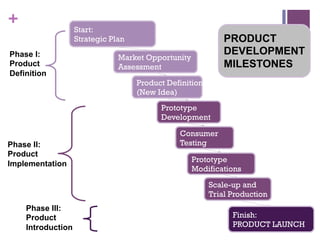
Product Definition
(New Idea)
Market Opportunity
Assessment
Prototype
Development
Consumer
Testing
Prototype
Modifications
Scale-up and
Trial Production
Phase II:
Product
Implementation
Phase I:
Product
Definition
Start:
Strategic Plan
Finish:
PRODUCT LAUNCH
Phase III:
Product
Introduction
PRODUCT
DEVELOPMENT
MILESTONES
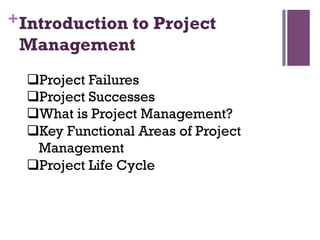
+Introduction to Project
Management
q Project Failures
q Project Successes
q What is Project Management?
q Key Functional Areas of Project
Management
q Project Life Cycle
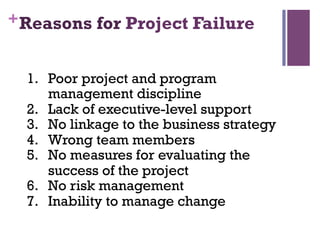
+Reasons for Project Failure
1.  Poor project and program
management discipline
2.  Lack of executive-level support
3.  No linkage to the business strategy
4.  Wrong team members
5.  No measures for evaluating the
success of the project
6.  No risk management
7.  Inability to manage change
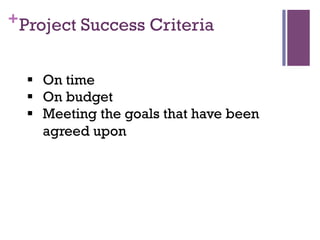
+Project Success Criteria
§  On time
§  On budget
§  Meeting the goals that have been
agreed upon
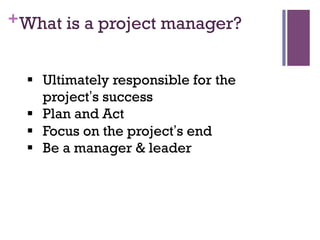
+What is a project manager?
§  Ultimately responsible for the
project’s success
§  Plan and Act
§  Focus on the project’s end
§  Be a manager & leader
+Seven Traits of Good Project
Managers
Trait 1
Enthusiasm for the project
Trait 2
Ability to manage change effectively
Trait 3
A tolerant attitude toward ambiguity
Trait 4
Team – building and negotiating skills
+Seven Traits of Good Project
Managers
Trait 5
A customer-first orientation
Trait 6
Adherence to the priorities of business
Trait 7
Knowledge of the industry or technology
+
Project Management
n Project Management
n “application of knowledge, skills, tools
and techniques to project activities to
meet project requirements.”
+
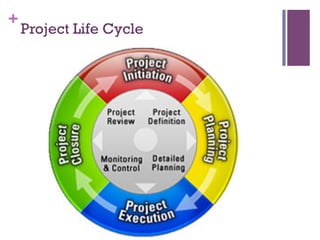
Project Life Cycle
+
History of Critical Path
Analysis/ Method
n Developed in the 1950s by the US Navy
n Originally, the critical path method
considered only logical dependencies
between terminal elements
n Since then, it has been expanded to allow
for the inclusion of resources related to
each activity, through processes called
activity-based resource assignments and
resource leveling.
+
What is CPA/ CPM?
n The Critical Path Method or Critical Path Analysis, is
a mathematically based algorithm for scheduling a
set of project activities
n It is an important tool for effective project
management
n Commonly used with all forms of projects, including
product development, construction, software
development, research projects, engineering, and
plant maintenance, among others
n Any project with interdependent activities can apply
this method of scheduling
+
What is CPA/ CPM?
n The essential technique for using CPM is to
construct a model of the project that includes the
following:
n A list of all activities required to complete the
project (also known as Work Breakdown
Structure)
n The time (duration) that each activity will take to
completion
n The dependencies between the activities.
+
What is CPA/ CPM?
n  CPM calculates
n  The longest path of planned activities to the end of the project
n  The earliest and latest that each activity can start and finish
without making the project longer
n  Determines “critical” activities (on the longest path)
n  Prioritize activities for the effective management and to shorten
the planned critical path of a project by:
n  Pruning critical path activities
n  “Fast tracking" (performing more activities in parallel)
n  “Crashing the critical path" (shortening the durations of critical
path activities by adding resources)
+
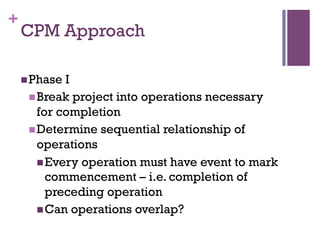
CPM Approach
n Phase I
n Break project into operations necessary
for completion
n Determine sequential relationship of
operations
n Every operation must have event to mark
commencement – i.e. completion of
preceding operation
n Can operations overlap?
+
CPM Approach
n Phase II
n Create time estimates for each operation
n Determine earliest possible start date,
earliest possible finish date , latest start &
finish
n Determine “free float” and “total float”
n Revised after completion of Phase III
+
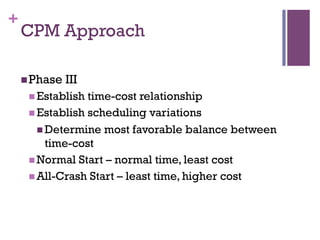
CPM Approach
n Phase III
n Establish time-cost relationship
n Establish scheduling variations
n Determine most favorable balance between
time-cost
n Normal Start – normal time, least cost
n All-Crash Start – least time, higher cost
+
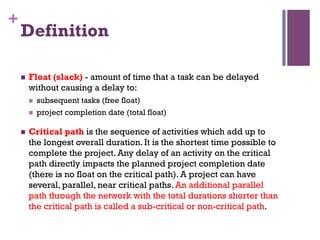
Definition
n  Float (slack) - amount of time that a task can be delayed
without causing a delay to:
n  subsequent tasks (free float)
n  project completion date (total float)
n  Critical path is the sequence of activities which add up to
the longest overall duration. It is the shortest time possible to
complete the project. Any delay of an activity on the critical
path directly impacts the planned project completion date
(there is no float on the critical path). A project can have
several, parallel, near critical paths. An additional parallel
path through the network with the total durations shorter than
the critical path is called a sub-critical or non-critical path.
+
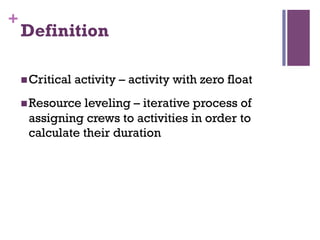
Definition
n Critical activity – activity with zero float
n Resource leveling – iterative process of
assigning crews to activities in order to
calculate their duration
+
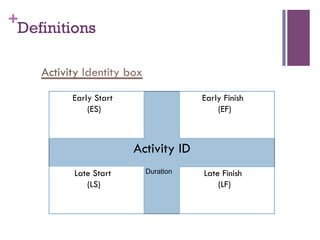
Definitions
Activity Identity box
Early Start
(ES)
Early Finish
(EF)
Activity ID
Late Start
(LS)
Duration Late Finish
(LF)
+
Critical Path Analysis
§  https://www.youtube.com/watch?v=LsbnHNAkfVQ
+
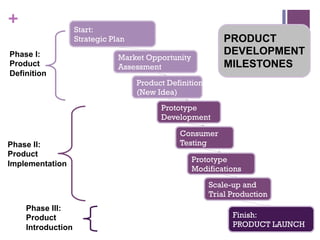
Product Definition
(New Idea)
Market Opportunity
Assessment
Prototype
Development
Consumer
Testing
Prototype
Modifications
Scale-up and
Trial Production
Phase II:
Product
Implementation
Phase I:
Product
Definition
Start:
Strategic Plan
Finish:
PRODUCT LAUNCH
Phase III:
Product
Introduction
PRODUCT
DEVELOPMENT
MILESTONES
+
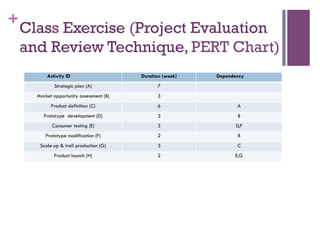
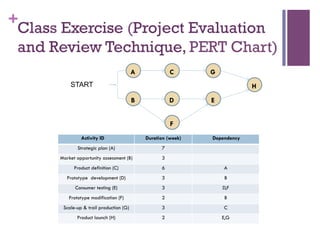
Class Exercise (Project Evaluation
and Review Technique, PERT Chart)
Activity ID Duration (week) Dependency
Strategic plan (A) 7
Market opportunity assessment (B) 3
Product definition (C) 6 A
Prototype development (D) 3 B
Consumer testing (E) 3 D,F
Prototype modification (F) 2 B
Scale-up & trail production (G) 3 C
Product launch (H) 2 E,G
+
Class Exercise (Project Evaluation
and Review Technique, PERT Chart)
C
E
G
H
F
DB
A
START
Activity ID Duration (week) Dependency
Strategic plan (A) 7
Market opportunity assessment (B) 3
Product definition (C) 6 A
Prototype development (D) 3 B
Consumer testing (E) 3 D,F
Prototype modification (F) 2 B
Scale-up & trail production (G) 3 C
Product launch (H) 2 E,G
+
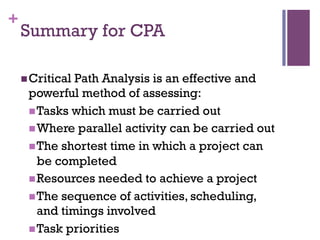
Summary for CPA
n Critical Path Analysis is an effective and
powerful method of assessing:
n Tasks which must be carried out
n Where parallel activity can be carried out
n The shortest time in which a project can
be completed
n Resources needed to achieve a project
n The sequence of activities, scheduling,
and timings involved
n Task priorities
+
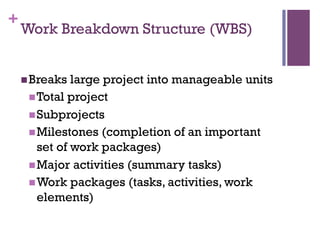
Work Breakdown Structure (WBS)
n Breaks large project into manageable units
n Total project
n Subprojects
n Milestones (completion of an important
set of work packages)
n Major activities (summary tasks)
n Work packages (tasks, activities, work
elements)
+
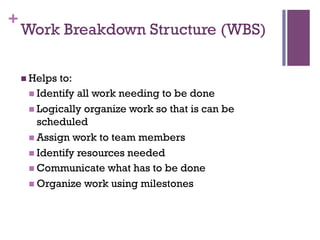
Work Breakdown Structure (WBS)
n Helps to:
n Identify all work needing to be done
n Logically organize work so that is can be
scheduled
n Assign work to team members
n Identify resources needed
n Communicate what has to be done
n Organize work using milestones
+
Work Breakdown Structure (WBS)
1.  Break work into independent work packages that
can be sequenced, assigned, scheduled and
monitored
2.  Define the work package at the appropriate level of
detail
3.  Integrate the work packages into a total system
4.  Present in a format easily communicated to people.
Each work package must have a deliverable and a
time for completing that deliverable
5.  Verify the work packages will meet the goals and
objectives of the project

Project management

  • 1.
  • 2.
    + Product Definition (New Idea) MarketOpportunity Assessment Prototype Development Consumer Testing Prototype Modifications Scale-up and Trial Production Phase II: Product Implementation Phase I: Product Definition Start: Strategic Plan Finish: PRODUCT LAUNCH Phase III: Product Introduction PRODUCT DEVELOPMENT MILESTONES
  • 4.
    +Introduction to Project Management q ProjectFailures q Project Successes q What is Project Management? q Key Functional Areas of Project Management q Project Life Cycle
  • 5.
    +Reasons for ProjectFailure 1.  Poor project and program management discipline 2.  Lack of executive-level support 3.  No linkage to the business strategy 4.  Wrong team members 5.  No measures for evaluating the success of the project 6.  No risk management 7.  Inability to manage change
  • 6.
    +Project Success Criteria § On time §  On budget §  Meeting the goals that have been agreed upon
  • 7.
    +What is aproject manager? §  Ultimately responsible for the project’s success §  Plan and Act §  Focus on the project’s end §  Be a manager & leader
  • 8.
    +Seven Traits ofGood Project Managers Trait 1 Enthusiasm for the project Trait 2 Ability to manage change effectively Trait 3 A tolerant attitude toward ambiguity Trait 4 Team – building and negotiating skills
  • 9.
    +Seven Traits ofGood Project Managers Trait 5 A customer-first orientation Trait 6 Adherence to the priorities of business Trait 7 Knowledge of the industry or technology
  • 10.
    + Project Management n Project Management n “applicationof knowledge, skills, tools and techniques to project activities to meet project requirements.”
  • 11.
  • 12.
    + History of CriticalPath Analysis/ Method n Developed in the 1950s by the US Navy n Originally, the critical path method considered only logical dependencies between terminal elements n Since then, it has been expanded to allow for the inclusion of resources related to each activity, through processes called activity-based resource assignments and resource leveling.
  • 13.
    + What is CPA/CPM? n The Critical Path Method or Critical Path Analysis, is a mathematically based algorithm for scheduling a set of project activities n It is an important tool for effective project management n Commonly used with all forms of projects, including product development, construction, software development, research projects, engineering, and plant maintenance, among others n Any project with interdependent activities can apply this method of scheduling
  • 14.
    + What is CPA/CPM? n The essential technique for using CPM is to construct a model of the project that includes the following: n A list of all activities required to complete the project (also known as Work Breakdown Structure) n The time (duration) that each activity will take to completion n The dependencies between the activities.
  • 15.
    + What is CPA/CPM? n  CPM calculates n  The longest path of planned activities to the end of the project n  The earliest and latest that each activity can start and finish without making the project longer n  Determines “critical” activities (on the longest path) n  Prioritize activities for the effective management and to shorten the planned critical path of a project by: n  Pruning critical path activities n  “Fast tracking" (performing more activities in parallel) n  “Crashing the critical path" (shortening the durations of critical path activities by adding resources)
  • 16.
    + CPM Approach n Phase I n Breakproject into operations necessary for completion n Determine sequential relationship of operations n Every operation must have event to mark commencement – i.e. completion of preceding operation n Can operations overlap?
  • 17.
    + CPM Approach n Phase II n Createtime estimates for each operation n Determine earliest possible start date, earliest possible finish date , latest start & finish n Determine “free float” and “total float” n Revised after completion of Phase III
  • 18.
    + CPM Approach n Phase III n Establishtime-cost relationship n Establish scheduling variations n Determine most favorable balance between time-cost n Normal Start – normal time, least cost n All-Crash Start – least time, higher cost
  • 19.
    + Definition n  Float (slack)- amount of time that a task can be delayed without causing a delay to: n  subsequent tasks (free float) n  project completion date (total float) n  Critical path is the sequence of activities which add up to the longest overall duration. It is the shortest time possible to complete the project. Any delay of an activity on the critical path directly impacts the planned project completion date (there is no float on the critical path). A project can have several, parallel, near critical paths. An additional parallel path through the network with the total durations shorter than the critical path is called a sub-critical or non-critical path.
  • 20.
    + Definition n Critical activity –activity with zero float n Resource leveling – iterative process of assigning crews to activities in order to calculate their duration
  • 21.
    + Definitions Activity Identity box EarlyStart (ES) Early Finish (EF) Activity ID Late Start (LS) Duration Late Finish (LF)
  • 22.
    + Critical Path Analysis § https://www.youtube.com/watch?v=LsbnHNAkfVQ
  • 23.
    + Product Definition (New Idea) MarketOpportunity Assessment Prototype Development Consumer Testing Prototype Modifications Scale-up and Trial Production Phase II: Product Implementation Phase I: Product Definition Start: Strategic Plan Finish: PRODUCT LAUNCH Phase III: Product Introduction PRODUCT DEVELOPMENT MILESTONES
  • 24.
    + Class Exercise (ProjectEvaluation and Review Technique, PERT Chart) Activity ID Duration (week) Dependency Strategic plan (A) 7 Market opportunity assessment (B) 3 Product definition (C) 6 A Prototype development (D) 3 B Consumer testing (E) 3 D,F Prototype modification (F) 2 B Scale-up & trail production (G) 3 C Product launch (H) 2 E,G
  • 25.
    + Class Exercise (ProjectEvaluation and Review Technique, PERT Chart) C E G H F DB A START Activity ID Duration (week) Dependency Strategic plan (A) 7 Market opportunity assessment (B) 3 Product definition (C) 6 A Prototype development (D) 3 B Consumer testing (E) 3 D,F Prototype modification (F) 2 B Scale-up & trail production (G) 3 C Product launch (H) 2 E,G
  • 26.
    + Summary for CPA n CriticalPath Analysis is an effective and powerful method of assessing: n Tasks which must be carried out n Where parallel activity can be carried out n The shortest time in which a project can be completed n Resources needed to achieve a project n The sequence of activities, scheduling, and timings involved n Task priorities
  • 27.
    + Work Breakdown Structure(WBS) n Breaks large project into manageable units n Total project n Subprojects n Milestones (completion of an important set of work packages) n Major activities (summary tasks) n Work packages (tasks, activities, work elements)
  • 28.
    + Work Breakdown Structure(WBS) n Helps to: n Identify all work needing to be done n Logically organize work so that is can be scheduled n Assign work to team members n Identify resources needed n Communicate what has to be done n Organize work using milestones
  • 29.
    + Work Breakdown Structure(WBS) 1.  Break work into independent work packages that can be sequenced, assigned, scheduled and monitored 2.  Define the work package at the appropriate level of detail 3.  Integrate the work packages into a total system 4.  Present in a format easily communicated to people. Each work package must have a deliverable and a time for completing that deliverable 5.  Verify the work packages will meet the goals and objectives of the project