CPM
Critical Path Method
Ghanshyam Prakash
MLIS
I Semester
Introduction
• CPM is a technique of Project Management.
• It is a algorithm for scheduling a set of activities.
• A network diagram technique to predict the
duration of project.
• Come in the existence in the last of 1950s.
• By Morgen R. Walker & James E. Kelley.
• The U.S. Navy adopted and improve it to build
missile project in the last of 1950s.
Purpose
• CPM is used for three main purpose : -
– To calculate the project’s finish date;
– To identify to what extent each activity schedule
can slip(float) with delaying the project.
– To identify the activities with highest risk that
can’t slip without changing the project finish date.
Where it can use ?
Software Development
Construction
Aero Space & Defence
To build a Library Infrastructure
in scheduled time
Publication of Abstract Bulletins
Use
Use in Library
Management
Step 1 – Identify Path
Activities Predecessor Duration
(In weak)
A -- 6
B -- 2
C A 3
D B 2
E C 4
F D 1
G E,F 1
H G 6
I H 3
J H 1
K I,J 1
A-C-E-G-H –I-K
A-C-E-G-H-J–K
B-D-F-G-H-I-K
B-D-F-G-H-J-K
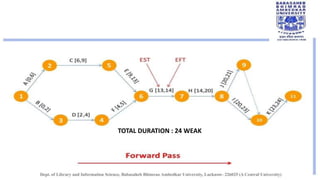
Step -2 Network Diagram
Formulation of Start & End Time
• Earlier start time (EST) – The earliest time an activity can start
once the previous dependent activities are over.
• Earlier finish time (EFT) – Earliest start time (EST)+ Activity
Duration.
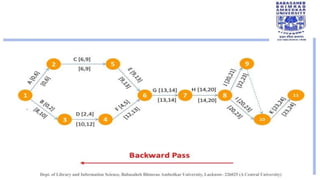
• Latest finish time (LFT) – The latest time an activity can finish
without delaying the project.
• Latest start time (LST) – Latest Finish Time (LFT)- Activity
Duration.
TOTAL DURATION : 24 WEAK
Step 4- Find Critical Activities
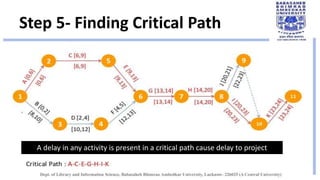
Step 5- Finding Critical Path
A delay in any activity is present in a critical path cause delay to project
Result
Total Project Duration : 24 week
Critical Activities : A,C,E,G,H,I,K
Non-critical Activities : B,D,F,J
Critical Path : A-C-E-G-H-I-K
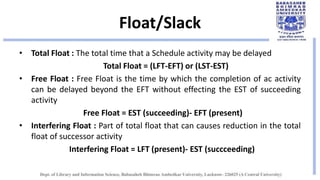
Float/Slack
• Total Float : The total time that a Schedule activity may be delayed
Total Float = (LFT-EFT) or (LST-EST)
• Free Float : Free Float is the time by which the completion of ac activity
can be delayed beyond the EFT without effecting the EST of succeeding
activity
Free Float = EST (succeeding)- EFT (present)
• Interfering Float : Part of total float that can causes reduction in the total
float of successor activity
Interfering Float = LFT (present)- EST (succceeding)
Activity Total Float Free Float Interfering Float
A 0 0 0
B 8 0 8
C 0 0 0
D 8 0 8
E 0 0 0
F 8 0 0
G 0 0 0
H 0 0 0
I 0 0 0
J 2 2 0
K 0 0 0
References
• https://www.slideshare.net/harshitjhawar/critical-path-method-14348135
• https://www.slideshare.net/hoangtung17/critical-path-method-cpm-
63551530
• https://businessjargons.com/critical-path-method.html
Any Question ?
Thank you for giving your
valuable time

Critical Path Method

  • 1.
    CPM Critical Path Method GhanshyamPrakash MLIS I Semester
  • 2.
    Introduction • CPM isa technique of Project Management. • It is a algorithm for scheduling a set of activities. • A network diagram technique to predict the duration of project. • Come in the existence in the last of 1950s. • By Morgen R. Walker & James E. Kelley. • The U.S. Navy adopted and improve it to build missile project in the last of 1950s.
  • 3.
    Purpose • CPM isused for three main purpose : - – To calculate the project’s finish date; – To identify to what extent each activity schedule can slip(float) with delaying the project. – To identify the activities with highest risk that can’t slip without changing the project finish date.
  • 4.
    Where it canuse ? Software Development Construction Aero Space & Defence To build a Library Infrastructure in scheduled time Publication of Abstract Bulletins Use Use in Library Management
  • 5.
    Step 1 –Identify Path Activities Predecessor Duration (In weak) A -- 6 B -- 2 C A 3 D B 2 E C 4 F D 1 G E,F 1 H G 6 I H 3 J H 1 K I,J 1 A-C-E-G-H –I-K A-C-E-G-H-J–K B-D-F-G-H-I-K B-D-F-G-H-J-K
  • 6.
  • 12.
    Formulation of Start& End Time • Earlier start time (EST) – The earliest time an activity can start once the previous dependent activities are over. • Earlier finish time (EFT) – Earliest start time (EST)+ Activity Duration. • Latest finish time (LFT) – The latest time an activity can finish without delaying the project. • Latest start time (LST) – Latest Finish Time (LFT)- Activity Duration.
  • 13.
  • 16.
    Step 4- FindCritical Activities
  • 17.
    Step 5- FindingCritical Path A delay in any activity is present in a critical path cause delay to project
  • 18.
    Result Total Project Duration: 24 week Critical Activities : A,C,E,G,H,I,K Non-critical Activities : B,D,F,J Critical Path : A-C-E-G-H-I-K
  • 19.
    Float/Slack • Total Float: The total time that a Schedule activity may be delayed Total Float = (LFT-EFT) or (LST-EST) • Free Float : Free Float is the time by which the completion of ac activity can be delayed beyond the EFT without effecting the EST of succeeding activity Free Float = EST (succeeding)- EFT (present) • Interfering Float : Part of total float that can causes reduction in the total float of successor activity Interfering Float = LFT (present)- EST (succceeding)
  • 20.
    Activity Total FloatFree Float Interfering Float A 0 0 0 B 8 0 8 C 0 0 0 D 8 0 8 E 0 0 0 F 8 0 0 G 0 0 0 H 0 0 0 I 0 0 0 J 2 2 0 K 0 0 0
  • 21.
  • 22.
  • 23.
    Thank you forgiving your valuable time