CRISPR
A New Gene-Editing Tool With Significant
Promise and Room for Regulation
Brian A. Smith, Science Policy InternOct. 27, 2015
4 Questions
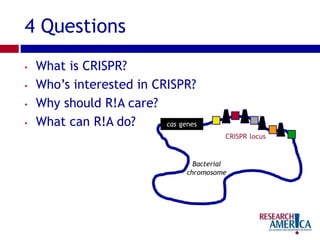
• What is CRISPR?
• Who’s interested in CRISPR?
• Why should R!A care?
• What can R!A do?
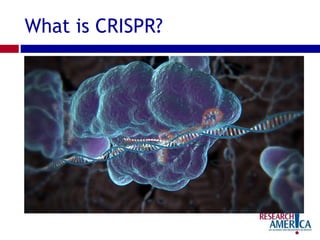
What is CRISPR?
• Clustered
• Regularly
• Interspaced
• Short
• Palindromic
• Repeats
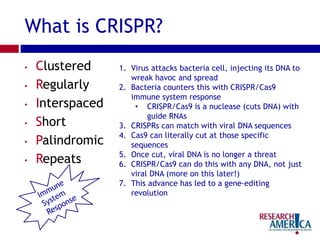
1. Virus attacks bacteria cell, injecting its DNA to
wreak havoc and spread
2. Bacteria counters this with CRISPR/Cas9
immune system response
• CRISPR/Cas9 is a nuclease (cuts DNA) with
guide RNAs
3. CRISPRs can match with viral DNA sequences
4. Cas9 can literally cut at those specific
sequences
5. Once cut, viral DNA is no longer a threat
6. CRISPR/Cas9 can do this with any DNA, not just
viral DNA (more on this later!)
7. This advance has led to a gene-editing
revolution
What is CRISPR?
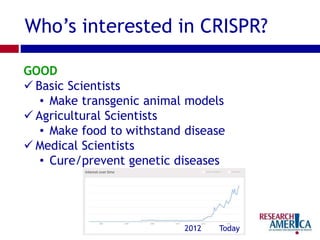
Who’s interested in CRISPR?
GOOD
 Basic Scientists
• Make transgenic animal models
 Agricultural Scientists
• Make food to withstand disease
 Medical Scientists
• Cure/prevent genetic diseases
2012 Today
Who’s interested in CRISPR?
BAD
χ Military
• “Want to militarize it”
χ Rich People
• “Want to make drone workforce”
χ Mad Scientists
• “Has science gone too far?!”
χ China
• Already used CRISPR in human embryo
Why should R!A care?
• This is going to be one of the biggest
scientific issues in the next decade
• NAS Human Gene-Editing Initiative
• Rep. Bill Foster (D-IL-11)
• CRISPR/Cas9 has started a worldwide
conversation on gene-editing
What can R!A do?
• We need to determine where we stand
• We should talk with researchers using
CRISPR/Cas9
• We should work alongside NAS and other
science and medicine governing bodies to
convey their insights to policymakers and the
general public
• We can highlight the medical benefits of this
technology
Questions?

CRISPR Presentation

  • 1.
    CRISPR A New Gene-EditingTool With Significant Promise and Room for Regulation Brian A. Smith, Science Policy InternOct. 27, 2015
  • 2.
    4 Questions • Whatis CRISPR? • Who’s interested in CRISPR? • Why should R!A care? • What can R!A do?
  • 3.
    What is CRISPR? •Clustered • Regularly • Interspaced • Short • Palindromic • Repeats 1. Virus attacks bacteria cell, injecting its DNA to wreak havoc and spread 2. Bacteria counters this with CRISPR/Cas9 immune system response • CRISPR/Cas9 is a nuclease (cuts DNA) with guide RNAs 3. CRISPRs can match with viral DNA sequences 4. Cas9 can literally cut at those specific sequences 5. Once cut, viral DNA is no longer a threat 6. CRISPR/Cas9 can do this with any DNA, not just viral DNA (more on this later!) 7. This advance has led to a gene-editing revolution
  • 4.
  • 5.
    Who’s interested inCRISPR? GOOD  Basic Scientists • Make transgenic animal models  Agricultural Scientists • Make food to withstand disease  Medical Scientists • Cure/prevent genetic diseases 2012 Today
  • 6.
    Who’s interested inCRISPR? BAD χ Military • “Want to militarize it” χ Rich People • “Want to make drone workforce” χ Mad Scientists • “Has science gone too far?!” χ China • Already used CRISPR in human embryo
  • 7.
    Why should R!Acare? • This is going to be one of the biggest scientific issues in the next decade • NAS Human Gene-Editing Initiative • Rep. Bill Foster (D-IL-11) • CRISPR/Cas9 has started a worldwide conversation on gene-editing
  • 8.
    What can R!Ado? • We need to determine where we stand • We should talk with researchers using CRISPR/Cas9 • We should work alongside NAS and other science and medicine governing bodies to convey their insights to policymakers and the general public • We can highlight the medical benefits of this technology
  • 9.

Editor's Notes

  • #4 CRISPR is a gene-editing tool that has recently been discovered and has been quickly adopted by many in the research community. Gene-editing, in short, is altering the genome of a living thing, whether its bacteria, plants, animals, or humans. CRISPR, which stands for clustered regularly interspaced short palindromic repeats, is the immune response system of bacteria. I’m going to show a short video on how this works, but here’s the general formula: the way it works is, when a virus attacks a bacteria cell, it infects it with viral DNA that has instructions to make more viral DNA as well as to rupture the bacteria cell, so that the viral DNA can escape and spread. Bacteria have a natural immune response to this, involving repeat sequences in bacterial RNA (DNA’s chemical cousin) that can match perfectly with viral DNA sequences. Cas9, which is a protein that’s part of the CRISPR/Cas9 compound, can literally cut the viral DNA at the site of the CRISPR match, disabling the virus and saving the bacteria cell. Once cut, however, DNA editing can take place, and it doesn’t have to just be on viral DNA—it can be on any type of DNA. So here’s a video to show this in a bit more detail.
  • #6 So now that we have a general understanding of what CRISPR is, we need to go over who’s interested in it. As the video mentioned, CRISPR is used by basic scientists to make transgenic animal models of disease, and this is important because many animal models of diseases are not that great. For example, many studies that purport certain findings in a mouse model can’t replicate the same results in a primate or even a human model. So this is an area that CRISPR really helps. Additionally, agricultural scientists have been using this technique to develop plants and food that are resistant to disease, which can greatly increase crop yields and provide more sustainable farming. And then there are biomedical scientists that are working with this technique to find preventions, treatments, and cures to disease. For example, Sickle Cell Disease, which is caused by a single mutation in a single gene in a single cell type, can use CRISPR to take a patient’s cells, replace the one bad gene with a healthy one, and then put the cell back in the patient. But while these are good examples of who’s interested in CRISPR and what can be done with it, there are also some bad examples.
  • #7 So I want to mention that these are all based off of commentary I’ve found on websites, but also from op-eds from scientists, politicians, and journalists. Basically, while there is a ton of promise in using CRISPR to make scientific innovation happen faster, to make food more plentiful and sustainable, and to cure disease, many are afraid that this super fast, super precise, and super cheap gene-editing tool can do a lot of harm. For instance, many have worried that the military will weaponized this tool, perhaps using it in warfare or interrogation. Another concern that I’ve seen is that people believe that this will be used by the wealthy population to create a “drone workforce,” which will weed out everyone who is not wealthy. Next, a common comment I’ve seen is “Has science gone too far?!” Essentially, this is referring to people thinking that CRISPR is capable of putting human genes into a horse, in order to make a Pegasus, or to put the genes of a bird into a pig so that pigs can finally fly. It seems that many people think that science is progressing towards our ultimate doom, and so they are scared and don’t want this to happen anymore (although they already think that it’s too late). Finally, and this is fairly recent, published back in April, there has already been some genetic editing of the human genome in China, where researchers used CRISPR on human embryos. The researchers took 86 non-viable embryos and injected a CRISPR system to fix a mutation in the HBB gene that causes a blood disorder. They only had to wait 48 hours to see if it worked, and only about half of those that survived and were sequenced showed that the splicing had occurred, and of those half only a fraction contained the right genetic material. After that, the researchers stopped and published the results which essentially say that CRISPR isn’t quite ready to modify human genomes.
  • #8 So now I want to bring up why we should care about this. Besides its obvious ethical implications, we should care because this issue is just now starting to come to a head. In fact, back in January a group of prominent scientists and ethicists, including Jennifer Doudna (who helped invent the CRISPR technique) and Keith Yamamoto (who’s on the R!A board), had a meeting to discuss how to move forward with this technology, and eventually led to the decision to put a moratorium on this research until more discussion is made on the ethical implications. The National Academy of Science has put together a Human Gene-Editing initiative to discuss the role of CRISPR. Rep. Bill Foster from Illinois, and who’s also the last scientific PhD in Congress, has called for regulation of this technique to limit the use on human germlines, meaning that he doesn’t want this tool to affect the genetics of future generations, and should only be used to treat and cure illness, better agriculture, and help with scientific progress. As you can see, CRISPR/Cas9 has started a world-wide conversation on gene-editing, and we should care about this as we want to be aware of what’s going on in this conversation.
  • #9 So there are a few things that I think R!A can do, and I only bring these points up to stimulate a conversation and to get the ball rolling. First, I think we need to determine where we stand. I imagine that we will consult with our board and members, but inevitably this topic will come up in the context of what we do and what we support, so I think we need to have a solid stance on what we think should be done with this CRISPR technology. Next, I think can start having conversations with people using this technique so that we know what is and isn’t happening in the lab. I think certain members of the public believe that Jennifer Doudna and scientists working with this tool are alone in their dark laboratories making genes to create a super human race, but I think that it’s much more boring than that and I think we would be smart to get the skinny on what’s really going on. Furthermore, I think we should try to work alongside NAS and other science and medicine governing bodies to convey their insights to members of Congress and also to the general public. I think we have a great opportunity here to disseminate this science to make it more accessible, and therefore less scary/foreign. Finally, I think we can highlight the potential benefits of this tool in terms of science progress and medical advancement. I think that CRISPR/Cas9 will need to be regulated, but I think we can help make policymakers and the public more aware of the positives of this technology by crafting a positive narrative that really shows why people will be better off with CRISPR. There’s a lot of room for discussion on this, so I think I’ll open it up to Q&A.