


CRISPR Discovery
& Potential Applications
Science’s Best Genome Editing Tool Yet
For more info, contact us: xeraya@xeraya.com
Follow us: @xerayacapital
www.xeraya.com
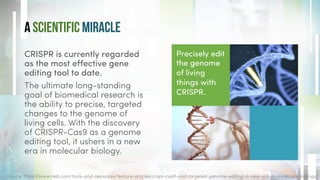
A Scientific Miracle
CRISPR is currently regarded
as the most effective gene
editing tool to date.
The ultimate long-standing
goal of biomedical research is
the ability to precise, targeted
changes to the genome of
living cells. With the discovery
of CRISPR-Cas9 as a genome
editing tool, it ushers in a new
era in molecular biology.
Source: https://www.neb.com/tools-and-resources/feature-articles/crispr-cas9-and-targeted-genome-editing-a-new-era-in-molecular-biology
Precisely edit
the genome
of living
things with
CRISPR.
Source: https://www.livescience.com/58790-crispr-explained.html
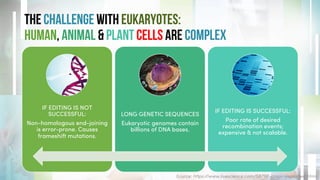
THE CHALLENGE WITH EUKARYOTES:
Human, Animal & Plant cells Are Complex
IF EDITING IS NOT
SUCCESSFUL:
Non-homologous end-joining
is error-prone. Causes
frameshift mutations.
LONG GENETIC SEQUENCES
Eukaryotic genomes contain
billions of DNA bases.
IF EDITING IS SUCCESSFUL:
Poor rate of desired
recombination events;
expensive & not scalable.
Source: https://www.vox.com/2018/7/23/17594864/crispr-cas9-gene-editing
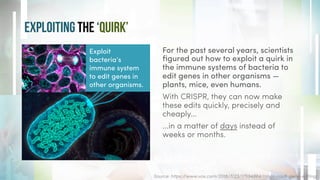
For the past several years, scientists
figured out how to exploit a quirk in
the immune systems of bacteria to
edit genes in other organisms —
plants, mice, even humans.
With CRISPR, they can now make
these edits quickly, precisely and
cheaply…
...in a matter of days instead of
weeks or months.
EXPLOITING THE ‘Quirk’
Exploit
bacteria’s
immune system
to edit genes in
other organisms.
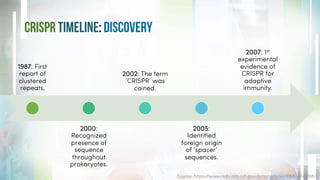
1987: First
report of
clustered
repeats.
2000:
Recognized
presence of
sequence
throughout
prokaryotes.
2002: The term
‘CRISPR’ was
coined.
2005:
Identified
foreign origin
of ‘spacer’
sequences.
2007: 1st
experimental
evidence of
CRISPR for
adaptive
immunity.
CRISPR TIMELINE: Discovery
Source: https://www.ncbi.nlm.nih.gov/pmc/articles/PMC4343198/
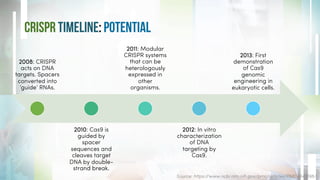
2008: CRISPR
acts on DNA
targets. Spacers
converted into
‘guide’ RNAs.
2010: Cas9 is
guided by
spacer
sequences and
cleaves target
DNA by double-
strand break.
2011: Modular
CRISPR systems
that can be
heterologously
expressed in
other
organisms.
2012: In vitro
characterization
of DNA
targeting by
Cas9.
2013: First
demonstration
of Cas9
genomic
engineering in
eukaryotic cells.
CRISPR TIMELINE: Potential
Source: https://www.ncbi.nlm.nih.gov/pmc/articles/PMC4343198/
Source: https://www.livescience.com/58790-crispr-explained.html
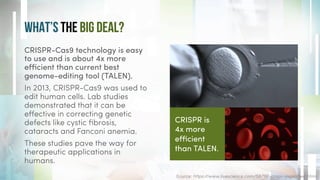
CRISPR-Cas9 technology is easy
to use and is about 4x more
efficient than current best
genome-editing tool (TALEN).
In 2013, CRISPR-Cas9 was used to
edit human cells. Lab studies
demonstrated that it can be
effective in correcting genetic
defects like cystic fibrosis,
cataracts and Fanconi anemia.
These studies pave the way for
therapeutic applications in
humans.
WHAT’S THE BIG DEAL?
CRISPR is
4x more
efficient
than TALEN.
PRECISION GENETIC ENGINEERING
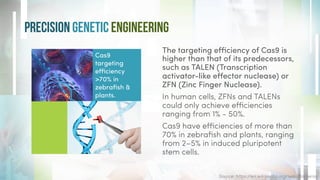
The targeting efficiency of Cas9 is
higher than that of its predecessors,
such as TALEN (Transcription
activator-like effector nuclease) or
ZFN (Zinc Finger Nuclease).
In human cells, ZFNs and TALENs
could only achieve efficiencies
ranging from 1% - 50%.
Cas9 have efficiencies of more than
70% in zebrafish and plants, ranging
from 2–5% in induced pluripotent
stem cells.
Source: https://en.wikipedia.org/wiki/Bacteria
Cas9
targeting
efficiency
>70% in
zebrafish &
plants.
https://www.ncbi.nlm.nih.gov/pmc/articles/PMC4343198/
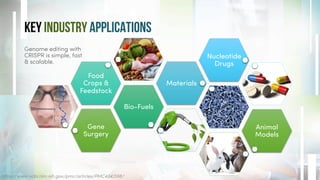
KEY INDUSTRY Applications
Gene
Surgery
Bio-Fuels
Food
Crops &
Feedstock
Materials
Nucleotide
Drugs
Animal
Models
Genome editing with
CRISPR is simple, fast
& scalable.
Source: https://www.cancerresearchuk.org/health-professional/cancer-statistics/worldwide-cancer
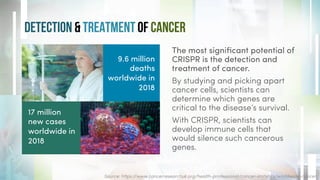
The most significant potential of
CRISPR is the detection and
treatment of cancer.
By studying and picking apart
cancer cells, scientists can
determine which genes are
critical to the disease’s survival.
With CRISPR, scientists can
develop immune cells that
would silence such cancerous
genes.
DETECTION & TREATMENT OF CANCER
17 million
new cases
worldwide in
2018
9.6 million
deaths
worldwide in
2018
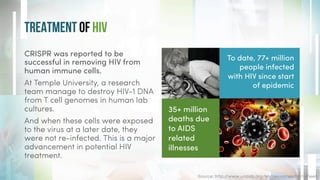
TREATMENT OF HIV
CRISPR was reported to be
successful in removing HIV from
human immune cells.
At Temple University, a research
team manage to destroy HIV-1 DNA
from T cell genomes in human lab
cultures.
And when these cells were exposed
to the virus at a later date, they
were not re-infected. This is a major
advancement in potential HIV
treatment.
Source: http://www.unaids.org/en/resources/fact-sheet
35+ million
deaths due
to AIDS
related
illnesses
To date, 77+ million
people infected
with HIV since start
of epidemic
Source: https://disruptionhub.com/9-amazing-applications-crispr/
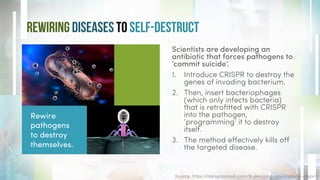
Scientists are developing an
antibiotic that forces pathogens to
‘commit suicide’.
1.  Introduce CRISPR to destroy the
genes of invading bacterium.
2.  Then, insert bacteriophages
(which only infects bacteria)
that is retrofitted with CRISPR
into the pathogen,
‘programming’ it to destroy
itself.
3.  The method effectively kills off
the targeted disease.
REWIRING DISEASES TO SELF-DESTRUCT
Rewire
pathogens
to destroy
themselves.
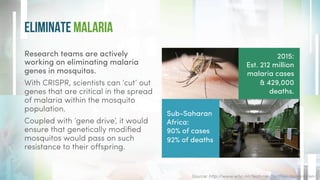
Eliminate Malaria
Research teams are actively
working on eliminating malaria
genes in mosquitos.
With CRISPR, scientists can ‘cut’ out
genes that are critical in the spread
of malaria within the mosquito
population.
Coupled with ‘gene drive’, it would
ensure that genetically modified
mosquitos would pass on such
resistance to their offspring.
Source: http://www.who.int/features/factfiles/malaria/en/
Sub-Saharan
Africa:
90% of cases
92% of deaths
2015:
Est. 212 million
malaria cases
& 429,000
deaths.
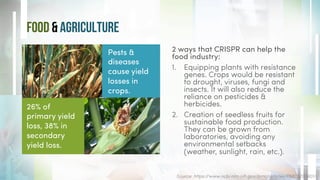
Source: https://www.ncbi.nlm.nih.gov/pmc/articles/PMC5207401/
2 ways that CRISPR can help the
food industry:
1.  Equipping plants with resistance
genes. Crops would be resistant
to drought, viruses, fungi and
insects. It will also reduce the
reliance on pesticides &
herbicides.
2.  Creation of seedless fruits for
sustainable food production.
They can be grown from
laboratories, avoiding any
environmental setbacks
(weather, sunlight, rain, etc.).
food & AGRICULTURE
26% of
primary yield
loss, 38% in
secondary
yield loss.
Pests &
diseases
cause yield
losses in
crops.
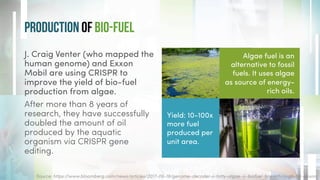
Production OF bio-fuel
J. Craig Venter (who mapped the
human genome) and Exxon
Mobil are using CRISPR to
improve the yield of bio-fuel
production from algae.
After more than 8 years of
research, they have successfully
doubled the amount of oil
produced by the aquatic
organism via CRISPR gene
editing.
Source: https://www.bloomberg.com/news/articles/2017-06-19/genome-decoder-s-fatty-algae-is-biofuel-breakthrough-for-exxon
Yield: 10-100x
more fuel
produced per
unit area.
Algae fuel is an
alternative to fossil
fuels. It uses algae
as source of energy-
rich oils.
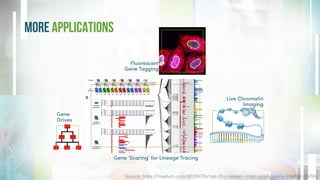
More Applications
Gene ‘Scaring’ for Lineage Tracing
Fluorescent
Gene Tagging
Live Chromatin
Imaging
Gene
Drives
Source: https://medium.com/@32ATPs/top-10-crispiest-crispr-applications-33db9cc3ef5b
CONCLUSION
•  Since the discovery of CRISPR, scientists figured out how to
exploit the immune systems of bacteria to edit genes in other
organisms.
•  CRISPR is currently regarded as the most effective gene
editing tool to date. It has better targeting efficiencies than
ZFN and TALEN.
•  Genome editing with CRISPR is simple, fast and scalable. It is
also cheaper, making it disruptive. Potential industry-wide
applications include healthcare, medical technology,
agriculture and even production of biofuels.
By xeraya capital
For more info, contact us: xeraya@xeraya.com
Follow us: @xerayacapital
www.xeraya.com

CRISPR: Discovery & Potential Applications

  • 1.
    CRISPR Discovery & PotentialApplications Science’s Best Genome Editing Tool Yet For more info, contact us: xeraya@xeraya.com Follow us: @xerayacapital www.xeraya.com
  • 2.
    A Scientific Miracle CRISPRis currently regarded as the most effective gene editing tool to date. The ultimate long-standing goal of biomedical research is the ability to precise, targeted changes to the genome of living cells. With the discovery of CRISPR-Cas9 as a genome editing tool, it ushers in a new era in molecular biology. Source: https://www.neb.com/tools-and-resources/feature-articles/crispr-cas9-and-targeted-genome-editing-a-new-era-in-molecular-biology Precisely edit the genome of living things with CRISPR.
  • 3.
    Source: https://www.livescience.com/58790-crispr-explained.html THE CHALLENGEWITH EUKARYOTES: Human, Animal & Plant cells Are Complex IF EDITING IS NOT SUCCESSFUL: Non-homologous end-joining is error-prone. Causes frameshift mutations. LONG GENETIC SEQUENCES Eukaryotic genomes contain billions of DNA bases. IF EDITING IS SUCCESSFUL: Poor rate of desired recombination events; expensive & not scalable.
  • 4.
    Source: https://www.vox.com/2018/7/23/17594864/crispr-cas9-gene-editing For thepast several years, scientists figured out how to exploit a quirk in the immune systems of bacteria to edit genes in other organisms — plants, mice, even humans. With CRISPR, they can now make these edits quickly, precisely and cheaply… ...in a matter of days instead of weeks or months. EXPLOITING THE ‘Quirk’ Exploit bacteria’s immune system to edit genes in other organisms.
  • 5.
    1987: First report of clustered repeats. 2000: Recognized presenceof sequence throughout prokaryotes. 2002: The term ‘CRISPR’ was coined. 2005: Identified foreign origin of ‘spacer’ sequences. 2007: 1st experimental evidence of CRISPR for adaptive immunity. CRISPR TIMELINE: Discovery Source: https://www.ncbi.nlm.nih.gov/pmc/articles/PMC4343198/
  • 6.
    2008: CRISPR acts onDNA targets. Spacers converted into ‘guide’ RNAs. 2010: Cas9 is guided by spacer sequences and cleaves target DNA by double- strand break. 2011: Modular CRISPR systems that can be heterologously expressed in other organisms. 2012: In vitro characterization of DNA targeting by Cas9. 2013: First demonstration of Cas9 genomic engineering in eukaryotic cells. CRISPR TIMELINE: Potential Source: https://www.ncbi.nlm.nih.gov/pmc/articles/PMC4343198/
  • 7.
    Source: https://www.livescience.com/58790-crispr-explained.html CRISPR-Cas9 technologyis easy to use and is about 4x more efficient than current best genome-editing tool (TALEN). In 2013, CRISPR-Cas9 was used to edit human cells. Lab studies demonstrated that it can be effective in correcting genetic defects like cystic fibrosis, cataracts and Fanconi anemia. These studies pave the way for therapeutic applications in humans. WHAT’S THE BIG DEAL? CRISPR is 4x more efficient than TALEN.
  • 8.
    PRECISION GENETIC ENGINEERING Thetargeting efficiency of Cas9 is higher than that of its predecessors, such as TALEN (Transcription activator-like effector nuclease) or ZFN (Zinc Finger Nuclease). In human cells, ZFNs and TALENs could only achieve efficiencies ranging from 1% - 50%. Cas9 have efficiencies of more than 70% in zebrafish and plants, ranging from 2–5% in induced pluripotent stem cells. Source: https://en.wikipedia.org/wiki/Bacteria Cas9 targeting efficiency >70% in zebrafish & plants.
  • 9.
    https://www.ncbi.nlm.nih.gov/pmc/articles/PMC4343198/ KEY INDUSTRY Applications Gene Surgery Bio-Fuels Food Crops& Feedstock Materials Nucleotide Drugs Animal Models Genome editing with CRISPR is simple, fast & scalable.
  • 10.
    Source: https://www.cancerresearchuk.org/health-professional/cancer-statistics/worldwide-cancer The mostsignificant potential of CRISPR is the detection and treatment of cancer. By studying and picking apart cancer cells, scientists can determine which genes are critical to the disease’s survival. With CRISPR, scientists can develop immune cells that would silence such cancerous genes. DETECTION & TREATMENT OF CANCER 17 million new cases worldwide in 2018 9.6 million deaths worldwide in 2018
  • 11.
    TREATMENT OF HIV CRISPRwas reported to be successful in removing HIV from human immune cells. At Temple University, a research team manage to destroy HIV-1 DNA from T cell genomes in human lab cultures. And when these cells were exposed to the virus at a later date, they were not re-infected. This is a major advancement in potential HIV treatment. Source: http://www.unaids.org/en/resources/fact-sheet 35+ million deaths due to AIDS related illnesses To date, 77+ million people infected with HIV since start of epidemic
  • 12.
    Source: https://disruptionhub.com/9-amazing-applications-crispr/ Scientists aredeveloping an antibiotic that forces pathogens to ‘commit suicide’. 1.  Introduce CRISPR to destroy the genes of invading bacterium. 2.  Then, insert bacteriophages (which only infects bacteria) that is retrofitted with CRISPR into the pathogen, ‘programming’ it to destroy itself. 3.  The method effectively kills off the targeted disease. REWIRING DISEASES TO SELF-DESTRUCT Rewire pathogens to destroy themselves.
  • 13.
    Eliminate Malaria Research teamsare actively working on eliminating malaria genes in mosquitos. With CRISPR, scientists can ‘cut’ out genes that are critical in the spread of malaria within the mosquito population. Coupled with ‘gene drive’, it would ensure that genetically modified mosquitos would pass on such resistance to their offspring. Source: http://www.who.int/features/factfiles/malaria/en/ Sub-Saharan Africa: 90% of cases 92% of deaths 2015: Est. 212 million malaria cases & 429,000 deaths.
  • 14.
    Source: https://www.ncbi.nlm.nih.gov/pmc/articles/PMC5207401/ 2 waysthat CRISPR can help the food industry: 1.  Equipping plants with resistance genes. Crops would be resistant to drought, viruses, fungi and insects. It will also reduce the reliance on pesticides & herbicides. 2.  Creation of seedless fruits for sustainable food production. They can be grown from laboratories, avoiding any environmental setbacks (weather, sunlight, rain, etc.). food & AGRICULTURE 26% of primary yield loss, 38% in secondary yield loss. Pests & diseases cause yield losses in crops.
  • 15.
    Production OF bio-fuel J.Craig Venter (who mapped the human genome) and Exxon Mobil are using CRISPR to improve the yield of bio-fuel production from algae. After more than 8 years of research, they have successfully doubled the amount of oil produced by the aquatic organism via CRISPR gene editing. Source: https://www.bloomberg.com/news/articles/2017-06-19/genome-decoder-s-fatty-algae-is-biofuel-breakthrough-for-exxon Yield: 10-100x more fuel produced per unit area. Algae fuel is an alternative to fossil fuels. It uses algae as source of energy- rich oils.
  • 16.
    More Applications Gene ‘Scaring’for Lineage Tracing Fluorescent Gene Tagging Live Chromatin Imaging Gene Drives Source: https://medium.com/@32ATPs/top-10-crispiest-crispr-applications-33db9cc3ef5b
  • 17.
    CONCLUSION •  Since thediscovery of CRISPR, scientists figured out how to exploit the immune systems of bacteria to edit genes in other organisms. •  CRISPR is currently regarded as the most effective gene editing tool to date. It has better targeting efficiencies than ZFN and TALEN. •  Genome editing with CRISPR is simple, fast and scalable. It is also cheaper, making it disruptive. Potential industry-wide applications include healthcare, medical technology, agriculture and even production of biofuels.
  • 18.
    By xeraya capital Formore info, contact us: xeraya@xeraya.com Follow us: @xerayacapital www.xeraya.com