
CRISPR/Cas9 Technology: Molecular Scissor for
Genome Editing
Md. Fahim Ahmad
M.Sc.
GENOME EDITING
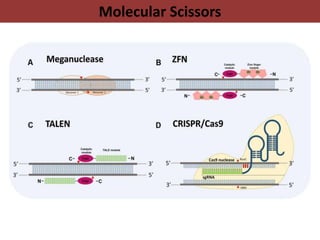
• Genome editing, is a type of genetic
engineering in which DNA is inserted, deleted or
replaced in the genome of a living organism
using engineered nucleases, or "molecular
scissors.“
• Genome editing was selected by-
Nature Methods as the 2011 Method of the Year
Molecular Scissors
CRISPR-CAS9
TECHNOLOGY
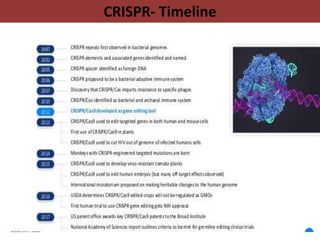
CRISPR- Timeline
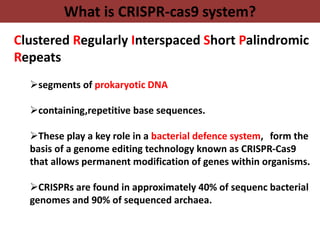
Clustered Regularly Interspaced Short Palindromic
Repeats
segments of prokaryotic DNA
containing,repetitive base sequences.
These play a key role in a bacterial defence system, form the
basis of a genome editing technology known as CRISPR-Cas9
that allows permanent modification of genes within organisms.
CRISPRs are found in approximately 40% of sequenc bacterial
genomes and 90% of sequenced archaea.
What is CRISPR-cas9 system?
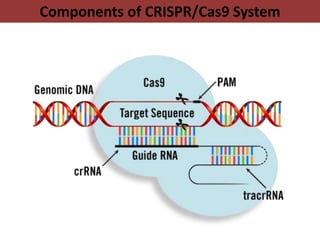
Components of CRISPR/Cas9 System
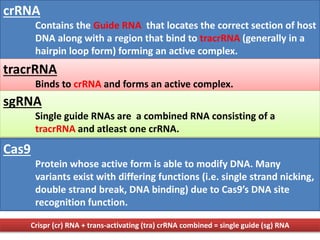
crRNA
Contains the Guide RNA that locates the correct section of host
DNA along with a region that bind to tracrRNA (generally in a
hairpin loop form) forming an active complex.
tracrRNA
Binds to crRNA and forms an active complex.
sgRNA
Single guide RNAs are a combined RNA consisting of a
tracrRNA and atleast one crRNA.
Cas9
Protein whose active form is able to modify DNA. Many
variants exist with differing functions (i.e. single strand nicking,
double strand break, DNA binding) due to Cas9’s DNA site
recognition function.
Crispr (cr) RNA + trans-activating (tra) crRNA combined = single guide (sg) RNA
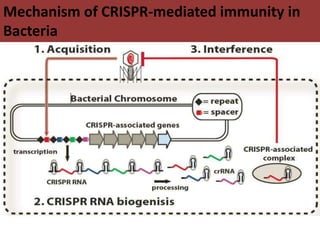
Mechanism of CRISPR-mediated immunity in
Bacteria
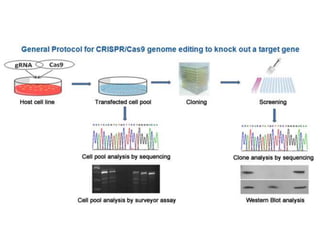
Protocol of CRISPR-CAS9
1. Choose your target
2. Design your sgRNA
3. Test sgRNA efficacy in vitro
4. Deliver your sgRNA and Cas9 to your cells
5. Monitor INDELs
RECENT ADVANCES
1. Expanding CRISPR-CAS9 recognition sequence
Drive gRNA expression using a different promoter
Remove restrictions in the PAM sequences
By editing the cas9 sequence
2. Improving cleavage specificity of the CRISPR-CAS9
system
3. Inducible cas9 expression
In order to make cas9 active in specific time or specific tissues
Photo activable cas9 (pacas9) by splitting cas9 into two
fragments and fused to photo induicible domain
Pacas9 dimerises and become active creating dsb when optical
stimulas is present
Applications
1. An effective technique that will allow scientists to
adequately edit genes to cure diseases. The case is similar for
plant species.
2. Where scientists desire to knock‐out a gene that will result in
an increase in a particular nutritional content or in increased
drought and/or pest resistance.
3. Sickle cell anemia is a great example of a disease in which
mutation of a single base mutation (T to A) could be edited by
CRISPR and the disease cured.
4. Germline manipulation with CRISPR‐Cas9 system in mice
were capable of correcting both the mutant gene and cataract
phenotype in offspring initially caused by a one base pair deletion in
exon 3 of Crygc (crystallin gamma C) gene.
5. human intestinal stem cells collected from patients with
cystic fibrosis, the culprit defective gene CFTR (cystic fibrosis
transmembrane conductance regulator) was rectified by homologous
recombination during CRISPR‐Cas9 genome editing while the
pluripotency was retained as demonstrated by formations of
organ‐like expansions in cell culture.
6. HepG2 cells expressing hepatitis B virus (HBV), the
introduction of CRISPR‐Cas9 system resulted in both decreased
hepatitis B core antigen expression which provides an impetus for
further research on the possibility of CRISPR‐Cas9‐mediated
hepatitis B prevention.
CONCLUSION
Undoubtedly this process caught most attention
for their potential in medical applications and
numerous other biotechnological applications like
crop editing, gene drives and synthetic biology
Despite the enormous potential that lies within
the CRISPR-Cas9 technology, further investigation
is required to make the system an applicable and
safe tool for therapeutically useful approaches
Thank You

Crispr

  • 1.
    CRISPR/Cas9 Technology: MolecularScissor for Genome Editing Md. Fahim Ahmad M.Sc.
  • 2.
    GENOME EDITING • Genomeediting, is a type of genetic engineering in which DNA is inserted, deleted or replaced in the genome of a living organism using engineered nucleases, or "molecular scissors.“ • Genome editing was selected by- Nature Methods as the 2011 Method of the Year
  • 4.
  • 5.
  • 6.
  • 7.
    Clustered Regularly InterspacedShort Palindromic Repeats segments of prokaryotic DNA containing,repetitive base sequences. These play a key role in a bacterial defence system, form the basis of a genome editing technology known as CRISPR-Cas9 that allows permanent modification of genes within organisms. CRISPRs are found in approximately 40% of sequenc bacterial genomes and 90% of sequenced archaea. What is CRISPR-cas9 system?
  • 8.
  • 9.
    crRNA Contains the GuideRNA that locates the correct section of host DNA along with a region that bind to tracrRNA (generally in a hairpin loop form) forming an active complex. tracrRNA Binds to crRNA and forms an active complex. sgRNA Single guide RNAs are a combined RNA consisting of a tracrRNA and atleast one crRNA. Cas9 Protein whose active form is able to modify DNA. Many variants exist with differing functions (i.e. single strand nicking, double strand break, DNA binding) due to Cas9’s DNA site recognition function. Crispr (cr) RNA + trans-activating (tra) crRNA combined = single guide (sg) RNA
  • 10.
    Mechanism of CRISPR-mediatedimmunity in Bacteria
  • 11.
    Protocol of CRISPR-CAS9 1.Choose your target 2. Design your sgRNA 3. Test sgRNA efficacy in vitro 4. Deliver your sgRNA and Cas9 to your cells 5. Monitor INDELs
  • 14.
    RECENT ADVANCES 1. ExpandingCRISPR-CAS9 recognition sequence Drive gRNA expression using a different promoter Remove restrictions in the PAM sequences By editing the cas9 sequence 2. Improving cleavage specificity of the CRISPR-CAS9 system 3. Inducible cas9 expression In order to make cas9 active in specific time or specific tissues Photo activable cas9 (pacas9) by splitting cas9 into two fragments and fused to photo induicible domain Pacas9 dimerises and become active creating dsb when optical stimulas is present
  • 15.
    Applications 1. An effectivetechnique that will allow scientists to adequately edit genes to cure diseases. The case is similar for plant species. 2. Where scientists desire to knock‐out a gene that will result in an increase in a particular nutritional content or in increased drought and/or pest resistance. 3. Sickle cell anemia is a great example of a disease in which mutation of a single base mutation (T to A) could be edited by CRISPR and the disease cured.
  • 16.
    4. Germline manipulationwith CRISPR‐Cas9 system in mice were capable of correcting both the mutant gene and cataract phenotype in offspring initially caused by a one base pair deletion in exon 3 of Crygc (crystallin gamma C) gene. 5. human intestinal stem cells collected from patients with cystic fibrosis, the culprit defective gene CFTR (cystic fibrosis transmembrane conductance regulator) was rectified by homologous recombination during CRISPR‐Cas9 genome editing while the pluripotency was retained as demonstrated by formations of organ‐like expansions in cell culture. 6. HepG2 cells expressing hepatitis B virus (HBV), the introduction of CRISPR‐Cas9 system resulted in both decreased hepatitis B core antigen expression which provides an impetus for further research on the possibility of CRISPR‐Cas9‐mediated hepatitis B prevention.
  • 17.
    CONCLUSION Undoubtedly this processcaught most attention for their potential in medical applications and numerous other biotechnological applications like crop editing, gene drives and synthetic biology Despite the enormous potential that lies within the CRISPR-Cas9 technology, further investigation is required to make the system an applicable and safe tool for therapeutically useful approaches
  • 18.